


Events in Petropavlivska Borshchahivka: how fake news about ’Azov’s torture chambers’ was spread
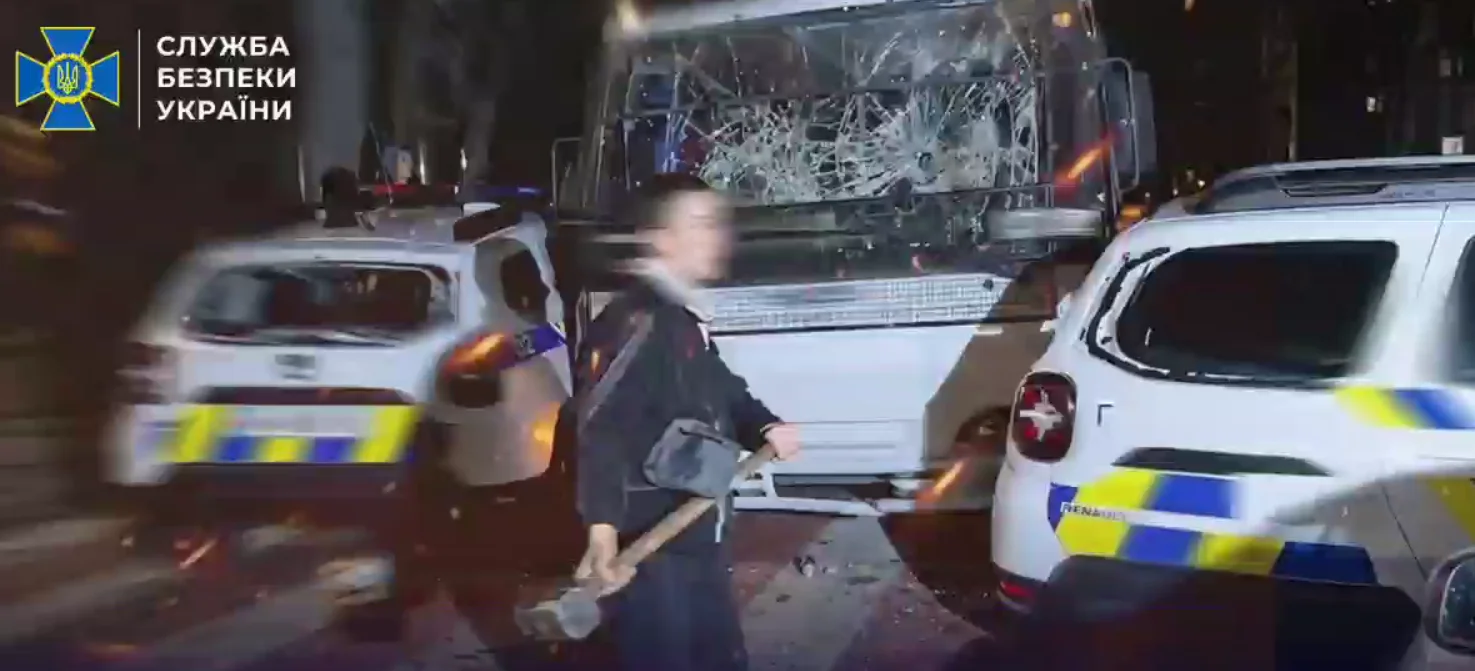
The Russian Federation’s disinformation campaign surrounding the events in Petropavlivska Borshchahivka was aimed at discrediting the National Guard and the Ukrainian armed forces. False claims about alleged torture and hostages spread rapidly on social media, sparked unrest and were picked up by Russian propaganda.
This was reported by the Institute of Mass Information, as reported by Censor.NET.
Details
On 2 November 2026, clashes broke out near a private house in Petropavlivska Borshchahivka, near Kyiv. The building was being used as a temporary base for the National Guard, specifically the ‘Azov’ battalion. It housed conscripts and servicemen who had returned from the north-western sector.
Reports began circulating on social media alleging that people were being tortured and killed inside the building. A crowd subsequently gathered at the scene, and rioters damaged the gate, the fence, a National Guard bus and police vehicles.
Law enforcement officers have identified over 130 people involved in the disturbances. Several suspects have now been served with notices of suspicion.
Timeline
The first call to go to the building appeared on Threads at 11:34. At 13:57, Russian media picked up on the incident.
In just three days, nearly 14,000 posts were recorded, with 53 million views.
Russian propaganda reported on "secret prisons" (over 120 million UAH), whilst in Ukraine the information was refuted (78 million views).
Official information
The police stated that the events of 2 November in Petropavlivska Borshchahivka were an organised provocation. Law enforcement officers identified 130 participants in the clashes; eight were charged with hooliganism, and one with resisting the police.
According to the investigation, one of the organisers was acting for financial gain: she arrived in an ambulance, posing as a doctor, although her clinic did not hold a licence to provide emergency medical care. The National Guard stated that the findings of the internal investigation had been forwarded to the State Bureau of Investigation.
Spread on social media
The Centre for Countering Disinformation provided a timeline of how the information was covered on social media
- 11:34 – the first call to go to the house appears on Threads;
- 12:41 – Kyiv’s local channels spread a fake story about "40 people in a basement", rephrasing the same message in different words;
- 13:57 – the first wave of coverage begins in Russian propaganda media;
- 14:00 – artificial amplification: 361 identical posts on Facebook;
- from 15:21 – pro-Russian commentators join in, including those subject to sanctions by the National Security and Defence Council;
- 19:00 – over 110 Russian channels are spreading the narrative of a "Ukrainian uprising".
Anait Khoperia, Acting Head of the National Security and Defence Council’s Centre for Countering Disinformation, gave an example of how the message in one of the posts had been altered.
The original text read: "We have received a post from social media, but it needs to be verified." Subsequently, the words "needs to be verified" were replaced with "needs support" and a link to a live stream on TikTok was added.
"Instead of asking readers to verify the information, they were essentially urged to share the material and watch the livestream," she noted.
The Russian side also promoted the narrative of alleged "Azov torture chambers" on international platforms. In particular, this issue was raised by Russian representatives at the UN and the OSCE.
A response protocol is needed
Mykita Poturaev, Chair of the Committee on Humanitarian and Information Policy, noted that the disinformation campaign aimed at discrediting the Ukrainian military had succeeded, in part because there was no official response protocol.
"Everything we have seen indicates that the Russians have a system in place; it operates daily and is designed to kick into action in a matter of minutes. We then have to deal with the consequences. But we have no protocol. And that’s bad – to be honest, it’s bad. I think it is well within our capabilities to develop one," says the MP.
The situation in Petropavlivska Borshchahivka: key developments
-
On 2 November, in Petropavlivska Borshchahivka in the Kyiv region, clashes broke out near a house where National Guard servicemen, who had left their military unit without authorisation (desertion), were staying.
-
The conflict was triggered by reports of the alleged unlawful detention of around 40 hostages and the refusal to allow medical personnel access. The police denied the reports of hostages and fatalities.
-
According to the commander of the National Guard, Oleksandr Pivnenko, there were soldiers in the building, four of whom required medical attention and were taken to hospital.
-
The building served as a temporary accommodation centre for mobilised National Guard personnel, where they were undergoing registration and checks prior to being sent to a training centre.
-
During the disturbances, participants threw stones at windows, used smoke grenades and firecrackers, and damaged the building’s wall and a bus. In the evening, a mass brawl broke out; shots were fired and there were casualties.
-
The head of the President’s Office, Kirill Budanov, arrived at the scene. He spoke with those involved in the events, including a 14-year-old teenager who had been escorted out of the building.
-
On 3 November, Budanov announced that measures had been drawn up to ensure an appropriate response to the incident and to prevent further provocations.
-
The Security Service of Ukraine (SSU) stated that it had identified around 100 people involved in organising and actively participating in the disturbances. The Service has opened criminal proceedings.
-
The State Bureau of Investigation (SBI) has opened an investigation into the possible abuse of authority or official powers by military personnel.
-
The Office of the Military Ombudsman, in conjunction with the National Guard command, has launched an investigation into the circumstances of the incident. The National Guard has also launched an internal investigation.
-
On 4 November, the court remanded Valentina Moloda, who is suspected of obstructing the activities of the Armed Forces of Ukraine, in custody without the right to bail.
-
The Security Service of Ukraine (SSU) detained three alleged organisers of the disturbances and served them with notices of suspicion.
-
The court also remanded Tetyana Kireyeva in custody without bail. She is suspected of attempting to remove a serviceman from his barracks under the pretence of an emergency evacuation.
-
On 5 November, the court imposed a preventive measure on another suspect in the case – Viktor Yeni. The National Police reported that they had identified 130 individuals who may have been involved in the riots.
-
On 10 November, the court imposed a preventive measure on a sixth suspect – a 22-year-old man accused of inciting the overturning of a National Guard bus and causing damage to it. He was remanded in custody with bail set at 66,000 UAH. In total, charges have been brought against six individuals.
-
Separately, the State Bureau of Investigation is examining the circumstances surrounding the military personnel’s stay at the accommodation centre, in particular their medical examinations and the procedure for returning to duty following sick leave.


