


Russia’s food terror: 62 attacks on food factories, warehouses and logistics centres in Ukraine have been recorded since start of 2026, - Ministry of Defence. INFOGRAPHICS
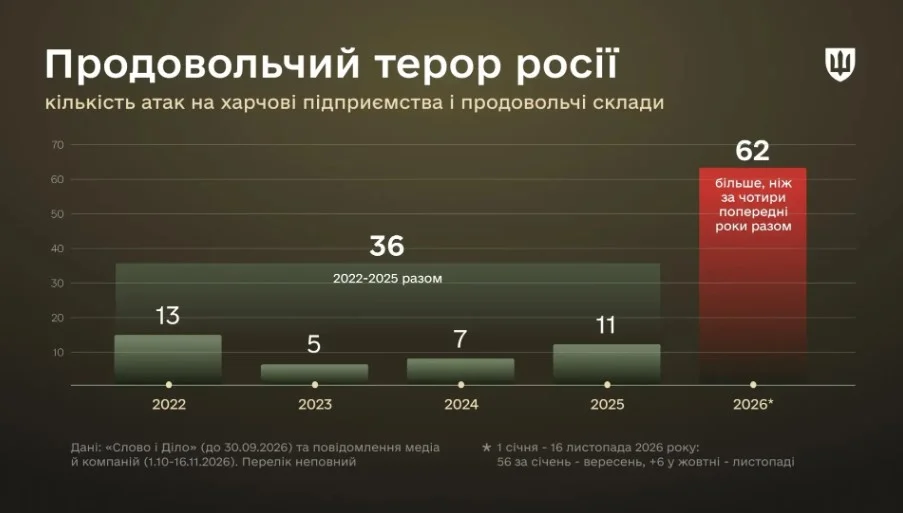
In 2026, Russia sharply increased the number of strikes on food production facilities in Ukraine: since the start of the year, at least 62 attacks on factories and food warehouses have been recorded, which is almost twice as many as in all previous years of the full-scale invasion combined. Such strikes violate international humanitarian law.
This has been reported by the Ukrainian Ministry of Defence, according to Censor.NET.
It is worth noting that a direct hit is not necessary to halt production: some businesses are ceasing operations due to power cuts and the threat of further attacks.
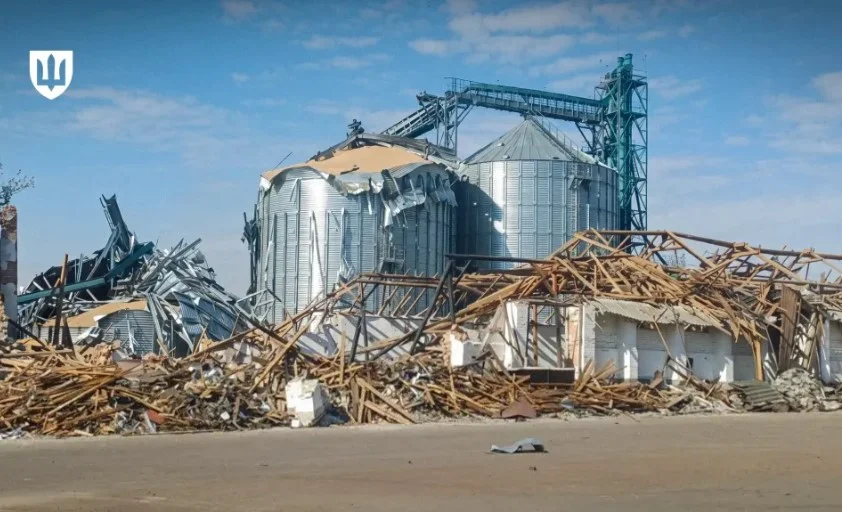
Russian attacks on food processing plants
The tally includes targeted attacks on food processing plants, food and cold storage warehouses and logistics centres. It is based on reports from the media and companies, so the list is incomplete: some of the affected sites are not named for security reasons.
Read more: Government has ordered verification of data on men aged 17–60 in the military registration database
It is not just factories that are under attack. In the Chernihiv region, there have been over 100 strikes on farms and agricultural enterprises since the start of the year, Viacheslav Chaus, head of the regional military administration, reported on 12 November.
On 10 November, a source within the Defence Intelligence reported that the Russian Federation is preparing strikes on grain elevators, grain warehouses, oilseed factories, dairies, meat processing plants and poultry farms. According to intelligence reports, the aim is to destabilise Ukraine’s food security.
The impact of the strikes on the food industry
The consequences of the attacks in the first half of November varied: from a damaged workshop to a production facility that was completely destroyed.
For the third time this year: a strike against an international holding company’s factory
The Ukrainian agricultural sector is export-oriented, which is why many enterprises are owned by international holding companies. Among them is the ‘Oleina’ plant in Dnipro, which is owned by one of the world’s largest grain traders. According to Reuters, it is one of Ukraine’s five largest food processing plants: it processes up to 1,600 tonnes of oilseeds per day.
On 16 November, this factory was attacked for the third time this year.
- In January, following a drone strike, around 300 tonnes of oil spilled onto the city’s roads.
- In September, two people were killed in the attack, and the factory was shut down.
- According to the company, part of the production facility was damaged on this occasion, but none of the employees were injured.
"This attack was not a mistake – it was deliberate," said Foreign Minister Andrii Sybiha following the January strike.
Production has been completely destroyed
On the evening of 16 November, jet-powered drones struck a facility belonging to the company ‘Korolivskyi Smak’ in the Kirovohrad region. The fire raged throughout the night, destroying the company’s products, production facilities and premises. One person was killed. The following day, the company stated: ‘At present, there is no possibility of resuming operations.’
Three days before the attack, the company had already announced that it was shutting down its plants due to power cuts and the threat of attacks.
Production is halted both after an attack and when there are no hits
On 11 November, trilateral talks between Ukraine, the US and the Russian Federation concluded in Abu Dhabi. Less than a day later, a drone struck the oil extraction plant of Kernel, Ukraine’s largest oil producer. Four tanks containing 8,500 tonnes of oil were damaged. The oil spilled over an area of more than 3,500 square metres.

That evening, the company shut down all eight oil extraction plants and suspended the purchase of seeds.
Other production facilities are being shut down without any direct hits. On 17 November, two bread and pasta manufacturers in Kremenchuk suspended operations: due to constant power cuts and the threat of missile and drone strikes, they are unable to operate consistently. It is not known when production will resume.
Breaches of international law
Attacks on food supplies and food processing plants cannot be viewed in isolation from attacks on the energy sector and water supply: they are components of a single, deliberate policy of terror against the civilian population, the aim of which is to create conditions unsuitable for normal life.
Food processing plants, warehouses and grain silos intended to meet the needs of the civilian population are civilian objects and are protected under international humanitarian law. Attacks on such facilities constitute a breach of international law and amount to war crimes. This protection is enshrined in Additional Protocol I to the Geneva Conventions, which is also binding on the Russian Federation.


