



Winter at war: Soldiers’ experience and advice, or "Donetsk wind blows all heat away"
How and with what our soldiers keep warm in trenches, dugouts and on duty at observation posts in Donbas, and what they suffer from the most in Kherson region.

Photo from the official page of the 47th Separate Mechanised Brigade
When the frosts get worse or vice versa, when the thaw comes, everything gets soaked, the first thought is what is happening at the front, in the trenches where the soldiers move. I have seen many times how mud sticks to their boots in kilograms, how happy they are to have warm knitted socks to wear at night, how a respected unit commander asked for hygienic lipstick because their lips crack instantly in the Donbas cold and wind. Over the years of war, our soldiers have learned to adapt to winter warfare. What can be useful to them? We talked to representatives of different units in different areas of the front line about how we can help them and how they keep their hearts warm.
"THE DONETSK WIND BLOWS AWAY ALL THE HEAT, NO MATTER HOW WARM YOU ARE DRESSED"
The medic, who has been helping the soldiers since 2014, met them near Avdiivka this winter:
"Unfortunately, Ukraine doesn't produce blankets like the ones I saw a few months ago. They were sent by volunteers. These blankets don't need electricity, they don't switch on, but they help a lot, they warm you up instantly. The guys wrap them around their legs in the trenches and it gets warmer. These blankets turned out to be very useful and comfortable.
This winter, heated insoles became fashionable. You know, they get hot from the power bank. Everyone is taking them to the war, but they don't work. People get frostbite and burns at the same time. Maybe they are used incorrectly. I do not know the reason, but I have seen with my own eyes the burns that remain after using them. There were cases when they brought a fighter who used such insoles, and his whole foot was burnt, completely.
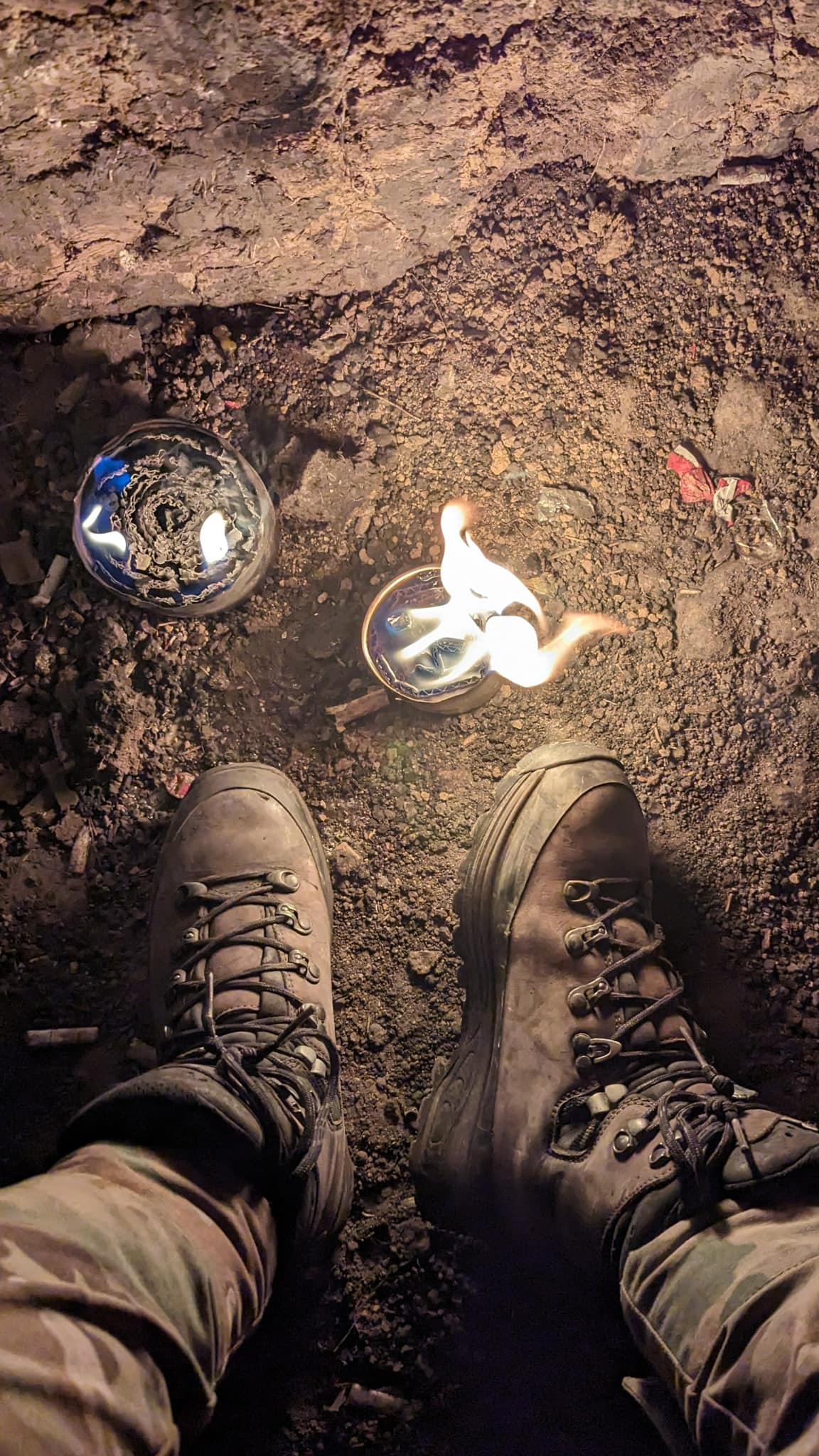
Photo from the official page of the 47th Separate Mechanised Brigade
Now they have started to make and use mini-stoves in which they put trench candles. Then they don't smoke and stink so much. At the same time, the stove heats up. It's warm near it. Craftsmen make such stoves. A coil comes out of it, which is led behind the dugout. This coil also provides heat. At the same time, there is almost no smoke. The guys use these stoves to dry their boots and clothes. They help a lot in the conditions we have today.
I do not use chemical heaters and have not seen anyone in the area where I work. Maybe they are not delivered to us.
I see a lot of soldiers buying special protective shoe covers that they put on top of their boots. You know, reusable ones. That way the boots stay dry and the feet don't get so cold.
What is the best way to dress in winter at war to feel warm and protected? I'll tell you by my own example. I have a good down jacket, like a pea coat, and high-quality thermal underwear, over which I wear my uniform. It would seem that I shouldn't be cold. I go out into the field and it feels like I'm standing naked, even without my skin and meat. The Donetsk wind blows away all the heat wherever you stand.
I see guys wearing woven woollen sweaters, and some of them don't give up woollen socks. I recently received three boxes of socks from Zaporizhzhia. I left two of them at the stabilisation point, and brought one to the assault battalion. For some reason, this time they were not very popular, probably because you can't wear them with your boots. I also offered the guys wicker round rugs. I threw them on the floor in the dugout, and when you changed your shoes, your feet would not touch the floor, but a nice rug. The men with experience were happy to have them and took them.
Of course, there are cases of frostbite. I collect the number of cases for sure. I would not say that this figure is critical. As a rule, those who do not control themselves suffer: they do not change their clothes in time, do not change their shoes. This is how hypothermia occurs, followed by frostbite.
Frostbite on the hands is less common than on the feet. Fingers are protected by gloves - everyone wears them. By the way, these are isolated cases, but there are also cases when the face suffers from frostbite. The guys cover it with buffs. But breathing causes condensation inside the fabric. And, if a person stays outside for a long time, frostbite can occur on the face. Fatty creams, which should be applied to the face, help. But these are men - one of them put it on, and five of them didn't. By the way, last winter there was a boom in hygienic lipsticks. I bought them in all the pharmacies and took them directly to the front line. And now no one has asked.
In winter, there are problems with warm clothes at the staging areas. The wounded are brought there - wet and dirty. Their clothes are cut off and they are left virtually naked. That's why warm clothes are needed at the staging areas, so that the wounded can be changed into something to wear and put on new shoes. This is also worth remembering."
"THE TEMPERATURE IN THE DUGOUTS IS SUCH THAT IT IS EASY TO PRESERVE, BUT IT IS DIFFICULT TO WARM UP"
For many years, Marusya Zvirobiy trained paratrooper groups for combat operations, and after the full-scale offensive, she became a sniper herself. She told us the following story:
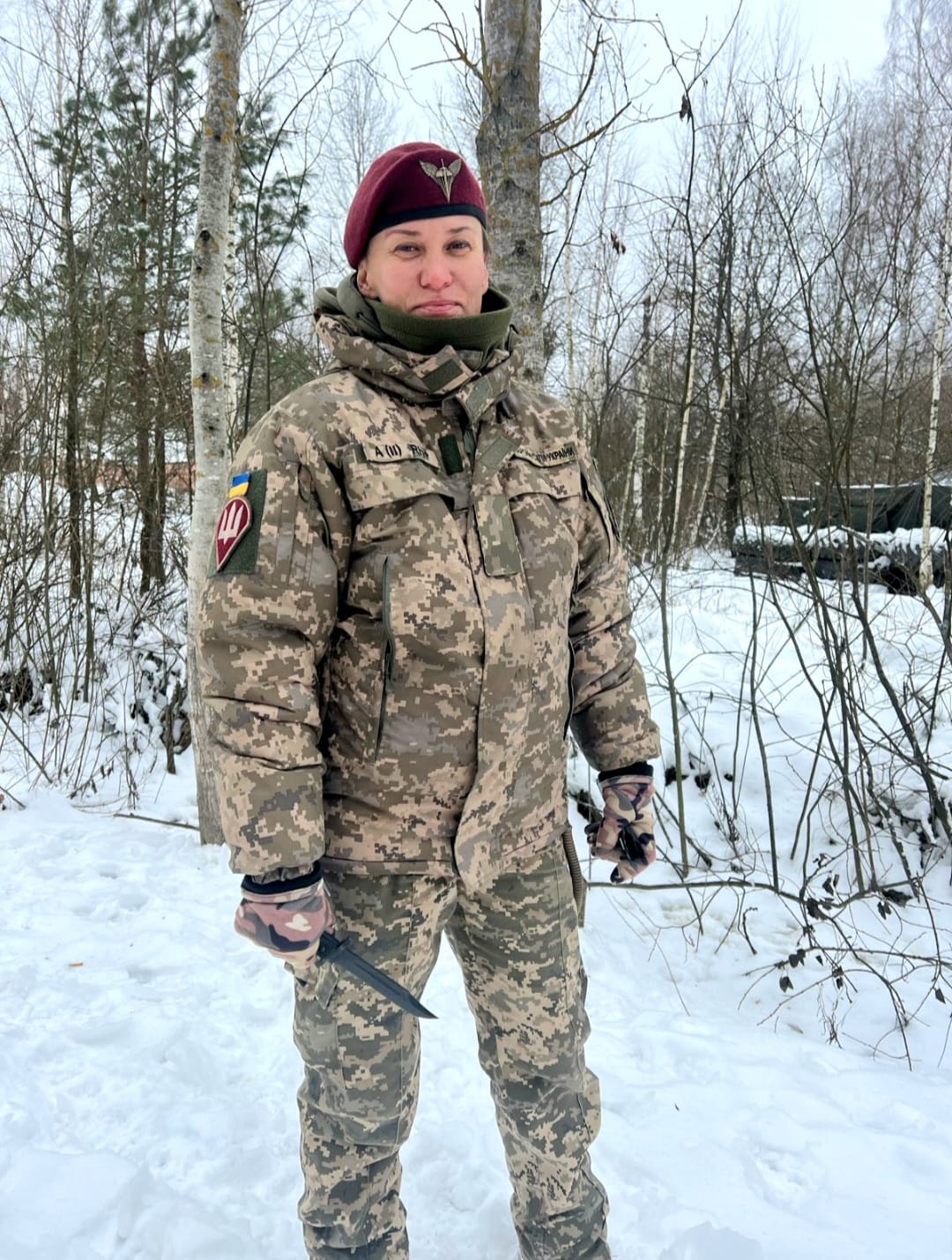
"It happened near Verbove this December. A couple of our snipers went on a combat mission for three days. But due to the dominance of enemy drones, they could not leave their positions for five days, and only left on the sixth. The temperature in the dugouts was sub-zero, and there was no way to keep warm.
At first, our victim did not notice that he had frostbite. When he returned, he noticed that his big toe was hurting. He took off his boot and saw that the toe was pale and the nail was black. But he had put a heating pad in the boot and didn't even think anything could happen. It was supposed to keep him warm. We sent him to the hospital. Fortunately, the frostbite was not critical.
The fact is that winter shoes should be one size too big to retain heat. Even our respected Talan company says so: either take shoes a size up or don't complain that your feet are cold. Our soldier's boots were just his size, so they were too tight with warm socks. He also put a heating pad in them, so there was no room for warmth at all. And heaters, meanwhile, also need air to warm them. This combination of mistakes led to the frostbite of the limb.
Good health to all, take care of yourself and be attentive to your winter clothing and footwear. If they are not chosen correctly, they can lead to serious consequences and even death. There are no small things in war. So weigh everything carefully."
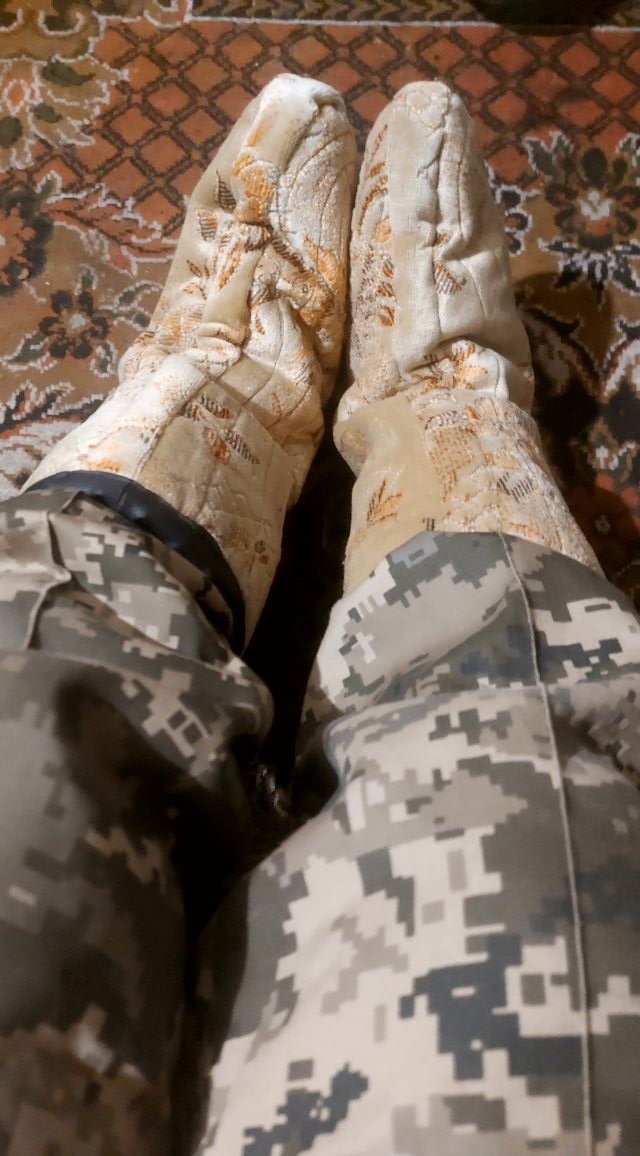
Marusia captioned this photo, taken in December, as follows: "Warming up. I'm so sick of the cold. And it has only just begun, damn it."
The commander of an infantry unit who has been at war since 2014 admitted that he hates winter. Because you can't hide from the cold. And on frosty days, you need to regularly warm up your equipment and keep your batteries warm. The hardest part is fixing the machines, turning the nuts... But there is no escape, and you have to do it in any weather:
"In cold weather, patrols change in time - it is optimal that the duty officers change every two hours. That's how long a soldier stays attentive in the cold, doesn't lose his vigilance, doesn't start to doze off. Three hours - there is already a risk that he will miss something. And he will freeze.
The temperature in the dugouts is just right for good preservation. But it is difficult to keep warm. Trench candles and stoves help. But the stoves at the front line are not used. So we are very grateful to the people who make and send us trench candles. They warm and dry us."
"BABY CREAM AND POWDER HELP MY FEET"
The Kherson direction is the one that raises the most questions now - while in Donbas, over ten years of war, the soldiers have become accustomed to winds and frosts and know how to withstand them, here they have to cross the Dnipro every day, and in Krynky, where our army has now established a bridgehead, it is constantly wet. And from time to time, you involuntarily think: what about the guys there? A fighter from one of the marines' units told us about the situation and how the guys keep warm in the water:

Photo from the official page of the 126th Odesa Territorial Defence Brigade
"If your feet are constantly in water, you don't dry your shoes, your boots are warm and then cold due to temperature changes, especially at night, you get the effect of steamed feet - and a layer of skin comes off. And it happens no matter what you do. This happened to me - the skin just came off. And every second person in my unit has this problem, because we move in humid conditions. We tried to put bags on our boots to keep the moisture out, but then our feet get steamed.

What can be done in such a situation? Nothing. Recently, protective knee-high boots have appeared - let's call them that. Last year there were no such boots. They perform well. Thick soles. They have fasteners. They protect your feet, keep you warm, and are waterproof.
But sometimes the water is up to your waist. You walk along that left bank, and it's basically all in water. And then you fall into a sinkhole - a mine hit, then the place was flooded with water. And you've already dived in... And sometimes you jump out of the boat as quickly as possible, because there's shelling, and you're in the water.
Children's cream and powder, also for children, help the feet. It dries the skin. We also wear spare insoles on our bodies. This keeps them dry and warm. If it's cold, we put wet insoles out in the cold. This way they freeze and become dry. Electric insoles are not always used in our conditions, because we save all the chargers for heaters and night vision devices. We cannot take generators with us to the left bank. It is impossible. But we take a change of socks and shoes with us. If you're wet, nothing helps, only dry clothes.
We don't protect our faces with anything. For some reason, there didn't seem to be a need. But we do use hygienic lipstick. It also helps when there is a dehydration process. Lips do not dry out and crack so much. When we cross to the left bank, we take a minimum of water with us. We take a minimum of everything. And there, dehydration happens quickly. After the flood, everything in those places is covered with sand. The houses are buried in sand to the middle. My feet sink, it's hard to walk. During such a movement, water leaves the body very quickly. Sometimes we drank from the Dnieper when we ran out of water, because we went for three days and stayed there for five or six.
I have never taken chemical hot water bottles with me. I know that they are used at observation posts. The guys don't move there, so they are suitable.
We haven't had any severe frosts here yet, it's just very damp. But at night it is very cold! Sometimes we used to lie on top of each other at night to keep warm. In those Krynky, all the houses are broken. Not all of them have basements. And where they do, it's very cold inside. And you can't light anything. So we spent the night huddled together. But for us, even sleep is death. If one falls asleep, everyone falls asleep. The body's work slows down. But you also need to sleep to do your work. You won't believe it, but the guys slept while standing up. In order to stay awake all night, to observe, we take turns sleeping in the dugout for two or three hours."

Photo from the official page of the 126th Odesa Territorial Defence Brigade
The unit commander, who also holds a bridgehead on the left bank, confirmed that his men cross the Dnieper not only with weapons but also spare boots to change into dry ones. This is the most important thing in those circumstances.
Violetta Kirtoka, Censor.NET


