



Taras Horpyniak, artilleryman with the 10th mountain assault brigade "Edelweiss": "The Russians were complaining: "One tank and 15 ’Ukrops’ killed two and half of our battalions"
Taras served in the 109th Battalion of the 10th Separate Mountain Assault Brigade for almost four years. He went through the most terrible and difficult battles near Kyiv, Yakovlivka and on the outskirts of Bakhmut with this unit.
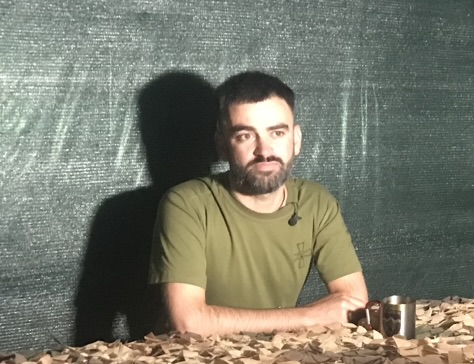
The number of contusions the artilleryman suffered led to him losing his eyesight. But even after doctors forbade him to spend many hours in front of screens and tablets, he did not leave the service - he was transferred to a territorial recruitment centre, a former military enlistment office. Taras's story clearly shows why people on the front line need to be changed, that they are not made of iron and need treatment, rest, rotations and replacement.
"AT THE BEGINNING OF THE FULL-SCALE OFFENSIVE, WE WERE IN VOLYN, NEAR THE BORDER WITH BELARUS"
- "I studied at the Physical Education Department of Yuriy Fedkovych Chernivtsi National University," says Taras. "Then I entered the military department and studied for two years. I'll be honest: I didn't do the best. After graduating in 2014, mobilisation began, and I joined the Armed Forces. At that time, it was the border troops, the State Border Guard Service. But I did not take part in hostilities. A year and a half later, my service expired, I went to the military enlistment office and was offered to join the Armed Forces. I hesitated and thought about it, and eventually joined the 10th Mountain Assault Brigade.
It was only when I joined this brigade that I realised what service was all about. For two or three months I was sent to the combat zone near Popasna, to the village of Vrubivka. I had to recall everything I had been taught at the military department, learn new things, and master modern technologies and tablets. I can say that I quickly mastered everything, and my career began to move very quickly. In a year or two, I changed two or three positions and received military ranks. At that time, units went every six months for recuperation and then to perform combat missions again.
- How did the war change by 2022?
- Let's take 2017. At that time, the fighting had calmed down compared to 2014-2015, there was no heavy shelling, but I will never forget how cannon artillery started firing at our units. Several brigades were being shelled at the same time... This had never happened before. We held our positions for three or four months, but it was the first time artillery from several brigades was working at once. But in general, every year it became calmer, quieter and quieter. It was, you know, like a recession.
- And how did our artillery work? Was there an opportunity to gain experience?
- Sometimes we worked every day. When we entered such settlements as Krymske and Zholobok, we had to work hard. However, it's not like now - now we have drones, and fire adjustment has become much more accurate. At that time, it was just a simple artillery observation post with a rangefinder, a bead, a stopwatch, and binoculars. But that's when I fell in love with the job. Because what was taught at the military department is one thing, but from 2017 to 2021, I understood and learnt a lot.
I first saw a tablet, I think, in 2017. Well, not the tablet itself, but the work with the tablet with the artillery. At the time, I was serving at the artillery headquarters, and I had to learn it very quickly because there was no one else to do it: some people were resigning, others were being transferred somewhere. I was given a tablet and had to figure it out. Everything is best learnt during combat operations. I cannot say that it was difficult for me. Literally on the second day, we were already adjusting the art on the tablet - no problems at all.
- By 2022, what did you have in your arsenal?
- Until 2019, I served at the artillery headquarters. I had all the equipment there. I like 2C1 the most. It is a self-propelled artillery unit, 122 mm. It is more manoeuvrable and moves quickly. And the D30 is a trailed gun that is attached to a KrAZ or "Ural" truck, so its manoeuvrability is quite difficult.
In 2019, I changed my place of service and joined the 109th Battalion of the same brigade - the position of deputy artillery commander became available. Here I began to master mortars. Yes, they have a smaller calibre and a shorter range, but the mortar has its effect in infantry units.
- How and where did you meet the full-scale attack?
- On the eve of the full-scale offensive, a battalion tactical group was formed on the basis of the 109th Battalion. And on the day the great war began, we were in the village of Volodymyr, Volyn region. We were being prepared to strengthen the border with Belarus. We were joined by units such as a tank company and a self-propelled artillery battery. The battalion was well-staffed. On the eve of the attack, someone woke me up at night and said that someone was going to speak, so we all ran to the commander's kung and watched a video of the Russian president. Twenty minutes passed and the missile attack began across Ukraine. We went to these settlements to reinforce the border. It took us a long time to get there: the roads were blocked, there were traffic jams, locals were queuing for fuel... We took up a defensive line, and by the evening we were ready for anything, for combat. We took up our positions and watched. From the first day, the local population actively helped us. People came out to dig trenches and make fortifications. We were pleasantly surprised by this.
We stayed in Volyn for some time. One of the battalions of our brigade, the 8th, was already near Kyiv at that time. So we were constantly on the phone with our comrades, checking in with them.
We have not yet seen the war as such, but many fighters had families in Kyiv region, in Mariupol, Kherson, Mykolaiv... Everyone came running and said: "The enemy is at home... What are we doing here?" But there were no orders for us to go anywhere, so we were forced to stay put. At that time, it was also a rather dangerous area - if the enemy moved from there, we would have to work. Someone had to perform tasks there as well.
"THE HEROISM OF THE PEOPLE ON THE FRONT LINE IS EXCEPTIONAL"
- A few days passed and we received an order to go to the village of Malyn to block the enemy on the border of Kyiv and Zhytomyr regions. In the late afternoon, we received a task to drive the enemy out of several settlements. There was very little time to reconnoiter the routes of advance, or for artillery support. At 12 o'clock in the morning, company commanders were called in and given tasks. The people were tired from moving, setting up the location, and received hot food only in the evening... As soon as we got there, we were given a task for the night.
At four in the morning on 7 March, we had to move to three settlements in three companies to carry out combat missions to clear and repel the enemy. Already while we were moving, they started shelling us from artillery, and the aircraft were also working, hitting the crossing. They hit the bridge, so we had to look for another route to bypass that bridge. But no one met us on the way. We thought that the enemy had already retreated or had been defeated by previous units. We were already approaching settlements - small villages near the Ivankiv district of Kyiv region, and everything was quiet. But when our tanks and a few armoured personnel carriers entered the village, they started shooting at them from everything they could. It turns out that the enemy knew in advance, or suspected, or was preparing for this. They shot at our vehicles, some of them got hit by mines. We suffered quite significant losses. The 2nd Mountain Assault Company was probably 75 per cent destroyed, some equipment burned, and many people were left behind. We received an order from the battalion commander to roll back and regroup. We drove back to the area of concentration. We started checking the personnel and equipment.
On 12 March, we were again tasked with re-assaulting the same settlements. By that time, everything had already been studied in detail, discussed, and the first quadcopters appeared to study the area, where there was an enemy and where there was not. And from 12 to 13 March, we planned the assault. We started well, the artillery worked well, and entered the settlements with fighting. In one of them, we cleared half of the village and gained a foothold. The next day, we continued the offensive and drove the enemy out again. We managed to enter two more settlements - Kukhari and Sloboda Kukharska - but the enemy was also there. There were constant battles at the poultry farm and at the checkpoints. The enemy behaved well. It was the 155th Marine Brigade, they were well supplied with everything, with the latest equipment, very well equipped. In two days we cleared these two settlements. One of our companies went forward to the third settlement, which was located five or six kilometres away from these two. We were tasked with blocking it. We went there, established ourselves, the enemy was not there, he was a little bit behind the bridge. We mined the bridge, organised security and defence. And massive shelling began. The artillery did not stop for three or four hours, in between the artillery, the aviation worked, and there were rocket attacks. Helicopters and MLRS were constantly working...
- Is this for these two settlements?
- Yes. There are almost none left. We were constantly trying to get the local population out of there, to evacuate them, but it was difficult.
I was lucky that instead of a battery, I was left with a whole artillery division, which is twice as big as a battery. I think we worked hard, but the enemy was probably working ten times harder. So it was very difficult.
- There was no panic: there are so many of them that we will not be able to withstand...
- I was in a panic about the infantry units that were at the very front line: how much longer could they hold out under such shelling? But, surprisingly, they held on, survived and went on and on, recapturing positions. The heroism of the people who were on the front line, the infantry, their commanders, is incredible!
There was active shelling for about a week. No one was leaving, the Russians even tried to storm one of the settlements several times: six armoured personnel carriers and six infantry fighting vehicles were sent. I kept telling the commanders that our battalion has a special feature: at the last second, we do something to turn the situation to our advantage. There were moments when the company commander reported that the enemy was already near his command and observation post, which was usually located behind the positions. And then, at the last second, our tank moved in and shot all six of those BMPs and destroyed the APCs. But everything was hanging in the balance... Thank God, everything was always in our favour. Many times it seemed that we were about to be knocked out, that our men would not be able to hold on - and yet it turned out that the enemy retreated, with heavy losses. In terms of interceptions and everything else, they said they could do nothing to us.
Let me give you an example. My very good comrade, who is now the commander of an infantry battalion, Hunter, and my comrade Romb, the chief of intelligence of the 109th Battalion, who is currently undergoing treatment, have done so much in our battalion! Thanks to them, we have achieved a lot in the Kyiv sector. One day Romb came to me and said: "We need to mine the road". It is difficult to give such an order to someone, because the road is between the enemy and us. He went alone and did it, and a few minutes before the enemy attacked. The artillery got ready to work. A convoy of eight or nine vehicles moved out - two tanks and six armoured personnel carriers were definitely there. The first tank exploded on a mine barrier it had set up, and then our artillery started working. It was one of the first times we used a quadcopter, a "Phantom" at the time. Three artillery batteries and the battalion's mortar battery delivered fire and burned all eight vehicles. When one tank tried to go around the road, a shell hit it directly. It stopped.
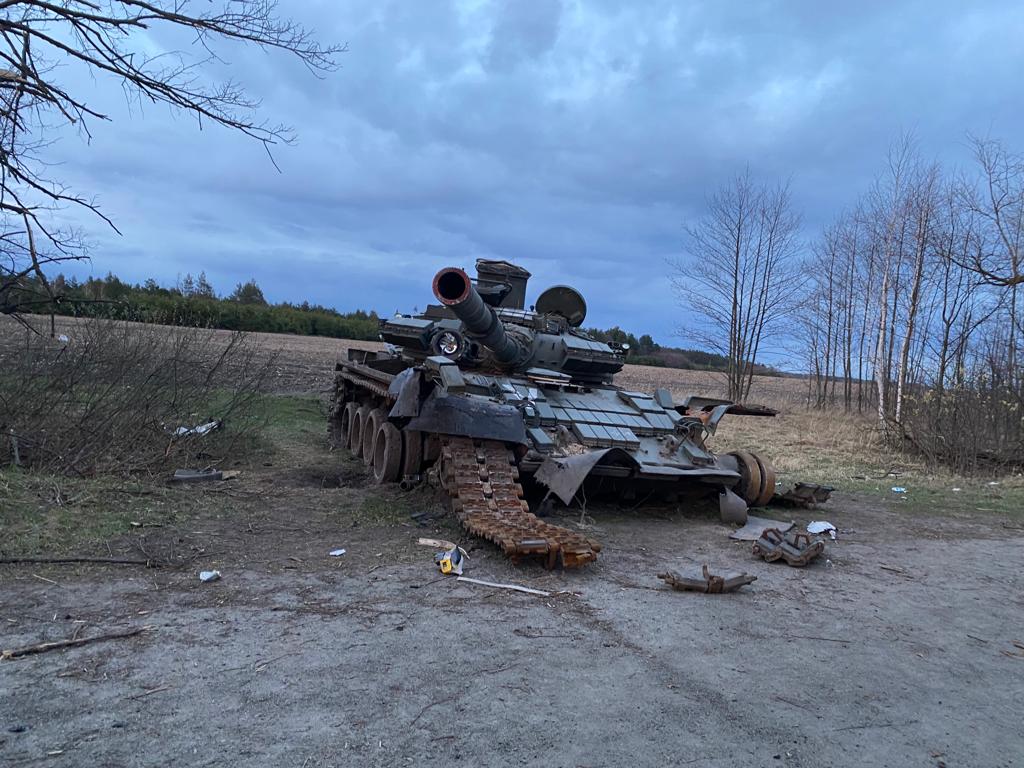
The vehicles on the road were completely burnt. Of course, such results raise the morale of the fighters. We also heard from the intercepts that the enemy was whining that something was not working, something was on fire. This is very important for everyone.
- How did the Russians withdraw from the Kyiv region at the end of March 2022 ?
- After a night of shelling, there was some kind of inexplicable lull. From the quadcopter, we recorded constant movement, but noticed that civilian cars were leaving the settlements. The next day, when we took off in the morning, we saw no one, no enemy, no one anywhere, no one shooting. We could not understand what was happening. We received an order to move forward. We moved in a convoy and made sure that there really was no enemy!
When we were travelling with the battalion commander, I showed him: "Here is my target, the 917th! Here was the enemy infantry concentration - you can see the craters where we worked."
- As they were leaving, the Russians destroyed all the bridges.
- Yes, they blew it up on the last night. They left behind a wasteland. No electricity, no communication... We helped people as much as we could. And the locals greeted us with joy, brought us milk, cookies... People told us how the occupiers behaved: they looted, took everything they could. We stopped at a small house of a forester - we had to stay somewhere, to make contact. The Russians had been there before. The house had been looted to the extent that the spoons and forks in the kitchen had been raked out, the curtains removed, and even the built-in stove cut out. Where it was impossible to cut out the appliances, they broke them down, tore out the stove and took it with them. The wardrobe where the forester apparently kept his clothes was empty, but there were still Russian uniforms - they left their uniforms and put on civilian clothes, and left.
"THE POSITION WHERE MANY RUSSIANS DIED, MY COMRADE CALLED IT A 'GRAVEYARD'"
- We arrived at the settlement that was assigned to us. We looked around the village and saw a lot of burnt-out equipment, both ours and the enemy's. We stayed there for up to a week and received an order that we would be replaced. Other units arrived, we interacted with them, and we went to Malyn. We stayed there for a month and a half to two months, so to speak, to recover. But at the same time, we still received tasks to cover the border in the Zhytomyr region. We travelled, prepared, and conducted training.
Two months later, we received a combat order to go to Donetsk region. We did not know where exactly we were going. I, my comrade Hunter and the head of intelligence went on a reconnaissance mission, that is, to study the area in the Donetsk region. We left the day before we were supposed to be loaded onto the train. When we got to Pavlohrad, we received a call saying that two or three missiles had hit the loading station... We were either calculated or betrayed, because they said that later they found a person who was an informant and passed information to the Russians. The next day we were told that the train had left...
The first task in Donbas was to push the enemy back from the village of Pokrovske, a settlement outside Bakhmut, towards Popasna. There were Ukrainian Armed Forces units there, but we had to get through their lines and push the enemy back four to five kilometres further, to other settlements. We planned everything and left in the morning. The infantry moved forward after artillery training, began to clear and storm. Everything seemed to be going well. However, the enemy sent out an armoured group, fired a tank, and we lost a platoon commander, several soldiers, and one company commander was killed by a mine... In the Donetsk sector, we saw the same thing happening as in the Kyiv sector. We were heavily sheltered, but there were fewer aircraft working compared to Kyiv.
We completed the task. The units that had been in front of us re-entered the area: they had retreated a little because the enemy was putting pressure on them, and we restored their position.
We were transferred to the village of Mykolaivka near the Lysychansk oil refinery. We were not very lucky there. We had to clear a fairly wide forest belt and move on. We went in, cleared half of the forest belt, and ran into the enemy. A battle broke out, with enemy artillery flying very hard. Many people were killed. We retreated, stood on the outskirts of the forest, and organised a defence and guard. We failed to complete the task, and the enemy kept trying to storm the area. We failed to complete the task because of the heavy shelling, but the enemy started sending out their groups, going on armour and on foot, trying to break through to Mykolaivka and the oil refinery - that was their goal.
Constant heavy fighting, losses, air and missile attacks led to our unit becoming less and less combat-ready: there was a shortage of officers, platoon commanders became company commanders, and instead of platoon commanders, squad leaders - sergeants with experience - performed tasks.
One day Hunter was sent to see the positions, check for weapons, help with something, and give advice to the soldiers on the ground. He left, and at that moment a massive assault began. Four armoured personnel carriers and tanks arrived. They drove through our defences and drove into the area where our units were stationed. We suffered losses. We radioed Hunter and told him to meet our tank. And he went with this tank and about ten men to knock out the enemy. The Russians were coming in our direction, and he was coming at them: the tank was firing in front, and he was behind with his men clearing the area. We cleared everything completely, and a lot of enemy were killed there. After that, there was an interception where the Russians were talking to each other: "One tank and 15 'ukrops' put down two and a half battalions".
And Romb, the head of intelligence, stood in a parallel position. Hunter was walking on one side and Romb on the other. And they met later. Romb called that position, where a lot of Russians died and a lot of equipment was completely burnt, "Mohylnyk". He marked it on his tablet and named the forest where the Russians died. These are my brothers and comrades who proved themselves during this war!
Gradually, neighbouring units and units of other brigades withdrew from those places. The enemy had already entered Sievierodonetsk, and eventually Lysychansk. We had to withdraw. We took the road that runs almost on the border between Donetsk and Luhansk regions, established ourselves there and held the defence. We were constantly repelling enemy attacks. Sometimes we had to retreat, though not far away. For example, the landing was located 200-300 metres from the enemy. We withdrew from it, and the next day we took it again. And so the enemy could not do anything in those places for a month or two. They had a task to close the Luhansk region, because two settlements remained unoccupied there - Bilohorivka and Spirne. They were shouting that they would take Kyiv in three days, but in reality they could not take a couple of landings for several months.
After these events, our battalion was withdrawn for some time to regroup, and we were replaced by a neighbouring battalion. Two weeks later, we entered the small village of Yakovlivka. We held defence there with another battalion for about a month. The enemy was constantly conducting assault operations. In the very first days, the enemy was entrenched in two-storey buildings. We organised assault groups and went to clear these buildings. After that, there were also many enemy corpses, burned vehicles - three blown up armoured personnel carriers, because the artillery had worked, and we had worked with anti-tank weapons - Stugnas and Javelins. Everything was on fire. We repelled that attack. There were several similar assaults.
There was a small landing there. The position was called "Moreman". The enemy approached it, wanted to storm it, and we inflicted fire damage. A month later, nothing remained of that landing, just a trench and a big black spot. We made a flyover and saw nothing alive. And for another two weeks, probably, our units held the defence there. Then we had to withdraw because we suffered losses. Slowly, the enemy was advancing through the neighbouring landings, to the right and to the left. If the enemy advances from the right and left, we have to point our artillery at one side or the other. And they were issuing less ammunition. We fought like this for probably another month. There were moments when we were working with 155 calibre and 122 calibre 50 metres away from our fighters, because they could not do anything. There were such active assaults, the Wagner had already appeared, they were attacking constantly, day and night. It was very difficult. We were short of personnel, and people from other units were seconded to us. But that Yakovlivka stood, I think, for six months. And then - due to the lack of personnel and weapons - the senior commander decided to withdraw us for reconstruction. And in a week, the enemy took Yakovlivka back. I think it was not due to the fact that some unprepared unit arrived to replace us, but to the fact that they knew everything, down to the bush, and held the defence with dignity.
For about three weeks, we had been training, conducting combat coordination, and replenishing our personnel. We received two mortars, French, rifled, the latest ones, so to speak. We were mastering all this, preparing for the next tasks.
"OUR TANK WAS DRIVING DOWN THE LANDING, SHOOTING AND CRUSHING THE ENEMY - LITERALLY"
- At that time, there were already battles around Bakhmut...
- The enemy was approaching the city and from the other side was entering Soledar, where very heavy fighting was taking place. After three weeks, we received a combat mission: to hold the defence between Yakovlivka and Soledar in order to block the enemy and prevent its further advance. We took up the defence. The enemy did not get out of Yakovlivka much, did not advance much. They had fewer artillery pieces and less shelling. When the enemy completely took Soledar, they began assaulting our positions. The "Wagner" was storming. As I remember now, there were up to 60 infantrymen on foot, in full growth, with machine guns, coming from both sides. As they were leaving, we shot them all down, and they remained lying there. A few hours later, the second batch followed their own "two hundredths", hiding behind their own "two hundredths". And so it went on for three days - active assaults, but they could do nothing. We held the defence, everything was fine.
One day they came again - at night. It's not that we weren't ready for it. While we were repelling the assault in one position, they entered the second. The terrain there is so different: a difference in altitude and landings dug with trenches, quite deep. The dugouts saved us. It was the second line of defence, and they had prepared it in advance. There was a place to stand. We were constantly under attack, it was difficult to fight with the enemy units, with the Wagner. One evening, the commander and I looked at the trench leading to our positions along the landing zone and saw it glowing. We thought it was the snow. But no: it was moving... Up to 20 enemy men were in the trench. It was 20 degrees below zero. We started firing at them with artillery, then set up a machine gun. It was very successful. They crouched down and sat there, unable to move. And so it went on all night in the cold. In the morning, we hit them with artillery several times - they scattered there... An hour later, their second party went through the same trench, and a tank and an infantry fighting vehicle came from the side. The tank shot at the landing with our units almost at close range, and we suffered losses.
They retreated, took up the defence again. And again, the same thing happened: artillery shelling, Wagner units - they were driven back and forth. We took a few prisoners, and they said that they were just shot behind us, not allowed to go back, they were only tasked to go forward. We had to withdraw from two landings because the enemy was already there. And they didn't just stop... They were almost to the road, about a hundred metres away, but their fighting stopped. At that time, there were active operations in Bakhmut, in the city itself. We held the defence in those places for about a month. Then there was another assault, we didn't lose our positions, and we killed a lot of Russians. And then we were brought back to restore our positions.
- Is that line still in place?
- Yes. We spent about a week recuperating and then took up positions near Rozdolivka, on the railway that goes to Soledar. We held the defence there for a short time, about a month. There were no major attacks, the enemy began to dig in ahead of us, and they were digging very actively in the front line. We were surprised: in the morning there was no trench, and in the evening there was one. And when they were digging, we didn't even see it...
It was already 2023. The day after Easter. We received an order to move to Bakhmut. We went for a reconnaissance. As usual, we got in touch with the units to which we were assigned, found out everything, and received our tasks. We had enough time for additional reconnaissance, discussed everything with the unit commanders and planned everything. We began to carry out the task: to enter the area where the enemy was, clear it out, and gain a foothold. At the same time, several other battalions were performing the same tasks - clearing the landings and trenches leading to the Bakhmut-Chasiv Yar road. The neighbouring unit was still in Bakhmut itself, fighting, but the road was gradually becoming not ours. The task was to go there and block the enemy. Assault operations began, several battalions moved forward at the same time, but the enemy used artillery and, again, Wagner... We completed the task, our battalion entered the area, but could not clear it completely, only half of it. And our neighbours to the right and left failed to complete the task. That is, we entered the landing, with the enemy on our left and right, and the enemy in front of us. A very active shelling began, many of our men were killed there, probably 50 per cent of the third company did not make it out.
A day or two later, we received an order to withdraw. We spent about a week preparing the unit for assault operations. Once again, we were tasked with clearing the track leading to Bohdanivka. On both sides of the track there is a forest belt, we are supposed to assault from the left, and the second unit from the right. We had been preparing for this for several days. We completed the task, cleared the area, but our neighbour on the left failed. Two days later, we received a task to clear the landing instead of our neighbour, to conduct assault operations. We planned again and used the tank. There was a video of our assault on the Internet. Our tank was driving through the landing, shooting and crushing the enemy - literally. We cleared it completely. We made the road to Chasiv Yar more passable, and there was less shelling towards Chasiv Yar and all the units stationed there.
After that, we were withdrawn for 18 days to recover and prepare for assault operations. But the situation was changing rapidly, and in just seven or eight days we were again tasked with storming Yakovlivka, where we had once held the defence. We stormed the village from two sides - our unit and a neighbouring friendly unit. It didn't work out, our vehicles exploded at the entrance to Yakovlivka. The enemy reacted very quickly, Russian troops, cannon artillery - everything worked. We retreated, regrouped, chose other routes, and started using artillery more. We had a lot of artillery systems, and the "Himars" were working at command posts. But we still failed to complete the task.
We were taken away from there and spent two weeks recuperating. And now we are defending the forest belt.

In the photo: During the recording of the interview near Bakhmut
- You have been injured three times in the last two years...
- This was the result of artillery fire. One contusion led to a significant deterioration in my eyesight. Once, during the shelling, it came very close. Everyone who was there survived. But the contusion affected my eyesight, as it turned out later.
- If we win as soon as possible, will you return to coaching?
- But, I think, never again...
- So you won't be a football coach anymore, but will remain a military man?
- To be honest, maybe I thought about coaching, but that was before the full-scale war. And now I don't see myself anywhere but the Armed Forces of Ukraine.
Violetta Kirtoka, Censor.NET


