



"I cannot help but criticize Syrskyi." Hero of Ukraine Dmytro Kashchenko on why he resigned
About Kashchenko’s military path since the start of the war, the reason for his discharge, and what Valerii Zaluzhnyi’s resignation and Oleksandr Syrskyi’s appointment have to do with it. About the chaos surrounding the military medical commission (MMC) process, the reform of Ukraine’s Armed Forces and the consequences of the transition to a corps-based system, the vacuum of command, and how Russian occupation forces exploited it.
Hero of Ukraine, Armed Forces of Ukraine`s Сolonel (Ret.) Dmytro Kashchenko, in an interview with Radio NV, speaks about the reasons why he stepped down during the active phase of the full-scale Russian invasion.
— You were deputy commander of the Special Operations Forces, commander of the 58th Motorized Infantry Brigade, and, until your discharge from Ukraine’s Armed Forces, deputy commander of the 20th Army Corps. In other words, you have seen a great deal. You fought, and have been fighting, since 2014, but you were recently discharged from Ukraine’s Armed Forces. Tell us what happened. Why did you leave? The grounds for discharge are limited to health reasons. You recently gave a fairly high-profile interview to Censor.NET, where you explained many reasons why you disagree with the way the Armed Forces are developing now, and this is one of the reasons for your discharge. You have been wounded twice, you are a Hero of Ukraine, and few people can reproach you for anything. But now you have left. Why?
— First of all, thank you for the invitation. As for reproaching me, that is already a matter of manners on the part of those who want to do so.
Briefly. Yes, I was wounded twice, and after that, I could have been discharged back in 2015, after treatment. But I still hoped I would be fit enough to do something useful for my country.
Accordingly, after being wounded, I continued to serve as deputy brigade commander, brigade commander, deputy commander — the only thing I will correct you on is that it was deputy commander of the Special Actions Command of the Special Operations Forces, there used to be such a command, the so-called resistance movement. Then I was a deputy corps commander. In between, I also studied at the National Defense University and served as head of the Directorate for Planning the Employment of Troops at Operational Command East.
The main reason for my discharge was, probably, the shift of Ukraine’s Armed Forces (after the removal of Commander-in-Chief Valerii Zaluzhnyi from office and the appointment of the current Commander-in-Chief, Oleksandr Stanislavovych Syrskyi) toward totalitarianism, toward authoritarianism. Toward an authoritarian style of command that does not accept any compromise decisions and does not tolerate alternative opinions. Any alternative views are perceived as hostile, and, naturally, you start being perceived as an enemy.
Therefore, having grounds for discharge and no desire to take part in what is happening, I decided to leave the service.
— You understand that with such phrases about the current Commander-in-Chief, you are effectively drawing a sword against him. I would like us to try to discuss these problems constructively: how, in your view, we should move forward, what is wrong, and what you disagree with. Because it is clear that a person in uniform, wearing camouflage and shoulder boards, would not allow themselves to say what you are saying now as a civilian. In your interview with Censor.NET after your discharge, you said: "I do not want to kill my subordinates."
— Yes.
— Please explain in more detail what you mean by this totalitarianism, this authoritarianism. But, Dmytro, I will still try to act even as an advocate for the Commander-in-Chief, because any word said now may discredit the Armed Forces. And we are currently in a far from easy phase of our defense.
— I understand that. First of all, discrediting is a bit of a loaded issue, you know. When we have certain problems, and if we do not talk about them, if we do not "discredit" anything, depending on how people perceive it, then the problem will not be solved. It should not be hushed up; it should be voiced.
At the time when I was a serviceman of Ukraine’s Armed Forces, I could not voice it because, of course, I would have faced fairly serious service-related consequences. And the Commander-in-Chief has quite a few levers of influence in this regard.
As for killing my soldiers. The final straw in my decision was probably an incident when, already serving as deputy corps commander, I had to spend, I think, three or four days as acting commander of the 110th Mechanized Brigade. While one brigade commander was being removed and another was being sought and appointed, and while he was on his way to take up the post, I was acting brigade commander.
When you are acting brigade commander, having arrived there for those three or four days, you basically have two options. The first is simply to sit there and wait until the appointed person arrives, and let everything continue as it had been going before you. The second option is to try to get at least somewhat into the brigade’s problems, starting with the personnel who are carrying out tasks or being assigned to you, and ending with the availability of weapons, military equipment, and logistical supplies.
Given that I cannot simply sit and watch things drift along, I started looking into those problems.
Starting with personnel. When the conditions under which these personnel are arriving are presented to you, they sound one way. For example, you are told that everyone has passed the military medical commission, everyone is excellent, healthy, and everything is fine with them. But when you task the chief medical officer with analyzing their illnesses, you realize that, roughly speaking, out of 280 people, only ten have MMC paperwork, while the rest do not.
I accept that perhaps someone threw it away, perhaps someone never had it in the first place, but when you start looking into their medical conditions, someone has meniscus problems, someone has a broken arm or leg, and so on, and you were supposed to send them to storm some settlement yesterday, you know, that creates a very negative feeling.

— Let me clarify, with your permission. Until recently, what was the principle of mobilization we had? A person was mobilized; at the TCR and SS (Territorial Centre of Recruitment and Social Support - ed.), if he had not come voluntarily earlier, had not passed the military medical commission, and had not provided all his medical certificates about his health, he would most likely be declared fully fit straight away. He would end up at a training center, from where he would then be sent directly to the troops, to the brigades that needed such reinforcements. Once in those brigades, especially those that genuinely care about whether their personnel are able to perform their tasks, the brigades faced the fact that people arrived unhealthy, and this became the brigade’s problem. Formally, the brigade had supposedly received reinforcements, say, 50 people, of whom 40 would have to be written off immediately because they were unfit for service.
The principle changed in December last year. Now, when a person is mobilized, the TCR and SS immediately offers him to a specific brigade, which then trains him using its own capacities and conducts Basic General Military Training (BGMT). This is the so-called fair distribution concept, where the brigade itself handles the serviceman from the very beginning and understands the state of his health. And the brigade itself is guaranteed to receive a certain number of people who join it every month. So, are you talking about the old principle, when people came from the TCR and SS to brigades, and their health status was anyone’s guess?
— Yes, this was September 2025, September to early October 2025. I even remember the figures. I moved 286 men from the training center using a certain amount of equipment. And even from memory, in the 7th Mechanized Company, out of 36 men, 29 had no MMC paperwork. And when we started looking into their illnesses, honestly, probably the mildest diagnosis was a man with some degree of Parkinson’s.
— That was the mildest?
— Yes. At the time, perhaps not very appropriately, I joked and said, "This one can be sent on an assault. The main thing is that he does not shoot his own people, because he will not remember who he is or where he is going."
The rest were people with fractures, people who already needed surgery somewhere on their knees, joints, and so on. And at that time, according to the information I had from my higher commanders, there were 86 assault troops among these people. That is, 286 people, including 86 assault troops.
I no longer remember the company commander’s surname... He was the commander of one of the companies of the 110th Brigade. He was a young man who had risen from soldier rank, had dozens of assaults behind him, and had probably already grown to the rank of senior lieutenant or captain. I spoke with him; he was training foreigners, Colombians. I gave him a task and said, "Talk to these 86 men so we can understand who is ready and who is not." Because calling someone an assault soldier is one thing, but actually being one is another.
He went there, spent some time, held conversations, came back to me, and said that out of the 86, there were 14 who said: "Yes, we are ready to carry out assault operations." Volunteers, let’s call them that. "But we need a bit of training, because the training at the center where we were was not great." The men said, "Yes, we are ready. Train us a little, at least for two weeks, and we will carry out the mission."
At that time, we were supposed to storm a certain settlement, which I refused to do. And one of my proposals was to build a defense, train those 14 assault troops, and then form them into a group to clear out Russian soldiers who had infiltrated through.
Why? Because when we talk to a soldier and ask, "Have you killed before?" we get the answer, "No, I haven’t." So, for training purposes, we locate these infiltrated groups and eliminate them. In other words, the soldier gets a taste of victory, a taste of blood. After that, after two or three weeks of their work in our rear areas against enemy infiltration, we could indeed have had two or three proper assault groups. If there had been some tactical need to assault a particular position, these men could have been used for that. But 14 and 86 are very different numbers. That is the first point.
Second, the training is nonexistent. Unfortunately, back in the day, I personally had to go on those assaults. And I understand that it is quite difficult, and that it requires proper training. Not only physical and tactical training, but also psychological preparation, which is also a very significant factor.
All the rest were, frankly, a bunch of sick men over 50 who still needed to be worked with, worked with, and worked with again. But the task had already been due yesterday. I even had a bit of a verbal clash with one commander. We spoke in a very sharp tone, with steel in our voices.
And after the new brigade commander was appointed, I returned to the corps, filed a report, and went to undergo the military medical commission.
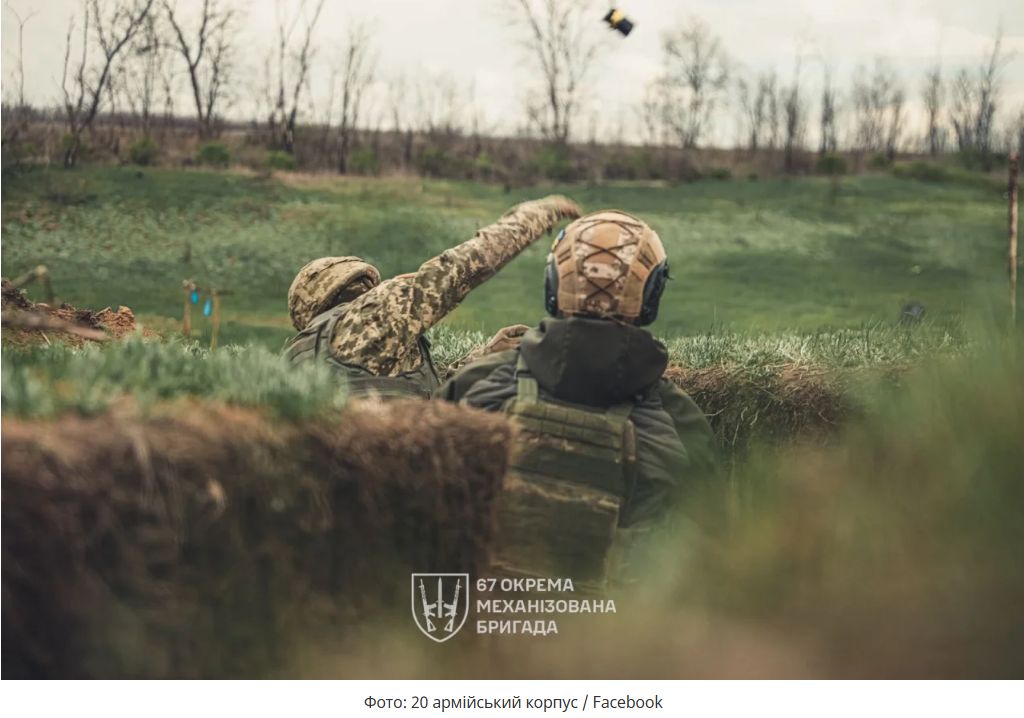
Therefore, when your arguments have no effect, and I understand that the Commander-in-Chief is demanding "attack, attack, attack"... An attack for what? To kill 10 soldiers for a piece of land? That land will be of no use to anyone when we have no soldiers left.
I believe that in that area and at that time, we had the opportunity to build a certain defense. True, it would not have stood there like a wall until today, but it would have given us the opportunity to prepare further defense lines deeper inside, a first, second, third, and fourth line, and to plan whom we would deploy there and in what sequence.
The point here is not that we need to pack the entire defense line with people; that is pointless. Today, the means of destruction on both sides are truly massive. That means drones. We are not taking artillery, its share is somewhere around 10 percent in destroying the enemy, mostly drones [are working].
In other words, the number of personnel on the front line should, on the contrary, be minimized, in my opinion. Yes, they must be there, but we need to plan specifically which key positions they should occupy.
Perhaps I will give a less-than-perfect example. Imagine we have a corridor and certain rooms. To prevent anyone from walking through those rooms, we need to set up a post right in the corridor that will overlook all movement and destroy [targets].
[The result will be achieved] when we station a limited number of personnel in such corridors, and by using the same drone component, we do our best to ensure that the minimum number of enemy forces reaches the post where our servicemen are stationed. And even if they do reach it, that is when assault rifles, close combat, and so on come into play.
— How can this be achieved? It seems things have started to change. Perhaps you rushed your decisions, your conclusions, and now everything is going better?
— You know, it has not gone better. And there is a certain understanding... I am not ready yet to say there is an actual piece of paperwork with a reference number, meaning an official directive. But as far as I understand, there are some moves toward, for example, stripping brigades of even basic military training.
Some generals have this very idea. It is in their minds, I know this for a fact, one hundred percent. It just hasn't reached the stage of assigning tasks yet, but the idea is there.
Today, many brigades already have their own basic general military training, and I believe this is a plus.
This is a huge plus for the brigades. Why? Because when it comes to training centers, there are many nuances. First is financial support, and it is the main one. No matter what anyone says about patriotism and so on, you cannot feed a child with patriotism. A serviceman stationed in the rear, at a training center, does not receive [enough money].
— Do you mean the instructor?
— Yes. So, what is the primary motivation? It is financial. Patriotism is a secondary matter... Someone is more of a patriot, someone is less of a patriot. All the people we have in this war are already patriots, but patriots with money make much better patriots than patriots without money. I am more than confident in this. Therefore, the first element is the financial component for the instructional staff.
The second point is ensuring comfort for that same instructional staff, meaning housing and family. For example, there is an instructor in Desna whose wife and child live in Lviv. In my opinion, it would be better, for example, to transfer him to serve in Lviv, let him serve there, or if not, then provide his wife with some work here, in this location, and with housing so that the family can be together. This would also be a serious motivator.
The third point. Here, we probably need to communicate collectively somehow with the brigade commanders. I believe that if instructors are provided with maximum comfort, money, and so on, they should also bear some responsibility for the training of their personnel. As of today, this is impossible in training centers. Any brigade has to retrain personnel coming from a training center.
— So it is better on a brigade basis?
— It is better on a brigade basis. Why? Because once the personnel arrive, the brigade commander assigns them to battalions, then the battalion commander assigns them to companies, and so forth. Company commanders have already spoken with that personnel where possible. Accordingly, instructors from these battalions, these companies, and this brigade train this personnel.
First, each sector has specific enemy characteristics — 100% there are. There are specific terrain features — 100% there are. And tailored to this specificity, I know many brigades, like the 23rd, the 93rd, for instance, the 28th. I understand that the 93rd and 28th are old brigades with established traditions. The 33rd Brigade. They have their own training grounds...
— The 92nd and 72nd could also be mentioned.
— Somewhere in the rear area, they have dug company and platoon strongpoints, where this personnel [trains]. Once they arrive and get settled, psychologists work with them, and they are reassigned to positions. That is where their training begins, and they already live at the platoon strongpoints.
For example, if it is infantry, they live there and [practice] how they will survive in dugouts when they are periodically subjected to attacks, drone drops, and so forth. In other words, a person gradually adapts to these conditions and learns within them.
Furthermore, the battalion commander and the brigade commander understand that they will have to fight alongside this personnel. There must be combat coordination, understanding, mutual understanding, and so on. I believe this is a truly positive development. Right now, yes, an option is being considered to strip brigades of BGMT.
— Was this only recently introduced?
— Recently introduced, yes. When I served as deputy corps commander, we developed this topic. I had a decent head of the combat training directorate — or rather, a deputy, because the combat training directorate was downsized to a department, and the deputy became the department head. Quite a smart fellow. With him, we considered an option where all our brigades should have BGMT. Meanwhile, the corps had an idea to experimentally set up a training center and use something as a baseline — perhaps it is not highly needed in the war today, but for testing purposes, for instance, an SPG, an AGS, or an MK, to train people professionally. Based on that MK or SPG, we would simply see how it works and conduct a trial to see whether it makes sense to handle specialized training within the corps itself. In other words, so that the corps...
— Would be completely autonomous.
— Yes, so that the corps would be completely autonomous.
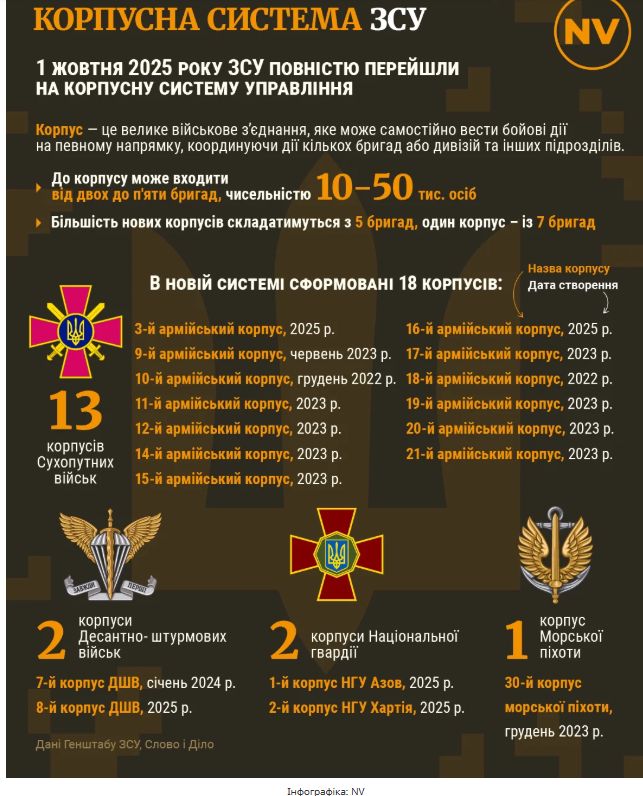
— Dmytro, you have stepped down from your post as deputy commander of the 20th Army Corps. Currently, there are many questions regarding the corps and where they should head next. We have lived through a year of corps reform. There are certain corps that, in the general public's view, have proven successful. These are resource-rich corps based on very resource-rich units. It is no secret: Azov, Khartiia, and the Third Army Corps. From their baseline parent brigades, they have developed into highly resourceful, capable corps. There are corps developing their structures within the army system: the 7th Air Assault Corps, which is holding the defense of the Pokrovsk-Myrnohrad agglomeration, and the 8th Air Assault Corps, which I think is also showing good signs of development. However, there is a noticeable skepticism in your voice about whether the corps have truly become what we expected of them. Have they? What prevents them from developing, what is holding them back?
— In and of themselves, the corps have been established, I can say, but I cannot say they have succeeded 100 percent. It is unlikely they have even achieved 80 percent. Why? If we leave aside the powerful ones you listed — the 3rd Corps, Azov, Khartiia, and the Air Assault Forces. They are much higher, by one or even two levels, than the Ground Forces corps.
Take the 20th Army Corps as an example. It was formed on the basis of the Territorial Defense Forces. The Territorial Defense Forces... I do not want to offend anyone or call them bad; they are just like all the other troops. However, back when they were being formed, people were gathered there from across the entire Armed Forces.
First of all, who is going to give away their best? I cannot recall the name of the American general right off the top of my head who, when he was a company, battalion, and regiment commander, usually gave away his best soldiers to build his image for the future. But today, it does not work that way for us. As a rule, people give away those they do not need.
The Territorial Defense Forces were created. Then, later on, two corps were established on their basis. Who is going to give their best back to the Ground Forces? No one, of course.
The 20th Corps began its formation, holding various activities and staff exercises; they were varied. The training itself was conducted as fully as possible and at the proper level, as far as the Territorial Defense Forces Command was able to ensure.
Here, I cannot say anything bad about the current commander of the Territorial Defense Forces, General [Ihor] Plakhuta. He truly provided maximum assistance, cooperated as much as possible, and I am very grateful to him and to the entire leadership of the Territorial Defense Forces Command for that.
First, the corps had a fairly short timeframe for its formation. When the corps were being created, it was the first one sent to carry out a combat mission. It was a corps formed on the basis of the Territorial Defense Forces and then transferred to the Land Forces, and there were many nuances and small details involved. And it was the first to go and carry out combat missions.
— It is now holding the defense in the Novopavlivka direction, between Pokrovsk and the section of the front where our offensive actions have recently taken place, the Oleksandrivka direction. That is the area of responsibility of the 20th Corps.
— At one point, the Oleksandrivka direction was part of the corps’ area of responsibility, and then it was transferred to the 17th Corps.
If we are talking about education, for example, when it came to so-called level-one education at the operational-strategic level, I think I was probably the only one in the entire corps command. And education, whatever one may say, [does matter]. We understand that to become a surgeon, you have to study; to become a programmer, you have to study; to become a pilot, you have to study. It is the same with the military. You can philosophize all you want, but to become a serviceman, and especially a military manager, you have to study.
— That is a fair point. Unfortunately, we now have this trend: any military commander, just go on Facebook, is bad. But what are the reasons why he is bad? At the very least, let us start with the fact that he has to be trained in order to be good. Because you need to understand what you are doing and how you are doing it.
— Exactly. The first corps commander, Colonel Maksym Olehovych Kituhin, is a good man. Yes, he did not have operational-strategic education. He came from the post of brigade commander and had no experience serving in command-and-control bodies. The same was true of the corps chief of staff, Serhii Lisovenko. But they were people who were learning, fully adequate people, people who did not act rashly.
The corps arrived and took up its area of responsibility. The question is: what did this corps have, apart from this newly formed command? Nothing. When the 2nd Army Corps moved in and took over its area of responsibility, the corps did not even have its own levers to influence the situation. No unmanned systems, no artillery, nothing.
Everything had been packed into the operational-tactical grouping that had been there before. If I am not mistaken, it had been formed on the basis of the 7th Corps of the Air Assault Forces. Things were very complicated there. But the issue is that when the 20th Corps moved in, the air assault corps was relocated to another direction.
The air assault corps began taking back the forces and assets that belonged specifically to it. On top of that, other military units began carving up forces and assets. For example, some units had been attached from Operational Command North or East, or from somewhere else. This so-called behind-the-scenes game began, a tug-of-war over who had more clout. For some time, the transfer of command itself was quite difficult.
And because of that difficulty, I would not say there was a loss of control, but there was certainly discomfort in command and control. That gave the enemy an opportunity to feel out certain moments and weaknesses. In addition, during the redistribution of assets, such as artillery and UAVs, [there were misunderstandings]: these ones are being moved here, those ones there; these have not yet arrived, but they are coordinating with these, while those are coordinating with those... We had a certain command vacuum, which gave the enemy an opportunity to identify some weak spots and then start pushing through them.
They say I criticize the Commander-in-Chief. Of course, I cannot help criticizing the Commander-in-Chief. Why? Because you appointed the corps commander. Did you understand that the person had no experience serving in command-and-control bodies? You did. Did you understand that this was a very great responsibility? Yes.
Maksym Olehovych Kituhin, I repeat once again, is truly a sound, adequate, knowledgeable, and intelligent commander. He is an intelligent brigade commander, a genuinely successful brigade commander. He fought in Kursk Oblast and has certain successes, knowledge, experience, and so on.
But a corps is not a brigade. You should have provided him with as much assistance as possible here, reinforced him as much as possible. Perhaps, I do not know, you should even have visited more often.
He came to us, I think, only once or twice during my tenure, over six months at war. Perhaps he should have reinforced us with certain assets, perhaps paid attention to where a breakthrough might occur, here or there...
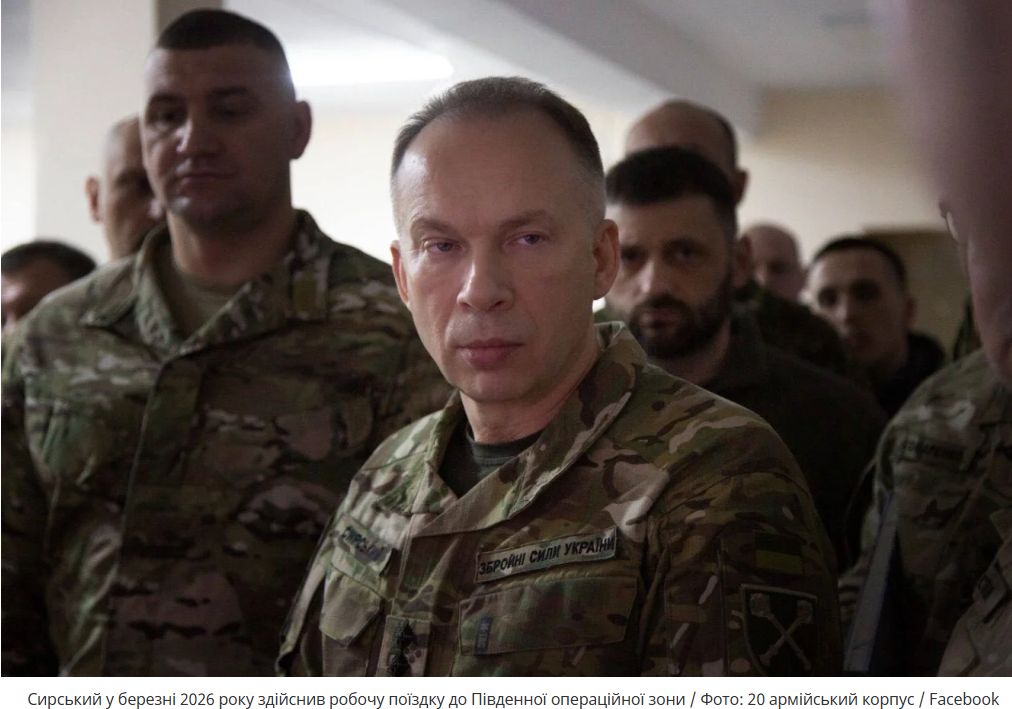
— I promised that I would try to act as an advocate for the Commander-in-Chief. We had 18 corps created at once, and by that logic, all 18 required additional attention from the Commander-in-Chief.
— If we are speaking in that vein, then the Commander-in-Chief should not be paying attention at all, because his main task is the development of the Armed Forces, not managing squad-level positions, as he does.
And the fact that he constantly sits in corps or brigades does not work in anyone’s favor. I am absolutely sure of that, I know it, because I know it from the inside. It is an unnecessary headache, unnecessary tension for the people carrying out the mission.
But if you are already working in certain directions... First, not all corps commanders lacked experience serving in command-and-control bodies. Quite a few corps commanders had previously been chiefs of staff of corps or operational-tactical groupings. At that time, some of them were already generals. Plus, some corps commanders were much older.
Also, the directions are very different. There are corps that were deployed to quieter directions, and there are those deployed to difficult ones.
Then there are the timelines. The 20th Corps was the first to deploy [to the line of combat contact], whatever one may say. I understand there is the 3rd Corps, which was formed there, in the war zone, bringing those brigades under its command, but that is a slightly different story. The 20th was the first to deploy to one of the difficult directions, because at that time an offensive in the Oleksandrivka direction was already being prepared.
— Velyka Novosilka.
— Yes, they had taken Velyka Novosilka just before we arrived. They stormed it. During the transfer of command, the fighting for Novosilka was already coming to an end, and we witnessed that. The Commander-in-Chief understood that something bad could happen there, and I believe he should have paid attention to it.
And when the breakthrough happened... What was specific about the corps? It was positioned where three regions meet: Dnipropetrovsk, Zaporizhzhia, and Donetsk. I understand that the president may have been banging his fist on the table, saying: "How could you let this happen to Dnipropetrovsk Oblast?" Did the Commander-in-Chief understand that? He did. He should have helped that corps commander instead of making it look like, "I removed the corps commander; he is to blame."
He is not to blame for anything there. He did everything he could. The fact that he was not helped is another matter. When a senior commander assigns a task, he is obliged (as the regulations say) to provide his subordinate, as fully as possible, with the resources and capabilities needed to carry it out.
— When a task is assigned, the commander is obliged to monitor and ensure that this task is carried out, correct?
— The corps could not do that at the time. Yes, later they brought in generals, commanders, one after another, so they could somehow stabilize the situation. Let us be honest: no one stabilized anything there.
By the way, I will add that at the time, the 20th Corps had, if I am not mistaken, 10 brigades under its command. At that time, no OTG had that many. Five or six, but here there were 10. That is a lot, really a lot. Even in management theory, [it is defined], I think, as five to seven for comfortable command. There should be no more than seven subordinate units. And we are talking about 10 brigades, if I am not mistaken, or nine.
But these are brigades. And then there are also some regiments, battalions, separate groups, some "sympathizers," as we called them. And there is also the Security Service of Ukraine, the Defence Intelligence of Ukraine, this and that, the police, and so on. It is simply a huge number of structures within the corps itself, which is quite difficult, and you also need experience working with that.
— Let us talk constructively: how should it have been? What should have happened with those same corps for us to become more capable and improve our defense? What have I seen in the public space recently? Corps are creating their own unmanned systems regiments, which are beginning to work in reconnaissance and carry out strikes at operational-tactical ranges of 100, 120, 150 kilometers. There is now a very heated public debate (this is another dig at the Commander-in-Chief, about assault regiments). Some people say: why should assault regiments exist? Let us disperse them among the corps, and then the corps commander will have a reserve. If a fire breaks out in the area of responsibility of your corps, you put out that fire with the specific assault regiment that will serve as the corps commander’s reserve. How would you see the further constructive development of the corps?
— First of all, I will say that I have no personal grievances against Commander-in-Chief Oleksandr Stanislavovych Syrskyi. It was under him, when he was commander of the Land Forces, that I became a brigade commander. He was the person who recommended me for that post.
During the war, I never crossed paths with him anywhere, literally not at all. I have no personal [grievances]. I simply have my own view of certain things and of how I would act as a commander toward subordinates.
As for the corps, the idea itself, as far as I remember... I once spoke with former Commander-in-Chief Valerii Fedorovych Zaluzhnyi, and I had the honor of speaking with the then Chief of the General Staff, [Serhii] Shaptala.
By the way, I think an article by General [Viktor] Muzhenko was published recently, where he also talks about the corps system. He had something on that as well.
The idea itself was specifically corps and division. Why division? A brigade is good for local conflicts. It is smaller, more localized, and has its own certain forces and assets. But a division is a formation specifically for waging the kind of war we have today. A large-scale war of national defense, where we are defending our state against an attack by another state.
Why a division? Because it has an area that is not much wider than a brigade’s in terms of frontage, but because a division has up to 15,000 people, it can echelon that defense. Second, a division has far more fire assets. At the very least, it has an artillery regiment, if we are not yet talking about unmanned systems today. And each regiment, whether infantry or tank, has its own artillery assets. Plus, there are many other units, battalions, and so on.
— I think to myself, this depends on the state’s capabilities. Whatever you call it, a brigade or a division, if there is no artillery to support the existence of artillery regiments, it still will not work.
— First of all, we are still forming some brigades, forming and forming new ones. And more than once, many people have shouted about this, even politicians; [MP] Mariana Bezuhla constantly raises this issue of brigades, saying: "Oh, so it turns out there are people to fill them." It would have been possible to take one of the older brigades with traditions, the 93rd, the 28th or the 72nd, or the Third Assault Brigade, and create a division on its basis, try it, test it, and see how it works. And I think it would have worked just fine.
And then the corps, in the concept where a corps is generally autonomous, has its own training center, has basic training directly in the brigades, and so on. It would have its own sector, which it could reliably secure. Defend it, hold back the enemy.
If we are talking about advances, about the enemy not being stopped... We will not stop Russia today. A mobilization pool of 20 to 25 million is a very large number. They will simply crush us with bodies, whether we like it or not. The only question is how many of those bodies are in front of us. Killing 10 people is one thing; killing 100,000 is another. Those are very different figures.
And we have to understand that we will not stop Russian bodies with our own bodies. We need to stop them technologically. That is why, ideally, it should be corps and division.
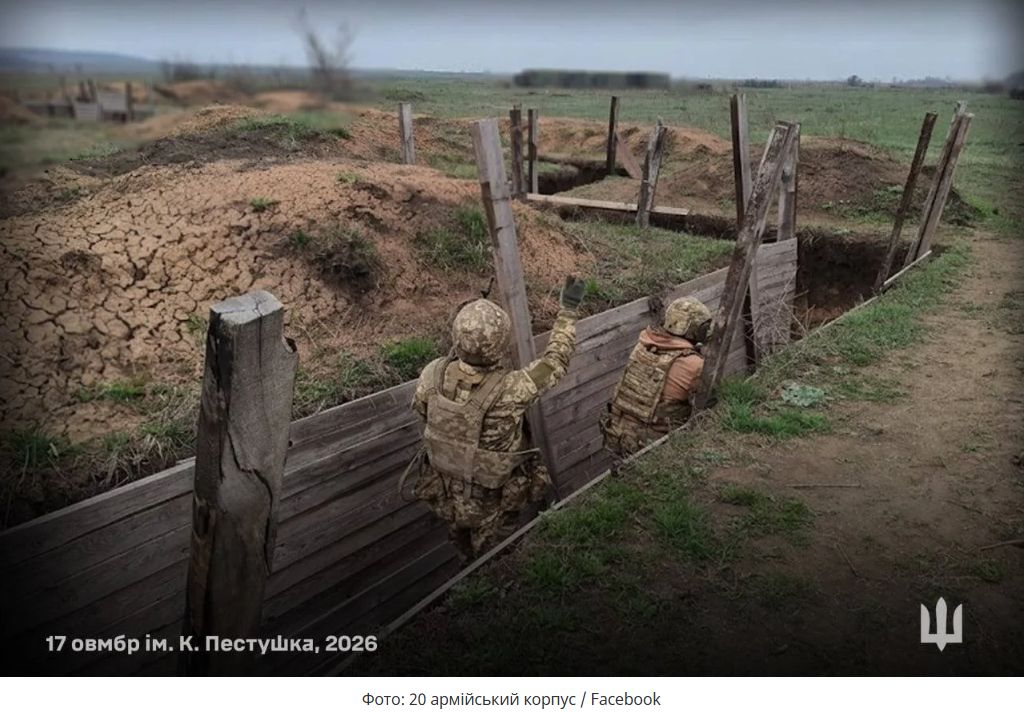
Since we have already come to corps and brigades. Today, corps-level artillery brigades have already been formed. We have fairly serious problems with supply. And they have begun creating not battalions, but regiments of unmanned systems. Yes, this is being created. If we take corps artillery, our artillery operates somewhere at 13-15 kilometers. It cannot reach farther, it cannot cover more. Today, the corps’ reconnaissance capabilities are somewhere around 25-30 kilometers, roughly twice as far.
— And it should be 150?
— Yes, it should be somewhere around 120, 150, plus the means to act on reconnaissance data at those 120, 150 kilometers: HIMARS and so on. The corps commander has none of that. He has no aviation asset of his own.
Here, I believe, it makes sense to turn back somewhat toward the Soviet-era model. Corps existed back then. And this is not only about the Soviet legacy. Germany also had corps during the Second World War, and a certain corps structure. Britain had corps, and France had corps. That is where we should have looked at the structure and, of course, made certain changes for today’s realities. That is the only way.
But when a corps exists without its own artillery, without an unmanned component, that is a different story. Plus, the brigade commanders are not its own, the brigades are not organic to it. The only one today, probably, is the Third Army Corps.
— And Azov is very close to that.
— Perhaps, honestly, I have not looked closely into Azov. The Third Corps gathered its own units under itself. We understand that the 3rd Assault Brigade is a really top-notch, hard-hitting brigade. It truly performs combat missions well, whatever one may say.
But here [commander Andrii] Biletskyi has an advantage: he is a political figure, and there is a certain political force behind him. He can do a little more than others. For example, if a corps commander, or even when Biletskyi was a brigade commander, told Commander-in-Chief Syrskyi: no, it will be either this way or not at all, the Commander-in-Chief would not argue.
If any other brigade or corps commander said that to the Commander-in-Chief, it would end very badly for him. Even if he did not say it that way, but said it politely, it would still end very badly; he would 100% be removed from his post.
Biletskyi has that opportunity. If he promises that you are an assault soldier, that you assault for one day, then rest for three days and train for two days, that is it, that is how it will be. He will assault for one day, rest for three days, and train for two days.
— So the most effective option would be for corps simply to have political structures and financial groups behind them?
— In an ordinary brigade, no one will let you [do that]. In an ordinary brigade, they will bring you people tomorrow, while you were supposed to have stormed the position yesterday, otherwise you will be removed from your post. Unfortunately, that is how it works.
So most likely, it is the same story with Khartiia. There is simply some political backing that the Commander-in-Chief cannot get past. He has no choice but to put up with it. And commanders can create certain comfortable conditions for servicemen, thereby motivating them to carry out missions more effectively.
What, do we have Chinese soldiers serving in the 3rd Corps? No, Ukrainians serve there, the same as in the 20th Corps, the same as in the 14th or any other. Nevertheless, it is more effective. Why? Simply because, thanks to their political backing, they can create certain conditions.
— What are you going to do now, from the perspective of a civilian, to achieve all this, change it, improve it? What are your plans for the future?
— For now, I have no plans. First, I want to sort out my housing, get all my documents in order, and tie up certain loose ends. Because during my service, especially over the past years of the war, a lot of issues piled up that simply need to be resolved.
— But you are not ending your fight, so to speak.
— No. I am not ending my fight. Today I have the opportunity to speak with military personnel, and I have both the education and the experience to analyze what is happening in the Armed Forces, to talk to servicemen and listen to their views. Because, as one commander once told me, two heads are better, even if it is not pretty.
So, having some alternative view, I [will] try to convey it, whether through Facebook or some Telegram channel. But I will try to get my view across to the Commander-in-Chief on what needs to change so that things in the Armed Forces become better. And perhaps, in some cases, provide some help, because not all servicemen can voice problems, since they will face consequences for it. But I can voice them.


