



"There is relationship between two nations, Polish and Ukrainian, they are different. We owe each other nothing," Oleksandr Alforov, head of Institute of National Memory
One year after historian and veteran Oleksandr Alforov took the helm of the Ukrainian Institute of National Memory, he outlined the Institute’s priorities for the coming years. The process of establishing the National Pantheon has begun. The first reburial in Ukraine of a prominent Ukrainian émigré—OUN leader Andrii Melnyk—took place. Plans to build a memorial to the Heavenly Hundred are being revived. Search and exhumation efforts continue in Ukraine and Poland.
At the same time, in our interview with Censor.NET, we could not avoid the high-profile issues of recent weeks – the deterioration in relations with Poland against the backdrop of the memorialisation of the UPA, the reaction to the demolition of the Bulgakov monument, and the threat hanging over the UINM itself, which may lose its rented premises.

- There is a threat from Karol Nawrocki to strip Volodymyr Zelenskyy of the Order of the White Eagle due to the naming of one of the Special Operations Forces units after the Heroes of the UPA. Of course, you have no direct connection to this matter, but it is linked to the discussions on Ukrainian-Polish reconciliation that have been ongoing since the Kuchma presidency, if not earlier – commissions are constantly being set up, words of apology are uttered from time to time, but it seems that the Polish side has definitively rejected the formula of ‘we forgive and ask for forgiveness’.
You supported the holding of the Polish-Ukrainian Congress of Historians, but at the same time made it clear that you do not expect a quick result. How do you view this situation in general?
- I am not qualified to comment on international politics. Let me put it this way: we and the Poles have been neighbours for over a thousand years. Families are delighted when they reach their 50th wedding anniversary, and yet they obviously have more than a few skeletons in the cupboard. Here, we are talking about nations.
What’s more, we are not just neighbours. We are two nations that have fought for these territories throughout history. No other state emerged here in the 11th–15th centuries. We were not displaced by the Teutonic Knights or the Mongols. And so, when we talk about the affairs of two nations, we must understand that this is truly a vast complex of issues. And we mustn’t think that there are any ‘good’ or ‘bad’ relations. There are simply relations between two nations, and they are different. We owe each other nothing. And because our relations are different, they sometimes converge and sometimes diverge.
And so, when we talk about understanding and dialogue, we must say that these dialogues must exist within the context of how we can move towards the least traumatic understanding of certain relationships, phenomena and events. Or how we can better explore these issues to gain experience and transform this dialogue into a story about the future.
- Different interpretations of history through the conflicts of the past mean that we do not simply have different heroes, but conflicting heroes.
- It is a philosophical concept that if a hero exists, then for someone else he is an anti-hero. We can get closer to writing a joint history textbook, but no single shared history will emerge, because there is the question of national history.
We read from one perspective, they read from another. And even when we say that we only see conflicts in the 20th century, in reality they have always existed. Because elites are at work, and elites, especially medieval ones, are people who seek out conflicts for personal gain, to further their own interests. Therefore, history is a history of conflicts, and there have been differing interpretations in every period.
- You supported the holding of the Polish-Ukrainian Congress of Historians, meaning there is backing at the level of the UINM. However, among the organisers on the Polish side is the Mieroszewski Centre, also a state institute, but not a government body. Why did the Polish Institute of National Memory not join in? It felt like an asymmetry in relations.
- The answer as to why the Polish Institute of National Memory did not join is very simple: because the IPN has a limited chronological scope of activity. This activity is linked to the 20th century, to the process of lustration and investigations.
In other words, it is a different structure to that in Ukraine. Our Ukrainian Institute of National Memory covers the entire history of the state. So, whilst we often focus on issues of the 20th century, this does not mean that we do not research or work on earlier periods.
- You have stated that, whilst you are head of the UINM, you will not obstruct the search operations and exhumations requested by the Polish side. The work is underway, and there are already some results. At the same time, the past rather painful confrontation was caused by the destruction and Poland’s refusal to restore Ukrainian memorial sites on its territory. What is the current state of these sites, in particular the graves of UPA soldiers?
- Whatever the relations between the two states may be, we must understand that search and exhumation work is about honouring the dead. I come from the army and I understand perfectly well what it is like when you cannot bury a loved one. That is why exhumations must take place, because this is about humanity, about human values.
As for memorial sites, I was recently in Przemyśl. There is a grave of soldiers from the UNR army there; I went to see what condition it was in. Naturally, I would like the Polish side to continue looking after it, as agreed, just as they promised.
WHEN WE ALLOWED EXHUMATIONS IN PUZHNYKY, THE POLISH SIDE PERMITTED THE SEARCH FOR THE BURIAL SITES OF UPA MEMBERS ON POLISH TERRITORY
- As for the UNR army, I don’t think there are any categorical issues in Poland. They remember 1920, the defence of Warsaw.
- There are issues.
- ???
- There are questions regarding the UNR and its army. This issue was raised at the Ukrainian embassy just a few months ago, following a visit to the Polish Army Museum.
It turns out that the topic of the UNR army’s participation in the defence of Poland is not covered there at all. It was mentioned that Romanian soldiers were preparing to support the Polish army, and that the French provided assistance. But nothing was said about the Ukrainians. This even became the reason for holding a conference of the Ukrainian-Polish alliance.
- Consequently, what happened afterwards is also ignored – the effective ceding of most of Ukraine’s territory to the Bolsheviks in exchange for the annexation of Galicia and Volhynia to Poland. In such cases, you think that if ordinary Poles knew our history better, perhaps these discussions would have taken a different course.
- And if we knew their history better. That’s true.
- In fact, take the topic of the Constitution of 3 May 1791 – the first modern constitution in Europe and the second in the world. It seems to me that this topic is practically ignored in our schools.
- The point is that the Constitution of 3 May was adopted, among others, by deputies from our provinces. And here it depends on the fact that, for example, the deputies from the Volhynian Province formed one of the most progressive legal parties, who did a great deal to bring this about.
But, you see, there is a confusion of terms when we say that Poland is the Polish-Lithuanian Commonwealth. Perhaps the classics of Ukrainian literature did us a disservice when they began to say that ‘the szlachta are Polish lords’. And they forgot the concept of the Ukrainian szlachta.
- This was cemented in place during the Soviet era.
My ancestors were deputies in the Polish-Lithuanian Commonwealth, so this is also a personal story. The Polish-Lithuanian Commonwealth is a ‘Common cause’. And we are simply returning to this understanding.
That is why the Constitution of 3 May was always considered Polish. But today it is honoured by the Lithuanians, and it should be honoured by us too. A great many people worked on it, and Ukrainians also made enormous efforts. Although we already had a legal foundation before that – the Constitution of Pylyp Orlyk. And it attests that even in exile, Orlyk and his officers had a thorough understanding of jurisprudence, as a science, in order to establish such documents.
- And yet, what about the graves of UPA members on Polish territory?
- We are raising this issue within the joint Ukrainian-Polish working group, which has been operating for a year now. But the key here is not to end up in the deadlock we found ourselves in previous years. Our task today is to establish the logistics that would allow us to begin the work – search, exhumation and memorialisation – so that, to put it bluntly, we can find our feet in these processes, ensuring that stubbornness on certain issues does not become an obstacle to the common cause. So, of course, we will always make it clear that there are issues which were agreed upon in the past and endorsed by the Polish side.
We see them, we remember them, we do not forget them, and we will raise them. Let us look at the process from both sides. When we allowed the exhumation in Puzhnyky, the Polish side allowed us to search for the graves of UPA members on Polish territory. They must not forget the agreements regarding the cemetery in Przemyśl; we do not forget their wishes regarding the cemetery in Mostyska; we do not forget their exhumations; they must not forget our search and exhumation work.
Step by step, we are moving towards normalising this process to the point where we will no longer need institutions or ministries to handle this matter. Thank God the process is underway. And at some point, it will become so normal that there will be no more of this ‘you scratch my back, I’ll scratch yours’ diplomacy.
THE LOCATION OF THE NATIONAL PANTHEON WILL BE KYIV ON THE BANKS OF THE DNIPRO
- The reburial of Andrii Melnyk and his wife Sofiia Fedak-Melnyk, as well as the announced reburial of Yevhen Konovalets, means that the creation of the National Pantheon has already begun. In one of your videos, you set out your own vision of the Pantheon in great detail. As I understand it, the concept itself is still under discussion. Is there already a clear understanding of where it will be and who will be buried there?
- When speaking of the Pantheon, we recall the President of Ukraine’s remarks regarding the reburial of prominent figures. This happened just over a month ago. But work on this, in accordance with the President’s order, began at the Ministry of Foreign Affairs and the Ukrainian Institute of National Memory in January this year, when we started reviewing lists of those buried abroad, studying the legal framework, and the Ministry of Foreign Affairs began verifying the existence of graves against the lists.
And this is a striking difference from previous initiatives, when people spoke of a Pantheon. We began our work not with an announcement, but with preparation. And in this context, this is an exceptionally significant new leap forward in this story.
The Ukrainian Pantheon is a concept that people began discussing immediately after Ukraine gained independence. Not because everyone suddenly saw the light, but because there were already precedents. We have pantheons, for example, the cemetery organised by Patriarch Mstislav in South Bound Brook in the US, where he brought the remains of Ukrainians from all over the world. There is an Orthodox cemetery in Warsaw; thanks to the efforts of Mr Yurii Reit, the Ukrainian community and the Ministry of Foreign Affairs, a section has been created for the burial of Ukrainian figures from the first half of the 20th century.
Since the 1990s, discussions about the Pantheon have taken place with varying emphases. Therefore, the Pantheon is a story that is still being told. And here it is important to understand that many of us lack terminological consistency in this context. The competition for the best idea regarding the Pantheon has led to a significant variety of names already emerging.
Some called it the ‘National Pantheon’, others the ‘Pantheon of Heroes’. And when we went to war in 2014, the Pantheon of Heroes immediately came to be understood as the heroes who died in that war. And now there is a great deal of confusion when people ask: where will the Pantheon of Heroes be? The National Pantheon is about the formation of the nation, whereas for the Heroes, there is the Memorial to the Heroes.
- What has already been decided regarding the creation of the Pantheon? For example, the location.
- The location where the Pantheon will be situated is Kyiv. And this is fundamental. Not because Kyiv is the capital of Ukraine. Kyiv, even if it were not the capital, is one of the world’s centres. Firstly, it has been one of the world’s centres of Christianity since the 10th century, and we must not forget this. Not Orthodoxy, but Christianity itself. Kyiv is one of the world’s logistics hubs. Kyiv is one of the world’s historic capitals. We need to take a step back and appreciate the grandeur of Kyiv.
And, of course, Kyiv is a sacred capital. It is not merely rich in monuments from the Rus’ era. It is a sacred capital. It is no coincidence that even in Orlyk’s Constitution we see that the capital would be in Kyiv. The hetman capitals were Chyhyryn, Baturyn, Hlukhiv, Nizhyn, Hadiach, even Kaniv and Cherkasy. But everyone understood that the capital was Kyiv. In other words, administratively the capital can be anywhere, but the de facto capital is always Kyiv.
And the Pantheon must be situated beside the river that gave birth to us all – the Dnipro. The Dnipro is the river that gave birth to our statehood. And at the same time, it is a river of unity, for without the left bank there can be no right bank. And the Dnipro is about memory. The Greeks called our river the Borysthenes, the Slavs called it the Slavuta, and 2,500 years ago the Scythians gave this river the name Dnipro.
- Despite the preparations, the Melnyks’ funeral did not go perfectly. You are aware of the comments regarding the disproportionately smaller stone on his wife’s grave, as well as the fact that the ashes of Melnyk’s mother-in-law remained in Luxembourg near two graves that are now empty. Will such details be taken into account in future?
- People do indeed interpret the situation in different ways. This was the first time in our country’s history that a historical figure had been reburied on such a scale. Of course, there were many aspects that need to be rectified. As for Andrii Melnyk’s mother-in-law, Maria Fedak, negotiations are currently underway with her relatives, the embassy and the Ministry of Foreign Affairs to have her returned to her husband, Stepan Fedak, who is buried in Lviv. And this is also a human story.
As for the criticism, I divide it into several specific categories. First. People who simply criticise the authorities shamelessly and fail to see that this was a state event. The second category of critics consists of people who were not involved in the processes but would very much have liked to be there.
At the start of my term in office, I convened a meeting of various participants in the memorialisation process. This sparked a heated discussion, so to speak. Recently, at a meeting in the President’s Office with Kyrylo Budanov, we brought together historians, including those who had previously criticised me for a lack of involvement. Some of them simply remained silent, as they realised that the level of discussion involved more than just a phone call; we are now moving on to action.
The third category is common sense and people who genuinely offer critical feedback. I am very grateful for that. Such experts simply state the facts with surgical precision: ‘You made a mistake here, but this is good.’ In other words, all criticism is accepted if it is relevant, rather than simply ‘the wrong government, the wrong professionals’.

IN THE PANTHEON, ALONG WITH A SMALL NUMBER OF GRAVES, IT IS NECESSARY TO ERECT CENOTAPHS, THAT IS, MEMORIALS WITHOUT BURIALS
- Were there special rituals during the exhumation, transport and reburial, or were these standard ceremonies?
- The transport of the coffin and the exhumation involved many different details. For example, when the exhumation took place at the cemetery in Luxembourg, everything was done exactly as it had been during Andrii Melnyk’s burial in 1964. Even the singing accompanied by the bandura, which had been heard back then, was recreated.
And before that, my colleagues and I sat and wondered: how exactly would Melnyk be transported? And it dawned on me that the bodies of Melnyk and his wife would be arriving in the independent state for which they had fought. Shouldn’t there be some sort of ceremony here too? Not for the press, but purely for these two heroes.
So we devised a ceremony for their arrival on home soil. One can live without this; one needn’t even speak of it. But we devised a ceremony here for how the coffins should pass and set foot on Ukrainian soil. As they crossed the border, the coffins were tilted three times – three bows to the native soil.
- Will this ceremony be used in future?
- It will be used, and it will be improved. Few people noticed that, during the memorial service in the cathedral, a cap from a reconstructed UNR army uniform and a sabre lay on Andrii Malnyk’s coffin – in accordance with the tradition of burying UNR soldiers. These are details that do not immediately catch the eye. But it is from these details that the very picture of our memory emerges.
And these details will be refined. For instance, when we speak of the reburial process at the National Memorial Cemetery, there are elements that need to be incorporated into the overall, very beautiful ceremony.
- Some in the diaspora took the reburial of Andrii Melnyk and the prospect of further reburials of other political figures in Ukraine rather hard. Ukrainians abroad viewed these graves as a kind of place of power, where they would gather and reinforce their identity. I saw reactions along the lines of "Take Vynnychenko, but I won’t give you Petliura".
On the other hand, there is a view that during wartime, the remains would be in greater danger on Ukrainian soil than ‘under the peaceful skies’ of the EU. What did you say to them?
- We have a deep Orthodox consciousness, which subconsciously shapes in us a phenomenon I would call ‘relic-worship’. As if we were the owners of the deceased’s body. Is a grave a centre of remembrance? Yes, of course. But would you take children there to sing festive songs? No. A grave is a memorial service, it is words. But it is not about the life stories or joyful tales that Konovalets, Melnyk, Petliura or Skoropadskyi were part of. At Skoropadskyi’s grave, we won’t talk about how little Olena, Skoropadskyi’s daughter, named her teddy bear Petliura. It’s out of place there, even though it’s a very family-oriented story.
So where can we do a better job of memorialisation? Of course, in a public space, where one can even play music, just as Father Mykhailo Verbytskyi played the Ukrainian anthem on the guitar in 1864. In a public place, one can invite a children’s choir, dance, and generally pay tribute in various ways.
But when people say we’ll give this back but not that, it’s worth remembering an important point. Ukrainians found themselves in exile not of their own volition. The people who left the country as emigrants acted and lived with the sole desire to return to Ukraine. And it goes without saying that, upon returning to Ukraine, they would wish to be buried here – near their loved ones, near their fellow soldiers, near the Kyiv cliffs.
And today, Ukraine is returning these people to their native soil. This is a celebration; it is such a unique story that the state has taken it upon itself to bring back its heroes! We should rejoice in this. I spoke with the Ukrainian community in Luxembourg at the reburial. They said that when the embassy informed them, they were immediately overcome with despair. But then they realised that this was the right thing to do.
- It seems there may be contentious issues regarding who will be in the pantheon. Take the case of Petro Sahaidachnyi. The community of the ‘Kyiv-Mohyla Academy’, on whose grounds his grave is believed to be located, is opposed to the excavation and exhumation of the hetman’s remains. As far as I understand, you would like Sahaidachnyi to be in the Pantheon. How will such issues be resolved?
- Hetman Petro Konashevych-Sahaidachnyi was canonised by the Orthodox Church of Ukraine back in the days of the Kyiv Patriarchate. Consequently, the discovery of his remains would be interpreted as the discovery of relics, and they would belong to the Church.
The Pantheon may not contain any burials at all. The Pantheon is about remembrance. We do not know where Princess Olha is buried. We do not know where the remains of Volodymyr Monomakh lie. We know that Pavlo Polubotok was tortured in St Petersburg and buried there in a mass grave for prisoners. We know that Hetman Petro Doroshenko is buried near Moscow. Demian Mnohohrishnyi is buried somewhere in the east. Ivan Mazepa is in Halats.
In other words, the issue of burial is the root cause. In the Pantheon, alongside a small number of graves, it is necessary to erect cenotaphs – that is, memorials that do not contain remains. Therefore, the Pantheon comprises a minimal number of reburials and a series of cenotaphs for those Ukrainians who built our nation.
As for other figures, there are plans to reinter soldiers of the UNR army at the National Memorial Cemetery and restore their names.
I VERY MUCH HOPE THAT THIS YEAR WE WILL TAKE THE FIRST STEP TOWARDS COMMEMORATING THE FEATS OF THE HEROES OF THE HEAVENLY HUNDRED
- Regarding the Heavenly Hundred memorial. There is talk again that there is a chance of the memorial being realised. Is that the case?
- As soon as I walked into this office at the start of my tenure, I made the Heavenly Hundred memorial one of my first priorities. Because, when this war ends, the losses will be known, the figures will be known – figures we do not know today and do not need to know at this stage. Society will undoubtedly be shocked by the full picture. We will be healing ourselves. Will we remember the Heavenly Hundred then? That is the question.
- Attempts to build the memorial in 2018–2019 were fraught with tension and met with resistance. There was a point when people said, ‘The project is bad because Poroshenko is behind it.’ We might also set aside the possible resentment of Ukrainian architects over the fact that their foreign colleagues were allowed to enter the design competition. But it is hard to ignore the seizure of the site and the stance of the relatives of the Heavenly Hundred members. On the other hand, it seemed to me personally that in some cases the relatives of the deceased did not even share their civic stance whilst they were alive, yet now speak on their behalf. How should we deal with this?
- An honest conversation is needed here. The families of the Heavenly Hundred are not the heroes of the Heavenly Hundred. And you are absolutely right that the families often did not know where their husbands, brothers or sons were. Sometimes they really did not share their views; some were indifferent. But now, instead of the heroes of the Heavenly Hundred, it is the families who are speaking.
This is a difficult question. I understand that everyone is in pain, but that pain has turned into a rigid stance that cannot be circumvented. For me, it is a personal tragedy that some people have taken on the role of representing the Heavenly Hundred, but have failed to grasp the broader national significance. Had that realisation been there, there would already be a memorial and a museum.
- But not all relatives of those killed on the Maidan behave this way.
- The fact is that the families of the Heavenly Hundred have taken the stance that there must be unanimity on their part. It is precisely this that has actually prevented the construction of the memorial. State funds had been allocated, materials had been purchased, and plans had been drawn up. An international competition was held – the first in Ukraine for architectural projects of this scale, with discussions and all the necessary procedures.
- Do you communicate with the families of the Heavenly Hundred?
- Yes, we have a special commission for veterans’ affairs where we maintain such contact. After all, the Museum of the Revolution of Dignity is part of the UINM structure, and it works continuously with the families of the Heavenly Hundred. I constantly emphasise that the war will end, and there is nothing about the Heavenly Hundred. What’s more, we will already need to commemorate the next heroes. I very much hope that this year we will take the first step towards commemorating the feat of the Heroes of the Heavenly Hundred.
- The one that is supposed to be built according to the competition?
- The land plot has been seized because the investigation is still ongoing.
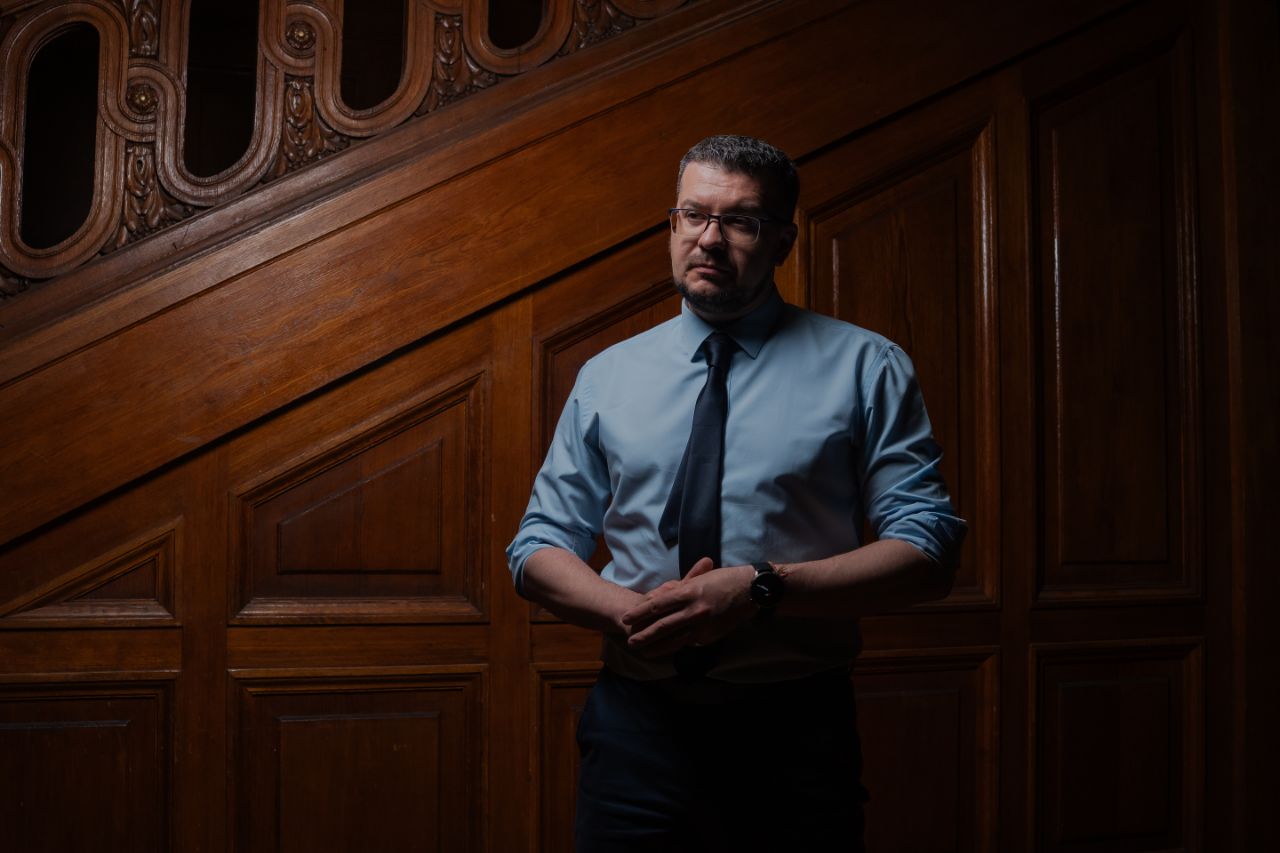
BULGAKOV EMBODIED RUSSIAN IDENTITY. HE LIVED WITHIN THE BOUNDS OF THIS WORLD, AND THAT IS WHY THE WORDS ‘BEAT PETLURA!’ ARE WRITTEN ON THE TURBINS' STOVE
- There is an expert opinion from the Ukrainian Institute of National Memory regarding Mikhail Bulgakov. His sculpture was recently removed from Andriivsky Uzviz. This has reignited reactions and discussions about de-imperialisation and decolonisation. You once used the concept of "quarantine" for certain cultural figures who raise questions – as if to say, let’s see how we’ll live without their cultural legacy; perhaps it will be just fine.
After all, the UINM website features a list of figures and events that "do not contain symbols of the Russian Empire". What are the criteria there? Simply non-participation in the oppression of Ukrainians, or their minimal participation in the glorification of the empire?
- I am strongly opposed to the term ‘decolonisation’. It is a poor term, though it is understood globally in the context of colonial policy towards the African continent. These are terrible stories for Africa, which was divided and carved up. But I emphasise that Ukraine was not a colony. No one conquered us. We became part of the Russian Empire at the end of the 18th century due to the constant restriction of our rights and freedoms. And in 1782, our ancestors suddenly realized that what used to be regiments and companies had become provinces and districts. It was a century of restrictions.
A country that once provided the metropolis with education, science, writing, literature, grammar, language, religion, architecture and urban culture cannot be a colony. And here it is more appropriate to use the term ‘de-imperialisation’, which is important in the sense that Russia considers itself the successor to the USSR and the Russian Empire, disregarding the fact that these state formations were created by people of various nationalities.
And here we must understand that so many Ukrainians worked for the empire. For many, it was a family affair. The Cossack officers became the nobility of the Russian Empire, but the Little Russian nobility. That is, a separate nobility. Ultimately, they were concerned with their children’s welfare. I think every Ukrainian would understand perfectly if they tried to imagine the situation: your child has the opportunity to enter a higher education institution, and the nobility granted that right. Wouldn’t you send your child there to study? If you were told that your child had a chance to become an officer, but to do so would have to enter military service to the Emperor, wouldn’t you send your child there?
Our senior officers entered the nobility and existed just as all their ancestors had in the civil service system. There were none who would say: ‘I do not want to be a nobleman, I want to be a serf.’ And these families maintained their Ukrainian identity in the 19th century, which was hostile towards them. For the language was banned, the theatre was banned. And they, these Kvitky Osnovnianynky, as leaders of the nobility, wrote their works, published magazines, fostered culture, and established the theatre. Shevchenko could not have emerged had it not been for the so-called ‘Little Russian Party’ in St Petersburg. Nor could Lesia Ukrainka have been born to delight us with her works had she not been, by birth, a Kosach from an old family of senior officers and nobility.
- However, the issue with Bulgakov is different. In the worldview you have described, he is an outsider, a descendant of those outsiders who came here to ‘Russify the region’. Yet a considerable number of people regard him with nostalgia, consider him a genius, dismiss his attitude towards Ukraine, and react nervously to attempts to interpret his works from different perspectives.
- Ukraine, the Ukrainian lands, is a territory on the border between Europe and Asia, where the concept of an ‘outsider’ is very specific. Because any outsider who comes to serve the state becomes a full member of it. For example, Vyacheslav Lypynsky, a pure-blooded Pole, a nobleman, a Roman Catholic, is at the same time the founder of the state-oriented school of Ukrainian history.
And there is a counter-example. Take Crimea: there are so many Russian military pensioners there, yet they are firmly rooted in their Russian identity. They do not want to serve this land; they do not understand it; they do not have the ‘speech jaw’ for it; they can only read Lesia Ukrainka in Russian translations. And so the question arises: who are these people? These people embody a different mentality, different behaviour, a different identity.
Consequently, Bulgakov embodied a Russian identity. Yes, the family trauma—the death of his father, his university circle and his rejection of the Ukrainian state—is not fully explored there. The Ukrainian state is not accepted by those who embody a Russian identity, because it is hostile to them.
Here, probably half the country has read "The Master and Margarita" or another story from the Moscow cycle. Yes, Bulgakov left a description of Kyiv in 1918, but he lived within the confines of his own world and embodied that world. And that is why the words ‘Beat Petliura!’ are written on the stove in the Turbins’ house.
- How do you see the future of the Bulgakov Museum?
- You shouldn’t fight museums; museums need to be supported. But we must understand: if there is a museum, what is its purpose? Firstly, museums are custodians of artefacts from an era. Museums also have an educational purpose. What is the educational purpose of the Bulgakov Museum?
- In recent years, the museum has been trying to find compromises. To be honest, in my youth, schoolchildren and students went there mainly for the special effects – judging by my own circle of friends.
- Surely we have other topics that would be of interest to Ukrainians and visitors from the capital? Is Bulgakov as well-known worldwide as some would have us believe? No, he isn’t. Shakespeare is known worldwide, but streets named after Shakespeare and Jules Verne have only recently appeared here.
Consequently, when we talk about the Bulgakov Museum, we must not be at odds with Bulgakov. It is about the influence of the Russian world and how this was later exploited by Russian propaganda. We must call a spade a spade.
- It will soon be 35 years since Ukrainian independence, yet the process of rehabilitating the victims of Soviet repression is still ongoing. How many such requests are there at the moment?
- We receive these requests constantly. The Rehabilitation Commission is working on them. At the same time, in addition to these requests, we rehabilitate people posthumously – when their files are provided to us by the archives. And among those rehabilitated are not just those who were convicted, but also people who were executed by the Soviet system, particularly in the Katyn case, that is, Polish soldiers.
- If a person has no descendants at all, is there still a chance that they will be rehabilitated through such archive cases?
- Yes, the cases are tracked down and reviewed. Initially, each member of the commission independently reviews 150, 200, or 300 cases. Then they meet as a commission. They discuss everything again and then draw up a final conclusion either to rehabilitate the person or, for example, to investigate the case further to ascertain whether the arrest was indeed unlawful. After all, there were cases where the Soviet criminal justice system acted in accordance with the law.
- And finally, I have an organisational question. We recently celebrated the 20th anniversary of the establishment of the UINM. The status of the Ukrainian Institute of National Memory has been raised to that of a higher executive body, and its budget has been significantly increased. And yet, just a month ago, there was a threat that your premises – the so-called Countess Uvarova estate on Lypska Street – would be taken away from you. What is the situation today?
- Yes, our lease on the premises expires in July, and we hope it will be renewed. I went to see our mayor, Vitali Klitschko, and explained the situation to him. What’s more, the Institute is expanding, and we need to rent the neighbouring rooms, which are currently empty.
Olha Skorokhod, Censor.NET


