



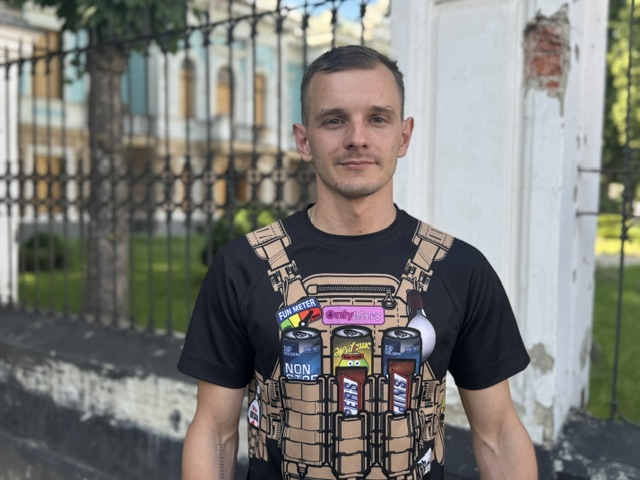
UGV operator Vladyslav Martynov: "This spring, one of our robotic vehicles completed 70 missions, evacuating nine wounded soldiers and bodies of four fallen troops and transporting tonnes of cargo"
A serviceman with the 157th Separate Mechanized Brigade described how unmanned ground vehicles (UGVs) operate in wartime, the types in use and the tasks they perform, the roads they travel on, and why communications can drop out during missions.
Since the war came to our country, we have all gradually learned the names of the weapons used by both the enemy and our military. We follow technological developments and are beginning to understand the different types of unmanned systems. We now know very well what FPV drones are and how Mavic drones are used to drop munitions; there is no longer any need to explain what a strike drone is or what a reconnaissance drone is used for. Our vocabulary has now also expanded to include the abbreviation UGV. And it seems there is no longer any need to explain that it stands for "unmanned ground vehicle", a remotely controlled vehicle. Videos of missions carried out by these systems, which now come in countless varieties, appear online from time to time.
We spoke with a soldier from the 157th Brigade who specializes in piloting such unmanned ground vehicles. Vlad already has extensive experience in both cargo delivery and evacuating the wounded, which he is ready to share, as some units are only beginning to develop this capability. Here in the 157th, all innovations are immediately adopted because they primarily help save soldiers' lives. For this unit, these are not just loud words, but a crucial aspect. And if an infantryman can be replaced by a ground vehicle or a drone, they do exactly that here.
"EVACUATING THE WOUNDED IS MUCH MORE DIFFICULT AND FRIGHTENING THAN RECOVERING THE FALLEN"
- You evacuated nine wounded soldiers. Were they all seriously wounded?
- It varied. There was one case when we did not carry lightly wounded soldiers out on the vehicle but guided them out on foot. My camera has a white light that switches on after dark. The soldiers who had climbed onto the UGV saw it and became afraid that the enemy would spot and hunt them from the air. So they got off the vehicle and walked in front of it, constantly asking, "Which way do we go? Which way do we go?" They were told over the radio: "At least walk behind the vehicle! If you do not want to ride on it, follow the UGV, but do not walk in front of it!" With our guidance, they all reached a safe location. During evacuations, the equipment we install on the vehicle allows me to hear the voices of the people I am transporting.
- Can you say anything to them?
- If you have linked a radio to the vehicle, then yes, you can speak to them; there is two-way communication. You can mount a speaker on the vehicle, but it does not last long. You drive through some branches, and it gets damaged or torn off completely. Who is going to bring you replacement speakers, and who is going to resolder them? But if you have a microphone, you can hear what is happening around the vehicle. Even if those waiting for supplies or evacuation cannot find the UGV immediately, you can hear that someone is nearby and tell them over the radio: "Yes, you’re close now." It is a useful feature of the vehicle.
- And when you are transporting the body of a fallen soldier...
- It is not as frightening as transporting a wounded soldier, because you have to get that person there alive and make sure nothing hits them along the way.
- What do you think about at such a moment? Obviously, you are watching the road, but do you think about the fallen soldier, about the war? How do you get through such a mission?
- The first time I went to recover fallen soldiers was after a group had been wiped out and three burned bodies had to be evacuated at once. I saw them being loaded... I switched off the shared video feed so that no one else would see it. But I watched everything myself, how they were carried out and loaded. I had to oversee the process. The UGV drove to the point where the bodies were collected, after which the vehicle returned to base, but it still smelled of blood for a long time. You cannot mistake that smell for anything else. The smell of burned bodies, of burned flesh... It is difficult, but it is something you have to do. The first time I transported bodies, I put on headphones, turned on some music, and tried not to think about how horrific the cargo I was carrying was. I muted the audio feed from the vehicle so that I could not hear it. I simply drove and listened to music so that it would distract me at least a little.
It is much more difficult with wounded soldiers. You cannot listen to music then. You hear their voices and can communicate and talk with them. Sometimes you tell them off.
- Why?
- Well, I was not arguing with the wounded soldier directly because the vehicle did not have communications equipment at the time. But my commander certainly got an earful from me! You see, the wounded man’s head was constantly blocking the camera. I could see him instead of the road. At one point, I had to stop because of it. And he was getting nervous, wondering why the vehicle had stopped. He did not understand that he himself was obstructing my view. You can understand him. He was panicking and under stress. I shouted to the commander: "Tell him to lower his head!" But he kept waving his arms and legs, gesturing at something, tapping the camera and tilting it... By then, I was shouting and swearing: "Tell him not to touch the camera!" And another thing: when I drive over potholes, the wounded soldiers curse at me. I can hear everything they say. I tell them over the radio: "Let them know I can hear them!" The message is passed on. That is it; they all shut their mouths (he laughs).
I understand that wounded soldiers are on edge and in pain, and that it is not always possible to avoid the potholes. One soldier hit his head against the metal frame of our vehicle and split his forehead open, and his arm got trapped somewhere. I understand that it is difficult for him, but I am also terribly anxious to complete the journey without incident.
Unloading a UGV and communicating with those on the front line waiting for essential supplies
"AFTER THE VEHICLE I WAS DRIVING HIT A MINE, I STARTED HAVING PANIC ATTACKS"
- "My first encounter with this thing called the army was in 2015. I did my compulsory military service from 2015 to 2017 in the Zhytomyr region," Vlad recounts. "We were responsible for storing missiles – somehow, I have always been drawn to explosives. After completing my compulsory service, I was discharged and got married. I thought that nothing except my old uniform would ever connect me with the army again.
- Are you not a military man at heart?
- Not at all!
- What did you do after leaving the army?
- I am a vehicle mechanic. I worked with tractor-trailers and trucks. Let’s put it this way: in four years with one company, I did everything; I handled the tools, sat behind the wheel, and learned what it was like to travel God knows where to repair a broken-down vehicle.
The full-scale invasion brought me back into the army. I returned from work on the evening of 24 February. My wife said they were recruiting for the Territorial Defence Forces. "Oh, great, I’ll go on patrols and learn my way around the city," I thought. So I rode my scooter to the military enlistment office (he laughs). I arrived there on 25 February, underwent my medical examination on the 26th, and was already at a military unit by that evening. I spent my first two years serving at Air Force Command headquarters. We had our own positions and deployed as mobile fire teams. It was like a lottery: would something fly over you or not? They constantly change their flight routes: today a Shahed or a missile flies through here, and tomorrow it flies somewhere else. I served there for two years, and then fate brought me to the 72nd Brigade.
- How did you end up there? Did someone recommend it to you?
- Air defence units are still rear-echelon forces. And personnel are obviously a finite resource, if I may put it that way. People were being transferred from rear brigades and military units to combat units. I specifically asked to join the 72nd, and I received help getting there. I later transferred to the 10th Brigade, where an Unmanned Systems Battalion was being formed.
- But did you remain a driver there?
- I was a driver at first, but after the vehicle I was driving hit a mine, I started having panic attacks. Whenever I had to drive somewhere, I would start shaking...
- Were you wounded?
- The menisci in my knees were damaged, but otherwise I got off with a minor scare. And everyone else in the vehicle also got off with just a scare, so to speak. I told my commander honestly about my panic attacks, so I was sent to a technical support unit, where I repaired vehicles; that work is always needed, and I know how to weld and turn a wrench. I eventually transferred to the 157th Brigade. There, alongside repairing vehicles, I began working with explosives; we made improvised explosive devices.
- The kind attached to Mavic drones and sent to the enemy?
- Yes. That was what I enjoyed most! You make something with your own hands, take it to the training ground, see how it works, and know that you are giving the soldiers an effective weapon.
- How did UGVs come into your life?
- The 157th Brigade began forming an Unmanned Ground Systems Platoon. They asked me: "Would you join it?" I replied: "That’s one place I haven’t been yet. I’ll go." I completed specialist training as a UGV operator – a month-long course.
Martynov pauses for a moment:
- Although... It actually began when our technical support platoon was stationed next to the drone operators. I was interested in what they did and how they flew, so I frequently visited them, took the controller, and flew on simulators. I watched closely what they were doing and how they programmed everything. From the outside, you see them sitting there soldering things, and it does not look very interesting. But when someone explains what everything is for, what controls one process and what controls another, you begin to understand, become absorbed in it, and see its value. After I completed my UGV operator training, we began actively developing this field. At first, having one vehicle is not very interesting. But when you have an entire fleet, that is a different matter! It is great fun to put them through their paces in the field. You see what works and how, and look for the best route. With a drone, you take off and fly. You do not have potholes or other obstacles. But here, you have to figure out how to get around a gully, a small bridge or a river...
- A vehicle can get bogged down, and in winter, snow can clog its wheels or tracks...
- That too. But sometimes there is not enough power, and the motors burn out. My first combat UGV gave me my first grey hairs and nervous breakdowns when it simply stopped because the control link went down.
- Where did that happen?
- In the Pokrovsk sector, in villages near Dobropillia. It was my first deployment with a UGV to a combat zone. We delivered supplies to the soldiers in the town and tested our vehicles under wartime conditions. On that occasion, we had to recover the body of a fallen soldier. Unfortunately, we did not reach it and could not recover the body because we lost control of the vehicle. But neighbouring units helped us. We found out who was positioned near our vehicle and contacted them. With great difficulty, the soldiers rebooted the vehicle, used their UGV to turn it around, and we managed to recover it. I was extremely worried that I would lose it.
- Did you determine why the control link went down?
- There was a problem with Starlink. It was an area where we were not the only ones losing communications. If I am not mistaken, three vehicles belonging to other units were also stranded in that area because of it. One of our vehicle’s motors had also broken apart. But UGVs are generally equipped with two, so I covered three kilometres on one motor in five hours; well, I say "covered"; I was controlling a vehicle that was slowly making its way back to us. My hands were shaking from the strain... During those two days, while I was trying to bring the vehicle back and establish contact with neighbouring units, I ate nothing and drank only water because I was so tense. I sat at the computer watching for the connection to return and waiting for an opportunity to contact the drone operators. There was a drone operator position nearby, and they needed to restart Starlink. The operators probably went out five times to restart it. And every one of those trips was dangerous. But the vehicle eventually returned to us. Under its own power, no less.
But the ordeal did not end there. That evening, after dark, we drove out to retrieve the UGV. On our way back, once we had reached what seemed like a safe distance and relaxed a little, an enemy Blyskavka (Molniya - ed.) drone almost flew into us. What saved us was that it struck the roadside parapet. We were incredibly lucky that time!
The video was recorded just as the soldiers were returning after retrieving the UGV, and the enemy attempted to hit their vehicle with an FPV drone
Incidentally, our vehicle was carrying supplies. It was transporting about 60 litres of fuel and a large quantity of provisions to infantry positions. Since I did not reach our soldiers, I called the drone operator who had helped restart the UGV and told him: "Unload the vehicle and keep everything. You have a generator too, so the fuel will come in handy, as will the food." He later said that our delivery had helped them greatly because they were having logistical problems at the time. He also said that infantrymen often stopped by on their way out of Pokrovsk. Some wanted tea, others coffee... So he had supplies with which to offer those men something. Even being able to offer them a simple cup of tea with sugar meant a lot. In those conditions, that was already a luxury...
- When you deployed to Pokrovsk on a UGV mission, you understood what was happening there. What about your panic attacks?
- I had no choice. I had to go and help the infantry. The soldiers needed food and water, ammunition, and those same drones so that they could conduct reconnaissance. It is a major responsibility. And someone has to do this work. I had been trained and knew how to operate the vehicles, so I had to go. But there are plenty of adventures everywhere: near Sloviansk, the electronic warfare systems on our vehicles once shut down as we entered a tree line; in the Sumy region, we nearly overturned... But the infantry are out there on their positions, under constant shelling, with the enemy attempting to assault them. The soldiers need support. We have to keep that in mind and help them.
- Does it ever happen that a UGV goes out for the first time and is immediately hit and disabled?
- It is very frustrating when that happens. An FPV drone once hit the wheel of one of our vehicles, and we lost communications. They showed me a video feed of it standing there intact, but it was in a location I could not reach, so I could not recover it. We waited for suitable weather and an opportunity to reach it. I replaced three motors on that first vehicle of ours, which had already completed a great deal of work! I would put a motor in my backpack, and the other soldiers and I would walk into the field and replace it. It does not seem particularly difficult, but once you get there, you hear over the radio: "KABs inbound." And you think: "Damn, come on, where am I supposed to hide?" But the danger would pass; we would replace the motor and continue working. Another of our vehicles was heading out on an evacuation mission when it was struck by an FPV drone. It escaped artillery fire only to encounter an FPV drone. This is war. All sorts of things happen.
Sometimes, after being struck by an FPV drone, a robotic vehicle continues its mission...
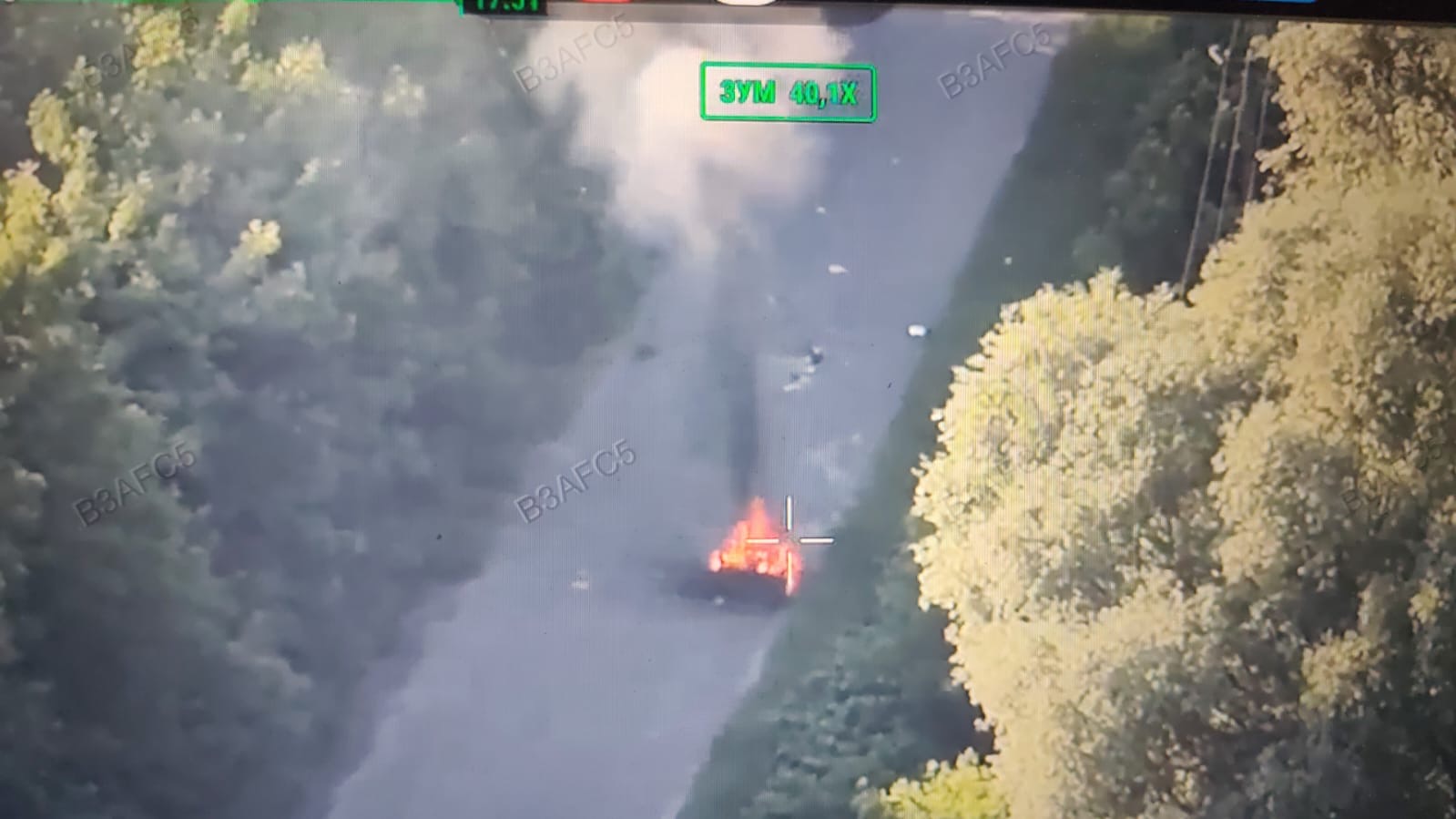
...and sometimes it catches fire and burns out on its very first run.
- Do you have a UGV that has remained operational for a long time?
- For several months, in late spring and early summer, I worked in the Sumy region with a vehicle that completed more than 70 missions in total! That is currently the highest number of any vehicle in our fleet. Using that particular UGV, we evacuated nine wounded soldiers and, if I am not mistaken, the bodies of four fallen soldiers. On top of that, it delivered tonnes of supplies! At present, it is our most effective vehicle – none of the others have completed that much work yet.
"OUR VEHICLES HAVE BEEN MODIFIED TO GIVE THEM A RANGE OF 40 KILOMETRES"
- What types of UGVs currently exist?
- There are logistics, logistics and evacuation, reconnaissance, reconnaissance and strike, and engineering UGVs. There are also kamikaze variants, which operate on the same principle as FPV drones: explosives are loaded onto the vehicle, and it makes a one-way journey.
- Engineering UGVs scatter mines...
- Yes, engineering UGVs scatter mines, deploy concertina wire, and clear passages through minefields. We have a Zmii vehicle equipped with flails – it is a mine-clearing vehicle. We also have a Sirko vehicle, another mine-clearing system that creates a path for infantry. A vehicle the size of a coffee table drives out, fires a charge, and uses the explosion to clear a certain area.
A strike UGV is a vehicle equipped with a machine gun. It moves into a firing position at a designated location, and when fire support is needed, the operator engages designated targets from a safe location. You do not need to place a person at the position; a piece of metal drives out there instead. An expensive piece of metal, but still a piece of metal. I saw a video in which a lightly armoured vehicle, either an infantry fighting vehicle or an MT-LB, was moving along, and a small piece of metal tore straight through it. A small vehicle carrying a heavy machine gun drives into the bushes and tears apart the enemy’s armour! I do not yet have any experience with strike UGVs. I work with logistics and evacuation UGVs.
- But all these systems are very expensive; some cost 300,000, others half a million or even a million...
- A human life is worth more! Its value cannot even be compared with that piece of metal.
- Is there a particular time when it is best to deploy? The enemy is also actively hunting UGVs now...
- We operated both during the day and at night. Rain is the best weather for UGVs. Fewer drones fly then, so you can operate more boldly. Taking advantage of bad weather, we completed three missions in a row.
You see, a UGV cannot take cover. If I drive it under a bush, I lose the connection. A robotic vehicle can operate only in open terrain. The ideal conditions are when you are driving along a road lined with trees on both sides, with open sky overhead. The UGV is then protected from both sides. Of course, we have also driven across fields. If you have to reach your destination, you drive. But if there are obstacles, the vehicle can overturn. Fortunately, mine has never overturned while carrying cargo.
What and how much it carries depends on what the soldiers request. They say they need food, fuel, and drones. I am told what needs to be delivered and where. The provisions are packed into bags, and everything is labelled in large letters so that even in a rush, people can see who is supposed to collect what.
As for weight, you have to consider the vehicle’s technical specifications. If it is rated for a certain weight, you should try to load it to that limit and not exceed it.
- But you do overload them, don’t you?
- Sometimes. For example, we once had to transport a mortar. My vehicle has a payload capacity of 150 kilograms, while the mortar weighs, I think, 200 kilograms or more. We delivered it in two runs. Fortunately, the mortar can be disassembled. If the vehicle is only slightly overloaded, you can live with that; you can still operate it. But if the vehicle is heavily overloaded, the motors break apart; they literally fly to pieces. An overloaded vehicle is also less manoeuvrable and can get bogged down. I have lost count of how many times the other soldiers and I have gone out to recover vehicles when there were no neighbouring units or our own positions nearby from which soldiers could come out and help. In those cases, we have to recover our UGVs ourselves.
- Then what is the point if you can reach the positions yourselves?
- First, I cannot carry in my hands as much as we load onto a vehicle. Second, the threat posed by munition drops and FPV drones is extremely high. It is better to risk a piece of metal. We dash out only when the UGV itself needs assistance. Sometimes we have had to push a vehicle back to base. Its controller burns out, and it simply spins in place. You drive as far as you can on one motor while walking beside it and tugging it along like a small child by the hand: you cannot go this way, you cannot go that way, do not go there... That has happened too. It is better not to abandon a UGV but to recover and repair it so that it can continue to be useful. That is why we try to retrieve all our vehicles and not leave them in the fields.
- Do you give your vehicles names? You have referred to them by their manufacturers’ names – Sirko, Termit... But do you give them names yourselves to distinguish between them?
- Our first drone had a frame at the front with chains hanging from it. I removed them because they were ineffective in the sector where we were operating, and fibre-optic cables became tangled in them. The chains were fitted to trigger "petal" mines while leaving the vehicle undamaged. But that type of mining had not been observed in our sector, so I cut them off, and the handle to which they had been attached proved very convenient for pulling the vehicle out. That particular vehicle completed a great many missions. We nicknamed it Gimli the Veteran: the vehicle itself is called Gimli, while Veteran became its call sign. We tried making a vehicle with analogue controls operating through Starlink, and that is how Gimli Analog appeared. But not every word fits on the controller display, so the way this name is abbreviated sometimes produces comical results... Not long ago, we acquired Natalka, a UGV capable of recovering other vehicles. Volunteers and audiences at the Ivan Franko National Theatre in Kyiv raised the money for it. The actors themselves decided to name the UGV Natalka after the play Natalka Poltavka. We had no objections. So now we have Natalka in our arsenal.
- Do all the vehicles have to be modified?
- It depends on their configuration. Some arrive already equipped with Starlink terminals. But most are designed to use radio communications, which work only over a very short distance.
Starlink allows us to operate over whatever distance we need. If there are no communications problems, the only limitation is battery capacity because UGVs use electric motors. They are less visible to thermal cameras, generate less heat, produce less noise and smoke, and cause fewer problems. When necessary, you simply replace the entire motor rather than having to tinker with it or change spark plugs.
As for range... The engineers responsible for repairs and modifications have given our vehicles a range of 40 kilometres. If a position is eight kilometres away, a vehicle can make two runs without additional charging.
- What is the greatest distance you have travelled?
- If I am not mistaken, 12 kilometres. Given that not all vehicles have shock absorbers or suspension, some simply have wheels bolted directly to the housing – they shake and bounce around, so you have to crawl like a turtle and avoid every pothole. You take care of the vehicle as if it were a real car. But it is great fun to race them across fields and along dirt tracks. Sometimes the commander who oversees all our missions even calls and tells me to slow down: "Reduce your speed. Where are you flying off to?"
- Essentially, you are still a driver; your vehicles have simply become smaller...
- You could say that. Sometimes a UGV would break down, so we would deploy another one, drive it to the same location, proceed there on foot, tie the broken vehicle to it, and then return together as a team.
It may look like Hollywood is filming another Star Wars movie, but this is the reality of our war: several strike UGVs being tested simultaneously at a training ground.
"I WOULD LIKE TO WORK WITH KAMIKAZE UGVs"
- Do you think UGVs equipped with machine guns will replace infantrymen at their positions?
- Nothing can replace an infantryman!
- Why?
- Because communications are our limiting factor. Radio communication depends on range, and Starlink stops working due to interference. You cannot drive into a forest; the vehicle will simply stop under a bush. Along one of our routes, I can see a machine-gun-equipped UGV belonging to a neighbouring unit. Its Starlink has fallen off. Literally: it is lying on the side (he smiles). And no one can do anything because it is in a location that cannot be approached easily, with no one nearby. The vehicle’s batteries are already dead, so someone would have to be told how to replace them and from which side to approach the vehicle to switch it on. Recovering it would not be easy either – it weighs more than 300 kilograms. So that unmanned machine-gunner is standing there useless. No robot can replace an infantryman. Robots can only assist them.
You know, when people break bones, doctors secure them with metal implants. But even metal bends and can be damaged. Likewise, there is nothing tougher in war than an infantryman.
This is how politely a man in a village near the front line treated a UGV. The operators controlling the vehicle at the time were themselves surprised when the man bowed gratefully to the unmanned ground vehicle. And there is plenty to be grateful for to these "pieces of metal," as the operators call them, to those who upgrade them, and to those who operate and recover them when something goes wrong.
- Whenever possible, do you watch videos made by colleagues and study how other UGVs operate?
- Of course. It is very important, especially since this field is now developing rapidly.
We also study the enemy’s experience. I have seen enemy logistics UGVs and a mobile mortar with a metal arm on its side that simply reaches over and loads a round.
- Do we have anything like that?
- I have not seen one. Perhaps the video showing that system in operation was generated by artificial intelligence – I did not verify it. But it is a great idea, so why not? You drive out, fire, and rush back. If it jams, you take it back to base.
UGVs are being developed around the world. There are already small tanks that operate without crews. Manufacturers are focusing more on strike drones. There is a platform fitted with a grenade launcher that fires VOG grenades. There is also, if I am not mistaken, the Shablia weapon station, which can be mounted on any suitable vehicle. But I would like to work with kamikaze UGVs. We are already forming an engineering platoon that will operate such vehicles.
- Is there a chance you will transfer there?
- No, I will not transfer, but I will definitely poke my nose in... (he laughs). We have a close-knit unit and good commanders, so what would be the point of leaving? Everything is well coordinated and continues to develop.
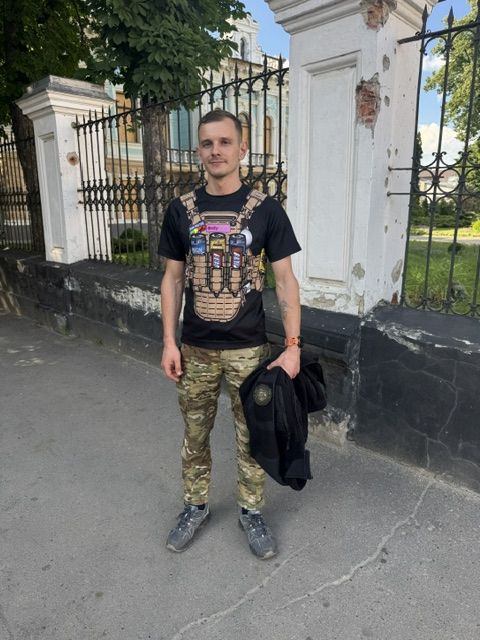
When I went off to serve, my wife told me: "Take care of yourself, because I want my child to have a father, not a Hero of Ukraine." I always remember her words and work carefully.
P.S. Guys in this unit pay the subscription fees for their Starlink terminals themselves by pooling their money. And this is not a standard plan but Global Priority, which enables them to operate UGVs. They also constantly purchase the necessary video cameras, microphones, and spare parts to upgrade the vehicles. We therefore ask you to support this unit by donating to the fundraising jar:
https://send.monobank.ua/jar/AiBscGAE5
Violetta Kirtoka, Censor.NET


