



"Sort things out at rear or we’ll swap places!" — Battalion commander, call sign ’Haika’, on TCR, language and shortage of personnel at front
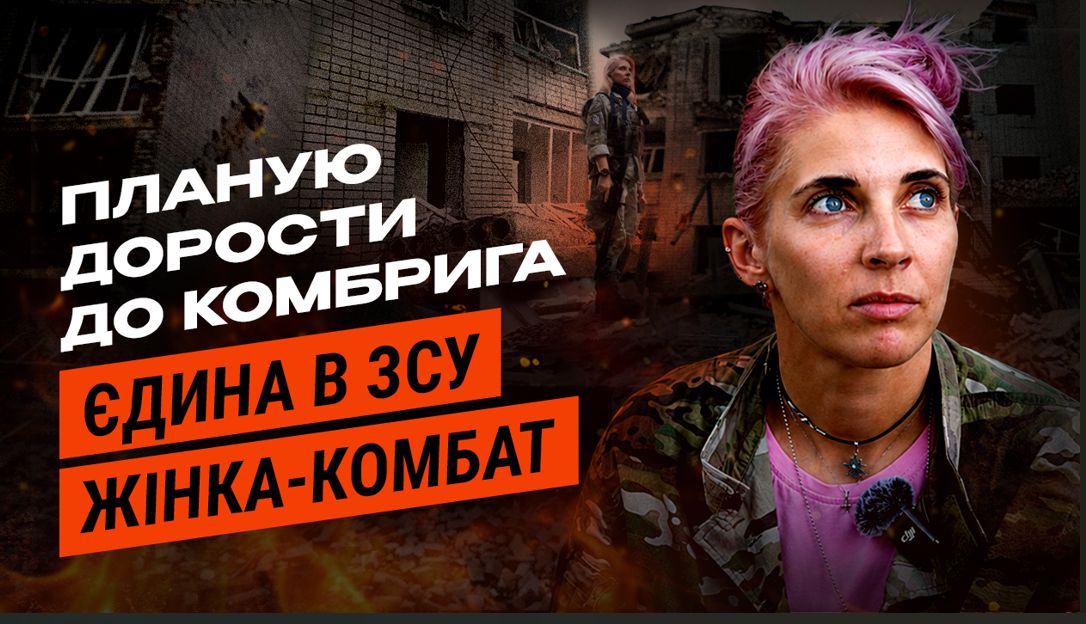
"War is a place where you either grow or die." Born in Russia, raised in Kyiv, she is now the only female commander of a drone systems battalion in the 141st Separate Mechanized Brigade.
In the latest episode of ‘In the Line of Fire’, journalist Iryna Sampan speaks to a battalion commander known by the call sign ‘Haika’. Having worked her way up from a paramedic with the "Hospitaliers", an evacuation nurse and a rifle company commander in the Pokrovsk sector, Haika went on to lead a unit specialising in unmanned aerial systems. In the interview, she speaks candidly about how she earned respect amongst her male subordinates and why women can be more effective than men when leading a battalion.
Also in this episode: the harsh truth about the situation in the contact zone on the Oleksandrivskyi front, aerial duels between FPV drones, the work of the ‘Vampires’, traitors amongst civilians, the sharp reaction to events surrounding the TCR, and the attitude of the home front towards the military.
Iryna Sampan: You are, if I’m not mistaken, the only woman in the Ukrainian Armed Forces holding the rank of battalion commander. Did you set out to achieve this deliberately, or did it happen by chance, and how did your team react to you in general?
Haika: I believe it’s impossible to become a good battalion commander unless you aspire to it. When someone is promoted to officer, senior officers usually ask: ‘What position do you plan to aim for in the future?’ I replied at the time: ‘I’ll take your place too; I’ll become a brigade commander.’ That’s actually what I’m still working towards. My path has been tough, but I’ve worked my way up through the ranks honestly, as required.
Iryna Sampan: Why do you think there are so few women in such positions?
Haika: A woman would cope better with the role of battalion or brigade commander than a man. Women are multitaskers. She can look after a child, apply eye make-up, watch a film, cook a meal, flip pancakes and, at the same time, think about what she needs to buy. That’s just how everyday life works. That’s roughly what a brigade- or battalion-level commander does: tactics, strategy, logistics, supply – it all has to be spinning round in their head. Women are brilliant at this. A man can only focus on one specific task.
But to become a battalion commander, you have to serve in the infantry. And that’s very tough — you literally have to survive there. I can only remember one female infantry soldier who was killed — a machine-gunner in Yunakivka. She served in a neighbouring company. I also remember a girl from ‘Shkval’ in the 68th Brigade, with the call sign Kuma. At first she couldn’t manage to shoot properly; I was training her for combat. But when the assaults began, she completely took charge, started leading the men — and everyone was stunned. She led several assaults, was wounded, and proved herself brilliantly. As far as I know, she’s now serving as a cook.
Iryna Sampan: How did you decide to join the army?
Haika: The Russians invaded my country. I didn’t invite them. I watched it all for two days and thought: they probably won’t manage without me. I joined the ‘Hospitaliers’. Together with the crew, we worked in the 68th Brigade for several months. Then they asked me, ‘Why don’t you enlist?’ So that’s what I did. At first, I was an evacuation nurse. We worked at the field hospital, evacuating the wounded. Incidentally, that was my favourite job. Even though you see people literally torn to pieces, every time you think of just one thing: ‘If only we could get them there.’ And when you manage it — you realise that you haven’t lived this day in vain.
Iryna Sampan: And don’t you have that feeling now? You’re in charge of a large number of people.
Haika: When you’re in charge of a battalion, you’re constantly faced with a huge number of problems. Most of them are minor and could be sorted out without me, but there are so many that they take up the whole day. We start work at five in the morning — that’s when I have my first briefing. The last one is around eight in the evening, but I usually work until ten or eleven at night.
And that’s if everything goes according to plan. Sometimes you forget to eat. The day is so long that you can’t remember whether something happened today or yesterday. You lose track of time. And sometimes you only see the results of your decisions two or three months later.
Iryna Sampan: What role did you take on in the 68th Brigade?
Haika: For the first six months, I was an evacuation nurse. Then I was assigned to combat training. There, a group of instructors was organised from the assault troops, whilst I led a group of paramedics. Later, I accepted a rifle company in the 68th Brigade. We were stationed just outside Pokrovsk. There are two villages towards Selydove: Dachenke and Zelenе. At first, my group was stationed in Dachenke, then we moved to Zelenе — we were responsible for defending these two villages.
Iryna Sampan: Did they listen to a female company commander?
Haika: They listened perfectly well! Actually, the main thing is to instil a sense of panic in them. When I turn up in front of them in a pink jumper, I say: ‘Right, I’m your company commander, get dressed, we’re off to the front.’ And I head out there with them — people are in shock, but they all accept me. As it turns out, not all company commanders go out on sorties. But for me, it’s important. As soon as I took command of the battalion, I visited all the positions within a week. If positions need to be moved, I’m the first to go and dig alongside the company commander and the company sergeant major.
Iryna Sampan: Is that the only way to earn respect?
Haika: There are different ways. You can simply get on with the work, but that takes a bit longer. We’re on the front line, after all. I don’t consider myself superior or better than anyone else. If you want someone to do something, show them how to do it. The biggest problem in the army is when people come along and say, ‘This is wrong, and you shouldn’t do it like that.’ So show me how to do it, and how not to do it — I can work that out for myself!
Iryna Sampan: Has anyone ever said to you, ‘A "woman" will never be in charge of me’?
Haika: Oh, hello to Artist. He’s now one of my most loyal comrades, an armoured personnel carrier driver. It happened after I was transferred from the 68th to the 156th Brigade. I arrived at the Rivne training ground, had a look around and said: ‘Can I go back? Here are the papers, sign them — I’m off.’ But they wouldn’t let me go. They said: ‘Take command of the company.’
‘The Artist’ walked in, looked at me and said: "Oh, a woman? I’m not going." I explained my position to him rather passionately. He replied: "You can’t speak to me in that tone." He’s a well-mannered man.
I had my own ritual. Every Sunday, the whole company would get together for a barbecue, chatting and socialising. One day he said: "I’d never have thought I’d end up under a woman’s thumb." I replied: "Mate, think of it not as being under a woman’s thumb, but under a skirt." Everyone laughed, and he blushed. And when I was transferred, 25 soldiers followed me. There were no women in my company.
Iryna Sampan: Some female commanders say they don’t want to see women in their unit. Why is that?
Haika: When people call me a ‘female commander’ or a ‘female medic’, I take it as a sign of disrespect. I’m a commander, not a ‘female commander’. A cook is a profession, and it has nothing to do with gender.
For example, when someone says: ‘Good health to you, gentlemen and lady officers.’ I’m one of the ‘gentlemen officers’ too. I don’t want to be singled out just because I’m a woman. I work just like everyone else, and I should be treated the same way — neither better nor worse. Especially as I already have to work three times as hard to prove my professionalism.
So, if women have come to work, they will work. The problem lies in the small sample size. Let’s say I have a company of a hundred men, of whom about 20 are real ‘workhorses’—the ones everything relies on; I set them a task and forget about it—they just get it done. Then there are another 40 men who are decent performers. Another 40 men will be alcoholics. Out of 100 people, I can select 20.
But when there’s only one, two or five women in a unit, such a sample simply doesn’t exist. That’s why it’s wrong to draw conclusions about all women based on just a few individuals.
Iryna Sampan: In defence of feminine forms, I’d say it’s a matter of habit. The Ukrainian language is very flexible, and feminine forms make women visible in professions. If we say ‘female officer’, it means that women also hold these positions, and you need to take that into account.
Haika: Not every officer is a commander. A commander and a chief are different things. A commander is someone people follow. They have a team, a core group. If I were to say right now, ‘Get in the vehicles, let’s go’, fifteen people with weapons would turn up here without even asking where we’re going. That’s a commander. A superior is someone who has subordinates, but no team. And if a commander needs to be treated differently simply because they’re a woman, a man, a child or an elderly person — then they’re no longer a commander. A commander is about leadership, trust and responsibility. Not about gender.
Iryna Sampan: I’d also like to talk about the situation on the Oleksandrivka front. How active is the enemy there? What’s currently happening in the combat zone within your area of responsibility?
Haika: We’re currently in a state of active defence. In some places they’re trying to break through, in others we’re repelling them. We’re trying to operate at full capacity as a brigade. The UAV component is crucial at the moment. Recently, our infantry came under fire; the FPV drones were deployed immediately, and we began targeting the enemy’s launch drone sites – in other words, we took out their launch drone sites – saving the infantry; the enemy stopped firing at them, and they managed to take cover.
Without FPVs or Mavics, we won’t be able to carry out reconnaissance or execute our operations – the infantry will be killed. That’s why the brigade is now operating quite cohesively, despite the fact that it was literally pieced together battalion by battalion. Just a year ago, these were detached battalions; we started pulling them together, and now we have more personnel in the brigade, and the battalions have grown.
Iryna Sampan: Are the FPV operators currently the closest to the front line?
Haika: I wouldn’t say so; there are a number of factors involved. The Mavic operators have to travel the furthest to reach their positions. My FPV operators fly in and cover 30–40 kilometres, whereas the Mavic operators cover around ten. So the positions closest to the enemy are those of the Mavic operators.
Iryna Sampan: And they’re on foot?
Haika: Yes. That’s the main problem with the kill zone: the enemy is systematically disrupting our logistics. Sometimes there are brief lulls – they’re probably redeploying their units. Just three weeks ago, the logistics situation calmed down a bit, but now it seems ‘Rubicon’ has been activated again and the FPV pilots have resumed targeting our ‘Vampires’.
The enemy is trying to prevent us from delivering everything we need to the front line. They’re mining access roads and main roads, causing vehicles to be blown up. They drop mines; we try to destroy them with drops. Now the enemy is better at camouflaging them: wrapping them in rags, hiding them in crumpled bottles or tins. So, if you see an energy drink can on the road, it’s best not to touch it.
Iryna Sampan: And do they scatter mines in areas where there are still civilians?
Haika: Yes. We’re constantly asking civilians to leave and offering to help with evacuation. But in villages like Havrylivka or Pidhavrylivka, people are still staying. The longer the defence goes on, the fewer of them remain there: some leave, some are killed.
Back when I was serving in the infantry, one of my soldiers went to the locals and said: ‘I’ll even give you money, just leave. We’ll be there shortly in an armoured vehicle to pick you up.’ They refused, and then let the Russians in, who killed my men. It turned out they were ‘collaborators’.
Iryna Sampan: How many drones does one of your FPV crews use per day or per shift?
Gaika: On average, about 15 FPV drones a day. There are different crews, flying different types of drones. There are the ‘Molniya’ models, but fewer of those are in use. In the motorised infantry battalion, we have a very strong FPV team — they can carry out 25–30 sorties a day. The first battalion also has specialists who carry out around 20 sorties. It all depends on the situation. Some of the drones are constantly patrolling, locating targets and striking them immediately.
This morning, for example, an enemy convoy was on the move. In two hours, we used around 20–30 drones and completely ‘took it apart’.
Iryna Sampan: And how difficult is it at the moment to locate the enemy’s launch sites? To what extent have they adapted?
Haika: It’s possible to find a launch site — our reconnaissance is working. It’s harder to destroy it. Unfortunately, there are people on the other side who are thinking too. They dig in, fortify their positions and camouflage them well.
Iryna Sampan: In such cases, do you call in artillery or try to ‘take out’ the position yourselves?
Haika: We always pass on the coordinates to the artillery commander whilst at the same time trying to deal with it ourselves. It all depends on the target’s location. If it’s a basement with concrete cover, it’s clear that we won’t be able to destroy it on our own. We pass the details on to the brigade; sometimes the brigade passes them on further up the chain, and they use KABs — everyone gets involved. Sometimes we send in the ‘Vampires’.
A built-up area is one thing, a dugout is another. It also depends on the dugout and how long they’ve been holed up in it. If they’ve only just moved in, they’re easy prey. You just drop a couple of FPVdrones or an incendiary device in there, it all goes up in flames, they all run out, everyone’s got what they deserved, and everyone’s happy.
Iryna Sampan: And what percentage of your resources do you spend on logistics?
Haika: We make an average of about three flights a day to the Mavic operators’ positions. That’s because it’s always petrol, water, plus food — that’s already three flights. We also periodically carry drones, batteries, antennas, EcoFlow charging stations and a generator. Basically, all this stuff breaks down from time to time.
Iryna Sampan: How do you see the future of drone technology in general?
Haika: It’s hard to predict, but I think more and more attention will be paid to ‘middle strikes’ – systems that operate at greater depths.
Electronic warfare (EW) and EW specialists are very effective at the moment. My vehicle can make four or five sorties a day, and thanks to EW, it returns safely and the lads stay alive. But it’s a constant race. Today we’re operating within a certain frequency band, and tomorrow the enemy switches to others. Right now, for example, they’re trying to move down to lower frequencies.
It’s like a card game. We came up with reconnaissance drones — they saw them and copied them. It seems as though our brains work better, but they have more funding.
There are more of them, their country is bigger, but it’s hard to compete with sheer numbers using just our brains. We’re still taking out the enemy at a rate that exceeds our own losses, but they’re coming at us in droves. Kill zones will expand, it’ll become increasingly difficult to reach our positions, and we’ll have to venture further and further afield. But over the last year or two, as experience has shown, nothing particularly new or surprising has emerged.
For example, right now I’ve got a drone in the air, and it’s being shot down by an FPV. I send out an FPV, and suddenly it’s like something straight out of *Star Wars* up there, because I’ve got two FPVs battling it out over the ‘Vampire’. It looks absolutely out of this world. And yet the person isn’t physically involved at all. With drones, there’s a kind of aerial war of their own; a person sits down in a trench and isn’t physically involved in the battle. But it’s also very difficult to move away from that.
Funding will probably win out. Or perhaps brains. War is a very dynamic process, so perhaps we’ll win through our brains. If we manage to develop faster than they do, that’s where we’ll come out on top. Even if the enemy copies something, we’re already coming up with something new.

Iryna Sampan: How do you view the news about the attacks on the TCR, the overturning of vehicles in Lviv and the public’s reaction to it?
Haika: I hardly read the news and try not to get bogged down in ‘civilian life’. Once every two or three months, I might take a few days’ leave: to see the doctors, collect my uniform, swap my summer kit for winter gear — and then I’m back.
We’re dying and wearing ourselves out here. It offends me when people say that the military will restore order in the country once they return. Personally, I’m not going to do that. And neither are my lads. We’ve all been through this, and after that, are we supposed to come back and fight injustice at the rear? Why did we leave you all there in the first place? So that you could look after our families, our children!
This is a very tricky situation. If we’re at war, we’re one country and we want to win, or if we’re going to keep fighting, well then please — come along, enlist. Yes, the TCR are in the wrong. Well, you’re not going either! Come along, take our place. It’s all very well shouting ‘Glory to Ukraine!’ and then saying ‘TCR soldiers are bastards’, beating up TCR members, and then being surprised that the front line is collapsing.
That’s why this is a very complex issue. I think that, probably, the best solution would be to simply hold a nationwide vote with two options: the first — we accept the terms of some kind of peace and release all the soldiers; the second — ‘I’ll enlist’.
Iryna Sampan, ‘In the Line of Fire’
Editor — Kateryna Kader


