



Labour market has gone underground: Ukraine loses at least 86 billion hryvnias in revenue every year due to undeclared employment
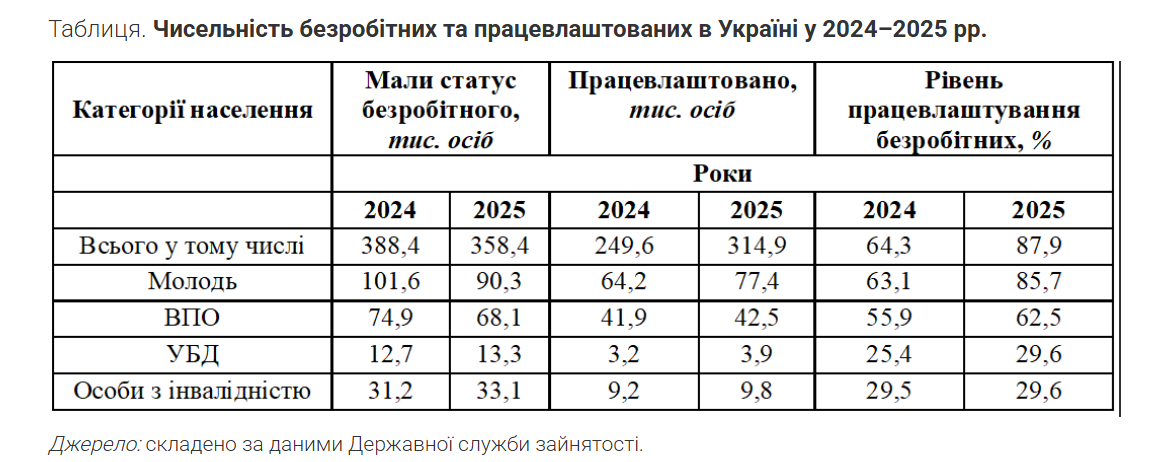
Year after year, the number of officially employed citizens in Ukraine is declining. In 2025, 10.96 million people were employed and paying single social contribution (SSC); by January–July 2026, that number had fallen to fewer than 9.5 million Ukrainians. Business Censor investigated why, despite an acute labor shortage, employment is still declining and what could be done to stimulate formal employment.
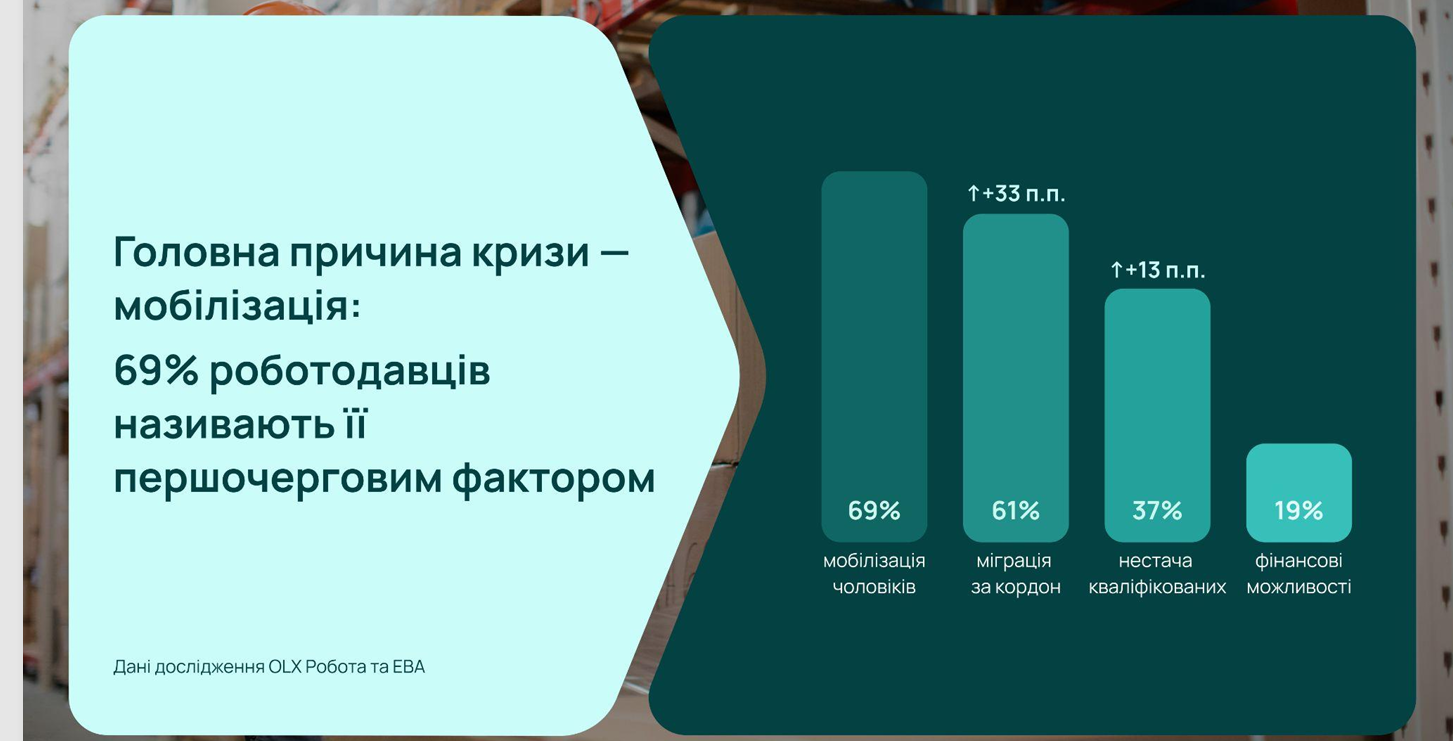
Data from a survey conducted by OLX Robota and the European Business Association show that 78 per cent of employers surveyed are experiencing a labour shortage, with 67 per cent of them expecting the situation to worsen next year (this figure is set to rise by a factor of 1.7 in 2026 compared with 2025). The most challenging staffing situation is in the manufacturing, wholesale trade, construction and services sectors.
It also emerged that only 54 per cent of the businesses surveyed officially employ workers on a full-time basis, whilst 21 per cent offer work without a contract – that is, through illegal employment (compared with last year, the rate of informal employment has risen by 6 per cent). A further 20.4 per cent of those surveyed make extensive use of partnerships with sole proprietorships, 13.6 per cent operate through civil law agreements, and almost 15 per cent officially employ staff on the minimum wage with the difference paid in cash.

The prevalence of illegal employment is acknowledged at an official level. In the ‘Strategy for Employment in Ukraine for the Period up to 2030’, which was approved by the government in January 2026, the use of labour without formal employment contracts is described as a structural feature of Ukraine’s labour market.
Whilst in 2021 informal employment accounted for around 19.3 per cent of the total number of employed persons (over 3 million people), by 2024, according to modelling carried out by the Mykhailo Ptukha Institute of Demography and Social Studies of the National Academy of Sciences of Ukraine, it will in fact account for a quarter of all workers – 23.6 per cent of the total number of employed people.
In 2025, the State Labour Service of Ukraine (Derzhpratsi), based on a quantitative cross-sectional study, estimated the level of employment without formalised employment relationships at 23.4 per cent, corresponding to 2.6 million workers.
The highest levels of informal employment are observed:
- in the temporary accommodation and catering sector (primarily hotels and restaurants) – 40.4 per cent;
- security services – 40 per cent;
- vehicle repair – 38.9 per cent;
- construction – 38.2 per cent;
- retail – 32.2 per cent.
Informal employment exhibits distinct gender patterns: currently, 60 per cent of those working without a formal employment contract are men, whilst 40 per cent are women. Informal employment is prevalent in both rural areas (53.6 per cent) and urban areas (56.7 per cent).
Around 40 per cent of all those employed informally work for sole traders.
Why is the informal sector in Ukraine growing?
"From the employers’ perspective, this is primarily about cost savings, ‘tax optimisation’ on wages, whilst for jobseekers who do not require formal employment, it is about the opportunity to effectively receive more money from the employer thanks to this ‘optimisation’," says Maria Abdullina, head of the OLX Robota platform and co-chair of the European Business Association’s HR Committee.
According to the latest research, when it comes to the factors influencing the choice of employment, the issue of formal employment ranks fourth in terms of priority. At present, salary remains the key factor for job seekers (it is the main factor in choosing a job for 90 per cent of job seekers; over the past year, this figure has risen by 9 per cent). In second place are proximity to home and a flexible working schedule.
"Formal employment is important for jobseekers, but money is more important. If they are offered a job on the minimum wage but can earn more ‘under the table’ or ‘off the books’, candidates tend to agree to this. The population is becoming poorer, and there is a very acute shortage of money," Maria Abdullina told Business Censor.
Formal employment is not currently among the main factors when choosing a job, partly due to the issue of military mobilisation. This explains the high proportion of men among informal workers, as employers are obliged to keep military records.
An analysis by the National Institute for Strategic Studies attributes the widespread use of the informal sector not only to the risks of war but also to the high tax burden, bureaucratic barriers for small and micro-enterprises, low trust in state institutions, difficulties in finding jobs of the desired quality, low wages in formal employment, attempts to avoid conscription, and a lack of state oversight regarding the non-payment of official wages, amongst other factors.
The prevalence of illegal employment, in addition to violating workers’ social rights, causes significant losses to the economy in the form of unpaid taxes and contributions.
According to calculations by the State Labour Service, for the nine months of nine months of 2025, budget losses from non-payment of taxes and the single social contribution due to undeclared employment amount to 86.1 billion hryvnias (based on the minimum wage) and 287.9 billion hryvnias (based on the average wage for that period).
Within the structure of these losses, the largest share is accounted for by shortfalls in the single social contribution (ranging from 42.5 billion hryvnias to 140.8 billion hryvnias), which calls into question the future viability of the pension system.
Who will provide for pensioners?
Only 9.5 million Ukrainians paid the single social contribution between January and July 2026. Meanwhile, as of 1 July, according to the Pension Fund, there were 9.98 million pensioners in Ukraine. This means that there is already more than one pensioner for every payer of the unified social contribution. Demographic changes, in particular, play a role in this.
Ukraine’s population has fallen by 40 per cent since 1991: from 52 million to approximately 31 million people. Almost a third of the country’s population are now pensioners: there are 10.3 million pensioners living in Ukraine, 60 per cent of whom are women, according to the study ‘Invisible Risks to Human Capital’ by the Centre for Public Finance and Public Administration Analysis at the Kyiv School of Economics.
Similar figures are cited in the government’s "Employment Strategy": from 42 million people in January 2022 to 35.8 million in July 2024; specifically, 31.1 million people live in territories under Ukraine’s control.
At the same time, the number of people with disabilities has risen by a third: at the start of 2022, there were over 2.7 million such people in Ukraine; by the start of 2026, the figure had reached 3.5 million, a trend also partly attributable to the war.
Whilst the employment rate for people with disabilities in the EU stands at around 50 per cent, in Ukraine it is only 14 per cent, which points to problems with the labour market’s adaptability: the lack of readiness among some people with disabilities to enter the workforce and stereotypical perceptions of them by employers.
At the same time, the proportion of the economically inactive population in Ukraine, according to estimates by the Mykhailo Ptukha Institute for Demography and Social Studies, accounts for almost half of the total labour force in Ukraine – 46.5 per cent.
As of 2024, Ukrainians aged 15 and over numbered 26.9 million, of whom 13.3 million were in employment and 900,000 were seeking work.
A large proportion of the economically inactive population (12.5 million people) are not working because they have retired, are in education or have a disability (9.7 million people), maternity leave and parental leave (800,000 people), running a household and caring for those requiring medical care (700,000 people), due to psychological distress caused by the war (200,000 people), are unable to find suitable work (200,000 people), lack adequate education (40,000 people), or are engaged in seasonal work (90,000 people).
According to the European Business Association, 74 per cent of companies operating in Ukraine are experiencing staff shortages.
At the same time, according to a survey of employers conducted by the State Employment Service, only 32 per cent of businesses were considering hiring staff in 2026. Of these, only 12 per cent were planning to create new jobs. This points to the ‘survival mode’ in which businesses find themselves during the war.
What is the government proposing to do about undeclared employment?
The Ministry of Economy has drawn up a document setting out the main objectives for the labour market – the ‘Employment Strategy until 2030’. The document states that Ukraine plans to bring at least 2 million additional people into the labour market by 2030, primarily from among refugees currently residing abroad.
One of the objectives set out in the document is to bring employment out of the informal sector. To regularise workers’ status, the Cabinet of Ministers is planning the following measures:
- to develop and approve a new methodology for setting and reviewing the minimum wage;
- introduce legal regulation of platform-based employment;
- legalise employment in sectors with high levels of informal work (domestic work, agriculture, seasonal work, temporary accommodation and catering, security services, vehicle repairs, construction, and retail).
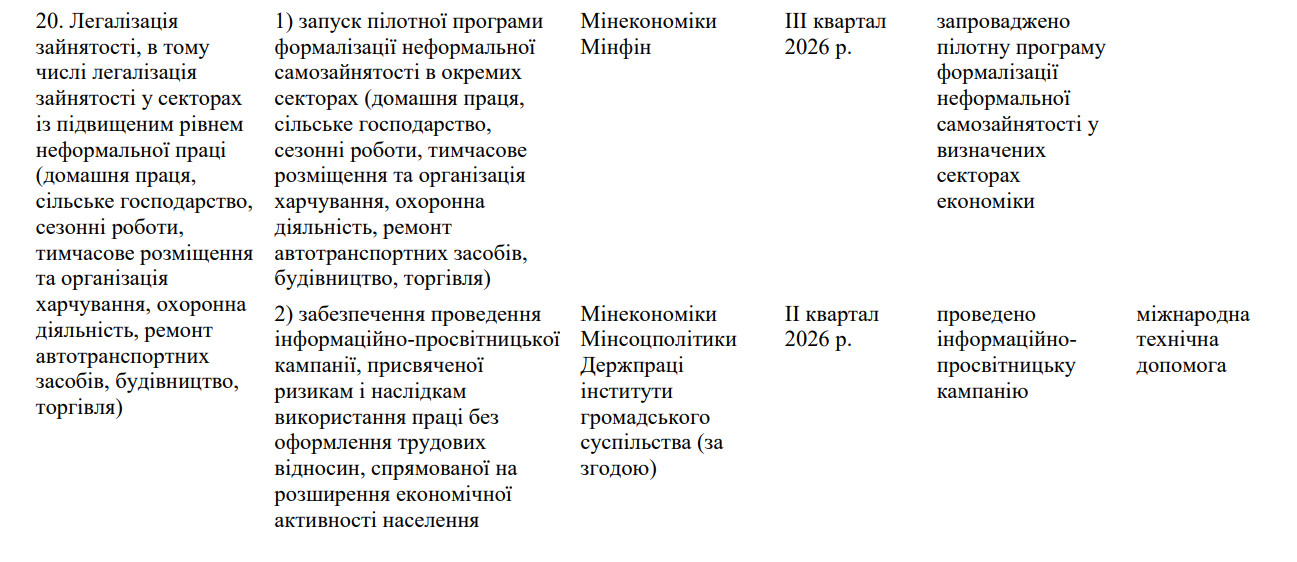
In the operational plan for implementing the Strategy in 2026–2028, the objective of formalising employment consists of two points:
- An information and awareness campaign on the risks and consequences of using labour without formal employment contracts, "aimed at expanding the population’s economic activity", which was to be carried out in the second quarter of this year using international aid funds (the amount of funding is not specified).
- To launch, in the third quarter of this year, a pilot programme to formalise informal self-employment in certain sectors of the economy (namely domestic work, agriculture, seasonal work, temporary accommodation and catering services, etc.).
Business Censor approached the Ministry of Economy, which drafted the Strategy, with questions regarding the new methodology for calculating wages and the programme to formalise informal self-employment. In particular, we asked how the methodology for setting wages would contribute to the formalisation of the labour market, and what is meant by the ‘formalisation of informal employment’? And could a reduction in the tax burden on employers, for example, be seen as an incentive to legalise employment? Or, conversely, would greater state control and increased penalties for illegal employment help to reduce the shadow economy? Unfortunately, the Ministry did not respond to our enquiries.
The Strategy had previously been criticised for a lack of specifics and for being overly declarative.
"The draft is dominated by general phrases such as ‘creating conditions’, ‘developing tools’ and ‘integrating standards’, without a clear description of who is to implement this, how, when and with what resources. With such wording, the document resembles a rough outline of intentions rather than a strategic action plan,"said Andrii Pavlovskyi, an expert on social policy, criticising the document on the eve of the Strategy’s approval. He rightly pointed out that the Strategy makes no mention whatsoever of the funding required for labour market development measures.
At the same time, according to World Bank estimates, the recovery of the labour market in Ukraine will require no less than 50 billion hryvnias in annual investment.
What could be done to move away from the widespread practice of ‘grey’ employment?
Currently, the tax burden on wages in Ukraine stands at 45 per cent (23 per cent of an employee’s wages is withheld in taxes and levies (18 per cent personal income tax and 5 per cent military levy), whilst the employer additionally pays 22 per cent in the unified social contribution).
According to Oleksandr Chumak, president of the "Association of Private Employers", reducing the tax burden on the wage bill is the first step towards curbing the informal economy. "Proposals put forward over the last 5–7 years suggest that the tax burden on the wage bill should be 25 per cent, or 30 per cent at most."
Secondly, it is necessary to introduce tools to monitor employers which, above all, will not affect legitimate businesses and will operate exclusively on a risk-based approach.
"For micro and small businesses, the first identified breach – provided it has not posed a threat to the life or health of an employee – should result in a notice and a deadline for rectification. Severe sanctions should be applied in cases of repeated violations, the deliberate concealment of employees, non-payment of wages, and the disguising of permanent employment relationships as civil contracts," says Chumak. "Businesses could, for example, be given six months during which the employer would have the opportunity to register employees independently, formalise employment relationships and begin making current payments without incurring penalties for past periods. A conscientious micro-entrepreneur should be offered a realistic and secure pathway out of the informal sector."
According to Marina Abdullina, the formalisation of the market will certainly not happen soon, "in one fell swoop"; there must be a gradual evolution from the current state towards market monitoring and support for businesses through tax simplification, in order to preserve jobs and improve worker protection.
During the war, there is no question of simplifying taxation for companies that employ staff. Quite the opposite, in fact.
"The Ministry of Finance bears full responsibility for the taxation sector. In its current composition, it consistently advocates only for tax increases, often without justification and without using actual calculations or regulatory impact assessments, simply because this was set out in the ‘National Revenue Strategy until 2030’, which was drafted in early 2022 on the assumption that the war would end in 2025. This strategy has long since ceased to reflect reality," concludes Oleksandr Chumak.


