



"Retroactive" anti-dumping: How fittings court case could affect all Ukrainian businesses
In early July, four fitting importers filed a lawsuit with the Kyiv District Administrative Court challenging the actions of the Ministry of Economy and the decision of the Interdepartmental Commission on International Trade (ICIT) dated 22 May 2026, by which the ICIT amended its own decision of 7 July 2025, "On the Application of Definitive Anti-Dumping Measures on Imports into Ukraine of Fittings for Water Supply and Heating Systems Originating in the People’s Republic of China and the Republic of Türkiye."
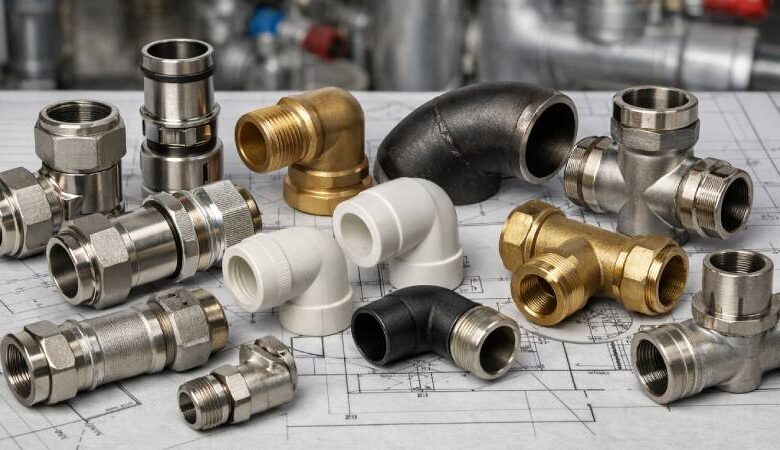
These amendments changed the description of the goods previously subject to a duty at the effectively prohibitive rate of 166.65% from "polypropylene fittings (including those with an insert made of copper alloys)" to "polypropylene fittings (including those with an insert made of metal)."
It is easy to see that the category of "metal" is considerably broader in scope than the category of "copper alloys." It is also clear that such metal inserts, and consequently the fittings themselves, have different production costs, selling prices, advantages and disadvantages, as well as specific characteristics affecting their use under different conditions.
As a result of this decision, the anti-dumping duty was extended to imports of other types of fittings with inserts made of all other metals, even though they had not been examined in the lengthy original investigation. The practical implications are also enormous: at a rate of 166.65% for goods originating in China, such a duty will, in practice, have an effect close to bringing their economically viable importation to an end.
Together with their statements of claim, the companies asked the court to grant interim relief and suspend the ICIT decision pending resolution of the dispute on the merits. The purpose of such a measure is to preserve the existing state of legal relations and prevent the challenged decision, even before its lawfulness is reviewed by the court, from producing consequences that would subsequently be impossible to remedy. After all, the matter concerns not only individual shipments of goods already en route to Ukraine, but also established supply chains, long-term relationships with counterparties, pricing models, and the very ability to continue doing business under the rules that were in force before the disputed amendment to the ICIT decision.
This may appear to be an ordinary business dispute. However, the problem runs much deeper than it seems. Indeed, in the context of the considerable number of anti-dumping investigations currently being conducted and expected to be conducted in Ukraine, a far more troubling question arises: can businesses rely on the stability of the rules at all if those rules can be changed after goods have already been ordered, paid for, and dispatched to Ukraine? In effect, "retroactively."
This is precisely why the problem created by one flawed decision may become a problem for many markets. Today, it concerns fittings. Tomorrow, any importer that concludes contracts and plans shipments on the basis of the rules currently in force may find itself in a similar situation.
If the court finds this approach permissible, the challenged decision could set a dangerous precedent that would harm not only businesses but all Ukrainian citizens. This is because every instance of excessive state interference in business is followed by a systemic crisis: goods disappearing from store shelves, substantial increases in the prices of essential goods, a labour market crisis and, as a consequence, lost tax revenue for the state and unexpected bankruptcies. Ultimately, consumers pay for all of this through reduced choice and higher prices.
Ultimately, the state itself also loses. A market where the rules can change in the middle of the game deters new players, increases concentration, and worsens the overall business environment. This sends a signal not only to importers but to anyone deciding whether it is worth doing business and investing in Ukraine.
How the rules of the game have changed
The process of imposing anti-dumping duties on fittings began on an entirely lawful footing back in 2024, although it was accompanied by numerous controversial and plainly questionable decisions by the Ministry of Economy and the ICIT.
At the time, the basis for the ICIT decisions to initiate the investigation and ultimately impose an additional anti-dumping duty on fittings (in addition to the regular import duty) was a complaint filed by TRADING HOUSE "ROZMA" LLC and SAN TECH RAI LLC. Decision No. AD-569/2024/441-01 of the Interdepartmental Commission on International Trade dated 15.10.2024 initiated an anti-dumping investigation into imports into Ukraine of fittings for water supply and heating systems originating in the People’s Republic of China and the Republic of Türkiye.
The aforementioned companies claimed that fittings were manufactured in Ukraine and that the "domestic producer" therefore needed protection from competition from cheaper imported products. Following the investigation, in July 2025, the Interdepartmental Commission on International Trade imposed anti-dumping duties: an astonishing rate of 166.65% on Chinese products and 34.72% on Turkish products.
Since the ICIT decisions both to initiate the investigation and to impose anti-dumping duties based on its findings concerned a clearly defined group of goods, including fittings with inserts made of copper alloys, they did not apply to other types of fittings, such as those with stainless-steel inserts. For its part, customs consistently refrained from collecting anti-dumping duties from importers of these products. Therefore, the plaintiff companies were neither interested parties nor participants in the anti-dumping investigation in question.

Why, then, did lawsuits begin a year later? As already noted, the reason was the changes made by the ICIT outside the prescribed procedure to the decision imposing anti-dumping measures following an investigation that had ended a year earlier. As a result of these changes, the duties were extended to goods that had not even been mentioned in the previous year’s investigation—fittings with inserts made of other metals.
In other words, while last year’s description was considerably narrower, referring to polypropylene fittings with inserts made of copper alloys, the new version replaced this wording with the substantially broader phrase "with an insert made of metal." The difference may appear insignificant at first glance, but the new description actually covers several times the volume of goods now subject to an effectively prohibitive anti-dumping duty rate and, consequently, a broader range of importers affected by these anti-dumping measures.
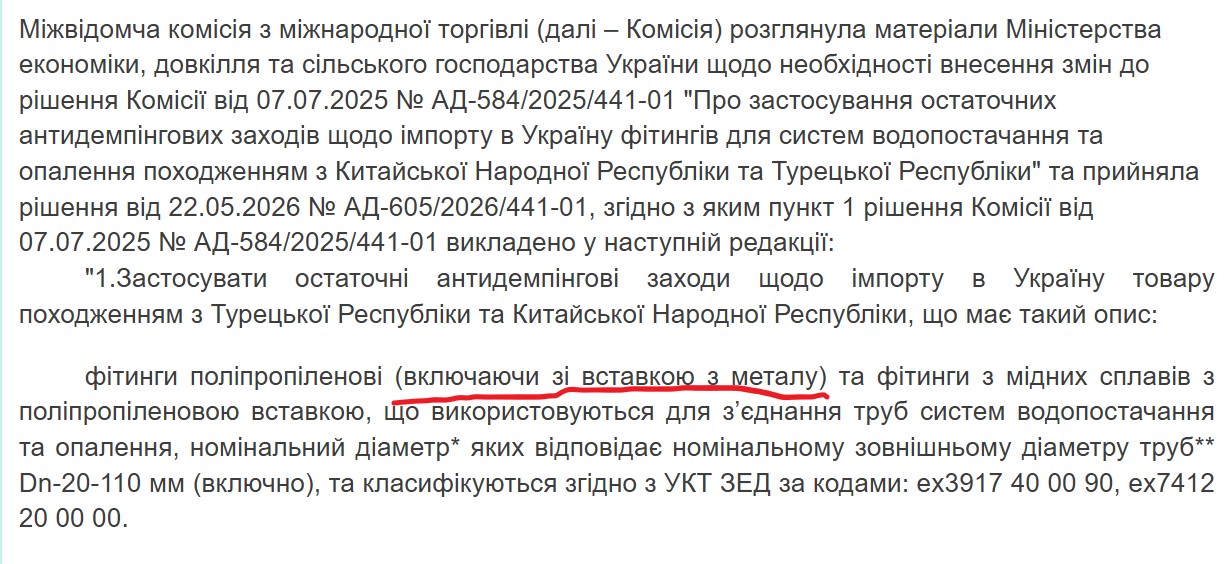
The revised product description extended the anti-dumping duty to types of products that had not been covered by the anti-dumping investigation itself and that are sold, among others, by the plaintiff companies, namely fittings with stainless-steel inserts.
Stripped of rigid legal language, what we are effectively dealing with is a situation in which the applicable customs rules are changed retroactively with a single stroke of the pen.
Incidentally, this is not the first time that SAN TECH RAI LLC has used anti-dumping instruments in the sanitary products market. The company previously joined another applicant in initiating an anti-dumping investigation into steel, aluminium, and bimetallic heating radiators, which also resulted in the imposition of anti-dumping measures.
Of course, actively defending one’s own business interests is not in itself unlawful. Questions arise when an exceptional trade defence instrument gradually becomes a routine means of reshaping the competitive landscape across entire product markets. Anti-dumping measures should provide protection against proven dumping, rather than simply making imports more expensive and leaving consumers with fewer alternatives. This is precisely why, in such cases, the state must take particular care to distinguish genuine protection of an applicant from situations in which a trade restriction may merely narrow competition and unjustifiably strengthen the positions of individual market participants.
To understand the situation, it is worth recalling exactly how the imposition of the anti-dumping duties unfolded.
A brief timeline of events
- On 18 January 2024, the applicants filed a complaint concerning dumped imports of fittings from China and Türkiye.
- On 15 October 2024, the Interdepartmental Commission on International Trade initiated an anti-dumping investigation. The investigation concerned polypropylene fittings, including those with inserts made of copper alloys.
- On 7 July 2025, following the investigation, the Commission imposed anti-dumping duties of 166.65% on products from China and 34.72% on products from Türkiye. The product description likewise referred to polypropylene fittings, including those with inserts made of copper alloys.
- On 22 May 2026, almost a year after the investigation had concluded, the Commission amended the product description: the words "inserts made of copper alloys" were replaced with the considerably broader term "inserts made of metal."
As a result of these actions by the ICIT, the anti-dumping duty was extended to additional product categories, including fittings with stainless-steel inserts, even though no separate investigation had been conducted into them. For companies engaged in importing and selling such products to Ukrainian consumers, this came as a complete surprise and not only jeopardised previously concluded contracts but also created a real risk of bankruptcy.
Moreover, neither the Ministry of Economy nor the ICIT notified market participants that such changes were being prepared or gave them an opportunity to submit explanations, technical documents, or objections. For businesses, it was as though the new rules had simply been pulled out from under the table and presented to them as a fait accompli. This shocked many market participants, as such decisions had never previously emerged from a legal vacuum. They had always been preceded by a clear public procedure, established powers, and an opportunity for those affected to be heard.
This is precisely why the importing companies were forced to go to court to seek justice, establish the unlawfulness of the Ministry of Economy’s actions and the ICIT decision, and protect themselves from unlawful actions by the authorised state authorities.
The core of the problem
An important point should be emphasised from the outset: the importing companies that went to court do not challenge the state’s right to apply anti-dumping measures as such. Their position is different: every product to which the state extends an anti-dumping duty must undergo the statutory procedure for investigating and establishing dumping practices, actual injury, and a causal link between the two.
In this case, the problem lies not in the anti-dumping duty itself, but in the manner in which it was extended to another product. If the authorised authorities believe that a new product should also be subject to restrictive measures, this must be established through the prescribed procedure, rather than decided merely by changing the wording of a previously adopted decision.
In other words, imposing an anti-dumping duty requires completion of the full procedure: conducting an investigation, publicly announcing that investigation, defining the specific product, establishing the existence of dumping, proving injury to Ukrainian industry, and demonstrating a causal link between the imports and that injury. Only then may the relevant restrictions be imposed.
This approach exists for a reason. It is set out clearly and step by step in Ukrainian and international law and is intended to protect simultaneously the applicant, the rights of businesses engaged in lawful international trade, and Ukrainian consumers of the relevant product.
In this case, however, that very procedure was violated. The result was a set of changes that came as an unwelcome surprise to the importing companies, which had ordered goods from manufacturers and paid for them on the basis of the customs tariffs and rules in force at the time and subsequently planned to sell them at economically justified prices.
The ICIT describes this situation as a "clarification," but there is a fundamental difference between a "clarification" and an "amendment." A clarification may explain a decision that has already been adopted, but it should not create new obligations for products that were not previously covered by that decision. Here, however, replacing several words produced a specific material result: products, including fittings with stainless-steel inserts, became subject to the duty even though no separate examination had been conducted and the necessary grounds and evidence had not been verified.
At the same time, the law does not leave the state without the necessary instruments. If grounds arise for extending the measures to another product, investigation and review procedures exist for that purpose. The issue in this case is precisely whether those procedures may be circumvented by describing an actual expansion of the scope of the anti-dumping duty as a "clarification."
Expanding the scope of an existing decision without a new investigation creates a highly dangerous precedent in which restrictions begin to apply to products for which neither the existence of dumping nor injury to the applicants has been examined.
Procedural safeguards constitute a separate argument. The plaintiffs were not notified that the relevant changes were being prepared, did not participate in any examination concerning the new product category, and had no opportunity to submit technical documents or their own explanations.
Why this case matters for Ukrainian business and Ukraine as a whole
This is not merely an administrative court dispute with the Ministry of Economy or a business battle between importers and manufacturers, albeit an indirect one. The lawsuit is not an attempt to evade payment of the duty or challenge the state’s right to protect domestic producers.
The issue concerns the rules under which Ukrainian businesses are expected to operate. For businesses, it is fundamentally important that these rules remain predictable.
Companies conclude long-term foreign trade contracts, plan logistics, and determine prices and product ranges on the basis of the regulations in force. If the existing rules can be amended through "manual intervention," with those amendments effectively altering regulations retroactively, this undermines the very logic of doing business. If the list of goods can be substantially changed after an investigation has concluded without a new procedure, this creates a risk of unforeseen financial consequences.
At the same time, the state has an interest in ensuring that anti-dumping mechanisms remain public and effective. If procedures are disregarded or doubts arise about their transparency, this may adversely affect both business confidence and the future application of trade law.
Anti-dumping legislation was not created as an instrument for combating competitors. Its primary purpose is to ensure fair competition in the domestic market and protect domestic producers from unfair imports.
This is precisely why every decision to impose or expand trade restrictions must be based not only on economic expediency but also on scrupulous compliance with the statutory procedure. Otherwise, any decision, even one adopted with the intention of supporting Ukrainian production, risks becoming the subject of protracted litigation and casting doubt on the predictability of state policy on international trade.
Changing a product description without conducting the appropriate investigation into the new product categories sets a highly dangerous precedent. For the first time, the Ministry of Economy and the ICIT used a simple change in wording in an existing decision to effectively expand the list of goods subject to the anti-dumping duty.
If this approach is deemed permissible, state authorities will subsequently have grounds to argue that they may extend existing measures to other goods in the same manner, without a new investigation, without establishing the existence of dumping or injury, without notifying businesses, and without giving them an opportunity to submit objections. Any officially approved product description would then effectively cease to be final and predictable, as it could be substantially expanded under the guise of a "clarification."
This is precisely why the case matters not only to individual importers: it concerns the general limits of the powers of state authorities and the predictability of the rules for doing business in Ukraine.
Although the court proceedings are ongoing, it is already clear that the judgment will affect not only the fate of several importers but also the future application of anti-dumping legislation in Ukraine. Moreover, the court’s judgment will itself set a precedent. In effect, the court must draw a line between where a permissible "clarification" of an existing decision ends and where a change in the rules requiring a new procedure begins.
It remains to be hoped that the court will examine all the details and circumstances of the case and consider the consequences that the chosen approach may have for the future practice of trade investigations. After all, this case is no longer only about fittings – it is about whether the rules can be changed after the game has ended.


