


Fictitious brother, forged DNA test and $30,000: why High Anti-Corruption Court convicted former State Migration Service official Pimakhova
The High Anti-Corruption Court sentenced Dina Pimakhova, the former first deputy head of the State Migration Service, to 9 years in prison with confiscation of all her property. The verdict has not yet become final.
In autumn 2017, the SSU detained an undercover NABU agent. This triggered one of the most high-profile scandals involving anti-corruption bodies and brought a covert special operation within the State Migration Service – concerning alleged bribery by a senior official of the service – to a premature end.
Almost nine years later, this case has reached a verdict: the High Anti-Corruption Court has sentenced Dina Pimakhova, the former first deputy head of the State Migration Service, to nine years’ imprisonment with the confiscation of all her property. The verdict has not yet become final.
We explain what was recorded in the conversations between Pimakhova and a NABU agent, how information about the wiretapping was leaked, and why one of the judges on the panel issued a dissenting opinion.
The fake Vietnamese
As established by the court, it all began in June 2017 at the ‘Goodman’ restaurant in Kyiv, where Dina Pimakhova met with a NABU agent who introduced himself as Serhii Titinkov. He presented himself as a representative of an investment fund from the UAE and sought advice on the legalisation of a Vietnamese citizen. At that time, the bureau was already investigating intelligence regarding corruption schemes within the State Migration Service, and it was her ex-husband who helped detective make contact with the official in question: during the agent’s trip to Zaporizhzhia, he personally recommended his ex-wife and immediately put them in touch by telephone.
Realising that there were no legal grounds for a permanent residence permit, Pimakhova immediately suggested a workaround: to fictitiously employ the foreign national so that he could obtain a temporary residence permit for one year, extendable up to three years. She promised to register him with a company under her control, obtain authorisation from the employment centre, secure a Type D visa and, using her official position, ensure the permit was issued within three days. For this, the official asked for $1,800, and if the foreign national did not have a degree, she promised to forge one.
As stated in the judgement, during covert investigative operations, detectives documented how the arrangements unfolded. Outside the "Fashion Club" restaurant in Lviv, Pimakhova personally received the agreed sum of $1,800 from Titinkov. She then sent a list of documents via WhatsApp, and at a meeting at the "Suluguni" restaurant in Kyiv, she collected a copy of the foreign national’s passport and a photograph, assuring him that she would return the money if the deal fell through.
She involved an official from the Main Directorate of the State Migration Service in Kyiv and the director of ‘Legal ProfService’ Ltd in the scheme. Pimakhova collected a medical certificate and a certificate of no criminal record from the agent, arranged for a power of attorney to be drawn up in the foreign national’s name to set up a company, and subsequently sent the name of the fictitious company — ‘Kong-Trade’ LLC. The formalities were not completed due to a leak of information about the NABU operation; however, the court classified the request for and receipt of $1,800 as a completed offence under Part 4 of Article 368 of the Criminal Code of Ukraine.
A fictitious brother for an Iranian national
In late August 2017, at the ‘Nochi’ restaurant in Kyiv, Titinkov approached Pimakhova with a new request: to help a businessman from Iran obtain Ukrainian citizenship and a passport, even though he had no grounds for doing so and had never even been to Ukraine.
The judgement states that Pimakhova once again proposed circumventing the law, this time through the fictitious acquisition of citizenship by territorial origin. They were to ‘create’ a biological brother for the Iranian in Ukraine: falsify documents, forge a DNA test using stand-ins, and obtain a court ruling on family ties even without the foreign national being present. With this ruling, the State Migration Service was to process his citizenship within 4–5 months and issue domestic and international passports. All the Iranian man had to do was fly to Ukraine three times on invitations that the official was to arrange.
In return, Pimakhova asked for $30,000, stating outright that she was not interested in working for a lower sum. Subsequently, at ‘Suluguni’, she personally drew up a list of the required documents and confirmed the price, whilst at the next meeting at ‘Goodman’ she went over the plan once more and assured them of the reliability of her connections within the courts and state bodies.
Pimakhova did not manage to collect the money: in September 2017, information was leaked, and subsequently, following her own statement, the SSU detained the NABU agent. However, the court recognised the demand to hand over $30,000 as a completed offence under Part 4 of Article 368 of the Criminal Code of Ukraine.
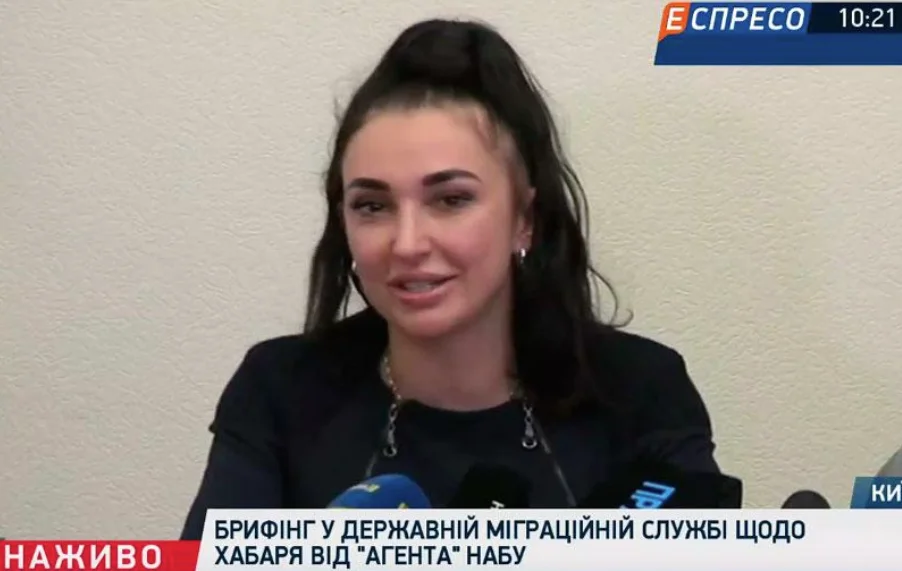
Dina Pimakhova comments on the detention of the NABU agent. Screenshot from the "Espreso" TV channel
How NABU tracked down Pimakhova and why the theory of a provocation didn't hold up
The defence insisted that the investigation into Pimakhova had been opened without grounds, and that she herself had "constantly expected provocations". As evidence, the defence cited a statement she had sent to the Prosecutor General’s Office, the Security Service of Ukraine, NABU and the National Agency for Corruption Prevention in December 2016: she claimed that an unknown person had warned her that a provocation was being prepared against her.
However, the court reconstructed the chronology of events. As far back as November 2016 the NACP had received a report alleging that, whilst holding previous senior posts at the Migration Service, Pimakhova had organised the illegal processing of documents for foreigners in exchange for $25,000–100,000. She submitted her statement only after she had learnt that the State Migration Service was investigating this tip-off. The court regarded this as an attempt to create an alibi for herself in advance and emphasised that such actions on her part do not confer immunity from liability.
According to the court’s findings, the criminal investigation was lawfully opened in June 2017, based on operational reports concerning a group of State Migration Service officials, judges and intermediaries who allegedly legalised the status of foreign nationals in exchange for money by fabricating family ties.
"We’ll forge it": how Pimakhova spoke to a NABU agent in the first episode
Records of covert investigative operations, cited by the court in its judgement, showed that from the very first meetings, Pimakhova did not merely offer advice but actually organised the scheme.
Back in June 2017, at ‘Goodman’, upon hearing about a Vietnamese man, she immediately asked: "That’s our most difficult category. What’s needed?". Instead of refusing, the official herself offered a temporary residence permit for $1,800 through a fictitious employment arrangement and assured him of her influence: "Whether they approve it or not, we’re not going anywhere. We’ve got people who’ll always sort things out for us. Any issue can be resolved." And when it emerged that the foreigner had no degree, she promised without hesitation: "We’ll forge one".
The handover of money near Lviv’s "Fashion Club" was particularly telling. Upon seeing the cash, the official immediately began acting suspiciously and fabricating a cover story: "Are you trying to give me money here? What are you even thinking?.. They'll beat us up right now and we won't even make it home... Money doesn't change hands like that in Ukraine... People can get killed here for two thousand... Maybe you're my lover and you're giving me money for the evening... I asked you for money for lipstick." Later, at ‘Suluguni’, she even gave her personal guarantee: "We take responsibility for our questions... Even something happens suddenly, first of all, I’ll return the money." For the court, this constituted clear evidence of bribery.
"This is our turf": how Pimakhova spoke to the NABU agent in the second episode
In the court’s view, the meeting at ‘Nochi’ in late August 2017 showed that there was no provocation, as Pimakhova herself had devised the scheme for the Iranian businessman. Upon learning that he had no grounds for citizenship, she took matters into her own hands:
"We can set him up with one of those interesting schemes. We already have one. The only one... We'll make him a relative... we'll see what we can tie him to. We'll get a court order, do a DNA test... That's the only one. But it's expensive... It’s a hefty sum. Everything’s done so smoothly that, you know, you can’t find a loophole. Let me put it this way: well, thirty is the minimum. That’s without any special… Tell him thirty. If he says yes, then yes. If not, then there’s no point—it’s not worth it economically at all."
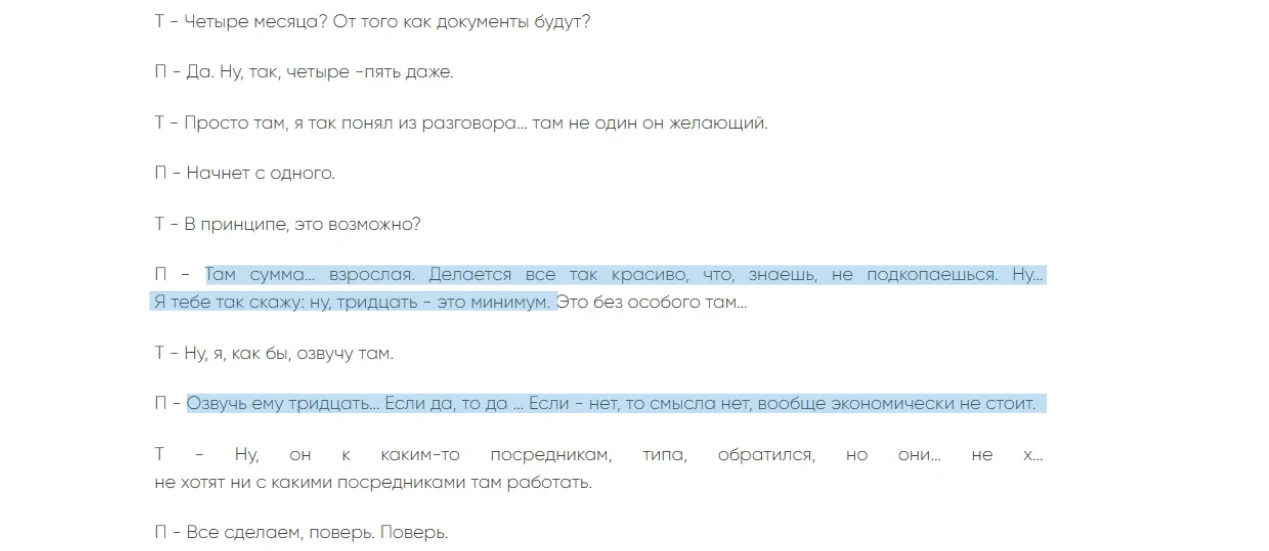
The official described her capabilities as follows: "We’ll sort it out… through the Presidential Administration we’ll speed things up… that’s our remit" (she meant that citizenship documents pass through this body). Later, at ‘Suluguni’, when asked directly by an agent, she confirmed both the amount and the currency without hesitation: "Thirty… dollars".
The plan fell apart: how information about the operation was leaked
Censor.NET reported back in September 2021 on how the operation fell through, citing declassified materials from the investigative case: NABU did not have the authority to conduct independent wiretapping, so it obtained information from Pimakhova’s phone through the SSU. In August 2017, an employee of the SSU’s Internal Security Department, who was overseeing this procedure, learned of the wiretap and reported it to his superiors, after which the SSU decided to warn the suspect. This employee is also mentioned in the verdict.
In mid-September, SSU officers came to Pimakhova’s home, told her about the undercover detective, showed her his photo, and advised her to write a statement claiming she had been offered a bribe. As evident from the correspondence cited in the verdict, on September 17, Pimakhova wrote to the agent: "I have an emergency—the authorities are here, my place is being searched... Leave so there won’t be any problems." The next day, she tried to downplay the situation: "The doorman got it mixed up and said they came to see me, but they weren’t here to see me. So everything’s okay."
After that, she began avoiding meetings, and on September 26, she filed a report with the SSU stating that an acquaintance had allegedly offered her a bribe of $30,000. The court noted the inconsistency of this behavior: an official who headed the commission for assessing corruption risks at the State Migration Service and who was allegedly constantly on the lookout for provocations had freely discussed shady schemes with an agent for several months, and after the "provocation" in late August, she waited another full month. She contacted the Security Service of Ukraine (SSU) only after being warned that her calls were being tapped, although the court ruled that her statement was an attempt to evade responsibility. And in late November 2017, the SSU detained the NABU agent based on her statement.
The parties’ positions in court
The prosecutor insisted that Pimakhova’s guilt in both incidents had been fully proven. Given her financial motive and her status as a ‘Category A’ official, the prosecution sought a 10-year prison sentence for her, along with a three-year ban on holding senior positions and the confiscation of her assets.
Pimakhova herself categorically denied the charges and insisted that she had no authority to register foreign nationals and had not been involved in such activities, but had merely provided the agent with standard legal advice. According to her, even before her appointment to the post, she had been under pressure from a representative of the Presidential Administration, so she was constantly expecting provocations and had written statements to the law enforcement agencies in advance. She considers the case to be fabricated.
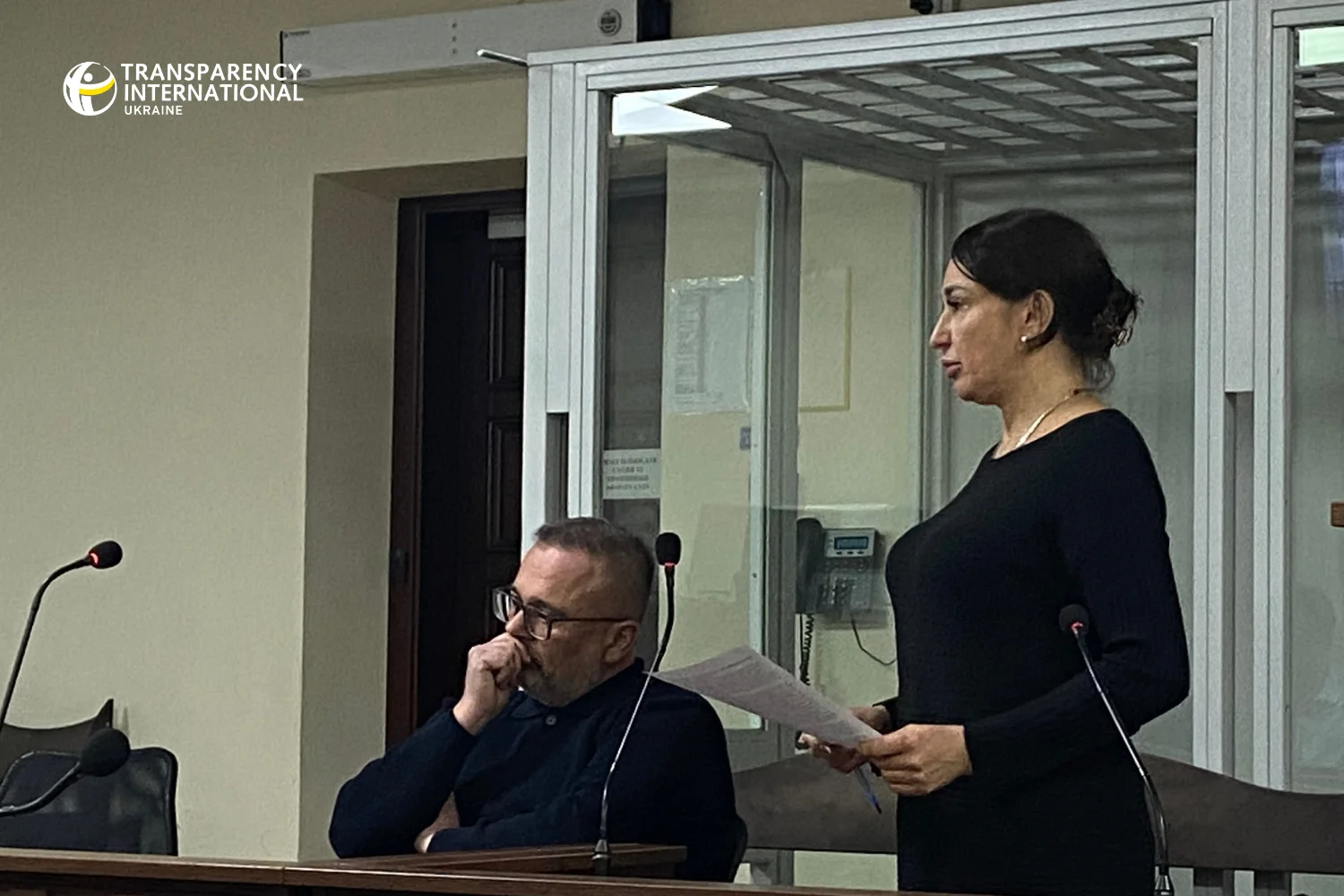
Dina Pimakhova at the High Anti-Corruption Court. Photo: TI Ukraine
The defence lawyer requested that Pimakhova be acquitted. He alleged bias on the part of the investigators and a lack of legal grounds for conducting investigative actions, whilst also insisting that this was a classic bribery sting: an undercover detective had set traps, shown excessive initiative and played on her sympathies. Due to these and other irregularities, the defence lawyer demanded that all evidence be declared inadmissible.
What conclusions did the court reach?
The High Anti-Corruption Court panel found Pimakhova guilty in both instances. The court rejected the arguments regarding her lack of authority: for liability under Article 368 of the Criminal Code of Ukraine, it is sufficient to have used the authority of one’s position and connections within the department. Furthermore, in 2017, Pimakhova stood in for the head of the State Migration Service and the relevant deputy for a total of 118 days, meaning she had direct authority to make decisions regarding citizenship and residence permits.
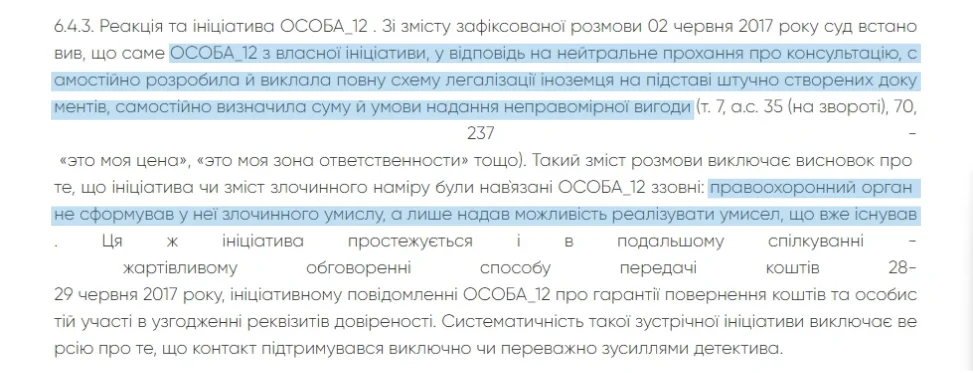
The court rejected the claim that this was a provocation by the National Anti-Corruption Bureau (NABU), agreeing with the detective: it was Pimakhova herself who proposed the schemes, named the sums and promised to forge documents. This was also confirmed by linguistic analyses, which identified signs of a willingness to accept a bribe specifically in the official’s speech. Furthermore, the court noted that the case against the NABU agent, which had been opened following a complaint by Pimakhova, had been definitively closed due to the absence of a criminal offence; denying the offence itself whilst simultaneously claiming it was a provocation constitutes incompatible lines of defence.
Ultimately, Pimakhova was sentenced to nine years’ imprisonment, with a three-year ban on holding public office and the confiscation of all her property. However, the court did not remand her in custody, taking into account her exemplary conduct during the proceedings and her strong social ties. Until the sentence becomes final, Pimakhova remains subject to personal obligations: she is not permitted to leave the country and will not have access to foreign passports.
Dissenting opinion on the verdict
Oleh Tkachenko, a judge at the High Anti-Corruption Court, disagreed with the verdict and issued a dissenting opinion in which he insisted on Pimakhova’s full acquittal. In his view, the case does not constitute bribery, the provocation has not been refuted, and the evidence is inadmissible.
The judge considers that, for liability under Article 368 of the Criminal Code of Ukraine, a public official must act in the interests of a real person. However, the NABU agent was carrying out a special assignment, and the Vietnamese and Iranian citizens for whom the documents were being prepared were fictitious characters with forged documents created by the investigation. Furthermore, the judge considers it unproven that Pimakhova received $1,800 in the first episode. And, in his view, the prosecutor failed to refute her prior statements regarding a possible entrapment and contacts under the control of the Security Service of Ukraine (SSU), which points to entrapment by law enforcement agencies.
The judge cited the ‘fruit of the poisonous tree’ doctrine as the decisive argument for acquittal: if evidence was obtained unlawfully, then everything derived from it is also inadmissible. The decisions to deploy an agent and carry out operational and investigative measures were taken by a detective, not by the leadership of the operational unit, and without notifying the prosecutor. However, the majority of the panel of judges did not examine these procedural points in detail in the judgement. The court merely noted that all orders and court authorisations were in place, the agent’s status was confirmed by an order from the director of the NABU, and the covert operations themselves complied with the requirements of the law.
The agent himself, according to the judge, confirmed during questioning that he did not have access to state secrets, had not seen these orders, had not read the final reports, and had not passed on any information that the detectives had recorded on his behalf. At the same time, in accordance with established practice of the Supreme Court, the law does not require individuals involved in carrying out operational tasks to have access to state secrets. They are merely obliged not to disclose information that came to their knowledge during the operation; therefore, they are not required to be familiar with classified rulings.
Due to these violations, as well as the absence of the original court orders authorising the wiretaps, the judge has deemed all the evidence gathered – from the audio recordings to the transfer of money – to be inadmissible. If the verdict is appealed, Pimakhova will remain at liberty at least until the High Anti-Corruption Court’s Appeals Chamber has reached a decision.
Oksana Kopiichuk, legal adviser at Transparency International Ukraine


