


"We are talking about at least 3.9 million people who died as result of Holodomor. At least!" – Lesia Hasydzhak, Director-General of Holodomor Museum
"We entered 2022 with colossal reputational damage, as our Museum was perceived as a place where history is falsified. Rectifying this is a massive undertaking," says Lesia Hasydzhak, Director General of the Holodomor Museum.
In contrast to other memorial institutions of national importance, the National Museum of the Holodomor-Genocide has been spared high-profile scandals concerning its construction or the allocation of land. However, for several years now, the Museum has been under attack from an unexpected quarter.
In the summer of 2023, a smear campaign began targeting the appearance of Lesia Hasydzhak, then acting director-general – the claim being that the Holodomor Museum could not be led by someone who was ‘overweight due to overeating’. This was later compounded by accusations that Ms Hasydzhak was "underestimating the number of Holodomor victims" and "concealing the truth about the Holodomors of the 1920s and 1940s". Around the same time, voices were also heard arguing that, during the war, it was not the right time to complete the Holodomor Museum, which was already a long-delayed project. Whilst the smear campaign continues on social media, it is well known how propaganda can exploit social media.
So what is triggering those who are attacking the Museum? The Museum’s previous administration, in particular its then Director-General Olesia Stasyuk, upheld the figure of 10.5 million victims of the Holodomor, claiming that anyone citing a lower figure was an "agent of Moscow". Under her leadership, the Museum also referred to the man-made famines of 1921–22 and 1946–47 as ‘Holodomors’. This outraged many historians and demographers, who consider such figures to be unfounded and to discredit Ukraine as a state, as well as undermining international recognition of the genocidal nature of the Holodomor. After all, fabricated figures could lead to accusations that the actual facts of the genocide are also fabricated.
Upon taking charge of the museum in 2022, Lesya Hasydzhak reinstated the figure for deaths from the Holodomor—at least 3.9 million people, as substantiated by demographers—into official records, whilst recognising the repressions of 1932–33 as an exceptional tragedy and genocide. Nearly 4 million deaths is a horrific figure and requires no artificial inflation, she says. However, this is the lower limit. Research into the upper limit is ongoing, using scientifically accepted methodologies.
Therefore, today, on the Day of Remembrance for the Victims of the Holodomor and the man-made mass famines of 1921–23 and 1946–47, we are having this conversation not only to honour the victims and commemorate the genocide. We want to understand whether the campaign to discredit the Museum is affecting its work and whether it is an attempt to permanently derail its construction, even when funded by donors. Censor.NET asked Lesya Hasydzhak about the completion of the museum, the return to official rhetoric based on scientifically verified data, as well as new sources on the Holodomor and what new insights they might reveal about the events of 1932–33.
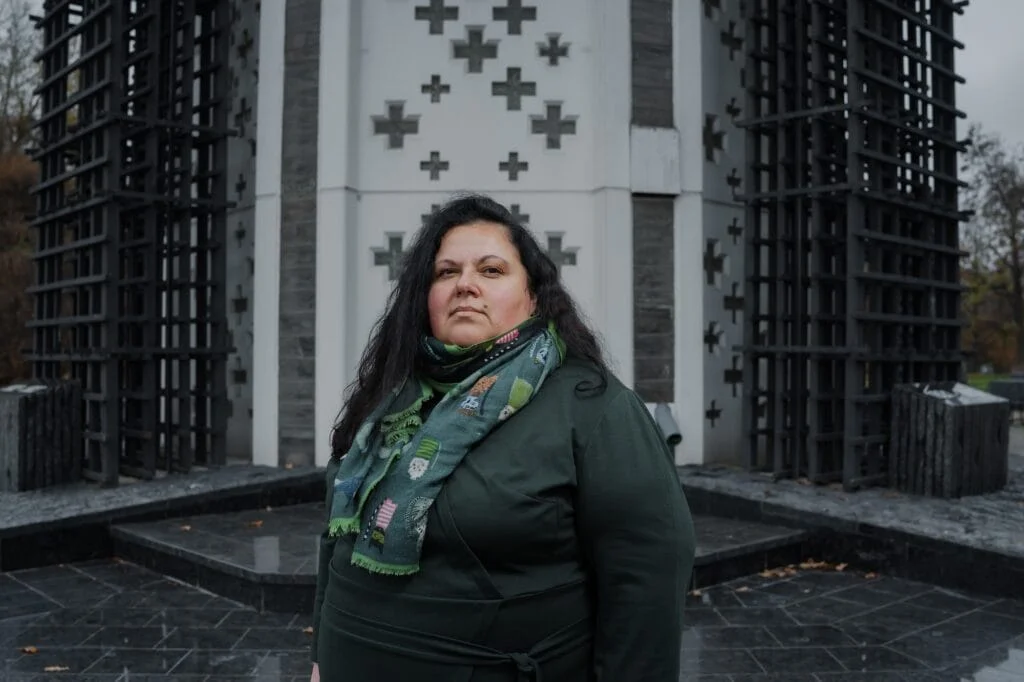
AFTER 2022, CONSTRUCTION OF THE MUSEUM IS ON HOLD, BUT OFFICIALLY THIS IS NOT A SUSPENSION OF WORK
- The Holodomor-Genocide Museum has avoided the high-profile conflicts of the sort we saw during the construction of several other memorial sites of national significance. Consequently, the general public is largely unaware of the current stage of construction of the museum’s second phase. Until 2022, it was a priority for the government; however, as far as I understand, it is still not complete.
- That’s right. We haven’t had a single scandal since construction began in 2017, because the project has been, and remains, a Ukrainian and state-led initiative from the outset, and for everyone involved in its implementation at various stages, this has been and remains the most important thing: not to defile it in any way, as this is a museum dedicated to the memory of something sacred.
Due to the major war, work is currently on hold. After all, Russian missiles and other deadly Russian debris are flying over it and over us too, and fragments of this debris are falling on our territory as well. Officially, this is not conservation, as no conservation work has been carried out. Consequently, the unfinished building simply stands there, awaiting the end of the war, when the state – or the state with the involvement of investors, or perhaps investors or benefactors brought in by the Supervisory Board – will resume construction and complete it.
- If we were to estimate, what percentage is complete, and how much remains to be done?
- The client for the construction is not the Holodomor Museum itself, but a specially established legal entity – the Construction Directorate. Why is this the case? Because the Museum’s organisation has never had, and still does not have, architects, engineers, structural engineers or other specialists capable of coordinating or supervising the construction work.
That is why, at the time, the Ministry of Culture set up this Directorate, which has been managing the construction project since 2017. When you ask me about the figures, I can speak with reference to the data provided by the Directorate. The head of the Directorate says that the building is currently 70 per cent complete. But that refers to the building itself; there is also a huge separate area of work – engineering, electrical systems, water supply and the rest of the utilities. In addition, interior finishing work still needs to be carried out. And then there is a separate, massive part of the work – the main exhibition.
- If no conservation work has taken place, how safe is it for what has already been done? What do the technical experts say about this?
- That’s a complex question. To preserve the building, a conservation project is required, which will also be costly. And then funds are needed to carry out the conservation work itself. It would be better to discuss this issue in more specific and detailed terms with the Construction Directorate…
- Taking the part of the Museum that has been operating for a long time, how would you rate the provision of resources?
- We’re funded in the same way as other museums. You can look at this in different ways – like the story of the optimist and the pessimist. If it weren’t for the Armed Forces of Ukraine and if it weren’t for the state, perhaps all of us who remain would be living in dugouts and just scraping by. But thanks to the Armed Forces of Ukraine, the state, the state’s partners, and the heavy price paid by those who support us, we are able to work and live. We receive a salary, and the state, through the Ministry of Culture of Ukraine, also provides us with security and covers our utility bills. For our project activities and development, we are already securing grants and other forms of non-state funding, and we are channelling funds from a special fund—that is, revenue from the sale of museum admission tickets and the provision of paid services.
THE SECOND PART OF ENGINEER BERMAN’S LETTERS HAS BEEN TRANSFERRED TO THE MUSEUM’S COLLECTION. THIS IS A UNIQUE SOURCE ON THE HOLODOMOR IN INDUSTRIAL CITIES
- Looking back at the period from the early 1990s, it is clear just how much work has been done by academics, museums, and the civil society sector in researching the Holodomor and uncovering the truth about it. But it is clear that academic work continues, and research is also ongoing at the Holodomor Museum. What are some of the most relevant recently discovered sources or facts that you could mention?
It is not only the National Museum of the Holodomor-Genocide that is engaged in researching the history of the Holodomor, but also many other institutions and individual researchers. The Holodomor Museum has never monopolised this subject for itself, and, of course, will not do so. And that is excellent, because every year new researchers enter the field, each with their own perspective.
- What are the museum’s researchers currently working on? Which new exhibits would you highlight?
- It is the collection that makes a museum, so the primary task of any museum is to build, preserve, research, and exhibit its collection. Therefore, first and foremost, the research staff study the museum’s own collection, but they also work on the subject of the Holodomor in the broadest sense, examining even the smallest details and drawing on various sources to do so.
Senior Research Fellow Andrii Ivanets has conducted research into the jewel in the museum’s collection – a painting by the Argentine artist of Ukrainian origin, Viktor Tsymbal, which is considered the world’s first work of art on this subject and which belongs to our collection. He is currently developing a broader theme – reflections on the Holodomor in art. Meanwhile, the museum’s agenda includes the task of preparing a catalogue of the art section of the museum’s collection.
Senior Research Fellow Andrii Kozytskyi has prepared a manuscript for a monograph on the subject of ‘Famine as a Weapon’, as current events demonstrate the relevance of such research: Russia continues to employ this tactic, first tried during the first man-made famine of 1921–1923, because hungry people are easier to control and subdue.
The work also addresses the colonial famine of 1921–1923, which I have already mentioned, as well as an examination of the regional characteristics of the processes of collectivisation, dekulakisation and grain requisitioning – a line of research initiated and successfully completed, using the Dnipropetrovsk region as a case study, by our leading research fellow, Dr Natalia Romanets, Doctor of Historical Sciences. Historian Inna Shugaleva is researching childhood during the Holodomor. Historian Mykhailo Kostiv devotes considerable attention to theory and individual figures in his research.
Historian Kateryna Lukianets, PhD in History, has collaborated with Svitlana Starovoit to prepare an archaeographic edition of the letters of engineer Jerry Berman, which form a valuable collection in our archives. The publication is currently undergoing final editing and peer review. We hope to translate and publish it in English. It is important not to become insular, because if we want the world to know about us, we must speak in languages that the world understands.
Berman graduated from the University of Cape Town with a degree in bridge engineering. In his search for work, Jerry first travelled to New York, where one of his brothers was already living. However, the Great Depression had already begun in the US, and he was unable to find a job. Jerry Berman read in the newspapers that bridges were being built in the USSR and that foreign specialists were being invited to work there. So, in 1932, Engineer Berman found himself in the Donbas, where he took part in the construction of a bridge in Stanytsia Luhanska. Whilst working there, Mr Berman wrote letters to his family. In 2020, the heiress of Jerry Berman, who had by then passed away, brought these letters to Ukraine and donated them to our museum collection; this year, she added a second batch of letters that had been found. This is an extremely valuable source of information on the history of that period and that region.
- If they were donated to your museum, are there quite a few references to the famine in them?
- These letters are an interesting historical source because Berman often describes working conditions and daily life from a foreigner’s perspective. We have no equivalent to this source here in Ukraine, nor have we had one so far. Our colleague, the highly dedicated academic researcher Kateryna Lukianets, managed to track down the contact details of a relative of one of the engineers who worked with Berman in the Luhansk region. So it turned into an intriguing historical tale – a detective story, if you will. Ms Lukianets also drew on materials from an Italian archive.
High-quality academic work is a lengthy process that requires time and careful reflection. I hope that when we publish this volume, it will serve as one of the building blocks in filling a major gap in history – life in industrial cities and towns during the Holodomor. After all, many people fled from the villages to industrial towns to hide there and find safety. And the question is: was there really ‘honey’ there? Was it really that easy?
- Was it ‘a land of milk and honey’ there?
- There were ration cards and rationed food; it was a little better than in the village, but by no means easy. Jerry Berman writes about inequality because, as a foreigner, he enjoyed more privileges than the ordinary workers labouring alongside him.
- Such a publication is also important for people or politicians who are campaigning for the Holodomor to be recognised as genocide.
- Recently, at the Ministry of Foreign Affairs, in collaboration with the Ministry’s Diplomatic Academy, we presented another of our publications to the diplomatic corps accredited in Ukraine – *The Holodomor: Key Facts*, prepared by our researchers Mykhailo Kostiv and Andrii Kozytskyi. It concisely explains not only the background and causes of the Holodomor, but also clarifies why it constitutes genocide. This answers the question that is most frequently asked: why is its recognition important to Ukraine, and why is it so relevant today, during the war?
We have published this booklet in fourteen languages, selecting the working languages of the UN, as well as the languages of those countries which have not yet recognised the Holodomor as genocide but are currently a priority in Ukraine’s international policy. Specifically, these include Spanish, Turkish, Greek, Serbian, Bulgarian, Norwegian and Swedish. In other words, we are not stopping. And that is precisely why we invited the diplomatic corps to the presentation. Firstly, to invite them to the museum once again; and secondly, to remind them that they can always turn to us should there be a request from their countries for information or clarification.
And, of course, these publications are intended for our diplomats abroad, as they regularly need such materials when asked to provide data on the Holodomor to the parliament or other state bodies in the countries where they are posted. Ideally, we need to publish several such publications, each covering different aspects of the Holodomor in foreign languages.
No professional demographers have ever worked at the museum, nor have any demographic studies been carried out there.
- The Museum’s website currently states that the number of deaths from the Holodomor was ‘almost 4 million’ – these figures are scientifically substantiated by demographers. You effectively reinstated this figure when you became the Museum’s director. Furthermore, the Museum officially recognises only the Holodomor as genocide; the events of 1921–23 and 1946–47 are referred to as ‘mass famines’. This is in contrast to the situation under the previous director, when a figure of 10 million victims was promoted, and many academics opposed such an inflated estimate.
At the same time, it is hard not to notice the smear campaigns against you – claiming that you have allegedly downplayed the number of victims and the significance of the famines of the 1920s and 1940s. How would you comment on this?
- All I can say is that I have learnt to carry on with my work despite all these campaigns, because I do not see my work as causing any harm to science or to Ukraine, nor do I see it as constituting any kind of violation. Like the National Museum of the Holodomor-Genocide, I cite the demographic losses from the Holodomor with reference to research by a specialist academic institution – the Institute of Demography. After all, professional demographers have never worked at the museum, and no demographic research has been carried out there. Based on the findings of demographers, we state that at least 3.9 million Ukrainians died in the Holodomor. At least! We are working to determine the exact number of those who died. Every day. Recording oral history, searching for names in the archives, step by step. And we constantly emphasise: the research is ongoing. Full stop.
As for the alleged ‘downplaying of the significance of the famines of the 1920s–1940s’ – this is just as much nonsense as everything else. It is the result of widespread ignorance, over which I have no influence and which I cannot control. Like all academics, I ask and insist that the correct historical terminology be used. ‘Holodomor’ is the specific name for the genocide committed against the Ukrainian nation in 1932–1933 by the communist authorities following the occupation of Ukraine, the main instrument of which was an artificially created famine. The genocide of the Jewish people during the Second World War has the same specific name – the Holocaust – as does the genocide of the Crimean Tatar people – the Sürgünlük in 1944, which until recently we referred to as a deportation, but which is now defined as genocide.
We regard the famine of 1921–23 as an artificial colonial famine, perpetrated in Ukraine by the Communist Bolshevik authorities with the aim of breaking resistance and halting the insurgency that was still ongoing in a Ukraine that was already almost entirely under occupation. This famine was fundamentally caused by drought and crop failure, but the Communist occupying authorities exploited the situation to inflict punishment by withholding aid from Ukraine and diverting grain to the Volga region. So, yes, it was an artificial famine; yes, it was on a massive scale; and yes, it was a crime. However, it is incorrect to refer to it by the specific name given to another event: the genocide of 1932–1933. The same applies to the post-war famine of 1946–1947.
And, in fact, that is why we commemorate 28 November as the Day of Remembrance for the Victims of the Holodomor – that is, the genocide – and the man-made mass famines of the 1920s to 1940s. In other words, we draw a very, very clear distinction. There is no downplaying, no disregard or forgetting involved.
Here at the museum, we are working to ensure that the name of every person who was killed during that time is made visible. Because these invisible, nameless millions represent a lack of respect for these people.
And it is an unfair accusation that we are downplaying their memory or forgetting them.
- Since you reintroduced this academic terminology into the Museum’s official discourse, do you feel that attitudes towards you as an institution have improved? Particularly amongst Western academics, whose stance is crucial for the recognition of the truth about the Holodomor worldwide. In the academic sphere, relying on verified data usually inspires greater trust.
- Of course, I do. The Holodomor Museum entered 2022 having suffered enormous damage to its reputation, as a place where history is falsified (I am referring to the so-called expert assessments that never took place), plagiarism is produced, and academic misconduct is permitted. When I approached the Institute of History of Ukraine of the National Academy of Sciences of Ukraine in the autumn of 2022 with a proposal to sign a Memorandum of Cooperation and to assist us with an independent external review of a single work, the director agreed to help with the review but refused to sign the Memorandum. It was a wake-up call and a realisation of where we stood, thanks to the former director, Olesia Stasyuk.
A great deal of work was then done to streamline our academic activities. The first to leave were the ‘researchers’ who, in two years of employment, had done nothing for the museum or for science; at most, they had published articles in newspapers. I am prepared to name them and produce the reports… But that would mean getting back into the mire. Among them was Olesia Stasyuk’s opponent during her thesis defence, for example. This is categorically unethical, as an opponent and a doctoral candidate cannot be in any employment or financial relationship.
Separately, I’ll briefly respond to yet another accusation – that of the liquidation of the so-called ‘Holodomor Research Institute’, which was part of the museum. There was no such institute; there wasn’t even a branch. There was a department – an ordinary department – which was called the ‘Institute’ branch. By the same token, one could have called the department – excuse me – a ‘ministry’ or a ‘university’. Consequently, my team and I brought the structure into line with the regulations. That is all. But everyone who was working there is still working. Those who wanted to retire or could no longer pretend to do academic work resigned. The museum is funded by taxpayers’ money, and I feel a responsibility to ensure that every hryvnia paid brings tangible results for the state.
- Viktor Yushchenko is a member of the museum’s Supervisory Board. Despite the fact that he is the driving force behind this museum, it was during his term in office – and partly due to his involvement – that the figure of 10.5 million deaths was also repeatedly emphasised. Today, this is explained away as a typographical error in the sources. Have you spoken to him personally regarding research that produces different figures?
- We have not yet had the opportunity to discuss this topic with Viktor Andriyovych. Viktor Yushchenko is a man without whom the subject of the Holodomor would not have become either a key aspect of national memory policy or a key aspect of state policy in Ukraine. Without Viktor Yushchenko, there would be no Holodomor Museum, no National Book of Remembrance of the Holodomor, nor anything else that has been achieved in this field, for it was he who provided the impetus. Viktor Andriyovych is accountable for the figures he cites and has his own rationale for them. But he is a politician, and society holds him to account as such. As for the museum, however, the expectations regarding this subject are those of a scientific institution.
WE REALISED THAT WHEN THE LAST EYEWITNESSES DIE, WE WILL LOSE INFORMATION ABOUT THE BURIAL SITES OF THE HOLOCAUST VICTIMS
- On your website there is a ‘Burial Registers’ section – certain settlements are marked with black crosses on the map. Are these the graves of specific individuals, or mass graves? After all, in almost every village there are graves from the time of the Holodomor in the old cemeteries.
- We began by sending requests to village councils asking them to provide information on the burial sites of Holodomor victims. It is common knowledge that during the Holodomor, the deceased were buried in communal graves at the edge of the cemetery, to which people were taken by an individual specifically appointed by the village council. Depending on the village and the number of deaths, there might have been one, two, three, or four such pits. By the time we embarked on this project, in some villages (and this was also a result of state policy during Yushchenko’s presidency) these sites had at least been marked, with memorial plaques erected there.
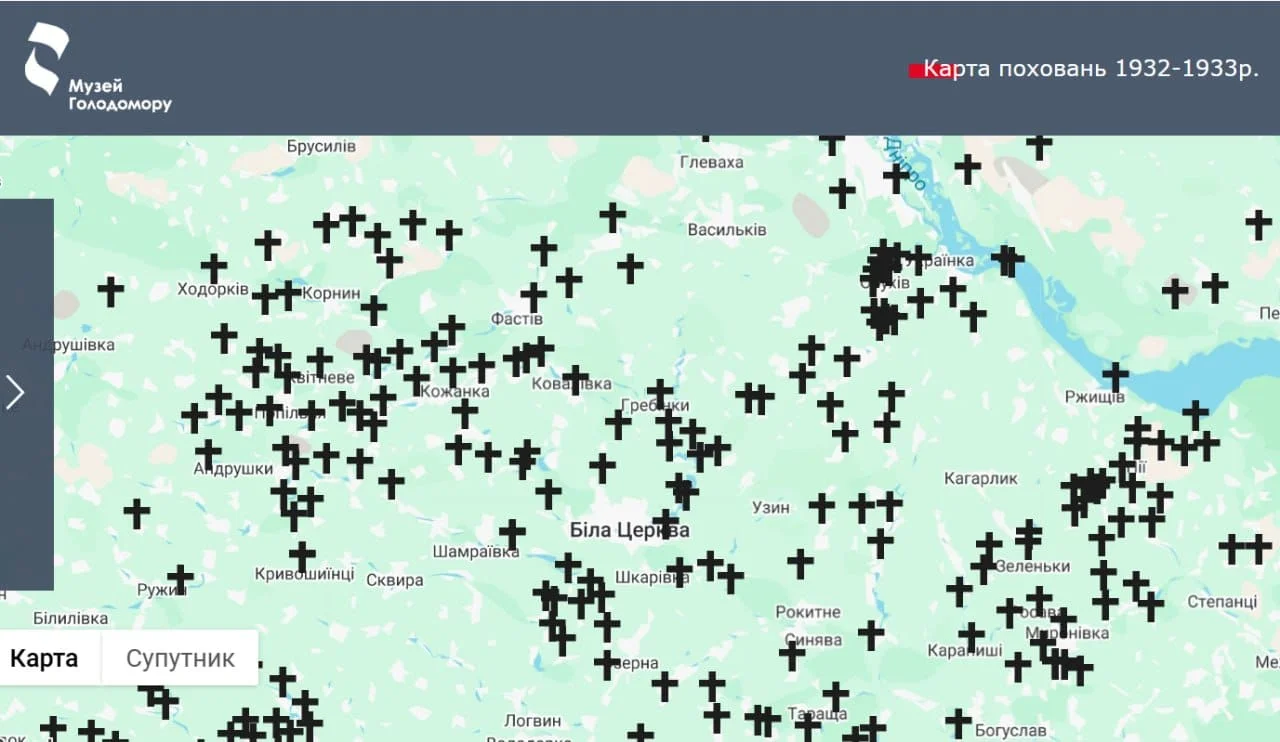
In other villages, there were elderly residents who knew that there were burials from the ‘famine’ period, as people in the village usually called it, but these sites were not marked in any way. We realised that once the last witnesses had passed away, we would lose this information. And so the idea arose to gather all possible information about the sites of mass graves and plot them on a map. It was a grant-funded project from the Ukrainian Cultural Foundation, overseen by our head of the Holodomor Oral History Department, Yulia Kotsur.
- Judging by the map, I imagine you didn’t receive responses from every village council.
- The responses varied greatly: some people took their responsibility very seriously, providing information, taking photographs, gathering several testimonies to confirm that there were indeed graves there, and supplying geographical coordinates. With others, however, we had to follow up and practically beg for a response.
Some of these sites were documented by colleagues during expeditions aimed at recording eyewitness accounts of the Holodomor and searching for artefacts of museum significance linked to the Holodomor.
There are currently around a thousand such sites on the map. The figures are constantly changing; I believe the latest figure was 1,180. These sites are in varying states of repair today. And, of course, it is now time to establish a separate department within the Museum to liaise with local communities to ensure that these memorial sites are properly maintained.
- So, if a village council has taken this matter very lightly and failed to provide you with the data, then they won’t appear on the map. A thousand across the whole of Ukraine is clearly not the full picture. So, is there still more to be found?
- Yes, we’re also doing this on our own. For example, if a village council hasn’t provided information, but colleagues on an expedition record the testimony of someone who points out a location in a cemetery, then we start looking for more information ourselves. Colleagues may travel out to document the site further, or they may search for materials in the archives. In other words, we do this as far as we’re able, but our resources aren’t that extensive.
MY DREAM IS TO HAVE A SPECIALIST ON THE MUSEUM’S STAFF WHO WOULD RESEARCH THE FAMINE IN KAZAKHSTAN
- The next question concerns conveying information about the Holodomor to the world. This process is gradually gaining momentum, with more and more states officially recognising the Holodomor. You organised the event ‘From Rwanda to Brazil’. Do you tailor your messaging to specific countries based on their cultural characteristics? How should we discuss this to convey our position?
- This year, we are fortunate to be working alongside our Canadian colleagues as part of an international technical assistance project funded by the Canadian Ministry of Foreign Affairs. This project is being implemented by Covater International in collaboration with the Canadian Ukrainian Foundation, and we are the beneficiary of this project. The entire project is aimed at helping the Holodomor Museum to improve and achieve what we could not have done without financial and partnership support. This is how the idea arose to prepare an exhibition on the Holodomor and showcase it in one of the countries of the Global South.
This is because the Global South is currently a priority in Ukraine’s domestic and foreign policy. To determine which country would be the best destination for this exhibition, a media campaign was organised, which lasted for a month. It aimed to gauge the level of knowledge of the history of the Holodomor and the level of sensitivity to this topic amongst the public in 13 countries of the Global South. The results showed which countries knew more about the Holodomor and which knew less, and in which countries there was a greater reaction; this reaction helped us to gauge the level of interest.
Based on the results, Brazil was chosen as the country for the presentation. The project team, led by Deputy Director-General Olga Melnyk, decided to address the audience through the language of art. After all, it is a universal language. Consequently, the curatorial team under her leadership—comprising Mykhailo Kostiv, Oksana Barshynova and Oleksandr Burlaka—created the exhibition ‘I’ll Tell You Stories from Ukraine’. Its launch took place on 21 November in São Paulo.
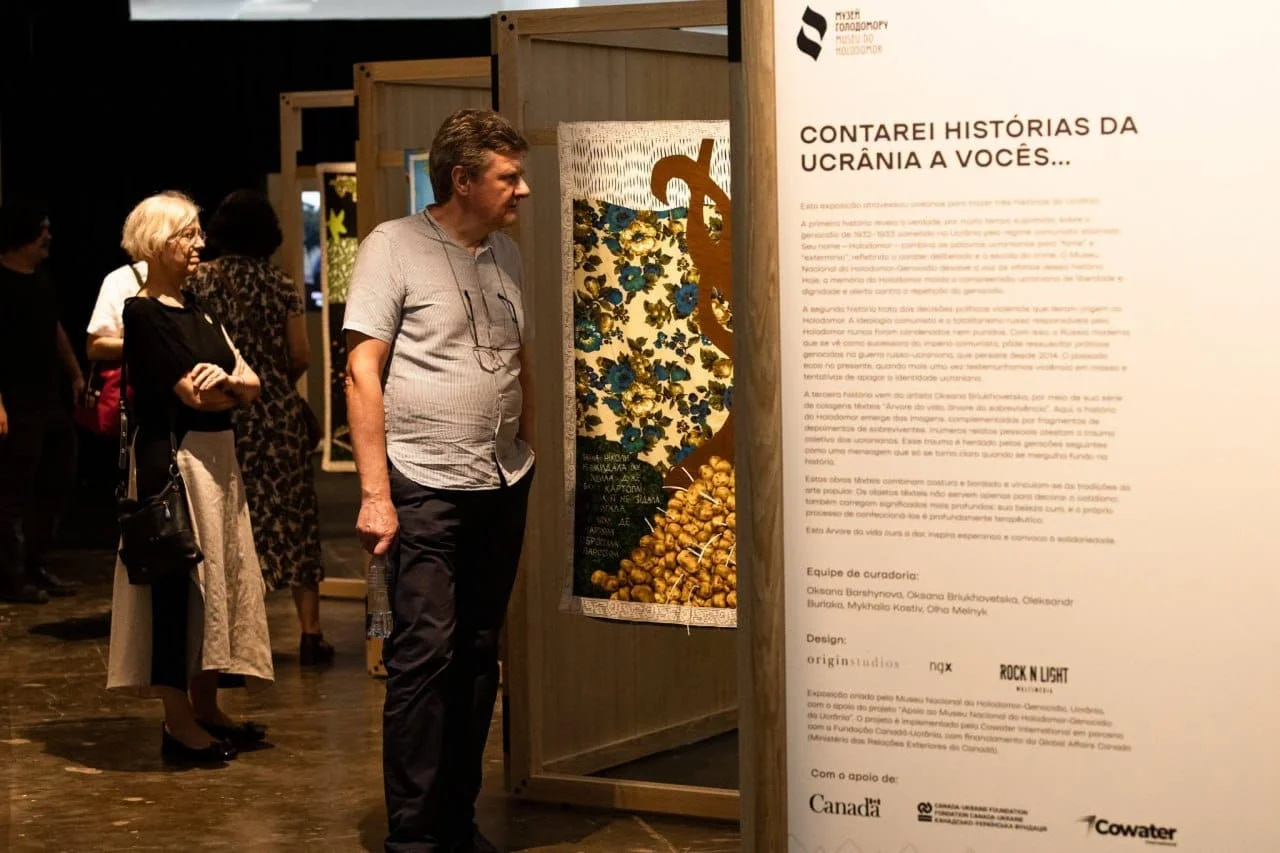
The exhibition comprises several media elements – stories about Ukraine, the Holodomor and the work of the Holodomor Museum today. But the core of the exhibition consists of Oksana Bryukhovetska’s artworks, created in the patchwork style, in which the artist has expressed her reflections on the history of the Holodomor.
I am very grateful to my colleagues and proud of them, as this is the first Ukrainian museum exhibition project in Brazil since independence.
- The complex issue of the famine in Kazakhstan in 1932–33, known there as Asharshylik. As far as I am aware, there is a hypothesis that this too was genocide. However, research into this tragedy is not as active as that into the Holodomor. In Kazakhstan, even a film about the famine of the 1920s, made by a Kazakh director, faced enormous difficulties in getting released, with the final credits referring to the victims of Asharshylyk being forced to be removed.
Would the Holodomor-Genocide Museum have sufficient resources to research the famine in Kazakhstan?
- Unfortunately, the museum currently has no specialist on its staff who researches the history of the famine in Kazakhstan. Although that is my dream. That is why, several years ago, I set up a department for the study of genocide, crimes against humanity and war crimes – so that we could research and discuss other genocides, other crimes committed by the Russian Empire, Russia and other totalitarian regimes, as well as international law in this field, and so on. But I am an optimist and believe that this will not always be the case.
- I’d like to move away from the Holodomor itself and talk about the harassment regarding your appearance that took place in 2023. If we look at who was behind it and how it was carried out, and link this to the smear campaign against the Museum—alleging that you are supposedly underplaying the number of deaths from the Holodomor—then there is a suggestion that this is all part of a single campaign to discredit the museum. Have you given this any thought?
- The only thing I can say with absolute certainty is that those who are involved in this and those who fall for it are wasting their time. All this mudslinging goes right over my head; it doesn’t affect me in the slightest. Not one bit. My team at the museum and I have so many ambitious plans, so much support and so much goodwill from the people around us that whether this is a single campaign or a series of them simply doesn’t matter.
Olha Skorokhod


