



Defense Ministry updates procurement mechanism for fiber-optic drones to ensure uninterrupted frontline supply
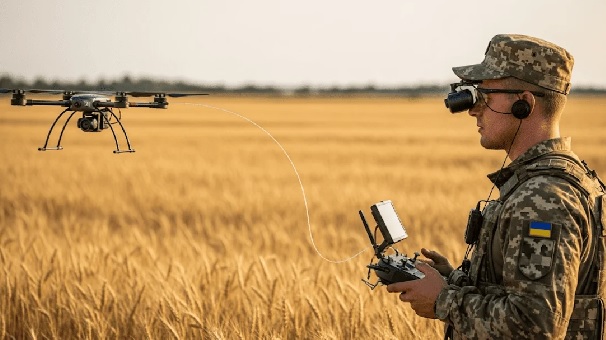
The Ministry of Defense has updated its approach to procuring fiber-optic drones in order to guarantee a steady supply of UAVs to the front amid sharp price fluctuations for key components.
This was reported by the Defense Ministry’s press service.
"Fiber-optic drones are a critically important tool on the battlefield. They operate under electronic warfare conditions and ensure stable communication in difficult environments, which directly affects the effectiveness of units," the ministry said.
Supply dynamics confirm that this area is a priority: during 2025, 374,000 fiber-optic drones were delivered under State Operator for Non-Lethal Acquisition (DOT) contracts, and as of April 2026, the military had already received more than 92% of the total volume delivered throughout the previous year.
This pace of procurement makes it possible to scale up production and promptly meet frontline needs in the conditions of technological warfare.
Challenges on the market and supply risks
Recently, the contracting process has become more complicated due to the global market situation: the cost of fiber-optic cable has been rising and fluctuating by a factor of 2 to 6.
Under such conditions, manufacturers were signing contracts at fixed prices, but within just a few weeks, the cost of components could change significantly, creating risks of supply disruptions.
New procurement mechanism
Together with the Cabinet of Ministers and the Defense Procurement Agency, DOT of the Ministry of Defense has introduced a mechanism for adjusting contract prices depending on the cost of key components — fiber-optic cable, spools, and bobbins.
Since late March, the first additional agreements with updated pricing taking into account the rise in fiber-optic costs have already been signed within the framework of centralized procurement. The new approach makes it possible to ensure contract fulfillment even amid market instability.
It is expected that supply rates will be maintained and that the necessary technologies will continue to reach frontline units.
As reported earlier, Ukrainian engineers have created a new power supply system for fixed-wing drones that increases their flight range by more than 600% and expands their use in previously inaccessible conditions.
Previously, the simplest agricultural drones used to assess yields or map fields could cover up to 30 km. Now, however, such UAVs have effectively been turned into strike systems.
The upgraded drones are capable of flying nearly 200 km deep into the enemy’s rear and striking high-value targets, including Buk-M1 surface-to-air missile systems and military depots.


