



Ukraine’s defense industry is growing faster than market can train personnel. Who are companies looking for?. INFOGRAPHICS
Drone Industry
Ukraine’s defense industry is actively scaling up: companies plan to hire new staff over the next 6-12 months, but the shortage of trained engineering and technical personnel remains the main constraint on growth.
This is according to a study by the Ukrainian Council of Defence Industry (UCDI) and CORE Team on the staffing situation and salary levels in Ukraine’s defense industry.
The survey covered 27 manufacturing companies. The sample included Ukrainian manufacturers in the fields of ground robotic systems, UAVs, dual-use solutions, electronics, components, miltech software, EW and related areas.
Hiring expectations
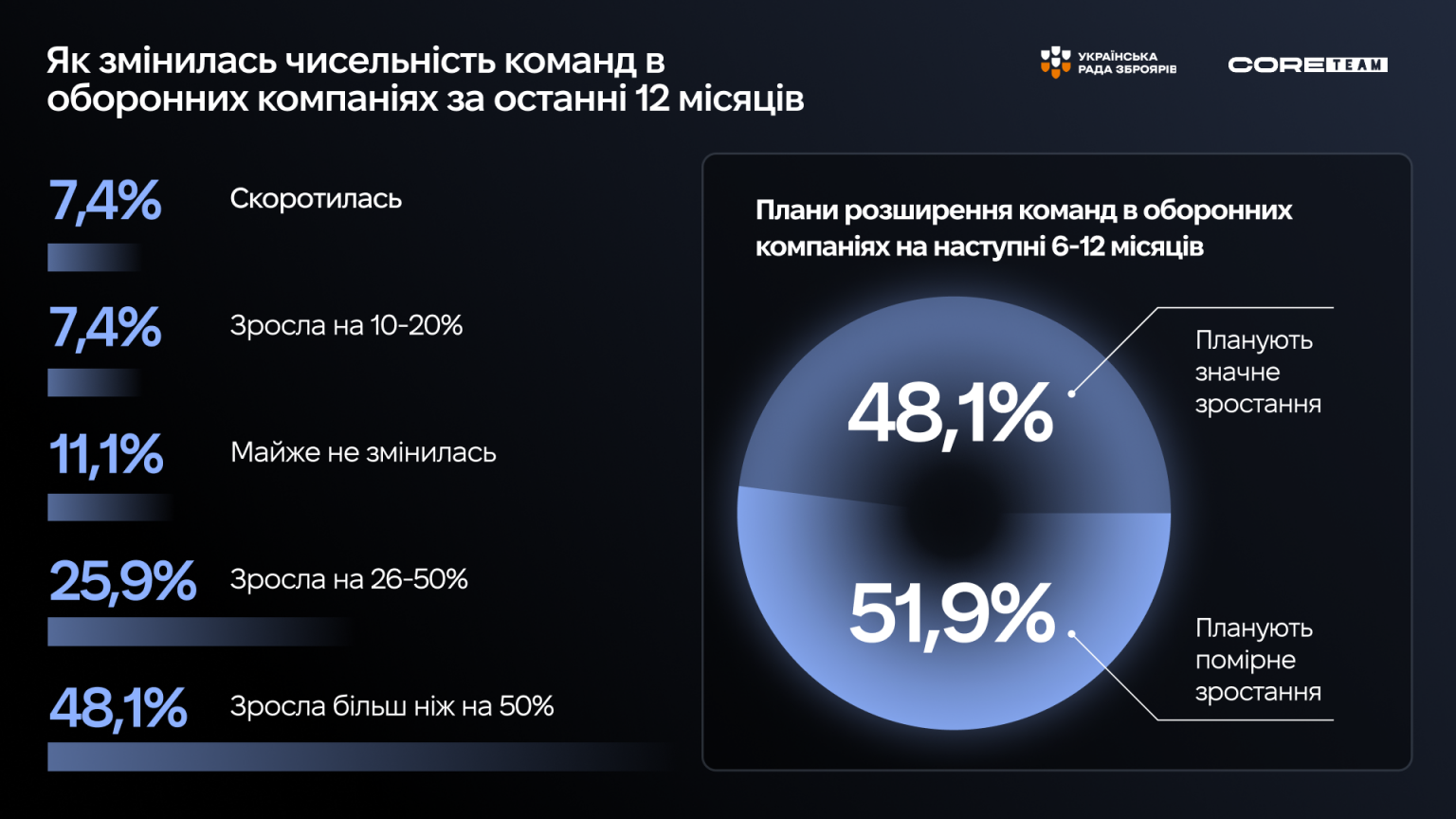
According to the survey, 74% of companies have increased their teams by at least a quarter over the past year.
Almost half of respondents grew by more than 50%.
At the same time, none of the companies in the sample plans to freeze hiring: 48% expect significant expansion, while another 52% expect moderate growth.
"Ukraine’s defense industry is no longer a narrow niche. It is a separate labor market that simultaneously needs engineers, production specialists, procurement specialists, project managers, and specialists in quality, exports and partnerships. The sector is growing quickly, but its further scaling depends on whether we can systematically train people for the real needs of production," said Ihor Fedirko, CEO of the Ukrainian Council of Defence Industry.
Who companies are looking for
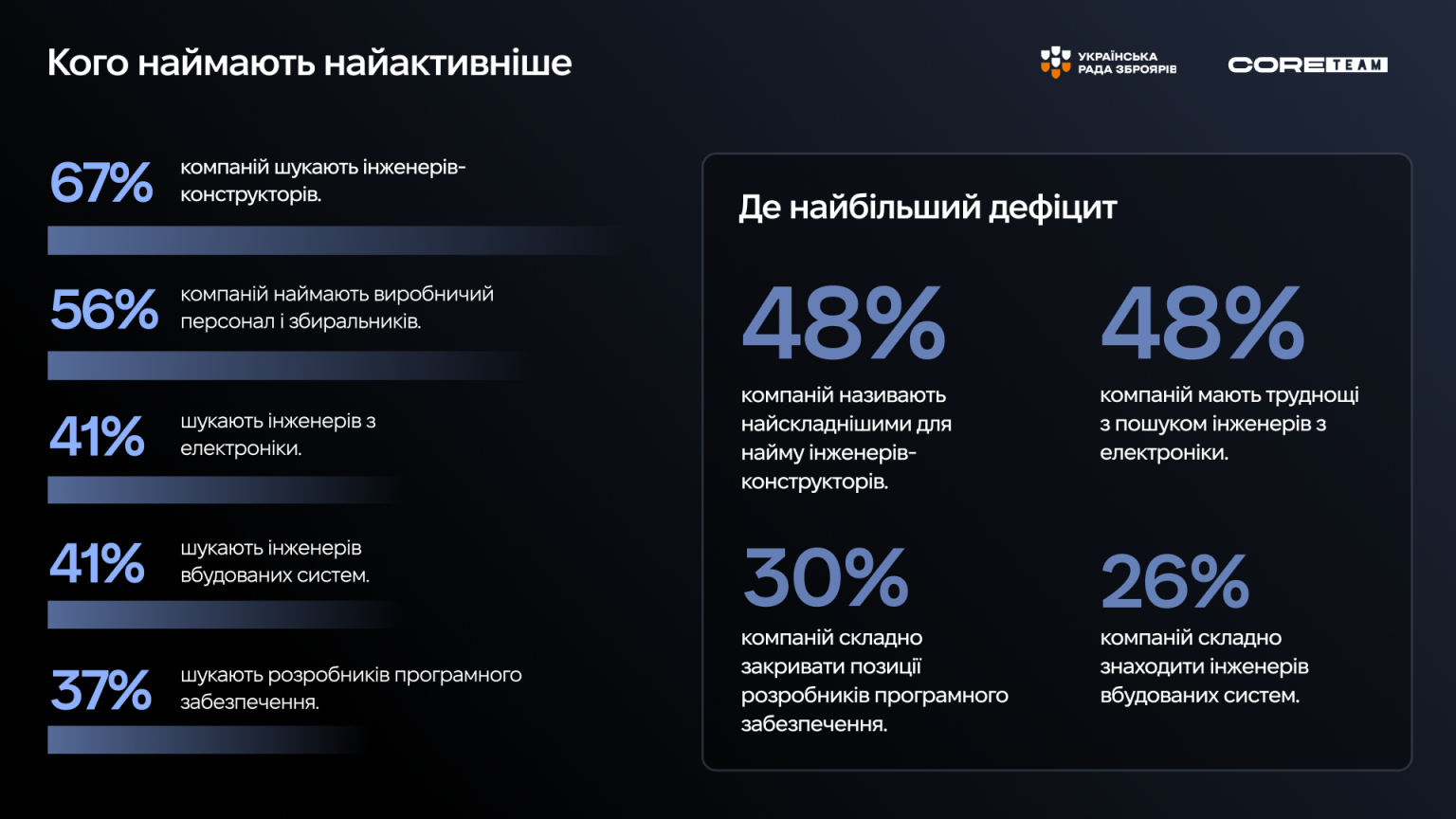
Companies are most actively looking for design engineers, with 67% of respondents reporting such hiring.
Production staff and assemblers are in second place, with 56% of companies hiring for these roles.
There is also strong demand for electronics engineers, embedded systems engineers, software developers, project and product managers.
Hard-to-fill positions
Engineering roles are the hardest for companies to fill.
A total of 48% of respondents named design engineers and electronics engineers as shortage positions.
Other hard-to-hire roles include software developers, embedded systems engineers, CNC machine operators, technical specialists, procurement and supply specialists, and quality control specialists.
Hiring challenges
According to the survey, 44% of companies named the shortage of candidates with the required qualifications as the main barrier, while another 33% cited strong competition between companies for the same limited pool of specialists.
The median time to fill a technical vacancy is one to two months, while about 30% of such vacancies take more than two months to close.
Salaries in the sector
It is noted that 89% of companies have reviewed salaries over the past year, either across the board or for specific roles.
The most typical increase was 10-20%.
However, this did not resolve the hiring problem: no company said that recruitment had become significantly easier after salaries were reviewed.
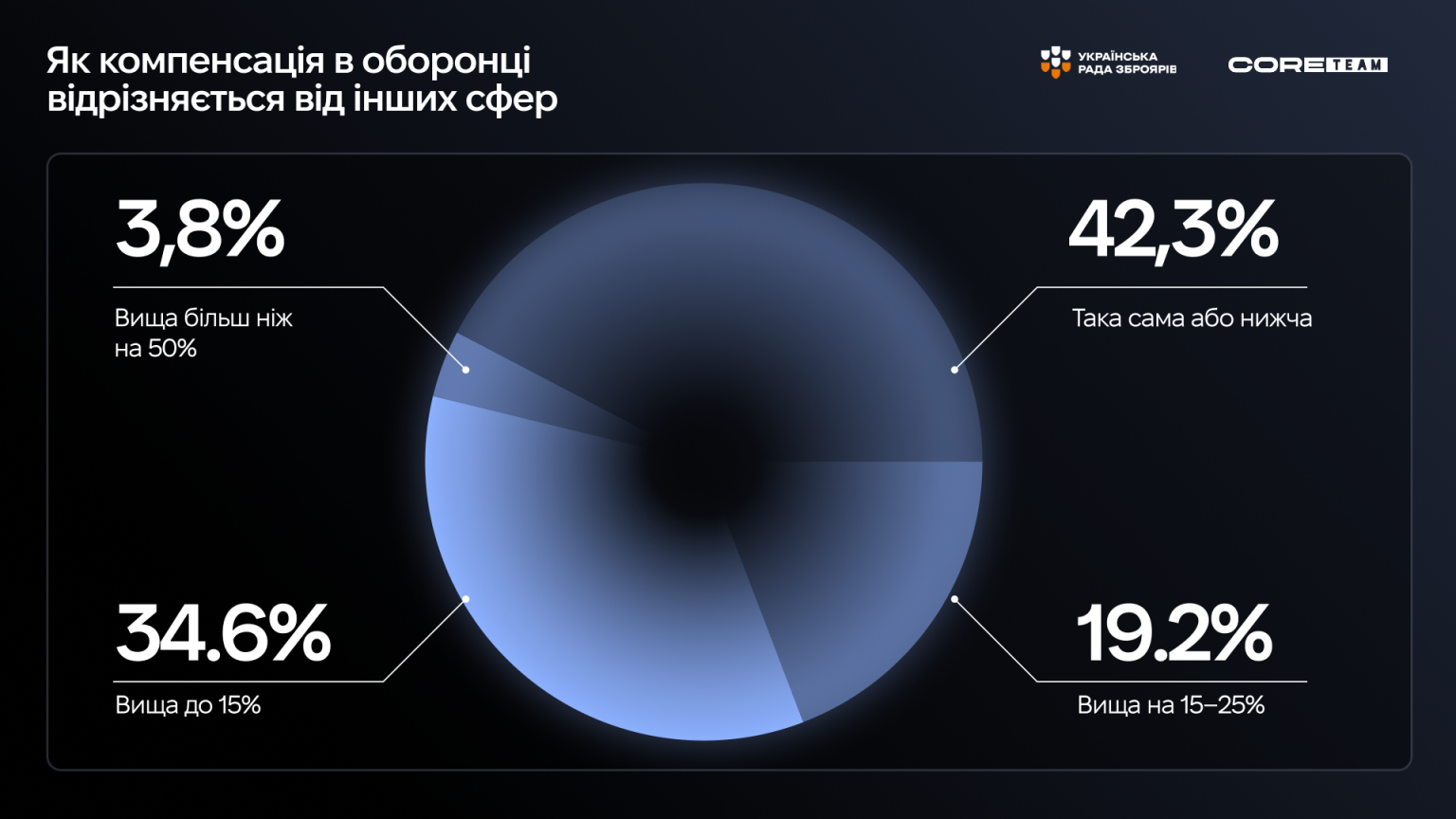
The study also disproved the perception that the defense industry always pays above the market: 42% of companies reported paying at or below the level of other sectors.
A salary premium does exist, but it is selective and concentrated mainly in shortage niches: embedded systems engineering, electronics, radio-frequency technologies, EW, avionics, hardware engineering and certain procurement and supply roles.
Employees’ exemptions from mobilization
A total of 74% of companies use employee exemption from mobilisation as a benefit. For some candidates, this is no less important than income level.
How to address staffing issues
Among the market’s main needs for the next one to two years, companies named more engineers and greater predictability of orders, with both factors mentioned by 56% of respondents.
Another 48% of companies said better cooperation with universities is needed, while 41% pointed to more retraining programmes. The sector is increasingly forced not only to compete for ready-made specialists, but also to develop personnel within companies or attract people from related industries.
The biggest sources of personnel for the defense industry are machine-building and industry, from which candidates come to 59% of companies, as well as IT, named by 44% of respondents.
As reported, at the end of April, Defence Builder Accelerator held a specialised workshop dedicated to the implementation of NATO AQAP (Allied Quality Assurance Publications) standards. The event was part of a systematic effort to prepare defence companies for integration into Alliance standards and entry into international markets.
As reported, in late April, the Defence Builder Accelerator held a specialised workshop on implementing NATO AQAP (Allied Quality Assurance Publications) quality standards. The event was part of systematic work to prepare defense companies for integration into Alliance standards and entry into international markets.


