



Yaryna Chornohuz: The military tired of phrase "I believe in the Armed Forces."
She is hard to lose in a crowd. A thick ponytail of extended pigtails, a large backpack - a tall woman in khaki. Yaryna Chornohuz is a poet and a combat medic with a reconnaissance battalion of the Marines. She is rarely in Kyiv. She says so herself - she prefers to be "there".
She has been at war since 2020. The full-scale invasion took place in the Donetsk region. In March 22, in the village of Zachativka, Volnovakha district, their company met a column of Russian tanks with only machine guns and grenade launchers. One of the most traumatic experiences was when they had to leave the bodies of their comrades on the battlefield. Another reason for reclaiming the occupied territories is to bury their dead.
She published a collection of poems entitled [dasein: defence of presence].
I am one of those frontline soldiers who are invited to meetings with international partners. Last October, she visited the Pentagon. She says that her stories about the daily heroic deeds of her comrades on the front line are listened to there as if they were stories from Hollywood films.
And now we have spoken to her during her business trip to Kyiv, where she met with diplomats from Western countries.
Are our Western partners tired of the war in Ukraine? Why does she think that society will soon forget the frontline soldiers? How did the male soldiers look at her, a woman, when she came to pick up the dead border guard? And why is the phrase "I believe in the Armed Forces" annoying for the Ukrainian military?

"AFTER THE 56TH TANK IN THE RUSSIAN CONVOY, THE GUYS STOPPED COUNTING THEM"
Let's start with the memories of the beginning of the full-scale invasion. You experienced it first-hand in Zachativka, in the Donetsk region. What happened there?
-"Itwas a clash of completely unequal forces. There was a battalion and a company of the Ukrainian Armed Forces, and they put about 3-4 armoured personnel carriers against us. We had an observation post at the elevator there, and we were counting tanks from there, and the guys told us that they counted 56 tanks and stopped counting, deciding that after 56 there was no point in counting them!
Now, as a survivor, I can talk about it with a smile, but back then it was not funny at all. We understood that we were facing a huge armada of forces, and we had very little, some of our BRDMs, a couple of behemoths.
No one understood what was coming. Now everyone understands their methods. How they can just take off with the whole tank platoon. That the column could be 30, 40, 50, and so many that there is no point in counting any further, and that they would just leave like that!
We then raised a copter and recorded it. I posted the video on my Facebook page so that no one could blame us.
Yaryna Chornohuz's video from her conception with a column of Russian tanks
We raised the quadcopter during their third offensive. There were three major offensives in Zachativka in total. We managed to repel the first one, when "Perun", our commander Anton Hevak, was killed. The second one was also repelled, and they concentrated more forces on the third one, and this video even shows how far away, somewhere in the middle of this sausage, a Russian with a flag comes out and just walks along the field along the column.
For a week, we repelled offensive after offensive with much smaller forces. Sometimes we even managed to scare them and during the first offensive, we captured their equipment. I still remember it, when their convoy drove to the observation post where our group was standing near the road, and then on the same day after the battle we came to the same road and took a couple of their bekhs from there, because after the battle many of them ran away to land.
These were completely unequal forces. And they didn't seem to fully understand how to act either. I will say this - this kind of naked courage solved a lot of things back then. We won a week for the state.
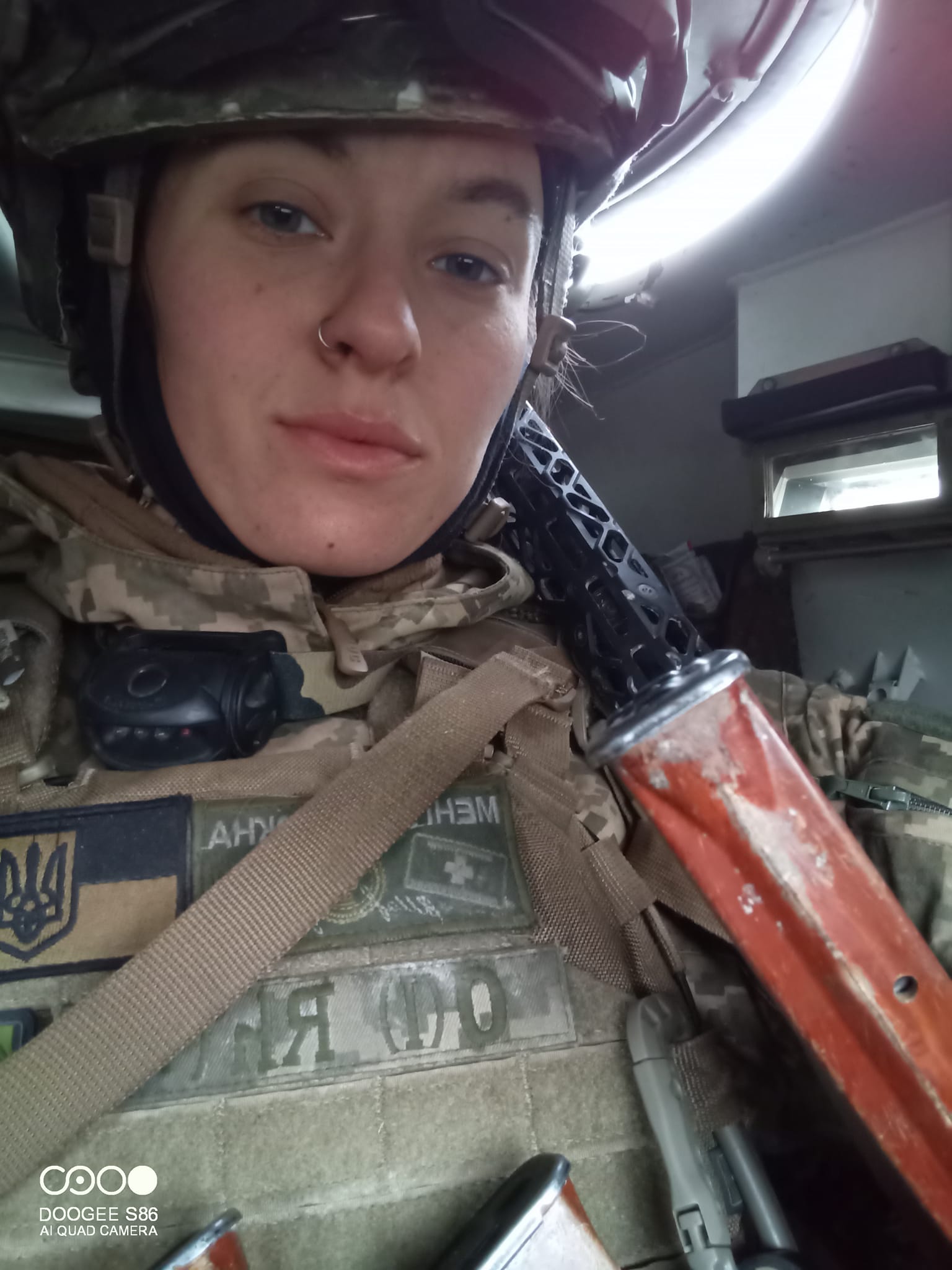
"THIS IS A CERTAIN DEFEAT FOR ME, BECAUSE THEY BACKED DOWN"
For a very long time, even now, I have been living through this episode as a kind of defeat for me. When I joined the army, I was completely naïve and thought that "you can't give away a single metre of land!" This is true for those who are just starting out, many people think this way. Later, when you realise that you are a battalion and they are three armoured personnel carrier groups, what do you do? You have to resort to these tactical retreats and then go in, but it's very difficult, because everyone would like us to have a lot of things at that time, and we would not let them go further than that Zachativka. And I'm very glad that we are now in a position where we can't let them go any further. We have already adapted to the new period. But this does not mean that we should relax, because it is very easy to lose it all.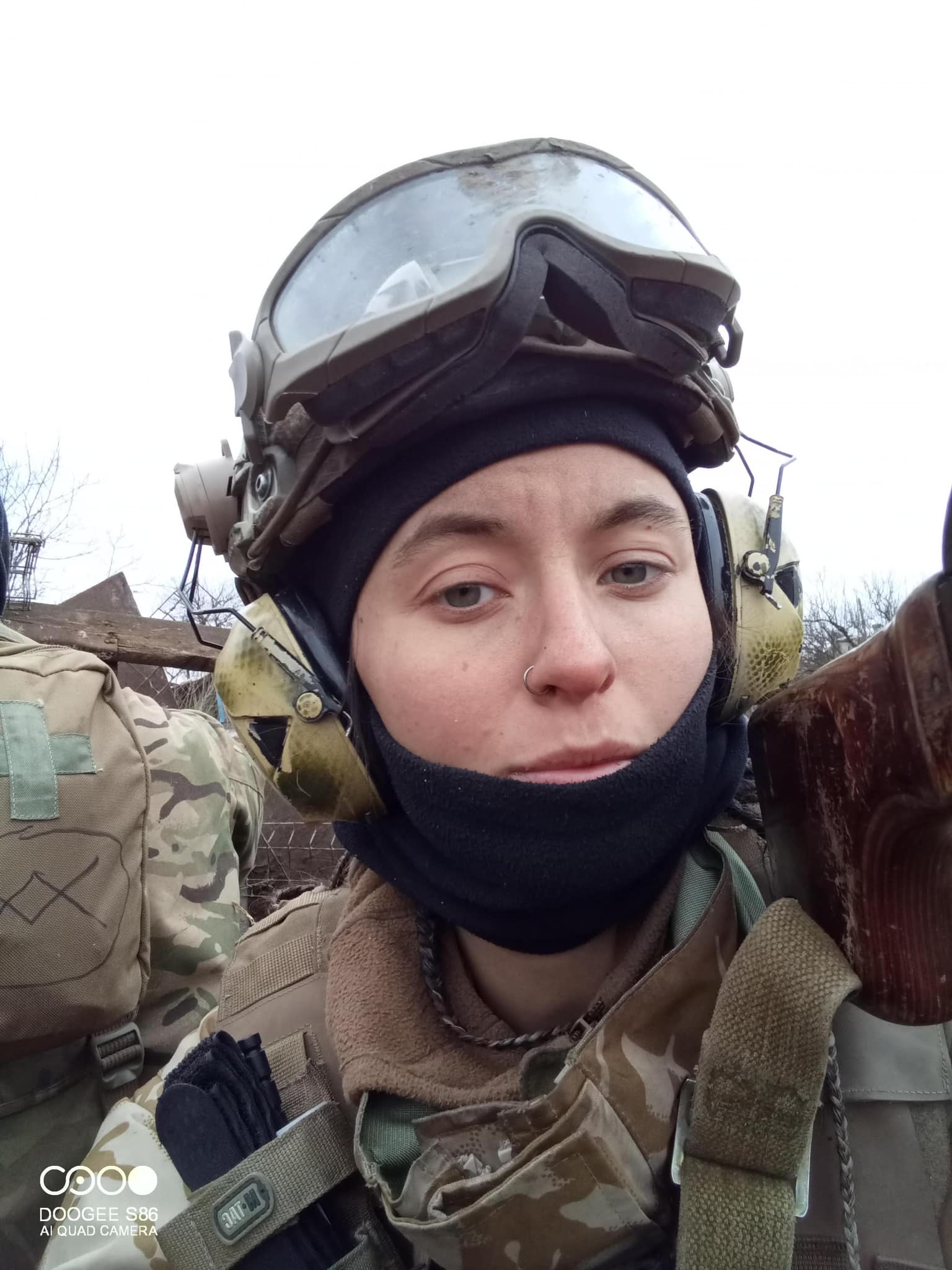
Zachativka, Donetsk region March 2022
"OUR COMMANDER RECEIVED THE ORDER A YEAR AND A HALF AFTER HIS DEATH"
-What is happening in Zachativka now?
- It is under occupation now. Unfortunately, I can't talk about what I know about this village, but I really want us to go back there again because the bodies of our brothers are still there.
We talked about my fallen platoon leader Anton Hevak, Perun. He received the Order for Courage only a year and a half after his death. I was very ashamed and embarrassed in front of his parents. After all, he was a man who gave his whole life, his youth - from the age of 18 in the army - to become a combat officer who eventually went to stop a convoy of racists in the Volnovakha district with an assault rifle and a grenade launcher. And the fact that he hadn't received an award for so long really hurt me. Before that, there was a story that a blogger was awarded with the assistance of the GUR. And I remember sitting with my comrades in arms and being so shocked and disgusted. He devoted his entire life to intelligence. In the Joint Forces Operation, he took a group of snipers to share the results of our intelligence work and show them where they could work! And he received the order only a year and a half after his death. And not least because of the publicity.
"I WAS NOT PREPARED TO LEAVE SOMEONE'S BODY ON THE BATTLEFIELD"
-What did you find yourself unprepared for in the war?
- I had no idea and did not understand what it meant to go missing in the war. I mean, I heard some stories about the missing from '14, just this line - missing in action. And also about other wars, about the Second World War and this large number of missing persons. But this is the most difficult thing to be prepared for in war, someone from your comrades will go missing, and someone's body will not be recovered.
We at the 205th Centre, the hospitalists, have always been trained to take bodies and do everything we can to do so. Although the TC3 protocol says otherwise, that we need to weigh the risks against the opportunity to prevent even greater losses, we need to take everyone.
And I was most unprepared for the situation when we would be stormed by a much larger force and someone's body would not be taken away. This is the biggest blow for me.
"IT ANNOYS ME WHEN MALE SOLDIERS SAY 'DARLING' TO ME.
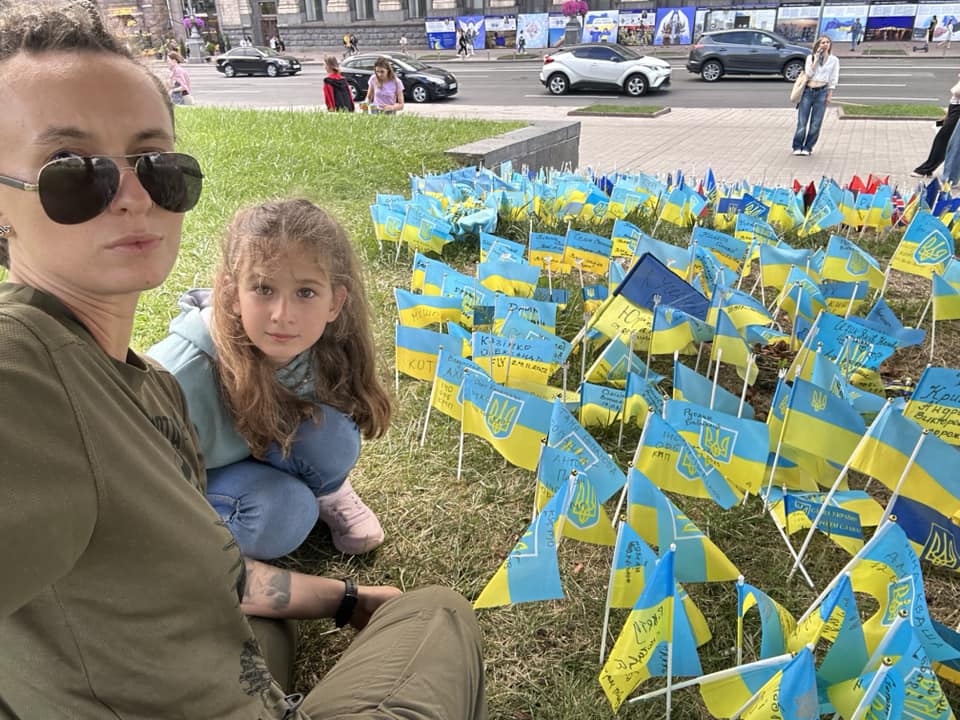
Yaryna and her daughter on the Maidan
-On Maidan Nezalezhnosti, you came with your daughter to put flags for the dead. For whom exactly?
- It's hard to talk about one person and not mention someone else. I will say that there are two women among them. I didn't talk about them - they are my sisters-in-law, both doctors. One is Nina Kvasha (Amazon). We went to the 205th training center together. We were friends. I remember her telling me that I had so many minor health problems: blood pressure or something else, and I was so angry with myself! Because she was doing so well, she was good at everything. I remember taking her blood pressure at the hospital and taking some pills. And then on April 22, I found out that she was killed in the 72nd Brigade near Moshchun.
Another woman is from the marines, like me, from the 503rd battalion, Tanya Romanova (Romashka). She is an older woman with grown-up children. I also started my service with her. We also went through this 205th centre. In Zachativka, she was the second woman I saw in that part of the village, among all the soldiers - me and Romashka.
Whenever we saw something like that, I liked to say to her tenderly - "Honey, are you alive?" And this is the only time when I was not annoyed by the word "darling" from a military man because I am terribly annoyed when men talk to me like that, but when Romashka did it, I liked it. And then I found out that she also died while being with her platoon. She was hit by a shell. Right on the frontline.
And I dedicated the book to five of my comrades whose flags are also there. These are the guys I walked with for all 3 years. I will probably write about them someday - about Perun, Cousteau, Rex, Achilles, Skrypal. Skripal, when there was the 20th Spring on Granite protest, we were together at this one protest of mine, which some people thought was crazy, but it was really about the fact that we shouldn't forget about the war, because it turned out that it just subsided before something as big as a full-scale invasion.

Yaryna's single protest "Spring on Granite"
"IT MAKES ME ANGRY WHEN I SEE A CONSUMERIST ATTITUDE TOWARDS THE MILITARY"
-How do you feel when you come from the frontline to a peaceful city? Are you not annoyed that people are having a rest?
-"It doesn't trigger me. In fact, I see it as a victory, that life goes on, that we can afford it. But I am triggered when people do not fulfil their duty and do not appear when summoned, when they flee. This triggers me. I get angry when I see a consumerist attitude towards the military - like, we live here and enjoy life, and you are fighting for this! Don't tell anyone what they are fighting for! You should ask yourself why you are not fighting for your home. Because the fact that our homes are ours at all is precisely the merit of the defence forces. For example, even when I'm on a business trip, after three years at war, I feel guilty that I'm not with my own people. And it is difficult for me to understand people who are not tormented by a sense of duty to those who are fighting. I've been tormented by a debt since I was 14 years old, that I'm not fighting. And I don't even care that I am a woman - all people have to defend their country. To the best of their ability and regardless of gender. I still feel more comfortable "over there".
-Do you agree with the opinion that Ukraine is running out of human resources for this war?
-"I'm not a demographer, but the state of the country here in the peaceful cities shows that we still have resources!"(smiles)
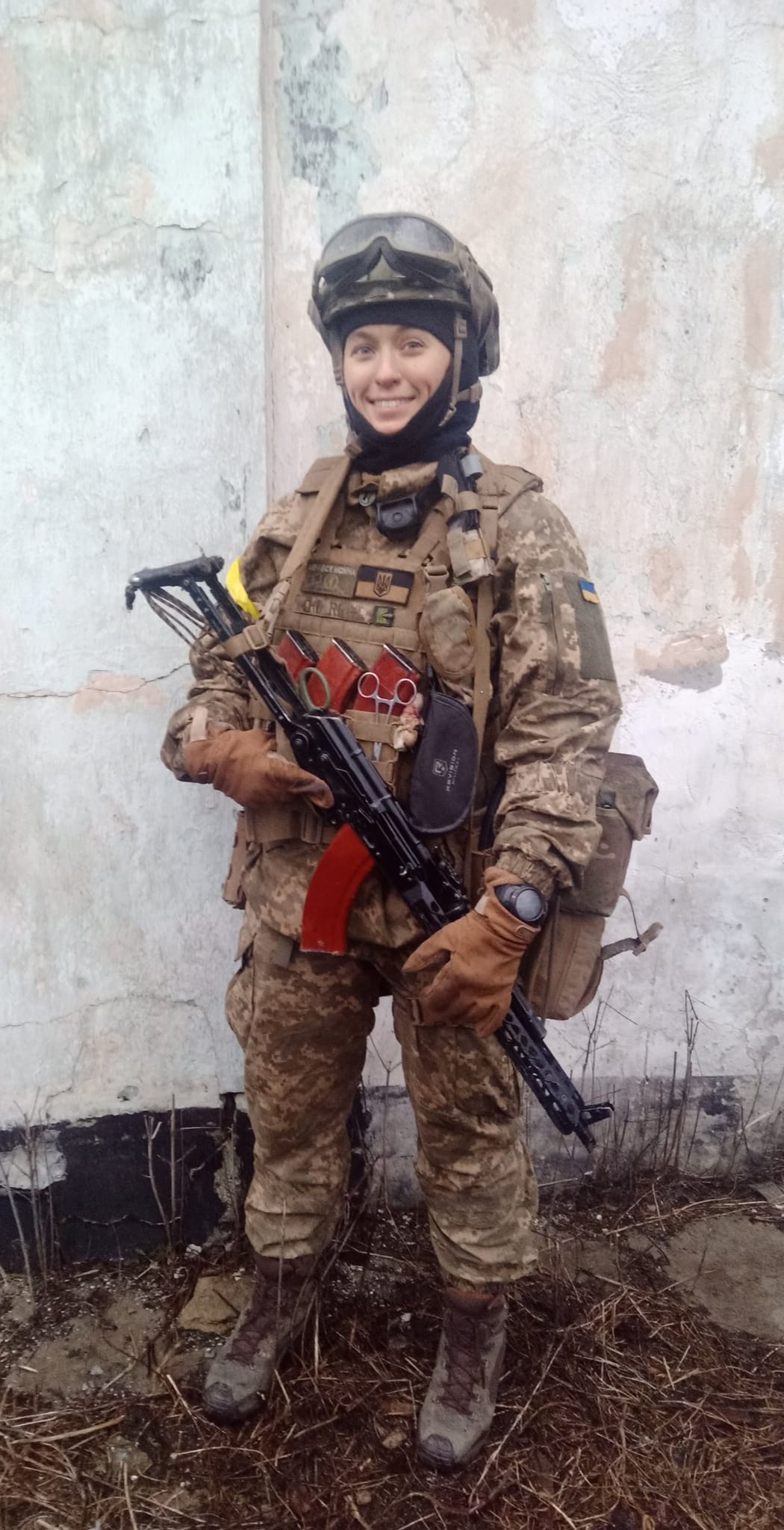
1 March 2022
"The military is tired of the phrase 'I believe in the Armed Forces of Ukraine' - become the Armed Forces of Ukraine!"
-What about the unity of the people - is it not disappearing against the backdrop of the challenge of a long-term war?
-"There is unity, but some people have a fashion for not being united. That is, some people treat it very superficially. We live in a time when putting a flag in your car or saying, "I believe in the Armed Forces" is not enough! Or even throwing money is not enough. There are responsibilities! We have not only rights, any democracy has rights and responsibilities! Not everyone here understands the importance of these responsibilities!
Unity often ends in words. Where is the action? A lot of soldiers at the front are tired of hearing this - "I believe in the Armed Forces!" - tra la la! Where's the action? Come and replace me! Do you believe in the Armed Forces? Become the Armed Forces!
"PEOPLE DON'T SWITCH TO UKRAINIAN ENOUGH!"
And to be honest, I miss this thing with switching to Ukrainian! Language is a part of identity. I'm not blaming anyone, but I will say specifically that I'm sorry that it's the 23rd year of my life, and my daughter is the only one in her class, just like I was at school in Kyiv, who speaks Ukrainian. I do not understand this. What are the parents of these children thinking about? What is their strategy for the future? They need to be taught to be principled, not that I speak Ukrainian to Ukrainian-speakers and Russian to Russian-speakers. They need to be taught linguistic stability. This is a guarantee that we will not be completely occupied by Russians again one day. It took us so long to get out of that.
"IF THE STATE BOUGHT LOW-QUALITY TURNSTILES, ADMIT THAT YOU BOUGHT CRAP AND BUY HIGH-QUALITY ONES!"
-What doyou think, as a combat medic, about the news that the chief medical officer who asked the Medical Forces Command to replace the low-quality turnstiles was severely reprimanded?
- I cannot comment on this particular story because I do not know these people and do not know the details. But our senior combat medic in Crimea and I have always had Cat or Sich, which means that since the JFO, when it was very difficult to get them, we bought them with our own money - for 400 UAH. It was very expensive for a salary of 13,000, but we sometimes bought them with our own money before the rotation. Then the full-scale war started and there were volunteers who always brought them, we concentrated them enough, and every soldier who came to our company was sure to receive 4 turnstiles. Then we got Sam turnstiles. I am sure about these 3 turnstiles, because I have always used them, they are very high quality. And we threw everything else away. We were given different first aid kits, we were always going through them, throwing something away, laughing at something, but we did not have a soldier who would go on a mission without a first aid kit with Chinese low-quality turnstiles. Soldiers on the front line should not have such turnstiles, they should be removed and replaced with these proven turnstiles.
-"What if the state has already bought 10,000?
- Admit that you bought shit and buy something else.
For example, I even teach my young daughter how to use a turnstile and I do it on a Cat turnstile.
"IT'S JUST THAT AT THE FRONT, YOU NEED TO BE ABLE TO HAVE A BLOOD TRANSFUSION!"
-As a combat medic, what do you think can be changed now to save the lives of soldiers at the frontline more effectively?
-"I have been very supportive since the JFO, when I was just getting acquainted with the TC3 protocol on first aid and read about plasma, that plasma or whole blood is poured, that this is the first priority! And then I was looking at what we had - at the bottles of saline, with the ringers, and I was thinking to myself - God, where is this already? Plasma? Whole blood? What is this and where and how? They can't even give us a "bogdanchik" to put in our mouths, let alone refrigerators! And now I'm so glad that there are combat medics, some of whom founded the 205th Training Centre, where I studied, and this is a very cool training for combat medics who are fighters and paramedics at the same time, that they have now raised this topic of whole blood and are already starting to implement it. I believe that if you have the resources and capabilities to give wounded soldiers whole blood immediately, you should do it. I personally would love to take a course and learn how to do this. I even have plans to learn how to do it while I'm in Kyiv. There is nothing complicated about it, but it really saves lives.
That is why I am now advocating that each company should always have one armoured evacuation vehicle, which is purely for the needs of the evacuation case of this first one, so that it is as close to the positions as possible to take the soldier out as quickly as possible. And ideally, it would also have a fridge with whole blood.
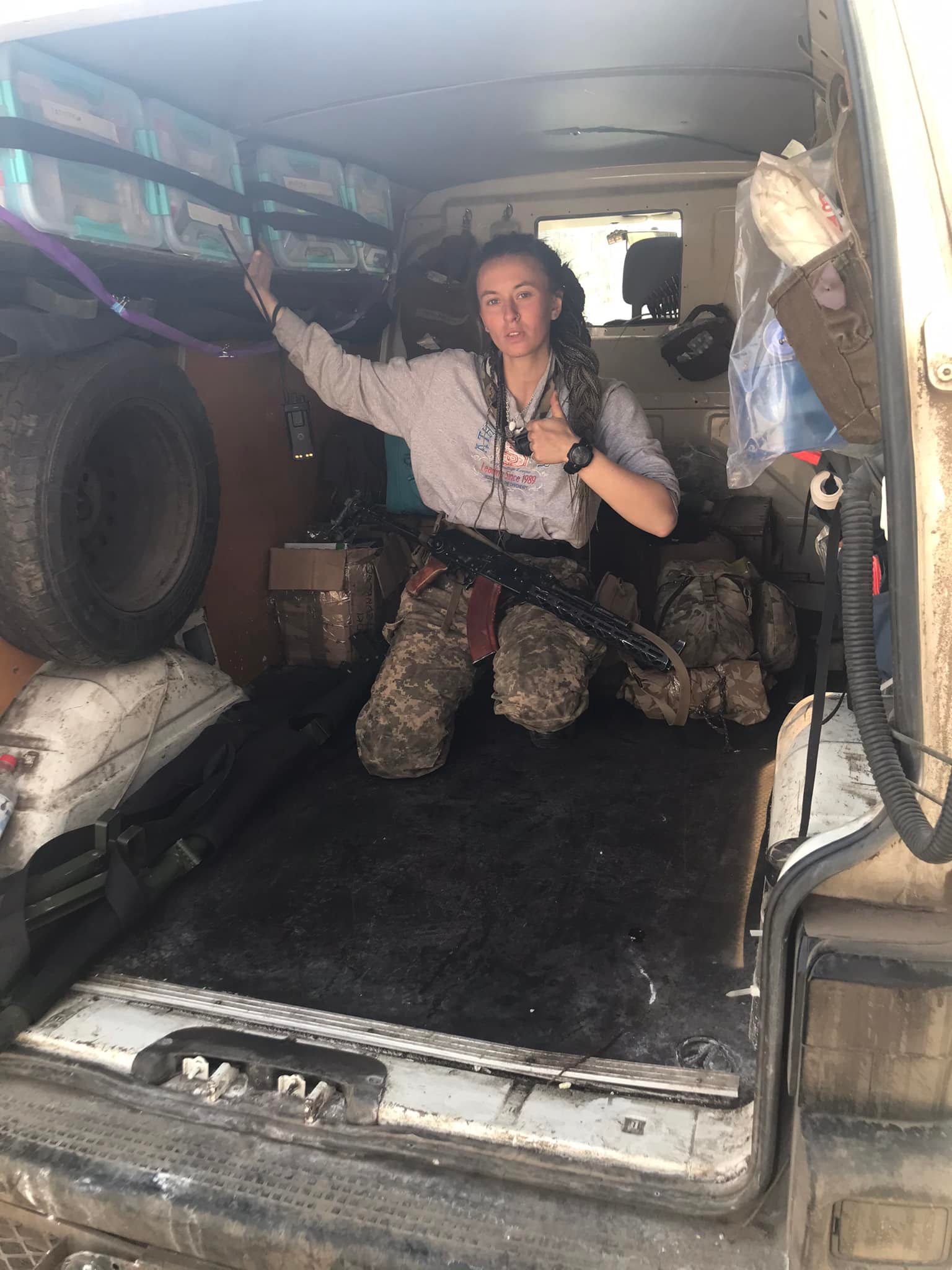
Yaryna Chornohuz, 29 March 2022
"WE NEED TO REPLACE THOSE WHO HAVE BEEN ON ROTATION FOR 2 YEARS"
-As for the overall situation, what changes do you think are needed?
-We need a completely different information policy on rotation. We need to replace those who have been on rotation for two years! This should be a clear message. Everyone understands that the way it used to be: six months of study, six months of rotation, or 8 to 9 months, six months of recovery or training, we obviously cannot afford this now. But we need to come up with some other structure to replace those who have been there for a long time, for two years, and it is very necessary.
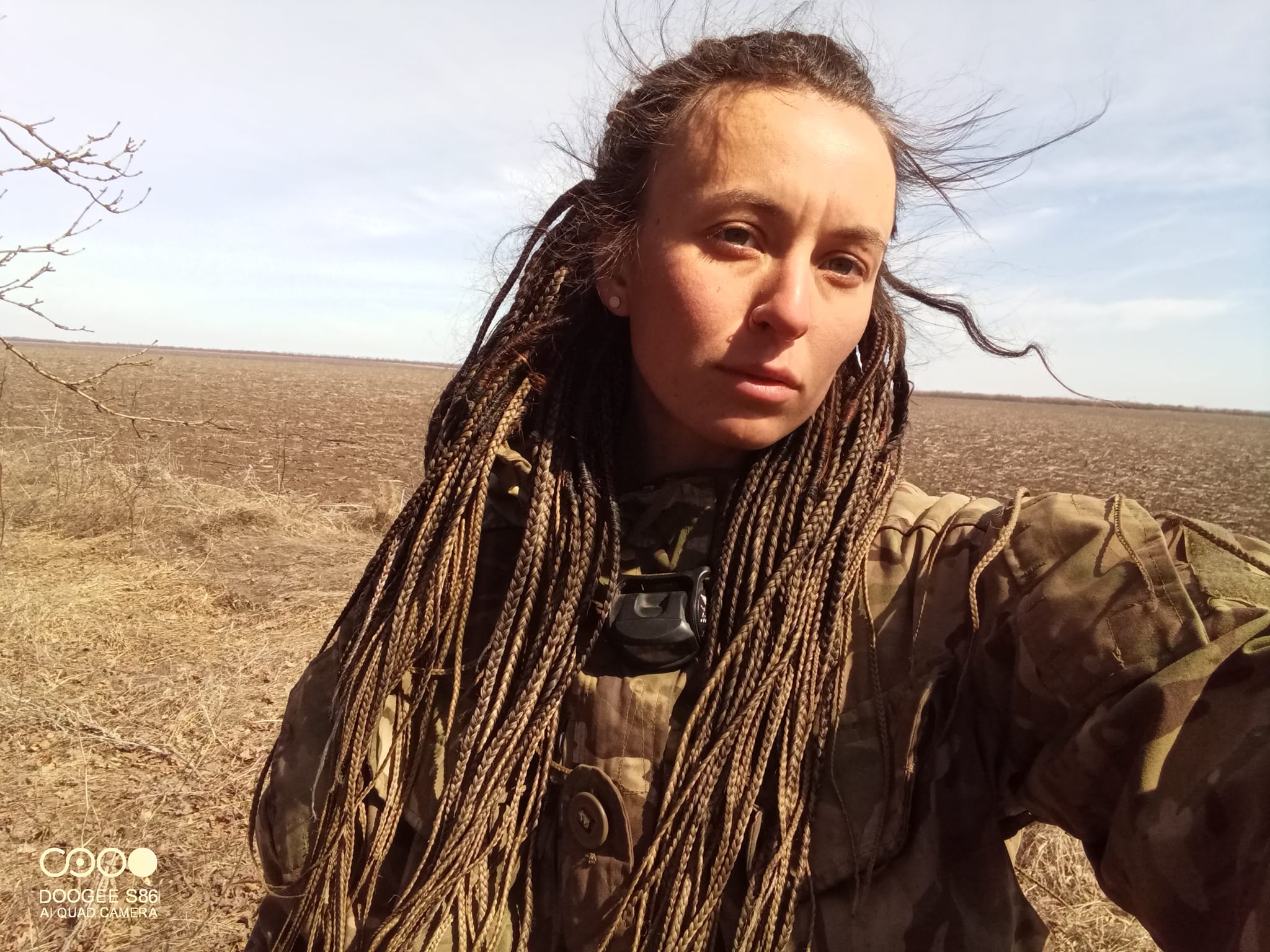
Yaryna Chornohuz, 28 March 2022
"A SURVIVING SOLDIER ... WILL ALWAYS BE ACCUSED OF NOT HAVING FOUGHT ENOUGH BECAUSE HE DID NOT DIE"
-Inone of your posts, you wrote about the devaluation of a soldier's feat. "A surviving soldier in a war like this one will always be accused of not having fought enough because he didn't die." Why do you think so?
- Soon it will be 2 years since the full-scale invasion began, and those who remember the year 14 also remember how, unfortunately, the attitude towards the military has changed in 2 years. Many people have forgotten about the war. This is in the nature of things - the psyche is capable of protecting itself in this way and forgetting traumatic experiences. However, what happened with the full-scale invasion is actually the case when everyone, regardless of their participation in the war, especially civilians, who are actually defending other people, needs to fight against forgetting.
At the same time, this thing with forgetting, it hurts a lot when you come back from there, and when you come back from the front after 3 and a half years on the front, and you are a private, and you are a woman, you are literally devalued twice as much as a man. Because no one believes in your frontline experience.
So I also have times when I get into some unfortunate incident here in a peaceful city with some civilians, and although I understand that it's a small thing when someone devalues me and so on, but then you think, that's it, I've put on my boots, I'm going to wear cartoons and I'm going to walk in Kyiv only in such a way that everyone can see who I am! And then you slow yourself down. Yes, you think, stop, stop, stop! As my husband, who has been at the front for 7 years, says, it's wrong to make war your peak point. Even if you are very passionate about it, very invested and love this business, you need to work on yourself somehow.
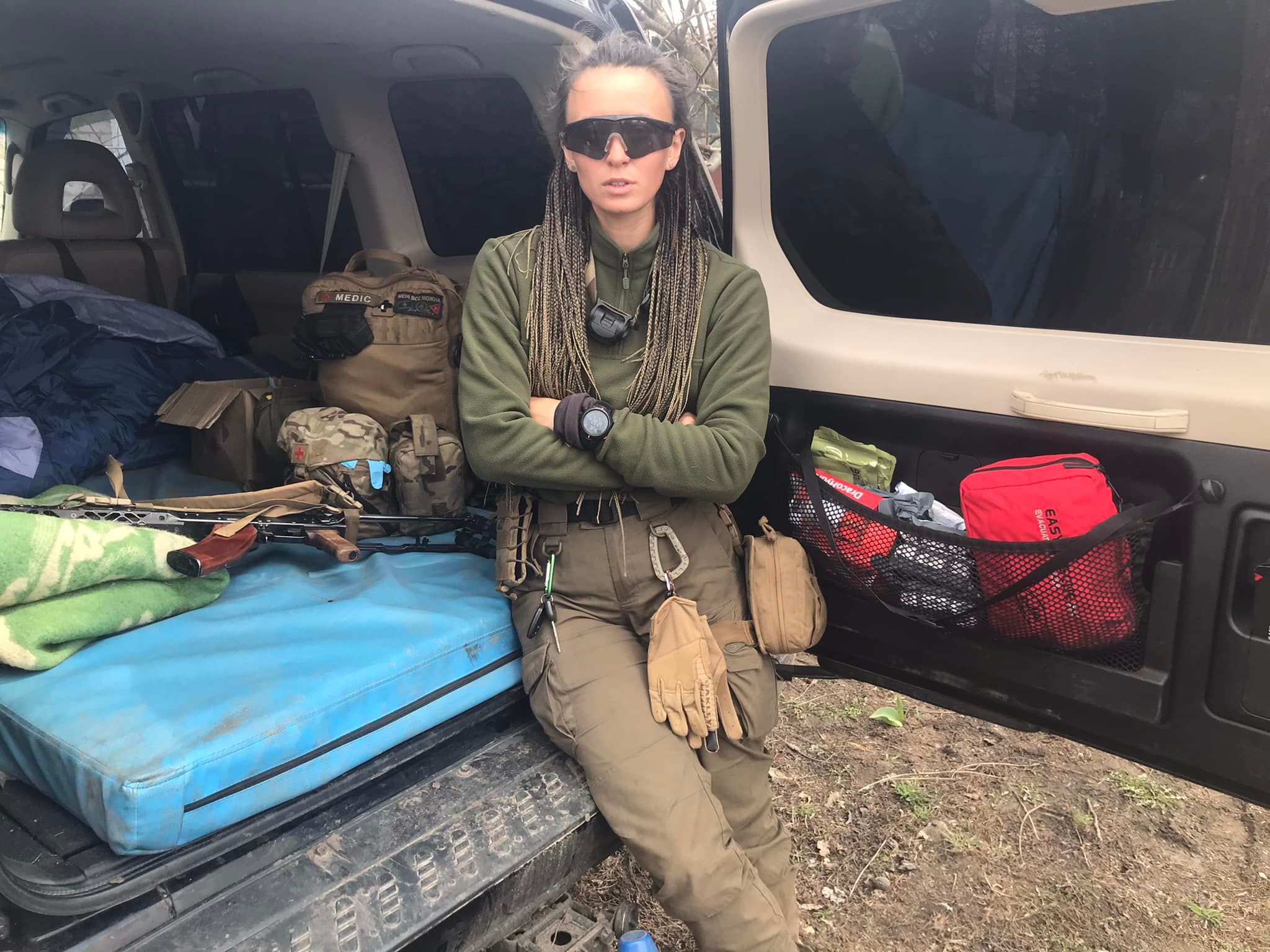
Yaryna Chornohuz, 5 April 2022
"I REMEMBER HOW THE MEN LOOKED AT US WHEN I, A WOMAN, CAME TO PICK UP ANOTHER WOMAN WHO HAD DIED AND TAKE HER AWAY."
As for women, I know from my female veteran friends who went through this back in 2014, because I joined the army in nineteen, that in our patriarchal society, women in the military are generally devalued. Although now the attitude has changed a bit with the full-scale war, because many women have given their lives. I say this as a combat medic who had to take a fallen border guard sergeant out of Popasna in May 22. She was at the wheel, driving out of there and died. I remember how the men looked at us when a woman came to pick up another woman, a dead woman, and take her away.
But to this day, society simply does not pay due tribute to women from the frontline. And what horror do the relatives of women killed at the front face? Sometimes it's just shameful. When a young woman dies, they start asking why she went there. What was she doing at home? Who called her there? Or - it would be better if she gave birth to children! That is, even about the dead women, some people allow this kind of talk, and it is disgusting. What can we say about those of us who were lucky enough not to catch a "flight" or catch something, but stay alive...
Many women have some kind of respect for women who are fighting, although I will say for myself, I have great respect for women who also stayed behind and look after children, it is a very important job to give birth and raise a generation that will live and continue to create this country. I have absolutely no devaluation, on the contrary. One of the hardest experiences I had as a combat medic was when I had to help a mother with two children. One of them was an infant, and thank God he was not hit, but the other child was. And this is a rather difficult experience for me.
That is, it is important not to judge each other. We still have to develop ethics as a society, and a full-scale war is a test for this ethics.
"WOMEN MEDICS ARE EXTREMELY NEEDED AT THE FRONTLINE NOW"
-As of October, all women doctors will be required to register for military service. What do you think about this?
- As a military woman who signed a contract in '20, I have a positive attitude to this, because I am generally in favor of the Israeli model, where everyone has to spend some time on thorough military training and be militarily obliged. And women doctors are extremely needed at the frontline now, even after two years of full-scale war. Very much so.
In addition, if the reform of military medicine is successful, women will be needed for new rehabilitation centers for the military - with a humane and ethical attitude.
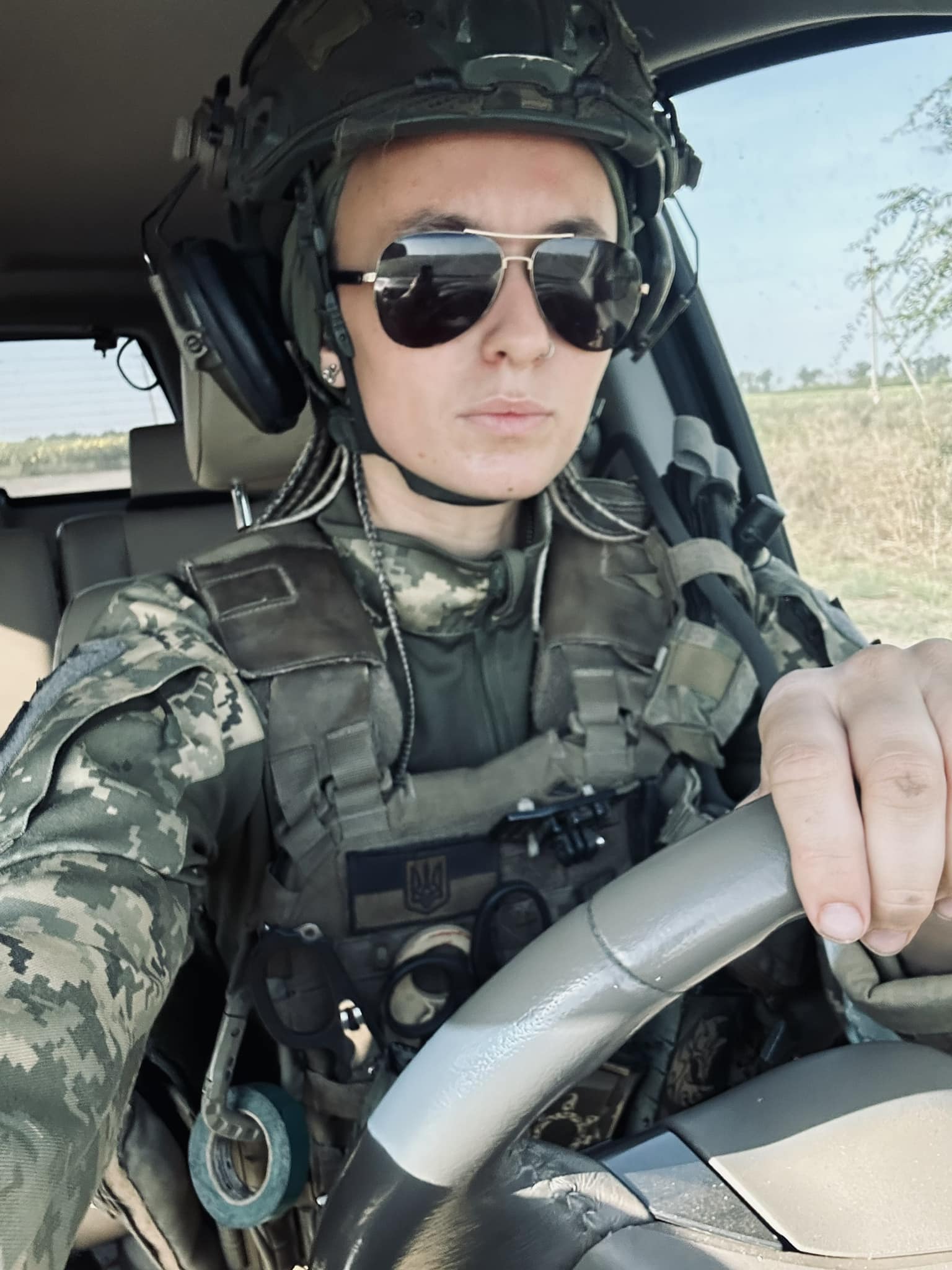
Yaryna Chornohuz August 2023
"THE DEMOCRATIC WORLD CAN NOT AFFORD TO LET US LOSE"
-You mean the war can't help but affect someone?
- Everyone will fight!
I was invited to read a collection of my poems for two days at the Meridian in Chernivtsi, and there I heard a very cool lecture by Joseph Zissels about how this war has already moved from the imperial Russian civilisation war, and that now two identities are fighting, democratic and authoritarian.
If we take a look at the range of partners who support us, we will see that these are democratic countries, and at the other pole, there is an authoritarian, Eurasian identity. He made this point that China will never allow Russia to lose. Because if Russia loses, it means that China will also lose, because it is also an authoritarian regime. And the lecture concluded that civilisational wars will continue for a long time. Because both civilisations have unlimited resources. And the clash happened here, in our country.
In other words, in such a war, everyone has to look at themselves for a long time, although they should have learned long ago, not just looked at what they will do as soldiers. And I am very sorry that the thesis about the duration of the war is not much discussed on global information resources.
Plus, the democratic world also cannot allow us to lose, because the defeat of Ukraine means the defeat of the democratic system.
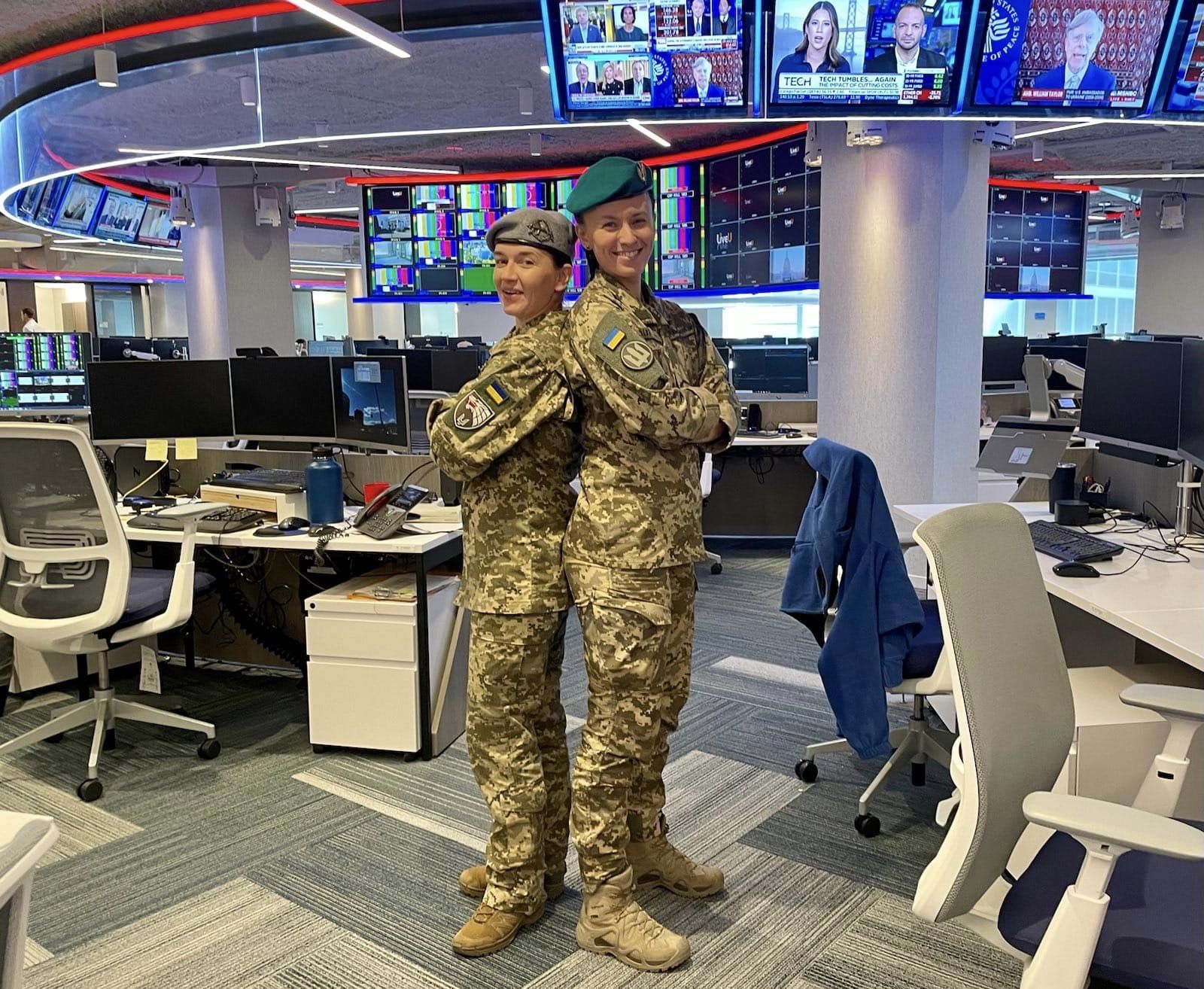
USA, October 2022
-By the way, you areoften invited to meetings with international partners. Last year you were at the Pentagon. What do you talk about there?
-"Yes, in October '22, we had a business trip to the United States for a week with women veterans. I'm still working in this vein on this business trip in Kyiv. I can't talk about it now, but we are in constant communication with several international partners.
- Do you have the impression that Western partners are tired of the war in Ukraine?
-"My impression is that they continue to be very supportive and always try to find realistic approaches to helping us. What I really like about our international partners is that there are many of them who are realists and want to do the most with the least resources. I see their enthusiasm and interest. From helping us to set up a rehabilitation system to lethal weapons, people understand the importance of what we are doing, and I feel we have a lot of support.
Those who come to Kyiv, and to the credit of our European partners, many of them come to Kyiv, are not afraid, they get attached. And I don't see any fatigue with those I've spoken to.
And my impression from the trip, for example, to Washington, when we went with the girls, we generally felt a little uncomfortable. Everyone looked at us as if we were heroes - it's true.
They really like to talk to those who were directly involved in the war. They take your words to heart. You say we need M113s in each company at least for evacuation, and they immediately say, oh, yeah, I see. It's very important for them to hear feedback. It's an experience, they also study it for their planning, and they are extremely interested in it and would like to do it more.
- What stories do you tell them?
-"For example, what I said at the beginning of the conversation. About how we had to hold back the attack in March 22 with much smaller forces. That we had very little equipment, but we still stood. About the commander Anton Hevak, a man who simply ran out into the street where the convoy had entered and fired openly at those sitting on the tanks. And he was one of those who said he would like to end his life in battle one day. And so I talk about him, and for them it's a story from a film. It seems to them that it is some kind of retelling of a Hollywood film, but this is our heroic reality, in which we have been living for two years.
I also tell our international partners that we need more armour, that jeeps and pick-up trucks are cool and convenient, but that we need to drive armoured cars to the ground.
They are very impressed when you show them the snags of war. We have a Mitsubishi jeep with broken seats in the back, and this is our evac case, and we use it to take the wounded out. There is a stench that cannot be removed by anything, no sprays. I showed them its interior, and they said, "Is this an ambulance? Not exactly, but smth like!
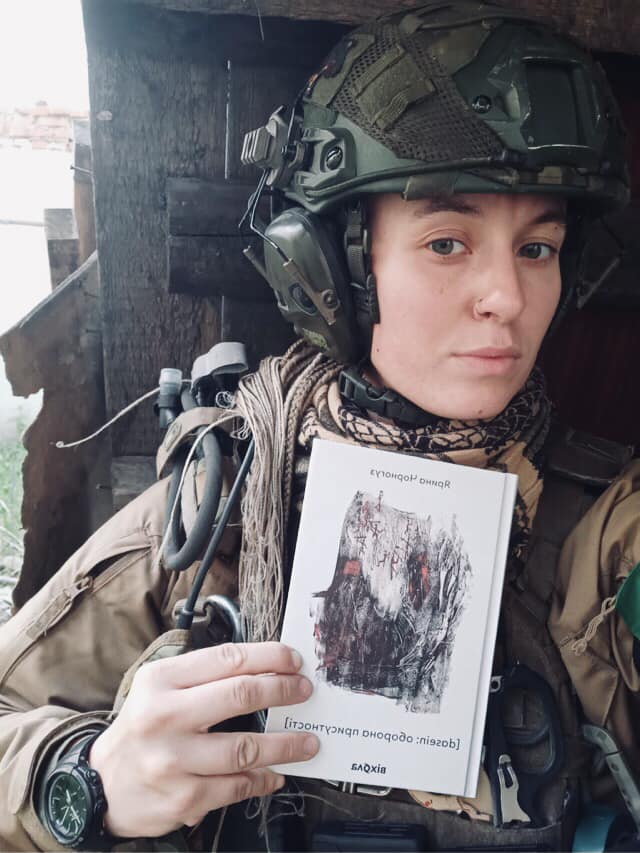
Yaryna Chornoguz
"THESE POEMS ARE WRITTEN ON AN EXHALATION"
- This year you published a collection of poems [dasein: defence of presence]. Did you create it during the full-scale invasion?
- I am often asked how you write at the frontline - when there is a shelling, I come, sit down and start creating! (laughs) No, I don't write like that.
I was doing it long before the army. I have been writing all my life - poems, short stories. That's why I studied philology - literary studies - for 7 years at Mohyla Academy.
Because language is my way of understanding the world. Language is a separate sensor for me. All these texts were written on an exhale, when I was in a state where I had to exhale and say what I had to say. And half of the texts were written before the full-scale war - in the Joint Forces Operation, these are my reflections on this silent war, in anticipation of the explosion. Although a lot of people now, when they read some of the texts I wrote, still think it's the 21st year of the 20th, they don't believe it, because everything is similar to what is happening now.
And the other half are poems written after the full-scale invasion. They were all written since May, when I started to recover a little from this new manoeuvrable war. They contain a lot of pain. They probably also contain a lot of fatigue, and the acceptance of the desire to speak about what is rapidly being lost before our eyes. I live in a lot of territories that are now, unfortunately, under occupation, and I cherish their memory. I believe that we will come back - this is Luhansk and Kherson regions - the sea coast, the rivers, like the occupied part of the Siverskyi Donets, the Bakhmut-Lysychansk road, which we fought for and which has always been one of the most beautiful roads in the whole of Donbas. My comrades, with whom I went to the exits, who are no longer there. It's all in the foreground in these texts.
Creating a world that is not remembered.
It doesn't take much intelligence to weep at graves
someone wrote when the war became commonplace
so much so that they began to doubt whether it was still a war
when the world didn't collapse
when the sun has not gone out
when a voice spoke into the silence
and you live like this
as if your life had already ended
as if the end is near
and this is the afterlife
among the eternal summer and weapons
A foreign language is like snow that won't melt
even in the middle of summer
the unprecedented Antarctica stands on the black shoulders of the earth
mired in frozen soil
and the Universe is waiting in ambush for several billion years
when the Sun goes out and gives a second chance
Nothing has changed since the sun went down
only the complexion of several thousand people changed
in those years
Serhiy lost Yana
Yulia lost Ilya
Inna lost Igor
Halyna lost Mykola
all names are real all losses are not fictional
lies emerge from oblivion
The world became honest when it named all the names
The world became fair when all those who died
and all those who have lost
began to live an afterlife
Olga Sidorenko, for Censor.NET


