



Ukraine short of skilled troops and munitions as losses, pessimism grow – WP
The quality of the Ukrainian army, which was once considered a decisive advantage over Russia, has deteriorated over the year of losses that have taken many of the most experienced fighters off the battlefield, forcing some Ukrainian officials to question Kiev’s readiness for the long-awaited spring offensive.
The Washington Post writes about it. Translation of the text Texty.org.ua
According to estimates of American and European officials, since the beginning of the full-scale Russian invasion, 120,000 Ukrainian soldiers have been killed or injured, compared to approximately 200,000 on the Russian side, which has a much larger army and approximately three times more population from which to recruit conscripts. Ukraine keeps the number of its current losses secret, even from its strongest Western supporters.
Ignoring the statistics, the influx of inexperienced conscripts recruited to fill the losses has changed the profile of the Ukrainian army, which is also suffering from an elementary shortage of ammunition, including artillery and mortar shells, according to military personnel stationed in the combat zone.
"The most valuable thing in war is battle experience," said the commander of the 46th Separate Airborne Assault Battalion with the call sign Cupola. "A soldier who has survived half a year of battles and a soldier who has come from the polygon are two different soldiers. It's heaven and earth."
"And there are very few soldiers with battle experience," added Cupola. "Unfortunately, all of them have already died or been wounded."
Such gloomy assessments spread a palpable, if mostly unspoken, pessimism from the front line to the corridors of power in Kyiv. Ukraine's inability to carry out the widely advertised counteroffensive will bring new criticism to the United States and their European allies for waiting too long to deepen training programs and provide armored vehicles.

Illustrative photo. Source: General Staff of the Armed Forces of Ukraine
The situation on the battlefield now may not reflect the full picture of Ukraine's forces, as Kyiv is separately preparing troops for a future counteroffensive and deliberately keeping them away from current combat operations, including the defense of Bakhmut, said an American official speaking on condition of anonymity.
Head of the Presidential Office of Ukraine Andriy Yermak said that the state of Ukraine's armed forces does not reduce his optimism about the future counteroffensive. "I don't think we have exhausted our potential," Yermak said. "I guess in any war there comes a time when new personnel needs to be prepared, which is what is happening now".
And the situation for Russia may be even worse. During a NATO meeting last month, British Defense Secretary Ben Wallace said that 97 percent of the Russian army is already deployed in Ukraine and that Moscow is suffering from "exhaustion at the level of the First World War".
Kupol said he hopes that Washington will provide better training for Ukrainian troops and that Ukrainian troops, who are accumulating for a future counteroffensive, will have more success than inexperienced soldiers who are now on the front under his command.
"There is always faith in a miracle," he said. "Either it will be a bloody meat grinder and corpses, or it will be a professional counteroffensive. There are two options. In any case, there will be a counteroffensive".
How much increased Western military aid and training will help to shift the balance in such a spring offensive remains unclear, given the exhaustion that is beginning to set in.
One high-ranking Ukrainian official, speaking on condition of anonymity to be candid, called the number of tanks promised by the West "symbolic". Others in private conversations expressed pessimism that the promised supplies would be delivered to the battlefield in time.
"If you have more resources, you attack more actively," the high-ranking official said. "If you have fewer resources, you defend more. We will defend. So if you ask me personally, I don't believe in a big counter-offensive of the Armed Forces. I would like to believe, but I look at the resources and ask: 'At what cost?' Maybe we will have some local breakthroughs."
"We don't have either people or weapons," the high-ranking official added. "And you know the ratio: when you attack, you lose twice or three times more soldiers. We can't afford to lose so many people."
Such an analysis is much less optimistic than the public statements of the political and military leadership of Ukraine. Ukrainian President Volodymyr Zelensky called 2023 the "year of victory" for Ukraine. His head of military intelligence, Kostiantyn Budanov, announced the possibility for Ukrainians to rest this summer in Crimea.
"Our president inspires us to victory," said the commander of the Ukrainian Ground Forces, General Colonel Oleksandr Sirchenko in an interview with The Washington Post. "In general, we all think the same, and we understand that, of course, we need to win by the end of the year. And this is real. This is real if we get all the help that our partners promised us."
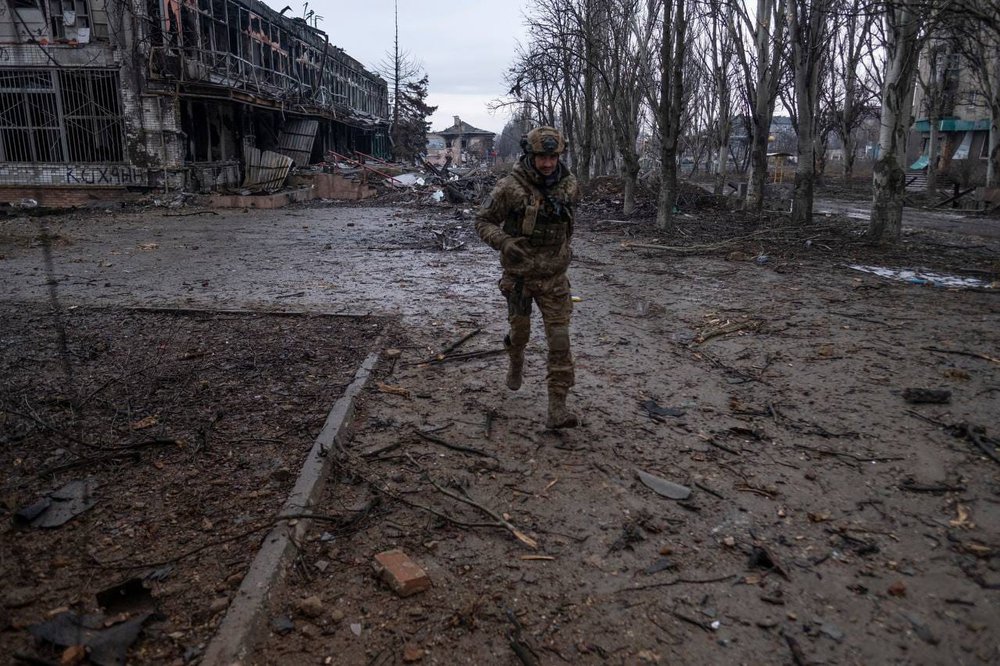
Ukrainian military in the area of Bakhmut. Photo: General Staff of the Armed Forces of Ukraine
But the mood on the front line is gloomy.
The soldier who agreed to be photographed and said he understood he could be criticized for his frank assessment, described how he went into battle with recruits who had never thrown a grenade, easily abandoned their positions under fire, and lacked confidence in handling weapons.
His unit had left Soledar in the east of Ukraine in the spring after being surrounded by Russian troops, who later captured the city. The soldier recalled how hundreds of Ukrainian soldiers from units that had fought alongside his battalion simply abandoned their positions, even when Russian mercenaries "Wagner" advanced.
According to the soldier, his battalion had changed unrecognizably after a year of the war. Of the approximately 500 soldiers, about 100 were killed in battle and another 400 were wounded, leading to a complete rotation of personnel. The soldier said he was the only professional soldier in the battalion and described how difficult it was to manage a unit composed entirely of inexperienced soldiers.
"I'm getting 100 new soldiers," said Kupol. "They don't give me time to prepare. They say: 'Take them into battle.' They just throw everything and run. And that's it. Do you understand why? Because the soldier doesn't shoot. I ask him why, and he says: 'I'm afraid of the sound of the shot.' And for some reason he never threw a grenade. ... We need NATO instructors in all our training centers, and our instructors need to be sent to the trenches. Because they couldn't cope with their task."
He described the acute shortage of ammunition, in particular simple mortar shells and grenades for the American-made MK-19.
Ukraine has also faced a sharp shortage of artillery shells, which Washington and its allies are trying to solve, and discussions about how to replenish Ukraine's reserves dominate daily White House National Security Council meetings devoted to the war. Thanks to Washington's efforts, Ukraine continues to fight, but the level of ammunition use is very high and the deficit is preserved.
"You are on the front line," said Kupol. "They come at you, but there is nothing to shoot with."
Kupol believes that Kyiv should focus on the systematic preparation of new troops. "We just give interviews and tell people that we are doing everything we can. It's like we are saying that all we are doing is giving interviews and telling people that we have already won, just a few more weeks and we will win," he said.
Dmytro, a Ukrainian soldier whom The Post, for security reasons, refers to only by name, described many of those same conditions. Some of the less experienced soldiers serving in his position in the 36th Marine Infantry Brigade in Donetsk Oblast "are afraid to come out of the trenches". According to him, the shelling is so intense that one soldier starts to panic attack and then "the others catch him".
According to Dmytro, when he first saw his service comrades who were very shaken, he tried to explain to them the reality of the risks. The next time, according to him, they "simply ran away from the position".
"I don't blame them," he said. "They were very confused".
The Commander-in-Chief of the Ukrainian Armed Forces, General Valeriy Zaluzhnyy, stated in September that almost 9000 Ukrainian soldiers had died. In December, Mykhailo Podolyak, an advisor to Zelensky, said that this figure had reached 13,000. However, Western officials give higher estimates, and in any case, Ukrainian figures do not include a much larger number of wounded who can no longer fight.
A German official, speaking on condition of anonymity, said that Berlin estimates Ukrainian losses, including those killed and wounded, at 120,000. "They don't share this information with us because they don't trust us," he said.
Meanwhile, according to Syrskyy, the Russian offensive has been intensifying since the beginning of January. The head of the Ukrainian military intelligence, Budanov, said in an interview with The Post last month that Russia has more than 325,000 soldiers in Ukraine, and another 150,000 mobilized may soon join the fighting. Ukrainian soldiers report that their numbers are smaller and they have less ammunition.
The stakes for Ukraine in the coming months are exceptionally high, as Western countries that are helping Kyiv try to understand whether Ukrainian forces can regain the initiative and recapture more territory from Russian control.
Russia is also facing problems with ammunition, manpower, and motivation – and in the last month, despite the tense state of the Ukrainian army, it has achieved only minor successes. According to an American official, Ukraine's losses are significant, but Russia's losses are even greater.

Illustrative photo. Source: General Staff of the Armed Forces
"The question is whether the Ukrainian Armed Forces' comparative advantage is sufficient to achieve their goals and whether it can be sustained," said Michael Coffman, a military analyst at CNA based in Virginia. "It depends not only on them but also on the West."
Despite reports of untrained Russian conscripts being thrown into battle, Sirchenko said those arriving now are well-trained. "We have to live and fight in these realities," he said. "Of course, this is problematic for us. ... It forces us to be more precise in firing, more detailed in reconnaissance, more careful in choosing positions and more detailed in organizing interaction between units. There is no other way."
Recent successes of Russia – particularly around Bahmut – have not led to a major breakthrough on the battlefield, and American military officials have said that even if Russia captures the city, it will not have great strategic significance. But given the heavy losses Ukraine is suffering, officials in Washington have cast doubt on Kyiv's refusal to withdraw. According to an American official, the United States advised Ukraine to withdraw from the city at least by January.
A Ukrainian official, who spoke on condition of anonymity because he is not authorized to make public statements, said that the battle for Bahmut is exhausting Russian forces in the city – mostly Wagner fighters who have recently been the most effective for Moscow – and that Ukrainian units defending the city are not planned to be involved in future offensive operations.
Ukraine has lost many junior officers trained in the United States over the past nine years, leading to a dilution of the corps of leaders who helped Ukrainians stay ahead of their Russian enemies at the beginning of the invasion, said the Ukrainian official. Now, according to him, these forces have to be replaced. "Many of them have died," he said.
At the beginning of the invasion, Ukrainians rushed to enlist in the military, but now men across the country who have not signed up for the military have started to fear that they will be handed draft notices on the street. Ukraine's security service recently shut down Telegram channels that helped Ukrainians avoid places where the government was distributing draft notices.
At first, the United States focused its preparation on new weapon systems that Washington decided to provide Kyiv, such as M777 artillery guns and HIMARS rocket launchers. In January, after almost a year of total war, the United States began to train Ukrainian troops. Currently, only one battalion, numbering about 650 people, has completed training in Germany.
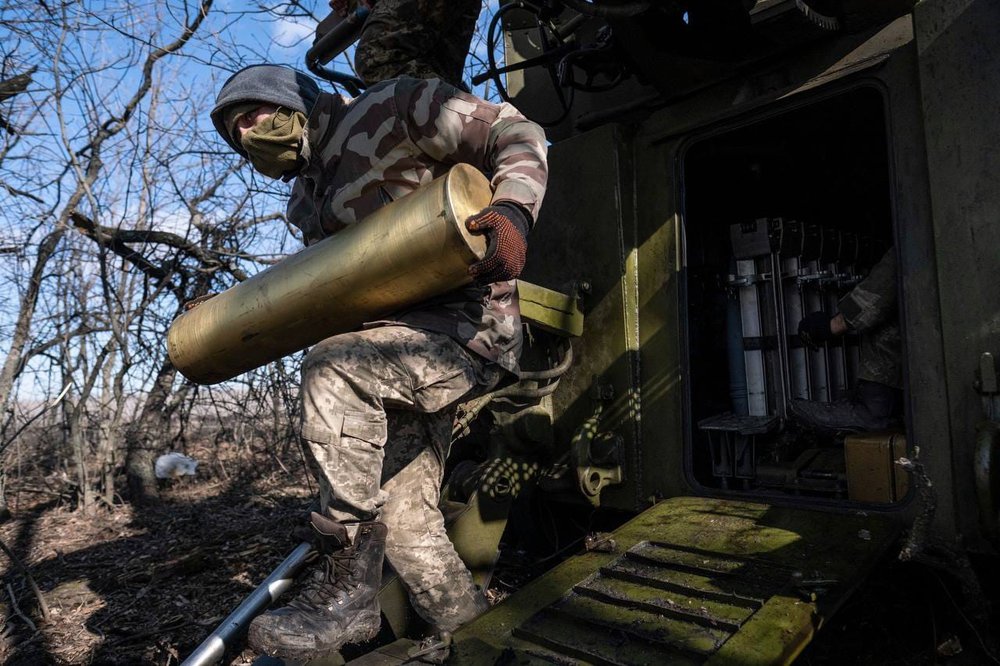
Illustrative photo. Source: General Staff of the Armed Forces
Other Ukrainian battalions will complete training by the end of March, and the program will be adjusted according to Ukraine's needs, Pentagon spokesman Colonel Garron Garn said.
The US Secretary of Defense Lloyd Austin "remains focused on ensuring that Ukraine receives the training it needs to fight the current battle," said Gen. According to him, the United States is working around the clock to meet Ukraine's security needs, as well as investing billions of dollars in the production and procurement of artillery ammunition.
"The point is that we are giving Ukrainians what they need and when they need it," said Gen. "And as President Biden and Secretary Austin have repeatedly emphasized, we will continue to support Ukraine as much as necessary."
Even with new equipment and training, US military personnel believe that Ukraine's forces are not enough to attack the entire giant front, where Russia has created a powerful defense, so the army is trained to look for weak spots that will allow them to break through with tanks and armored vehicles.
Britain is also preparing Ukrainian recruits, about 10,000 last year, and another 20,000 are expected this year. The European Union has announced that it will train 30,000 Ukrainians in 2023.
Ukraine is maintaining soldiers for the spring offensive and training them in the composition of newly created assault brigades. Kyiv is also organizing battalions based on new combat vehicles and tanks provided by Western countries.
According to Syrsky, he is focused on maintaining the front line against Russian attacks, while his deputies are preparing soldiers for the next offensive.
"We need to buy time to prepare the reserves," said Syrsky, referring to Ukrainian soldiers who are training abroad with Western arms. "We know we have to hold this offensive to prepare the reserves that will take part in the next actions. ... Some defend, others prepare."
American officials have said they expect Ukraine's offensive to begin at the end of April or early May, and they are acutely aware of the urgency of arming Kiev, as a protracted war could be to Russia's advantage, which has more people, money, and arms production capabilities.
Responding to recent hearings in Congress on the question of how much more to help the US may need, Deputy Pentagon Chief Colin Kal told lawmakers that he doesn't know. "We don't know the course or trajectory of the conflict," he said. "It could end in six months, it could end in two years, it could end in three years."


