



Serhii Dykun, who lost his leg in war: "I think I’ll be useful in army. My amputation is not too big yet - one leg... I will be useful in army somewhere"
Serhii Dykun is from Nikopol of the Dnipropetrovsk region. He is an ATO (anti-terrorist operation) veteran who worked abroad for five years and returned to Ukraine after the full-scale invasion. In August this year, he lost his right leg during a combat mission in the Luhansk region. Now he is undergoing treatment and waiting for a prosthesis at the Unbreakable Rehabilitation Center in Lviv, where he was admitted on 24 October. This is where we met. This is the first interview he has ever had, so he does not hide his emotions. He feels shy. But he speaks sincerely and frankly.
- How did you lose your leg?
- I was performing a combat mission in the Luhansk region - Stelmakhivka, Novoselivka. There was remote mining by Russians. We did not move three meters to the position. As a result, there were a lot of dead and two seriously wounded, including me.
- Did you get blown up?
- We didn't blow up. I was the first to go through it. I was followed by Andrii, who was second. He also made it through. The third one that came was a "200th". He was hit in the area of the nose. We couldn't find him. He crawled off, leaned against a tree and that was it - no one knew where he was. He was found only in the afternoon. The fourth one was a slight "300th". He was immediately helped and that was it. My leg was immediately broken. I could neither walk nor do anything. They carried me out.
- How were you evacuated?
- Our guys are evacuating. Of course, it was hard. We were 20 meters away from the Russians - well, the Katsaps, as they say, the aggressor. A mortar was working. The boys could hardly stand it. I am grateful that medical aid was immediately provided. Thanks to them, I survived.
- When did this happen?
- On the eighth of August.
- Where were you first taken?
- To Synelnykove (Dnipropetrovsk region - O.M.). There, at either six or five in the morning, I was operated on, my leg was cut off, hanging only on a skin that I tied with a belt...
- And what about the tourniquet?
- I've had tourniquets everywhere. Some just didn't work. I had five of them. One of them just didn't work, it was a spare. So I had tourniquets everywhere - on my legs and arms. It turned out that I had a whole right arm and face, my body (torso - O.M.) was in shrapnel. Everything was very cut. All the soft tissues. They removed the shrapnel they could (the rest - O.M.) here in Lviv.
- How did you get into Unbreakable?
- There was an evacuation train from Kharkiv. I came here by assignment, as I understood it.
- Did you undergo rehabilitation?
- I had seven operations. Here, they cut the stump in such a way that they were preparing to sew it back up. The first time they sewed it up unsuccessfully because they hit the nerves. I couldn't move. Then it was opened, and it turned out that there was a little bit of festering or inflammation. They cleaned it and put a vacuum on it. Now everything has started to progress normally.
- Are you getting a prosthesis?
- So far, I have submitted the documents. We have to wait for the Military Medical Panel (MMP). Then they will start prosthetics - after the MMP.
- When do you have to go?
- When the doctor says. It all depends on him. So I have to go to the hospital. I have doctors here too. So they prescribe the MMP. They know when it is necessary.
- Have you had any opportunities or thoughts about going abroad?
- I came from abroad. I'll tell you a little secret: I worked there for five years. I am an ATO veteran myself. I served in the paratroopers - the 25th Brigade. I came here when it all started. But a little later - I crossed the border on 6 March, and on 7 March I was already in the Nikopol security company at the military commissariat. Then I was transferred to a Kharkiv brigade - a month and a half later, or two months later, I don't remember exactly. The unit was additionally expanded - the 92nd Brigade. I was a senior rifleman there.
- What jobs did you do abroad?
- I've done all kinds of jobs (smiles - O.M.). A multifunctional laborer, so to speak.
- Have you ever thought about going abroad for treatment or prosthetics?
- I think our doctors should do better. And abroad, in my opinion, why would they need me? I have one leg like that, you saw it yourself. I think some guys are heavier. Maybe they need me more. I'll just take up extra space.
- So it's possible to do all this in Ukraine?
- Yes. Although I have never had to deal with it, I hope that there are good prosthetists who will provide good prostheses, make good ones that will look like a real leg.
- Are you undergoing a psychology here? Does it work here?
- Of course! It is mandatory here from the very beginning, everyone works with psychologists. There are a lot of doctors. A lot of girls. I mean, in general! Honestly, I'm not used to it (laughs. - O.M.). For a year and a half, I didn't see too many girls. But since the eighth of August, when I was wounded, I have seen a lot (smiles. - O.M.).
- Does it help psychologically?
- Of course, it does! When they come in, they smile, when they are happy - it's very nice.
- Why do I ask you about it. We civilians cannot always communicate properly with a person who has an amputation. What are you not allowed to say? What might irritate you? What is unpleasant?
- Yesterday, my friend Misha took me to the park in Lviv. Of course, people pay a lot of attention to us. I'm like a newbie in this role. Of course, it's unpleasant that everyone looks at you like that. You don't seem to be a celebrity, but somehow you are. Plus, you don't go where the parks are, because everyone is pointing fingers. It's also very unpleasant. And there are children there, but they don't understand yet. I'm still a newbie in this role, learning.

- You were in a wheelchair, right?
- Yes. I got a lot of wounds in my left leg as well. I was lucky that it didn't get blown off. It is very good! Only five shrapnel fragments were pulled out of my heel. To give you an idea, I was walking on these handrails, on all fours, I don't know how to say it correctly (on a walker. - O.M.), trying to move on my toes, and my foot was bleeding. If I had to go somewhere for business, it was very difficult... More than two months have passed, and I still have a haematoma (takes off his shoes, socks, shows his injured left foot. - O.M.) and two "jelly" fingers.
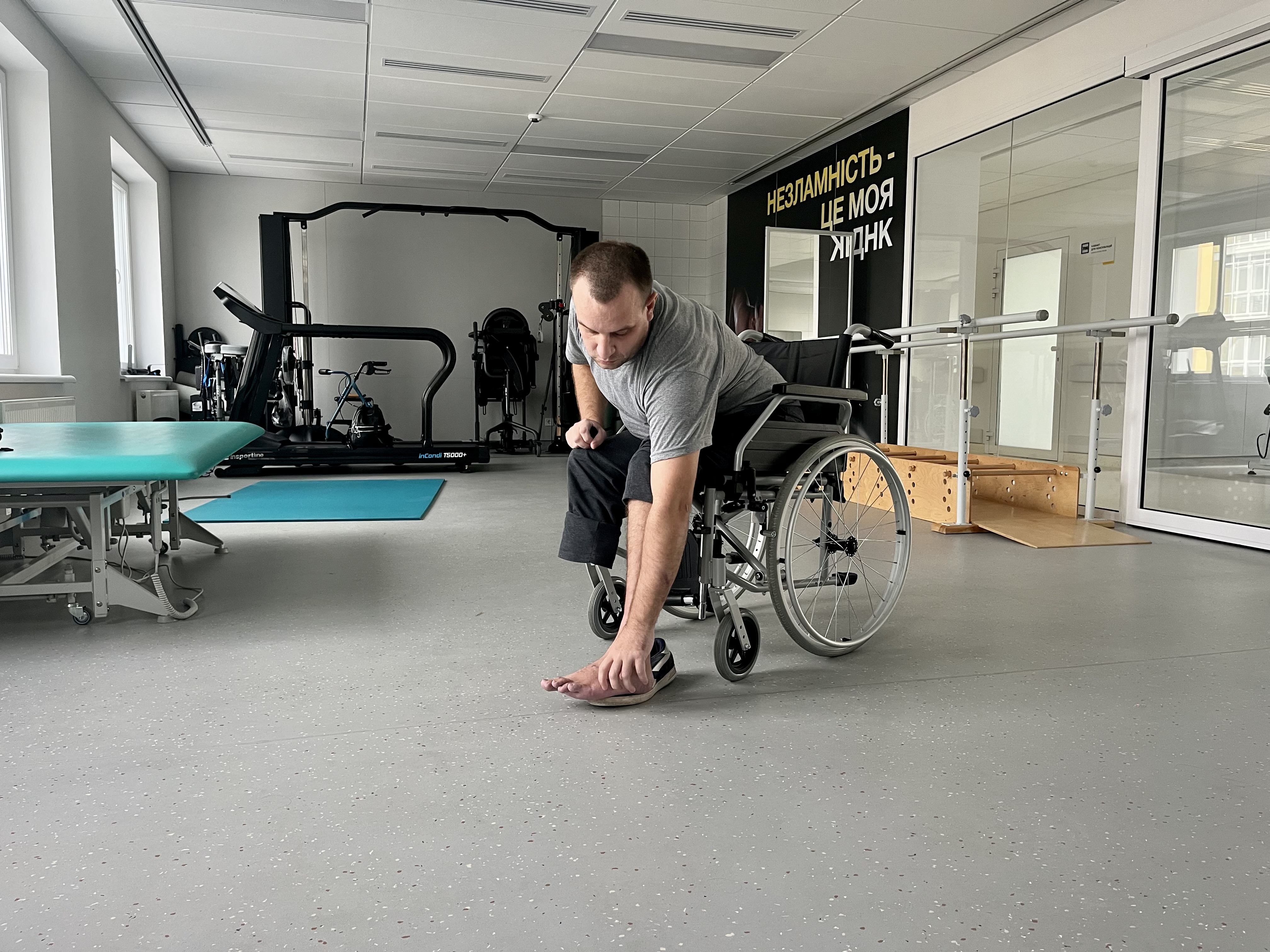
They seem to be balancing, but I can't feel them. They said it was like an impact injury... I have a deep wound here (he takes his right leg in the groin area - O.M.). I was lucky - two centimeters were missing. If it had been a little higher, I probably would not have survived... I have small shrapnel in my soft tissues. They said that they could not be removed. They do not interfere. Then they will grow like a capsule or gradually come out...
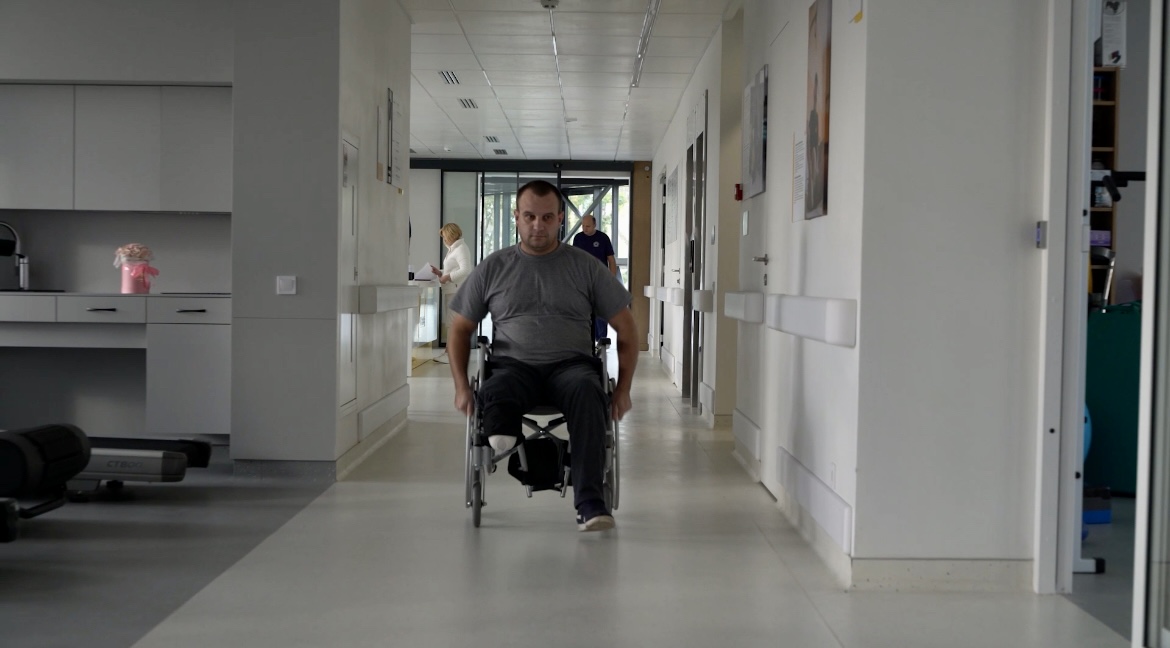
I spent more time lying down. It's just... When everyone comes to you, and you can't do anything (Serhii's voice trembles - O.M.). It's very difficult. Now I'm riding in a wheelchair. It's like an elite-class Mercedes (laughs - O.M.). There are no passengers, nothing. I am alone (smiles - O.M.).
- Have you ever been depressed?
- Of course! How can you do it without depression? Mostly, probably, in Kharkiv. Not since I was transported there. It started when they cleaned my leg. In Synelnykove, they cut it open to prevent infection, and in Kharkiv, they started cleaning it and treating me. I had a lot of medicine, IV lines. I had two operations there. Here - five or more.
- What did you think about? What were the most difficult thoughts you had?
- How to say... I don't want to be disabled. One thing is that I am glad to be alive... When I was in hospital in Kharkiv, my guys were already being buried. It was very sad. It's like telling a story (Serhii looks down, his voice trembles. - O.M.), it's better to keep silent...
My mum was with me. Who else would help if not parents. And they found me in Kharkiv. My brother found me. He is also in the army. So I was staying in Kharkiv, but no one knew I was wounded. On the third day, his friends brought a note with a phone number. My parents, brother and wife came to see me the next day.
- Didn't you have a phone?
- I had a phone. It just saved my left arm. I had a phone on my side. The shrapnel hit me and pressed so hard that I had a blue bruise. Thanks to the phone. I won't tell Mark (smiles - O.M.). Otherwise, I would have lost my arm too. I've seen guys without arms, without legs - it's really sad...
- So is the phone all you have?
- The guys brought me what was left of the phone - a SIM card and a memory card.
- It had worked.
- Yes. And the tourniquets were on my arms and legs. I gave myself first aid. When my leg was cut off, one went under the other. I was lying down and realized what was happening - a large shrapnel hit above my ankle and immediately cut off my leg. It was very hard. But I had a belt, which I used to bandage my leg while waiting for the evacuation. The whole place was covered in tourniquets. One didn't work, so it was good that I had the fifth one. But I did not know where else I was wounded. I was cut all over. You know, you get wounded, and it's like being on fire - you're burning. You have such a fever! When they were taking me away, the guys poured water on me. They said they were bringing me in, but I was already unconscious. I am grateful to them. Well done, guys!
- Now you are preparing for prosthetics. It's a completely different mood, isn't it?
- Just like at school, you start learning again here. I've mastered this machine - a Mercedes. Now I will master the "spare legs" - (crutches as we say). At the moment, I can stand on my left leg for five minutes at the longest.
- And what about physical training? Is it hard for you?
- It is very hard! I can't do much on my knees and I can't do much on my elbows. Because I have been lying down for a very long time. I'm getting out of this. I've only been driving a Mercedes recently (smiles - O.M.). That's when I was transferred here. I started very well. I started to make progress in my recovery. I really want to run. I don't know why, but I really want to run. But so far, I have not reached this level.
- You're still without a prosthesis!
- With the prosthesis, I will advance even further - as they say, to the 11th grade and graduation (laughs - O.M.). That's how it should be, I guess.
- Are you making plans for the future?
- I don't even know what my plans will be. In general, I think I will stay to fight. My criteria are that I think I will still be useful in the army. My amputation is not too big yet - one leg. Of course, it is so heavy. But I will be useful in the army somewhere...

- You want to come back...
- What am I supposed to do? Why did I come to Ukraine?" (smiles. - O.M.). I have to go on fighting. I think all the guys here will say that they want to go to the front too. As long as we have a war, we will all defend our homeland and our home. This is the most important thing.
- What does this war mean to you?
- Oh, I don't know, I can't say. It would be better if it didn't exist at all. But the war shows who is who. We have guys who are fighting and those who have fled. I came back here with the guys I served with. Everyone was coming back. We met in Lviv. It turns out that there is no way to leave Lviv, but people come here from all over Ukraine. They said that we would be loading in 15 minutes, and I went to Nikopol. My Nikopol (smiles - O.M.). But I got there quickly.
- The roads there were free.
- Well, three people are going back. That's just it! They were coming back like that. Three guys went out in Dnipro, and I went out in Nikopol. They were coming back like that. Then, what can I say... We'll win, probably...
- Why probably? We will win!
- We will win! We will. It's time to win (smiles. - O.M.). We were attacking then. Now we have to attack successfully. I think our top commanders have already come up with something.
Olha Moskaliuk, Censor.NET
Author photos


