



Intelligence officer of Defence Intelligence of Ukraine "Artan" Kep: "Cat basked on Wagner’s corpse until it got cold"
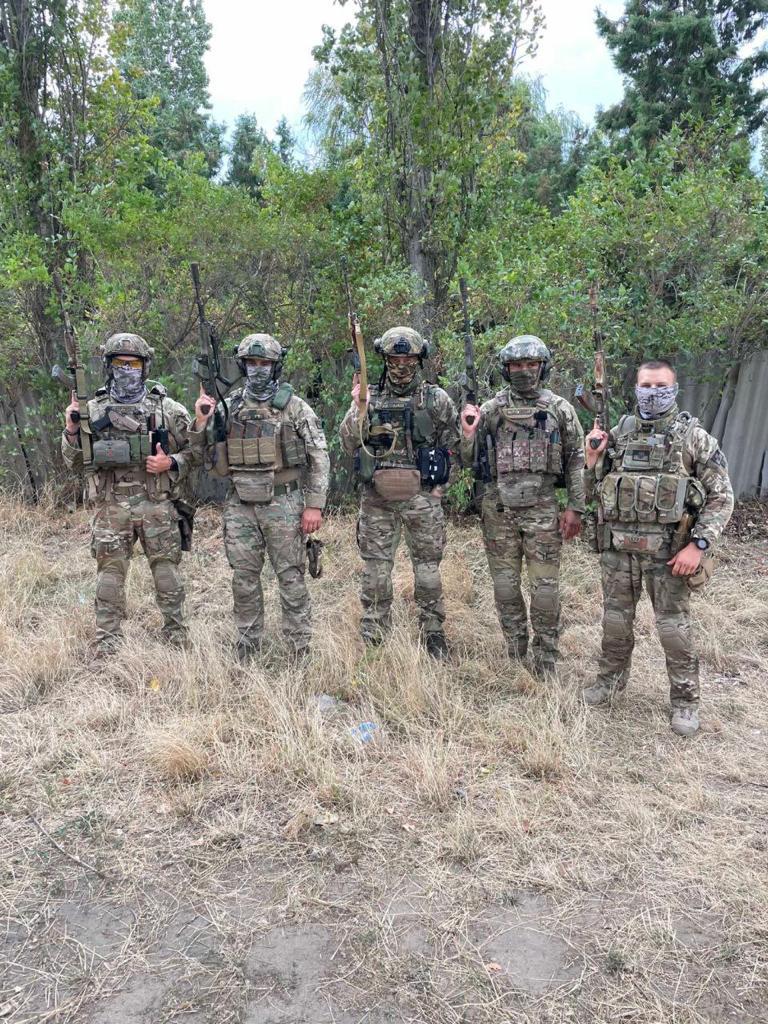
Kep, deputy commander for combat training of the "Artan" unit of the Defence Intelligence of Ukraine, told about the peculiarities of the service of intelligence officers, SEALs (ed. - soldiers) at war, special operations on water and in hot spots. Exclusive interview in the programme "Who is with Miroshnychenko?"
-Call sign Kep, deputy commander of the "Artan" unit for combat training. I am a specialized rescuer by profession and education.
-Wow. He is very handsome, if you saw our hero today, you would understand, there were Australian firefighters, they were filmed... How long did you work as a rescuer, where exactly and what did you do?
-I won't specify where, so as not to be too specific. Although my tasks were quite responsible in my speciality, I worked for 9 years in total and 5 years at a responsible facility. When the full-scale operation began, I knew without any doubts or hesitations that I would participate in it to the maximum. First of all, one of the government agencies asked us to help with counter-sabotage tasks. Upon completion of these tasks, I received an offer to continue my service in a unit of the Main Intelligence Directorate. In fact, all our operations are unique. Each operation leaves an imprint on every soldier who participated in it. It may be, and unfortunately, there are doubtful moments, it may be the specifics of the task itself, it may be difficult, it may be the first time you have to do something, swim far, go far, lie still for a long time. Each operation has its own peculiarities and leaves its mark and memories on every soldier who takes part in it. The most memorable operation is actually the first complex operation I took part in as a commander of a special forces assault platoon - an airborne operation involving a water obstacle. When we managed to overcome a large-scale water obstacle...
-On boats?
-at night, on boats. I remember it because during the crossing of this water obstacle, my group and I, along with 5 other fighters in the boat, sank twice in the middle of the night, and in fact, there were about 10 kilometres to one shore, and about 10 kilometres to the one from which we had started, swam, also. We were completely disoriented as to where we should go next, because we had fallen behind the group we were moving with, our boat...
-What happened to the boat?
-"Unfortunately, some technical aspects were not taken into account, and let's just say that the team in the boat was too heavy. The peculiarity of my fighters is that they take a very large amount of weapons and ammunition with them. The peculiarity of our tasks is that as a rule, the logistics are quite complicated, we go far, we go deep, we go unnoticed, and in fact the weapons we take with us are the only weapons we can 100 per cent rely on, so we take a lot and in fact the entire crew of the group, that was in the boat, each of them had about 60-70 kilograms of extra weight, and this was a little bit too much for the boat, and at speed it was taking on water, but not dumping it, and in fact in the middle of the night, at the end of October, the water was so brisk, the boat sank twice. But the will was higher, and we got out of it, and there was a critical moment when you involuntarily asked yourself, "Is that all? Not that you were filled with pessimism, but you made decisions, you thought about what could be done, how you could get out of this situation, we found a way out and basically did it.
The next logical thing to do at the time was to return to the starting point. Since we were disoriented and had fallen behind the boat group, we had no idea in which direction to continue. To land on the opposite bank to the one where the task was to be performed, to make a mistake 50 metres to the right or left, meant to enter a mined bank or an ambush, so the landing had to be as accurate as possible. But despite that, the motivating factor in this difficult situation at that time was that I understood that I was in only one boat, with only part of my personnel, the rest of the personnel were sailing on and I understood that I could not allow I realised that I could not allow them to make a landing there without me, so the decision was made to look for our boat group, we found it later, transferred to a more technically reliable boat in principle and we completed the task, we made the landing, completed the task, sailed back, returned to our shore.
- I think that few people now have an understanding of what a landing is, how complicated it is? Can you describe it in general terms - when people say that our military landed there and then?
-It's very complicated, there are a lot of aspects of technological, boat characteristics, tactics, you have to take into account the intelligence potential, the moments and means of the enemy, i.e. drones, you have to find that direction, that window, where you can make a transition quite efficiently and easily with a certain size of group, it will be more effective if you land a large number of them at the same time, but it will usually always be 100% detected, so you have to do a certain timing, exposure, you have to calculate it, stick to it, you have to control it. Plus, if you're overcoming a water obstacle, for example, it's an additional source of danger, because what I've experienced is that drowning in armour is a certain feeling. You're looking for a solution, but you understand that the situation is extremely complicated and that every landing is associated with additional risks. The issue here is not the battle itself, the danger of small arms fire, artillery shelling, the use of aircraft, but the fact that, in principle, failure to take into account the technical aspects of the boats, any mistakes made by members of your group can actually lead to drowning. But besides that, for example, even the temperature regime - in particular, from my own experience: I had to spend about 8 hours on a boat, and this was also at the end of October. Everyone was wet, and in that particular operation we were not wearing wetsuits, due to certain factors and conditions that caused this, and we actually froze, to put it simply. There was severe hypothermia, and when you actually get to the point where you have to take active action, you involuntarily, sitting in the boat, leaning on the side of the boat, you just start to have cramps, your limbs, different muscles, it's uncontrollable. You realise that you have to land now, you still have a battle to fight, in which you have to be as effective as possible. Therefore, you need to foresee these moments, and even if you take everything into account, there is always something that will be unpredictable and you have to cope with it on the fly, so every landing is a complex operation.

- If we're not talking about operations on the water, those on land, were there any dangerous moments there as well? From what we talked about, you told me about the operations in Bakhmut in particular...
-This operation will stay with me forever because, perhaps, to put it a little poetically and philosophically, it took away a part of my heart. All my people, all my guys, they are close to me and these were my first combat losses. Frankly speaking, I lost two friends in that battle and three more were wounded. There were quite active hostilities, it was December 2022, the end of the first year of the war, and then there was a turning point in the direction of the village of Bakhmut. Wagner's forces began to use night tactics. This was a turning point to which the Armed Forces needed time to adapt, to understand what to do with this tactic and what countermeasures to take.
In particular, we, as a unit that largely specialises in night work, were sent there with my platoon. This is the southern outskirts of Bakhmut, a small settlement, but there was a specific point, a platoon stronghold, which was being advanced to, the pressure of the main Wagner forces in order to bypass Bakhmut from the south, and the stronghold was an earthen structure measuring 70 by 130 and the specifics of the task was that we were reinforcing the infantry unit of the 28th Mechanised Brigade, you have to hold this small rectangle of earthen and you cannot manoeuvre. Our task was to reflect all the Wagner waves that came at us. According to a radio message from the chief of aerial reconnaissance, waves of 250-300 people were gathering, and this was under artillery fire. It was quite difficult, psychologically difficult, because there were many critical moments when tactical textbooks and common sense dictated that you should take some active action, retreat to reserve positions or something else, but this would mean failing to complete the task. The decision was made to stand unitedly and steadfastly until the end, and in fact, for the period of time we were given to complete the task, the task was completed despite the losses. It was quite difficult, there was a tragic moment, but at the same time there were some moments that made us smile. A story about a cat.
-Tell us.
-"After repelling the next wave of Wagner, at night, in the dark, we mainly worked using night surveillance equipment, airborne surveillance and thermal imaging sights. After the next wave was repelled, the field was littered with the abandoned corpses of Wagner's fighters, we were observing and controlling the sectors, because it was possible that some forces, remnants or new reinforcements, reserves would approach again. And then I see the following picture - a small heat signature moving across the field. I visually assess that it's a cat, in fact, I can tell by its characteristic features through the thermal imager that it's a cat at night. It approaches the corpse of Wagner, climbs on top of it, on the chest, settles down, and actually warms itself, warms itself for about an hour and a half, until the corpse has cooled down and the cat basically continues its route.
-Is this fun for you?
-It wasn't really a cheerful smile, more of an ironic one, so to speak. I don't know what an ironic smile looks like, but I think I had one at the time.
-"Listen, these Wagners, they don't spare their own, do they?
-Clearly, what I observed at the time, yes. Because this is what is called a meat assault, it really was. Wave after wave, concentrated pressure on one point, on this IED, reflecting all the waves, and then the second, third, fifth wave came in and so on. In fact, our task ended with them running out of meat, to put it simply. And there was a moment, on the positive side, when they ran out of meat faster than we ran out of ammunition, because the last battle, when reinforcements came from our group to evacuate the dead from the previous group, the group was actually sent out purely to evacuate their dead comrades, but together with the group that was in position before and arrived for evacuation, it got into another wave of battle. This wave of fighting lasted from 6:30 to 11:30, repelling the assault. And as of 11:30, virtually all the soldiers of the group had half a box of ammunition left, and we, of course, had some spare ammunition, I am convinced and 100% sure that the infantry of the 28th shared their calibres and guns, but we worked out our ammunition and exchanged it.
-Do you have any plans for this year, do you, the intelligence officers, have any plans, or do you act, you are told what the task is, for a certain time, for a certain date, outlined how it should be and you carry it out? Or how do you actually do it?
-"Basically, there are two variants of our tasks - planned special operations and when we are involved in stabilisation measures. If the situation on a certain front line is quite tense and we need to help our neighbouring units, we can be involved quite suddenly. This is one of the most difficult options for our work, because the time for planning is very limited and you actually have to go into combat as quickly as possible to stabilise the situation. The most recent such operation was our operation in Kupyansk. We were working together with our friends, the Kraken special forces unit, in fact, on the same positions. In fact, it was a stabilisation operation on those borders near the town of Kupyansk. Planned operations, I already have a clear understanding, we have the next special operation, which will be planned and implemented for a certain period of time, but despite this, understanding that there is a certain amount of time, it is possible that there may be sudden tasks tonight or tomorrow.
-Do you navigate, prepare and drive quickly and efficiently?
-This is the specificity of our unit - rapid response. When a task comes up, we move out, and in the shortest possible time we move to the specified point to make a decision and take active action.
-Can you talk about how often, if at all, you go "abroad", as they say?
-There are options for using visa-free travel with the Russian Federation. I wouldn't say that we abuse it, but we actively use it.
-What is more dangerous for you - to go "abroad" as you say, to use visa-free travel, or to perform an operation, for example, in the Kharkiv direction, you mentioned Kupiansk?
-It's hard to say, because both the first and second options have their pros and cons. It's a matter of military science and art, miscalculations, some places are easier with logistics, some places are very difficult with logistics, but somewhere you can manoeuvre, somewhere you have to take a static position, so you suffer more from artillery, somewhere you can manoeuvre, so you have the opportunity to manoeuvre, move away from artillery fire and so on, somewhere you can work covertly, somewhere you can't actually work in static positions, so everything is relative. Each combat mission is very subjective and specific, and there are a number of factors that determine its characteristics. To say that something is easier is not really true. Going into any task or battle, you cannot predict whether it will be easy or difficult, because even when planning, there is a saying that any plan is good until the first shot is fired. There are always a number of factors that you have to take into account in the beginning. At the time of planning, you try to anticipate and take countermeasures, but it often happens that sudden and unexpected situations arise and you have to make decisions. It happens in any combat mission, so it's hard to say. This is when they have already taken place and you can, so to speak, do a debriefing and analyse, say what went relatively easily or was difficult, but it is impossible to predict how any operation will go.
-Do you have the ability to refuse operations as an intelligence officer? Are you told to go there, and do you say no, if you assess the risk?
-I would like to have such an option, but we don't have it. When a task is set and there are options for its implementation and proposed, you can make a counter-offer, that is, you can include creativity only in plans for the implementation of this task, but you need to perform it anyway.
-We know that the Russians are hunting for our intelligence officers, so is there any way to protect yourself from this? Are you taught how to avoid becoming prey for the Russians? I understand that you cover your faces, we will not say your name or surname...
-The easiest option and gift for an enemy scout is social media and the like. You need to be restrained, concise, and generally
-Do you use social media at all or not?
-I use it, but more for analysis, for collecting information, there is no need to disseminate any information.
- How do you see this year, 2024? How difficult will it be in terms of transactions? Perhaps you are already preparing for something?
-It will be surprisingly difficult.
- Difficult than the previous year, how do you feel?
-It is quite possible, for the sake of understanding, this war is quite dynamic, it is a new war, it is constantly evolving and you have to adapt, it is a continuous process of monitoring, deep analysis, decision-making and their rapid implementation. Roughly speaking, if there was a concept of an arms race in the Cold War, in fact, we are now in an arms race with the Russian Federation and there are no options, you cannot stop here, and this year, I am convinced that there will also be many challenges and you must prepare as much as possible in all possible ways - physical, tactical, skills, technological, especially technological. A special feature of this war is technological warfare, the use of new means of reconnaissance, firepower, such as FPV drones, anti-drone weapons, electronic warfare and so on. This is now being used very actively, and it is progressing and evolving quite rapidly, and we have to keep up with the challenges.
- Do you have enough people? At the beginning of the year, we were actively talking about mobilisation, about the fact that the law on mobilisation is being considered and we will obviously have some news on this soon. Will you have enough people to fight in the war this year? Where do you take them?
-We will not have enough, we proceed from what we have at our disposal, the number of our brothers in arms and take the maximum possible to complete the task, although they sometimes, roughly speaking, are running on the edge with opportunities, but we are using them positively in our favour. It comes down to the fact that we are expanding our staff and we will be looking for new, motivated colleagues who are ready to join our family, to develop, who are ready to confidently enter the battle.
-"I just looked, by the way, and took a screenshot of the person you're looking for to your unit. Briefly, point by point, the age should be 18-40 years old. If a person is over 40, then you don't take that person as a scout, right?
-Not necessarily. It's a subjective approach, but if we're talking about a special forces assault soldier, the criterion of pure physical capabilities is usually 18-40 years old. A 40-year-old person is effective if he or she has been actively involved in sports, but if a person is 50 years old, but is technically competent and has some exclusive skills, especially in the technical field, such a person will be of interest to us.
- Good physical endurance. You have to be physically fit, I take it?
-This is a key point and it is somewhat philosophical. Because physical endurance is very much combined with mental endurance. The question is not just about the ability to run far, to run for a long time. The question is about the ability to go without sleep for a long period of time, to withstand high temperatures, to withstand low temperatures, to be steady, to be enduring in terms of the ability to cover a long distance and to be enduring in terms of the ability to stay in a position for five days in the cold.
- Do you often check your health at all? Do you get checked or improve your physical fitness skills in any way?
-The improvement of physical skills is virtually continuous, outside the scope of a combat mission. That is, when we take preparatory measures for the next task, everyone works on their physical condition, improving or restoring it.
-That is, do you have time to go to some theoretical or imaginary gym?
-"In fact, we don't need a gym for our tasks. We just take full equipment with a load, take a distance of 20 kilometres and work out, yes. Everyone has the opportunity to work out even in that gym if they wish, but in general, when you practice, for example, deploying a tactical unit, manoeuvring with shooting, making marching throws, you use all muscle groups, especially those that are key to our functions. In terms of physical training, we also have specific training. Again, there are water operations, and swimming is relevant. If there is training specifically for the implementation of the amphibious operation, then if necessary, training is carried out, in simple terms, swimming.
- The absence of close relatives who are citizens of the Russian Federation is one of the requirements for those who want to join your ranks.
-Candidates are vetted, and relatives in the rashka (ed.- Russia) beyond the border is a very specific moment, because we can be convinced of the motivation and sincerity of the candidate who wants to come to us, someone can vouch for him, but if his relatives are in the Rashka and this information that he is serving in such a specific unit gets to interested parties on the other side, then this is a direct danger for the relatives, for the parents of this candidate. If the candidate values his parents, we do not want him to risk them.
-You also have a separate clause in the unit's requirements that prohibits drug use. By the way, I have never seen such requirements anywhere else, but for some reason you have them. Why is that?
-"Drugs and alcohol are such an ironclad postulate and taboo in our country. People who abuse such substances are unpredictable. For us, the reliability of our colleagues is very important, with whom we perform specific tasks side by side. The specificity of the tasks means that the group can be somewhere surprisingly far away, in difficult conditions, and the reliability of everyone in the group is very important. Those who abuse such things cannot be relied upon, so it makes sense and we strictly adhere to it.
- Are there those who come in and you don't take them on, or do they start serving with you and you realise that this person is not ready to work in your unit?
-Yes, of course it happens. These are sociological moments in any society or social group. There are those who lag behind. If we set our standards too high, then we may get those who do not reach the level we need, so to speak, they leave our ranks, we do not involve them in our holy war and our tasks.
- Do you have any 3 points as a commander, 3 theses, 3 things that you constantly tell your soldiers?
- There is a saying, and I'm not ready to recall from whom I heard it, but it has become my fundamental postulate and I constantly profess it: 'heroes are needed when professionals run out'. And everyone will undoubtedly have a moment during this war when they will need to show heroism, but until then, they should try their best to be a professional.
I feel some kind of fatigue in you and I can't understand - is it from the interview, because you are a non-public person, is this the second interview?
-Yes.
- Are you tired of the war and the understanding that it is a long time coming and may not last a year or two?
- No, I'm ready to go all the way. Of course, I would like it to be over soon, but if necessary, I will go all the way.
- What would you be doing now if it wasn't for the war?
-This is a tricky question, I'm not ready to answer it now. I have many things that interest me. If for some reason I am unable to continue my service, I am sure I will find something else to do.
- At the very least, you'll get some rest. Thank you very much for talking to me.
- Thank you.
- Our viewers, please thank our scouts, they are great guys, and thank you for what you do.
Anna Miroshnichenko, "Who is with Miroshnichenko?"


