



Sergeant of 82nd Brigade’s medical company, Yurii Bondar, call sign Shaman: "Today we have more or less good material support, but there are fewer and fewer people willing to become medics"
In 2014, the Lviv resident joined the war as a volunteer paramedic with the 95th Brigade: he took the wounded out of Donetsk airport and Debaltseve, helped the soldiers not only with medicine but also in general in any way he could. After the full-scale offensive, he mobilised and is now officially serving in the paratroopers.

Yurii is persistent and very inquisitive. If he is interested in something, he will understand the issue thoroughly. This is exactly what happened with medicine. He, a volunteer paramedic, has no medical education, not even a primary one. But during the war, he saved dozens of lives. Sometimes it depended on the speed and passability of the evacuation vehicle, sometimes on the first aid provided. In each case, Shaman tried to be as effective as possible. The Lviv resident says that he knows the roads in Donbas much better than in his hometown. It just happened that way.
In 2015, Yurii was awarded the silver order "People's Hero of Ukraine". He voluntarily saved the wounded in the hottest spots of the frontline, not considering it necessary to join the army. He is still a little surprised that he did not get to Ilovaisk. "Because I had to pick up something extremely important either in Kyiv or further away from the war. Otherwise, I would have definitely been in Ilovaisk," says Yurii. Shaman told us about his work in the army during the full-scale offensive during our meeting in Kyiv.
"I DIDN'T EXPECT THE RUSSIANS TO ATTACK ACROSS THE COUNTRY, BUT ALL MY THINGS - BODY ARMOUR, FIELD MEDIC'S BACKPACK, HAIRSTYLE, HELMET, BOOTS - WERE IN ONE PLACE"
- Until 2022, you were doing your own thing for a while ...
- I joined the war in 2014 and stayed until mid-2016, if I'm not mistaken. Then I went back to civilian life - until the start of the full-scale war, until the second series...
- Did you know you'd have to come back?
- There was no expectation that we would have to go to war again, or any suspicion. But there was a clear understanding that it would not just end there. There had to be a continuation, something had to happen. It happened a little bit unexpectedly for me, probably because I distanced myself from the war, from the army, from everything related to it. Some people say: we analysed the information, we understood that there was going to be an outbreak, that it was close. I didn't analyse it. I let go of the situation and moved away from it. And I was surprised by a full-scale offensive near Zhytomyr...
- What were you doing near Zhytomyr?
- On the night of 23-24 February, we were driving from Lviv, because in the morning we had to be in Zhytomyr to attend the funeral of our comrades from the 95th Brigade. At the petrol station, before we reached Zhytomyr, 50 kilometres away, the Internet was connected on my phone and I received messages that the war had started. Kharkiv, Odesa, shelling, shelling... I dialled Borya Ryabukha - after serving in the 2nd Battalion of the 95th Brigade, he lived and taught in Kharkiv, so who could better to tell me what was going on there: "Well, there is a war".
We managed to break through to Zhytomyr at a time when convoys of civilian vehicles were already moving from Kyiv and Zhytomyr to western Ukraine. They went to the rear, and we went forward. We arrived at the funeral. Since the deceased were officers, there was supposed to be an orchestra, all the honours, but because of the war, everything was reduced to a minimum, literally ten minutes: a priest, flowers, a grave... After that, I went to the location of the 95th Brigade - it was empty, no one was there, everyone had already flown away. Those who stayed there could not answer questions. The only person I could get through to was Yurii Alimovich Halushkin. At that time, he was the commander of the Territorial Defence Forces. I asked him: "What should I do? Where to go?" He asked me where I was. I said: "Now I'm in Zhytomyr." - "And your things, ammunition?" - "At home." - "Let's go home, and we'll decide there." I arrived in Lviv. I don't know if it was done automatically, but all my things - body armour, a field medic's backpack, a hairpiece, a helmet, boots, all the uniforms - were put in one place. I periodically, every six months or a year, went through all this - I don't know why. I opened my backpack, looked at it, threw away the expired stuff, added something, transferred something. And then it all came in handy. I put it in the car. Yurii Alimovych said: "Do you remember Lieutenant Colonel Kurko?" - "Of course, from the winter of 2014-15." "Now he is the brigadier of the 103rd Brigade of the Lviv Tank Corps. Let's go there, they also need to form a medical unit. You will find yourself there."
Imagine: there is a war in full swing in Ukraine, and we start creating and moulding a brigade... There was absolutely nothing. We started recruiting doctors, paramedics, those who had anything to do with medicine. The only medical equipment we had at the time was my medical field backpack from 2014-15, which I brought with me. It was a big plus that I still had some contacts. We started conducting trainings, teaching the soldiers. Everything was happening at a fairly active pace. And on Easter, the unit went on combat missions.
- Where exactly?
- To the East. One part went to the Kharkiv direction, the other part - towards Sloviansk, Kramatorsk, along the Siverskyi Donets River, where the enemy was setting up crossings. I stayed in that brigade until June, then transferred to my native paratroopers.
- Why did you do it?
- I had a feeling that I was wasting time. Every day there are battles, and you are sitting in Kramatorsk, somewhere on the rear lines, and you are not fulfilling your function, or you are fulfilling it by five to ten per cent. I'm not saying that the TRO is bad, but it's not the same. When you've been in the paratroopers for two and a half years, on the front lines, when you've seen how things are going and you know what you can do, you start comparing it to what you're doing here... It's not that your self-esteem falls, but you realise that you're not effective here - I mean, "not at all" - and you need to change something.
At that time, I didn't even know that Pavlo Rozlach was in command of the 3rd Battalion Tactical Group of the 80th Air Assault Brigade. I found out by accident. My friends, volunteers and doctors from abroad sent me various things. I received expensive optics and nightlights, which I, a medic, did not need. The TRO team did not know how to use them, and had no place to use them. These things had to go to those who really needed them. I wrote and sent photos over the phone: "I have this - do you need it?" - "Yes!" - "Who do you want to send it to?" - "To that man, here's the point - you bring it." I did. And one day I came to Pavlo Ivanovych: "My nervous system can't take it anymore. Take me to your place!" He said: "Take it".
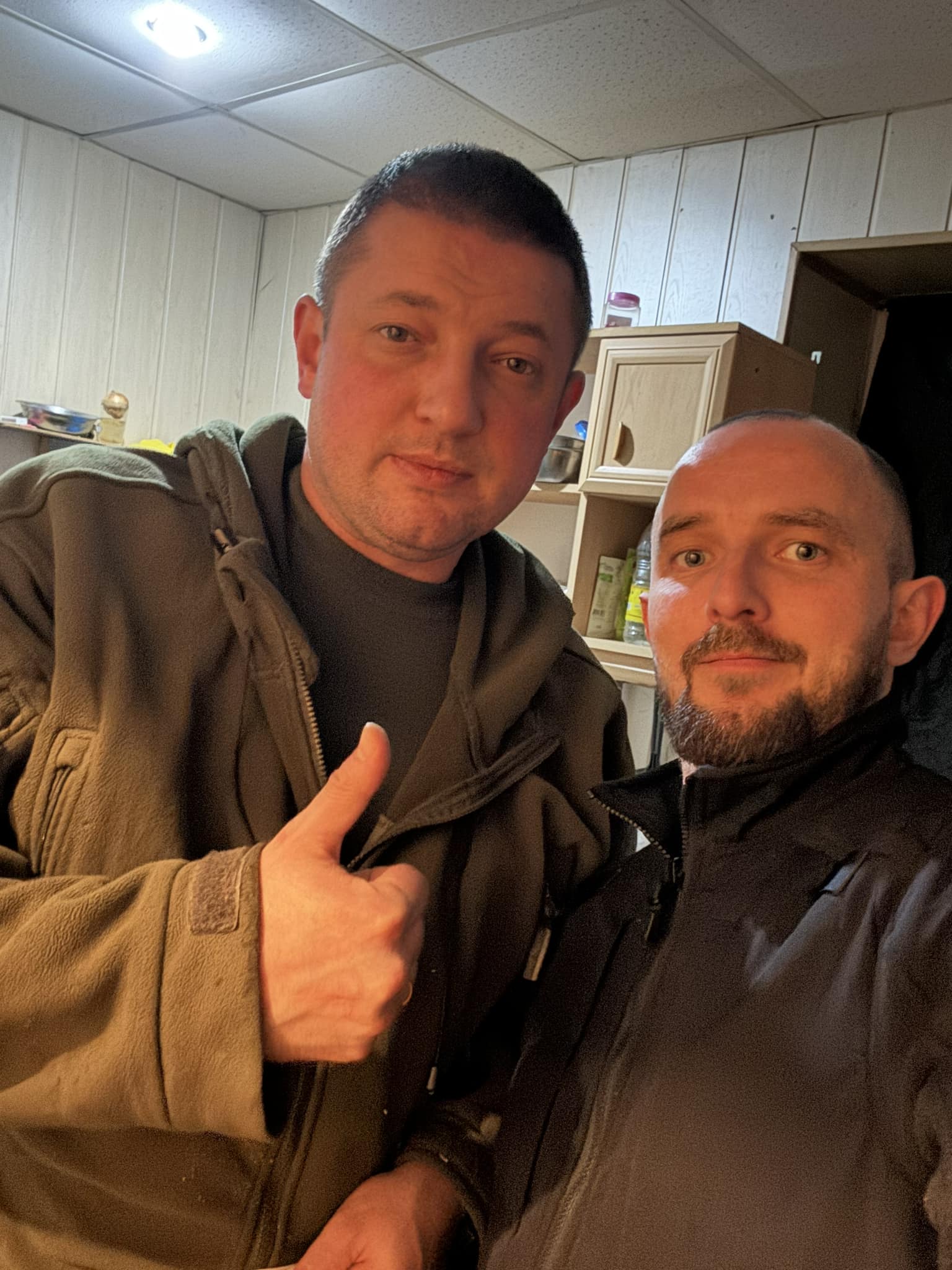
It was a long procedure to transfer from the Special Forces to another type of troops - the Airborne Forces - a somersault, but I did it successfully. Not without help, of course. I had to ask and bother a lot of people...
- Was the medical service in the 3rd BTG already established?
- The 3rd Battalion Tactical Group then moved towards Verkhnekamianske. I came, as they say, from a ship to a ball. I got to know the head of the medical service, and we found a common language very easily and simply - we worked together with him and the team very quickly. And we quickly grew from the 3rd BTG of the 80th Brigade to the 82nd Brigade, a newly formed brigade. Most of our medical service moved to the new brigade. Everything became a little bigger here: there was a medical station, and here - a whole medical company.

"THE FIRST THING TO DO ON THE POSITION IS TO BUILD A SHELTER, A HOLE, BECAUSE IT SAVES LIVES"
- In 2014, you saw what kind of vehicles there were, what kind of injuries there were, what kind of intensity of fighting there was. And you came now, a few years later. Can you compare these two periods?
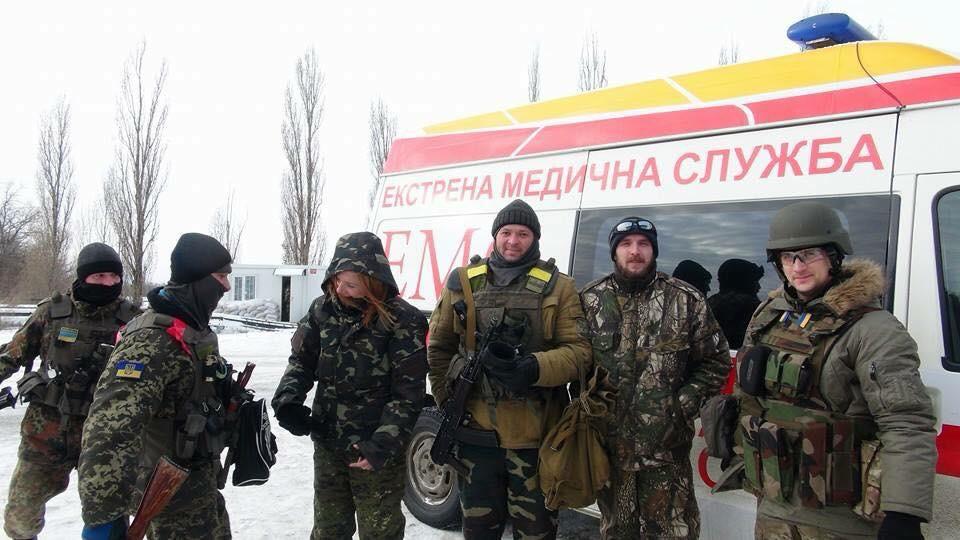
- Roughly speaking, the war was in 2014 and part of 2015. Then everything turned into defence. And now we have such an afterburner! In terms of the level of provision, we can say it's like heaven and earth between what we had before. In 2014, the first ambulance I worked on personally was an old "Fiat Ducato". The only difference between it and a truck was that it had medicine boxes inside. There was no gurney - for some reason, the Poles decided that we didn't need it, so they dismantled it along with the ramp, and just put an ordinary folding army stretcher there. It was covered with blue stripes and had a flashing light - that's the only difference from a freight truck. There are no such vehicles now, and I can't even imagine working on one - either I or the battalion's medics or company doctors.
Yes, we may not be getting everything we need as much as we would like. But there are also many more people and units fighting now, which is not comparable to the number that fought in 2014. When the war started then, we were not ready for it at all. And now... We could not have foreseen that we would need thousands of personnel, one hundred thousand five hundred brigades, separate units, battalions... Now they say that the state is doing nothing. Yes, the state may not be meeting some of our expectations, but we may be setting the bar too high, not realising and not thinking that we need to sit down and, using simple arithmetic, calculate how many brigades we have, how many personnel they have, how many medical stations they have (if we are talking about medicine), and how many medical companies, how much we need to provide for everyone. And in the end, it will result in such a crazy figure... And if you multiply it by banknotes and translate it into hryvnias or foreign currency, it will be just a nightmare. No one asks this question, everyone wants instant solutions and quick response. Unfortunately, it will not happen. At least for now... What we have now is not the worst option.
- You were a direct participant in the liberation of the Kharkiv region in the ranks of an airborne unit in the autumn of 2022...
- If we talk about the Kharkiv operation in general and compare it with what we faced in the Zaporizhzhia sector, we can firmly say: yes, it was a cakewalk. Although the Kharkiv region was not easy either: Krasnyi Lyman, the forcing, the crossing, Pisky-Radkivski... There were losses - both sanitary and irreversible, unfortunately. However, assessing the scale of the liberated area, I would say that it was a great operation. It was the situation: the enemy's unpreparedness and well-thought-out planning. In many ways, everything depended on the preparation of our actions. I believe that the 3rd BTG of the 80th Air Assault Brigade at that time, under that command and with that personnel, was a very powerful organism. Despite the fact that, as far as I recall and as far as I know, it was not fully equipped with personnel and everything that should have been. And with all this incompleteness, the unit showed very good results.
It is painful to remember every loss. One of our comrades was killed during a heavy shelling. The medics were digging out the wounded under fire, ignoring all the canons of self-preservation. There was hope that there was a niche under the rubble and they could try to save people. Unfortunately, no miracle happened. We managed to pull out one of them - he was under the rubble, but he was pinned down to halfway down, he was lucky, he was born with his shirt on.
- It is said that almost a hundred wounded are taken out every day in the Zaporizhzhya sector. Do the wounded have any specific characteristics?
- I cannot confirm this statistic. But there are a lot of wounded. I can only compare the battalion tactical group and the number of wounded we had when we stormed Avdiivka. Here we are talking about a whole brigade. There, we performed a deterrent function, and here we have assault work. This is a huge difference in the number of sanitary and irreversible losses.
The nature of the wounds... There are a lot of multiple fragmentation wounds. We also receive a lot of cephalgia - let's call it contusions. Something came, fell and contused them - ringing in the ears, vomiting, disorientation... There are a lot of these. There are fewer shrapnel wounds, because the commanders and sergeants are working properly, telling them that the first thing to do at the position is to make a shelter, a hole, because it saves lives. Our predecessors from the 47th Brigade had a lot of traumatic amputations, especially of lower limbs. This is due to mining. The enemy mines everything, many of them remotely. There are a lot of Lepestok mines, they won't kill you, but they can seriously injure you: they can tear off a foot.
"THE RECORD WAS WHEN THE WOUNDED WAS CARRIED ON HIS HANDS FOR 2 KILOMETRES AND 700 METRES"
- To what extent are there not enough doctors in the war?
- Today, this is the biggest headache. If I use the analogy of 2014, I can proudly say that there were many medics or those who wanted to become a combat medic then. It was impossible to provide them with proper consumables, proper field medic's backpacks, and transport. This was a problem. We did not have the material and technical base, but we had a large number of people who could take this job. And today we have, I would say, the opposite situation: we have more or less good material support, transport, or we can provide a car in a short period of time, but there are fewer and fewer people willing to become a medic. The problem here is twofold, because we can train a combat medic - there are courses, we have a lot of help from foreign partners, Norway, Italy and France provide training, we can send people anywhere. We could only dream of this in 2014. And they provide everything. You don't arrive from there empty-handed, but already equipped, equipped, with an A-plus. But the shortage of people is very high.
After the combat medics, they have to provide assistance in the medical company. The situation there is also not the best. I may be wrong, but there is not a single unit that has a full complement of medics. It all depends on narrow-profile specialists: we need a surgeon, traumatologist, anaesthetist, resuscitator, general practitioner... The shortage of narrow-profile specialists is terrible. And without them, all the work of combat medics and battalion-level medical stations comes to naught. Because we, as a medical company, are part of this mechanism that stands between the hospital, a stationary facility or a mobile hospital, and combat medics. We have to relieve the combat medics so they can return to their positions as soon as possible, and we have to stabilise the wounded, bring them into proper condition so they can be admitted to a hospital for further treatment.
Everyone says that you need to take recruitment measures to attract specialists. But the fact is that you can't lure people with anything new. All units of the Armed Forces of Ukraine are basically in the same conditions, they all have the same salary, the same financial reward, depending on which front line you are on.
The head of our hospital department is a proctologist by profession. I look at him and don't understand why he didn't join the army earlier, he's so good at what he does. We also have a great dentist, and we have a mobile dental office. I can say that we were 95 per cent correct in our appointments. All people are in positions that suit them.
- The biggest problem is that it is impossible to evacuate the wounded from the position in time...
- If we are talking about the system of evacuating the wounded in general, everyone is trying to come up with some kind of standard, a "golden hour" rule. It's all very well, but, you know, there is a phrase in chemistry: reaction under normal conditions. Our conditions are abnormal, and we cannot come up with a standard because there is no standard. We have borrowed medical standards from Europe and the US, and adopted their experience. But, again, they did not have the same experience and events that are happening here. When we tell them how we fight during the exercises, their hair stands on end - they can't imagine it. "How could you break the line, enter, storm, and conduct raids like that? It doesn't work like that! Our aviation has to come in, bomb everyone, then the artillery has to destroy them, tanks have to go over the corpses, and only then we will go in and shoot the survivors." It is the same with medicine. Deaf defence or more or less active defence is one kind of action, we build our work in our own way. Offensive actions are quite different. In the Zaporizhzhia direction, there is mostly steppe, few settlements, and a considerable distance between us and the enemy, but you can see everyone in the palm of your hand, which complicates the process. If you take Bakhmut, for example, it has its own specifics, and Avdiivka has its own. We adapt everywhere. We do a preliminary analysis, reconnaissance on the ground, study the routes, analyse the state of the road surface, how long it takes to get there, to understand how to act. But it's impossible to calculate everything, because everything happens dynamically, on the move, and we have to constantly correct everything.
The offensive that took place in the summer showed that not everything is as simple as we would like or as we thought. The enemy is constantly in the sky, constantly watching what we do, how we do it, so we can evacuate the wounded under the cover of night. Depending on when the soldier was wounded, the time for evacuation starts. If he was wounded in the afternoon, but the enemy is heavily shelling the positions, using drones, "Orlans", ZALA, all this does not allow us to send a group to him, because it can also come under fire and replenish the number of the "300", and we will have to send the next group, and then another - and so we will, sorry, destroy the personnel. So we wait for evening or dusk, smoke up the area for cover, and evacuate. Of course, the evacuation time can be completely different. Conventionally, from half an hour to three, five, six hours or more. There were cases when the enemy used artillery and tanks so actively that they did not give us any chance to evacuate, and the time was delayed for up to ten hours, sometimes even more. Having a lot of experience and looking at a brief description of the nature of the injury sustained by a soldier, you think: he will last two or three hours. The evacuation does not take place, and you mentally transfer the status from "300" to "200"... Because you cannot do otherwise, you understand that he needs help NOW - not in three or five hours, when the situation allows for evacuation. Trying to spit on everything and take a risk to evacuate him is a completely unjustified risk, because you can put the whole group on the line for one person at once. Unfortunately, we don't have more people. And this is not a computer game where you can replay a level and win it...
In our direction, evacuation is mostly carried out manually - the wounded are carried on their hands using a soft stretcher. The record was two kilometres and 700 metres - on our hands. This requires at least four soldiers. They carry the wounded to the point where the battalion or company medical unit can evacuate him on some type of transport - a motorcycle with a sidecar converted into an evac, or a quad bike. They evacuate him further to the rear, and there the battalion's medical unit intercepts him, transports him in an ambulance to the medical company, and then either to a hospital or to a medical company...
And while the wounded are being taken out, as a rule, enemy artillery, tanks, FPV drones are working... All this makes it impossible to get there. In the open field, you are in the palm of your hand. That's why this time is running out. And it becomes critical.
As for tourniquets... As we have always been taught, if there is bleeding or a traumatic amputation with a limb severed, you take out a tourniquet, apply it, tighten it, and then check: there is no bleeding. Everything is fine. But time is running out, and if we can't evacuate within five or six hours, and all this time the turnstile is pinching the vessels... There are different ways of asking questions here. There is a situation when a combat medic cannot control this process, because the unit moves on, and he moves with it - he needs to look after those who have gone ahead. And the wounded man he tourniqueted stayed behind in the conditional rear, waiting to be evacuated. After he is evacuated, we get the following picture: the tourniquet was applied, the conversion was not performed, the tissues began to die... This leads to traumatic amputation - not due to a mine, not due to the injury, but because the tourniquet was there for so long.
This played a cruel joke on us - I mean not on our unit, but on the military in general, because there used to be a lot of shouting and hype about the fact that the soldiers did not have turnstiles, or had them, but of inadequate quality. "There should be at least two for each soldier!" Yes, I completely agree with this: there should be, and they should be of proper quality. We have received the turnstiles, we have them, some part is provided by the state, the command, the rest - by foundations, volunteers collect them from all over the world. But the effectiveness of their use... Stopping the bleeding without control... How many tourniquets were applied and whether it was necessary to apply them at all in that wound... Maybe tamping and bandaging would have been enough... No one monitors this. "Oh, a bullet wound!" or "Oh, shrapnel! Blood flow!", although there is a little blood there - we apply a tourniquet. But with certain types of injuries, in many cases, you can get by with a compression bandage, wound tamponade - and, in principle, that's it. Or, if the bleeding is a little more massive, applying a tourniquet with its subsequent control and conversion so that the tissues do not die off. But very often now we get the situation when a person should have this limb healthy after treatment and surgery, but it has to be amputated because the tourniquet has been in place for so long. Unfortunately.
"FOR SOME TIME, I FUNCTIONED AS A 'LONE WOLF': I WAS A DRIVER, A PARAMEDIC AND AN ORDERLY"
- Do you have a medical degree?
- No, I am self-taught. And, in principle, I have no regrets. I was drawn to medicine for some time. It's not even like that. I like to learn new things. And absolutely unrelated things. I like to study technical issues - I worked for a long time as the chief power engineer of a corporation, powerful enterprises, although my education is not technical at all, but economic and legal. When I like something, I start studying it and delving into it.
The situation with medicine was the same, but a bit forced. In 2014, there was a banal lack of vehicles. So when we brought another ambulance, we asked the guys what other needs and wishes they had, and we heard them: "We have the equipment. It would be good if we had the manpower". Since I have zero medical education, I came in handy as a driver, just turning the wheel of the ambulance. The medic on board was Vadym Silver. Vadik was patching up, I was driving - everything was great, we were doing well. I know my way around, I don't suffer from cartographic cretinism, I can calculate the time of approach, where and how to drive - everything works out great. That's how I started my career, relatively speaking. I was curious about what Vadym was doing, and he started to pull me up. Over time, I was no longer just driving and helping to carry the wounded, but I could put on or take off a tourniquet, put a bandage on a wound, treat it, inject something, put an intravenous drip... And the further I went, the more I learned. For some time, I functioned as a "lone wolf": I was a driver, a paramedic, and a medic.
And then - new steps. In no time, you've managed to set up a small medical centre. And a medical centre is already a team, you are not working alone. And then, in a flash, you have a whole medical company.
Now I make sure that people work in more or less comfortable conditions, because it is basic respect for their work and for those to whom we provide assistance. We need to provide it not in some broken-down garage, but in a stabilisation unit on wheels. In 2014, we could only dream about it. When I first saw a vehicle in the Debaltseve direction, it was a ZIL or 66th gazelle, and it was wow. It had a lamp and a table that looked like an operating theatre... Years later, I saw that there were much better versions of such ambulances. And I realised: how was it possible to live and work in those conditions? The heat, no ventilation, no convenience... Now I would not want our doctors to work in those conditions.
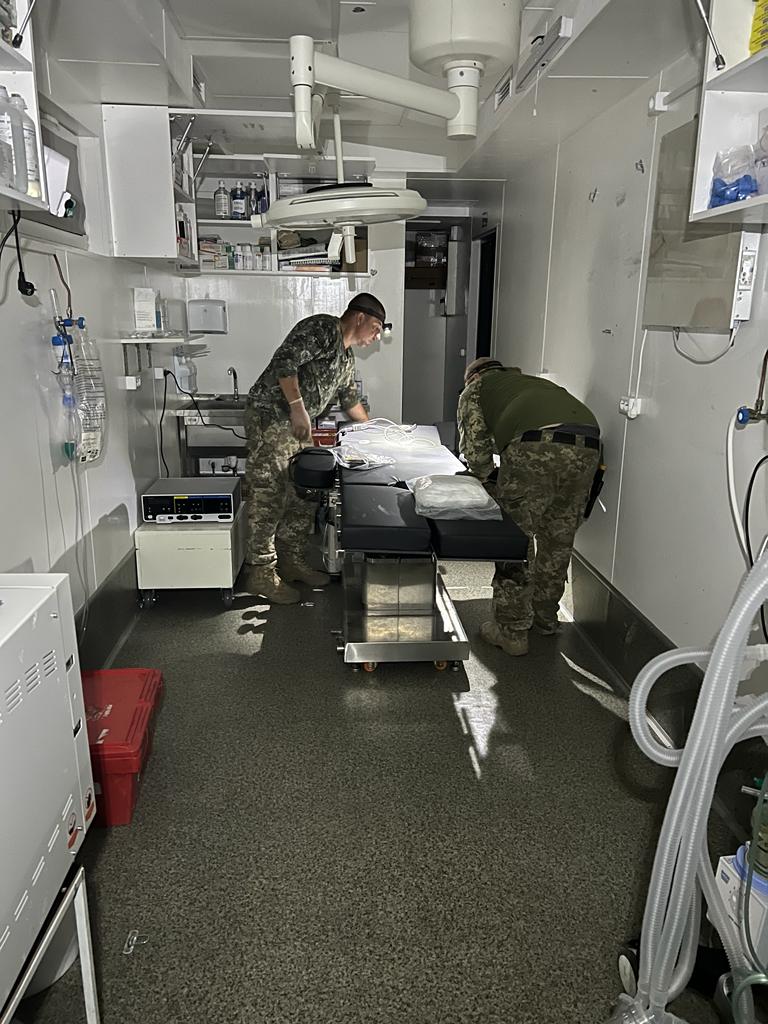

- What is your dream "ceiling now" - portable ultrasound and portable X-ray?
- Yes. As far as I know, our friends have already paid for the ultrasound machine. The last thing we don't have yet is an X-ray. It costs a lot of money, one and a half million or one million 600 thousand hryvnias, if I'm not mistaken. This is the only thing the team doesn't have yet. But it's not a given that if we fulfil this point, realise this moment, we will stop. I will find what else we don't have or what else we can do better.
- Remember the most painful situation for you...
- Two such incidents stick in my memory... The first was when there were battles for Verkhnekamianske. The guy could not be evacuated. For some time he was unconscious, we can say that he had already crossed the threshold when it was possible to bring him back to life. But we tried: adrenaline and heart massage - everything we could do. We had medics from the 57th Brigade with us, because we were in the process of transferring positions - they were replacing us. We were all working on him, believing that we would pump him out and bring him back. We worked on him for 15 minutes, and unfortunately, it didn't work. Then I remember sitting at the entrance to the basement and analysing the situation: what, how, why. And I couldn't find an explanation for myself...
The second such incident occurred during the fighting for Pisky. A wounded man was brought to our improvised stabilisation centre, which we had set up in a garage. He was conscious and had no critical injuries. We cannot say that this "three hundredth" was easy. We assessed his wounds as moderate. Everything seemed to have been done correctly: he was anaesthetised, put in an intravenous drip, rewound and bandaged. Everything is just perfect. We sent him for evacuation - the crew from the medical company worked in our interests to relieve us a little bit, so that we did not waste time on delivering him to a medical facility. The crew took him on board, and they were very sane, experts in their field. They took him, came back and said: "Guys, he's a 200..." I said: "How?" - "We took him to the hospital, they put him on the table right away. We didn't even have time to go out the door of the hospital - he was bent in an arc, convulsing, his pulse and heart stopped. A resuscitator and an anaesthetist came running and started resuscitation measures, but they had no effect." We analysed what we might have missed, whether we did everything right. We were picking on ourselves. We were giving him solutions - were they really the right ones, or did we get something wrong? Did we anaesthetise him with this and that - was it expired? No, we checked. We listened to him, examined him - we always do this as good as possible, cutting his clothes, fully examining the body of the soldier. Nothing indicated a critical injury. But we still missed something. This situation is disturbing, because absolutely nothing said that a person could become the "two hundredth" after you and in such a condition when, relatively speaking, you could put in an intravenous drip, anoint his forehead with brilliant green, let him sleep - and in three days he would walk back to his position... It is harder to perceive now than even in 2014.
- What determines where the scales will tip in the course of providing assistance?
- There are many believers among doctors, and many non-believers. Everyone chooses for themselves what they believe in. There is no answer as to what needs to be done to make everything great. Yes, the end of the war will definitely give everyone a chance to live and not be wounded or become one of the "two hundredth". But we must clearly understand that all those things that increase the chances of life are a whole mechanism. And each cog in this mechanism plays its absolute role. It is impossible to say that, for example, by giving everyone eight turnstiles and 12 occlusive stickers, we will close this issue. We will never close it. Or we will provide advanced resuscitation vehicles, new, from the showroom, and this will solve the problem of rescuing the wounded. No, it will not.
This is a set of measures, starting with a good material and technical base and high-quality training for combat medics. Part of the training should take place in a deaf defence, so that people get used to the sounds of explosions, to the flight of planes and drones overhead, so that they can navigate them and not be afraid. This is one of the things. There must be proper equipment and vehicles. There must be decent equipment and supplies. And again, personnel make all the difference. Without people, having everything - machinery, the best equipment - especially without highly specialised specialists, we will do exactly nothing.
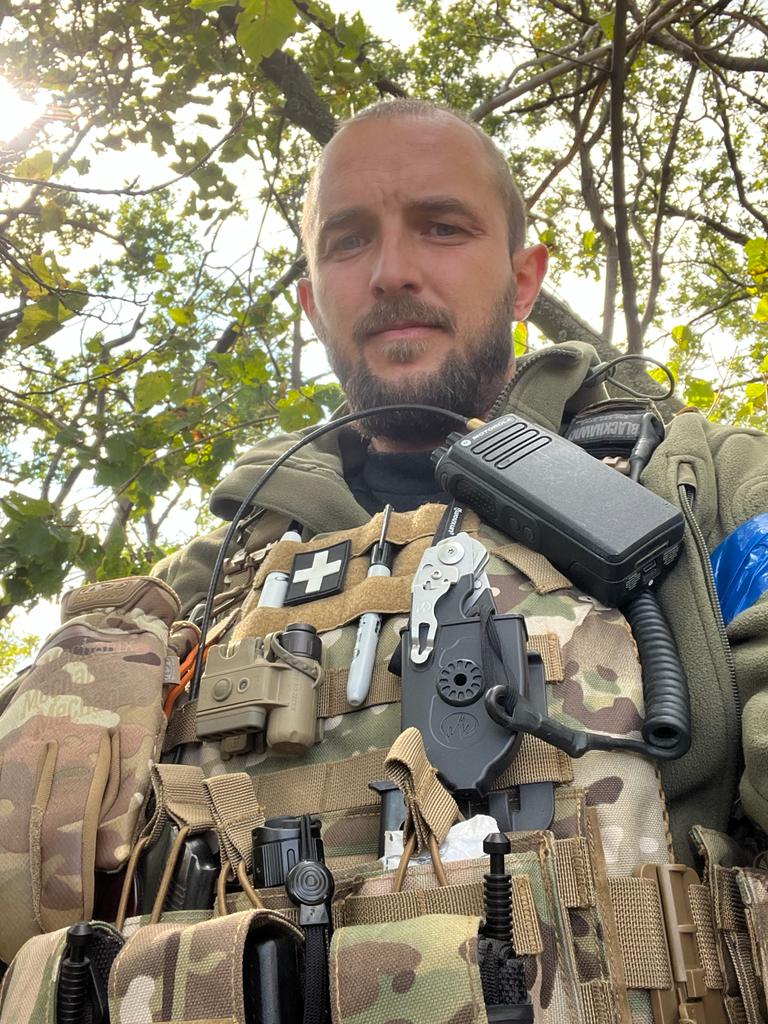
- Do you feel like a cog in the machine that is in place and doing what it should?
- I consider myself a part of this working mechanism-organism. My main task, which I set for myself, is, first and foremost, to do my job perfectly. Because the work of others also depends on my work.
Am I in the right place? I believe that wherever you put me, I will find a fulfilment, and this fulfilment will be effective. If I were to carry shells, I would find a hundred thousand five hundred options for not carrying them but transporting them, or not transporting them but flying a helicopter (of course, I'm exaggerating). Therefore, I think that my work and actions should definitely be assessed by people from the outside, either by my immediate commanders or by commanders in general. But I believe that I am at least trying to do more, trying to do better. That is, you need to set goals for yourself all the time, and sometimes set goals that can be called unattainable, because only by demanding the impossible will you get the maximum. I would not say that we always get the maximum, but this focus works. And it keeps you moving. You are constantly progressing, inventing something. So I think I am a very small gear, a cog in a big clockwork organism, and I am doing a good job in principle. But I can do even better.
You can support the collection for the purchase of a portable X-ray machine here:
Mono
https://send.monobank.ua/jar/6Zuf911m5e
- Pay Pal
- Oschadbank
5167 4989 8079 9138
Bondar Yurii
IBAN UA183257960000026204504953385
- Privat Bank
5168752087437912
Violetta Kirtoka, Censor.NET


