



150 billion hryvnias in shadows: where three annual budgets for drone production are hidden
Ukraine loses more than UAH 150 billion a year from schemes in the gambling business, tobacco and alcohol markets, fuel market, and smuggling. This is three times more than this year’s budget for the production of UAVs, which is UAH 43 billion.
At the end of 2023, the Cabinet of Ministers approved the National Revenue Strategy until 2030 developed by the Ministry of Finance. The declared result of the six-year program is a 27% increase in GDP.
As part of the National Revenue Strategy, in addition to harmonizing domestic legislation with European standards, Ukraine must reduce its share of the shadow sector. The IMF estimates the Ukrainian shadow sector at 30%.
According to The Economist, in 2020, Ukraine became the largest supplier of illegal tobacco products in the EU, overtaking China. But the country does not only export illegal products: at least one in five packs of cigarettes and one in two bottles of alcohol are counterfeit or fake on the domestic market.
Shadow economic sectors overlap and build mutually beneficial schemes.
Business Censor has estimated that the budget loses more than UAH 150 billion due to shadow gambling, tobacco, alcohol, fuel and smuggling.
For comparison, according to the data of Ministry of Finance, in 2023, the State Tax Service collected:
– UAH 214.1 billion in value-added tax;
– UAH 175.7 billion - personal income tax and military duty;
– UAH 143.6 billion - corporate income tax;
– UAH 102.8 billion in excise tax.
The shadow UAH 150 billion is the money that the tax and customs authorities can receive now, not in six years, as envisaged by the National Revenue Strategy, which is aimed at the simplified taxation system and threatens to destroy small businesses.
Business Censor has been looking into the schemes of the shadow economy and how to find additional sources to finance the defense of Ukraine.
Gambling business
Revenues from gambling consist of two major parts: taxes and license fees.
The first license was issued by the Commission for Regulation of Gambling and Lotteries (CRGL) in February 2021. Cosmolot paid UAH 23.4 million for it. For comparison, the annual license fee for producing alcoholic beverages, wine and tobacco products is only UAH 780.
In total, in 2021, the budget received UAH 1.6 billion from gambling licenses. In the first year of the full-scale war, revenues dropped to UAH 1.2 billion. However, in 2023, the industry reached the pre-war level.
The dynamics of taxes are different. In 2021, operators paid only UAH 206 million in taxes, in 2022 - UAH 731 million. In 2023 alone, the industry paid a record UAH 10.4 billion.
The Center for Economic Strategy estimates that the volume of "legal" gambling business in 2023 increased from 5% to 40-50%.
The prerequisite was a grace period of taxation - operators were allowed to pay only 2% of their revenue for 9 months. In April 2022, a separate amendment regarding the gambling business was included in the draft law No. 7246 "Final and Transitional Provisions" of the Budget Code of Ukraine.
In early February 2023, the President signed a law that banned gambling businesses from the simplified taxation system.
In the spring of 2023, law enforcement agencies became involved: the BES and the SSU exposed the main money laundering schemes. Among them, the most popular were "matching" and "miscoding".
Gambling business schemes
"'Miscoding is based on collusion between a bank and a gambling operator. According to this scheme, the transaction code is changed to one that does not correspond to the company's real activity. This means that players' bets can be processed, for example, as payments for movies.
"Matching involves a three-way collusion between gambling businesses, banks, and retailers. According to this scheme, player bets are transferred to the cards of retail employees as black wages.
"45 criminal cases have been opened. Among the suspects are employees of the National Bank, banks and fintech companies that provided software for the fraud," said Deputy Oleksii Zhmerenetskyi.
During the investigation, it was estimated that the state budget loses about UAH 10 billion in taxes annually due to these schemes.
In August, the Cabinet of Ministers passed Resolution No. 924 to transfer the gambling business to the Ministry of Digital Transformation. The goal is to launch an online gambling monitoring system.
On February 1, 2024, Minister of Digital Transformation Mykhailo Fedorov announced that the Verkhovna Rada Committee on Finance, Taxation, and Customs Policy supported the idea to eliminate the CRGL and automate the issuance of gambling licenses.
According to the strategy of the Ministry of Digital Transformation, in addition to digitalization, there should be a transition from the general taxation system to a 2% rate of turnover.
According to the National Bank, the annual turnover of the gambling business, including the shadow sector, amounts to UAH 180 billion. Taking into account taxes and license fees, in 2022, the entire industry paid about 1.2% of the turnover to the budget.
Business Censor calculated the figure for 2023. The budget received UAH 1.6 billion from licenses (excluding December), and the amount of taxes amounted to UAH 10.4 billion. That is, the total revenue figure is 12 billion. This is 6.6% of the industry turnover.
Conclusion: Illegal physical establishments continue to operate in all cities of the country, but online is prevalent. Therefore, the infrastructure of the shadow segment is mostly digital.
At least 50% of the gambling business is in the shadow. This means that the total amount of revenues under the current tax burden can be doubled - increased by UAH 12 billion.
Tobacco
According to the Kantar Ukraine research agency, in 2023, the level of illegal trade in tobacco products in Ukraine reached 21.8%. The volume of the shadow cigarette market in Ukraine is 8 billion units.
Taxes on the price of cigarettes amount to 75-80%. These include excise tax and VAT.
Since 2017, Ukraine has been implementing a seven-year plan to increase the excise tax by 20% annually. Its goal is to reach the minimum excise rates in the EU.
For example, in 2022, the excise tax rate on cigarettes (1000 packs) was UAH 1306.37, in 2023 - UAH 1567.64, and in 2024 - UAH 1881.17.
As the rate increases, budget losses from illegal products increase.
Kantar Ukraine estimated that in 2021, the share of the illegal cigarette market was 16.9%, and budget losses amounted to UAH 15.5 billion. In 2022, the figures increased to 19.9% and UAH 19.1 billion, respectively. In 2023, the shadow market reached a record high of 21.8% and UAH 23.5 billion.
That is, last year's budget losses increased by 23% or UAH 4.4 billion.
The most popular scheme in the tobacco market
The Temporary Investigation Commission of the Economic Security Council has established disproportionate amounts of taxes paid per ton of raw materials, which indicates the production of counterfeit products.
Tobacco manufacturers sell counterfeit products alongside legal batches or products intended for sale in duty free or for export.
Retailers, including large retail chains and gas station chains, collude with manufacturers to sell illegal products.
Kiosks and shops are the main channels for selling illegal tobacco products. In 2023, they accounted for 68% of the product flow.
Some of the illegal sales were legalized by manufacturers through the Duty Free network.
On October 1, 2023, the Law "On Amendments to the Customs Code of Ukraine and Other Laws of Ukraine on Combating Illegal Trafficking in Tobacco Products" came into force, which prohibits the sale of domestic tobacco products with the Duty Free label in duty-free shops during martial law.
The document also prohibits the sale of more than 40 cigarettes or 10 cigars or 20 cigarillos in one payment transaction.
Ukrainian Tobacco Production and "United Tobacco are the manufacturers that generate the vast majority of illegal products according to the inscriptions on the packs.
The geography of sales of illegal products corresponds to the location of gray and black factories. The leaders are the following regions: Dnipro - 17%, Odesa - 12%, Lviv and Kharkiv - 9%.
In 2022, the United Tabaco tobacco factory in Zhovti Vody in the Dnipropetrovsk region was shut down. It had a license but mostly produced counterfeit tobacco that was sold locally. According to Yaroslav Zhelezniak, first deputy chairman of the Verkhovna Rada's financial committee, production has probably resumed in the Ternopil region over time. However, according to a report by Kantar Ukraine, the distribution channels remain the same.
Nevertheless, counterfeit cigarettes of global brands, which can be produced using equipment seized by law enforcement at the scandalous United Tobacco factory in Zhovti Vody, still appear in kiosks, shops, and Telegram channels all over Ukraine.
According to an investigation by journalist Yevhen Plinskyi, cigarettes of various leading international brands are freely available at kiosks for 50 hryvnias per pack, which is impossible if all taxes required by law are paid. In Telegram channels, cigarettes are sold even cheaper at UAH 40 per pack.
The packs are made using high-quality printing and have fake excise stamps that look like real ones. However, inside the packs of cigarettes sold under global brands of different manufacturers, there was foil with the same inscription embossed with "Pull" - a brand of cigarettes produced at the United Tobacco factory in Zhovti Vody, which was shut down due to illegal production.
"It was only in 2022 that we managed to close this factory, the equipment was taken somewhere by law enforcement for safe keeping, and that was the end of the public history of this factory. But, as we can see, the foil from Pull cigarettes has found its second life in high-quality counterfeits that have appeared all over the country today," says Plynskyi.
Thus, the journalist suggests that a large number of branded cigarettes of various brands can be produced using equipment that belonged to the United Tobacco factory.
In addition to United Tobacco, in 2022, the leader in the fictitious production of cigarettes for duty-free was Vynnykivska Tobacco Factory LLC, which is associated with former Lviv Regional Council deputy Hryhorii Kozlovskyi. The security forces also eliminated illicit tobacco production in the Odesa region.
Conclusion: The geography of counterfeit sales is dominated by frontline cities, but Odesa and Lviv are not losing ground.
One-fifth of the tobacco market is in the shadows. In 2023, budget losses increased by 23% or UAH 4.4 billion and reached UAH 23.5 billion.
Alcohol
Data on the share of illegal alcohol products varies. The World Health Organization says it's a third of the market, while operators say it's 50%.
The last time the Accounting Chamber officially estimated budget losses in the alcohol market was on the eve of a full-scale war.
As reported, the taxation of illegally produced and imported alcoholic beverages can additionally replenish the state budget by UAH 9 billion annually - and this is only due to the excise tax.
20 distilleries in Ukraine produce unrecorded alcohol. Unofficially produced alcohol is used in the production of alcoholic beverages.
The volume of alcohol that is unaccounted for is over 2 million liters per month. There is no excise tax on this volume.
The BES report illustrates the geographical cross-section of the shadow alcohol market. In 6 months of 2023, the BES seized 5 alcoholic beverage production lines in Chernihiv, Odesa, Poltava, Volyn, and Vinnytsia regions worth over UAH 650 million as part of 59 registered criminal proceedings. Also, 375 tons of alcohol-containing products and more than 150 thousand excise tax stamps with signs of counterfeiting were seized.
Scheme on the alcohol market
The source of the shadow market is alcohol producers who generate unaccounted for volumes.
Counterfeit alcohol accounts for a large share of the shadow market. It is produced by clandestine manufacturers that operate in all regions of the country.
But most of the illegal alcoholic beverages are counterfeit, produced by official players.
Counterfeit and fake products are sold through an extensive network of kiosks and "watering holes", as well as in retail chains, gas stations, and catering establishments.
According to the study by the Economic Expert Platform "Determination of the Shadow Share in Excisable Goods and its Dynamics for the Third Quarter of 2023", the level of annual alcohol consumption continues to grow and has already reached 6.18 liters of alcohol per person. However, the shadow share is falling - from 47% in the first quarter to 30% in the third quarter.

Conclusion: Illegal alcohol production is taking place throughout the country. Up to 50% of the alcohol market is in the shadows. Due to non-payment of excise tax alone, the budget loses UAH 9 billion a year.
Fuel
The fuel market mostly operates within the legal framework. Excise tax is paid on virtually all motor fuel consumption. It is levied either on imports of petroleum products or on their production in Ukraine.
In 2019, the fuel market was subject to a reform that tightened control over the circulation of petroleum products. In particular, licensing of both wholesale and retail fuel trade was introduced. Operators of gas stations and oil depots were required to equip their facilities with fuel level meters and flow rate meters, the readings of which are transmitted to the Tax Service in a digital format daily.
A small number of gas stations circumvent control measures. These are either illegal gas stations that operate without licenses or those that have a license but sell fuel without a cash receipt.
According to estimates by the specialized publication NaftoRynok, approximately 300-400 gas stations are operating illegally in Ukraine. And while law enforcement closes down some stations, others open. When Odesa ports started operating in the second half of 2023, and the flow of trucks increased in the region, the number of illegal gas stations in the Odesa region increased significantly - by about 50 units.
According to NaftoRynok's estimates, about 350-400 thousand tons of fuel are sold through illegal channels per year, while the total market volume is 10-11 million tons. Thus, illegal fuel sales account for about 3% of the motor fuel market.
Such gas stations usually trade with a margin of about UAH 5 per liter, which they do not declare anywhere and do not pay taxes on. In total, this segment can generate about UAH 2 billion in net income per year, which is not subject to income tax.
As for counterfeiting, the volume of its production in Ukraine is insignificant, according to NaftoRynok.
VAT and income tax evasion and "salaries in envelopes" are the main problems of the market. Almost all gas station chains commit such violations. According to estimates by the A-95 Consulting Agency, the budget loses about UAH 9 billion a year on the retail fuel market.
Main schemes in the fuel market
Trading without issuing cash receipts or manipulating receipts is a classic scheme used by illegal and official gas stations.
"Carousel fraud" with the help of "tax holes" is a fraud involving a conversion center. The fuel is registered as sold in bulk to legal entities, but in fact it is sold at retail for cash - through gas stations without cash registers.
The fictitious tax credit is returned to the "carousel fraud". The cash is used in the following schemes, for example, in "matching".
According to A-95, in the third quarter of 2023, almost 50 of the largest fuel market players paid a total of UAH 1.485 billion in operating taxes, including VAT, income tax (IT), payroll contributions, etc. This is one and a half times more than in the second quarter of 2023 when the figure was UAH 937 million. However, the increase in contributions is mainly attributable to VAT: from UAH 174 million in Q2 to UAH 533 million in Q3.
However, this is primarily due to an increase in the VAT rate: from July 1, 2023, it rose from 7% to 20%. After the full-scale invasion, the government temporarily reduced the VAT on fuel to slow down the price increase that resulted from the shutdown of the Kremenchuk refinery and the halt in sea deliveries from abroad.
As for IT, the volume of its payment by the 50 largest gas station operators in the third quarter increased by only 10% compared to the second quarter, to UAH 595 million, A-95 reported. OKKO paid UAH 432 million for the IT. That is, one company accounts for almost 75% of the total amount of IT payments, while its share in the fuel market in terms of sales is only 26%.
Another important indicator of transparency is the amount of official salary. It varies greatly among gas station chains. According to A-95, UPG pays its employees an average of UAH 25.7 thousand per month, OKKO - UAH 19.6 thousand, WOG - UAH 15.5 thousand, Avantage7 - UAH 10.3 thousand, KLO - UAH 7.8 thousand, and Petromol - UAH 3.2 thousand. Obviously, some companies pay their employees extra in "envelopes". To do this, they need to have millions in cash every month.
At the same time, almost 30 of the 50 largest gas station chains in Ukraine showed negligible profitability, although they sell fuel at roughly the same margins. This suggests that most companies show fictitious expenses to avoid paying taxes.
Conclusion: Illegal gas stations operate in the suburbs of large cities, near Odesa ports, and in the frontline area.
The majority of market operators pay the excise tax. The main tax evasion schemes in the fuel market are implemented in retail trade. The budget loses approximately UAH 9 billion a year on the retail fuel market.
Smuggling
According to the State Customs Service, foreign trade in 2023 amounted to $99.5 billion: $63.5 billion worth of goods were imported and $36 billion worth of goods were exported. At the moment, there is no annual data on the volume of export and import duties. However, according to Hlavkom's calculations, the ratio of tax payments to foreign trade in 9 months of 2023 was 0.8%.
This is low tax efficiency, which indicates the presence of a large shadow sector. For comparison, the average tax efficiency in the alcohol industry is 5%, but some producers show 0.5%. In the fuel market, all networks show an average efficiency of 0.5%.
In 2023, the State Customs Service fulfilled its revenue plan for the general fund of the state budget by 93.7%. The shortfall amounted to UAH 26.5 billion. The official reason was the blockade of the Polish border.
According to research by the Institute for Economic Research and Policy Consulting (IER), as of 2020, a quarter of goods on the Ukrainian market were gray imports. According to various estimates, Ukraine's budget loses up to UAH 100 billion annually from smuggling and gray imports.
Main schemes of "gray" imports and smuggling
The first scheme involves collusion with customs and illegal movement of goods across the customs border of Ukraine.
The second scheme involves actions to minimize the customs burden.
Smuggling makes it possible to buy foreign goods up to 50% cheaper than from legal importers. The most popular product categories before the full-scale invasion were cars, electronics, chemicals and clothing.
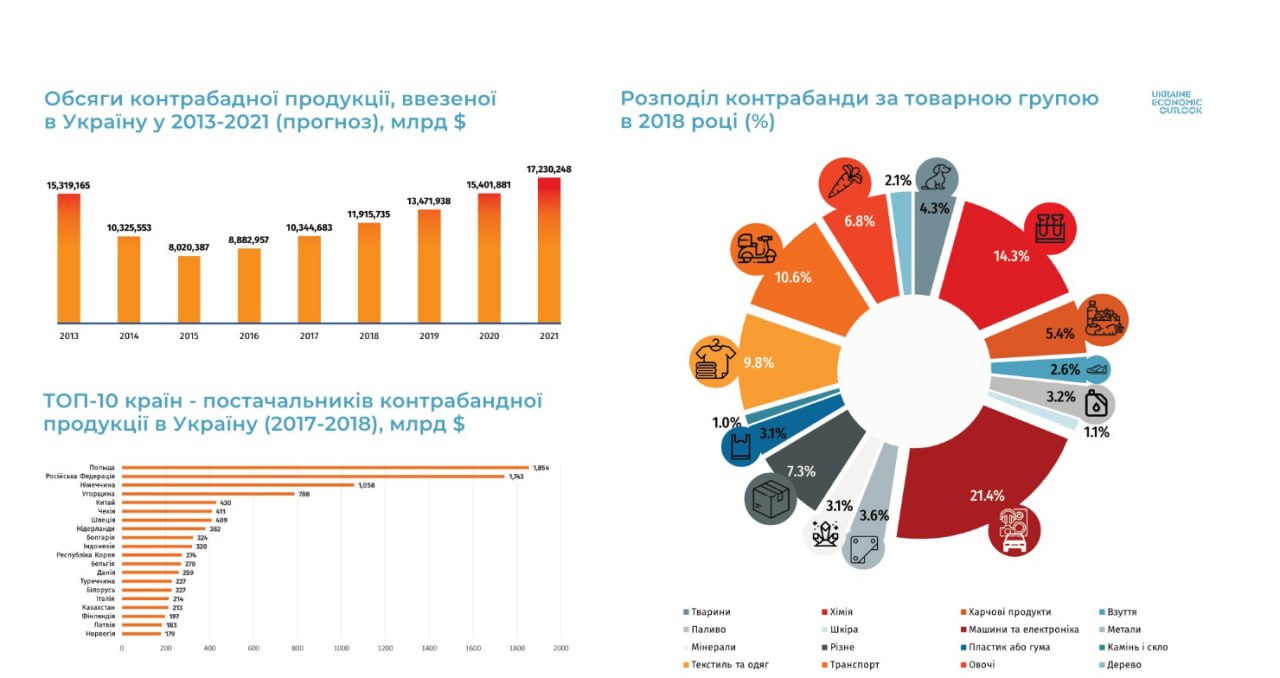
In 2022, the focus shifted to goods for the frontline: cars, drones and components, equipment, etc.
At the end of 2023, the President signed draft law No. 5420, which criminalized smuggling, into law. However, the entry into force of the provisions on smuggling is postponed until mid-2024, when the BES will be restarted in accordance with IMF requirements.
Conclusion: budget losses from smuggling and "gray" imports amount to at least UAH 100 billion. There is no up-to-date data during a full-scale invasion.


