



How Telegram channels work and how much they earn in Ukraine
After Russia’s full-scale invasion of Ukraine, Telegram became almost the main source of information for Ukrainians. How much do channel owners earn from it?
According to a survey by the analytical company InMind, at the end of 2023, 72% of our compatriots followed the news on Telegram channels. The absolute leader among them was Trukha (2.6 million subscribers at the time of writing), which 15% of respondents recognized as the channel they most often watch or read news on.
According to available estimates, the reach of one of their posts is on average 1 million people. For comparison, the United News marathon across the country has a weekly reach of about 10.3 million viewers. Roughly speaking, ten posts by Trukha is a week of the telethon.
But Trukha is not the only one. Ukrainians subscribe to dozens, if not hundreds, of different channels on Telegram. Thousands of people are involved in content creation, and the income of authors of the telegram channel is estimated at millions of hryvnias. No wonder our government officials have their eyes on Durov's brainchild. They want to control it and either tax it or ban it.
While discussions are ongoing about what to do with Telegram in Ukraine, Business Censor has been looking into business intricacies in the messenger.
By the way, don't forget to subscribe to the Business Censor Telegram channel. There we publish the most relevant materials from our editorial team to keep you up to date with the main business and financial events in Ukraine and the world.
Where did Telegram come from?
Russian businessman Pavel Durov launched Telegram in 2013. Before that, he created and developed the social network VKontakte, which was essentially a clone of Facebook. It became especially popular in the post-Soviet space, particularly in Ukraine.
In 2014, VKontakte was taken over by the Mail.ru Group of Russian oligarch Alisher Usmanov, who has been called "one of Putin's favorite oligarchs" by EU leaders because of his close ties to the dictator.
Durov claimed that he was forced to sell his stake in VKontakte because of pressure from the security forces. However, the new owners had been building up their presence in the company since 2011, and the final takeover was conditioned by an option agreement signed in 2012.
Telegram is registered as a company in the British Virgin Islands and as an LLC in the Emirate of Dubai. It is in the UAE that the company's headquarters is currently located, although at the start of the project it was in Berlin.
Pavel Durov positions his messenger as the most secure in the world. However, in an interview with GQ, Anton Rosenberg, the former director of special areas at Telegram, said that Telegram's security is a myth invented by Durov himself. The security topic sells well, so the emphasis in PR was on it.
Telegram's popularity in Ukraine began to grow after Russian social networks VKontakte and Odnoklassniki were blocked in 2017.
The Russian authorities, who tried to block Telegram after the St. Petersburg subway explosion that year, also played a role in popularizing the messenger. The terrorists allegedly used Telegram to communicate and coordinate their actions, so Durov was ordered to provide the keys to decrypt the messages. Durov refused (at least that's what the official version says), and the story of the blocking attempts began.
As we can see, it all ended with attempts. After all, Telegram continues to work for the Russian Federation. It has become one of the key tools for spreading Russian propaganda in the war with Ukraine.
Durov may be unofficially cooperating with the Russian authorities. In particular, this opinion was previously voiced by the former Deputy Minister of Information Policy of Ukraine, information technology expert Dmytro Zolotukhin.
Are Anonymous Telegram Channels a Kremlin Technology?
During 2018-2019, when Ukraine was preparing for the presidential election, and later the election itself, a network of anonymous channels appeared in the Ukrainian segment of Telegram, aimed at influencing the Ukrainian political environment.
In general, the technology of anonymous Telegram channels was developed in the Russian Federation, where the establishment has invested in creating hundreds of channels to "kill opponents."
It's done simply: dozens of messages claiming to be insider information, accompanied by emotional comments on current events, are posted daily. The subscribers are given a false sense of elitism and involvement in some kind of secret. Or, on the contrary, the channel's authors deliberately ignore certain information or personalities.
Anonymous people can write anything, even outright disinformation or promote enemy narratives. There is no accountability, because it is not known who is hiding on the other side of the smartphone. Even though the SSU disclosed anonymous channels whose ultimate beneficiaries were Russian special services even before the full-scale war, they continue to be read:
Extract from the SSU press release
Such channels are promoted on purpose using special software, bot farms, and other tools. Over time, the audience begins to grow organically.
In general, the promotion of a Telegram channel depends on many factors, including the topic and competition in this niche. In some niches, the cost of an acquired subscriber starts at 1 UAH, while in others it can be 10, 40 UAH or more.
In general, the narrower the specifics, the more expensive a subscriber will be. Obviously, socio-political channels are not one of them.

Changes in the number of subscribers to popular Ukrainian telegram channels. Data: research by the Ukrainian Institute of Media and Communication
After the outbreak of a full-scale war, Ukrainians were in dire need of quick information about the course of events in the country, which gave rise to the development of Telegram channels.
Anonymous people use clickbait to increase their audience, as well as manipulate emotions and parasitize on socially important topics, such as mobilization or the likelihood of shelling of certain cities.
Often, the information they publish turns out to be fake or taken out of context. However, they do not bear any responsibility, not even reputational.
In addition, such channels rarely produce original content and repost posts from other resources without identifying the source. This leads to a massive spread of disinformation and can be dangerous.
Regulatory and tax issues
There is no clear classification of channels. There are also no clear approaches to the formation of classification criteria. However, the Ukrainian Institute of Media and Communication in its analytical report on the activities of telegram channels offers the following system:
- topics (news, political and entertainment);
- transparency of sources (official and anonymous);
- the principle of working with information, in particular in terms of compliance with standards (media and non-media, i.e., those that were not formed by classical media).
Telegram channels have gained considerable weight in the information space of Ukraine. This is understood in government offices.
In October 2023, the President's Office held a closed meeting with journalists, to which more than 20 people were invited, including representatives of the aforementioned Trukha, which has grown from a local Kharkiv channel to an all-Ukrainian information source.
The journalists were outraged that the state had put them on a par with anonymous telegram channels that repeatedly published fakes, stirred up panic over a potential nuclear threat, and posted videos of hits.
"Of course, if a Telegram channel is completely anonymous, yes, there are questions, and no one will invite it. But if the owner of this channel is not anonymous and is ready to bear legal responsibility, then unfortunately - unfortunately, I emphasize - such a channel is currently a source of information for a huge number of consumers. We have to take this into account," commented Mykhailo Podoliak, Advisor to the Head of the Office of the President of Ukraine.
According to the official position of the Trukha Telegram channel, its founder and owner is Kharkiv resident Maksym Lavrynenko. However, the channel has previously been linked to local businessman Volodymyr Lytvyn, the founder of the Turboseo business promotion company and a friend of the son of former Interior Minister Arsen Avakov.
In general, there is no regulation of social media in Ukraine, including Telegram. It was decided to address this issue. On March 25, the Verkhovna Rada registered a draft law "On Amendments to Certain Laws of Ukraine on Regulation of the Activity of Information Sharing Platforms through which Mass Information is Disseminated."
"It is obvious that a platform used by 72% of Ukrainians to obtain information should be regulated no less than other media sources with much less reach," the initiators of the draft law emphasize, citing the platform's alleged connection with Russia as an additional argument for the need for regulation.
The people's deputies want Telegram and other social networks that do not fall under the jurisdiction of Ukraine or an EU member state to provide the National Council of Ukraine on Television and Radio Broadcasting with information about the contact details of their representative within two months of the new law's entry into force, if it is adopted. If such information is not available, the ownership structure of the platform may be recognized as non-transparent and its use by government agencies, officials, banks, etc. may be prohibited.
It is worth noting that after February 24, 2022, the Ukrainian authorities were forced to switch to Telegram, where a significant part of the Ukrainian audience moved.
Today, all heads of military administrations, mayors, and representatives of other authorities at various levels, as well as government officials and President of Ukraine Volodymyr Zelenskyy, have Telegram channels. Communication with the population through official Telegram channels is almost real-time.
It is likely that Telegram will ignore the requirement of the new law if it is adopted, as the platform has not complied with similar regulations in other countries. Telegram is a rather non-public company. Most of the information about it became known from the report of the US Securities and Exchange Commission, which interrogated Pavel Durov in the case of the launch of his cryptocurrency Gram.
According to Yaroslav Yurchyshyn, chairman of the Verkhovna Rada Committee on Freedom of Speech, the activities of anonymous Ukrainian telegram channels should be the subject of attention of the Ukrainian Fiscal Service. It should find out how the "editors" of these telegram channels exist, whether they pay taxes on the money they charge for advertising or announcements.
The committee he chairs is initiating a request to the State Fiscal Service regarding Telegram in general, and in particular, those publics that contain a lot of advertising and demonstrate economic activity.
"I am convinced that we will see that if taxes are paid, they are tears and drops. And here is the question: if this is economic activity in a country at war, then these taxes and fees should obviously go to our defense. Therefore, the key story now is not only to agree with Pavlo Durov that we have mechanisms to influence Russian propaganda but also to find out why such a profitable business is most likely very undertaxed in our country," Yurchyshyn said in an interview with Detector Media.
At the same time, he noted that as soon as someone from the Ukrainian authorities declares the need to regulate Telegram, Telegram channels spread information that they are going to be blocked in Ukraine, and this is immediately picked up by Russian propaganda.
"It is always better to regulate than to close. Why? Because it is a more democratic approach. On the other hand, Ukraine is at war and we don't have the luxury of solving issues for a long time. It's better to cut the knot than to unravel it," summarized Yaroslav Yurchyshyn.
How much do Telegram channels earn?
No one knows for sure the real income of telegram channels, because they are not officially registered anywhere, do not submit any reports, unlike classical media.
However, the approximate amounts can be calculated. The main way to monetize a Telegram channel is to sell advertising. The more subscribers a channel has, the more expensive the post will be. When choosing channels for advertising, advertisers use platforms that provide certain analytics about the channel, such as TGStat or Telemetr.
Advertising can be ordered directly or through special catalogs. Here are a few screenshots from one of these catalogs for your understanding:
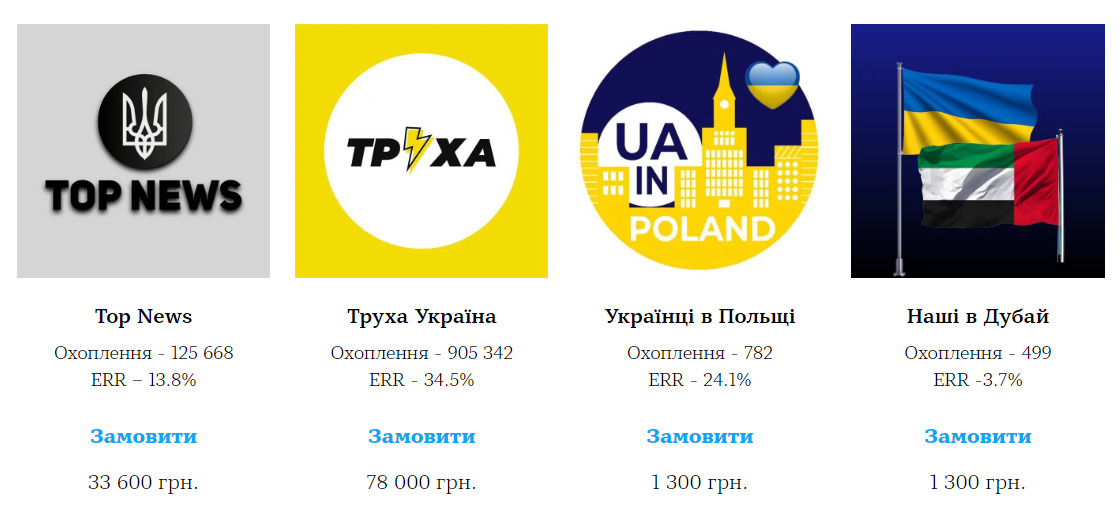

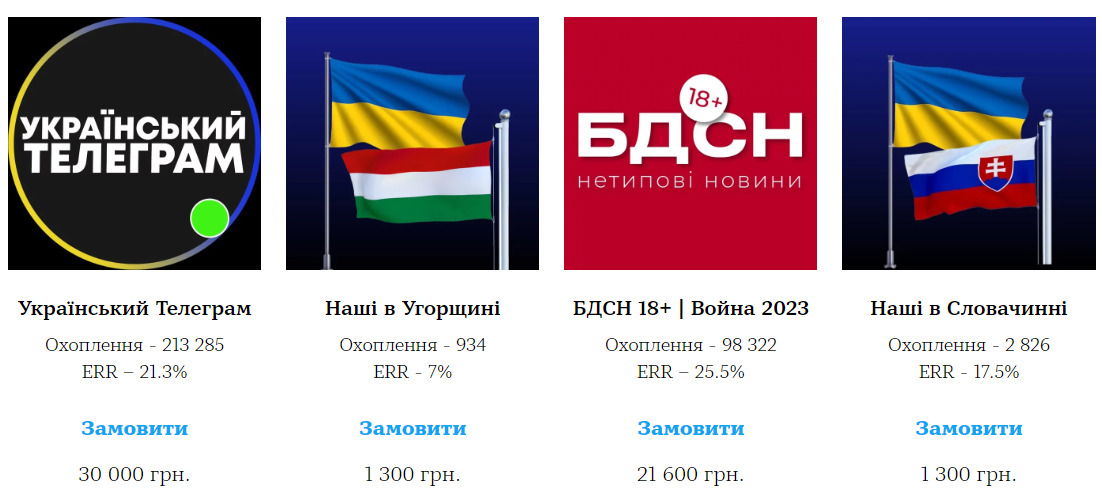
For example, the Telegram channel "Trukha Ukraine" needs to make almost 13 posts to earn UAH 1 million with such a price tag for advertising posts. "Ukraine Online will achieve this goal faster. For smaller channels, this is an unrealistic figure.
Most likely, the prices here are indicated taking into account the percentage that goes to the catalog owners, but the rates are more or less clear. Also, the level of earnings, as elsewhere in the media market, is affected by the seasonality factor: closer to the new year, they grow, and in the summer they fall.
The cost of publishing a channel with 10-13 thousand subscribers in the business category can vary, for example, in the range of $50-100 per post. Accordingly, an administrator can earn $500-1000 for 10 advertising posts per month.
But a news channel with more than 200 thousand subscribers will want $300-500 for one advertising post. And its gross monthly income can exceed more than $5000.
Anonymous channels with 1 million subscribers can ask for $1.5-2 thousand per post. Such resources publish 20-30 advertising posts per month.
"On average, if we divide it by months, we get about $300-500 thousand per month. But this is not net income... Then you start paying salaries, and almost all the money goes [to the development of the network]," said Maksym Lavrynenko, owner of Trukha, in an interview with Dmytro Hordon.
By the way, according to the job search portal Work.ua, a telegram channel administrator in Ukraine earns an average of UAH 17,500, which is the median salary based on 1105 relevant vacancies posted on their website.
Will Telegram be banned in Ukraine?
According to Andrii Kovalenko, head of the National Security and Defense Council's Center for Countering Disinformation, it is impossible to ban or block Telegram in Ukraine. In his opinion, it is necessary to work with Telegram channels reasonably to protect the country from enemy fakes and psyop "and to continue to strangle the pro-Russian segments of the media field together."
In general, Telegram channels, according to the Law on Media, are the closest to the category of "online media," but they do not meet only one criterion: the dissemination of information by such media on their own website. Most likely, there will be changes, and Telegram channels will be required to register, as classical media currently do.
On the other hand, if there is indisputable evidence of Telegram's involvement with the Russian authorities, we will have to think about how to get rid of it. After all, if the platform cooperates with the enemy, albeit unofficially, it poses a direct danger to the state and citizens.
Today, there are plenty of alternatives that can replace Telegram. Ordinary users will definitely not lose anything. The owners of large Telegram channels, for whom the platform has become a profitable business, will suffer the most.


