



History of first battle near Sloviansk on April 13, 2014 through eyes of soldier
A participant in the first combat engagement in the Russian-Ukrainian war, which took place 10 years ago in the suburbs of Sloviansk, Lieutenant Colonel Ivan Mykhayletskyi is now heading one of the departments of the Chortkiv District Territorial Center for Recruitment and Social Support in Ternopil region.
Andrii Ahieiev writes about this in his article for ArmyInform.
Due to injuries to both legs from an enemy tank shot near Khriashchuvate and shell shock in combat while leaving the Luhansk airport, he was declared unfit for service in combat military units by the Military Medical Commission at the age of 24. For the young paratrooper, the doctors' verdict did not sound like a sentence. The officer with combat experience joined the system of military enlistment offices of the time and today successfully performs all the tasks assigned to the TCR and SS in his area of responsibility.
"From the sky to the battle!"
Ivan was born and raised in Buchach, Ternopil region. After graduating from high school in 2007, he entered and graduated from the Faculty of Airborne Forces and Intelligence of the Hetman Petro Sahaidachnyi National Army Academy four years later. He began his officer's service in the glorious 80th Separate Airmobile Brigade, now the Separate Airborne Assault Brigade of the Air Assault Forces. Like all lieutenants, he looked like a fighting dog that was off-leashed and commanded "Fas" - full of patriotism, hungry for combat training, thirsty for parachute jumps, and dreaming of going into battle: "Out of the sky and into battle!"
- Since November 2013 and in the first months of the tumultuous 2014, there was already a strong smell of gunpowder in the air. Given that our brigade was one of the most capable military units in Ukraine at the time, we were all like a compressed spring - ready to act! The annexation of Crimea by Russia in February only added to our confidence that we were about to get out of our permanent base! And so it happened. In February 2014, I was just appointed deputy company commander for airborne training, which was then commanded by Senior Lieutenant Vadym Sukharevskyi (now the brigadier of the Yakiv Handziuk Separate Infantry Brigade - Author), and in two days our brigade was already in the Kharkiv region, and later we were transferred to Luhansk. There, in March, the first provocations against us took place from local separatists who believed and pretended to be the government of the day. They came to our base camp and said to us: "Why did you come here, what do you want here? Get out of here, you have never been here and you will never be here!" Ivan recalls.
"...Do not put a round of ammo in the cartridge chamber! Do not insert the magazine!"
On 13 April, at night, a company on 6 armoured personnel carriers received an order to move to the area of Sloviansk, which had been seized by militants led by Girkin the day before. They were to reinforce the special forces of the Alpha unit of the Security Service of Ukraine. Another task of the Lviv paratroopers, as it would turn out later, was to demonstrate the presence of the Ukrainian Armed Forces in Sloviansk, but after 08.00 their plans changed!
- We stopped in the area of Semenivka, near the entrance to the town, in the early morning. We set up our military equipment near the main road in a forest belt, organized security, and waited for the brigade commander's instructions, he was also with us. In the morning, around 8:00, Nelia Shtepa arrived, and our brigadier, Colonel Viktor Kopachynskyi, the commander of the airborne troops, Colonel Oleksandr Shvets, and representatives of the Security Service of Ukraine began to consult and talk about something. After that, Colonel Kopachynskyi arranged the personnel for briefing and instructions. He said that we had to drive through Sloviansk with a convoy of military equipment, to show, or rather demonstrate, the presence of the Ukrainian Armed Forces in the city, and ordered: "Do not open fire without my command. Do not put a round of ammo in the cartridge chamber! Do not insert the magazine! Private corps and sergeants inside the vehicles, officers on the armor!" We started preparing to go, wearing bulletproof vests of the first class of protection. Everything looked quite peaceful. There was not a single hint of any hostilities," Mykhayletskyi said, recalling that morning.
About the first battle that started the ATO
- Suddenly, a taxi stopped on the main road, four armed men ran out of it and opened fire at the SSU officers and their cars. I remember one of the guys in the APC said: "What's all that gunfire, airsoft or fireworks?" At the same time, an enemy group from the forest belt, 300 metres away on the opposite side of the road, also opened fire. They didn't seem to be shooting at our side, but a few bullets did hit our armour. We realized that it was not a "shooting game" but a real battle - fast, at a short distance. Let me remind you that there was no ATO yet! Sukharevskyi reported the situation to Kopachynskyi, although he saw and understood everything himself, and was again ordered not to open fire, not to shoot! "A representative of the SSU ran up to my APC with a grenade and said: "Either you open fire or I'll throw a grenade into your APC!" I radioed the company commander, he was closing our column, but when he didn't hear a response, he turned around to hear a roaring engine behind him... It was our company commander who flew up with his APC and stood in front of the Techik (VW-T4 minibus. - ), covering it with armor from the enemy's automatic weapons fire and ordered his machine gunner, soldier Mykola Lavrenchuk, to open fire from the Vladimirov heavy tank machine gun (KPVT) at the enemy sabotage group in "a woodland area". In this way, we extinguished the enemy's fire activity and helped the SSU special forces, and, in fact, the active phase of the war with the Russian occupier began with these first machine gun bursts on April 13, 2014.
...About his company commander Vadym Sukharevskyi
Ivan Mykhailetskyi has known his company commander, First Lieutenant Vadym Sukharevskyi, for a long time. He is only two years older than him, and they lived in the same barracks on the same floor as cadets. He says that even back then, at the Academy, Sukharevskyi stood out among the others for his strong character and well-deserved authority.
- "By the time I arrived in the 80s Brigadge, he had already gained combat experience as part of our peacekeeping contingent of the coalition forces in Iraq, participated in the Battle of Al-Qut," Ivan recalls and says he was not surprised when his company commander, contrary to the order of the brigadier, took responsibility and ordered to open fire on the occupier. "That was the day when Captain Hennadii Bilichenko of the Security Service of Ukraine, the first of our men to give his life in the current Russian-Ukrainian war, was killed by an enemy bullet," the officer says. "I took on two wounded representatives of the Security Service onto my APC and organized their evacuation and transfer by ambulance to a hospital in Luhansk.
Sukharevskyi set us tasks and directed our further actions. We spent the next two days in Izyum, 50 kilometres from Sloviansk.
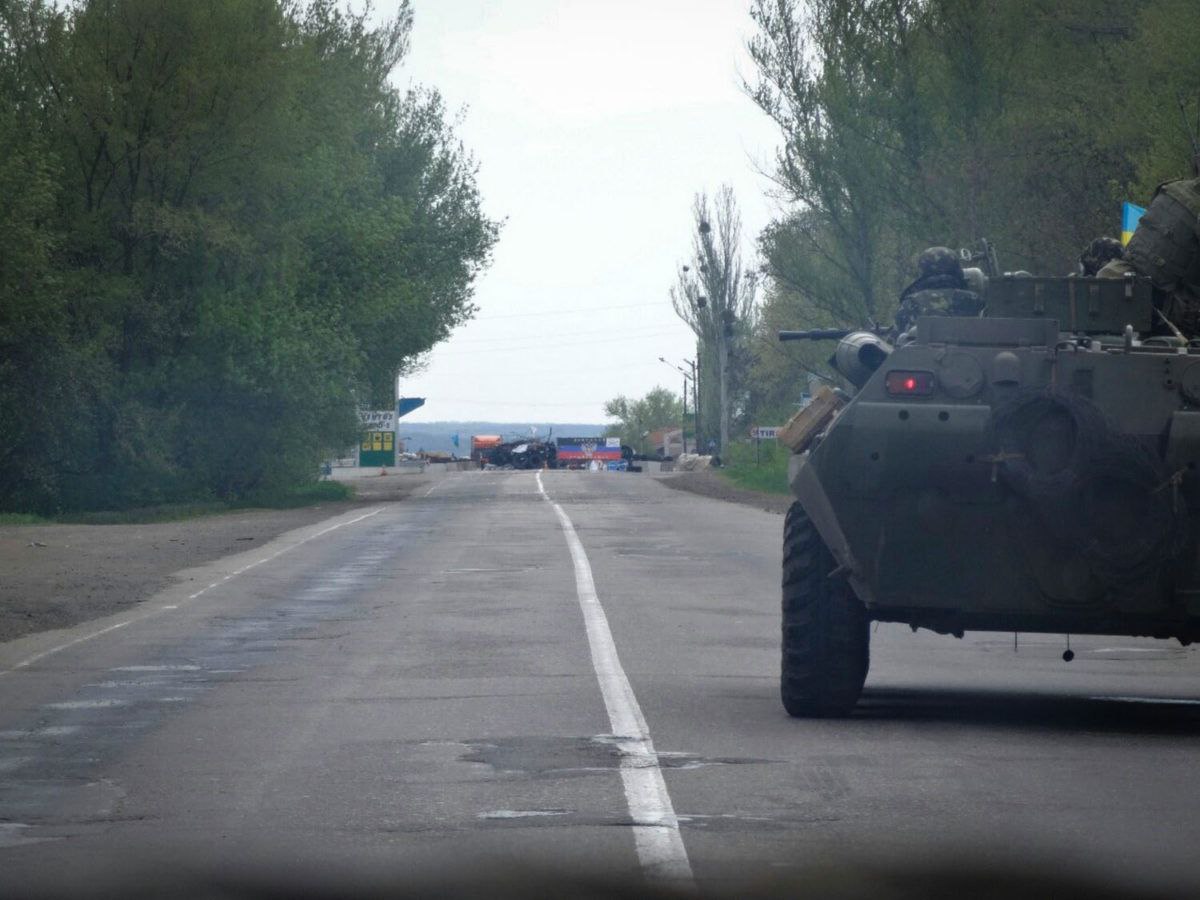
Before the storming of checkpoint No. 3 in Sloviansk, April 2014
On the assaulting of checkpoints in Sloviansk
On 15 April, our company, in cooperation with the Alfa forces and special forces from the National Guard of Ukraine, began to assault checkpoints 3 and 3a on the north-eastern outskirts of Sloviansk, which were then deployed by Russian invasion forces, joined by militants of the self-proclaimed "Donetsk People's Republic" and some local criminals.
The Special Forces used the large-calibre machine guns of our APCs to suppress enemy fire, and the armoured vehicles themselves as a shield during assaults. We captured the second time and took up positions there. On 18 or 19 April, we also took control of checkpoint 3a, where the road to Sloviansk and Kramatorsk forks.
We held our positions against the enemy's constant attempts to assault us out of there until almost mid-June, when other combat units of the Ukrainian Armed Forces, the Security Service of Ukraine and the National Guard of Ukraine were brought up from Kramatorsk. It was there, at checkpoint 3a, we had our first wounded, and it was there that our 3rd company's combat training was being toughened.
Ivan Mykhailetskyi, as deputy company commander for airborne training, also performed tasks to search for, rescue and evacuate our helicopter and aircraft crews shot down by the enemy in the area. He says that most of the pilots who ejected or left the aircraft by parachuting were found and rescued, but unfortunately not all of them.
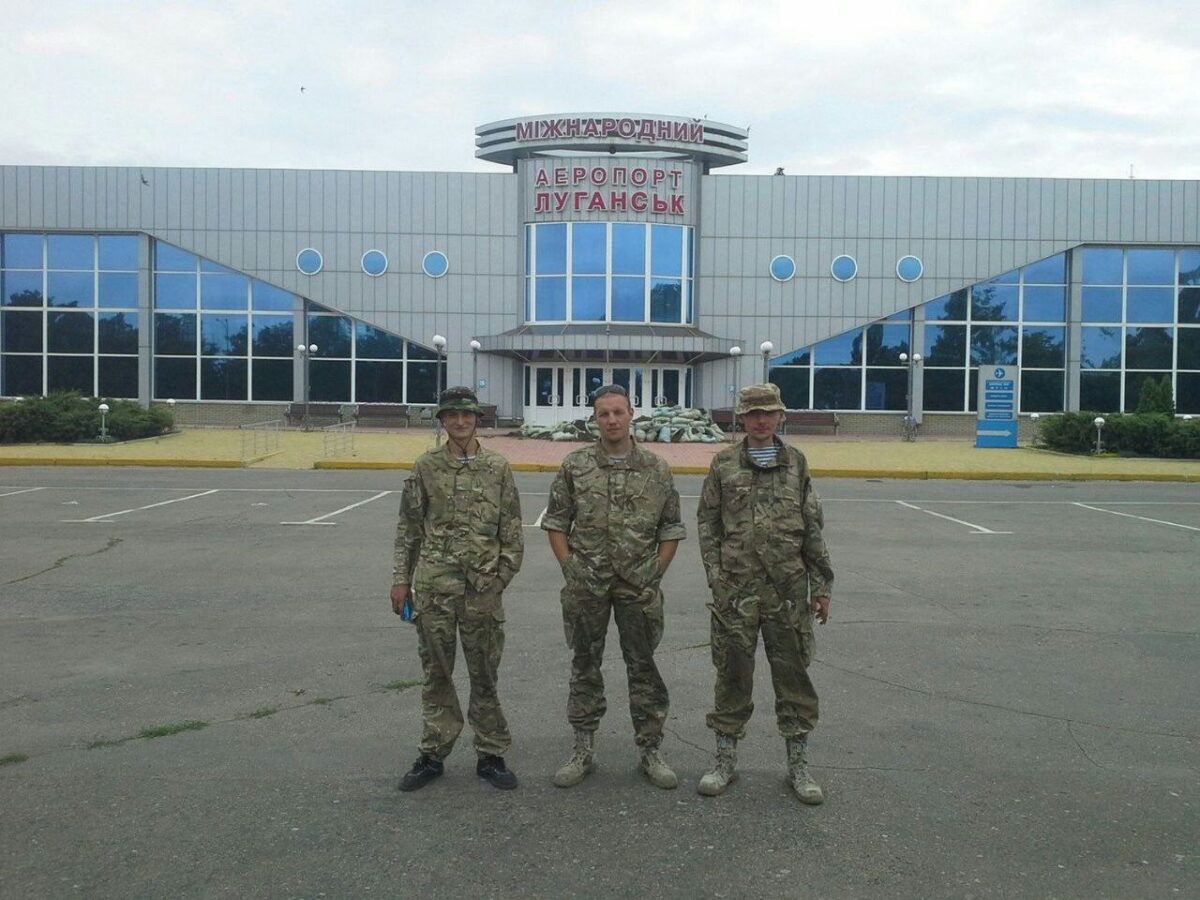
Luhansk airport. Company commander Sukharevskyi (centre) with his deputies Mykhailevskyi and Dunduk, June 2014
Luhansk airport...
At the checkpoints in Sloviansk, the third company of the 80th Brigade was replaced by fellow paratroopers from another brigade. They were taken to the reconstitution area for a few days, where they replenished their weapons, equipment and ammunition, and at night they were to be redeployed to their own unit at Luhansk airport by three military transport aircraft of the Air Force IL-76.
- A plane with guys from the 24th Brigade landed in front of us in Luhansk. When our planes started to land, the enemy opened fire on them. After getting out of the fire, our IL-76s headed for Melitopol. We spent the night there, and the next day, at noon on 13 June, we made another attempt and managed to land at Luhansk airport.
"I immediately noticed a striking, enormous difference between the state of affairs here and there in Sloviansk," Ivan Mykhailetskyi continues to recall. "Nearby, in the woods, tanks and armoured personnel carriers were driving past and unknown armed men in strange military uniforms were running around. Two different worlds - there is war, constant shooting, a finger on the safety lock of an assault rifle 24/7, and here!"
Full encirclement, Grads and lifting of the blockade
The only thing that was clear was that we were at the airport, completely surrounded by Russian occupiers and separatist fighters. On the night of 14 June, three more IL-76s were coming to land. The first one landed, the second one with the guys from the 25th Brigade was shot down by Russian militants with an Igla MANPADS, and the third one turned around in the sky and went back. We had enough forces and means to hold the airport, control it and prevent the enemy from landing their planes here.
In the first days of July, we were hit by Grad rockets for the first time, then tank shelling and cannon artillery began.
The higher command launched an operation to lift of the blockade of Luhansk airport and our main forces - a raiding detached unit under the command of the then Chief of Staff of the 80th Airmobile Brigade, Lieutenant Colonel Andrii Kovalchuk, and units of other military units. The breakthrough of the corridor allowed us to provide our airport defenders with ammunition and food supplies. In mid-July, we began clearing the surrounding settlements of the enemy, expanding the controlled security zone.

About the injury and the order...
Thus, during the clearing of Heorhiivka, a few kilometres west of the airport, we conducted a small arms battle with several subversive groups of Russian militants. A tank started firing at us almost directly, and I got my first concussion from one of the hits. I have a special love affair with enemy tanks," the officer laughs and adds that he also received his second injury from a tank shot at the positions between Khriashchuvate and Novosvitlivka.
- My guys and I were standing on a height, covering a section of the road between these settlements together with our comrade in arms from the 24th SMB and the Aidar battalion. The enemy repeatedly tried to break through with the fire support of tanks and enter with a convoy of vehicles, self-propelled guns and armoured fighting vehicles. As a result of a tank shell hitting our position, the fragments hit me in both legs. My condition was not critical, some of the shrapnel went right through, and a few got stuck in my muscles. Our combat medic provided first aid, stopped the bleeding, skilfully treated the wounds, and I did not need medical evacuation and was able to continue performing my duties. A few months later, after I returned to the permanent base, surgeons at the Lviv hospital removed the fragments from my body.
For reference. Ukrainian paratroopers have been defending the airport since 8 April 2014, completely surrounded and without ground communications. In July, Ukrainian troops broke through to the airport, lifting the blockade.
As a result of the August offensive by Russian regular troops, the airport was once again surrounded. Its buildings were completely destroyed by Russian artillery. On the night of September 1, 2014, Ukrainian defenders withdrew from the ruins of the airport after 146 days of defense.
On 1 September 2014, ATO spokesman Colonel Andrii Lysenko reported that Ukrainian troops had withdrawn from the airport. According to him, the paratroopers destroyed and damaged between 2 and 7 enemy armoured personnel carriers and tanks.
First Lieutenant Ivan Mykhailetskyi received his state award, the Order of Bohdan Khmelnytskyi, III class, for personal courage, heroism and determination during an assault on the enemy, who tried to surround one of the checkpoints in Sloviansk in May 2014. At that time, the enemy wanted to surround his comrades, led by the company's deputy commander for moral and psychological support, Oleh Dunduk. But Ivan, on his APC, pushed through the militants' encirclement with fire, lift the blockade of the checkpoint and, covering them with his armor, freed them from the trap.
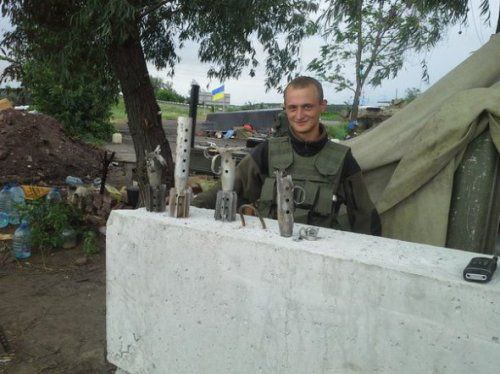
Outskirts of Sloviansk, checkpoint 3a, May 2014
We will definitely win
After returning from the ATO to the permanent base after 8 months of participation in hostilities in the Luhansk and Donetsk regions, the officer was appointed deputy head of the field communication centre for airborne training, which was his last position in the combat brigade. After being treated for his injuries in hospital and undergoing long-term psychophysical rehabilitation, he was declared unfit to serve in combat military units by the Military Medical Commission.
Today, Lieutenant Colonel Ivan Mykhayletskyi is the head of the Chortkiv District TCR and SS (Territorial Centers for Recruitment and Social Support) department in Monastyryska. He says that this is his frontline, a responsible and challenging area in the overall system of Ukraine's defence against the Russian occupiers.
- We get a lot of negative feedback from the public, they say: "They sit there in military registration and enlistment offices and only hand out draft notices!" But this is what only those citizens say and think who do not have relatives or friends in the military or who have nothing to do with military service. Widespread negative and vituperation come exclusively from those who want to "evade", who want someone else to defend the homeland, not them. Like: "Those who left will do it!" No, it will not be like that, everyone has to defend their native land from the Russian occupier. We have no right to lose it for the sake of our future and in memory of our comrades, patriots and conscious citizens who gave their lives in this struggle from Maidan in 2013 to the present day. And we will definitely win!" the officer is convinced.
Photo by the author and from the archive of Ivan Mykhailetskyi.


