



How to extract trillion from "shadow"? Major interview with Director of the ESBU, Oleksandr Tsyvinskyi, about beneficiaries of schemes, cash limits, and new tools for investigations
The recent high-profile successes of NABU and SAP in the "Mindichgate" case have not only boosted the standing of these agencies in the eyes of Ukrainian society but also increased the pressure on other law enforcement bodies and institutions tasked with fighting corruption and shadow schemes, where the state loses while individuals enrich themselves.
The question frozen in the air: "And where, dear sirs, are your successes? Why did we breed so many of you?" – from now on pursues SBI and NACP, ARMA and ESBU day and night.
Therefore, the Director of the ESBU (and until recently, a NABU detective) Oleksandr Tsyvinskyi faces a daunting task: to extract a trillion from the shadow economy, while simultaneously "rebooting" the agency and revealing to the public exactly who stands behind these illicit financial flows.
In an extensiveconversation with "Censor.NET," the Head of the ESBU talks about how, under conditions of insufficient funding, the organization of work and personnel selection will take place, which shadow schemes are currently leaders in budget losses, why it is necessary to create an institute of financial investigators, why receiving a salary in an "envelope" will become unprofitable, and what will happen next with the illegal cigarette market, which is growing at a record pace.
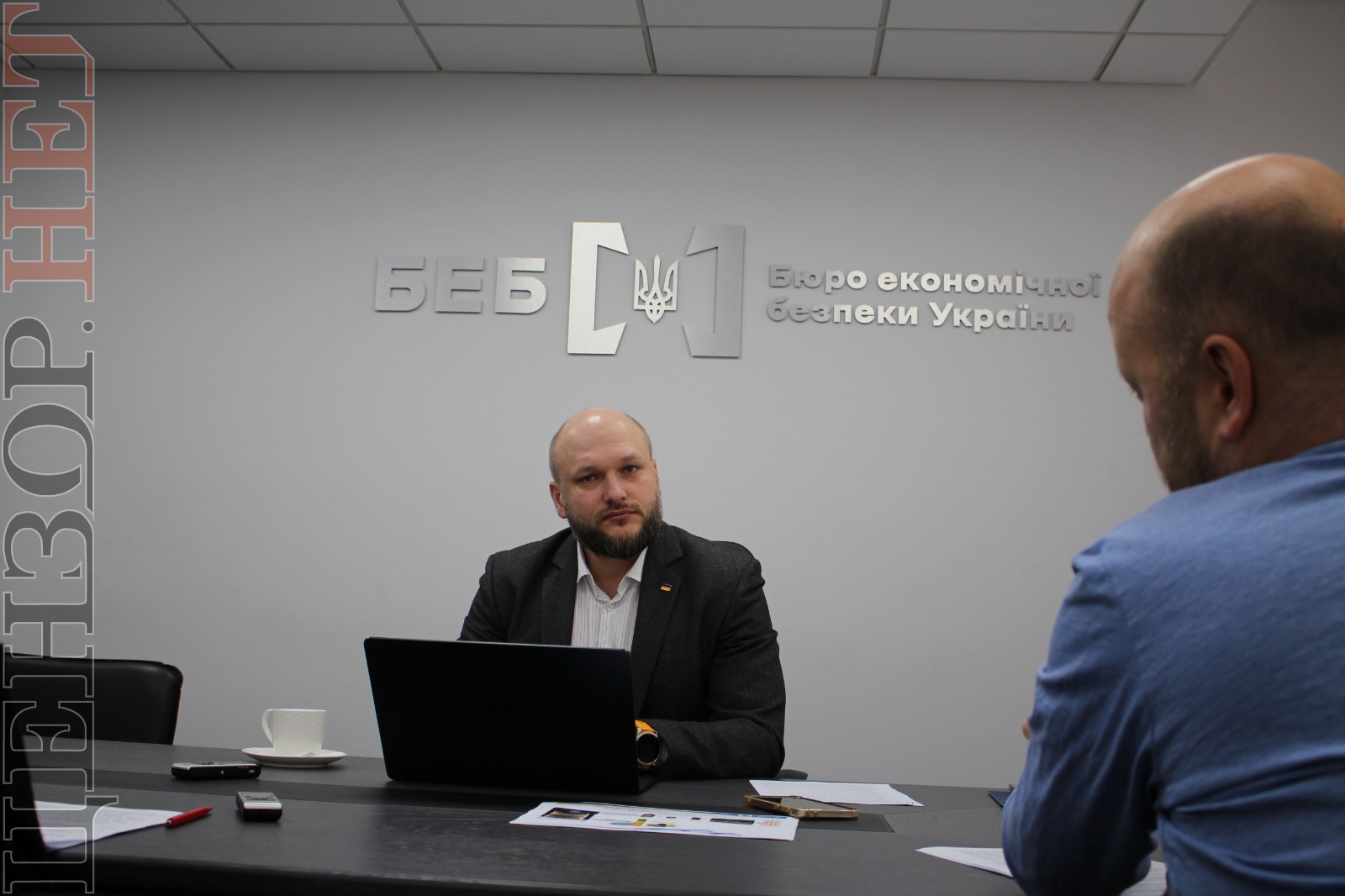
And we started... again with the "Mindichgate," or more precisely, its unexpected collision for the ESBU.

"MINDICHGATE", VETTING AND LACK OF FUNDS
– Start with the story about the 527 reports that the heads of NABU and SAP spoke about at the anti-corruption committee. They mentioned some names, in particular, the name of Zheleznyak. The next day, we noticed that Zheleznyak had commented on this and stated that these reports, according to his information, were prepared by ESBU analysts. And he added that this analytics is of very low quality. Do you confirm this information? Have any official investigations been launched regarding this matter? How do you react to this story in general?
– First: we started an inspection regarding this fact immediately, as soon as this information was made public.
– Second: we proactively sent a request to NABU to obtain specific information from them regarding these reports. So that we could check both the databases and internal communications to clarify whether we had such information or not. Of course, if someone was doing something not quite correctly, they probably took measures to hide it. But if our analysts logged into the databases under their logins and obtained any information regarding any of the specified individuals, then this story will be studied in great detail.
If this is a trace of someone from the ESBU, then we will further sort it out and clarify. Because if it is an employee of the Bureau, that is one procedure. If it is not an employee of the Bureau, we will already interact with NABU. That is, we have close cooperation here...
– And do your employees have access to all databases without exception? Are there any restrictions?
– They, of course, have access to many databases. Not to all of them, but they certainly have access to those needed for work.
– Have you communicated with Yaroslav Zheleznyak after his statement?
– We are currently gathering all the information. Including him as well. But as a priority, we want to receive information from the official body to be able to verify it. However, we will interact with Zheleznyak too. And if information was gathered here regarding any citizen–journalists, deputies, or officials, we will process every such fact. This is the reputation of the institution.
– Are there any deadlines for this internal investigation?
– As of this moment, we have not yet received information from our colleagues because this event occurred recently. But we will do it as quickly as possible.
– And what if they refuse to inform you, citing the secrecy of the investigation?
– No, I think we are all interested in establishing the truth. And they are too.
– As the head of the ESBU, did this phrase about the low quality of the analytics offend you?
– We are definitely working to ensure that our analytics is of high quality. It will be possible to evaluate this when we have these materials. For now, I don't know how to comment on this.
– You answer with a smile — and in general terms…
– Well, how else can I comment on this?
Differentiate. Firstly, I am the head of the institution, plus a professional lawyer who makes decisions. And for many years now, my professional activity has been structured so that I can draw a conclusion for myself. That is, to internally formulate a position that I will later defend. However, to do this, I must rely on specific data. In other words, I examine the materials to determine if there is any evidence of the institution's involvement. Of course, I do not rule out that this fact can be hidden, because in these reports, there is a lot of OSINT. OSINT is information available in general databases. That is, essentially, any person can do this without entering a database where there is information protected in a certain way.
At the same time, according to available information, there were entries into databases. And specific information, personal data, was obtained. This is what is very important to me.
– How did your subordinates react to this? For instance, Zheleznyak makes such a statement. Is there any fear among the employees that there will be an investigation? After all, it is unpleasant in any case, even if you did not prepare those reports. So, how does this affect those who work at the ESBU?
– Now ESBU is in a period of renewal. And the very fact of vetting is a turbulent period. Because the vetting is unique compared to all those that came before. For the first time, not a single representative of the ESBU participates in the work of the attestation commissions, only representatives of the public and international experts. For law enforcement structures, such participation has always been the norm. Moreover, there are no conditions as strict as this time anywhere else. If an ESBU employee, for example, does not pass the intellectual test, they will not pass it. And it is actually quite difficult. For example, I also passed it at the time when I was joining NABU. Back then, out of 4,000 candidates, either 400 or 500 passed.
– How difficult?
– For example, are you ready to solve a linear equation with fractions X and Y now?
– I’m afraid not — I’ve forgotten what I once learned at school.
– Exactly. And if you don’t solve it, you won’t pass this test. And if you don’t pass this test, you will be barred from working at the ESBU for 10 years.
What am I getting at? The vetting is very strict in terms of conditions and consequences. That is, there is legislation, a test, and an interview. And you still have to reach the interview by passing the relevant tests. And this whole story causes serious turbulence and anxiety among employees, because many of them went through the previous vetting. And some are resigning because they do not want to go through this procedure again.
The vetting began from the first day I took this position. I am grateful to the representatives of civil society who agreed to work in the commissions. These are lawyers, representatives of public organizations, and military personnel. I appointed them under my quota. Other candidates for the commissions were recommended by the EU Delegation to Ukraine, the Embassy of the Kingdom of the Netherlands, the U.S. Embassy, and the European Union Advisory Mission Ukraine. I also want to thank these organizations and the international experts who joined the vetting and personnel commissions.
Vetting and personnel renewal are important not only for the development of our institution but also for the recovery of the economy as a whole. This creates high-quality conditions for the reconstruction of the country and strengthens its economic security.
As of today, 86 people have been dismissed from the ESBU, 27 of whom are managers. The process is ongoing.
– Return to the question about analysts. How do you test and prepare them?
– We are currently about to open the competitive selection. This testing is difficult: we will set a serious passing score to select only the truly best.
Second. Analysts are people with critical thinking. And here it is important to say that within the analytics unit, there are different directions and specialisations. For example, there are analysts who identify violations in the field of tax legislation. Naturally, experience where a person worked, for instance, in the private sector, in auditing, or in the tax office, will be valuable here.
There are people who aggregate information and describe violations — this is closer to auditing work. There is strategic analytics — more high-level, where it is necessary to consolidate risks; to see how a certain normative act will affect the situation; to have the ability to predict impacts on revenue, and in general on the construction or elimination of a shadow scheme.
And there will also be analysts who support operations and conduct financial investigations.
So, the specialisation of analysts can be broken down into 4 categories. And for each of these categories, a person will be selected based on specific skills. To get in here, there will be special questions.
– For example?
– For example: how to overcome this specific scheme? Tell me how you would collect information to verify the spread of schematic VAT? And if a person understands what it is, they explain how they will work with it. Or, for example, how to process a procurement?
But we are talking about professionals. And we also want to attract young people. That is, if you want to, this can be learned. The main thing is that you have the appropriate mindset. A person may not know some details that specialists who work with this know. But if they think logically and have certain knowledge, then such a person passes.
Then there is a period of internship, a probationary period. If a person is interested in this work, and if know how to aggregate various data, they will work.
– Well, we understand the selection principle for lower-level positions at the ESBU. But what principles do you follow when appointing people to leadership positions?
– We always proceed from three positions. The first is integrity. The second is professionalism. And the third is interest and the desire to work, drive — you can call it different things. But these three components are the main ones for me. And then comes the specifics. For managers, the second component, professionalism, is the ability to build a team, to unite people. And it is very important to me when they share the vision and cultivate the declared values. If we have declared, for example, values regarding integrity, we can talk about them a lot, hang beautiful signs all over the corridors — but if, first and foremost, the managers do not cultivate these values during decision-making and do not demonstrate through their actions and decisions that these values work, then it will not work. If they make decisions taking values into account, then the subordinate personnel will follow suit.
– In your opinion, what knowledge and skills should the head of the ESBU have? What exactly should you know and be able to do without the help of deputies and specialists among the employees?
– That is a good question. Probably, considering that I am currently in this position, the competencies I possess are sufficient to lead the institution. These are: the ability to build a team, to form an integrated system that works for results, to implement values, and to change or build an effective corporate culture. The ability to interact within the system of state authorities with partners at the appropriate level.
– How about analytical skills in the work of the head of the ESBU? So that there is no gap between the leadership and the pros on the ground.
– Of course, I have such skills. After all, the Economic Security Bureau of Ukraine is an analytical law enforcement agency. So, for at least the last 10 years, I have been engaged in law enforcement analytical activity. My team and I conducted pre-trial investigations. These pre-trial investigations were inextricably linked with analytical tools. Yes, our team was the first in Ukraine to achieve the return of funds to Ukraine – EUR 3.3 million from France.
I am implementing this here as well. Our team worked effectively on joint investigation teams (JITs – ed.). We traveled a lot around the world and saw what, where, and how things work.
It is clear that there is official information — that is, when you write letters or documents. But there is also the establishment of live communication. And it works. Already today, for the first time in the Bureau's history, we are working on creating an international investigative group. This seems a bit unusual here, but I think it will work.
Another important story is the Institute of Financial Investigators. Currently, this story is being built within the National Anti-Corruption Bureau. But our team was one of the first to work out how it should be. And I understand how to develop this story — so now I hope that we will be able to create our own such structure. I still need to obtain a number of approvals to determine internally how and what to do, and then we will introduce this structure.
In general, the knowledge and detailed understanding of how pre-trial investigations happen and qualification, why it is damage or not damage, how to define it correctly — all this helps me a lot.
I understand how analytical tools work, what programs are needed, how to process crypto assets, and how to arrest them in the Seychelles — I can always share my experience on how it works. When you are deep in the subject, it is easier for you to work…
At the same time, I cannot say that if you do not have experience in pre-trial investigation, you cannot head a law enforcement agency. There are good examples where a person without such a background effectively manages a law enforcement agency. I believe that you can — maybe you have other skills. But when you have such experience, it is definitely an advantage.
– Talk about money. You say: We want to hire young, ambitious, talented people. Where is the money for this coming from? We have already heard that you have the lowest salaries. So why should anyone come here?
– Great question. Firstly, because these are people who are interested in the mission and the idea. There are such people, I know this for sure. There are people for whom these are not empty words. When you can get involved and do something useful. On the other hand, it is actually very valuable. Not for everyone, of course. But it is an opportunity to simply work honestly and do your job without any "tasks" for which you might later be punished. This is the second story we will be working with.
At the same time, I understand that it is indeed difficult to build equal conditions while being in a non-competitive, artificially created environment. This is a tough idea — primarily mentally. Because, on the one hand, you have to explain to people that they must act very clearly, responsibly, and according to the law toward citizens. Meanwhile, regarding the employee, the law does not work and is intentionally violated. This is more of a problem on a mental level.
Now, regarding salaries. Yes, they are lower than in other law enforcement agencies – and this is a problem. For us, it is not easy to find, for example, an IT specialist, or to invite an analyst from a good analytical company, or a financial investigator. But I know for sure that such people exist, they are ready to work with us, and we will attract them.
The difficulties lie elsewhere. At the present moment, the number of employees in the ESBU is 1,221. Our funding, which is allocated for 2026, provides for the recruitment of approximately 1,300–1,350 people, taking into account these discriminatory salaries. Depending on the position (how the coefficient will be distributed), this is actually an addition of 80–120 people. Under such conditions, we will not be able to create new Territorial Offices. We can only slightly supplement the Central Office and Territorial Offices. Well, those are the difficult conditions, what can I say?
(At the time of the interview, the draft budget for 2026 had allocated UAH 1.9 billion for the ESBU's funding. In the draft law on the state budget for 2026, adopted by the Verkhovna Rada of Ukraine, an additional UAH 244 million is provided for carrying out the reform of the ESBU. This means the funding situation has slightly improved ed.).

– You keep repeating that, despite all the financial difficulties, such people exist. Have you spoken with them?
– People write to me on Facebook, often asking when the competition will be. Clearly, you are not competitive in your field because of the lower salary. But I think we will be able to recruit people.
– And what was the percentage of vacant positions at the ESBU when you arrived?
– 70% as of today. You understand, we want this institution to deliver results, to de-shadow the economy. We demand that it work through all sectors at once, to overcome absolutely everything. But I state that for now, the number of our staff is only 30%. Moreover, of this 30%, a large part consists of people who ensure the vital functions of the agency. These are not the ones who investigate or analyze, although the institution cannot exist without them either. But the key product that we can present to society (and prevent budget losses worth billions of UAH) is produced by two units – analysts and detectives.
Another problem is that with the budget that has been allocated, we can grow by only 100 people next year. Within the framework of 2,769 vacancies, this is very little. And this contradicts the Roadmap for Ukraine's accession to Europe. Because it clearly stipulates that the ESBU is an important body because it allows for pulling money out of the shadow economy into a live, working economy. And thus , to reduce the amount of aid coming from the West. It is simple mathematics. Therefore, there is logic for us to be in all regions of Ukraine. But we are not in all regions. And it is not planned for us to appear there next year.
– You talked about this with the Prime Minister. What did she answer?
– There are no funds.
– Did you try to lobby for certain amounts to be included in next year's state budget?
– Yes, I did.
– And which of them were approved, and which were not?
– None were approved. For the ESBU to simply function, it needs an additional UAH 500 million. This is a basic development format. Because we are currently undergoing attestation. Every dismissal means compensation for unused vacation days. This is a fairly large sum. And in fact, these funds are also not included in the budget. This means the attestation is under threat.
Second — and I have informed everyone about this in writing, and there has been much communication in oral format — for other agencies where financial support is regulated by separate laws, for example, the SBI or NABU, salaries are set in relation to the subsistence level for able-bodied persons for the corresponding budget year in the amount of UAH 3,028, but only for the ESBU, it was set at 2,102.
And now everyone perfectly understands – I have already written a letter about this – that there are court decisions stating that former employees were underpaid by UAH 1,000. When recalculated into salaries, these are enormous sums. This alone could reduce our budget for next year by another UAH 500 million.
– Do you have to pay this money?
– Yes. And I cannot predict how many lawsuits there will be or how the process will unfold. However, this is the current judicial practice. The Accounting Chamber conducted a detailed audit of the Bureau from February to September. It clearly stated: UAH 2,102 is a violation of the law, as the minimum is 3,028. This information is public.
(Report of the Accounting Chamber of Ukraine "On the results of the compliance audit on the topic countering offenses encroaching on the functioning of the state's economy", – author's note).
But this recommendation of the Accounting Chamber has been violated. It has not been implemented. We have been allocated 2102 UAH for next year.
– You know, you take a punch quite well. But in the evenings or mornings, don't you get a sense of despair? Because at the ESBU, the state is clearly keeping you on bread and water. Moreover, both the bread and the water are insufficient. And all this while feeding you with promises. Don't you have a feeling that those at the top are deliberately sidelining you?
– Let’s put it this way. I prefer to speak the language of facts. Fact number one: the Bureau's funding for 2025 remained at the same level. This was planned with the understanding that a 'reboot' (restructuring) was supposed to take place. Therefore, the idea was not to recruit new people at all. Because they would all have to be "rebooted", vetted, and it would have to be determined who continues to work and who does not. In other words, the logic behind the minimal budget was exactly that.
Let's move on. There are many norms that directly obstruct our work. This is a direct failure to implement the Law on the ESBU from 2021. These issues remain unresolved to this day. Let me give you one example. We are talking about the de-shadowing of the cigarette market. The excise industry, 25 billion, many complaints – and they are objective. There is an agreement between an honest taxpayer and the state. An honest taxpayer pays money – the state ensures they have the opportunity to work normally and that their quota is not displaced by illegal products. At the same time, the ESBU, for instance, cannot even buy a video camera to covertly record something! We have the right to conduct secret investigative (detective) actions (SIDA – editor's note) – and we do conduct them. But I cannot buy a single piece of special equipment. This is a purely technical issue that must be resolved. And it can be done very simply – by making amendments: writing "ESBU" instead of "Tax Administration". The logic is that this must be done. And it should have been done back in 2021.
And there are countless such norms. I state: not a single norm has been changed as of this moment, unfortunately. We are working very actively with the government, submitting our proposals, and working in government committees. I hope we will reach a consensus on all points. But I state a fact: for us to be able to de-shadow the economy today, and not tomorrow, we must receive the critically necessary tools specifically today. Especially considering this fact, like many others, the Accounting Chamber has also identified it as a violation. And when all law enforcement agencies have this, but our law enforcement agency does not, it is absurd.
– Do you have an internal deadline for when you will leave, when you will have had enough of everything?
– I have a massive amount of energy to see this through to the end. And my team, which came with me, has it too.
– You are not being very sincere. Perhaps you are right to do so, as your colleagues and subordinates will read this interview. At the same time, do you remember what you said when we first met? "If there is no budget, I will leave..."
– No. I said that the presence or absence of a budget is a very specific marker of whether we are fighting the shadow economy or not. And this is a story about whether the institution will develop and become what it should be, or not. Regarding when and how, it is difficult for me to answer that question right now. Here, one must do absolutely everything possible to achieve success. Everything you can. And I know for sure that these opportunities exist, and they are not exhausted. We will do our maximum. At the same time, communication will also be frank and honest, including regarding the obstacles to the de-shadowing of the economy.
– So there is still a resource of patience?
– Well... there is a belief that this is necessary. Because in reality, it's absurd if you think about it. We are talking about Ukraine living on subsidies. Yet the agency that is supposed to ensure the fulfillment of the IMF program is not being funded! And the decisions that should have been made back in 2021, according to the transitional provisions for the full implementation of the Law on the ESBU, have still not been adopted.
– I am going to ask a question now. It is up to you to answer it. But this question is also for those at the top who tell you: There is no money, but you hang in there. Let's imagine – purely hypothetically for now – that Zheleznyak is right, and someone from your staff was secretly compiling a dossier on him for the Mindich and Co on the one hand, it is a crime. But on the other hand, isn't there a certain logic in this: a Bureau employee, receiving a salary that is quite unsatisfactory compared to colleagues from other agencies, works on the side?
– It’s very simple. What is a high salary? The question is very relevant. Is the salary of a NABU or SBI employee high? It is decent. But a high salary has never saved anyone from breaking the law. Yes, it is a basic criterion that allows many to refrain from doing something stupid and to fully concentrate on their work. In my understanding, it’s very simple: if you are not satisfied with what you receive, go somewhere else, to a private institution. Go and earn.
This whole story involves unacceptable things. If you break the law, especially for money, it is a crime. If this turns out to be true, if we identify these employees, we will do everything within our power, as provided by law, to ensure such a situation never happens again in the Bureau. So that everyone knows what the reaction will be. I hope our partners fully support us in this. For us, this is very important.
"THERE ARE NO ATTEMPTS TO PRESSURE US; HOWEVER, THERE ARE ATTEMPTS TO MANIPULATE."
– You mentioned that you worked at NABU. We all remember how, at one time, many famous people sat in the reception rooms of Sytnyk and Kholodnytskyi. They asked for things, drew attention to certain matters, feared something... Are there attempts by those in power to influence the ESBU?
– There are no attempts to influence. There is communication. The ESBU is a central executive body. It is part of the Cabinet of Ministers system. The ESBU is directly overseen by the Prime Minister. And this is entirely normal; actions must be coordinated, as well as where the system should move conceptually as a whole.
In other words, there are no attempts to pressure us. There are attempts to manipulate, and mostly not by representatives of the government. However, it must be noted that, unlike other bodies, according to the roadmap for Ukraine's accession to the EU, the ESBU must have a special status. This provides a certain independence and autonomy. Then the body can work independently, deliver results, and fulfill its purpose.
– Is there no such status at the moment?
– It is provided for by the Roadmap. We have submitted all the documents and are currently working on this, as it must be implemented. Such a status does not exist yet because I have to coordinate numerous small internal management actions with the ministry. For instance, moving funds from one line item to another, buying fuel or stationery – there are many technical points. It works, but it’s certainly not about the independence of the agency. On the other hand, a great many decisions must be coordinated through regulatory procedures. Consequently, to block our work, one doesn't need to apply pressure. One simply cannot approve certain decisions for a very long time. Delay the approvals, and then ask: So, what results do you have?
– I can imagine how much that boosts the morale...
– We had a discussion at one of the committees, and a piece of good advice was given: why don't you work undercover and uncover these violations? I said: We will make every effort to do that, but the problem is that we still cannot purchase the special equipment for it.
The problems with streamlining the regulatory framework are more than obvious, as these are direct requirements of the law, but...
A common, consolidated position is needed here. For a craftsman to do something, he needs tools. If, for some reason, they are still missing – and I write and speak about this publicly, and we are working on it actively – then it is difficult to achieve the expected result under such conditions.
– And on top of that, they compare you with NABU...
– ESBU is somewhat different from NABU; we have a very broad jurisdiction. We are a new-generation economic intelligence service with extremely powerful analytical potential. NABU has 13 types of offenses, while we have 34. This covers a significantly larger number of criminal proceedings. And if we are talking about smuggling, there must be high-quality investigations. The same applies to the excise industry. Because it is commonly believed that conducting a procedural action like a search is already the end of the story. No. The end of the story is when the final, top-level beneficiary is held accountable.
You asked what competencies are needed. Our vision was this: we are not interested in an individual committing a crime. We are interested in the organized crime group and bringing the ultimate beneficiary to justice. And most importantly, the seizure of their assets. If a person commits a criminal offense, makes money, and we don't go after them – that's not much of a success...
"OUR KEY TASK IS TO STOP SCHEMES WHERE PRIVATE ENTREPRENEURS ARE USED AS A TOOL FOR TAX EVASION"
– Talk about de-shadowing. You mention a figure of one trillion. That is 1/3 of Ukraine's economy. According to your estimates as an agency, which shadow schemes are currently the leaders in terms of budget losses?
Once again, this is very cool, because this way, law enforcement agencies have both their own information and external information. But, for example, regarding individual entrepreneurs (FOPs), we are working to break the very scheme that prevents the state from moving forward. Because the FOP, if you look into it, is a very good thing. It is an opportunity for a person to earn money for themselves through their own labor by registering as a business entity. For the state, in theory, this should be an ideal story because our tax burden on FOPs is one of the lowest. Effectively, we are creating an opportunity for many professions – experts, psychologists, manicurists, and so on – to earn money.
However, we often have a situation where, for example, there is a chain of 150 stores, and these are 150 individual entrepreneurs. But in fact, there is one person at the top who fully manages them, and they are salaried employees. In this specific story, all these FOPs are a tool for tax evasion. Because all these FOPs, for example, of the third group, pay 5+1.5% in taxes, but de facto, it is a large legal entity. Meanwhile, when we talk about competitive conditions, there is an LLC that also has 150 stores, but they pay 18% PIT (Personal Income Tax) and 22% SSC (Social Security Contribution) for their employees, and they automatically find themselves uncompetitive.
– How do you react to situations where FOPs are used?
– We are currently documenting such groups and recording everything—the first step is for them to compensate for the damages caused. The second step is that these FOPs transition into a single legal entity, and these individuals become hired employees. Consequently, taxes start being paid for each worker; the company begins to show a profit and pays corporate income tax. Clearly, there could still be numerous abuses here—but that is a different story.
What matters here is that the tool provided to people to develop their entrepreneurial activity without asking the state for anything must operate transparently. Theoretically, FOPs are wonderful people for the state. They don't ask for benefits, they earn for themselves, and they stimulate the economy. But in this case, the state's desire to provide such capacity and opportunity is being completely neutralized by these groups and certain individuals.
Our key task is to stop schemes where FOPs are used as a tool for tax evasion. At the same time, it is vital to create normal conditions for genuine FOPs who operate honestly under the simplified system. Because if this model continues to be abused, it could simply disappear—and small business would suffer the most.
– The International Chamber of Commerce (ICC Ukraine) has issued an open statement to the International Monetary Fund, the U.S. Embassy in Ukraine, and the EU Delegation to Ukraine regarding the illegal cigarette market in Ukraine. The document emphasizes the need to bring the tobacco market out of the shadows and cites figures previously mentioned in a Kantar study. It states that the Ukrainian budget loses over 25.6 billion UAH in tax revenue annually. Have your analysts evaluated this illegal market? Does the ESBU generally plan to react to the current situation?
– We are conducting research, but not in the same way Kantar does. There are objective reasons for this. First of all, there is a lack of personnel who should be doing this directly. Secondly, we have the attestation process, which is currently only reducing the number of employees. However, after the 'reboot,' these figures will be provided by the ESBU based on very clear algorithms—and not just regarding cigarettes, but for the economy as a whole. This will allow us to provide this information as an alternative to the calculations that currently exist.
Do the voiced figures correspond to reality? I think so. Perhaps the methodology is not perfect, but it is of sufficient quality. This is a large sum, and in percentage terms, it is quite significant. Such a situation is also typical for France and other countries that are ahead of Ukraine. But I am not saying that we are doing better than them. Statistically, of course, that is the case, but the point is that industry representatives who operate transparently and pay taxes honestly naturally demand that the state fulfill the social contract. That is, they want to ensure their honest products are not replaced by dishonest ones.
For us, this area of work is a priority, and we are working to ensure that taxpayers truly feel positive changes in our performance.
–How do you envision the solution to this problem?
–This problem can be solved. No country has ever managed to achieve this 100%, but it is possible to significantly reduce the percentage of illegal products in this market. We have the will and the desire, but we still need to fully staff our team and eliminate the artificial restrictions that deprive the ESBU of the ability to document such crimes.
There is currently a certain narrative that, since the head of the ESBU has changed, the agency will instantly become hyperactive. But everyone forgets about the attestation process, which is still ongoing. Maximum efficiency will be achieved only after its completion and the selection of high-quality personnel.
We understand that cigarettes manufactured in Ukraine are indeed being seized in other countries. You likely see our international activity, which is quite high. Our top priority is the countries we share borders with, specifically in terms of developing joint investigations with foreign law enforcement agencies and responding to such cases. When these cigarettes are seized, it is essential to investigate where they were made and how they got there.
We are currently building a specialized database to address this problem as comprehensively and effectively as possible. If worked on comprehensively, this type of activity will become unprofitable.
– While you are building, more and more kiosks with cigarettes are appearing. This means counterfeit goods are being sold openly. Including the frontline regions. Perhaps the ESBU should combine efforts with other law enforcement agencies to finally overcome this?
– In order to work effectively in a region, you need to be present there. In many regions, including the frontline ones, we do not have our directorates.
The minimum staff for a directorate in a region is at least 80-90 people. Because various units that ensure its activities must be present there, as well as analysts and detectives who can travel and investigate offenses. Because traveling from Kyiv to Dnipro or Kharkiv is not economically viable.
This is indeed important, and the Prosecutor General has repeatedly emphasized this. I fully share his position. And for them to be there and work on this, that territorial directorate must exist. We have not planned any new territorial directorates for 2026, because there is no funding for this.
In addition, we propose amending Part 2 of Article 204 to classify the manufacture and sale of excise goods as a serious crime, which would enable the conduct of undercover investigative actions (NSDR). This is necessary because such activities are highly clandestine.
We also propose introducing the confiscation of proceeds. Currently, the Code only provides for the confiscation of equipment and goods, but not the profits earned by criminals. While there is a concept of money laundering, that is an additional offense. For those directly charged under Article 204 of the Criminal Code, the confiscation of earnings from the manufacture and distribution of cigarettes is not currently provided for. We are actively working to change this.
In summary, to overcome this problem, three issues must be resolved. First—creating the conditions for the ESBU as provided by law, so our employees are present where the problem exists. This would allow them to react to the production of illegal goods and, if necessary, take action on the spot when distribution begins.
Second—regulatory adjustments. We need to strengthen the liability for the illegal manufacture of excise products.
Third—adopting government resolutions that will directly help bring the economy out of the shadows (procurement of equipment, access to customs posts, etc.).
With these conditions met, our team will be able to virtually eliminate this problem within six months or even faster.
– It is unlikely that these kiosks operate independently; most likely, we are talking about networks controlled by someone. Do you understand who exactly is behind this?"
– We are working on this.
– Can you explain what signs consumers should look for to identify counterfeit cigarettes?
– If a self-respecting person approaches a kiosk and sees a pack of cigarettes costing 60-70 UAH, they will realize it is counterfeit. Because cigarettes simply cannot cost that much today.
But generally, it shouldn't be up to the individual to choose; together with the Tax Service, we must ensure that counterfeit goods are not distributed at all. We will specifically target oganized criminal groups involved in the mass manufacturing and sale of such products.

– There are three well-known national manufacturers of counterfeit cigarettes operating in Ukraine, as well as a large-scale retail network for their distribution," reports RBC-Ukraine, citing Oleh Hetman, coordinator of the Economic Expert Platform. The expert notes that the Temporary Commission of Inquiry of the Verkhovna Rada studied this issue, identified these enterprises, and emphasizes that "essentially, these are three production facilities with abnormally low tax indicators, raising many questions from law enforcement and tax authorities." According to Hetman’s estimates, tax losses from the illegal sale of tobacco products have already reached a staggering amount—15-17 billion UAH. Can you comment on this? Has the ESBU recorded such facts? Are investigations being conducted?
– The ESBU is conducting analysis regarding excise activities, and there are ongoing pretrial investigations. We will speak about this using facts in the form of completed results. We will not make any assumptions regarding anyone.
– Has the ESBU identified organized criminal groups involved in moving cigarettes into Ukraine and their transit further into Europe? As well groups engaged in the illegal manufacture of tobacco products within Ukraine?
– From August to November 2025, within the scope of work on de-shadowing the excise goods market, ESBU detectives served notices of suspicion to 89 individuals and referred 76 criminal cases to court. This includes 22 cases regarding the illegal manufacture of excise goods, specifically in the tobacco and e-cigarette sectors.
Specifically, suspicion notices were served to 80 individuals, 28 of whom were linked to the illegal turnover of e-cigarettes. Out of the 76 criminal cases sent to court, 25 involved the illegal turnover of e-cigarettes, and 22 cases were referred to court specifically regarding illegal manufacturing.
A total of 19 lines for the illegal manufacture of excise goods were detected and seized. The estimated value of the seized products and equipment exceeds 280 million UAH.
Regarding the production lines, there is a differentiation: some lines produce vapes, others manufacture cigarettes, and there are also lines dedicated to the entire process of fermentation and tobacco processing, which is later turned into cigarettes.
If we talk about figures and quantities, they are significant, and the pace of our work has not slowed down in any way. However, as I mentioned, our priority is organized groups—reaching the ultimate beneficiaries and ensuring the recovery of funds. This involves a much more complex set of operational and investigative actions than simply conducting searches and seizing illegal products or equipment. It takes much longer to document such cases properly. Detecting the crime is one thing; identifying who commits it and receives the profit is much more difficult.
– Do you also count representatives of the government and law enforcement agencies, who may be involved in such illegal activities, among the ultimate beneficiaries?
– Here, it depends on the jurisdiction, which may lie with NABU or the SBI. For example, take the situation with smuggling. If something is transported illegally across the border by a private individual, then it is within our jurisdiction. However, if a government official takes money for it, that is a bribe and falls under the jurisdiction of the SBI. In reality, these fragments are disconnected, and we want to consolidate everything in one place. The ESBU should investigate such stories comprehensively.
Another important nuance: the ESBU does not have access to customs posts. We have submitted proposals for legislative changes. Point 14, which at least allowed us to issue instructions to customs officers and jointly inspect cargo, was canceled last year—despite the good results achieved when that rule was in place. Therefore, we are asking for these powers to be restored. If smuggling is exclusively the jurisdiction of the Bureau, how can we perform our duties without access to the territory where such crimes occur?
Furthermore, when we see that officials are involved, the question arises: do we really need to involve other agencies to document the crime and take further action?
An equally important issue is the protection of witnesses and our own employees. Illegal businesses always fight back. To effectively tackle those who defend themselves, we must be able to protect both our detectives and the witnesses. Currently, we are deprived of this capability. For instance, we cannot purchase specialized equipment specifically for this line of work, even though the law stipulates we should have such a possibility. Therefore, we have also submitted a legislative initiative regarding this matter.
I won't say that we cannot work without this. We can reach out to another law enforcement agency, but our colleagues have their own tasks and priorities.
Our goal is not to complain or ask for help, but to have the capability and tools to enforce the law effectively. I am confident we will reach a consensus with decision-makers. After all, de-shadowing the economy is not just a slogan; it is a requirement of the IMF that must be fulfilled regardless of whether someone wants it or not.
– In August of this year, the ESBU conducted about 40 searches of retail outlets, offices, and warehouses of the network under the UVape brand. During these searches, detectives seized 7 production lines and products worth over UAH 50 million, which was reported publicly.
Currently, this disposable e-cigarette retail network continues to open new locations, while there is no news regarding the results of the investigation. How can you explain this?
– An investigation is not a TV series, and it takes place in accordance with certain requirements. Once searches have been conducted, we need the opportunity to examine the seized materials, schedule forensic examinations, and carry them out. There are backlogs at expert institutions. All of this is a process. I am convinced that once we complete all of this and communicate the findings, you will see the results of this work.
– How to deal with the fact that the law prohibits the sale of flavored electronic cigarettes and flavored liquids?
– The law states that there are three components that are not prohibited from being sold separately: flavorings, glycerin, and a nicobooster. The Nicobooster is where the nicotine that provides a certain sensation is contained.
You can now go to any store where these are sold and buy all these components separately without any problems. But if they are mixed, it conditionally becomes an excise product.
Therefore, in the context of prevention, we are working to ensure that the nicobooster is subject to excise tax, but we must take into account the interests of the relevant industry to ensure it remains competitive.
There are active discussions at the TSC meetings about how to do this correctly. Because there are things that, whether you prohibit them or not, will continue to happen. If people smoke this and they like it, there will always be those who sell it. Accordingly, we need to clearly choose the path we will take moving forward. If we take the position of legalization, then we make a decision on the payment of the excise tax. Then those in this business can sell it legally, and we will only have claims against those who sell it illegally.
If, however, we take the position that we want to eliminate this activity as a whole, then we must increase the level of liability and implement legislative changes that will make such activity impossible.

– I read that "home-mixes" (self-mixed e-liquids) can be dangerous to health, especially for young people.
–In fact, it is a vehicle for delivering nicotine into the bloodstream. And unfortunately, it is a very effective one.
– Can one get poisoned?
– I am not an expert. But I know that the Ministry of Health is categorically against legalization.
– According to Kantar, which also researched this market, the share of illegal products is 93.6%. Because of this, the budget loses 7.5 billion in taxes.
– That is why we need to either legalize it or create the conditions for a total struggle against this problem. Given the budget losses, legalization is likely the expedient path.
"WE NEED TO THINK ABOUT HOW TO LIMIT THE USE OF CASH"
– Restitution to the budget has always been one of the most urgent tasks for the ESBU. What are the results in this area of work?
– I have decided for myself that I will not tailor the future to past indicators or compromise by preserving old practices for the sake of quick results. Our goal is to create an institution that fulfills its core mission—fighting the "shadow" economy. At the same time, we must focus on increasing revenue from the honest, "white" market that operates under equal rules. In parallel, we are working with the segment that compensates nothing because it exists entirely in the shadows.
We are currently restructuring the agency into a completely different format of operation. We need to "reboot" the ESBU and recruit new people. Once that is done, we will achieve good results in terms of restitution, as violations and tax evasion have always existed and always will. Meanwhile, business must see that we are working primarily against those who pay nothing at all and operate "in the dark".
But here, there will be no situation where we work on "black-market" business and immediately get a result in the form of restitution to the budget.
There is a direct effect of the investigation. The formula is: investigation → restitution. You identify a violation, bring the perpetrator to justice, the violators pay the funds, and under Part 4 of Article 212, the criminal case is closed. And there is an indirect effect.
Everyone talks about prevention. And prevention is about increasing revenues. It's when you fight against a scheme, against the shadow economy.
The IMF, in the context of the new program, clearly stated that government authorities are obligated to implement measures for mobilizing domestic revenues—of which we actually have quite a few—and to accelerate efforts to prevent tax evasion. When we talk about prevention and the "schemes" column, it's not about the figure that entered the budget because we held someone accountable; it’s a different indicator. We are currently working to make this as relevant as possible because I don't want inflated figures; I want it to be as objective as possible.
Let me give an example of what prevention looks like. We are currently working, in particular, within the defense sector. We see that a certain company in the defense sphere is purchasing specific components for a final product at prices several times higher than market value.
We cannot state that this is a crime, but since we operate with a risk-oriented approach, this is a risk for us. We do not disturb this company; we do not come to them with searches; the analysts are working. Having discovered this story, we inform the customer. In this situation, it is the defense sector—those who directly make the purchase. And this letter to the company was not made public. We simply informed the customer so they could assess the situation and make a decision. Of course, without no instructions on what that decision should be.
Later, we received many inquiries, including from members of parliament, alleging that we were supposedly putting pressure on the business. However, a few days later, searches were conducted in a European country, revealing that the cost of the goods supplied specifically to that company had been inflated dozens of times. After that, all questions regarding our actions disappeared.
Currently, several companies have approached us, stating: we are ready to communicate and show everything as long as you are simply doing your job. We also received a letter from an association that offered to provide all the necessary information for analyzing the situation. In my opinion, this is a normal, partnership-based dialogue between a business and a law enforcement agency.
– How does the ESBU cooperate with honest businesses that want to help identify shadow schemes? Are there already any joint cases?
– Cooperation with honest business to create a level playing field is our priority.
Yes, in September 2025, the ESBU, together with control bodies, held a meeting with representatives of the electronics retail sector regarding the rejection of gray tax optimization schemes. Despite the short timeframe for a proper evaluation of the result, I can say that in November–October, we already observe a positive trend in increased tax revenues from this industry.
The Bureau has also launched the official chatbot "StopShadowBot" for reporting violations during the sale of household appliances and excise products.
The messages received are promptly analyzed and distributed among the ESBU structural units for effective response. To date, 76 messages have been received, 36 of which are relevant. These primarily concern sales without receipts. While the sale of a single phone without a receipt is not a criminal offense, it is certainly a marker and a sign that we are dealing with phone smuggling and off-the-record sales involving tax evasion. This is an element we will respond to.
We also receive reports regarding excise products. Just yesterday, I was informed that in one of the regions, 5 gas stations were shut down, and another 16 closed on their own.
– To prevent money laundering and complicate the operation of "back offices", several safeguards are needed: limiting cash usage, strengthening bank financial monitoring of fragmented income, and implementing risk-oriented analytics by the ESBU. The digitalization of the excise market via the e-Excise system in 2025 is also a crucial tool to ensure transparency and stop the flow of untaxed capital.
– This is a very interesting and extensive topic for a separate conversation. If we speak briefly, it is about capital outflow and money laundering. To solve these two problems, we need to first think about how to limit the use of cash. When funds pass through transactions, they are controlled.
Second is the issue of withdrawing funds abroad. There are quite a few schemes used for capital outflow. I will not retell them; I will only say that we are also working to counteract them. This is another important area of our work.
And finally, about something that some might not like: the need to prove the legality of the source of income. In the effective tax systems of various countries, it is established that you cannot buy goods worth 5 million if you do not have the corresponding income. In other words, they verify your capacity to make a purchase.
Why is this important for de-shadowing? Because it would become unprofitable for a person to receive a "salary in an envelope". They wouldn't be able to buy the things they need without proof of income. This stimulates receiving an official salary.

– A question from your past at NABU. Do you continue to follow the fate of Denys Komarnytskyi?
– Of course (smiles – ed.).
– Does the state of Ukraine have real chances for his extradition from Austria? Or is it a futile hope?"
– The fact that someone hasn't done it yet doesn't mean it's impossible. I am convinced that everyone who must will face Ukrainian justice. It is a matter of time.
– Are you speaking more about karma or about an actual return through extradition?
– I am talking about the fact that conditions for detaining such persons have been created in Ukraine. These are safe locations in the western part of the country. One of the reasons why extradition, particularly from Austria, did not occur was the cited danger to the individuals for whom requests were filed, as well as inadequate detention conditions. These problems have now been resolved.
There are other legal obstacles, but I know that the procedure is moving forward, and people are already being extradited from many countries. Therefore, I believe that regardless of the last name, people will be extradited. And there will be fair verdicts.
Tetiana Bodnia, Yevhen Kuzmenko, Censor.NET
Photo: Angelina Shorokhova


