



Can SBI investigators work freely? Story of one letter
Censor.NET is in possession of a letter by Pavlo Pavlenko, now a former employee of the Territorial Administration of the SBI in Kyiv, which he sent on 17 November to the parliamentary Temporary Investigation Commission on the investigation of possible corruption or corruption-related offences in law enforcement agencies, courts, and judicial authorities.
In it, Pavlenko claims that investigators are being pressured, that employees are being prohibited from participating in competitions for positions in other bodies (in particular, the HQCJ), that the principle of investigator independence is being undermined, and that labour laws are being violated at the Kyiv Territorial Administration.
Formally, this appeal has not yet led to any tangible results. So what is it: a description of the real state of affairs or internal strife?
Here is the text of Pavlo Pavlenko's appeal:
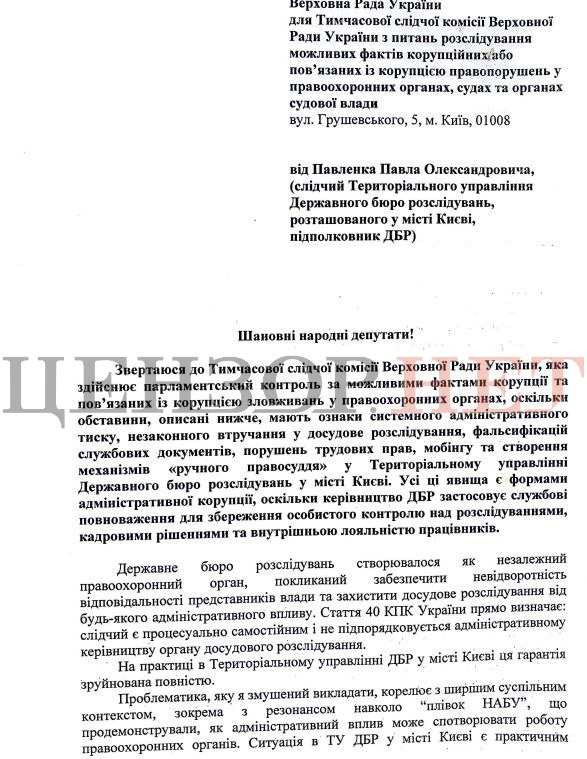


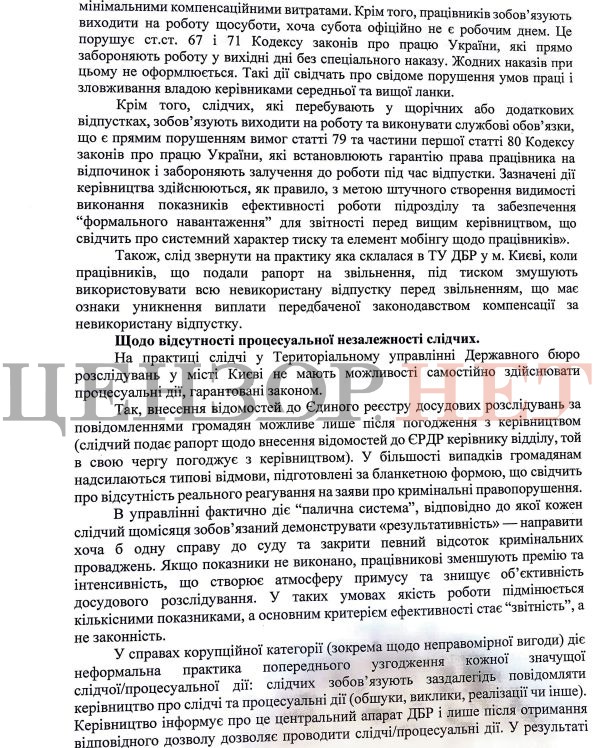
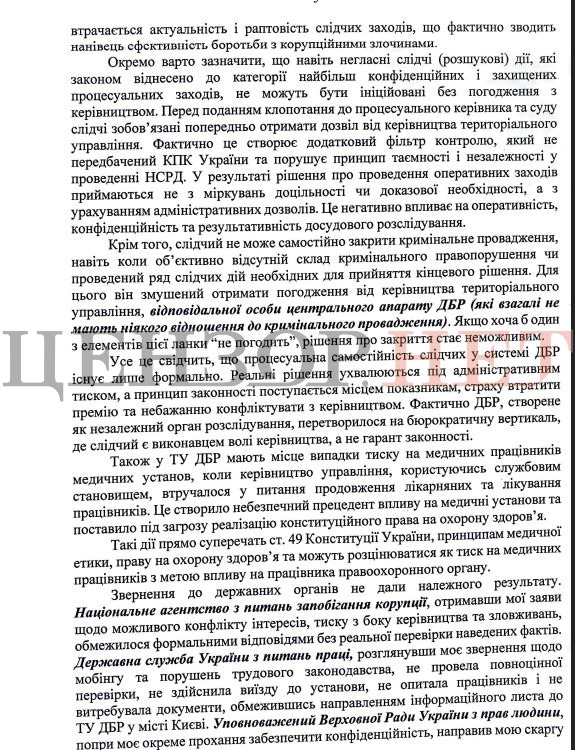

We spoke with Pavlenko. According to him, the management announced the ban on applying for positions in other agencies back in December 2024:
"The head of our TA said this at a meeting of the heads of the investigative and operational departments of the TA, and they, in turn, began to pass this on to their immediate subordinates — operational staff and investigators — at meetings. The same thing happened in other territorial administrations. Some employees began to ask questions: why is it not allowed? Management was unable to explain this, so they informally gave permission to participate in the competitions.
At the end of March, when people were ready to submit their documents, the heads of the operational and investigative departments were gathered again and told that the central office and the head of the SBI had given direct instructions prohibiting participation in the competitions. However, about 15-20 people from all over Ukraine submitted their documents anyway, and they became the targets of so-called mobbing.
According to him, he and other SBI employees complained to the supervisory authorities, but in fact, no one conducted an investigation into the allegations:
"Employees like me appealed to other bodies that have the right to control and inspect the SBI. But, as practice has shown, these bodies, fearing the future situation, limited themselves to formal replies, or worse, forwarded these appeals to the central office of the SBI. This is what the Verkhovna Rada Commissioner for Human Rights did. The NACP did not respond at all.
The SBI was created to fight corruption, so logically, only parliamentarians should have influence over it. But I decided to go through the appeals process from the bottom up. First, I appealed to the Internal Control Department of the SBI. Then – to the State Labour Service and the NACP. But when I realised that nothing would come of it, I appealed to the Parliamentary Committee on Law Enforcement and the relevant Temporary Investigative Commission. But even they replied that they had forwarded my appeal to the central office of the SBI.
They either ignore it or really don't understand what the problem is. If there is no independent investigator, this body will be useless. I mean procedural independence, as provided for in the Criminal Procedure Code.
I have been working at the SBI for five years, and before that I had held various positions in the prosecutor's office, including the Prosecutor General's Office. So I have something to compare it to. I can say with confidence that the Kyiv Regional Office has highly qualified investigators, but the management has turned them into robots. Investigators must do only what they are told to do.
We asked why, if his statement is to be believed, SBI employees were carrying out illegal instructions. Pavlenko explained the algorithm of pressure exerted on operatives and investigators at the SBI:
"The SBI should be independent, and this independence should be evident in the smallest element – the investigator. In reality, investigators are placed in such a position that they cannot do anything without the approval of their superiors. Investigators cannot make any decisions in proceedings without the approval of their management, including entering a case into the Unified Register of Pre-trial Investigations or closing proceedings. In some cases, approval is even required from the central office of the SBI, which has no connection to the case. An investigator from Mykolaiv or Poltava, for example, must contact the central office, send them the decision, and only after they give their approval can he close the case. Similarly, at the outset, when a statement is received from any Ukrainian citizen, the investigator cannot decide on his own to open proceedings – he prepares a report for his superiors, and if the investigator enters it into the Unified Register of Pre-trial Investigations without this, the management will simply not approve it in the Unified Register of Pre-trial Investigations (the head of the department must approve it with his flash drive) and the case will simply hang in the register without being opened. And the investigator simply has no choice, he is forced to comply with these conditions in order to be able to respond to the appeal and move the case forward.
Let me give you an example. A colleague summoned the head of a department at one of Kyiv's universities for questioning. He was almost reprimanded for this because he did not inform the management. And such situations are indicative for other investigators, who understand that it is better not to do so.
Regarding the impact of such a system of pressure on high-profile investigations, Pavlenko explains:
"This system is uniform throughout the SBI, and, of course, high-profile cases are no exception. Investigators cannot open or close cases on their own."
Pavlenko himself was dismissed from the SBI because he returned to the prosecutor's office. He assures that he has no intention of returning to the Kyiv Territorial Office of the SBI, but would like the remaining investigators to be able to work independently.
The only body that responded to Censor.NET's request was the State Bureau of Investigations.
Here is the text of the response:
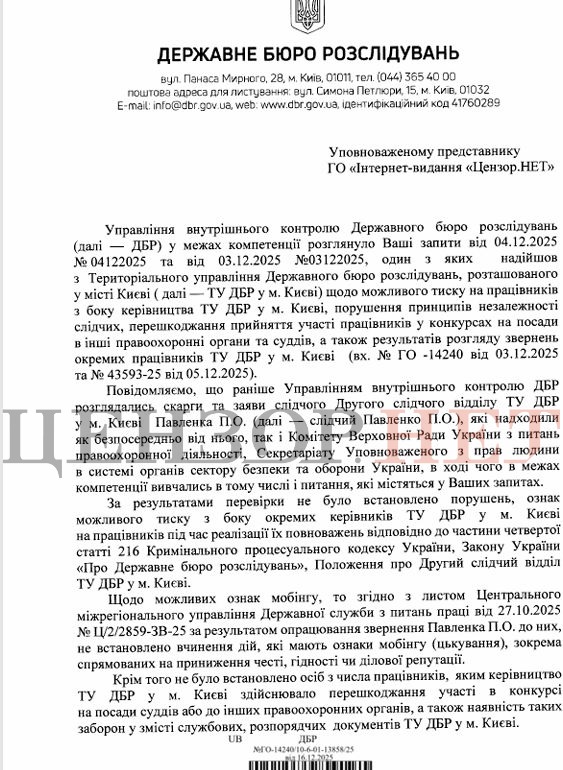

In other words, according to the SBI, the Internal Control Department conducted an investigation and found no evidence of the alleged abuses or violations, nor any signs of pressure on investigators.
Given the series of scandals and the scrutiny to which anti-corruption agencies are currently subject, everyone can draw their own conclusions and assumptions. It remains to conclude in the traditional manner: Censor.NET will continue to monitor developments.
Olha Skorokhod, Censor.NET


