



Chronicles of hybrid frost: report on how residents of unsafe buildings survive in Kyiv’s Teremky
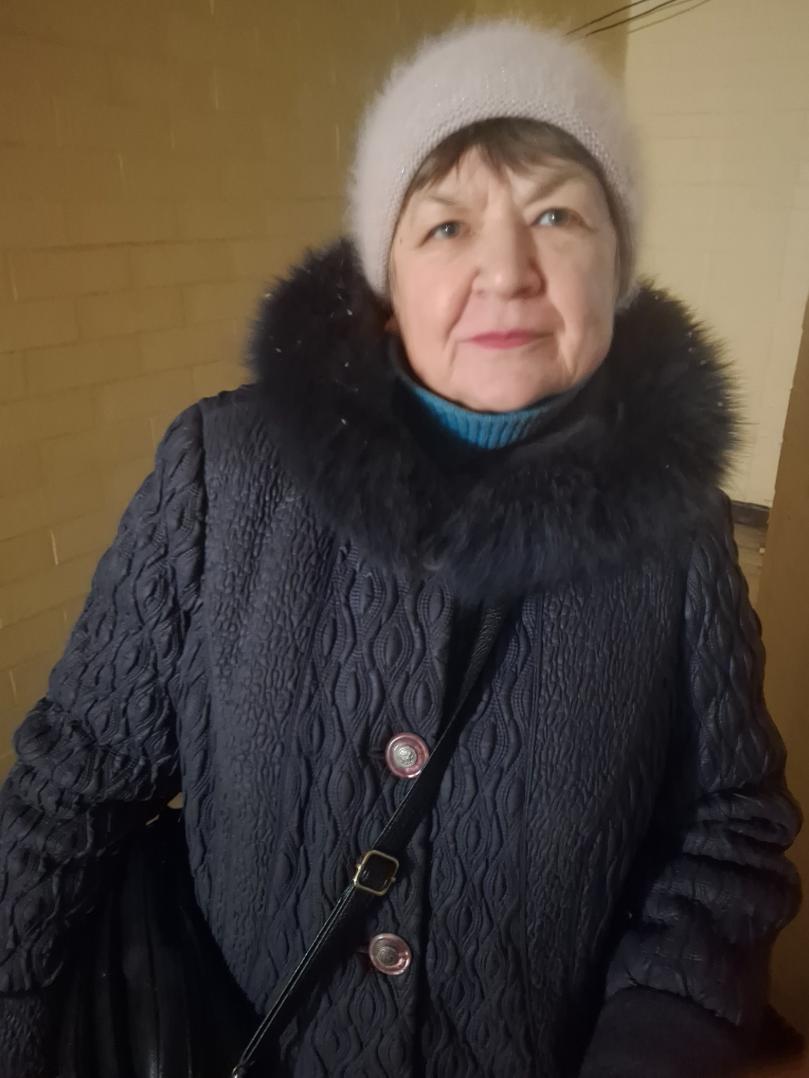
- Young man, could I ask you to walk me to the entrance? It’s very slippery…
Supporting an elderly woman in a dark jacket by the arm, I walk her to the doors above which there is a sign that reads: "Zabolotnoho St., 32".
"So you’re from this building?" I ask the woman. "I was headed here anyway. How do you survive here?"
"Oh, we survive," she sighs. "No heat, no water, and the sewage system has burst as well…"
This is how my introduction to this building and its residents begins.
AKADEMIKA ZABOLOTNOHO, 32. "IN THE KITCHEN, THE TEMPERATURE REACHED +6. HOW ELSE DO WE KEEP WARM BESIDES A HEATER? A FEW ‘LAYERS’ ON, BOTTLES OF WATER, A DOWN DUVET, WARM PAJAMAS."
But even against that wider backdrop, the plight of residents of the high-rise at Akademika Zabolotnoho, 32, stands out.


Last Friday, January 23, a Censor.NET correspondent saw this with their own eyes.
The 21-storey building is located not far from the Teremky metro station. It was built in 1989, with its own design nuances, and not all public utilities office workers today understand those 36-year-old specifics. This had to be recalled more than once when troubles hit the building in January.
First, on January 9, after a massive overnight enemy attack, heating in the high-rise disappeared. After that, problems began piling up one after another, so residents had no time even to look up.
In a few sentences, 72-year-old Olena Radomska tells a Censor.NET correspondent about the scale of the disaster.
"When the shelling happened on the 8th, there was no heating and no hot water," she says. "On the third floor, everything froze up — the toilet, the sewage system… And on the 19th floor, I still have no water; they said it’s unknown when it will be back because the pipes need to be replaced. And in my apartment, the temperature is -9 degrees. It’s good that the elevator works when there’s electricity. But often you have to go on foot…"
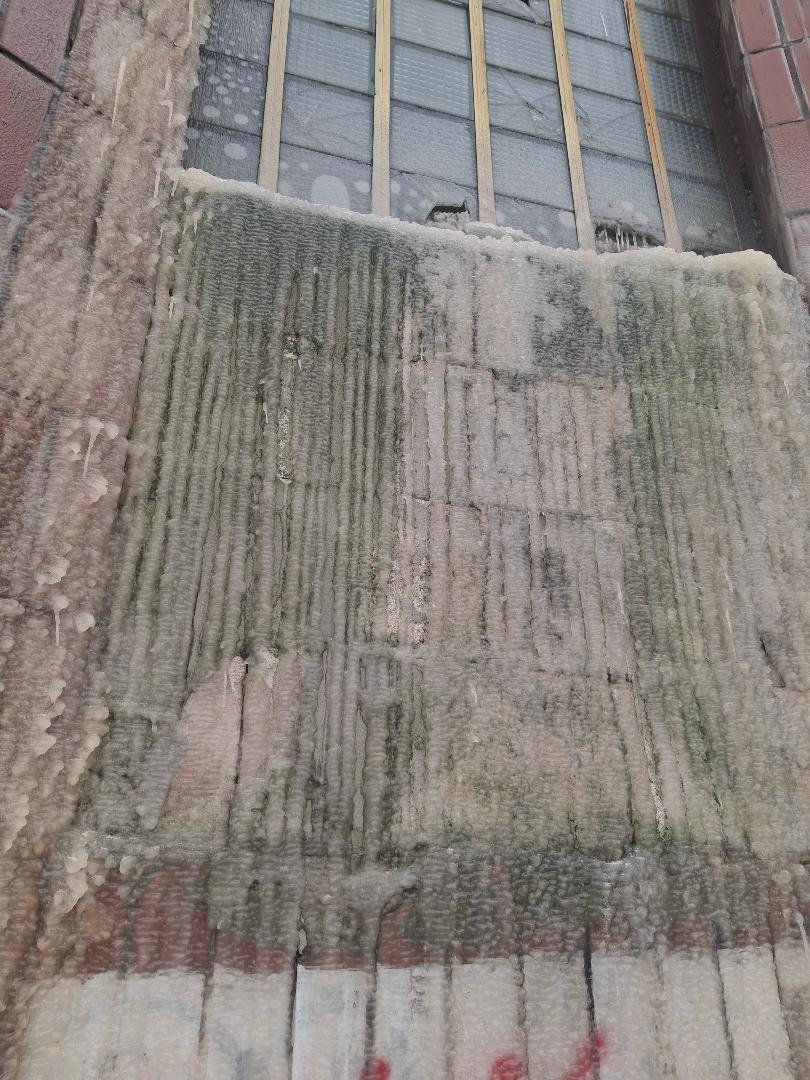
A grim tour of the building is given to me by 38-year-old Tetiana and 32-year-old Viacheslav. There is rime ice and ice on the walls, and the air is cold and damp here and there.
"We’re heading now to a technical room on the third floor where the guys from a team from Ukrzaliznytsia are working," Tetiana explains. "The building has huge problems with the sewage system; we’ve been thawing it out for three days straight. The problems keep coming because everything freezes along the way, and the sewage system gets clogged. But at least it isn’t leaking into apartments, because the other day we already had a shit flood."
And indeed, the closer we get to the third floor, the more a distinct, harsh stench hits you.
"The day before yesterday," Tetiana continues, "during the day, an apartment on the fifth floor was flooded first, because everything started overflowing. Then it ran down into an apartment on the fourth floor. The guys from the repair crew were already on site, but at that point, they were working with cold water, thawing out the pipes. Cold water started running through one of the risers; it also went into the sewage system. The pipes couldn’t take it, which led to this kind of collapse. The crew switched to thawing the sewage pipe, and all of us were running around, heating water and trying to flush it through the pipes. It didn’t help."
I listen to her and, in my mind, compare the situation here with what things are like in my own 16-storey building in Kyiv’s Darnytskyi district, in Pozniaky. We are, of course, in bad shape when it comes to electricity and hot water, and in some places, cold water disappears too, but the radiators are still warm, and there are no horrors like flooding and a burst sewage system. Not yet.
Here, people live between no heating and a wrecked sewage system. Every day is a fight against cold, dampness, and filth. After the first "shit flood," they use the toilets only from time to time (when circumstances allow).
But they didn’t give up; they organized themselves and got a gas heater from the public utilities office to warm up a technical room on the third floor. The three of us have just come there now. In the semi-darkness, we see three stern, somewhat worn-out men in Ukrzaliznytsia jackets. They are the ones helping to save the building.
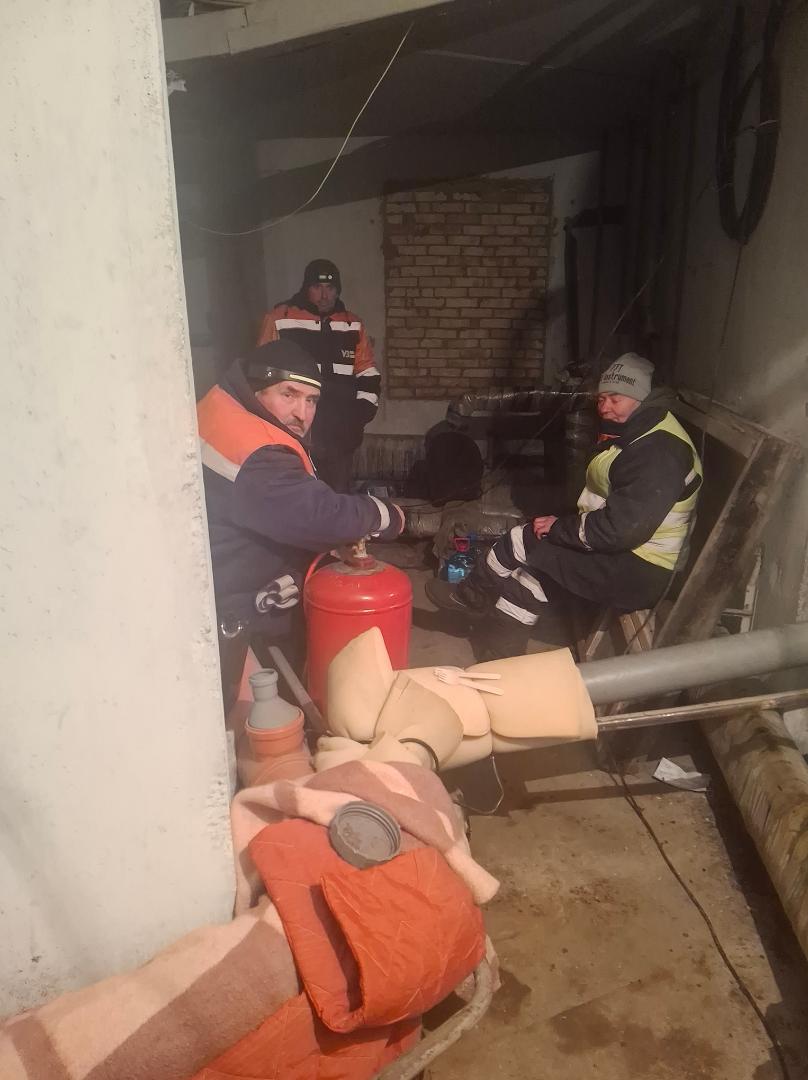
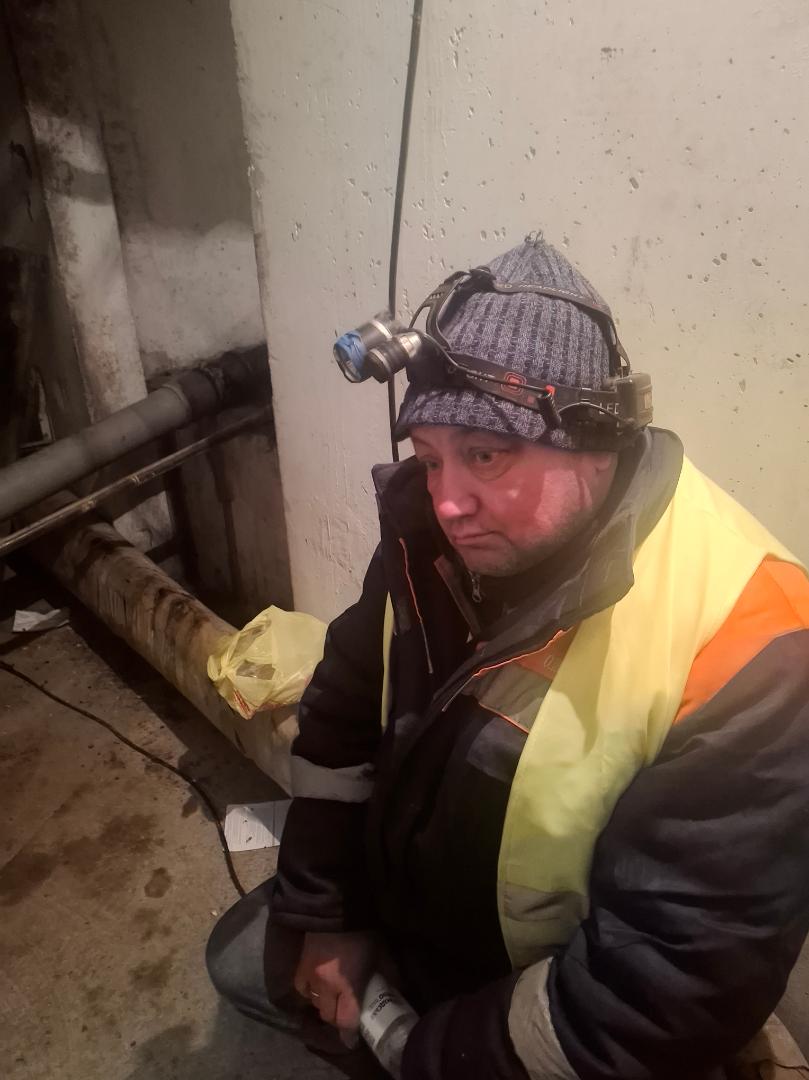
At first, they came to deal with the cold-water problems, but instead, they are helping keep the sewage network from collapsing. This crew includes people from Mykolaiv, Sumy, Chernivtsi, Poltava, and Kremenchuk.
My "guides" tell:
"The guys have been here the whole time, heating the pipes any way they could. But there’s a problem: when you heat metal pipes, they start expanding from the warmth, and the ice starts cracking. Our cold-water pipes are cracked everywhere! On the fourth floor, the taps have cracked, and the faucets are literally falling off. Because it’s ice — solid ice, icicles."
We meet the crew’s plumbers. One of them explains:
"See, the cast-iron pipes burst here. And it’s good they burst at the top, you can still patch them up somehow here, and they’ll keep working for a while. But if they had burst at the bottom, that would have been it…"
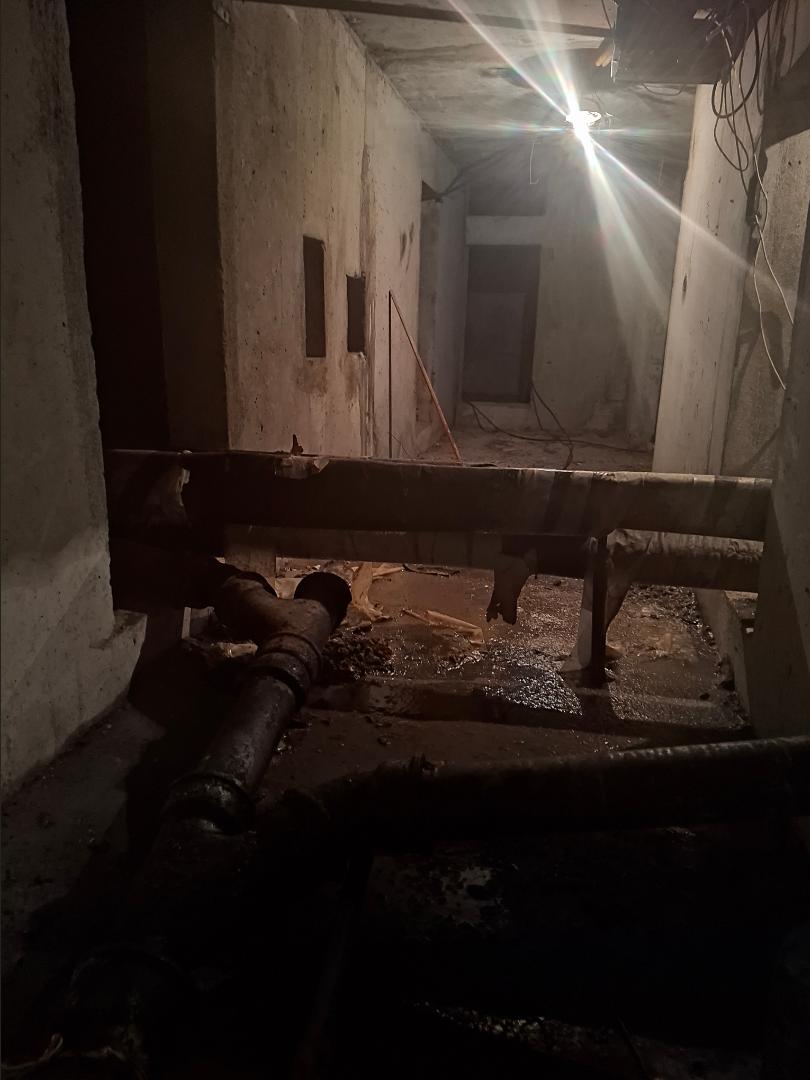
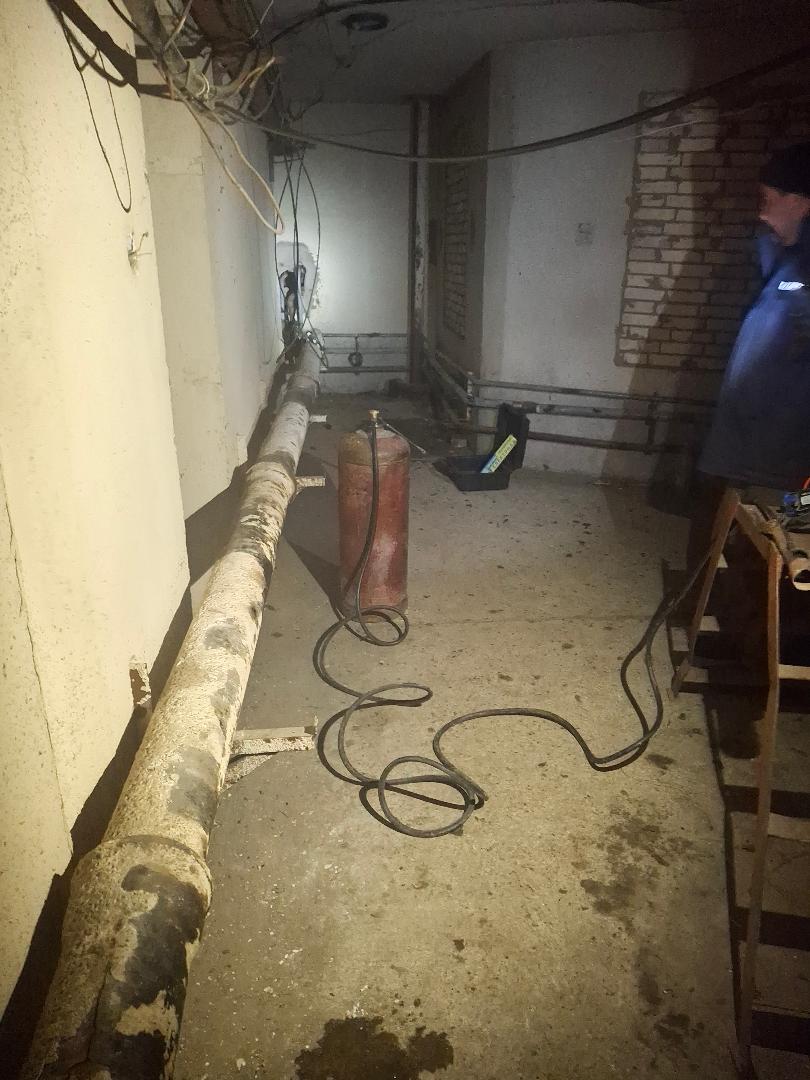
"What are we working with? First, a blowtorch, and second, a heat gun, it’s standing right over there. We’re warming things up. If we weren’t doing this, things would be bad. Very bad."
"The heat gun warms up the utility systems because they’re frozen," another member of the crew explains. "There’s no heating here. This space was designed on the assumption that it would be heated, and then everything would keep functioning. But now everything freezes here, so we have to warm it up artificially. If it weren’t for the heat gun, it would be colder here than outside."

"We came here on a duty trip from Mykolaiv," says plumber Serhii Hrishyn, speaking about himself and his colleagues. He then thanks the building’s residents for their support and… shares with Censor.NET a rationalization proposal on how, in a situation like this, it is possible to keep heat in the premises. What exactly does he mean? Please watch the video to the end.
Rationalization proposals are a good thing for the future, but what is life like for the building’s residents right now? Tetiana, a homemaker we already know, tells us.
"We live on the fifth floor. There’s been no water for four days already; it’s cold, and the temperature in the kitchen has reached +6. I live with a nine-year-old child and a dog. My husband is constantly away on business trips. How do we survive? When there’s electricity, we turn on the air conditioners and heaters (that’s when the outdoor temperature allows it, because air conditioners work down to minus 10). Electricity? Mostly it’s there; they switch it off for an hour or two. I suspect that since we’re an area classified as unsafe, we’re being supported. How else do we keep warm besides the heater? A few ‘layers’ on, bottles of water, a down duvet, warm pajamas. The child says, ‘Mom, when all this ends, we’ll be a cyber nation!’ But for now, the child is freezing, studying is hard, and it’s hard to keep the child occupied with anything, too. Because mostly you want it to be something active, something that involves moving around, but in these conditions it’s impossible."
- When Klytschko first advised those Kyiv residents who have such an option to leave the city temporarily, how did you take those words?
- Today, the situation is such that I really would like to leave. I took the child away because there are simply no living conditions. What hygiene or what sanitary living standards can we even talk about going forward…
- And what about you?
- Well, I can’t abandon the apartment; you can see the situation yourself. Yesterday, my neighbors had a burst on the fifth floor; today it could happen in my place. Right now, with my own efforts, with words, calls, and actions, I’m trying to help the building survive in such a difficult time.
We contacted the 112 service, and they responded a day later. Yesterday, we left a request there; today, we followed up to see how things were and reported the urgent situation. All of this was passed on to the Kyiv City State Administration (KCSA).
We also reached out to TV, but so far, you’re the only ones we’ve seen.
- I’ve heard that in this hardship, a public utilities office plumber has been a big help to the building’s residents?
- Yes, Ivan Ivanovych. He’s already well into his fifties. At the moment, he’s the only person who can help; he understands our structures. But he’s being pulled in all directions because he can’t help everyone, and there are problems in every building. Still, he can always advise, give some kind of task. The guys who came to help us, on the one hand, really want to help. But on the other, they don’t have the means, and they don’t understand what is fastened where and how it all connects. Ivan Ivanovych does what he can, but he’s not enough to go around.
Together with Tetiana and Viacheslav, we go to the fourth floor, where an apartment was flooded the other day. The owner rents it out, but for now, the apartment is empty. It, too, is suffering from cold and dampness

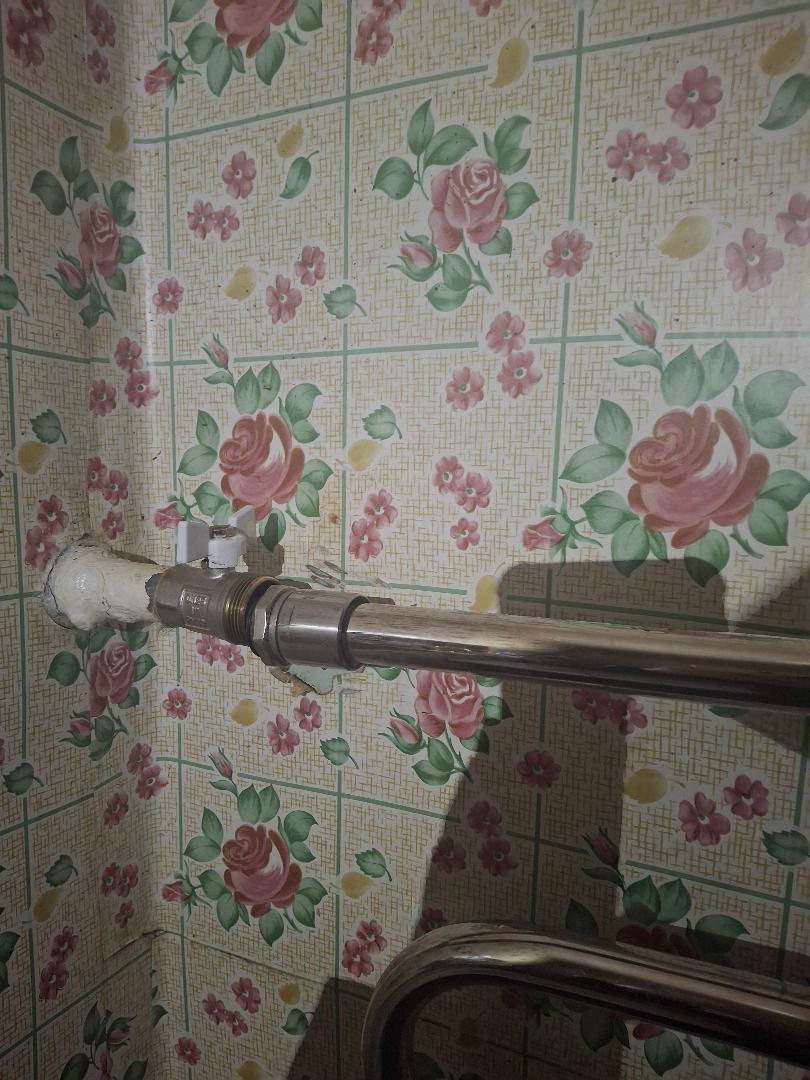


Overall, there are many problems at Akademika Zabolotnoho, 32. And every day, new ones appear. Or old ones resurface.
"A serious problem is the constant drafts in the building’s archways," Viacheslav says. "They freeze through, the floor slabs cool down, and the cast-iron radiators are right next to them."

You understand how hard things are for the building’s residents by reading their chat. It has every genre: slice-of-life sketches, online "meetings" to solve problems, technical mini-lectures, sharp quarrels among some residents à la Nechuy-Levytskyi, political takes, dark and not-so-dark humor. And hopes, hopes, hopes. Just about every day, there is some "rock-solid information" that today they will definitely restore the heating. Supposedly, an agreement has been reached, the authorities will take care of everything, promises have been made. But each time, something gets in the way.
Here are excerpts from the building chat, which isn’t even a chat anymore, but a true chronicle of people’s standoff against bad weather.
***
"We’re not losing hope!
The guys left us a heat gun. We can warm up the technical floor ourselves for further work on restoring the cold-water supply and keep it warm so the sewage doesn’t freeze!!! At least overnight.
But we need diesel, about 10 liters a day."
***
"I’m addressing the residents of our building. If we don’t buy an alternative power source soon, we’ll just keep going in circles from one attack to the next."
***
"Cast-iron ones are troublesome: by design, they can’t drain completely, and there’s always water left in little ‘pockets.’ If it freezes, then when it comes into contact with the coolant, it bursts exactly in that spot."
***
"We need to heat the lower floors, they’re the coldest. Higher up, it’s warmer. And in apartments where nobody lives, it’s freezing; those need heating too. And not everyone needs to heat, only those who are really freezing in the bathroom. If it’s +5 there, heating it is just money down the drain.
Given the overall unstable situation, we need to think through a permanent solution (until the building warms up) for the lower floors, the 14th floor and above, and vacant apartments. Best option: a heating cable + 10 mm of insulation on the pipe. It’s a universal solution, works for the sewage line too."
***
"And on Holosiivskyi Avenue, they needed paving tiles in December!!! Thieves."
***
"They installed portable toilets behind the public utilities office."

***
"Today I had the experience of sitting in an elevator. 😜 I drew a few conclusions: 1) When the power goes out, you need to check whether anyone is stuck. 2) You need to think of a place to sit. 3) Always have an extra source of light with you."
You read this chat and see exhausted, sometimes irritated people in extremely harsh circumstances. But you also see people who are resourceful, close-knit, and persistent.
You can’t help asking yourself: maybe the wrong places were called "Points of Invincibility"?
HLUSHKOVA, 29. "THIS BUILDING WAS PUT UP LIKE A METAL BOX. AND SO NOW THAT THE FROSTS HAVE SET IN…"
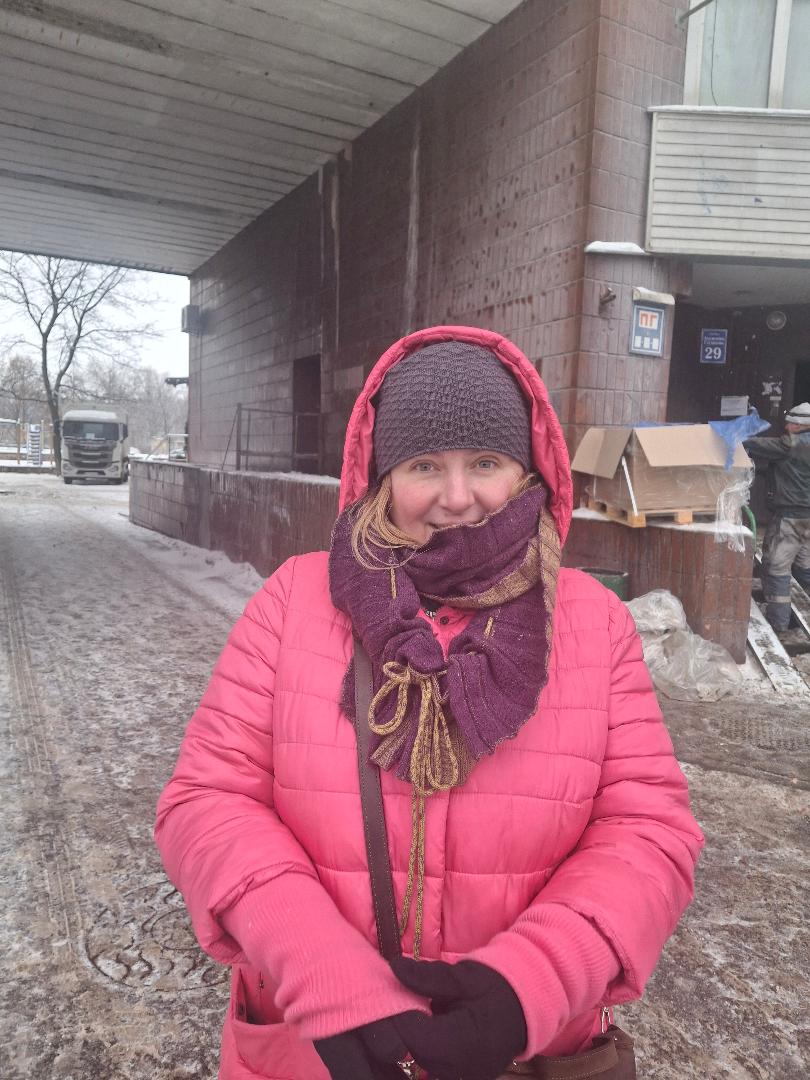
A 10-minute walk away, near the Teremky metro station, I enter a building at 29 Hlushkova Street. It has 11 residential floors and 55 apartments, and it was built in 1986. The project was designed for multi-room apartments for large families. Later, the children grew up and had children of their own; the parents grew older, and now they are all suffering together from Russian attacks and Ukrainian frosts. When the frosts hit, many residents left the building and took their children away. But quite a few stayed.
Residents here are dealing with utility-related problems in a scenario similar to what has happened at 32 Akademika Zabolotnoho.
Forty-two-year-old Iryna explains:
- Right after the shelling on January 8, we lost both heating and electricity (and electricity was also out in nearby buildings, every other one). On January 9, our initiative group went to our public utilities office No. 109. We filed a statement about our situation…
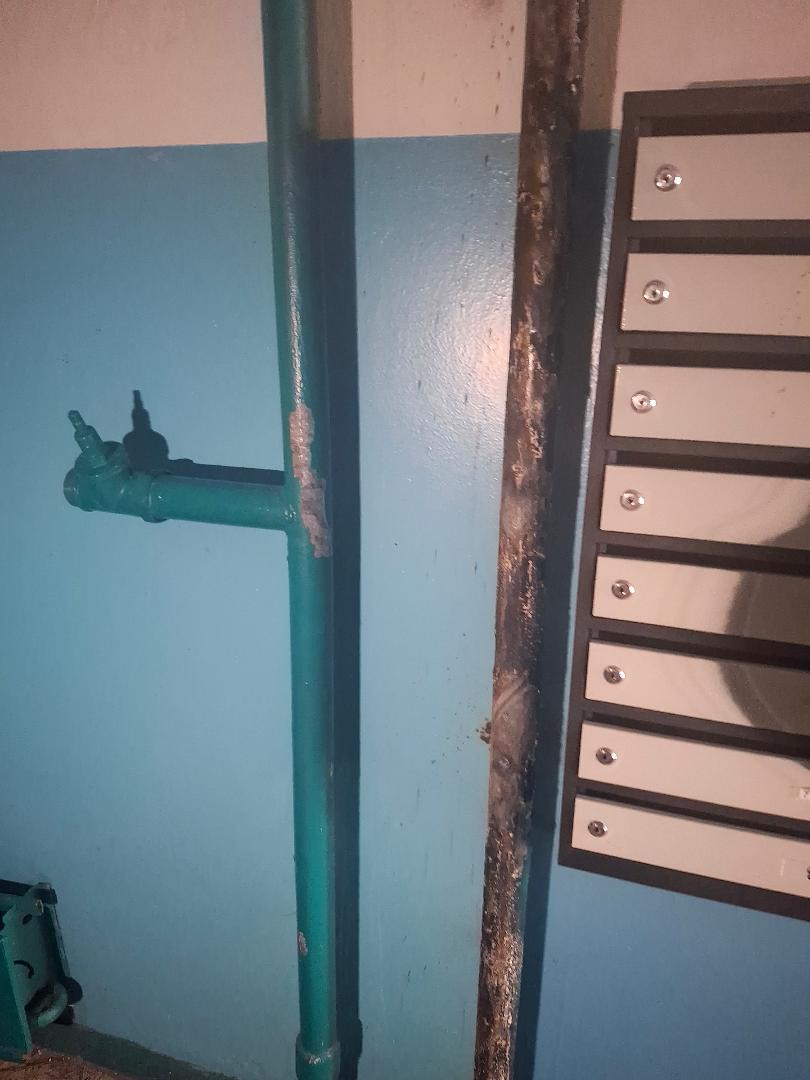
At that point, our main problem was the lack of electricity. It turned out that a circuit breaker in the heat distribution unit had been damaged. A DTEK crew came and said they couldn’t do anything; they would connect everything directly for us. We weren’t even dreaming about heating anymore; we just wanted the electricity back. But at that time, we still had water and sewage.
- Something in what you’re saying tells me that soon there was no water or sewage either...
- Exactly. The electricity came back, but then there was trouble with the water supply and sewage. We, the residents on the upper floors, can’t use the toilet, can’t wash dishes, and can’t wash ourselves. Because if we do, the residents downstairs will be flooded.
On January 19, a crew arrived at 29 Hlushkova Street — guys from Vinnytsia and Odesa regions. Just like at the building on Akademika Zabolotnoho, they were thawing the riser. But it turned out the building has a very complex layout of pipes. And the guys were not locals and couldn’t figure out what exactly needed to be warmed. All day, they were doing things by feel, but their efforts proved fruitless. It was a good thing that the next day, a local plumber came and gave the visiting colleagues some pointers.
"Right now, there’s a very unpleasant smell in the building," Iryna continues, "but the guys say this morning they’re expecting a gas heat gun from the public utilities office. They’re expecting it, but the public utilities office isn’t sending anything. And private crews won’t come to us. The residents of our building set up a ‘jar’ fundraiser; there’s already 23,000 hryvnias in it. We’re ready to buy and pay for everything. But beyond that, we don’t know what to do…"
42-year-old Mariia joins the conversation:
"On the top floor where I live, it’s cold," she says. "We turn on fan heaters, but yesterday it already smelled like something was burning, somewhere the wiring can’t handle it…"
"And you’re turning on fan heaters too?" Iryna protests, half-joking. "I’m trying to save, for crying out loud, and they’re turning on fan heaters!"
"Only in one room! Well, it’s six degrees for us… One heater and all of us are in one room: me, my husband, and two children. Now my mom has come too. And for cooking, we bought a gas stove. We also warm up bottles on it to put them in the bed. When the electricity comes back, we’re happy because we can buy a blowtorch. But there’s a problem: the voltage is very low, below 180. Appliances barely work. Thankfully, the refrigerator is holding up."
- "And how do you manage with no sewage?" I ask Mariia.
- We go either to the metro or to the Magelan shopping mall. Or at home, we use, so to speak, whatever makeshift means we have.
- You have my sympathy. How old are your children
Eleven and sixteen. Well, it’s fine — we heat one room and sleep there. Electricity is the only thing that saves us
Mariia and Iryna lead me to one of the technical floors, where the same kind of stern men in dirty uniforms are heating cast-iron sewer pipes like the ones at 32 Akademika Zabolotnoho. By all appearances, this is a different crew than the one that was here in the first days. The rescuers refuse to be photographed.
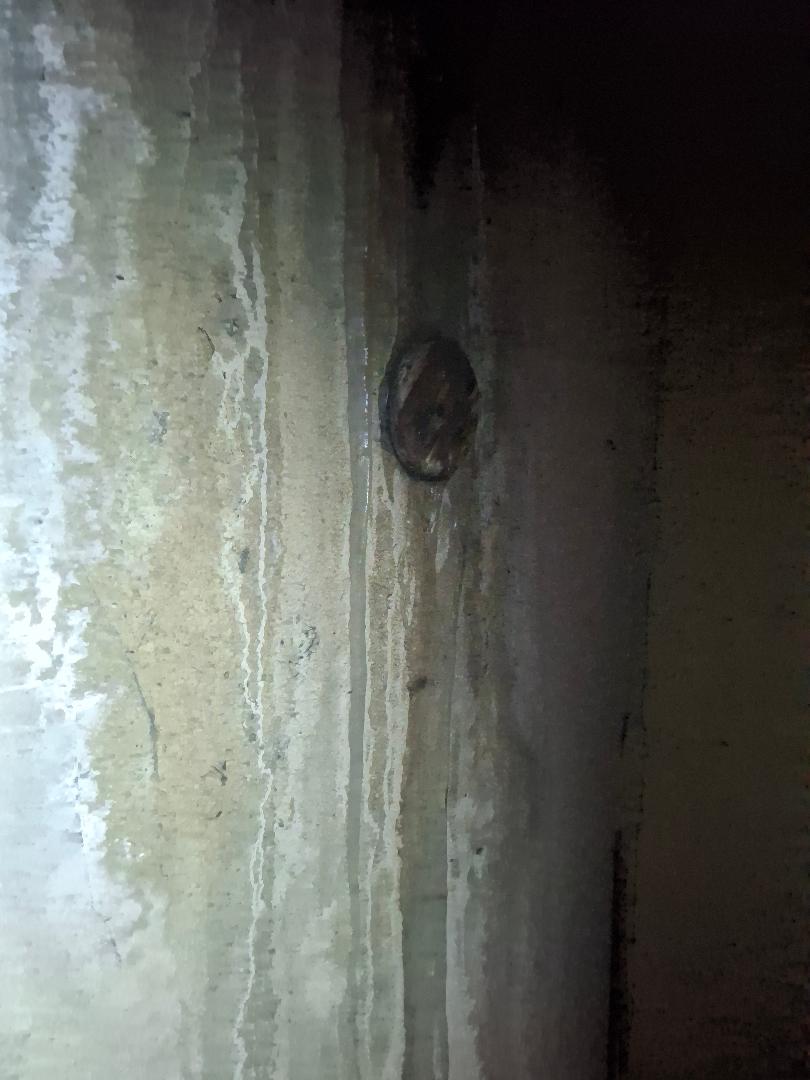
- "Over there, we removed two pipes," one of the men explains, "and they were completely frozen. And this cast iron, over the years, it gets clogged up, you see? It even burst here, and look, the water is just standing there."
- And where are you from?
- From Boryspil district. A municipal utility company called Horianyn sent us here, to the public utilities office. There must have been a request. We’ve been heating the pipes since early morning. There are other guys, too, but they’re dealing with the water.
- I was just at a building nearby — there, a gas heat gun more or less makes it possible to keep a similar situation under control…
- One heat gun won’t help here, you need at least three or four. Ideally, you need to replace this sewer main. But the temporary solution is exactly the heat guns. In a day, they’d warm everything up properly…
- What temperature are you working at here?
- Below zero, because if it were above zero, all of this would be thawing out.
- What is the situation in your Boryspil district?
- Better than here...
...…On the way out of the building, a Censor correspondent runs into a local resident, Ivan Petrovych. Learning that he is dealing with a journalist, he pointedly asks whether I have documents. Seeing the editorial ID, Ivan Petrovych, no longer a young man, a seasoned fellow with plenty of experience, gives the visiting journalist a short lecture:
I believe this story started long before the foundation of this building was even laid. Because it was designed with an elementary violation of insulation requirements. Specifically: the walls are thin, it’s dense concrete, its thermal conductivity, I think, is 0.53. And the thermal conductivity of cast iron is 0.39. So, in effect, it turns out that this building was built like a metal box. And that’s why, once the frosts set in, all the utility lines located on the first three (technical) floors froze! But under building requirements, you can’t run utilities through spaces that freeze.
- We’ve covered the construction mistakes. Tell me, what’s the temperature in your home now?
- My wife and I live on the first residential floor. Even though my apartment is insulated from the outside, you could say my balcony is a freezer, and my home is a refrigerator.
- I see you haven't lost your sense of humour. But what does that mean in practice?
- In practice, it means I walk around the house in a sheepskin coat and felt boots. In our home right now, it’s basically as cold as it is outside. On top of that, the sewage has frozen, and you have to scoop it out and pour it out. Because waste from the upper floors ends up coming down to us…
- Tell me, have you figured out for yourself why suffering buildings in Kyiv are being helped by crews from different cities across Ukraine?
- Because the local authorities (including local plumbers) simply failed to organize themselves to prevent these failures. Everyone knows it’s going to be cold, so if you can’t insulate it, drain the water! It takes five minutes to open the tap and drain the heating water. But here, they didn’t drain it…
…I walk toward the Teremky metro station in small half-steps so I don’t break my legs (arms, neck) on the sheet ice everywhere. It takes serious concentration. And I can’t get out of my head the words of Tetiana’s nine-year-old daughter from the building on Zabolotnoho Street:
"Mom, when all this ends, we’ll be a cyber nation!"
"We will be, my child," I think to myself. "We definitely will. If we live to see it."
INSTEAD OF AN EPILOGUE
As of today, 737 residential buildings in the capital are without heat. The vast majority of them are in Troieshchyna. Some are in several other districts, according to Kyiv Mayor Vitalii Klytschko.
Head of the Desnianskyi District State Administration (DSA) Maksym Bakhmatov told LB.ua that he is asking large shopping malls to set up warming points and is preparing to dig cesspits in the courtyards of high-rise buildings.
In Kyiv, meteorologists are warning of a prolonged spell of sharp cooling that will begin on Friday, January 30, and last for almost a week. In the capital, forecasters predict a gradual intensification of the frost, reaching peak values of up to -26°C at night.
Yevhen Kuzmenko, "Censor.NET"


