



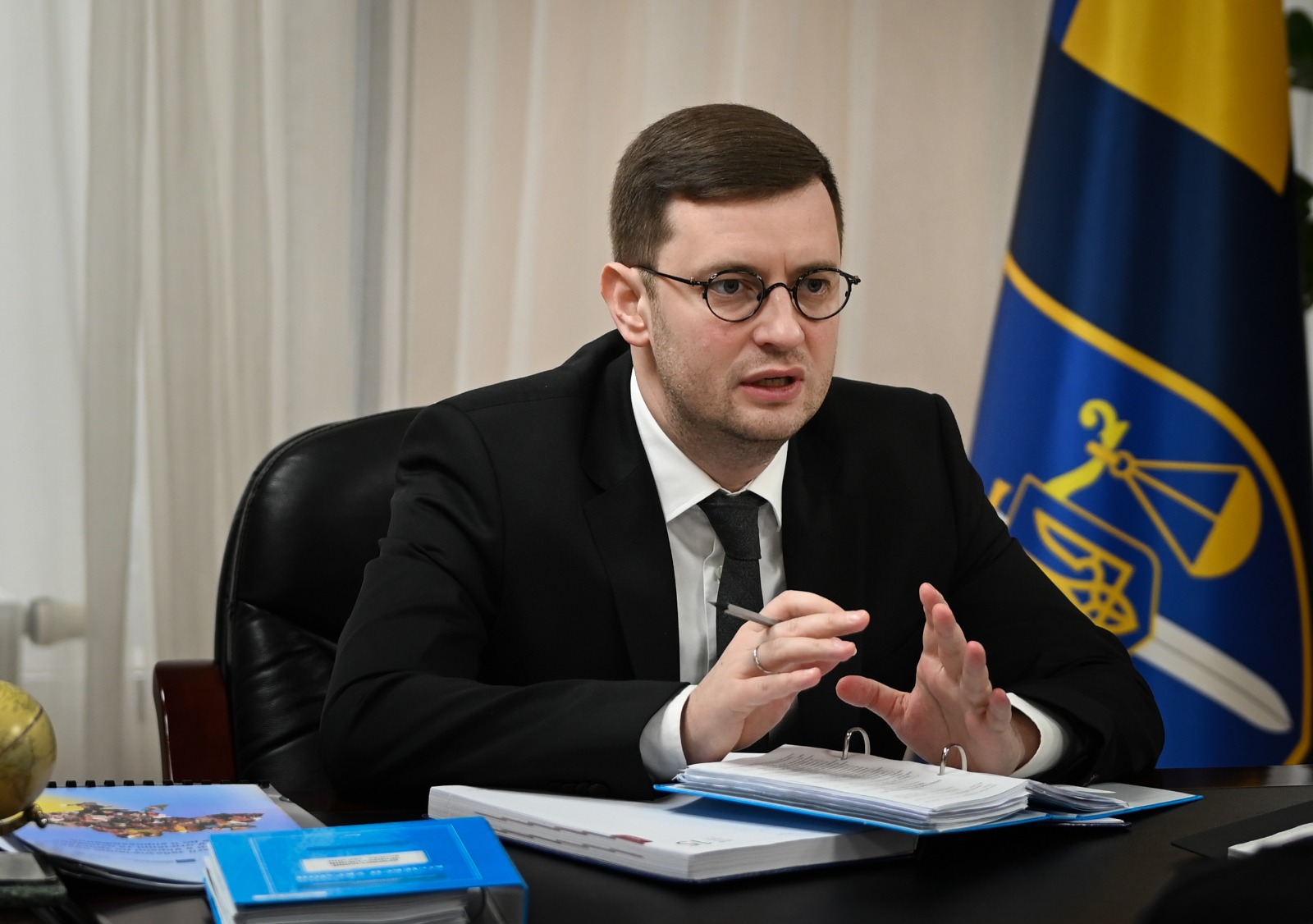
Deputy Prosecutor General Viktor Lohachov: "Those who rape children, as a rule, do not admit guilt and do not repent. Therefore, in order to protect children, changes in legislation are needed"
Large-scale inspections of orphanages and boarding schools are continuing, as are inspections initiated by the Prosecutor General and carried out by the relevant services to verify the authenticity of the diagnoses of children staying in such institutions.
The Prosecutor General announced a series of such measures in December last year after visiting the international crisis centre for mothers and children "City of Goodness", where children who had survived violence and been given fabricated diagnoses in the institutions where they had previously been held were taken. "Four healthy children who were deliberately given serious psychiatric diagnoses in order to receive additional payments. 20,000 hryvnia per month," he wrote on his Facebook page and cited several more examples of child abuse.
At the same time, he announced the appointment of a new deputy prosecutor general, Viktor Lohachov, who will deal exclusively with issues related to children. We spoke with Viktor Lohachov to find out what the interdepartmental groups had already discovered during their inspections and what consequences this would have for those working in such institutions.

"CASES WERE FOUND WHERE ADDITIONAL MEDICAL EXAMINATIONS OF CHILDREN WERE NECESSARY"
– The Prosecutor General announced the opening of 214 criminal proceedings based on the results of inspections of boarding schools, children's homes and family-based care facilities, covering more than 26,000 children. What systemic violations were found during these inspections?
– We have summarised the interim results, and the inspections are ongoing. Currently, they cover 13 palliative care facilities, 51 boarding schools, 21 children's homes, 42 social and psychological rehabilitation centres and 154 other facilities for children, as well as 722 children in family-based care. The results of these inspections revealed violations of sanitary and epidemiological legislation in the activities of institutions, violations of legislation in the field of fire and man-made safety, and instances of poor-quality repair and reconstruction work.
There were also cases where additional medical examinations of children in these institutions were necessary.
In addition, there were cases of foster parents not doing their job properly and restricting the kids' freedom. This included cruel treatment, food restrictions, and physical punishment. There were also cases of abuse of guardianship rights.
– Can you give some examples?
– For example, one of the family-type homes did not even have a daily supply of food, even though this is a mandatory requirement under the law. There was no proper bathroom, so it is unclear where the children bathe and what condition they are in. Some of the children are sick and have a fever. At the same time, there was no medicine either.
– How did children end up in such family-type homes? Didn't those who placed them there check all this?
– This is one of the main questions. Surely, when they were placed there, there were conditions. And then some factors influenced what we see now.
Perhaps alcohol played a role. During the inspection, some of the parents were found to be intoxicated. Therefore, during the inspections, decisions were made to take measures to remove children from such families.
– Why did the so-called parents take the children if they did not want to care for them?
– Most likely, it has to do with financial payments. Perhaps the amounts are small for each child, but when there are 4-5 children, the total amount is not so small.
– How prepared were state institutions and families entrusted with children for these inspections?
– If they had been prepared, I think we would not have had such terrible results and we would not have initiated the removal of so many children in just one month – more than 100 children – with our colleagues from the relevant services.
All inspections were conducted objectively. No one sought to achieve a certain indicator or discredit any institution or family. There are indeed good families where children are properly cared for, fed normally and treated when necessary. Similarly, there are many good boarding schools and children's homes. We are not saying that there are problems everywhere. But they do exist and must be addressed. That is why we continue to work.
– What did the inspection of boarding schools reveal? Can you give some examples?
– There were documented cases of child abuse. For example, during an inspection at one of the boarding schools in the Odesa region, a child was found to have signs of beatings on their body. It was clear that the child had been beaten systematically. A criminal case was opened, an examination was conducted, witnesses were questioned, and when it was established what had happened, the teacher at the social and psychological rehabilitation centre was notified of the suspicion. She was suspended from her position and dismissed.
– When Ombudsman Advisor Anton Hulidin published photos he took during an unscheduled inspection of the Mahalskyi boarding school a few years ago, many people were shocked. One of the photos showed a boy, one metre fifty tall, in a cot with a broken bottom.
He then made considerable efforts to ensure that the children had adequate living conditions in this institution. Is this attitude towards children with disabilities in state institutions widespread or is it an exception? What did you see in such institutions?
– In institutions where there are seriously ill children and children with disabilities, we initiated a medical commission to provide an expert opinion on their condition and whether they are receiving the medical care they need in a timely and comprehensive manner. We recorded instances when this care was not provided. For example, there were cases where children needed painkillers to ease their suffering but did not receive them. We initiated that these children be referred to children's hospitals, in particular to "Okhmatdyt", so that they could undergo a full examination and receive the necessary treatment.
Unfortunately, one of the boys could not be saved. He needed intestinal surgery, which did not cost much money. But all this was hushed up, and the child suffered. The children's facility let it get to the point where the boy died.
As far as I know, charitable organisations knew about this child and initiated his removal from the home, his transfer to "Okhmatdyt", and payment for the necessary surgery. But they were not given permission by the institution where the boy was staying.
Currently, the person who was involved in this and not only failed to take action but, in our opinion, prevented the child from being saved, has been notified of the suspicion. But a series of measures are still being carried out there, and there may be other suspects in time.
I spoke with the doctors. In their opinion, if the child had been operated on in time, he would have undergone rehabilitation and continued to live a full life.
– Why was this not allowed to happen?
– In our opinion, it is because the institution receives more money for a child who is bedridden and in constant pain. A comprehensive forensic medical examination has been ordered to answer the question: could the child really have lived a full life after this operation?
– Such children's institutions are closed, and it is unknown what happens to the children there in general. Is there an algorithm that determines how often the health of the children staying there should be monitored in order to prevent such cases?
– Child welfare and guardianship authorities and child services should check on them. But it is clear that this is not enough. Therefore, we have developed a number of proposals that could influence the situation. We propose that children who are in difficult life circumstances or in institutional care and education facilities, or who are in hospitals for long periods without parental supervision, should be subject to an independent medical examination at least once a year. Seriously ill children should be examined at least twice a year. There may also be unscheduled medical examinations at the initiative of the juvenile prosecutor. If the prosecutor learns from any charitable organisations, concerned individuals or the media that there is a child who needs inpatient treatment or surgery, he or she should immediately initiate the involvement of medical professionals to carry it out. However, it is essential that the medical professionals involved are independent. In other words, they may be specialists from the same "Okhmatdyt" hospital or regional hospital.
We propose to enshrine this in law. But, of course, it is up to the MPs to decide.
– What changes in legislation or procedures do you consider critically necessary to save children from tragedy, rather than reacting to something irreparable that has already happened?
– We have sent a number of proposals to the Verkhovna Rada Committee on Humanitarian and Information Policy regarding the development of a separate bill that would be in effect during martial law and for a certain period after the end of the war. We want to prove that these norms are necessary, that they will indeed be effective, and that they need to be implemented in the relevant legislative acts.
– What exactly are you proposing, apart from unscheduled medical examinations?
– The main goal is to introduce mechanisms for the rapid identification of children who find themselves in dangerous situations. Therefore, we propose to make it mandatory to inform the child welfare services and the prosecutor's office about cases of violence.
We are also initiating the introduction of video surveillance in children's institutions.
In addition, we consider it necessary to shorten and limit the duration of court proceedings involving minors, taking into account their interests. Unfortunately, we do not have judges who deal exclusively with such cases. All cases involving child victims or children who have committed crimes are heard in the general order. This can take years.
The National Police has juvenile police officers, and we have juvenile prosecutors. We would like the courts to also address this issue at their level when considering criminal proceedings.
Another proposal is to expand the rights of vulnerable categories of children in terms of education, medical care, social services and housing. If children are deprived of parental care, the state should give them privileges regarding admission to educational institutions that provide secondary vocational and higher education, and after graduation, help them find employment and provide them with housing benefits.
– Do seriously ill children currently receive a full basic school education? Do you pay attention to this during inspections? For example, in a comment to our publication, Marta Levchenko, founder of the "City of Goodness", which has a separate building for children with incurable diseases, emphasised that conditions must be created everywhere so that such children can study.
I have also been to the "City of Goodness" and seen how they work with children there. They even read books to children who, due to their illness, may not fully understand everything. This cannot be compared to what happens in other institutions. But children in other institutions should also receive an education. As for the quality of education, it is difficult to verify; you have to be there to see what is really happening. Because on paper, everything may look fine.

– Do the changes to the legislation initiated by the Prosecutor General's Office provide for the possibility for a juvenile prosecutor to visit any children's institution at any time to see for themselves what is happening there, and for no one to prepare for this visit in advance? That is, provided that there are no criminal proceedings. Currently, prosecutors do not have such opportunities, or am I mistaken?
- Why do we emphasise that changes in legislation that will provide more tools for protecting children are needed precisely during wartime? Because now there may be situations when a service cannot reach an institution or a family for objective reasons. That is why we are asking legislators to give the juvenile prosecutor the opportunity to do so if he or she has received some information or initiates such a visit. We also want the prosecutor to have access to CCTV footage if he has information that children are being bullied or beaten at the institution. You understand that video surveillance protects not only children but also adults. For example, a child may fall down the stairs and injure themselves, and someone may interpret this as if they were beaten or punished by one of the educators. But if there is video surveillance, the recordings can be reviewed and everything can be clarified.
In addition, our proposals provide that the prosecutor may initiate the removal of a child from a state institution or family if there are grounds for doing so, or transfer to another institution by filing a lawsuit in court.
– When announcing the inspections in December last year, Ruslan Kravchenko noted that the relevant services should also verify the authenticity of all children's diagnoses. Have there been any cases where children were given fictitious diagnoses?
– During these inspections, cases were identified where additional medical examinations of children in institutional care were necessary. These cases were found in the Zhytomyr, Poltava and Cherkasy regions. Therefore, I cannot comment on the results at this stage.
– Why did you focus on these cases in these regions?
– This was initiated by doctors, who said that they needed to check here. We, in turn, proposed that a register of children with chronic diseases be maintained on a permanent basis at Helsi. This would be where objective information about diagnoses made during inspections would be entered. If such a register is created, the rule on mandatory examinations of children once or twice a year by independent medical commissions will apply, and it will be clear who has undergone a check-up, who is undergoing one, and who needs one.
– How many heads of boarding schools, orphanages, and rehabilitation centres have already been removed from their posts thanks to the position of the prosecutor's office, and how many of them have been charged?
– Based on the results of the legal assessment of the actions of persons responsible for the lives and health of children, 48 officials have been served with notices of suspicion. Among the suspects are employees of child welfare services, social rehabilitation centres, educational institutions and healthcare facilities. Two managers were suspended during the pre-trial investigation at the initiative of the prosecutor.
"WE ARE SEEING A STEADY INCREASE IN CRIMES AGAINST THE SEXUAL FREEDOM AND SEXUAL INTEGRITY OF CHILDREN"
– "During a monitoring visit, employees of the Office of the Ombudsman of Ukraine, led by my representative in Zakarpattia Oblast, Andrii Kriuchkov, recorded evidence of alleged sexual abuse of children in a children's home. What should have been stopped immediately remained unaddressed by the management of the institution for years. The crimes were reported by teachers whom the children dared to confide in, and who provided materials and evidence," Dmytro Lubinets said on his Facebook page. Why were these facts not revealed during the inspections that were carried out in all regions on the orders of the Prosecutor General?
- It is strange that the ombudsman's publication came out after our publication that the director of this institution had been notified of suspicion under Article 137 of the Criminal Code and that the case had been sent to court. The suspicion was reported on 30 December last year, and on 16 January this year, the indictment was already sent to court.
The essence of this accusation is that the director of this orphanage, knowing that a 17-year-old boy was committing sexual acts against three minor children, actually covered up these acts.
The case against the boy himself was sent to court on 5 December.
– Did he rape these three children? How old were the children?
They were under 14 years old.
– When it becomes known that a child is being raped in a children's institution, is the child transferred to another institution, or what happens to the child while the investigation and court proceedings are ongoing?
– The child welfare service immediately removes the child or several children and places them in social, psychological and educational rehabilitation centres. During the pre-trial investigation, the investigating authorities and juvenile prosecutors have to work with such children. I think you know what a "green room" or "barnahus" is. It is important that a psychologist is always present with a child who is a victim of a crime or a witness. To assist the investigation.
– In the stories that were made public, the children did not die "instantly" but slowly, and adults were aware of their condition. For example, this was the case in Vinnytsia, where a 10-year-old boy died of starvation and neglect. How are you going to change attitudes towards children when everyone knew but no one did anything?
– In my opinion, attitudes towards children must change first and foremost in the minds of people who are directly involved in such situations. Let's take a look at the situation in Vinnytsia as an example. I think the family doctor saw what was happening to the child, and the services saw it too. And if they didn't see it, but reported that they did, and didn't visit the family's home, that's also a crime. They were negligent in their duties. Therefore, when such facts are revealed, it is necessary to provide a legal assessment not only of the actions of the parents, but also of everyone around them. And the doctor who noted that she had visited this child 11 times. Was it really impossible to see in 11 visits that there was no child there, that there was only a skeleton? Although in reality, as the investigation established, she was only there a few times.
There are just as many questions for the staff, who knew that this was a child with a disability, that he needed special care, that his mother also had a disability, even though she understood what she was doing. There was food in the house. But they fed the boy like this. They gave him something, he couldn't eat it, they took it away.
The investigation must also assess the actions of the educational institution's employees, who knew that the child had not been attending school for more than three months and did not respond appropriately.
In other words, only a proper legal assessment of the actions of all those involved in the crime and the publication of such facts can change the situation. So that those people who are currently involved with children can see this. And understand that the same thing could happen to them if they fail to perform their duties properly.
– Are you counting on them to start being afraid?
– It's not about fear. I want them to see what inaction leads to, what consequences it has for children. And if they read this interview, I want them to realise what a negligent attitude to their duties can lead to, rather than running around ringing alarm bells out of fear.
– So, not because of fear, but because of conscience? That would be good, but I don't really believe it. Because in such cases, in my opinion, everyone involved is already aware of the consequences of their actions.
Mr. Viktor, for the first time, the Office of the Prosecutor General has a deputy head who is responsible for issues related exclusively to children. Has the Prosecutor General set KPIs and deadlines for you? What specific steps have you set for yourself as a personal action plan?
- The first thing is to make children visible. So that society and, most importantly, all officials at various levels who deal with children can see them.
I am completely open to anyone who wants to communicate, and I personally check all the information I receive about children who need help. Because another task is to save these children with the tools we have now and to assess the actions or inaction of the people who put the child in difficult life circumstances. And to make sure that this works continuously and does not depend on the will of the Prosecutor General or mine.
It is important to enshrine this in law and in people's minds.
As for my KPI, I have it in my head. I have to assess my own effectiveness. I cannot tell you what the criteria or deadlines are. If what I do is not beneficial, it will be difficult for me to continue working. The Prosecutor General, in turn, will assess whether I have coped with the tasks he has set me and whether I have implemented my ideas and innovations.
– How have crimes committed against minors and by minors changed during the war?
– During 2025, the number of children who were victims of criminal offences committed against them increased by 15% (more than 7,000 children).
We are seeing a steady trend towards an increase in crimes against the sexual freedom and sexual integrity of children. In particular, in 2025, 27% more children were victims of criminal offences in this category.
The number of minors who committed criminal offences increased by 4%.
This increase was mainly due to minors who committed criminal offences against national security. It should be noted that children do not commit such crimes on their own initiative, but because they are recruited and exploited by Russian special services through deception, blackmail and promises of financial reward.
The highest number of such cases was recorded in the Dnipropetrovsk, Donetsk, Zaporizhzhia, Kyiv, Kirovohrad, Mykolaiv, Odesa, Kharkiv regions and the city of Kyiv.
– How has the war affected the number of cases of domestic violence affecting children?
– The number of children who have suffered from criminal offences related to domestic violence remains consistently high.
In 2025, 585 children were victims of such criminal offences.
At the same time, almost a third of these crimes were against the sexual freedom and integrity of children.
Last year, in criminal proceedings related to domestic violence, where the victims were adults, about 500 child witnesses were identified. Similar figures are recorded every year.
– Another initiative announced by the Office of the Prosecutor General is to increase penalties for the murder and rape of children. This involves the introduction of mandatory life imprisonment for particularly serious crimes against minors. Have MPs responded to this initiative?
– When I was head of the Chernivtsi Regional Prosecutor's Office, I participated in court proceedings in cases of child rape. A juvenile prosecutor also worked there as a procedural supervisor, who in 20 years of work had more than 20 people sentenced to life imprisonment for murder and rape of children. After talking to her and participating directly in court hearings, I saw that those who rape children, as a rule, do not admit guilt and do not repent. And I am 100% sure that when such a rapist is released in 7-10 years, he will continue to do so. Unfortunately, nothing can change these people. Therefore, in order to protect children, changes in legislation are needed.
As for the response to this initiative, the Prosecutor General has sent an appeal to the Committee on Law Enforcement, but no one has invited us to the discussion yet. If an invitation comes, I will have something to say based on practical cases.
– How can we reach out to MPs to draw their attention to this problem now? Children cannot be "ill-timed", as politicians often say nowadays.
– I would suggest that they attend court hearings on child rape cases together so that they can listen to what the victims have to say, understand how it happens, what the rapist does, how the child feels at that moment and how they live after the violence. They will be able to see with their own eyes how rapists behave in court hearings, how aggressive they are towards their victims.
Usually, children are questioned during the pre-trial investigation by an investigating judge on video, with the involvement of a psychologist. This is so as not to repeat it a second time and traumatise the child. But even through these video recordings, you can understand what the child had to go through. If this is not a convincing argument, then I don't know what else could convince them.
After we recorded this interview, the media published an investigation by the Anti-Corruption Centre "Mezha", which stated that the father of the Prosecutor General allegedly has Russian citizenship, which he obtained in 2023. It also mentioned several deputies of the Prosecutor General's Office whose relatives have Russian citizenship or businesses in the temporarily occupied territories and pay taxes to the budget of the aggressor state. Among them was Viktor Lohachov's father.
Ruslan Kravchenko publicly commented this information. The author of the text contacted Viktor Lohachov a second time to ask him additional questions about what had been reported in the media.
"I saw both the video and the article. I learned some very strange information about my father from them. – he said. - I was told that journalists check information before publishing anything. So let me explain how it really is.
Yes, we lived in Luhansk until 2014. My father was in business his whole life. And quite successfully. He had many companies and property in these companies.
In the summer of 2014, my wife, children, parents and I moved to Kyiv. Within a few months, some of the businesses were re-registered in Kyiv, and some in the liberated territories of the Luhansk region. These were Stanytsa Luhanska and Severodonetsk. They operated in territory controlled by Ukraine and paid taxes to our state budget.
But when full-scale war broke out and Russian troops occupied both Severodonetsk and Stanytsa Luhanska, these assets were also lost.
– The investigation mentions one of the companies, "Vodomyr "LLC. What is happening with it now?
– It was registered in Stanytsia Luhanska, which was not occupied until 2022. The village was captured in the first days of the full-scale invasion.
My mum and dad have never visited the temporarily occupied territory or the territory of the russian federation.
– In such cases, is it necessary to inform the state authorities that the business belonging to the person remained in the territory occupied by Russian troops?
– Back in 2014, we informed law enforcement agencies about the property of enterprises and vehicles belonging to these enterprises that were taken by militants during the capture of Luhansk. Criminal proceedings were initiated in this regard.
My father and I have a very good relationship; he lives in the neighbouring entrance. When he moved to Kyiv, he started actively maintaining his Facebook page. Over the years, he has accumulated more than 11,000 posts about how much he hates the occupiers and what they have done. With such posts, he would not only be unable to do business in the temporarily occupied territories, he would simply be killed there. I will give you a link to his page so you can see for yourself.
I am not familiar with the legislation of the russian federation, but I do not think it is possible to re-register a business and run it if you are not in the temporarily occupied territory of Ukraine or in russia itself.
I spoke with my father after the publication of the article you are asking about. He explains that he does not know what has happened to all the assets that remained in the territories occupied by russia. He says that he does not even have any acquaintances there whom he could call and ask.
Tetiana Bodnia, "Censor.NET"


