



Evhen Avdieienko: "I hold in contempt those who consider themselves not born for war"
Evhen Avdieienko, call sign "Avdiei," is an actor and serviceman whose life today is divided between the stage and the front lines. A volunteer, he understood long before the full-scale invasion that a major war was inevitable, as Russia would not stop. To be prepared, he underwent training with the Azov Regiment and became a reservist.
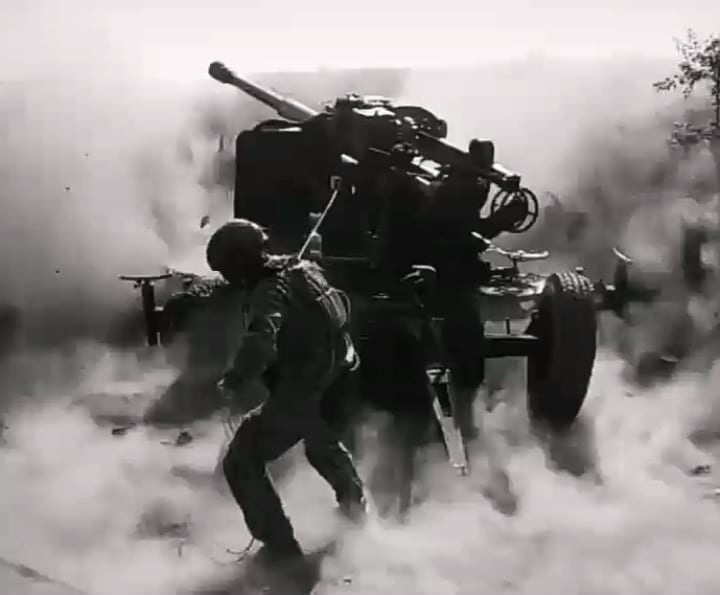
Therefore, the full-scale invasion did not come as a major surprise to him. Rather, it was the moment when assumptions turned into reality. On the morning of February 24, 2022, he said goodbye to his family and joined the Bratstvo volunteer battalion. Initially, he defended Kyiv, and then deployed to the Zaporizhzhia sector to serve as an artilleryman operating a 1947 D-44 gun. This was followed by heavy fighting for Bakhmut and Andriivka. Two years ago, he partially returned to the theater with a one-man show, "Not Born for War," in which Evhen reveals the truth of the war to the audience through his own memories and the stories of his brothers-in-arms. Its logical continuation was the tragicomedy "Everything Will Be Fine, But Not Immediately," performed in a duet with actress Anna Yanovitska, with a pre-premiere showing taking place in Kyiv on February 25. In March, it could be seen in various cities across Ukraine. All ticket sales proceeds are directed to the needs of the Third Army Corps, where Avdieienko serves as an ensign.
- How much of this play is about you?
- It is a composite story – both about me and about many other guys. I am a volunteer. A draft notice was brought to me when I had already been fighting for a year (he smiles – O.M.). In the spring of 2022, we were in the Azov Kyiv SOF, so we were registered in one part of Ukraine, but the draft notice came from the Kyiv-Sviatoshynskyi Territorial Centre of Recruitment and Social Support (TCR & SS) on May 1, 2023. I showed up, they apologized to me, but did not remove me from the military register at that time, so I only recently resolved this issue through Reserve+. I know this happened not only to me, where people had been fighting for a long time, but draft notices were sent to their homes.
So, in the play, I tell my stage partner, who plays my wife, that a draft notice has arrived.
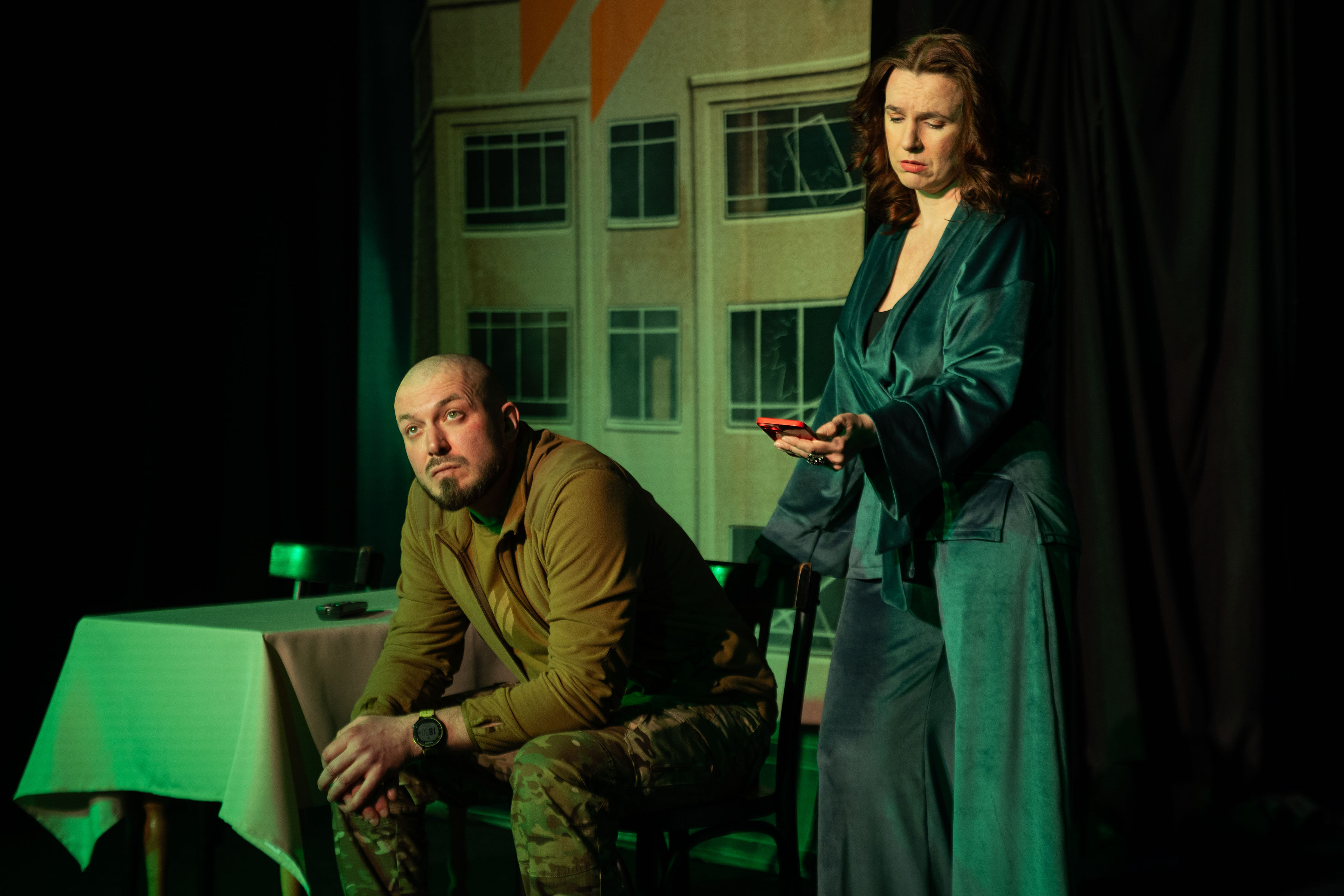
She asks if I will go. This is a reference to the guys who were not drafted into the army at the beginning of 2022 due to a lack of a military profession, age, or other reasons, but were later mobilized, and they came to us, among others – at that time, still the Third Assault Brigade. They did not run away, did not hide, did not sit under the sofa. Perhaps they went without the kind of motivation we had in the spring of 2022. Therefore, it was necessary to talk to them, explain, and instill this volunteer spirit in them. And I saw how they changed. Especially after the battles near Bakhmut. They became real warriors right before our eyes.
And the other play, "Not Born for War," starts specifically about me: how I packed, how I prepared, because I knew that a full-scale invasion would happen. So, on the morning of February 24, 2022, I say goodbye to my children and wife and go to get weapons. This is truly my story. And then it is about the guys. In "Everything Will Be Fine, But Not Immediately," there are also my memories of my childhood friend Evhen, who loved listening to Metallica. He died near Bakhmut. I changed my call sign. And in real life, it was not me who pulled him out of the car. Also, a brother-in-arms died in my car. So this episode is my internal dedication to both of them.
The guys told stories about hand-to-hand combat. At one of the rehearsals before the premiere, there was a guy in the audience who married an actress from the Chorny Kvadrat theater. He is an American and has three combat wounds. A tough fighter! So, he had a knife contact with the enemy during an assault: in order not to shoot, he took down the b@stard with a knife. Such hand-to-hand confrontations occur often. This is about heroic guys who see the enemy's eyes and destroy him literally with their own hands.
- With "Not Born for War," you took the stage for the first time since the beginning of the full-scale invasion. What was it like returning to this already different reality? Moreover, with a one-man show, being alone on stage for an hour and a half.
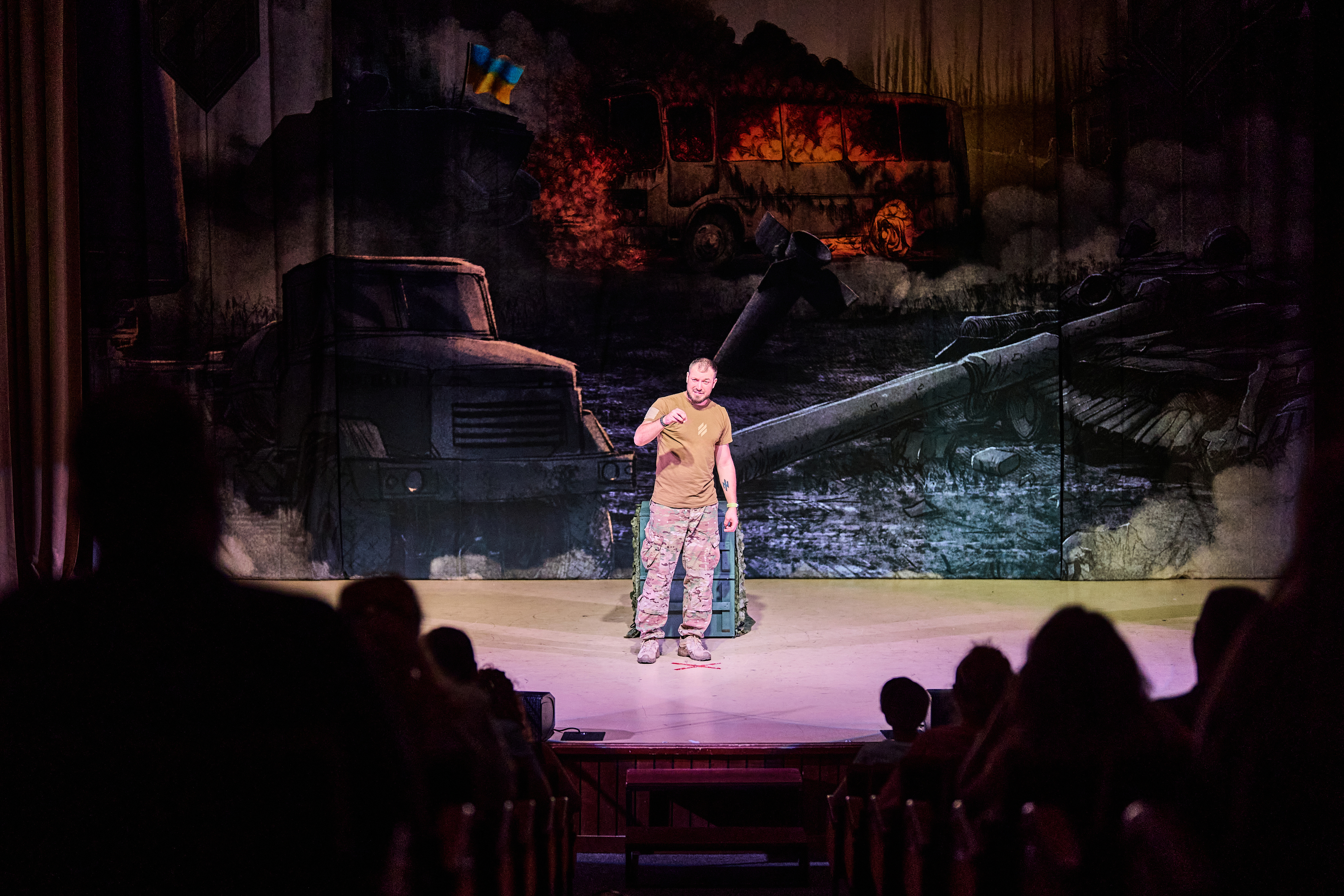
- Psychologically, it took me quite a long time to adjust, although time was short. Our media team informed me about the idea for the first play around late April or early May 2024. Then a vacation, meeting the director, and the start of rehearsals. We managed it in a month and a half, because a tour was scheduled for early August. So I did not really have time to slack off (he smiles. – O.M.). It was difficult for me to get into it, because I had played in an independent theater production on February 19, 2022, so two years of such solid downtime had accumulated. Moreover, in a one-man show, you really carry everything on stage by yourself. And at that time, I still did not know the director's approaches. Some things were strange and incomprehensible to me. His working principle differed from what I was used to in the theaters where I had worked before - the Lesia Ukrainka Theater, the Theater on Podil, or the Left Bank Theater. A slightly different principle, but quite interesting. It was a co-authored work – we even published a book based on this play authored by Nieiolov and Avdieienko. I brought some texts, the director brought most of them. I asked to send the stories of my fighters, acquaintances, and brothers and sisters in arms. We reached out to the media team and the ensign service. It was a very fast, but deep, serious, and hard work. Every story had to be organically connected to another. Moreover, it had to be interesting to the viewer. And the topic had to be such that people would buy tickets and go to watch, because all the funds go to our unit's fund.
The most important thing, it seems to us, is that it turned out to be a conversation with the rear, civilians who have been touched by the war. Spectators approached me and told me that they had fled the occupation; others have relatives fighting, in captivity, or killed in action. In my opinion, those who are not indifferent to what is happening in the country come to see us.
- And how do you feel about those who are indifferent? About those who consider themselves not born for war and, as you noted, are sitting under the sofa?
- Very negatively. It is contempt. A journalist in Dnipro once told me: "I have an acquaintance who constantly says, 'I will not go anywhere right now. Only when they enter the city, then I will.'" I replied that this is pure b@llshit! Such people will not defend, but will flee on the very first evacuation trains and buses.
Such behavior is completely incomprehensible to me. Is it scary? Yes, everyone is scared! Me too. That is completely normal. Moreover, if you absolutely cannot fight, then help. For example, my classmate delivers everything necessary by trucks to the combat zone. He is a civilian, but does such work. I have no questions for him. But when a person sits at home and does not even go to the store because they are afraid of the TCR & SS, how can one live like that?! Especially if they have children. Someday they will ask: "What did you do? Our friends' parents fought. Why didn't you?" There are those who will answer: "But I am in one piece – I have my legs and arms." These are not men, but individuals who have no dignity. Hiding from one's duty to protect the country, family, and nation is a very sad story. As I say: there were cases when people with minimal internal motivation joined our unit, but even after working with sergeants during Basic Combined Arms Training, they changed. What scares a person? The unknown. And when everything is explained and shown to you, the situation changes. Why do people join our Third Army Corps under the "18-24" contract? Because they have examples: an acquaintance joined, served, and told them about the approach to the soldier, how the non-commissioned officer tier is trained, what the ideological and worldview components are, as well as the traditions and rituals. Of course, there are units where this is simply ignored, where motivation is not "cultivated" in some recruits, and that is when AWOL occurs. But there are also other examples that people know about. Our Third Army Corps, under the command of Andrii Biletskyi, is an example of the new Ukrainian army.
- Moreover, nowadays, a person can often choose a profession for themselves under the condition of voluntary mobilization. You did not have such an opportunity, did you?
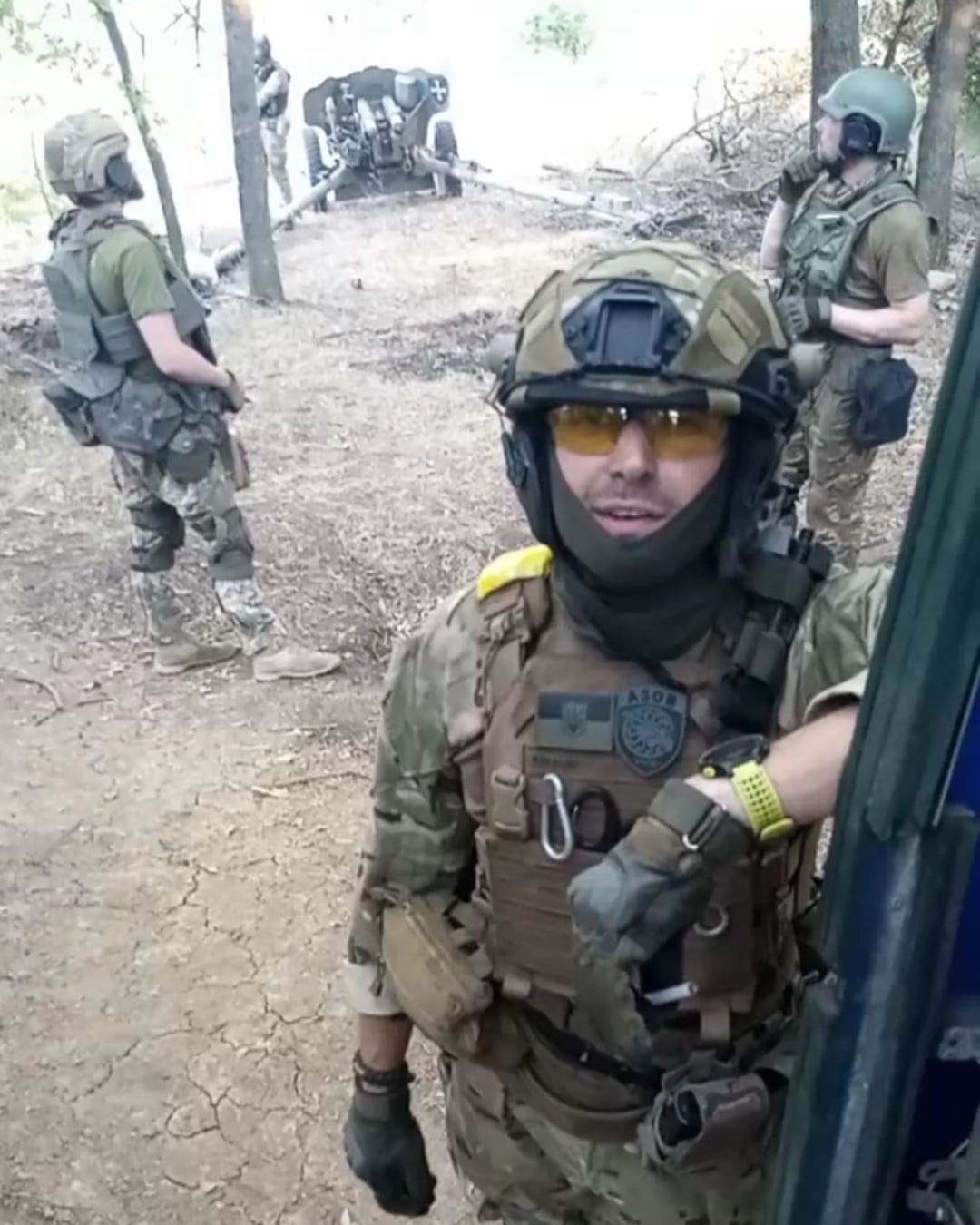
- Yes. It actually turned out quite interesting for me. On February 24, I was supposed to be in Mariupol, but I was still in Kyiv – I had a ticket for that evening. But the invasion started in the morning. They told me from Mariupol to sort things out here at the capital base. I arrived there, but the guys had relocated to another point because there was a threat of a missile strike. I could not get through to them at that moment, and we simply missed each other. So the adventures of looking for weapons in a volunteer battalion began, where I ultimately ended up staying as a rifleman for a month. We operated in the Boryspil district. Just so you understand, the guys were in sneakers. I had a "British" uniform, but neither a helmet nor proper body armor – only some very uncomfortable police one meant for small shrapnel. There were not enough magazine pouches. So my cartridges were rattling in my pockets like sunflower seeds. And now there is an opportunity to join excellent units – the Third Army Corps, Khartia, Rubizh, and others, where they will train and supply you, including with weapons. It is simply top-notch!
- And with modern ones at that. When you joined the artillery, you worked on a Soviet-style gun...
- But near Bakhmut, we took down a decent number of Wagner mercenaries with our old 1947 85mm gun. We fired it like a machine gun. According to the tactical and technical characteristics, it was simply impossible to fire such a number of shots, but we worked - the shells were being brought up. Our command managed to get them somewhere – both in Ukraine and abroad, including old ones from the 1960s. But they destroyed the enemy very well. The infantry constantly thanked us. And this means that we did our job well, because we protect them or help them advance.

Now, of course, there are more various means of destruction: you can be in EW, operating fixed-wing UAVs, FPVs, or bomber drones – the spectrum is wide. You will learn; you will have a profession. As I say in the play: everything eventually ends. The war will end, too, and you will be a specialist not only in your civilian profession but also in a military one. You have to take all the advantages, if you understand them.
- In the summer of 2022, I recorded an interview with artilleryman Volodymyr Duda, who worked on a Soviet BM-21 Grad. He described working with this system as follows: "Generally not bad: accurate, effective, and productive. However, it breaks down often. Sometimes the vehicle has to be repaired right at the firing position because the machines are old and fail." What difficulties did you have with your gun?
- We had similar issues. As I mentioned, according to the tactical and technical characteristics, you can fire no more than 40 rounds per day. We were firing that many in less than an hour. That meant over a hundred rounds per day for us. Yes, there were times when we didn't fire because reconnaissance drones were circling above, or we were searching for a target, etc. But there were times when we fired so much that the muzzle brake at the end of the barrel looked like a torch, the gun was so hot. Although it is a fairly simple mechanism, there are parts that wear down and need to be lubricated or cleaned. We had to do this on the battlefield or evacuate the gun when, for example, the sights needed replacing. It was only later in 2023 that we were given a 1990 152mm self-propelled gun. Quite a "new" one (he smiles. – O.M.).
Also, with the 1947 gun in Donbas, there was a funny moment when a shell got stuck – there was a misfire. The shell there is like a large cartridge: combined with the casing. So, the primer clicked, but there was no shot at the coordinates. Tried again – nothing. Again – same thing. We started extracting the shell with a special tool – we pried it, but only the casing came out. The shell wasn't armed. But we couldn't fire because there was a slug inside. We shook the gun and even came up with a contraption to knock that slug out – it didn't work. And we did everything very carefully – after all, it's a shell! And right at the position, too. Moreover, it was our last shell – after that, we were supposed to pack up and go for rearmament. Eventually, we called for engineers. We were told they were very busy and wouldn't come, so "resolve the issue yourselves." But you can't hitch a gun with a shell inside to a vehicle and roll it over potholes. We had to do something! We managed. Our commanders went and got another shell with a primer, unscrewed it, brought us this casing, and we joined it inside the gun. We just inserted it there, hoping it would connect, attached a rope to the firing lever, went into the trench, and fired at the coordinates where the b@stards were still supposed to be. To our surprise, it went off perfectly – everything flew exactly where it needed to, we packed up, and left.
- Did you hit the enemy?
- We didn't ask anything then (he smiles. – O.M.), as we had to pack up quickly. The main thing was that we took a shot toward the enemy. We had already been spotted by that time – the position was compromised, so we couldn't afford to linger. Grads had already started working on us. Therefore, we had to leave quickly. It's good that everything was done in a coordinated manner. We had a fairly professional crew. It's just that such situations had never happened before that case, so we had to think a bit about what to do. We even laughed more than we were nervous. You can't get anywhere without humor.
- Most often, servicemen who were also in Bakhmut describe that period like this: the Russians simply overwhelmed the city with "meat." You said that you took down many Wagner mercenaries there. Was that the most difficult period?
- We were constantly shelled. They were hitting us very hard back then. We experienced some rough moments because they were pounding us with 120mm and 152mm calibers. There were five-hour bombardments when you couldn't even poke your nose out because they were covering the area so densely.
Then, in the summer, there was Andriivka, the liberation of which was a very difficult story. It's a village near Bakhmut with just one street. It was a very challenging sector. Our brigade was conducting a local counteroffensive. We liberated dozens of square kilometers in our area of responsibility. We reached the Siverskyi Donets Canal, which was still under the b@stards' control in the winter. We liberated it and moved further. Beyond Andriivka was the Bakhmut-Donetsk highway and a railway line, so they clung to that village and didn't want to leave. They occupied all the basements. To give you an idea, several brigades were resisting us. That's when our guys captured a battalion commander (call sign "Shaitan" – O.M.), who had been abandoned there by his command. This episode, by the way, is featured in the film "2000 Meters to Andriivka." So that hellish summer was tough. Those were brutal battles.
- How does acting help in war?
- If I had the strength, I could tell the guys something funny. I also filmed videos for volunteers. Besides, acting helped me restrain my emotions. The acting profession is also about mastering your nervous system.
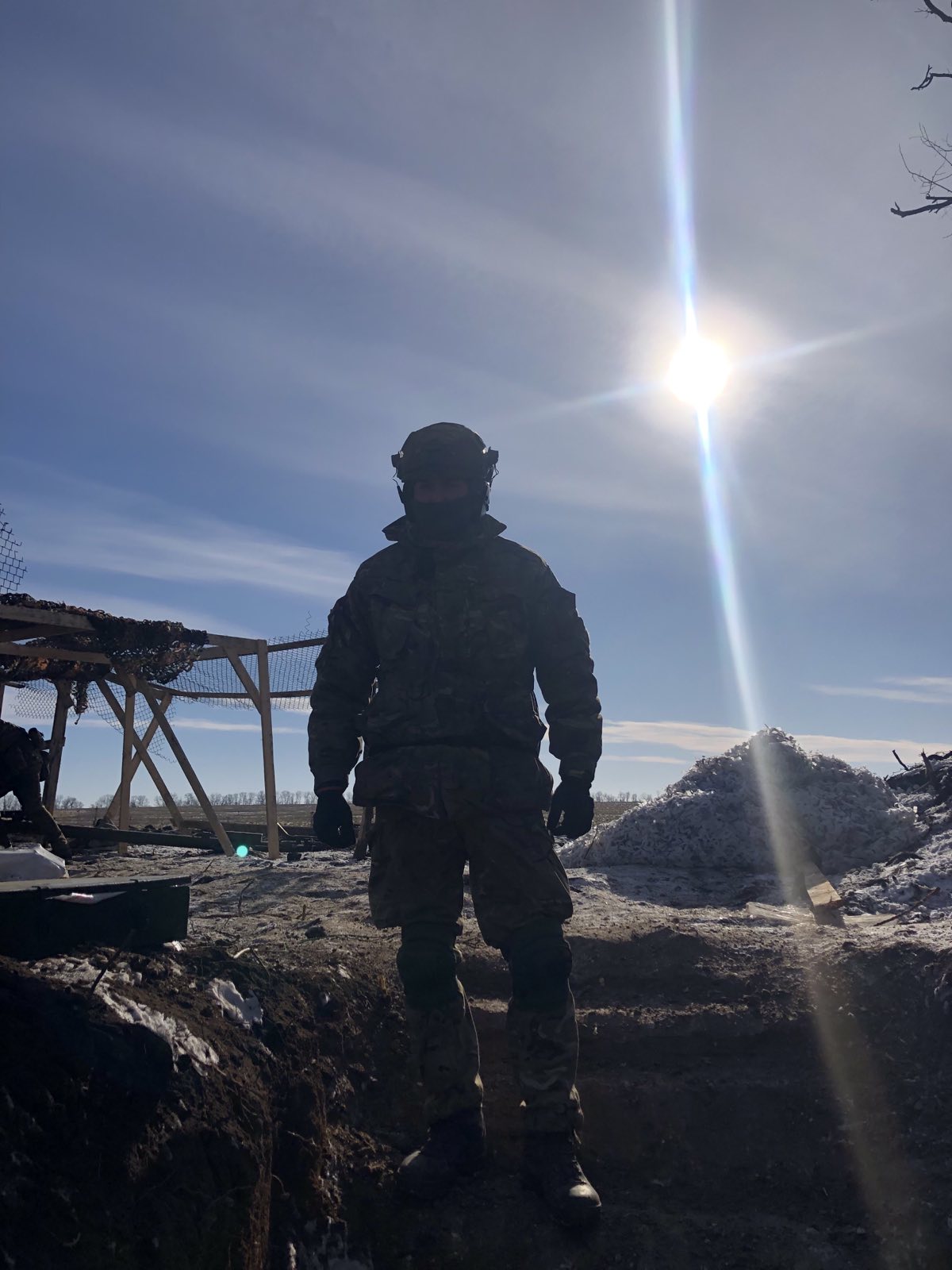
You know, in 2022-2023, sometimes in the dugout when the Starlink was working, I would message colleagues and watch news about what was being filmed in Kyiv and what premieres were happening. I followed it. That was about it.
- Speaking of colleagues: What do you say about civilian male actors who play military personnel? For example, last year there was a scandal when actor and serviceman Daniil Mireshkin criticized Taras Tsymbaliuk for playing an "Azovite" in the film "Liutyi Pryvit" (Furious Greeting - ed.).
- I understand Dania and his emotions. Another issue is that someone in the arts will indeed have to play the military. You cannot gather everyone who was an actor and joined the army. It won't work that way. Therefore, guys who did not fight and are not veterans will play [these roles]. Of course, I would like such roles to go to real servicemen. But, as I said, that won't happen. I would just like those who play them to at least have some awareness of the uniform they put on and think about what they say in interviews later, or conversely, why they stay silent when something needs to be said. Let them filter their babbling. Many of them say, "I volunteer, I donate," and then they appear with very controversial individuals of a pro-Russian "vatnik" nature, like Alkhim. You just have to watch yourself. If you are already playing a national hero, dude, have some awareness of your words and actions. When you say, for example, "Well, war is not for me," of course, colleagues who went to fight will treat you negatively. Unfortunately, we have such athletes, representatives of culture, and show business who sometimes spout such nonsense that it's mind-boggling. Yes, there are examples of guys and girls who stayed in the profession but helped the army to the maximum, even to the point of exhaustion and burnout. Some later ended up in the hospital. Just like those who were in the Territorial Defense Forces in the Kyiv region; they didn't go further, but in the beginning, they took up arms and were volunteers until May 2022. That is, there are worthy actors and actresses. However, there is also scum, including those who paid thousands of dollars to get the hell out of the country.
- People are different. In Ukraine, there are still "waiters" who are waiting for Russia to arrive...
- Unfortunately, there are quite a lot of them. Personally, I am originally from Sumy, so I know that closer to the border in the Sumy region, they have always been there. Already during the war, I encountered them in the Kharkiv, Zaporizhzhia, and Donbas regions. It would happen like this: decent, patriotic Ukrainians live there, and right next door is a neighbor who is absolute "vata," waiting for a master who will shoot him in the knee, and he will lick the boots in response. Katsaps and vatniks share a common trait: they need to be beaten a little, and they will be grateful for it and be such good servants. But when you are refined with them, it doesn't suit them. This tolerance – "let's be gentle" – doesn't work. We have OPZZh members like Boyko sitting "gently" in the Verkhovna Rada, who at the very least should have all been behind bars or buried by 2022.
- Shufrych is in jail.
- That is a very minor example that ends with talk of release on bail. Like, by the way, with Dubinskyi. But these are isolated cases. The main devils still walk into the Verkhovna Rada, and for some reason, among the people's deputies, there was no one (although there are brave people there who fought) who would simply physically drag those freaks out of the session hall by the scruff of their necks. And they are the ones who brought war to Ukraine, who openly worked for Russia, and still play along with it. A specific FSB agency sits in the UOC-MP, and various Bubkas are still in the Olympic Committee.
And how many citizens of Ukraine, supposedly, have been detained for adjusting strikes on Ukrainian cities! Yes, among them are drug addicts and alcoholics looking for three kopecks, and the Katsaps take advantage of this. But when teachers do it – that is, people with higher education – how is that even possible?! Such a powerful Soviet-Katsap "firmware" in the head.
- They share the same "values" with the Russians. I remember how, before the New Year, they opened the "restored" drama theater in Mariupol, which their army destroyed in 2022, killing hundreds of Ukrainians. What did you feel when you saw this news?
- In principle, nothing new is happening with these freaks. I am not surprised by their behavior. When I saw the news about this event, I remembered once again what happened there – that "Children" inscription, the bombed theater... How cynical these scumbags are about everything. First, they destroy, and then they open it with their "Russian," so-called pompousness. The Mariupol theater is their entire history: rape, kill, destroy, then put on a kokoshnik and say, "We are continuing KVN!". That is the face of the Katsaps. They needed a picture. Mariupol is our very beautiful city. I underwent training there at the Azov base in 2021, so I saw it with my own eyes. But the Katsap nature is so vile that they want to destroy everything like that.
- Do you think we will return Mariupol in the future?
- I believe so. We must do it. If you look at our history, events have often unfolded rapidly and even paradoxically. The collapse of the Soviet Union happened quite dynamically. For history, these are just moments. Therefore, everything can happen very quickly. I don't know when, but it is absolutely possible. Ultimately, we will return to the south of the Kherson region, to Mariupol, and to Crimea.
Olha Moskaliuk, "Censor.NET"
Photos provided by the press service of the Third Army Corps


