



Doctors for Heroes project founder Natalia Liutikova: There are many cases when guys say, "I carried my jaw in my hands and spat out all my 28 teeth"
In 2015, a Crimean native, together with like-minded individuals from the Kyiv Military Hospital, ensured that wounded service members with amputations began receiving prosthetics at state expense. Now she is doing the same for service members who sustained facial injuries, resulting in the loss of sight or jaws.

Ordinary Ukrainians continue to raise funds for these complex surgeries. However, since January, the Ministry of Veterans Affairs has been financing the costly rehabilitation of those who have lost their sight.
This is far from everything that Natalia does. A mother of three, she evacuated them from occupied Crimea in 2014 to prevent them from attending a Russian school. Over time, she assumed guardianship of three more children, a girl from Crimea and two teenage boys from the occupied Kherson region, whose parents agreed to let them move to Ukraine. In total, since 2018, she has helped fifty teenagers who identify as Ukrainian and speak the language enter the country; some of them wish to join the Ukrainian army and fight the occupiers. Natalia has joined forces with other volunteers and organizations to bring as many of our children as possible out of the occupied territories.
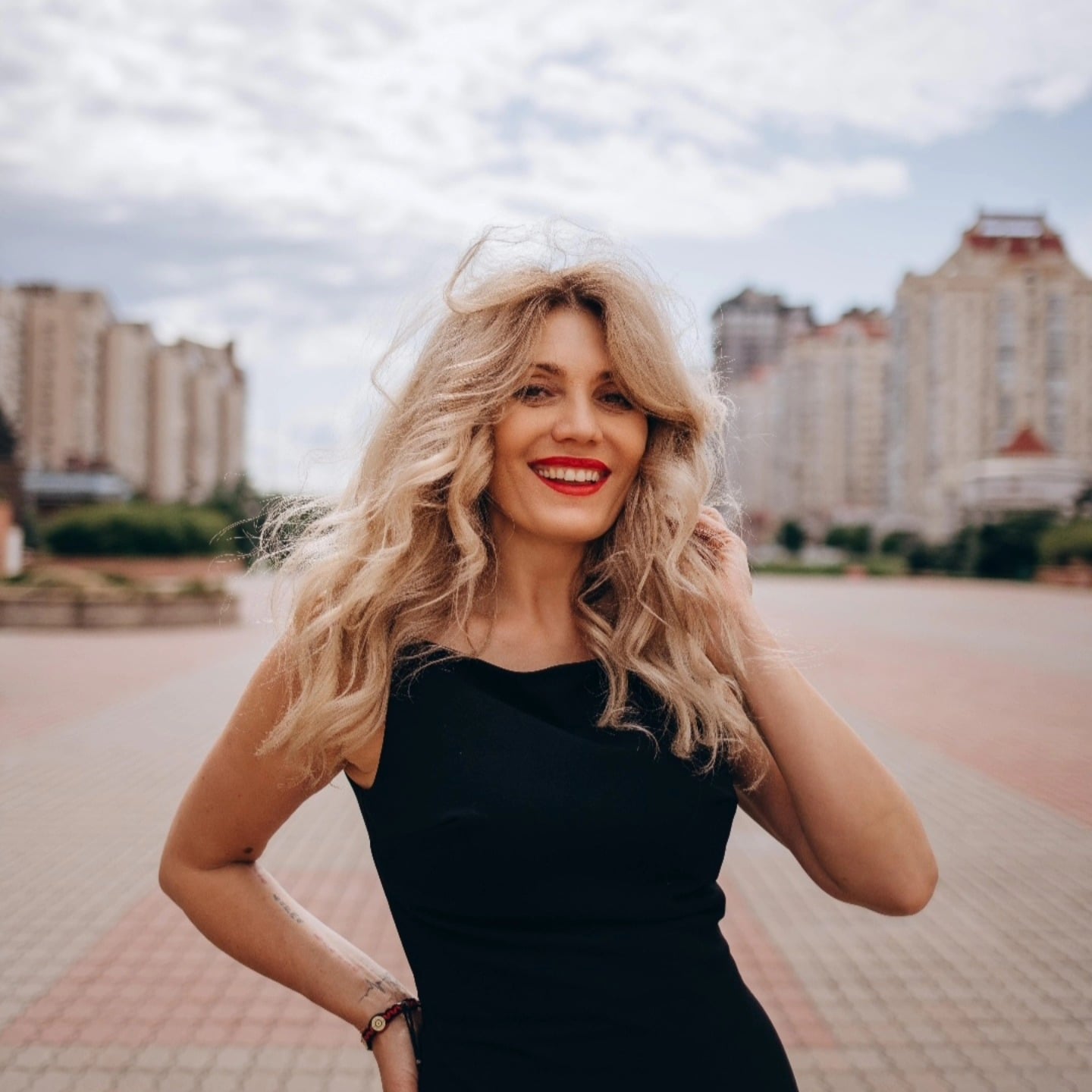
"I came into this world for a reason," says Natalia. "Probably not just to cook borscht and give birth to children, but to do a little more. These two projects, helping wounded military personnel and youth from the occupied territories, I consider to be my mission."
CRIMEA
"We left Crimea in the summer of 2014. We lived in the suburbs of Simferopol," recalls Natalia Liutikova. "When the shootings occurred on the Maidan, I realized what would happen next. That we would have to leave, even though my husband and I were born and raised in Crimea, and I gave birth to all three of our children on the peninsula... But then, in the winter of 2013-2014, some mystical events occurred. We had six dogs and two cats. While the Maidan was ongoing, they all died of various causes. We could never leave home for long before because the dogs were large yard dogs; you couldn't leave them. The last dog died on the day Nihoyan was killed. Then I thought that nothing was holding us in this house."
Of course, when the occupation itself was taking place, I experienced all those feelings: denial, the hope that we would be heard. I went to rallies with my children where there were many foreign journalists; it seemed the world would understand and help. But I quickly realized that everyone was indifferent. We waited for the children to finish school. And we thought about where to go: Odesa, Lviv, or Kyiv. Odesa is the sea. Lviv is very Ukrainian. Kyiv, I could find a job there, as it was unclear how we would live, whether we would save any property, or take any money with us. Our youngest child was one year old at the time.
- How many children do you have?
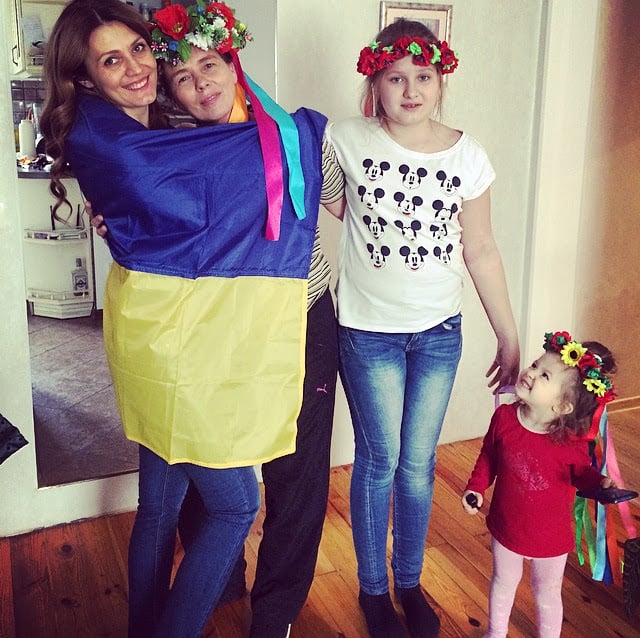
- At that time, there were three. Three more are children from the occupied territories; I am their guardian. They joined our family later, the first child in 2018. When we left Crimea, the older children were teenagers. In the end, we decided to go to Kyiv because our godparents live here; there was someone to consult with and someone to come to.
- What did you do for a living?
- At the time of the occupation, I had been working in a bank for twenty years, in fact, at the same one my entire life. I rose from the entry-level position to the head of retail at Ukrsotsbank for the entirety of Crimea. All Crimean branches reported to me. At the time of the occupation, I was on maternity leave. I managed the bank remotely. However, I didn’t plan to return to work at the bank. Everything in the banking system had become so clear and uninteresting to me that I was looking for something new. I wanted to teach because I enjoy communicating with young people; I am good at it and find it rewarding for my own development. I already had some experience, as I had been invited to guest-lecture at Simferopol universities. I had held negotiations and understood where I would be working. And then came the occupation.
My husband did not understand my conviction that we had to leave. I told him: 'If it weren’t for the children, we would have stayed and somehow helped the country from within the occupied territory. But I do not want my children to have a normalized experience of betrayal. They felt Ukrainian; they studied in a Ukrainian school. From September, they will be told they are Russians. I do not want them to have that experience. That would be normalizing betrayal. We would not be able to resist the propaganda. It would be risky. That is why we must leave.' Eventually, my husband agreed with me. My second motivation was the desire to help our own people.
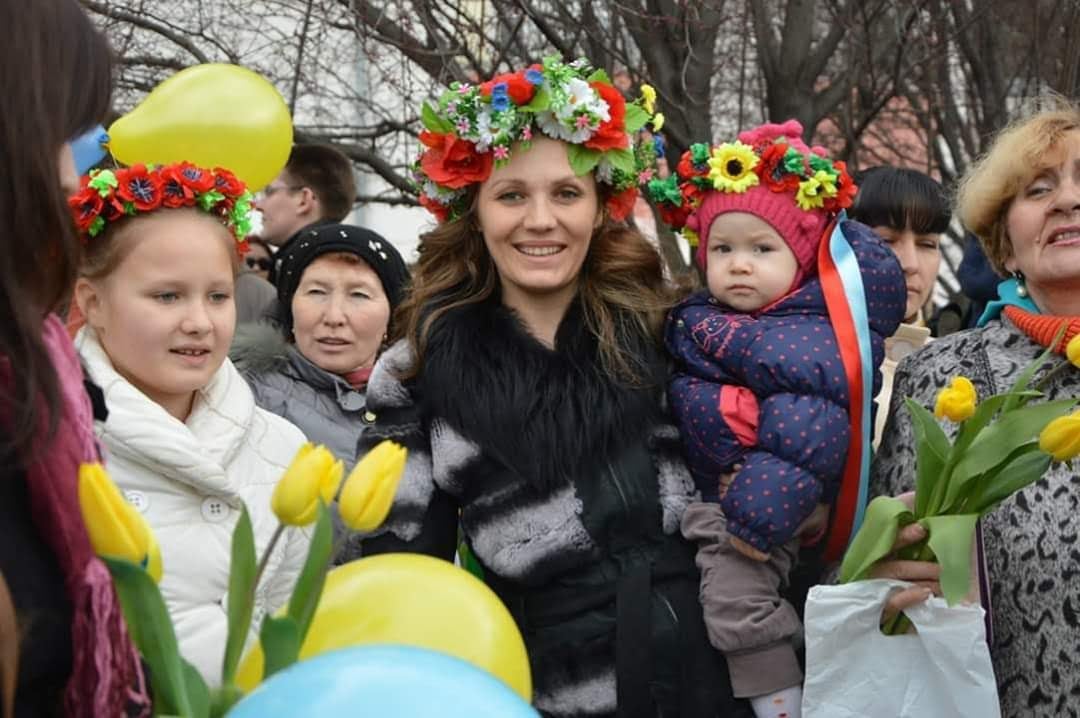
On March 1, when Russia’s Federation Council announced it was authorizing the deployment of troops to the peninsula, my father called me: 'Natasha, Natasha, such joy, Putin is sending in troops!' And I clearly remember saying: 'Dad, you must not have understood anything about me. I will stand with Ukraine. There will likely be a war, and I will either be in the trenches or passing ammunition into those trenches from the Ukrainian side.' He was so surprised!
- Did he stay in Crimea?
- Yes. My father and mother are divorced, but both remain in Crimea. It is a very sad story... My father is bedridden now; he has dementia. I realize that we will likely never see each other or hug again... It is emotionally difficult to come to terms with this. We wanted to move him out before the full-scale invasion when it was still possible. But he hesitated... And my mother does not want to leave.
MILITARY HOSPITAL
- We arrived in Kyiv. We spent the whole summer looking for housing. We managed to sell land in Crimea and bought a house in the suburbs of the capital. We were spared the harsh fate of displaced persons living in other people's homes. In September, I went to a military hospital. At first, I just asked what was needed. I would buy the necessities and bring them in. I brought my first donation of 10,000 hryvnias to Prytula at Novyi Kanal ('New Channel'), he was still working there and already collecting for the army. Later, I got to know the female volunteers at the hospital and got involved. 2014, 2015, and half of 2016 were spent in the purulent surgery department. We took on the most difficult cases, where the wounded person was an orphan or where doctors gave no chance of survival. During that period, it was crucial to arrange timely transfers abroad for those who were accepted. I researched how to do it and found the necessary contacts.
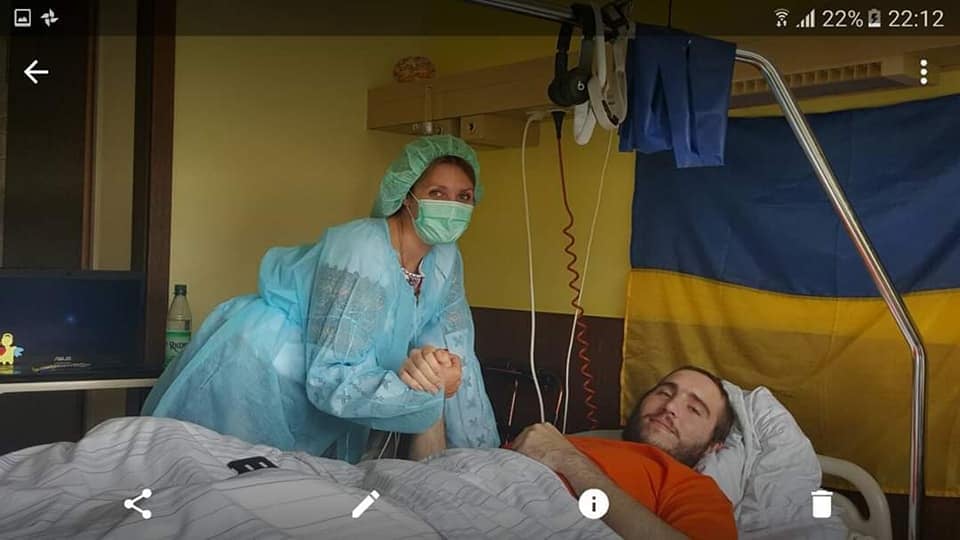
My most beautiful story is about Lonechka Khmilkov, a 'Cyborg.' He was wounded near Spartak, close to the Donetsk Airport, in January 2015. He is an orphan. I remember well how I entered his ward to introduce myself. I said: 'I thank you and God that you survived.' He was semi-conscious because he had sepsis, but he added: 'God and the bulletproof vest.' It was from him that I first heard the phrase, 'the Cyborgs held out, but the concrete did not.' Lonia needed to be sent to Germany. My friend found a clinic where a Ukrainian doctor from Crimea worked, who was ready to take on a severe patient. But money was needed, a large sum. And then there was the question of how to transport him. Then a plane arrived for our wounded. Lonia was scheduled to fly the next day. They were ready to transport him, but a 50,000-euro deposit had to be guaranteed to the clinic. I went home. I said nothing to my husband; I took 50,000 euros that had been set aside for a car, money we had brought from Crimea, tied it with a yellow-and-blue ribbon, and brought it to the hospital. I gave it to the girl who was handling the arrangements with the clinic. That is how Lonia got onto the Bundeswehr plane. And in Germany, they saved Lonia! He returned six months later. Later, we sent him to America. He underwent treatment there for a year and a half. They removed his femur and replaced it with an implant. Many people fought for him, spending over a million dollars on his recovery. When the full-scale war began, he went to train guys in his amalgamated territorial community, even though he had a disability and could not walk very well. Later, he moved to Sweden. He and his wife had no children for a long time. Six months ago, their daughter, Yarinka, was born. Now I receive wonderful video messages from a boy who was given no chance of survival, showing him with his daughter. This is a story about the victory of life, about the fact that it was all not in vain.
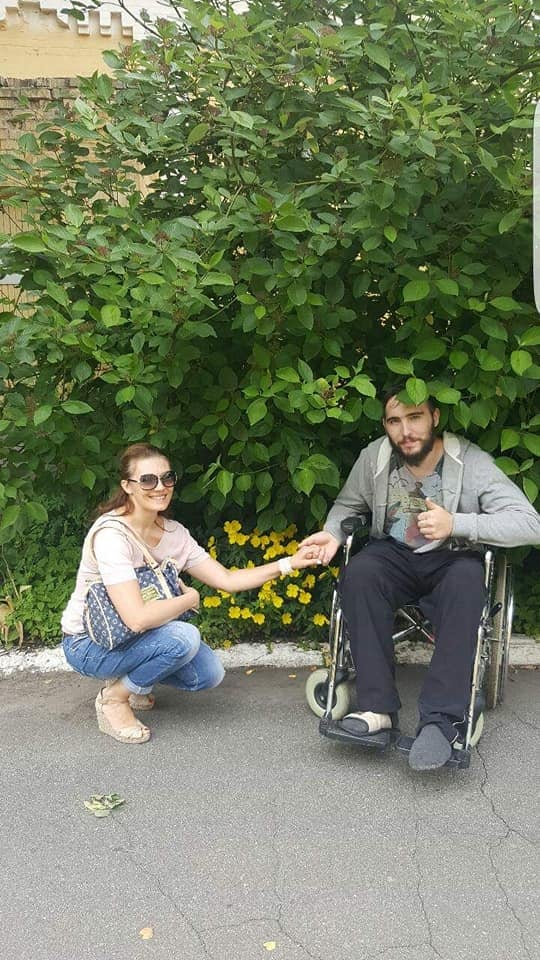
I told my husband about the money the next day. He replied, "Do you know why I love you? It's because you are the way you are."
Ira Liutik was one of the most difficult patients at that time. The woman had lost both legs, the amputation was very high. She didn't accept anyone. Oksanka Ostapenko and I were told: "Go to Liutik, maybe you'll succeed." I was still wondering: Ira's nickname is Liutik, and mine is Liutikova... And she accepted us. I brought her books. She let us bathe her, it was her first bath since her injury. I took her to get prosthetics, held her waist when she stood up on her prosthetics, but she still didn't want to walk... Eventually, she stopped communicating with us. She cut off all ties. It's a difficult story.
In 2016, when there was no longer such a need for volunteers and the state was getting back on its feet, the girls and I created a women's clothing brand. Ivanka has good taste and a talent for design. Olia is a wonderful communicator. And I helped with the business side of things. We created "Zelo. Dukhmiana Maisternia Odiahu," which still exists today. It's a small craft business, which is very difficult. But the girls are working. I've never had any income from it. When necessary, I support the girls. They have a wonderful space. We hold various events there. This story is beautiful because we wanted to do something Ukrainian for women, with European quality. And we did it!
FOSTER CHILDREN
- I was involved in active community work. I live in the village of Hora near Kyiv. It is the wealthiest rural community, yet it has no sidewalks, nothing beyond the main street. I joined the community when I saw what wonderful people were there. Also, there is a great Plast chapter founded by local residents Sasha Kulchytskyi and Ira Pustovit. Everyone believed then that things depended on us. Together with them, we united over a hundred people. We established an NGO and published a newspaper. I was a journalist and conducted anti-corruption investigations into everything related to our community’s budget. We truly believed we would manage to overcome the incumbent head. But we lost the election, the person we were fighting against won by a small margin. There were two reasons for this. First, manipulation. We have a Roma neighborhood in our village. The head simply 'bought' them, and forty people were registered in a single apartment. We documented all of this, but nothing worked. He brought in up to 700 people. This accounted for the same 10 percent that gave him the advantage. Second, public sector employees always vote for the pro-government candidate."
Decentralisation played a cruel joke on us. The village always had a budget of 2 or 3 million. What can you do with that money? Nothing. The old lady head, as the locals say, tried to do something, but there was not enough money for development. Then, on the Maidan wave, another person took office. Now taxes stay in the village, and the budget grows to 30 million. And the head starts doing window dressing, focusing on the facade. To this day, there is neither a sewage system nor a proper water supply. However, an incentive program was introduced material assistance to anyone and everyone, especially elderly people who are certain to show up for elections. He knew exactly how many people he needed for the next victory and worked on this every year, distributing 10,000 each. And people said: 'Well, he’s doing something; it was so bad under the old lady head, and now we have traffic lights.' At the same time, he did not want a new school. We fought for it. The sports grounds that appeared were built in spite of him. But we failed to win the election. Sasha is fighting now. He is doing very useful things, much more impactful than if he were the head.
But after those elections in our village, I experienced profound disappointment. It chilled my enthusiasm significantly. It’s not that I stopped believing in people, but a realization occurred: this situation will persist, all these feudal lords and corrupt officials, and it will take much more time to overcome all of this.
It was during this period that a girl appeared in our lives. She is the child of a distant relative of my husband. She was an only child. Through mutual acquaintances, we knew that things were not well there. My husband and I had a fixed idea about bringing children out of Crimea. It was obvious that the occupation was for the long haul. I didn't know that girl; she had only seen my husband once or twice. He simply proposed to her mother: 'Let us take your daughter so she can receive a proper education.' The mother agreed immediately. The girl was 14 then, in 2020. During that period, it was easier to cross the administrative boundary between Crimea and Ukraine. That is how the girl ended up with us.
Over time, I discovered that before starting school, the child had spent a lot of time with her grandmother in the Zhytomyr region, where she spoke Ukrainian. But she didn't remember this; she had forgotten it while living in Crimea. At the railway station in Kyiv, she heard Ukrainian and was surprised: 'I’ve heard this somewhere before.' Only later did she recall that it was from her childhood. This is a phenomenon I have observed many times with teenagers leaving Crimea. They easily forget what used to be.
The girl arrived with zero academic knowledge. When they sent us her report card, it was appalling. Here, she repeated the eighth grade. Quite by accident, I discovered what she was actually good at. There is a military unit near our village where a friend of mine served. He invited us and the children for a tour. When they were demonstrating how to assemble and disassemble assault rifles, our girl from Crimea asked: 'May I try?' In a matter of seconds, she did everything correctly. She explained: 'I was enrolled in the Yunarmia in Crimea.' Everything she was proficient at, everything she had been taught in Crimea, was assembling and disassembling a rifle! For me, this was yet another argument that our children must be rescued from there.
Here, she finished the 9th grade. It turned out she had creative abilities. At college, she specialized in graphic design. She is already completing her studies and doing an internship. She is twenty years old.
- What about your other two children?
- They are my relatives. They are the sons of my second cousin, whom I had only met twice in my life. They are from the left bank of the Kherson region, from the village where my mother was born. I was well-acquainted with their grandmother, who essentially raised them. She passed away in 2019. At the time of the full-scale invasion, the older boy was 14, and the younger was 11. The grandmother had taught the older boy to send me holiday greetings. When the full-scale invasion occurred, he began writing to me. I started asking how they were doing because they found themselves under occupation. They described how the Russians’ first order of business was hauling away grain. Their village specialized in pig farming, and the occupiers slaughtered thousands of heads at the pig processing plant... The children saw all of this; they knew. Then, communication with them was lost until May. In May, Illia wrote to me, there was Wi-Fi near the village council. He said there was no work, many people had left the village, and teachers refused to work in Russian schools. He said they were starving. They only had their mother and a bedridden grandfather. The mother had no job, so they went from house to house asking for food. Communication was lost again. The next time he called, he said they were being threatened with deportation to Russia. He pleaded: 'Please, take us.' Their mother agreed to this.
At that point, I already had experience collaborating with carriers who helped people evacuate from the occupied territories: from Nova Kakhovka, Berdiansk, and Kherson. We even evacuated one wounded soldier disguised as a civilian. But in this case, we were dealing with minors. Nevertheless, the carriers took it on. I drafted a sample statement for their mother to write out by hand, stating that she entrusted her children to me.
"Once we had arranged everything, the younger boy unexpectedly fell ill. He developed a severe fever and a cough. They were stuck in Simferopol for several days. We were incredibly nervous. When the fever broke, they continued their journey: through Voronezh, Moscow, and Latvia. Thank God, they passed through smoothly with their birth certificates and the note from their mother. We went to Poland to pick them up. When we were entering Ukraine, the Poles asked: 'Who are these children you are bringing? What documentation do you have for them?' I produced the paper from their mother. They found someone who understood Ukrainian, read it, consulted for a long time, and allowed them through. That was the nature of the times, the summer of '22. Great guys! They were such frightened little sparrows. Но we began looking after them.
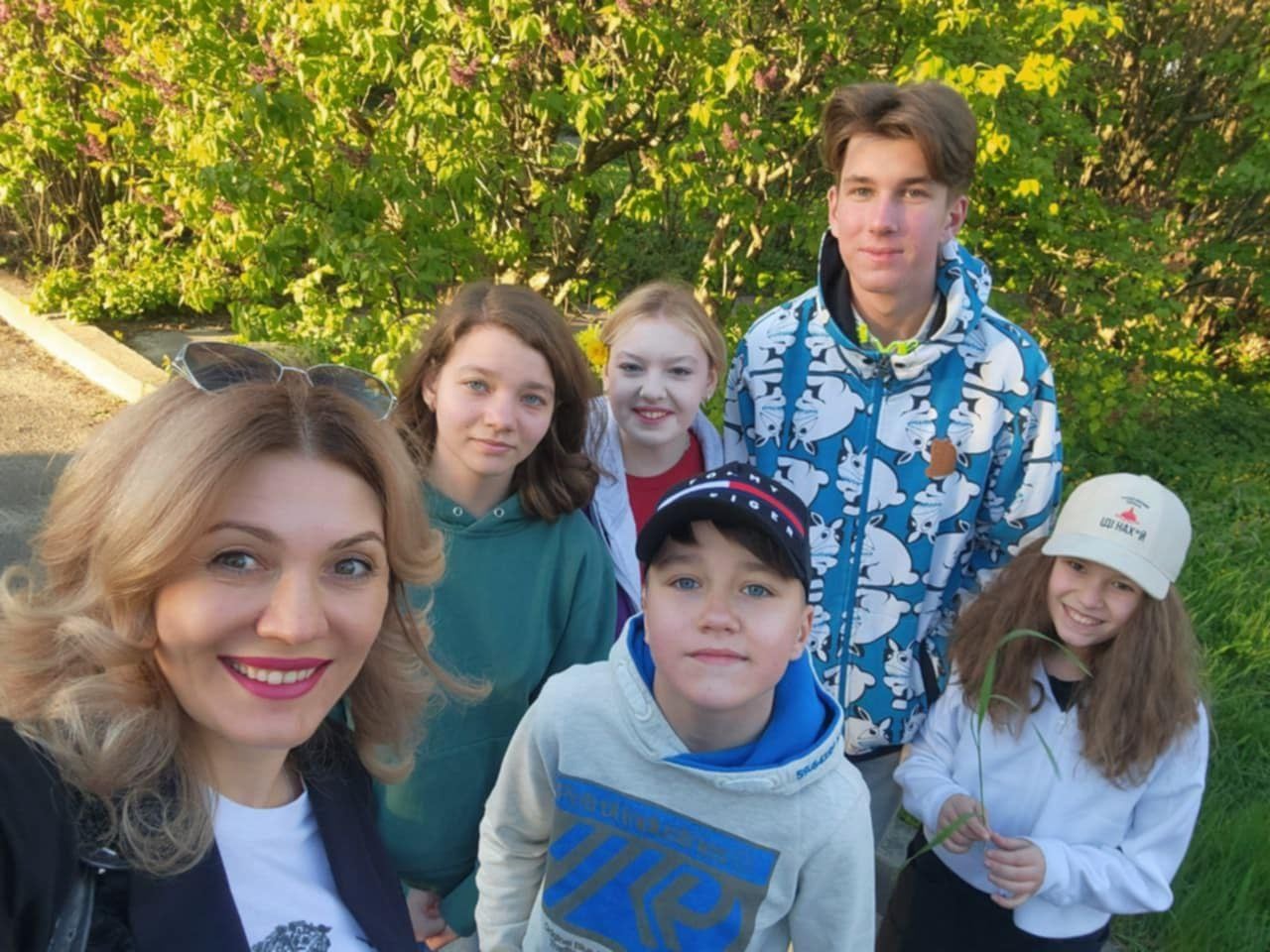
Natalia with her two biological daughters and three foster children
We visited every stable around Kyiv with Illia, the older boy. He asked to volunteer, to care for the horses, and be near them. He wanted to pursue show jumping, but it is very expensive. So he said: "I am ready to do whatever is needed as long as I am allowed to ride from time to time." Two stables accepted him. Illiukha was a very diligent student. He decided he wanted to be a large animal veterinarian and was admitted to the Agricultural Academy on a state-funded basis. He also took up folk dancing.
The younger one is in school. I saw immediately that he was different, but I didn't understand what was wrong with him. A year ago, a blogger I know mentioned he had ADHD (Attention Deficit Hyperactivity Disorder - ed.).
And I realized the younger boy has all the symptoms. He cannot remember actions more than one step ahead. This creates serious challenges with his studies. At the same time, he is very sweet and sociable. But he immediately forgets everything we tell him. It turns out this is a diagnosis. We underwent a serious evaluation. One must learn to live with this. It requires constant psychotherapy and medication. He needs a separate desk, a schedule, and a planner where he can check off completed tasks. His entire life must be structured. I have to supervise all of this. But my eldest daughter helps me a great deal with it. She is studying to be a psychologist and started working last year at the school where she used to study and where my other children are currently enrolled.
- Did your biological children ever feel jealous of the foster children?
- They never showed it in any way. They communicate with them as a family. The older children have never reproached us for our decision to take the children into our family. And I am grateful to them for that.
FULL-SCALE OFFENSIVE
- Were you prepared for the war to reach Kyiv?
- When we bought our house, it belonged to a retired military officer who had served in the 90s," Natalia replies. "He sold the house in a panic and went abroad because, back in 2014, he was already convinced the Russians would reach Kyiv. It surprised me then. When I was in school, Ukrainian history wasn't taught properly. Yet, I have this love for Ukraine, I don't know where it comes from. Well, my grandparents were from the Kherson region and always spoke Ukrainian. They had a photo album of Kyiv on their stove; I had never been there, but I thought it was hauntingly beautiful. But is that enough? All the young people leaving Crimea now speak Ukrainian with me. I ask them: 'Where did you get this knowledge? You were nine when the occupation began.' And I hear in response: 'I can't explain it; I just love Ukrainian. How can one not love it?'
After moving to Kyiv, I began reading everything I could about Ukrainian history, wars, and everything related to Crimea and the Crimean Tatars. I wanted to understand. Plus, my children were taking turns studying, and I asked them to recount everything from their history lessons to me. I sought out films outside the curriculum, and we watched them together. Therefore, I understood a full-scale war was coming. I had been expecting it for a year. In January 2022, we went to Andorra. On the 2nd, I turned on Russian television in the hotel. I realized they were indoctrinating their citizens with 'holy war' and 'Lenin.' I told my husband then: 'There will be a war at the end of February.' He was surprised. 'Look at what they’re doing,' I continued. 'On New Year's, they aren't showing concerts; Mikhalkov is telling them about a holy war.' So, I started preparing. I attended first aid training and packed an emergency 'go-bag.' I alerted the school: teach the children what to do in case of war. My birthday is February 13. The family gathered, and I told the children: 'There will be a war. We must have Plan A, Plan B, and Plan C.' The older ones already live separately. I explained to them that the car's fuel tank must always be full. When the bombing began, I called the older children and said: 'Plan B.' That was specifically for the event of a move toward Kyiv, though I hadn't seriously considered that specific scenario. I thought they would push toward the Donbas. The older children left for Chernivtsi.
We stayed home with the younger children until March 12. Then we left for Kolomyia; I realized there were no children left in our village at all, only adults, and we were the only ones sitting in the basement. The explosions were close,strikes hit Baryshivka, and sounds from Hoholiv began to reach us. The 72nd Brigade was stationed in those areas. We brought batteries for Javelins to an acquaintance serving there because I knew where to buy them in Osokorky. It was terrifying. The first three days were pure horror. I will never forget the smell of the sweat of fear. And it was also scary when the food disappeared. I remember peeling potatoes to make soup and freezing the potato and carrot skins. I had heard about such things from my grandmother during my childhood. I froze them just in case food didn't reappear, thinking I could boil something else from them. I will never forgive them for this! Thank God it didn't come to that. But...
DOCTORS FOR HEROES
"In the very first days of the full-scale invasion, I thought about going to the hospital," the Crimean native continues. "But, to be honest, I realized I was not ready to return to work at the hospital; I was emotionally exhausted. Another job appeared: acquaintances from America were sending truckloads of supplies, but they didn't know what to do with them. They asked me to organize the logistics. I was constantly sorting through it all and sending it out according to needs. It was through these acquaintances that I heard about a maxillofacial surgeon and learned that treatment for facial injuries was not being funded. They suggested: 'Perhaps you could take on this issue.' Back in 2015, when I first started visiting the hospital, limb prosthetics for the military had to be paid for. There were no programs then, either. We formed a community and pushed through a program. I was somewhat involved in that. I thought: this is practically the same thing, just a different localization. It worked then, so it’s worth trying now. But initially, I had internal resistance. Emotionally, I wasn't ready. My husband said: 'You can do it; come on, why wouldn't you?'

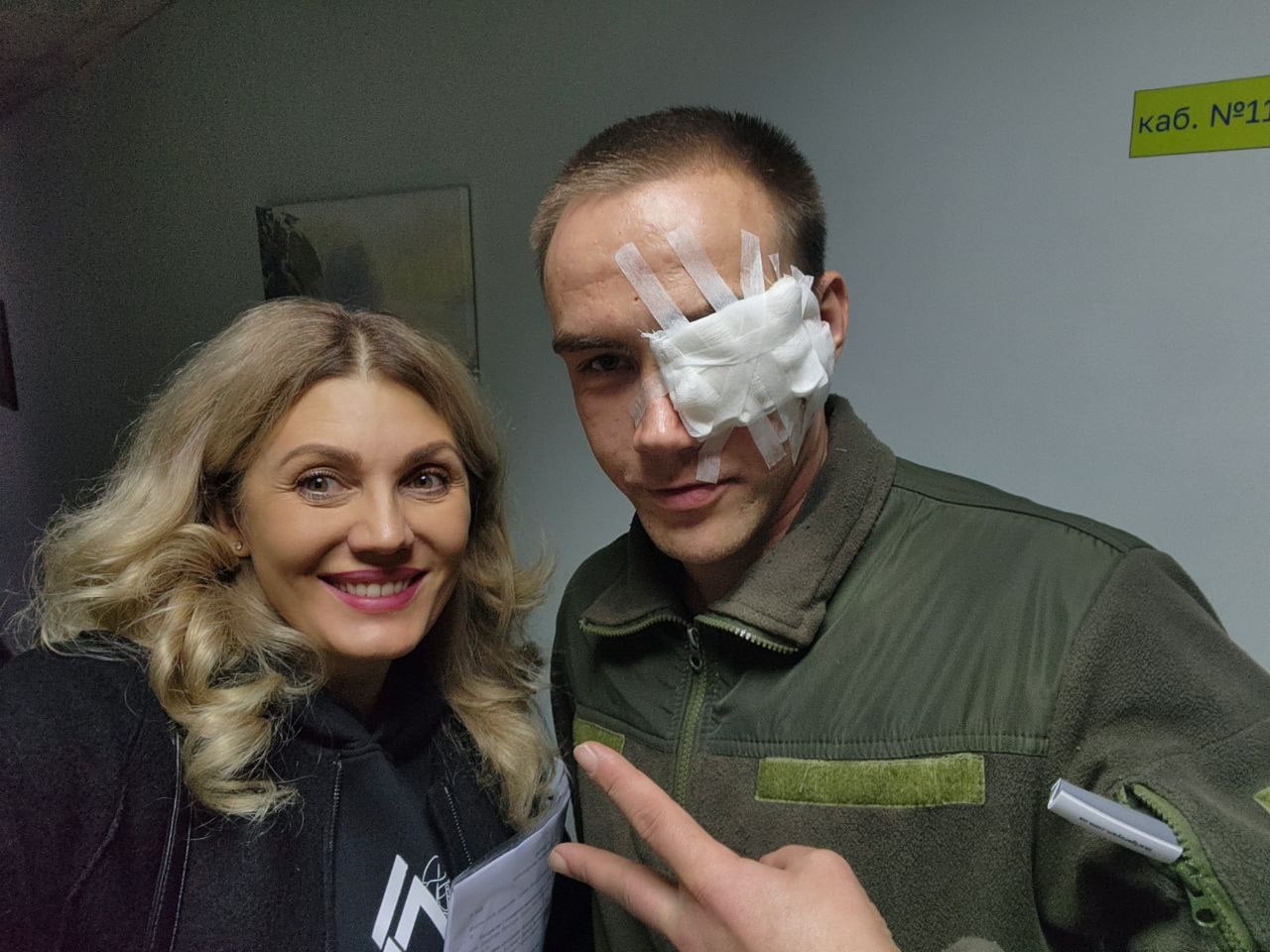
Natalia and Valentyna Kalynovska (far right) with soldiers who became beneficiaries of the "Doctors for Heroes" project.
The doctors introduced me to Valentyna Kalynovska, a representative of Imatech Medical, where they ordered implants. For a year, they provided them free of charge. But to continue working, materials must be purchased. And we cannot ask soldiers for a hundred thousand (hryvnias - ed.) The state should pay for this. That is clear. The scheme isn't complex, yet no one is moving it forward. So, I came up with a name for the project and realized how reporting should be handled for each specific case, how to handle the legal documentation to ensure transparency, and that a website was necessary. I was very lucky to find an SMM specialist right away. We spent about six months developing this platform. The first donations came from my acquaintances, friends, and friends of friends. I am deeply grateful to each of them for believing in what we were doing at that stage, because there was a constant fear that we wouldn't pull through. It is always important for me to account for every kopeck so that people see and understand what we paid for and who received the help, even though this is often perceived as PR. But I take that calmly. It’s not PR; it’s responsibility and an example for others. If you think I’m doing something wrong, do it better. I would gladly stop doing this. In fact, I’m doing everything possible so that I won’t have to do it anymore.
Six months later, it turned out that the people who brought me into this field were trying to steal from the military behind my back. They wanted to misappropriate up to 30 percent of the funds I was raising, and in a way that I wouldn't find out. But I am a banker. I sense such things at a visceral level. A conflict began with those people; they couldn't do anything without me. So, we parted ways. I established my own foundation and transferred everything to it, including this project, and was able to continue working.
- How many wounded have gone through your program so far, receiving ocular prosthetics and bone implants?
- About six hundred. The number changes every day.

- Is the state responding? Will this treatment eventually be included in state funding?
- Together with representatives of the Ministry of Health, Superhumans, the Department of Maxillofacial Surgery, and a Belgian company, we signed a memorandum to implement a reform of maxillofacial surgery over the next two and a half years. Our foundation will act as an expert specifically in properly designing the patient pathway for those with facial injuries, creating inclusive conditions at all stages to ensure they receive exactly what they need, including rehabilitation and social adaptation. This applies to both those who have lost their sight and those who have lost teeth or jaws.
Forty percent of facial injuries result in a loss of jaw integrity. Sometimes it is a simple fracture, but occasionally an entire fragment is lost. Without it, a person cannot chew. To restore this, a very complex operation is performed. Only three or four people in Ukraine are capable of doing it. The essence of the operation is that bioengineers use an individualized implant to contour the future jaw. A fibula bone is taken from the leg along with soft tissue, vessels, nerves, and skin to replace the defect. Such operations last from 12 to 16 hours. They are extremely complex; it is microvascular surgery. The Kyiv team is achieving good results
If a patient does not smoke, everything heals perfectly. However, 99 percent of service members smoke, and that leads to 99 percent of complications. We always ask them to quit smoking, at least for a while.
There are many cases where the guys say, 'I carried my jaw in my hands and spat out all my 28 teeth. Or 23 teeth.' All of this must be restored later. It is difficult and expensive. Full recovery can take two or three years. It is impossible to simply put in dental implants. Most likely, a removable structure is needed, but a very specific one.
A jaw provides the taste of food, a smile, the ability to kiss, and the opportunity to make new acquaintances...
When the jaw isn't functional, the guys begin to lose significant weight because they eat only liquid food. And if a soldier has other injuries at the same time, they need to undergo rehabilitation that requires physical effort, but they have no strength. It is a complex of problems, with psychological issues being at the forefront.
Foreign journalists often ask: 'Is it true that facial trauma is harder than amputation?' Yes, it is true. The guys with amputations say so themselves. One’s self-identification changes, and not everyone manages to accept themselves.
The most difficult patients in our category are those who have lost their sight. A few days ago, we were in Odesa and saw a boy who was wounded on January 1 of this year. Both of his hands were affected, and he will most likely not be able to see. There is a faint hope that vision in one eye can be restored. I want this very much. Soldiers who have lost their sight are so strong in spirit, but it is very hard to live in darkness.
- How many patients with total loss of sight are in the project?
- Up to three dozen.
The other day, we learned that another of our boys had passed away... Out of our six hundred protégés, we have lost six. None of them died at the front. One threw himself under a train. Another did not survive surgery. One more young man had come a long way; half of his face had been reconstructed. The doctors had invested so much faith and hope in him. He started with suicidal thoughts in intensive care, but over a year of treatment, so much life appeared in him. He wanted to live. And just the other day, he went on vacation for the first time since his treatment began. He connected a generator incorrectly and did not wake up. It is so painful...
Another project is currently in development. The Belgians will help us establish two national centers specifically for facial surgery, in Lviv and Kyiv. These will also serve as training bases with simulation operating rooms for young doctors.
There has been progress. The Ministry of Veterans Affairs listened to us, and in October of last year, a resolution was adopted to cover all expenses for the rehabilitation of the blind. Since this year, service members can undergo a 56-day rehabilitation program at the Trinity Center and other rehabilitation facilities. This will ease our work, as we used to raise funds for this as well. The second thing the Ministry did was to cover the treatment of scar tissue changes. This can now be done across the country in various clinics. We are currently drafting the text for a future resolution on covering surgery costs for those with facial injuries. I very much want this to become operational.
- When that happens, will you close the project?
- Yes. I want everything to function without my involvement so that I no longer have to do this.
- What other areas in the treatment of the wounded do you see where issues remain unresolved?
- Palliative care, when assistance is needed for the hopelessly wounded. I cannot even say how many of them there are. Many such wounded are invisible. For me, the issues regarding wounded service members from the occupied territories remain unresolved. Essentially, they are abandoned, without housing, without the help of relatives. No one visits them. And when you have nothing to chew with, you need all your food blended; you need someone to help with that. When such patients are discharged, they have nowhere to go. Usually, they drift between hostels. Some start drinking. There are no temporary hostels, dormitories, or rest houses specifically for service members who have lost their homes. A person needs to know there is a place where they can live for two weeks, a month, as long as necessary.
Another problem I see that is not being addressed systematically is addiction: to nalbuphine, alcohol, and gambling. There is a lot of this.
CHILDREN WHO WANT TO LEAVE CRIMEA
"I have been working with children who want to leave Crimea for Ukraine for about six years," Natalia continues. "Before that, it was episodic, occurring from time to time whenever a need arose or someone reached out. That was when I learned of a problem related to legislation: as soon as you turn 18, if you only have a birth certificate and your parents do not support you, you cannot obtain a Ukrainian passport."
It is a mystery to me why the SBU (Security Service of Ukraine - ed.) and migration services do not want young people from Crimea to come here. Their version is that they are all agents. Of course, that is not the case. But even if some of them were indeed recruited, it would be beneficial from all sides. If an agent comes here and falls into the hands of our professionals, the service will obtain useful information from young, inexperienced agents. And what if they are not agents after all? Everyone who has passed through me is a young, active individual who left a circle of acquaintances behind on the peninsula. These are ready-made networks of 'eyes' there. They are willing to do a lot, to help... The youth in Crimea are very pro-Ukrainian. It surprises me that our special services underestimate this and do not utilize it.
- How many children have you brought out of Crimea?
- Several dozen. I have never counted because I help in various ways. I have provided consultations to some, guided others throughout the journey with advice, and met some here with their documents... In total, about five or six dozen.
- Is it difficult for them to come here? Many questions arise, where to live, how to study, or where to work.
- Until 2018, there were hundreds, thousands in Crimea who wanted to leave. They couldn't do it due to a strict Ukrainian resolution. They had to bring three witnesses with them, physically, in person, two of whom had to be parents, plus a neighbor living no more than 500 meters away. This was impossible if the parents were opposed. And for many, the parents were precisely the ones opposed. If only one family member was willing to testify, that was it, goodbye, it wasn't enough. That is why most were unable to leave because of these conditions. Closer to the full-scale invasion, there were already hundreds and dozens of people willing. During the big war, the entry procedure into Ukraine was finally simplified. Now, one witness who can testify via video link is enough, either a parent or a neighbor. But now a host of borders has appeared. How do they travel now? And those youth who were 12, 13, or 16 in 2014 have grown up. They have formed ties there. Some got married. Some started working. We have lost them. Furthermore... I asked everyone who left: 'Let's make a story, tell people how it’s possible, that Ukraine is waiting for these people.' But no one agreed until recently. Only Polina and Dima, who arrived before the new year. After them, Artem and another Dima gave interviews, a chain reaction began.
For several months now, two boys have been stuck in Armenia, being denied entry. They want to come to join the Ukrainian military. The consulate is refusing them. Each of them has a birth certificate, but that is not a document... We are trying to break through this wall.
A year ago, we met Bohdan Krotevych. I used to raise the issue of youth entry, and I was being silenced. Bohdan spoke with me, got involved in this topic, and is trying to find ways. Thanks to him, and now also to Polina and Dmytro, this topic has finally started moving. Polina is very brave. She fights for herself and for everyone else. And she will not be silenced

Natalia with Polina during a walk in Kyiv. The girl desperately wanted to leave Crimea for Ukraine. Now, she gives interviews, sharing how it can be done, talking about life under occupation, and her love for all things Ukrainian.
After Polina’s and the boys' interviews, I started receiving messages from numerous children in Luhansk, Donetsk, and the Kherson region. Thanks to her, I connected with the Plakhta foundation, which helps cover travel costs and initial accommodation for children from the eastern regions. Only now did we discover that there are payments available for such children who arrive in Ukraine. There is also a hostel for temporary residence. The process has gained momentum, and we will not stop.
All the volunteers who were handling such cases individually have now united. We are working to create a one-stop window where people can turn, even while remaining under occupation or in another country. A person can submit their birth certificate and information about their parents. The data is verified, and the individual is informed which consulate to visit, where they are expected, and where they can obtain an entry document for Ukraine.
I constantly think about how many children we will never get back. Sometimes I watch my foster children playing and interacting, and I think: if we hadn't brought them here quickly, their mother would have taken them to Russia, as she lives there. But instead... the eldest, Illia, got a trident tattoo, because he is Ukrainian. We preserved three Ukrainian citizens who would have certainly become Russians. And they will have children of their own. So, it's not just three! I find comfort in this thought. Taking them in was the right thing to do. I realize they are freer here. They have been given a chance for a future and identify themselves as Ukrainians.

- Do you believe that you will ever return to Crimea?
- Of course! I don't know when it will happen, or if I will still be of working age. But I have never doubted that the peninsula will be de-occupied. However, I would like to live in two homes, in Kyiv and in Crimea. And to cultivate Ukraine there!
Violetta Kirtoka, Censor. NET


