



10 days of close-quarters combat with Andrii (Hrom) from Khartiia
Junior Lieutenant Andrii, callsign Hrom, the deputy battalion commander, led an assault group and carried out missions continuously for 10 days.
Andrii has been at war since the very beginning. He has sustained five wounds, including three severe ones, and nine officially recorded concussions.
This is a man who has gone through everything there is to go through in the infantry in this war. And now he will tell the story of his operation and his feats himself, what he did, and what his brothers-in-arms, Ukrainians, Colombians, Brazilians, and Americans, did.
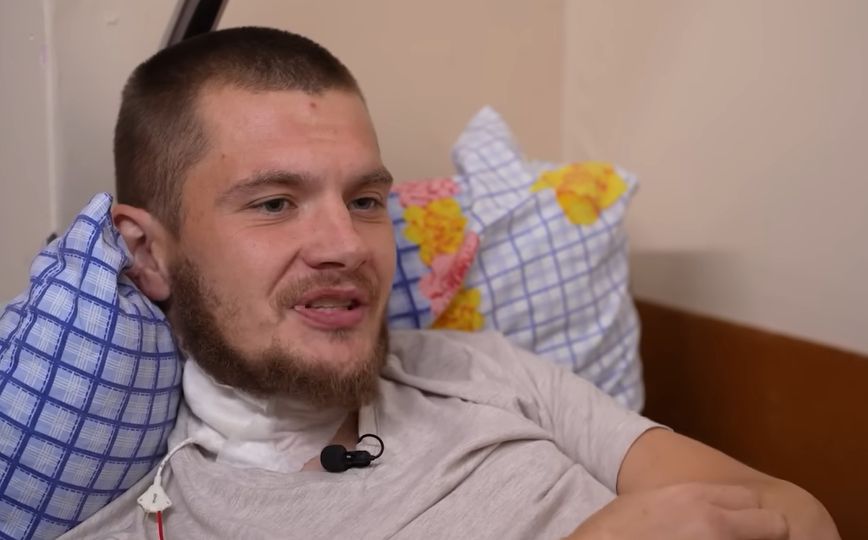
Tell me, please, what happened to you? Why are you lying here?
I was wounded whilst carrying out a mission in the Kharkiv sector, specifically in the Kupiansk sector; I didn’t escape the artillery or the FPV. My first injury was minor.
We were carrying out certain tasks on a particular section of the front when we were trying to push up to certain lines, and the b#stard started dropping grenades on us there. One small fragment hit my left leg. I reported that I was WIA, lightly wounded, green (in military medical triage, "green" refers to the "walking wounded", soldiers with minor injuries who do not require immediate evacuation and can often continue their mission - ed.) They told me to pull back, but I said I would not pull back, because of the particular group I was with and the tasks we were carrying out, it just couldn’t be done. So I stayed, and everything was fine. Then, three days later, we were involved in assault actions again.
We continued clearing our sector. During the clearing operation, one of our guys was killed there, and another was wounded by mortar fire. While we were putting a tourniquet on him, it was difficult because he did not understand Ukrainian. While talking to him with gestures and tightening the tourniquet, an enemy UAV dropped a munition that struck my helmet. The helmet took some damage, and I was hit in the right leg. Not too badly, but there was bleeding. I was also hit in the left arm. After that, the decision was made to pull the wounded man back. We pulled him back and applied a tourniquet. Then I put a tourniquet on my own left arm. I did not put one on my right leg because the bleeding was not massive, but it was there, so it was partially bandaged. Then I pulled back after the mission had been completed, since it had been completed before that munition drop, but there were still a few things that needed to be checked. Still, I understood that I had to pull back and check myself.
I pulled back to a dugout shelter, took cover, removed the tourniquet from my left arm, and bandaged it, because the bleeding had stopped and there was no need to risk losing the arm. I then started checking my right leg and understood that I needed to put a tourniquet on it as well, but there was no opportunity, because I still had specific tasks to carry out. Later, when the main group was ordered to fall back, after the holding force had already moved in, the guys withdrew, eight men in total, three of them wounded. I was supposed to be the last one out. At first, I did not want to withdraw, but then a certain situation arose where I had to, because there was an order, and we all understood that we had to prepare for other missions as well. I reached the edge of the field, went maybe 15 to 20 metres, and then there was some kind of explosion in front of my feet, mortar fire, or a 152mm round, from what I remember, and I crawled across the field toward another tree line.
Were you wounded by that explosion?
Yes, that was the most serious wound.
And why did you go into battle yourself? You are the deputy battalion commander, yet you personally led the assault groups into combat.
I came up through the infantry myself. And for me to become who I am, my previous commanders were always there for me, both morally and physically. From the start of the full-scale invasion, not one of my commanders ever called any of us bad, just to avoid swearing at us. They always helped us out, punished us, gave orders. Sometimes they passed certain information on to us, sometimes they withheld it at first and then passed it on later. I also held command positions before this. First, I was a senior squad leader, then platoon sergeant major, then company sergeant major, then acting company commander, then company commander, and since 15 August 2025, I have been the deputy battalion commander working with foreigners, a battalion of foreigners. There, it became much harder for me in practical terms to learn things on my own. But everyone kept saying that they had come for the money, that all they cared about was completing their tasks quickly and getting out of here.
When I arrived, it was hard for me to understand them, to understand their language, the language barrier, and to understand what was expected of them, because when things were explained to them, first of all, everything went through an interpreter, and not every interpreter can convey the information in full, with the degree of emotion that is needed. Also, because they are foreigners, if you do not speak their language, for some reason they all think and believe they are being deceived or used as expendable material.
Do you speak Spanish? How many words do you know?
Amigo, and probably nothing else. Well, and no comprendo.
And I spoke to them using the words they understood. If we were on video link, I would point with my finger and show them what not to do. Before these actions, we had another mission, and that is where I realised they needed more confidence, so I went with them there as well. And here I would tell them, ‘Topi-topi.’ For them, that meant they understood that I was telling them to keep moving forward only, no turning back. Or if I said ‘Topi-topi,’ I would point in the direction, and they would carry it out.
’Topi-topi’, were those already your own commands?
Yes, that was just something I came up with to say to them. And I would also tell them ‘amigo-vampire’ at any sound of a drone. They understood that 'amigo' meant friend, but in this case, that 'friend' was no friend at all. It just didn't work for them otherwise, because they weren’t paying attention. They believed that if I was there with them and I was telling them something, then it was a kind of moral encouragement. Then, in the morning, I was called in, and I arrived. They told me we were out of time, that the adjacent units were already starting to move, and that if we delayed any longer, we would break the line, fail to carry out certain tasks, and then there would likely be no one left to answer to for those tasks because it would already be a failure. We would be held accountable for it, and the front would move forward, not in our favour, toward Kupiansk. So the decision was made. I went up to the brigade commander and said: I have a certain understanding of why this is happening. I had already been through this with them a month earlier, while working with them. Let’s try now. But he said: No, I won’t let you go. You’re the deputy battalion commander, on top of that, you’re wounded, and there will be an uproar over you.
Did you volunteer to go and lead the assault group yourself?
Yes, but they set certain conditions for me: I had to take two more Ukrainians with me, so that I would be able to communicate and understand what was going on. Alina volunteered to go with me as a guide; she is the senior sergeant of the American company and served as an interpreter.
Is Alina a woman?
Yes, she is an interpreter. And I also took Karma with me, one of the young officers who had just arrived from the academy.
Karma, so that is this year’s academy graduate, Lieutenant Nazarenko.
Alina took point, because she more or less knew the route. I was at the rear, Karma moved in the middle, and everyone controlled their own sector. We made it there without any problems. And most importantly, very quietly. We reached the position, assembled at a certain location there, and once again split up according to who would go where. Alina stayed at a certain position, because her task was to remain there. Then it was me, two or three Colombians, and Karma bringing up the rear. The second group of Colombians then moved on its own.
Well, why did you decide that this was the kind of moment when the commander of a company tactical group had to personally lead an assault group?
Well, first of all, I put myself in their shoes. They were unfamiliar with the terrain. To them, both Russian and Ukrainian sounded hostile, so to speak. They could not tell where it was Ukrainian and where it was Russian. And third, by that point, I no longer had confidence in our adjacent units, because they had seriously screwed us over the first two times. They said that the tree line was under control, that the guys would get through without a fight. But the guys came back and said they had had to fight there, because the b#stards were sitting there. So nobody was controlling it. They started saying, ‘We’re not going, they’re screwing us over.’ I understood that, from their point of view, that was exactly how it looked. So I decided to go with them again, I had already gone with them once, twice. And on the Kupiansk sector, at an even more difficult moment, I decided to go with them and get it done. Karma and I went, while Alina went to the command post, the field command post, as an interpreter, to the radio, to the communications link, so that I could stay in contact. If the Colombian group that was moving was to push ahead or lag behind somewhere, we needed to avoid friendly fire, so they could pass information to her and she could translate it, because I understood some words, but not all of them, and otherwise we could have made a real mess of it. And the first group that moved out with me was me, Karma, and five Colombians.
Tell me, how did you actually get in? There was already a big open stretch to cross before you could reach that forest.
Well, we sprinted from one position. First, we moved into that position, and there were b#stards there too. We were taking them apart with drones, even though the adjacent units had told us everything was good there, that they controlled it, that our infantry was holding it. But there were two old-timers sitting there who did not even know which end of the rifle to grab. We ran the first 600 metres across the field to a tree line, then lay low there for about 10 minutes, crossed the road to another tree line, another 50 metres or so. We sat in the second tree line for about 20 minutes while a plan was coordinated with command: our drones would work them over, and our artillery and mortars would hit certain sections of the front to mislead the enemy, so to speak. In other words, we were not hitting the place we actually planned to move into, not doing it the way the book says, firing where you intend to go, because the b#stards use that tactic too, and it would have been obvious that we were heading there. We hit the centre of the forest and the far end of the forest from our side; what was the far end for us was the beginning of the forest for them. That is where we hit. The b#stards thought we were going to encircle them, but our group was small, seven men. We got in quietly and spent the night there. We had a close-quarters combat there, but we still did not actually see them at a distance of five to ten metres — we fired through the bushes, and they pulled back. They thought we had withdrawn, that we had retreated. That was their mistake, and it is a good thing when they make mistakes. In the morning, it was decided to bring in eight more Colombians. We asked the five Colombians who were already with us to tell their guys that we needed help, and eight more Colombians joined us that morning. By sometime after lunch, we split up. There were 15 of us by then. Ten Colombians went one way, three Colombians went on the left flank, I was on the left as the commander, and Karma was there on the left too. And we started clearing the forest along the flanks, so to speak. The b#stards did not expect that, but we carefully drove them off the flanks, reached the far side, all the way to the end of the forest, and dug in there. Our first real fight came when it was already clear that we had them under control. That was in the evening. They did not have much in the way of provisions there, some water and food, not much ammunition, and they used to go back and forth to the settlement they had occupied as if they owned the place. We lit up that route, and the Colombians positioned themselves where they needed to be.
How did it happen? Under what conditions did the assault take place?
There were three Colombians, me and Karma. I moved first; the Colombians advanced in a zigzag. Dugout, grenade, shot, move on. That is how we gradually cleared the left flank
It is quite a large forest. How many dugouts and positions did you clear?
On the left flank, about 12. In three dugouts, we had direct firefights, but grenades helped us
The Colombians had heavier weapons, Fort rifles, and a machine gun, while I went in with a captured weapon and my own AK.
Each dugout is basically like a separate assault, a separate operation, and you went through one, then another, then a third, eight dugouts — incredible. How much ammo did you burn through in all that?
I took nine magazines with me, plus loose rounds, probably around 1,500 in total. For the assault itself, I took 700 loose rounds with me, plus whatever I had in loaded magazines, and whatever I picked up. At one point, I had maybe 15 magazines.
Oh, so you were picking up captured gear.
Yes. Why would I carry all that with me if I could use what was there? I do not fire in long bursts because it makes no sense for me to waste ammo. Single shots, double taps, and short bursts if I need to suppress fire. Plus, I had the Colombians with me, and I had Karma; they were armed with UARs and had brought more ammo with them. The Colombians also had a Fort-600 and were loaded with grenades. If I could not tell whether a dugout was clear or not, and there was resistance, I would shout, ‘Prima, topi-topi.’ Prima was one of the Colombians. He would look where I was pointing. When he saw me indicating the dugout, ‘topi-topi,’ the dugout, I would tell him, ‘Asalto.’ For him, that meant assault; they understood that word. I would point at the dugout, say ‘topi-topi,’ then ‘asalto,’ and from a certain distance, he would put a grenade straight into the dugout with the Fort-600. That grenade was decisive even if someone was still inside. By evening, we had our first fight, because we had reached the far end of the forest and stayed inside it, while the flanks had already been cleared. The flanks were no longer under their control, but they were not fully under ours either; they were more of a neutral zone.
Did the right-flank group of Colombians also complete their mission?
Yes, they completed it even earlier than we did, because their flank was shorter. Ours stretched about two spans on the map, theirs about one and a half. There were fewer dugouts there, because the b#stards did not control the right flank as tightly. On that side was their occupied territory, where they had gotten a bit too comfortable. I do not know how many b#stards they killed there, but they came back pleased. Mai, the senior group leader, was getting worked up with me because the holding force had not moved in. He kept saying, ‘We completed the mission, we need to leave, why are we sitting here?’ But it was explained to him with gestures that we had to keep assaulting and take the middle of the forest all the way through. We then set up our observation posts at the far end and stayed there at that position. We left three Colombians back where we had started from, and they covered our rear there. Karma and I divided things up there: he controlled the left flank and the Colombians, while I ran over to them and passed on tasks. He knows a bit of English, maybe some Spanish, but I was still mostly explaining things with gestures. Mai was the senior Colombian group leader, and I would show him things using my phone, drawing on the ground, overall, everything was fine. And then the first fight came in the evening. The b#stards were moving along the path and did not realize we could see them. They came in very carelessly. We killed three of them. One of them, callsign Sivyi, had a radio. It was decided they would not need it anymore, so I carefully took it. The Colombians wanted to switch it off, but I explained to them that it was the b#stards’ radio, that we needed it, that I would listen in. Mai explained it to them in his own way. He showed them that if we listened in, they would go topi-topi, they would come, they would go topi-topi, and we would pick them off. That would give us better chances of surviving.
Did those three come straight at you?
The first three did, yes. They did not understand what was there. They thought the observation posts were still theirs.
What was the distance when you opened fire?
About 15 metres.
From 15 metres, so you could actually see them?
We could see them. We were in the bushes, and they could not see us. The dugout on the edge was under our control, and they did not realize that. On top of that, I had an AK, and they were moving in carelessly. The Colombians always open fire on command, or when you tell them to, they do not just open up for no reason. The Colombians were told that the closer they got, the harder we had to hit them, so that no one would get away.
Fire discipline was maintained, which is also the commander’s will.
We did everything, took out the three of them, got water from them, got canned meat from them, ate, smoked their cigarettes, because a lot had been used up during the assault, and we had gone into the assault without backpacks, travelling light. We had left them at the dismount point. And that night, with the help of the radio, it became clear just how useful that radio set was. I already knew their trails, where they were coming in from, and in the morning, we started setting small ambushes for them on those paths they used, and we hit them there.
So you decided not to just sit in one dugout, but to operate throughout the forest?
Our task was to establish ourselves on the second edge of the forest, not the front edge where we had entered, but the rear one, where the b#stards were filtering in from. But I understood that they were also filtering in on the right flank, and that if they kept coming in, they would start massing there, and then we would not be able to clear them out with our own forces. So the decision was made to try to hit them wherever they were moving. At first, we hit them with drones. I passed information by radio to Alina, Alina relayed it to headquarters, and Karma was also passing things to me. We had coordinated communications, interconnected radios, and the Colombians were listening to it too. Alina was chattering away to them in her own way, and specific tasks were being assigned. Everyone understood that we had to show as little fire as possible. We hit them with drones or mortars. We could hear them moving, and we passed the coordinates, and they...Then the day came when it was no longer possible to control things with mortar fire, because a mortar cannot always operate, at night, in the early morning before first light, you cannot do that, because you can give away your own positions. So Karma and I decided to move through the forest ourselves, from the point we had taken to the point we had originally come in from. That was where they were dropping us provisions, ammunition and water. By then, two Colombians had already been killed.
What happened?
There was a meeting engagement. The b#stards came out for supplies, shot two of ours, and we shot two of theirs.
It was a dense forest. What was the visibility like?
Five to 10 metres.
Was this a company defensive sector for the enemy?
At least a platoon.
Tell me about the tactic of "moving through" the forest. You were doing that with Lieutenant Nazarenko, Karma.
First, we were checking the dugouts we had already cleared, because the adjacent units had let us down. They were supposed to relieve us in the morning so they could encircle the enemy, but they did not come, and we held the position for three days.
This was a company's defensive area, dense forest. You could not see all the way through it. In the forest, you cleared the flanks, but enemy groups remained inside, and reinforcements kept filtering in.
They needed food, which was being brought in by "mules". The enemy was building up there.
So the enemy was actually everywhere. He could appear at any moment from any direction.
Yes, but the enemy also understood that it was better not to move at night, and that gave us a chance to catch our breath.
Tell me, please, what kind of engagements did you have during your patrols through the woods with Lieutenant Karma?
We had a lot of contacts, but the most interesting one happened on the day the clearing operation was supposed to be in full swing. They had already brought in reinforcements from adjacent units for me, and they had taken their flanks. But they were lazybones who weren't keeping a proper watch. And the Russian army had this guy there, call sign 'Repa'. I figure he was some kind of commander, maybe a squad leader or something, an older guy. On the radio, it was 'Repa' this, 'Repa' that. Repa was always talking, always listening, walking around his observation posts. In short, Repa was a king and god to them. Anyway, one time we slipped right past him. He reported that he heard movement, saw one person walk by, even though Karma and I always moved together. But he thought it was his guys because we were also wearing Multicam, and we had taken off some of our identifying patches to move through the woods. His other commanders chewed his ass out. They told him, "Moron, our guys weren't out there at that time, you were supposed to f#cking drop him." We just brushed it off. But on this particular day... well, he walked right into our line of fire. Karma and I were on our way to check on the adjacent units, bring them water, and pick up the Brazilians to prep them for an assault. So it's just Karma and me, I'm on point with my Kalashnikov, no backpacks. And suddenly, this guy steps out right in front of me. Half a head taller than me, moving at a sprint, and he asks: "Guys, what battalion are you from?" We go: "What about you?" He calmly replies: "3rd Battalion, 122nd Brigade... and whose guys are you?" He says, "Kamov's." I tell him, "We're Phantom's." I already knew their setup; I had been keeping lists on my phone of their call signs...
So you gathered and analysed all the information from the people you killed?
From those we took out, from what I heard over the radio, from their drone pilots who were dropping supplies for them, they identified themselves, too. I wrote it all down. I already had some of their codes, the phrases they used in different situations. I already knew their company commander, I think, or maybe their battalion commander, because they reported in every hour, even every half hour at night.
How close were you when you ran into him?
About as close as you and I are now.
He came out from behind the bushes, right?
There was a path there. Our adjacent unit had had an observation post there and screwed it up. They put up their own observation post, and the b#stards set up their own little lookout shelter to guide their groups through. It was like a checkpoint for them.
So he came out right in front of you, and you saw him?
He came out calmly. He saw I had an AK. They do not understand either, same as we do not always understand, who exactly is the enemy.
You move with your weapon under control, but not ready to fire. Because if it is ready to fire, then the enemy will instinctively start shooting, and you will start shooting too. And he said: Pass it on to Phantom that we are going to trade fire. We talked, went our separate ways, and then I turned around and put half a magazine into him from behind.
What were the Brazilians doing?
We all moved together. During the assault, one of their guys was killed, and I was wounded.
You spent 10 days in close-quarters combat, stayed on position and kept carrying out the mission despite a light wound, pulled your men back, held the position, and were wounded again.
When the full-scale invasion began, I was in a canine unit. I was the commander of a special-purpose dog handler group. Then, over certain incidents, I was transferred as punishment to an operational assignment battalion. 2nd Platoon, 2nd Company, 1st Battalion. We had Uncle Slava there, 58 years old. It turned out he had known me since childhood, because we are both from Pavlohrad. Fate brought it together so that I ended up with guys I had crossed paths with before. And we gave our word that we would do what we were told, but do it the way we believed was right. I am not afraid of anything except losing my family and loved ones. My family is the team, the Brazilians, the Colombians and the Americans; before that, it was only Ukrainians. You are one small unit in the army. For us, two is one. And one is zero. But if that one unit is left alone, you cannot show that you are zero, because other people’s lives depend on mine. I do not want them entering Kharkiv or any other city. I want to drive them out. When I was crawling, I caught myself thinking that I had to survive, because I had given certain people my word that I would stay alive. Besides, I had a lot of information on my phone that could not be allowed to fall into the b#stards’ hands. I got it out and passed it on.
He’s a Brazilian who...
He carried me out. At first I was carried out... there is video of it. Two Brazilians were carrying me out. One was Sidri, who had been waiting for my withdrawal. He thought I would bring out the Brazilian who had stayed behind, but that guy stayed with Karma. Sidri carried me for the first kilometre and a half, and then they switched, they changed over, and Meni carried me. Sidri is the commander of the four-man team, and Meni is the commander of the eight-man team, the commander of the whole group. Brazilians. He carried me for almost five kilometres, maybe even five and a half. He carried me on his back until I was stabilised, to what you could call a forest aid post.

Had you already lost consciousness?
I don’t remember that. That’s what the guys told me, and later I saw it on video. And he came today. I’m grateful to him. He’s six months younger than me, but he pulled me out. First one pulled me out, then another. The third Brazilian who tried to pull me out was killed.
What was his callsign?
Edbor. Their callsigns are specific. He was killed. His leg was blown off. I saw it later on the video, after Meni had taken over carrying me. A 152mm round. He was covering us from drones. He bled out. The guys patched him up, but he did not make it to the hospital. Karma stayed there, and so did that Brazilian. Karma is also in the hospital now. He is recovering. We spoke today. We will keep carrying out missions. I asked for him to be moved from platoon commander to company commander. As deputy battalion commander, I can give orders like that. I gave the order and asked the battalion commander to pass it on to the brigade commander. He deserves it, he will be a commander. Even if he is only fit for limited duty, he will still have the tactical sense, and he already has the experience. We will help him. He knows the paperwork well, the admin side. I do not. Sitting in one place is not for me. I will keep moving, and he will work. A new company of Colombians is being formed for him. He will take charge of it.
Tell me, please, about Lieutenant Nazarenko, callsign Karma, who literally graduated from the National Guard Academy this year. By the way, I was with him on the adaptation course in Khartiia. So tell me, please, how did he show himself?
I met him when I arrived at the battalion as deputy battalion commander. The battalion commander gathered all the officers for me. He was very calm, like he did not really need much in life. An academy type. I sort officers into five categories, and he fell into the category of the bookish academy types. Then I went around checking positions. He was on a position on the second line here in the sector. At one point, we needed help, and he was the only one who agreed to do it. He took three men with him and helped evacuate a WIA. That is how we started talking, and then it turned out we had some mutual acquaintances. And when it came time to take someone to the Kupiansk sector, I was told I had to take one young officer with me so he could get the experience he did not yet have. He went, arrived calmly, and when it was time to go on that mission, I called him and said, Get ready, you’re going with me. You’re not going to sit at the command post. There is no point in your sitting here watching a drone feed. That is fine, but you need to feel this with your own eyes and your own feet. Then you will be one team with the infantry guys. Because the infantry, whatever anyone may say, are the queen of the battle. And he calmly got ready in half an hour, called and said, I’m ready. So we went out on the mission. When he dropped his first b#stard, he was really beating himself up over it. He kept saying, I killed a man. I killed a man. He barely ate or drank for almost a day. I told him: there are no people here. It’s either you or him, and this has to be done. That first one was Repa. He helped take him out, so to speak, and he thought he was the one who killed him. I can give him those frags. It was shared work, team work, brotherhood. They became brothers to me. I do not call many people brothers, but now there are more of them, both foreigners and Ukrainians.
And tell me, what happened next after you were wounded? Did Karma stay at the position, did he keep defending it?
Yes, he was wounded the day before yesterday. He was a 'yellow' (a moderately wounded casualty under the colour-coded triage system - ed.) WIA, medium severity. He was only evacuated last night, and just regained consciousness this morning. But he's an absolute badass, he patched up three other WIAs there and got them out first. No matter how it sounds, he did exactly what I would have done, and I'm glad this crazy experience of mine was useful to someone.
Tell us about yourself, how old are you?
I turned 30 on September 16. I studied veterinary medicine, first at a technical college after 9th grade, then university, then the army. While in the army, I studied remotely as a special K-9 veterinary handler. Veterinary medicine is a broad field, but my specific focus is as a dog handler. Then I studied at the National Guard facility in Zolochiv, I wouldn't call it an academy, more like a National Guard K-9 training center. I got my qualification there as a basic training group commander. Later, I had a certain "fuck-up" with the command, so they transferred me to an operational unit. They took away my group, all 20 guys, and transferred me. Nobody wanted to take me because I had a "stellar" service record, quote-unquote.
And what did you do there?
At the start of the war, in 2022, I wasn't afraid then, and I won't be afraid now, we were in the Kherson sector, carrying out certain tasks. A drunk officer came up to us, Lieutenant Colonel Kokarev, a former commander of the 92nd Brigade. He was driving a car, didn't stop at the signals, then got out and started acting aggressive, grabbed a female police officer by the hair. I warned him three times that I'd put him face down on the asphalt. And I did it, without even threatening him with a weapon. You didn't need a weapon there, just give him a flick and he’d drop. His driver got out, his wife with a young child, also wasted. We called the Military Police.
Military Police arrived and tried to rough me up. Since I already had some connections, I didn't give up my weapon, because I was on combat duty, so to speak. My unit commander arrived, an absolute prick, I won't name him from back then, and said I’d be choking on my own blood in another unit, that I'd be kicked out of the K-9 squad. They shut the cops up, shut the MPs up, and I spent 10 days in the cooler. After that, they gave me such a "glowing" performance review that no unit wanted to take me. But back when I was a sergeant, young lieutenants used to come to us for internships. And Zhyvchyk, who is now the commander of a training battalion, but back then was the commander of the 2nd Operational Company of the 1st Operational Battalion, where we served, took me under his wing. He made me a squad leader, taking me from a higher position to a lower one. There was a battalion commander there who also vouched for me, so I could serve with them. We ended up in Kharkiv with them, fought there, and then in Kreminna.
What unit did you fight in?
In Military Unit 3036, the 1st Brigade of the National Guard of Ukraine. Then, after our first deployment to Kreminna, after nearly a year and a half of war, we returned. They promised us time off, but we never got it. Right around then, "Khartiia" was being established as a military unit, and they transferred the remnants of our battalion, whoever was left. Back then, when I was put up for state awards here in Kharkiv, Kokarev axed all of them, because at the time he was the deputy commander of the ATO "East". He vetoed everything. Later, we ran into each other in Kreminna, the first time I was in the hospital, after being surrounded. I was encircled for three days, breaking out with my group. He saw me, didn't shake my hand, told me I was unworthy, and asked, "Are you still alive?" And I told him, "Don't hold your breath." For that, I got demoted again because I mouthed off to him. Anyway, it is what it is. After that, when we ended up in Kharkiv, my career really took off: from squad leader to platoon sergeant, company first sergeant, and now deputy battalion commander.
Kornet must have noticed me alongside the late Kapa, God rest his soul. Kapa was a golden sergeant. To me, he really was. He is probably one of those idols I’d want by my side forever.
The Chief Sergeant of the Khartiia Brigade, Oleksandr Yushchenko.
Kapa, yes. To me, he’s Kapa for life. We met when we were sent there for training. At first, they pulled NCOs from the battalion for an internship, so we could see how the NCO corps was developing in Khartia. Then I met Kornet. We didn't have a very pleasant meeting; we had a really nasty conflict. But after that, Kapa and the others must have seen something in me, because they started pulling strings to keep me off the line, to stop me from going into combat. But anyway, I always managed to slip away. I belong with my boys, with my platoon, my company, then the battalion, and now with the foreigners. And I’m not going to sit in an office, I don’t want to, that’s a no-no for me.
Are you going back into battle after you recover?
Yes. I am infantry. I’ve been infantry my whole life, and I always will be. The infantry is everything to me. As wrong as it might sound, they are closer to me than my own children. There is no one closer to me than my boys in the infantry.
I’ve been awarded the Order of Courage twice, I have the 2nd and 3rd degrees. But I will never forget when they were awarding me my first Order of Courage, and when, I won’t say who it was, people will figure it out themselves if we don't edit this out. We’re sitting in Kyiv, on the third floor. He walks in, acting like such a hotshot, handing out awards, and he asks the guys: "Was it scary?" I say to him, "No." I told him, "If you want to know, go and see for yourself." That’s the first thing. Secondly, I told him, "I don't need all your f#cking bullshit, just give me my boys back." There's the blood of my boys on every single one of these trinkets. And right then, the air raid siren goes off. He gets ushered out, surrounded by 20 meathead bodyguards, while 30 of us are left sitting there on our chairs. They didn't even let us out for a smoke. Nobody goes to the bathroom, they tell us, until the air raid alert is lifted. So, us guys, the ones actually pounding the dirt, while "his highness", just because he represents the state, goes down into a bunker and sits there. The alert lasted 4.5 hours, starting at 10 AM, I remember it like it was yesterday. The ceremony was supposed to run from 9 AM to 6 PM, but we only left at 9 PM because the all-clear signal didn't sound until around 2 or 3 in the afternoon. Then he took a break so we could go out, have a smoke, take care of our business, and only after that did they actually start awarding us. And when they say he's a representative of the country, which is why they tremble over his safety so much, honestly, let's swap for a day and see who represents the country better. We’ll go sit in your chairs for a day, scratching our balls, and you go, you wouldn't even have to go on an assault or sit in a trench. Just take a rifle, clean it at least, and see how it's done.


