



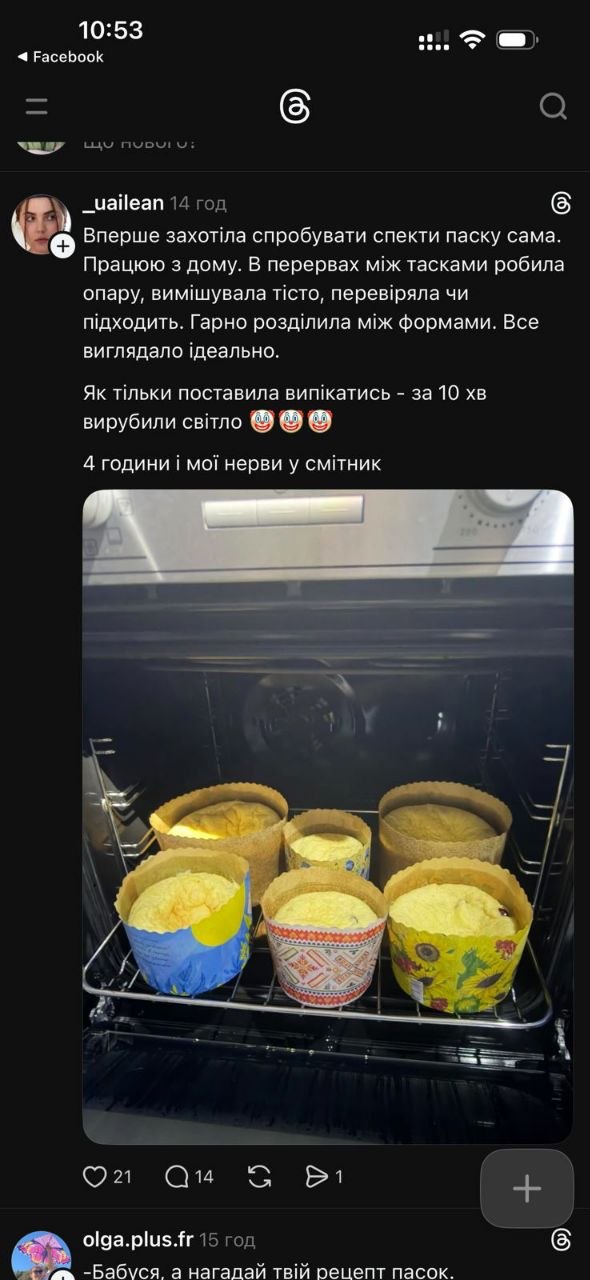
How to bake Paska on price caps, or Whose Maybachs are leaving Ukrainians in dark again
For a week now, Ukraine has once again been living with temporary power outages. Although it shouldn’t be. Objectively speaking, spring should have been a period of respite for Ukrainians after a difficult winter. There is more sunshine now, which means additional solar energy is entering the market. After a snowy winter, hydropower is performing well. And the nuclear reactors are still operating, though they will undergo maintenance this summer, at which point we can expect power outages again.
But whilst nature is on the Ukrainians’ side, the officials have decided otherwise.
In winter, due to the electricity shortage, the NEURC temporarily raised price caps (price limits – ed.) until 31 March to stimulate imports and power generation. This made it possible to reduce the duration of power cuts for consumers by 1.5 shifts.
From 1 April 2026, following the expiry of the increased price caps under NEURC Resolution No. 70 of January, the price caps on the electricity market for non-domestic consumers returned to a lower level.

As a result, for a significant number of hours, prices on the ‘day-ahead’ (DA) market and other segments do not reach a level that would make it profitable to import electricity from the EU or to start up gas-fired generation at thermal power stations and cogeneration facilities, reports Forbes.
"To put it plainly, the NEURC has taken a step akin to setting a price cap on diesel at petrol stations at 50 UAH/litre. And electricity has vanished just as diesel would vanish instantly," wrote former "Ukrenergo" head Volodymyr Kudrytskyi last Thursday.

On 7 April, NEURC Chairman Yurii Vlasenko stated that the commission had initiated a procedure to review the price caps on electricity.
"The commission is initiating the procedure to review price caps. I would like to emphasise that the price caps currently in force were set by the NEURC on 16 January 2026, and no changes to them have been adopted. This specifically concerns the opening of a procedure to gather comments and proposals from all interested parties," he explained.
However, it appears that if something was in force until 31 March, the document should either have been extended or a new one created.
Sources at Censor.NET say that at the mid-level, preparations were underway to extend the higher price caps. But then suddenly everything came to a halt.
"It’s quite easy to become paranoid in the energy market, but we know that the resolution was being prepared. And then this work stopped. Why? Someone decided that price caps should be reduced to their historical levels. Who gave the order? We have a single decision-making body," says the publication’s source in the market.
Incidentally, Vlasenko denies that price caps are the factor driving down imports.
"The market is influenced by objective factors, in particular the abolition by the Cabinet of Ministers of Ukraine of the gas PSO from 1 April 2026, which led to an increase in production costs and a partial suspension of generation, the premature cancellation by the Cabinet of Ministers of Ukraine of the decision obliging business entities to import electricity to meet their own needs, as well as repair campaigns and the restoration of damaged infrastructure," stated Vlasenko.
"At the same time, electricity imports are gradually recovering and, as of 6 April, stand at around 87% of the level recorded on 31 March," he added.
But the reduction in price caps is not the only decision that has dealt a severe blow to alternative generation.
The second step taken by the government was to reduce the gas PSO.
The PSO mechanism – the imposition of special obligations – is, in effect, also state price regulation.

On 1 April, the Cabinet of Ministers amended Resolution No. 222 and abolished preferential gas prices for electricity generation, leaving them in place for another six months only for frontline territories.
Following this, ‘Cherkasyteplokomunenergo’, in particular, announced that it had been forced to shut down its cogeneration plants and cease electricity generation.
In an interview with "EnergoReform", the company’s director, Pavlo Karas, noted that heating companies are ready to operate in the market, but clear mechanisms and fair conditions are needed.
According to him, the government’s abolition of gas subsidies for electricity producers from 1 April has jeopardised the development of cogeneration by district heating companies, as they currently lack mechanisms for purchasing natural gas on the market.
"In fact, there is a solution. Government Resolution No. 812 provides for gas supplies for heat production (...). It also includes the so-called ‘Volume No. 2’ – gas used for electricity generation (cogeneration) for own and other needs. Therefore, we could simply allow district heating companies to use natural gas under the so-called ‘Volume No. 2’. This would be gas at market price," Karas explained in an interview.
The reaction of the owners of gas-fired power stations was clearly much more heated.
"On 14 March, the operators of these new gas-fired power stations received a notice stating that, from 9 March, they were no longer consuming gas supplied at a special price, and that for the period from 9 to 14 March, they would have to pay a fine because the government had adopted a retroactive decision," said Volodymyr Kudrytskyi, as quoted by LB.UA.
"The second fact. On 30 March, the government, amending its previous decision, stated that we are providing subsidised gas to frontline territories where there are gas piston and gas turbine units, but only to those commissioned from 1 December 2025. Those gas piston units that were operating in November 2025, in October (remember how well everything was going for us?), are deemed unnecessary and harmful. Their gas price will be one and a half to two times higher," added the former head of "Ukrenergo."

In conversations with market representatives, one even heard that although the decision-makers for the two measures were different – the NEURC decided on the price caps, and the Cabinet of Ministers on the PSO – they share a common denominator.
"It was sort of said that decentralised generation producers had become too big for their boots and were driving around in Maybachs," says one of the interviewees.
The authorities’ dislike of decentralised generation was "party policy" during the time of Energy Minister Halushchenko. But it hasn’t changed much now either. The logic is simple – it’s difficult to herd many small players into a stable.
They say that DTEK representatives are now on very good terms with the president. The company’s CEO, Maksym Timchenko, attends meetings. And DTEK, if you look at it objectively, has absolutely no interest in decentralisation.
"DTEK is afraid of losing its market power and wants to use the money for decentralised generation from donors to rebuild its old power stations," suggests one market participant.
The only person to defend the government in this situation is ExPro Consulting expert Mykhailo Svyshcho.
"Electricity producers, who have been receiving preferential gas prices in recent years, are selling the electricity generated from it at market prices. This has created a distorted situation in the market," he noted.
But given everything that has happened over the last fortnight, it may well be that the 1.5 GW announced by Prime Minister Yulia Svyrydenko may not materialise.
According to the former head of Ukrenergo, investors building new generation capacity have adopted a wait-and-see approach and are currently in the process of halting projects. They are waiting for clarity on what the government intends to do next regarding electricity and gas prices.
"It is now early April, and it takes 8–10 months to roll out this new generation. Therefore, we can plan for the roll-out of this new generation and look forward to it, but the decision on this generation is not made by the Prime Minister, the President, the government or a Member of Parliament. It is made by the investor," Kudrytskyi noted during a discussion on Nova Kraina.
Tetiana Nikolaienko, Censor.NET


