



Yaroslav Yurchyshyn: Telegram abuses fact that no one is punished for failing to comply with rules
The conversation with Yaroslav Yurchyshyn, chair of the parliamentary committee on freedom of speech, immediately moved onto the "core track" of information policy and media freedoms during the war. There was plenty to discuss: Mindichgate, among other things, showed society that corrupt officials monitor journalists just as they do politicians.
And they do more than just monitor them. They also try to paralyze entire newsrooms through the use of lawsuits known as SLAPPs. Meanwhile, Russia singles out Ukrainian military journalists as especially dangerous to itself. The same applies to our journalists who have ended up in Russian captivity: they see a lot, notice even more, and once released, can tell the world about it.
We began the conversation with Telegram and its harmful "50 shades of grey," which the Ukrainian state currently does not control at all.
- There is now a lot of talk about draft law No. 111-15 on regulating Telegram’s operations in Ukraine. As is known, the bill provides that platforms must officially disclose who owns them and how they are financed. They must maintain contact with the Ukrainian state through an authorized body in cases involving terrorism, fraud, or threats to national security. Such platforms are required to respond promptly and cooperate. If they fail to do so, sanctions are envisaged, ranging from financial penalties to restrictions on the use of these platforms by state agencies, banks, and institutions that handle citizens’ personal data. The Committee on Humanitarian Policy has already unanimously supported the bill. But what will happen at the parliamentary level? Something tells me that many MPs will not want to vote for it, so as not to fall out of favor with users of this platform. How right am I in my observations?
- Quite right, because unfortunately, politics here is often not real but virtual. This law is not against Telegram. It creates a framework for all social media platforms. In other words, if drug sales begin on TikTok and TikTok decides not to share information with us, the same rules will apply to it as to any other platform: Meta, meaning Facebook, Instagram, and so on.
This law is not aimed against Telegram. The only nuance that is actually important is the ownership structure. There are reasonable concerns that Telegram’s ownership structure includes Russian state-linked funds. And this gives rise to a situation that already depends on current legislation, under which Ukraine cannot cooperate with entities from the aggressor state, including those that effectively support Russia’s war in Ukraine. This creates the conditions for sanctions. Telegram has not disclosed its beneficial ownership structure even internationally. Durov says the owners are he and his brother. What their stakes are, who else invests in Telegram (and this is not a cheap toy), is information no one has. So in this case, this component can be seen as aimed at identifying bad-faith networks where Russian money is hidden and, accordingly, taking certain measures against them.
- Even if the Ukrainian parliament does vote for this bill, will Telegram’s owners take the steps required of them? And if not, will the state have enough political will, as well as the technical and legal tools, to carry out the threat?
- Starting with the latter: there are enough technical capabilities. We have blocked individual Telegram channels, and, in principle, it is entirely possible to restrict access to Telegram as a whole, especially for new users.
- By what means?
- Through downloads on Google Play and the Apple Store. These are two platforms that are de facto monopolists for getting the Telegram app. Every phone or computer update will require downloading an update. If these apps are not available on those platforms, Ukrainians will not be able to use it directly... We are, of course, leaving VPNs and ways to bypass bans out of the equation. That will happen, but as Odnoklassniki and VKontakte show, it is less than 10%. Compare that with the 80% who currently use Telegram for one purpose or another and, presumably, 10%; of course, the impact will be nowhere near as powerful.
Will Telegram agree to this? Yes, it will. Remember the high-profile court case against Durov in France? How did it end? Durov began sharing the personal data of those committing criminal offenses in France. He does not say a word about this; he tries to maintain the position that "we still do not provide any information, we have a free space," and so on. But according to information from French law enforcement agencies, when they need information, they get it. So if a state sets rules, a player operating in that state must play by those rules. Provided, of course, that the state is prepared to punish them. And this is our weakest point. The popularity of social media, and Telegram first and foremost, creates enormous fear among political players that they will become unpopular if any restrictive measures are applied to social networks, not only Telegram. So the arguments that Ukraine is too small to engage with social media platforms are all fairy tales. Recently, a meeting was held at the National Council for Television and Radio Broadcasting with Kateryna Kruk, Meta’s public policy head for Eastern Europe. She said quite plainly: yes, of course, we analyze countries’ practices; yes, of course, we comply with the laws of the countries where we operate. The only nuance is this: if a country demands something we technically cannot provide, or something that violates human rights, we will not do it and are ready to defend that position in court.
So everything is fairly normal. But this is Meta: an accountable, reputable Western megacorporation that will, of course, try to avoid certain restrictions (because they reduce profits), but once legislation is in place, it will take it into account. What does Telegram do? Classic Russian-style business: playing without rules. Like in the joke about a Russian man and a game of roulette: "And then I realized that gentlemen play by the rules, and things really took off for me." In this case, Telegram is abusing the fact that it does not follow the rules in places where no one is punished for failing to follow them.
Telegram gives France everything France demands. Perhaps not as quickly; perhaps it also tries to obscure certain things. For example, if there are traces of some Russian security service. Any Telegram knows what they have stashed away in their vaults. But in France, it shares information.

In Ukraine, however, Telegram is a Wild Field. Durov either discovers some Ukrainian roots of his own or says he is being persecuted in Russia, that he is such an opposition figure there is simply nowhere further to go. (All while never once publicly condemning the war in Ukraine, never once substantively criticizing Putin’s regime! Putin himself, not some circumstances). And at the same time, Durov is in fact engaging in filibustering, in piracy in our country.
Returning to the law, I am not sure it will be passed. The only case in which it will definitely be passed is another terrorist attack carried out using Telegram. A high-profile terrorist attack. How likely is that? Very likely. As a reactive democracy, we start talking about important things not when we can do so with a cool head, but when serious problems begin.
- Here I will remind readers once again that, according to law enforcement officers, 80% or 90% of cases in which Ukrainians are recruited by Russian intelligence services happen through Telegram.
- And there is a very common manipulation here: if there is no Telegram, they will recruit through something else. Okay, we understand perfectly well that they will use phones or some other means. The point is that if such a large number of recruitment cases happen there, then it is currently the most convenient platform for this. Accordingly, we need to work with this platform. Does the government have the political will to work on this? No? But let me remind you that our discussion about the arms market and how to regulate it had been lying dead in the water, if I am not mistaken, since 2020 or 2021. Until people were shot dead in the Holosiivskyi district. Now the discussion has actively resumed, at the ministerial level, but whether this will lead to anything is not certain. And if it does, it will most likely lead to an emotional decision, not a measured and balanced one. We will get an imperfect law on the circulation of weapons. One that is actually important to us, and one that exists in all European countries.
Similarly, all countries are now making decisions on regulating social media. Let me remind you once again: at the legislative level, we cannot regulate only Telegram. The rules that will apply to Telegram will also apply to other social media platforms. But if we adopt these rules, we must ensure they are enforced. And here there are nuances even from the President’s press conference. When he is asked about Telegram, he mostly says: the Europeans will regulate it, and then we will join that regulation. The only problem is that 80-90% of cases in which Europeans are recruited do not happen on Telegram. There, the Russians operate through other networks. Although Telegram is also actively expanding in the EU now. It already has more than 45 million users. It will now fall under the Digital Services Act. We will see. Europe can certainly help us in this regard. A prophet is not without honor except in his own country, but when rules come from the European Union, even though we discussed them much earlier, for some reason, they become extremely popular and necessary for adaptation.
- But can the Ukrainian authorities’ failure to impose tough sanctions on Telegram be explained only by fear of public reaction? Is anything known about their financial ties with Telegram’s leadership?
- There is a reason, but it comes from a slightly different angle. It is the huge investment that representatives of the Ukrainian authorities and opinion leaders have made in Telegram. First and foremost, in promoting their own channels, in creating entire networks of channels used to praise their beloved selves and smear opponents. Even representatives of the security services use this, although, logically, they should be doing the exact opposite, countering Russian influence as much as possible. Instead, they use a Russian network and Russian methods, when anonymous channels are used to spread some filth about opponents. And then comes the classic joke: "Is your daughter a prostitute?" — "I don’t have a daughter." — "Now explain..."
I have no information that anyone in the Ukrainian authorities is financially interacting directly with Durov or has a joint business with him, or anything of the sort. But since the days of Andrii Bohdan, our authorities have had this very mistaken impression that in the age of social media, media outlets are not needed, that you can become the media yourself. The Telegramization of the Ukrainian authorities is the result of a failure to understand that balanced information from media outlets trusted by society is far better than the use of anonymous sources. Because these anonymous sources, today you pay, they work with you; tomorrow you pay less, they work with your opponents. And our key opponent is the opponent of Ukraine’s very existence, that is, Russia. So will Russia not pour a pile of cash into these anonymous channels tomorrow? The most sensitive situation in this case could arise when a ceasefire is reached and elections begin. And these channels, which yesterday praised the Servants of the People, European Solidarity, Holos, and Batkivshchyna — boom! — start actively working against these political forces, discrediting them. After all, those Russian channels, such as Legitimnyi and the like, initially worked quite softly with the newly elected Ukrainian authorities in 2019. They even praised and promoted them. But at the moment of truth, when Putin decided that the attack would happen, long before that attack, they began systematically attacking them. When you do not control the source of information, when you do not understand who is behind that source (and with anonymous Telegram channels, even when we expose the nominal owners, they can always shift things around, because this is indirect data), you cannot be sure of anything. So this was a major mistake dating back to 2019, when they invested not in building strategic communications, both inside and outside the country, but decided to take the easier path traditional for Ukraine and humanity. They used social media, and now social media are using the Ukrainian authorities to the fullest.
- You, that is, MPs, representatives of NGOs, lawyers, and media experts, are currently preparing a bill intended to prevent SLAPP lawsuits and allow judges to close cases at an early stage if there are clear markers of SLAPP. To begin with, give us a definition: what is SLAPP?
- Strategic lawsuits against public participation. This is when those with resources deliberately abuse the right to file a lawsuit, usually to protect their name and dignity, creating problems for civic activists and members of the public in carrying out their work.
- So a SLAPP situation can be described this way. Some official or politician, or two in one, is engaged in corruption or abuses power. A certain outlet writes an exposé about him or her and may be planning to continue writing. What to do? And then this official, or his lawyers and advisers, resort to the following tactic: let’s sue the journalist and the outlet, file a major lawsuit that is draining in terms of time and nerves, and financially burdensome if possible, so that every day the journalist and the outlet have a growing desire simply to remove this story from the information space, as they are being demanded to do, in order to throw off this heavy burden and keep working. Am I reflecting the essence of the phenomenon correctly?
- Absolutely. The only thing is that it may not be only a corruption investigation. It may be an investigation into corruption-related crimes or an investigation into human rights violations.
- In other words, abuse of power to one degree or another.
- Exactly. Those who have resources. This can include representatives of big business. Especially representatives of state-linked businesses who obtained contracts in bad faith, after which exposés appear about them, and they try to refocus the attention of activists or journalists away from their work and from exposing problems, and onto defending themselves in court. Mounting such a defense is quite expensive and time-consuming. Ukraine has a vivid example: the Svynarchuk and Bihus case. Bihus.Info exposed corruption in the defense sector. The court proceedings are still ongoing. A huge amount of resources is being spent on them. At the same time, Bihus.Info is well known. They can at least appeal to their readers; they have lawyers working for them, including to minimize such challenges. But the idea of SLAPP is to block the work of a newsroom, so that journalists spend their time going to court instead of digging up materials of public interest.
- The mere existence of an international English-language term identifying this phenomenon indicates that it is typical and global in nature. However, in Ukraine in recent years, its ideological lobbyist was Andriy Portnov, who introduced SLAPP as a constant mechanism for fighting the journalistic community, primarily against investigative journalism. Currently, Portnov is out of the picture, but his practices live on. Are there any recent examples of SLAPPs?
- Yes, there are. For example, lawsuits against an investigative journalist and a number of environmental activists fighting the legally dubious construction of wind turbines in Zakarpattia, where public hearings are being falsified. They are already pouring foundations there without any permits — and claiming that it is not construction at all. Colleagues from Zakarpattia are exposing all of this, and then various forms of pressure begin, including the use of fake social media accounts. It is very clearly visible here that there is an entire campaign aimed at discreditation. Lawsuits are an element of this discreditation... There are lawsuits against the Anti-Corruption Action Centre (AntAC), against Transparency International, against many environmental activists. Mostly, it is a standard set. Quite often, it is not a lawsuit filed in a single court, but rather a so-called blanket filing of vexatious lawsuits. That is, they are filed in various courts — hoping that one will eventually stick. These involve demands for massive compensation for the protection of honor and dignity, which are quite often measured in tens of millions. There are such categories that very clearly indicate this is not about honor and dignity, but about distracting attention and discouraging action. You noted very well that mostly, those who file these suits pursue a primary goal (especially when it comes to small media outlets), to make people wonder: is this material worth all these problems? There are such examples all over Ukraine. There are not hundreds of them, they are measured in the dozens, but predominantly they target the most proactive activists carrying out activities in the public interest, as well as investigative journalists.
- You write about "dismissing a case at an early stage if there are clear SLAPP markers." What exactly are these markers? How is this intent to keep a journalist under constant pressure identified?
- I have already mentioned them — these include vexatious lawsuits and exorbitant compensation claims; prior threats such as, "I will drag you through the courts." This can also be an indicator, especially when a certain ultimatum is issued. A call from a company owner or a state official: "What are you getting into?", "You don't realize who you're dealing with," "I'll drag you through the courts!" And then a lawsuit follows. In such cases, it is clearly evident that the individual is using the legal action for pressure rather than to establish justice.
For Council of Europe and EU member states, the adaptation of anti-SLAPP legislation is a requirement. In principle, we have also committed to developing such legislation as part of the European integration process. 2026 is precisely the year when we must adopt this legislation to stay on schedule... You are right, this initiative originated in Malta, where prolonged legal actions by business representatives against a journalist led to a tragic situation in which the journalist was targeted and murdered. It later emerged that those who had filed lawsuits against her were the ones who ordered her assassination. Initially, they created obstacles for her work. Later, realizing they could not silence her, they ordered the killing.
- Readers can learn about the details of your draft bill from your column. I have a different question. Do you believe that the current convocation of the Verkhovna Rada will vote for your bill? After all, a significant number of deputies are not particularly interested in expanding the capabilities of the press. Many have undergone reputation scandals and certainly do not want increased attention on themselves.
- You know, I recall a case where more than 30 subjects of investigations by the National Anti-Corruption Bureau voted to strengthen the independence of the National Anti-Corruption Bureau (he smiles. — Ye.K.). This happened because it was a demand from society and our European partners. Therefore, it is currently very important for us to explain to the public (especially those who have not been targeted by SLAPP lawsuits themselves and have no such prospects, being less involved in social activism) how vital it is to help journalists have the opportunity to do their work rather than being dragged through courts on absurd charges.
Therefore, in this case, much depends on public demand. The Europeans have given us time to adopt this decision by the end of 2026. We involved Council of Europe experts in our work. They provided certain proposals on how to improve it. But they clearly noted that our initiative ensures the fulfillment of the minimum benchmarks that are mandatory for member states and candidates for the European Union.
Therefore, we already have one half of the sandwich. The Europeans have clearly stated that without this legislation, we will not be in the European Union. On the other hand, we are currently engaged in explaining to society what this is about. Because it is very easy to substitute concepts there and revert from SLAPP legislation back to Soviet-style liability for defamation, which even we have already abandoned. Because quite a few of my colleagues are trying to present it precisely in this combination... We currently have defamation lawsuits as well. If there is genuinely false information, the requirement to remove it and publish an apology — whether by a court decision or possibly in a bilateral format — does not contradict the right to protect one's reputation and dignity at all. This simply limits the ability to manipulate the process in order to hide socially important issues from the public.
- Another social issue concerning journalists. In January, responding to your inquiry, the National Police reported that the Solomianskyi Police Department of Kyiv had initiated criminal proceedings regarding possible illegal surveillance of a number of journalists by the subjects of the NABU "Midas" operation. As is known, the individuals involved in Mindich-gate collected information on a whole series of Ukrainian journalists. Is there anything new in this story? Perhaps not only related to the police and their investigation?
- Unfortunately, the State Bureau of Investigation (SBI) did not see its jurisdiction in this matter, although, in reality, it was impossible to gain access to closed registries in any way other than through the verified access of a state official (primarily, most likely, a representative of the law enforcement system). Therefore, the SBI's jurisdiction is very clearly evident here. And the SBI is the police for the police; that is, it monitors to ensure there are no abuses by representatives of the law enforcement sector.
- The problem is that the SBI's involvement is also plainly visible in certain aspects of Mindich-gate. Therefore, regarding the SBI's position on its jurisdiction, everyone can have their own private thoughts...
- I completely agree. But the story here is such that the logic can be understood. Our task is to ensure that law enforcement agencies perform their function. The investigation by the Solomianskyi department is ongoing. They have familiarized themselves with the materials of the National Anti-Corruption Bureau, communication has taken place, and the first individuals from this list have already been invited. Mr. Andrii Kulykov has already been called, and they agreed that in late April or early May, he should come in to give testimony. At the same time, Yura Nikolov has not been contacted. So, it is proceeding somewhat selectively. I do not know about Yura Butusov. The last time I spoke with him was only when he was informed that the case had indeed been opened.
- But was it NABU that opened it?
- No. The National Police opened it based on investigative jurisdiction. This does not fall under NABU's jurisdiction. The collection of private information is under the jurisdiction of the National Police. Obstruction of journalistic activity is under the jurisdiction of the National Police. If NABU had opened the case, they would have had to immediately transfer it to the National Police. Therefore, it is logical that they waited for the National Police to open it and granted the National Police access to all the information related to this component of the case, namely, the unauthorized surveillance of journalists. I plan to appeal to the National Police again sometime in May to understand at what stage the investigative actions are. Of course, it is unlikely there will be any details, as it falls under investigative secrecy. But are there grounds to believe that this involved the extraction of information from closed sources? Accordingly, has an expert examination been conducted to determine who used this access? Because by searching for a surname in the registries, it is very easy to determine under which USB token a verified user searched for information on this or that person. If this is established, we will then force the SBI to work, to perform its function, and find out why state law enforcement officials provided private information about certain figures — in this case, journalists — in the interests of an organized, corrupt group.
- Do I remember correctly that the police wanted to receive official complaints from the journalists who were being surveilled? And as far as I recall, only Butusov submitted a statement to the Prosecutor General's Office. The rest of the journalists did not do this.
- There was a public statement by the Commission on Journalistic Ethics with an appeal to law enforcement agencies to investigate the cases concerning journalists. There was a statement from Andrii Kulykov, and we worked with Yura Butusov's lawyer. I am extremely grateful to Yura for this statement. Yura Nikolov said that he had written and rewritten countless such statements, and every time it ends at the stage where, at best, they expose the scapegoats; that it is not worth the effort.
And this is a major problem. The inaction of law enforcement agencies undermines the very concept of protecting one's rights and dignity. That is why I made a separate appeal regarding all the journalists. As for the others, I know they were in contact with law enforcement agencies, but whether they filed official complaints, I cannot say. I do not have that information. But this is a very big problem. The rule of law only works when we are ready to use it. And we use it when it inspires trust in us. If I do not believe that the court will deliver a fair decision, I will not go to court. If I do not believe that the police will investigate, I will most likely not file a complaint. But democracy is based on the premise that we utilize our institutions, rather than trying to resolve issues through extra-institutional means. Therefore, I am very grateful to Yura. We are keeping this case under control.
- Is it known how many politicians were featured in these dossiers?
- We only have unofficial data. A number of deputies were included. With very different objectives — collecting information on opponents and on those who were viewed as potential partners... There are several dozen deputies and officials. Especially officials in the energy sector.
- There were apparently many of their own people there...
- A great many of their own people, supposedly. Once again, these are classic files on public figures. The infamous Tatarov files, which can be used to ensure that certain deputies vote for a specific decision. I understand the same principle was applied here.
- We often hear that certain journalists are featured on various Russian blacklists with potential plans for terrorist attacks against them. Their security is evidently managed by the SBU. What can be done at the legislative level to provide them with the maximum possible security? The key word here is "possible" — because it is clear that no one can provide a 100% guarantee.
- This is rather a matter of the proactive positioning of journalists, because we understand that Russian lists include a very large number of civil activists, politicians, cultural figures, and journalists. Practically anyone who voices active criticism, especially with exposés, and whose materials are featured in the Western press, this is already a marker that they might be of interest to Russia. In this context, physically, no state in the world will ever have the capacity to assign a special agent to each of these individuals for systematic personal protection. Therefore, an important component here is what we call proactivity. For instance, together with the OSCE, the Security Service of Ukraine, the Ministry of Foreign Affairs, the Ministry of Internal Affairs, the National Police, and the National Guard, we are currently conducting a training course on cybersecurity and personal safety.
- Who is this training for?
- Primarily for war correspondents. Because this is a priority focus for Russia. Russia is eliminating Ukrainian war correspondents, as it quite reasonably considers them to be essentially the source of truthful information about war crimes, and a verified source at that. Based on the investigations conducted by our war correspondents and investigative journalists, numerous cases have already been initiated — and not only in Ukrainian courts.
- Do I understand correctly that the enemy's interest in war correspondents is primarily an attempt to help their military personnel avoid the fear of punishment? As if to say: nothing will happen to you, go ahead and kill, the state is working to ensure that no information is collected about you, so that you will not be brought to justice later.
- Exactly. It is an attempt to convince them that they can continue committing war crimes and will face no consequences for it. Because, regarding those who could document them; those who work at the front, on the line of contact, the professional journalists engaged in this — we will do everything to ensure their information does not reach the public or judicial authorities. That is the approach.
Regarding legislative changes, this issue concerns not so much our internal regulations as it does international regulations. Humanitarian law does not define what an anti-drone gun is. Very often, the Russians, manipulating the narrative, claim that journalists carrying an anti-drone gun are a legitimate target, that they are combatants. We are currently working very actively across all international platforms to get through, primarily to the UN, and to put an end to these absurd discussions.
- The problem is that international institutions often do not understand these realities. They themselves need training to understand what our realities consist of.
- Therefore, our cooperation with the OSCE is very positive, because we organize it not only for our own people but also for official representatives; Ambassador Jan Braathu, the Representative on Freedom of the Media, opened the respective events. We must enlist partners from their circles who will demonstrate that while previously a bulletproof vest bearing the word "Press" served as protection, now such a vest is a legitimate, even priority target for the Russians. If it used to be enough to write "Press" on a car so that, relatively speaking, they would try to avoid hitting it, now they will definitely launch drones at you, and without basic anti-drone protection, you will not survive. Because when a drone crashes into a car, firstly, detectors provide a chance to jump out, and secondly, there is a chance the vehicle will protect you. Therefore, this is quite a complex process. It concerns not only journalists. Currently, the biggest problem for our Coordination Headquarters for the Treatment of Prisoners of War is that, under international law, there should be no civilian prisoners. That is, the parties are obliged to release civilians as soon as the situation becomes more stable. They can only be detained for their own safety, so they do not end up in the cauldron of hostilities. What do the Russians do? They simply take hostages in batches, attempt to manipulate, and constantly issue ultimatums saying, "You will give us our captured military personnel." Because in Ukraine, there were no civilian hostages even during the Kursk operation, as we adhere to international law (and sometimes it turns out we punish ourselves). But on the other hand, the Russians constantly try to incentivize us: let us give you civilians, and you give us military personnel. And as soon as we fall for this, everyone who remains in the occupied territories will become a hostage. Despite the fact that they essentially already are.
- The Russians practically do not hand over captured journalists. Why?
- Because a journalist who has survived Russian captivity, such as Maks Butkevych, Vlad Yesypenko, or Dmytro Khyliuk, represents professional eyewitness testimony. This is a person who can speak about their experience at the international level; they can show on their own body how they were tortured, what was done to them, and how they were denied the possibility of receiving medication. As is currently the case, for example, with Iryna Danylovych from Crimea. She is essentially being murdered in prison, because even though Russian lawyers, her parents are not allowed to provide an adequate amount of medical treatment. This is why the Russians are so reluctant to exchange journalists. Over the past year, we have managed to free only three out of thirty. And we have the tragic case of Viktoriia Roshchyna, who was simply purposefully murdered in a Russian prison.

Therefore, we established a special investigative commission in the Verkhovna Rada to investigate Russia's crimes against the media, in order to convince the international community that crimes against freedom of speech are crimes aimed at concealing war crimes. If they go unpunished, any totalitarian regime — Asian, Islamic, or any other — will primarily kill journalists, including citizen journalists. Because in Crimea, they arrested many people who simply reported the truth on their platforms. Therefore, in this case, one of our tasks is to engage international partners in a broader understanding of why journalists and civilians must have enhanced protection, and the Geneva Conventions in this regard must be seriously reviewed. There must be protocols that make it possible to tie the severity of sanctions to whether a state party to a war releases civilian hostages or not.
- It is clear why the Russians do not want to hand over civilian journalists. But the question is, can we be sure that our authorities are making every effort to free all captured journalists?
- They are making every effort. When Maksym Butkevych goes on an advocacy campaign around the world (and Maks had several consecutive months when he did not even visit Ukraine — he traveled to various platforms as a journalist and also with a human rights background), he is simply a treasure for the Ukrainian cause, not for the government, but for the Ukrainian victory. Therefore, we do not have priorities regarding which civilians to release. Whoever we have the opportunity to release, we will release. But why are journalists in a way a separate category for the authorities? Because we can talk about them; they were public figures up to the moment they were arrested.
- Yes, and they entered the full-scale war holding this status.
- Yes, and the Russians know perfectly well who they are. No matter how much we might have wanted to conceal that Maks Butkevych, who joined the Armed Forces, is a human rights journalist, finding this information required just one click on the Internet. You cannot scrub this clean; it is not a social network where, if you expressed pro-Ukrainian views, you could theoretically delete them (although there is no guarantee that in Telegram this will not fall into the hands of the FSB). Unfortunately, we have cases where released prisoners recounted being interrogated based on materials from accounts they had deleted.
Therefore, in this case, the authorities clearly understand the importance of such individuals. Ultimately, a very significant indicator is that our commission includes a majority of "Servant of the People" party members, and they are very active. I would like to highlight the work of Zhenia Kravchuk, who pushed through the PACE resolution on arrested Ukrainian journalists. Together with her and Mykyta Poturaiev, we are working on a resolution and measures regarding captive journalists at the OSCE. Here, the authorities are doing as much as they can.
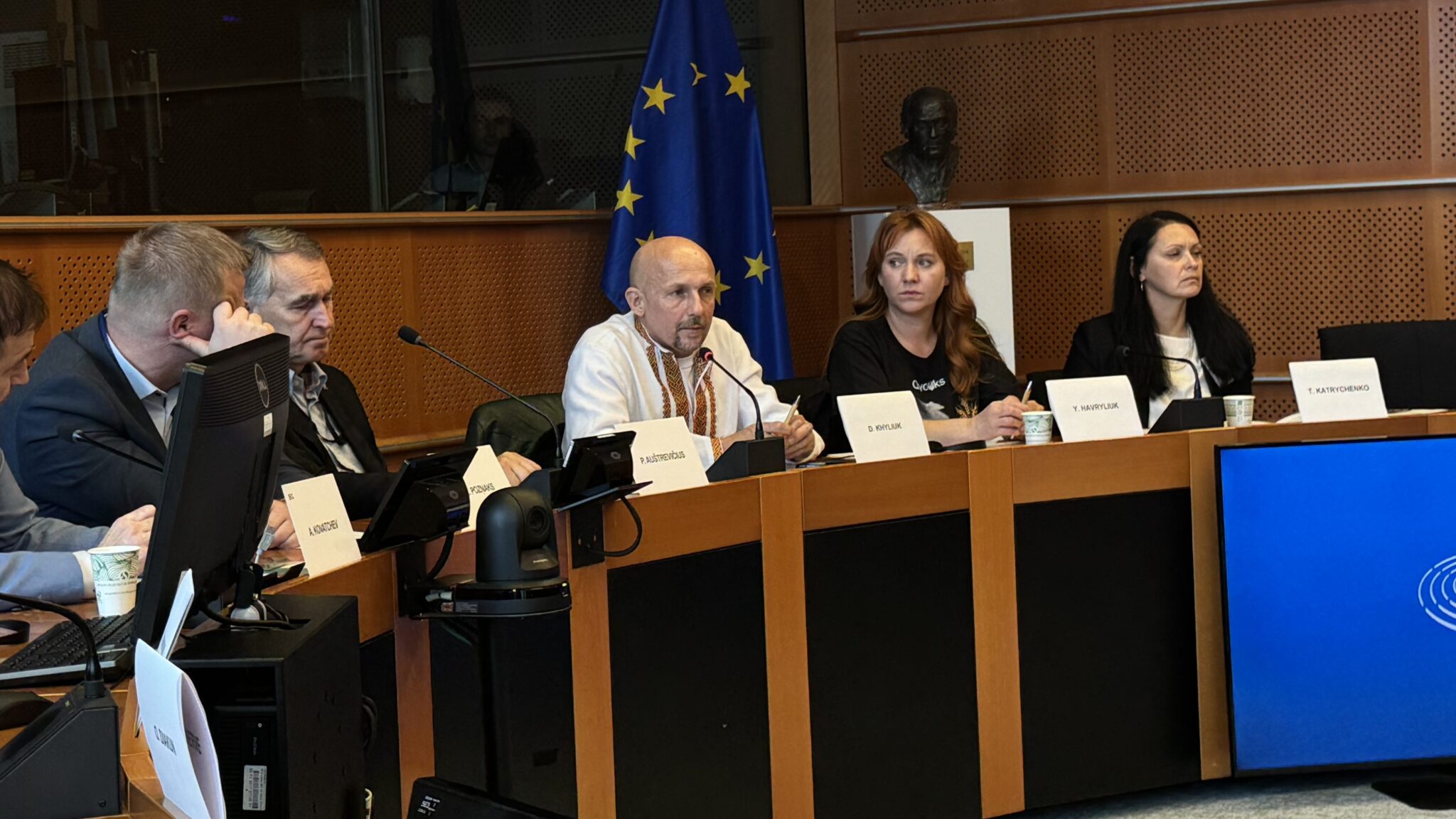
Journalist Dmytro Khyliuk, released from Russian captivity, speaks at the European Parliament. Photo: Media Initiative for Human Rights
- And the Prosecutor General’s Office?
- I cannot say with certainty that these cases are highly prioritized within the Prosecutor General's Office, because there are a great many cases concerning war crimes. Frankly speaking, it seems to me that the priority of the Prosecutor General's Office should not be pressuring NABU and SAPO or shielding certain figures in corruption cases, as we witnessed quite recently, but rather the investigation of war crimes. Because this will form the foundation with which we will approach the international tribunal, and with which we can appeal to partner countries for the extradition of war criminals if they end up there. As we have seen with the Scandinavian countries, this is a quite realistic scenario. Or with the recent example of "black archaeologists" (illegal diggers -ed.) in Poland. If we have sufficient arguments, they are ready to listen to us. I have more questions for the law enforcement system. Not in a critical sense, but in terms of whether those who deal with war crimes have been given a sufficient level of priority regarding access to resources, technical capabilities, and international cooperation. Because often this is a crime not only within Ukraine; it is a crime where the subjects may already be abroad. And it is necessary to work very actively to ensure they do not slip away.
- The Russians are actively stepping up their propaganda; they have filmed and continue to film series and movies about the situation in the occupied territories, where they turn everything upside down: demonizing our people and heroizing their own. What do we need to do?
- We need to build strategic communications. We will not beat Russian propaganda with our own propaganda. Firstly, we are not geared toward that. Secondly, our people fall for it less because there are competing sources of information, so information can always be verified. And such mega-glorification is not guaranteed to resonate. The issue here is that for a long time we attempted to build a tradition of telling society only good things, the mobilizing "3-4 weeks." In the 13th year after the start of the war, and the 5th year after the full-scale invasion, this does not work. Therefore, we need to establish honest communication with people, both with our own citizens and abroad. But this must be a coordinated position. It cannot be a single "one voice" strategy, because Ukrainians never sing in unison. We are too democratic and freedom-loving for that. But it can be a good coordinated choir, if there is cooperation in this. If the president speaks about our plans, goals, and what can be discussed, at press conferences, answering difficult questions; if there are meetings between the government and civil activists, who quite often have much easier access to our international partners. Because since the Revolution of Dignity, the first people the IMF, the World Bank, and the European Union communicate with when they come here are representatives of civil society, as the drivers of positive change.
Business contacts. We are severely underutilizing them; our large companies are very often included in management processes involving various businesses in different countries. What do we lack? We still do not have an information policy strategy or, apologies for the tautology, a strategy for strategic communications. It is not about the name; it is about what image of Ukraine we are jointly building in our explanations for both our citizens and international partners.
Frankly speaking, Europeans admire our information policy. They do not understand how it is possible to withstand such pressure and not collapse. But the reason they admire it is that, at times, they do not realize that for us, it is a network of individual acts of heroism. Journalists gathered and investigated who murdered Viktoriia Roshchyna. And they exposed, down the line, representatives of almost the entire penitentiary system. The Prosecutor General's Office stepped in, and criminal proceedings have already been initiated against some of them.
But this can be done systematically, balancing resources, helping one another. And not like it was during the Maidan: someone realized that hedgehogs needed to be placed so the internal troops could not pass, they found them themselves, placed them, and so on. That is, we need to learn from our Zaporizhian Sich and transition from an internal impulse to building this at the state level. We can defeat Russian propaganda very simply. Because the truth is on our side. We do not need to invent things, we do not need "crucified boys" and bullfinches; our facts are real. (Editor's note: "Crucified boy" and "bullfinches" refer to infamous and absurd Russian state media fakes from 2014. Propagandists falsely claimed that Ukrainian soldiers crucified a three-year-old boy in Sloviansk, and that Ukrainian schools taught children to kill red-breasted bullfinches because their colors supposedly symbolized Russia).
Yevhen Kuzmenko, "Censor.NET"
Photo: Yaroslav Yurchyshyn's FB, Internet


