



"We need you for another year to sort everything out": How Mindich and Umerov carved up Fire Point’s billions
In mid-April, six months passed since the first NABU recordings in the Midas case were released. They showed how the president’s inner circle amassed wealth by siphoning money out of the energy and defense sectors. But while all the figures who appeared on the recordings in the energy-sector case received notices of suspicion, no one has been served with one over the defense sector.
There was even a theory that Western partners had asked NABU not to move forward on this, understanding that after these materials leaked, it would be difficult for them to explain to their citizens why they were giving Ukraine money for weapons.
On Tuesday, journalist Mykhailo Tkach nevertheless published some of the materials he had received from Ukrainska Pravda’s sources.
The most interesting part concerns the defense sector.
Until now, journalists had only two sentences on this subject from a conversation between former Defense Minister Rustem Umerov and businessman Timur Mindich.
"Throughout 2025, facts were established indicating Mindich’s criminal activity in the energy sector through his influence on then Energy Minister Halushchenko, and in the defense sector through his influence on then Defense Minister Umerov," a SAPO prosecutor said during the first hearings in the Midas case.
Later, a phrase from a conversation between Umerov and Mindich was leaked via Telegram channels, but it merely indicated the businessman’s pressure on the minister. It did not provide any insight to outsiders regarding the minister’s involvement.
"I don’t want to hear from Timur about body armor anymore, and I meet with him twice a week." "Well, this is one of your teams, that’s all." "Sort this issue out, please, or this is going to turn into some kind of f***ing disaster." "There is simply 7 [inaudible]–300 million invested there, half of it my money," Mindich says.
This episode concerns Mindich asking the minister to accept body armor supplied by his companies.
No one would have understood this phrase had the author of this article not found several suspicious tenders back in March by the Defense Ministry’s state enterprise, the State Operator for Non-Lethal Acquisition, for the procurement of Israeli body armor.
Although the companies won with prices lower than those on the Ukrainian market at the time, the tender documentation showed that it had been tailored specifically to allow these companies to be admitted to the tenders. Under the standard qualification criteria, they would not have passed.
At first, an obscure shell company was supposed to receive almost a year’s supply of body armor worth 1.5 billion, and later, only 10,000 bulletproof vests were put up for tender. At the same time, the next shell company brought to the tender a certificate of conformity that had been issued for a bulletproof vest produced by another company, which was not a party to the contractual relationship. The tender was placed under monitoring by the State Audit Service of Ukraine (SASU), while the Independent Anti-Corruption Commission also flagged it in its report as showing signs of corruption.
The body armor was later not accepted. The Ministry of Defense carried out additional live-fire testing and determined that the bulletproof vests were of substandard quality.
Once it became clear that Mindich was behind the scheme, the Public Anti-Corruption Council at the Ministry of Defense filed a criminal complaint with NABU, describing how the manipulations took place at the qualification stage.
And now Mykhailo Tkach has published the full dialogue, which also makes Defense Minister Umerov’s role in the scheme clear.
Mindich’s conversation takes place on July 8, 2025, at 7:37 a.m. It is a Tuesday, and the day before it had emerged that the president planned to move Umerov to the post of ambassador to the United States, while Denys Shmyhal would become defense minister.
Mindich: Good morning, Mr Minister. At your command.
Umerov: How are you?
Mindich: Everything is fine. How are you?
Umerov: After the news.
Mindich: Yes.
From Mindich’s point of view, "appointing Shmyhal is a deep sh*t."
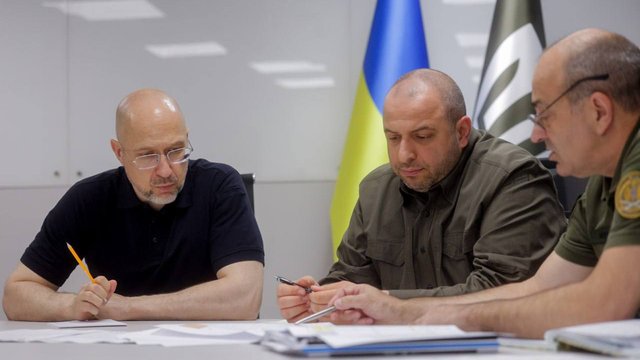
Umerov, judging by the conversation, told the president in response: "If you trust him, it will simply weaken you."
Mindich: Well, yes, because this is Davyd. That’s what will happen.
Umerov: Well, you will simply, in six months or a year, become a secondary part of the sentence. He will already be able to play his own game, he will be strong. Do you understand what the problem is?
Mindich then steers the conversation toward his desire to receive payments from the Ministry of Defense.
"You are temporarily not settling the payments. We are ready to hand over all the goods, no questions asked. He also talked about this: ‘Hand everything over.’ I say: ‘We will hand everything over.’ But our plant will come to a halt tomorrow," Mindich tells Umerov.
Mindich then says that they invested all their profits in the production of Fire Point’s long-range strike drones, the FP1, FP5, and FP7.
Since the summer, journalists have published more than one investigation suggesting that Timur Mindich may be one of the company’s beneficiaries and that this was what helped the company secure contracts. Incidentally, Mindich himself denied any involvement with the company in a winter interview with Tkach: "Someone says his daughter is a prostitute, and then you have to go and prove he has a son." A large-scale whitewashing campaign was carried out for the media to show that Mindich had no connection to the company.

For some time, the discussion focused on the cost of the products, but that does not seem to be what the story is really about. The question is how the company received the orders and why the defense minister himself was involved in finding investors for it.
"We need it, we are not asking, we need current financing to produce everything. That is without the 120. As of today, we are owed seven," Mindich continues complaining to Umerov. He adds that he has 2,000 people working for him.
Judging by what Umerov says next, Fire Point’s contracts were financed by foreign partners.
"We are now asking the partners, 1 billion will come in somehow. I can see it will not be quick," the then defense minister explains.
"53 billion here, I brought another 45, another six. This is, well, not exactly, you understand, not according to plan. I am saying we need to raise it, but we will manage there, nothing like that. Have you heard about the US? There are still some tasks there," Umerov goes on to tell Mindich about the financial options.
He also says he is going to the UAE.
"I am going to the UAE, Masha has been driving me up the wall," the then minister says.
Umerov: I wanted to ask you, are they doing anything on this track, or is it all a lot of nothing?
Mindich: A lot of nothing, brother.
Umerov: Yes.
Mindich: It looks like they want to understand what we have, that kind of information, a spy game.
Umerov: Yes.
Mindich: They are dangling a carrot like this. Well, you can’t not fly there.
As is known, reports have been circulating for more than six months that investors from the UAE were supposed to acquire a stake in Fire Point. Even the company’s nominal director, Iryna Terekh, spoke about this.
Mindich: Well, we are ready, if we sell, we will give everything. What they need from you is that you will give permission. That is, we are a real company, we did everything we talked about. They value the company like this; they want 33%.
Umerov: Have they already said that?
Mindich: Yes, yes, there is an offer. Out of the 33%, they want to invest 60% in the company and 40%, well, we can agree on making 50% a cash-out.
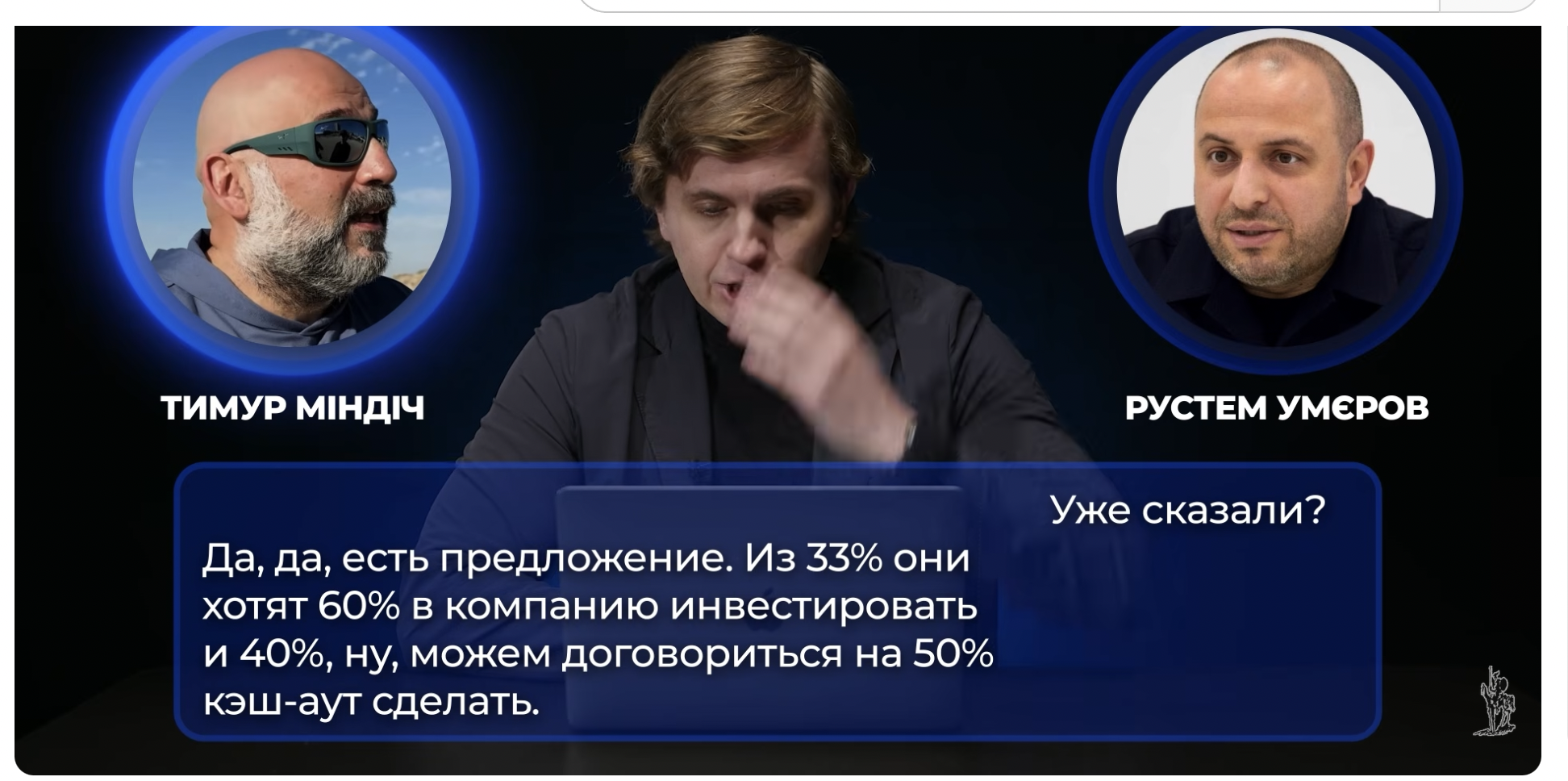
Mindich’s next words already indicate a plan to move 300 out of 600 million into cash. The currency is not specified.
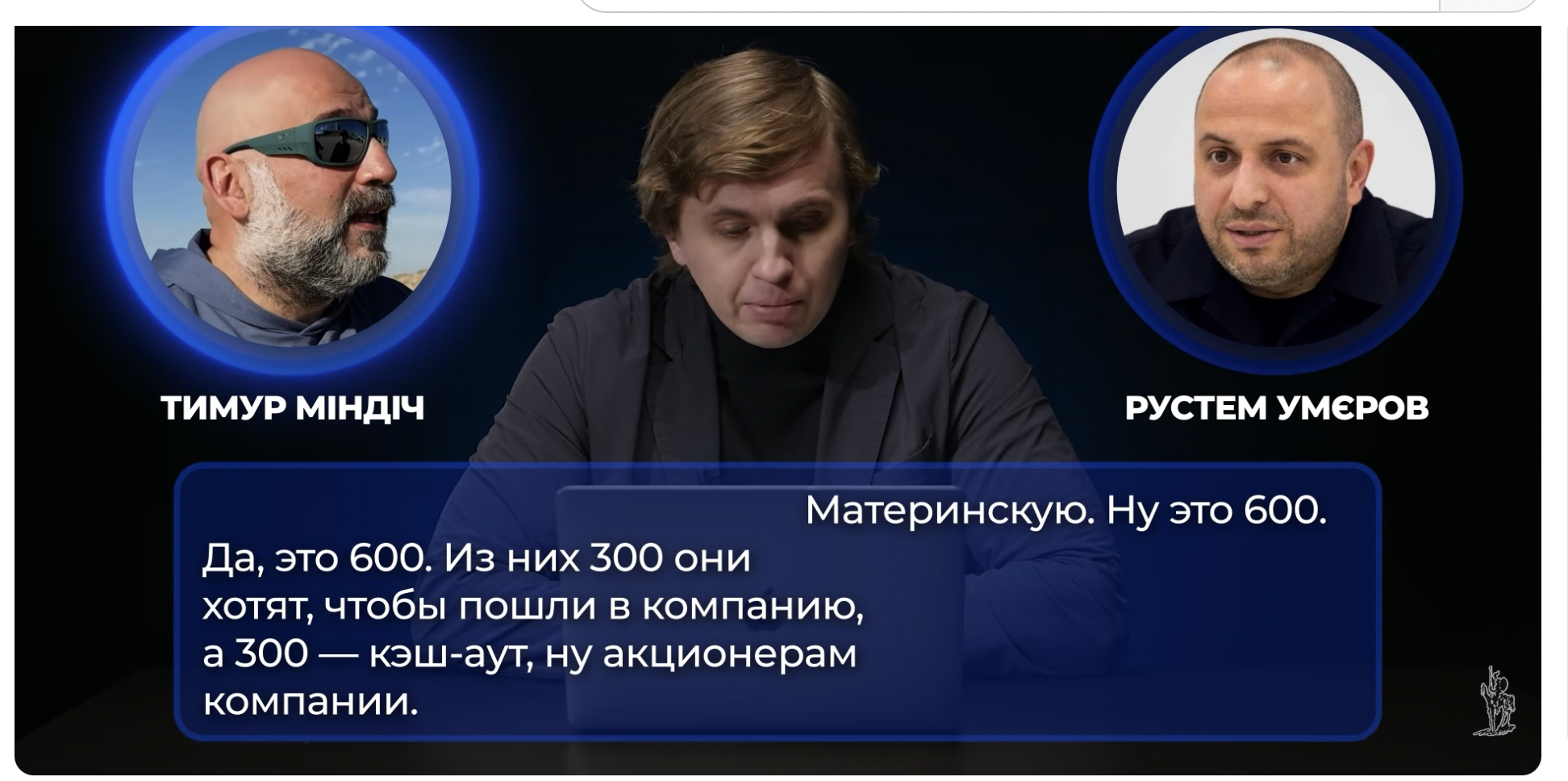
Since at that moment Mindich doubts that his company will receive 120 billion from the state, he wants to use the investors’ money as a safety net.
"But it is better to have this parachute. I mean, that there is someone foreign there, we are hedging our risks and all that," the businessman tells the minister.
He then effectively asks the minister to influence his subordinates so that the contracts he needs are signed.
Mindich: You are about to leave, and everything there will go to hell across the board. On the body armor, I will be down $7 million. But I am not alone. I mean, there is Fire Point here, and competitors can just take it down like that. They can stop paying now, and that is it. You will now take the goods, yes, yes, yes, then say, give us a new advance payment, and I will be in trouble. You are about to leave, everyone will be swept out, and we will not have a single person there. No one to communicate with. Please, call all these people in.
Umerov: It is set for today.
In addition, it is Mindich who proposes opening up arms exports.
Mindich: Maybe open export-import, but what it will give, I do not know.
Umerov: Opening exports is fine. Defense City allows it from Aug. 1, you will have exports.
Mindich: Then at least all these production facilities will keep working, you understand? Apart from the fact that we will be ripped apart, well, sooner or later.
As is known, at that time several associations of arms manufacturers were speaking about the need to open up exports. But who knows, perhaps the need of one specific company played a decisive role in this decision.
Umerov and Mindich then discuss the possibility of producing ballistic missiles that would be eight times cheaper than American ones.
He promises to produce 1,000 and 5,000 missiles as early as the following year, that is, in 2026.
"We have a sh*tload of mixers. If you give us money today, an order along with what is needed so that banks can lend to us, contracts, advance payments, we should manage, we should open up. We need to open up today in other places. We cannot hide in Kyiv," Mindich says.

He asks the minister for 150 million for ballistic missiles.
Umerov suggests that Mindich hold out for 10 days, until July 17, when he will allegedly receive 311 million.
But the businessman demands that the minister put pressure on banks, in particular on NBU Governor Andrii Pyshnyi.
Umerov: I have simply realized now that no one is going to help with anything. I will go again.
Mindich: Call in the bank, get them on board.
Umerov: I have already called them in.
Mindich: Did you call in Pyshnyi?
Umerov: He is simply not in the country.
Mindich: Then call in Sense.
After that, Mindich asks Umerov not to leave, because otherwise he will have no way to advance his interests.
Mindich: Please, do not leave. Well, the body armor is big money.
Umerov: Well, the body armor, we were just dealing with finances. Honestly, I did not get to it.
Mindich: Just have them sign the acceptance documents, that is all. Well, it is one phone call for you.
Just say: "I do not want to hear from Timur about body armor anymore, and I meet with him twice a week."
Umerov: Interesting.
Mindich: Well, it is one of your teams, that is all.
Finally, Mindich asks him to take on his acquaintance Mykola. They also clarify the payments for Ira and Masha.
Former NABU detective Bronevytskyi wrote that Masha could possibly be Mariia Berlinska. But Mykhailo Tkach’s sources say it is Dotsenko Mariia Vasylivna, adviser to the CEO of the joint-stock company National Investment Fund of Ukraine on strategic partnership development with Middle Eastern countries.
Finally, Mindich tells Umerov: "It would be better if you stayed here for another year, brought everything you are doing here to completion, and remained here with this kind of resource, on the team. If not, then go to America."
In response, Umerov suggests opening a Spice Center in the United States.
In November, Mindich was served with a notice of suspicion under the following articles: creating and leading a criminal organization (Part 1 of Article 255 of the Criminal Code of Ukraine); money laundering of illegally obtained funds (Part 3 of Article 27, Part 4 of Article 28, Part 3 of Article 209 of the Criminal Code of Ukraine); influencing members of the Cabinet of Ministers in order to secure unlawful decisions (Part 1 of Article 344 of the Criminal Code of Ukraine).
At the same time, despite Umerov being questioned, he was not served with a notice of suspicion. In behind-the-scenes conversations, this was often explained by the lack of evidence of any direct benefit to the minister from his actions, and by the fact that otherwise his guilt would be difficult to prove.
But there is another nuance: he is currently the only official mentioned in the Midas case who has not lost his post. And there is hardly any explanation left for why he should remain in that position.
Tetiana Nikolaienko, Censor.NET


