



From clearing rubble after strikes to hunting Russian drone pilots: story of Odesa native with call sign Kalmar
— Viktor, where did your call sign Kalmar come from? — I ask the 37-year-old deputy company commander from the Dovbush Hornets UAV Battalion (part of the 68th Separate Airmobile Brigade named after Oleksa Dovbush of the Air Assault Forces of the Armed Forces of Ukraine). — Is it some Odesa story? Or are you a fan of the famous South Korean series?
Kalmar smiles.
– When we were already finishing the Basic General Military Training (BGMT) course, the old-timers began coming up with call signs for the newly minted BGMT guys, – he says. – They came up with something for one guy, then another... And I thought: I need to take control of this process before they come up with something for me.
– Wise.
– Then it was my turn, and they said: you are from Odesa, so we need to pick something related to the sea. – Let’s go with Kalmar. – Great, Kalmar it is.
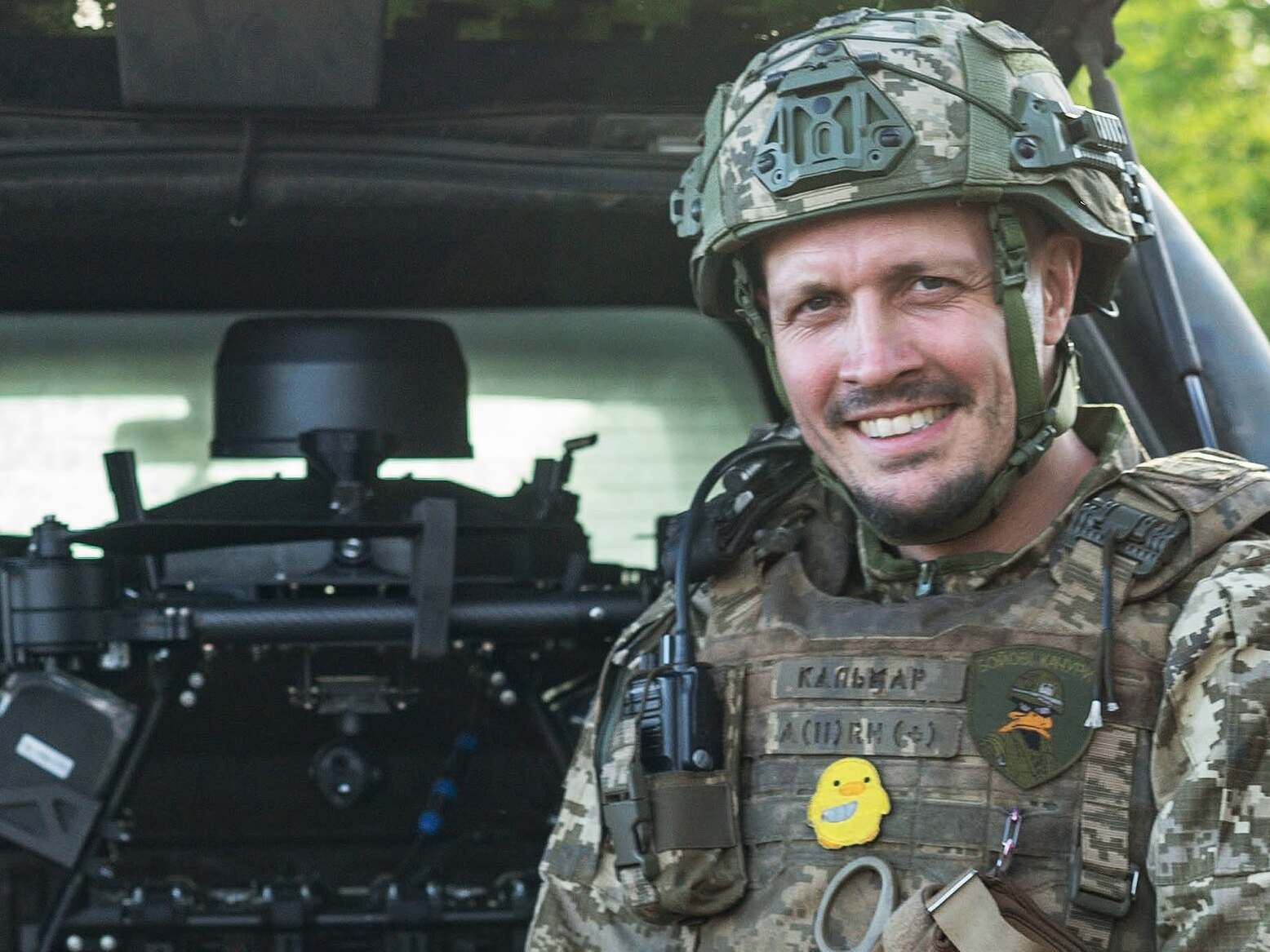
It turned out to be a pretty good call sign – humorous, connected to the sea and, in my view, quite versatile.
– I would say it is in Odesa style. In Odesa, you were generally a private entrepreneur, but after the war began, you became a volunteer rescuer. How did that happen?
– It happened in 2022, when the full-scale invasion began. The first reaction was, of course, fear; then came a lack of understanding of what people do in such situations, how to act. Since I am a kind person by nature, I had never associated myself with the Armed Forces or anything military. So I did not immediately think that I had to join the Armed Forces; that is my internal constitution. But I did have the feeling that I needed to do something, to be useful. I decided to make use of the fact that in civilian life I had done mountaineering and gone to the mountains, meaning I had skills for working in difficult conditions, with ropes; I had the equipment and an understanding of how it all works.
– For a rescuer, those are very important skills.
– Yes. So, together with like-minded people from the mountaineering community, we created a volunteer rescue unit and tried to be useful in that particular field. We applied those skills when there were massive strikes. In Odesa, we cleared rubble, and we often went to help colleagues in Mykolaiv, which at that time was suffering from shelling more than Odesa.
– What do you remember most as a rescuer?
– At night, we were on duty when a call came in that a missile had hit a private house. We went to the strike site and began pulling the remains of the dead from under the rubble. As it turned out, it was Oleksii Vadaturskyi (Hero of Ukraine, owner of the agricultural company NIBULON) and his wife... Later, when the Kakhovka HPP was blown up, we also went to Kherson and helped evacuate people from flooded areas. All of Ukraine was there, regardless of whether you were a rescuer, a doctor, or simply someone who loved animals. Everyone wanted to help — some with cars, some with boats. That feeling of unity when people are suffering from some kind of disaster was very uplifting. For us Ukrainians, it is one of the greatest traits. No matter how much we may quarrel in ordinary times, when some, excuse me, sh*t hits the fan, we come together and help one another.

— Let us turn the page. How did you end up with the Dovbush Hornets?
— Time passed. A year of war went by. A lot of my friends joined the Armed Forces. And I could not shake the thought that what I was doing was not enough. I could not simply exist outside the war. I thought: okay, I need to join the Armed Forces somehow.
It was a gradual process, because from the outset I wanted to make it as controlled as possible. That is, to do it in a way that would allow my skills to be used as effectively as possible. I started looking into what vacancies were available. My first thought was to become an artilleryman. Because, on the one hand, going into the infantry was scary, and on the other, I did not quite understand how useful my skills would be there.
I wanted, if I was going to shoot, to shoot something powerful. I thought: what is the largest calibre we have in the Armed Forces? I found out it was 230, the Pion. And which brigade uses the Pion? The 43rd Brigade. I went to their Facebook page: is it possible to serve in your brigade? They replied that there were currently no vacant positions.
— A bit strange.
— At the time, it did not surprise me — but now it does, because everyone is short of personnel. Now I understand that it was a very strange answer... Anyway. Many of my friends joined aerial reconnaissance. I did not — because I do not like being in the mainstream. I try to find my own path. I thought I would keep looking for vacancies, but I did not want to go into aerial reconnaissance. And then, drones, drones — all of that was unclear to me. So I kept looking for vacancies. And then a friend of mine from the Armed Forces says: so you do not want aerial reconnaissance, but what about strike drones?
My first thought was: strike drones — are those the ones that fly to Moscow? Oh, interesting. I started studying the subject. As it turned out, it is not only the ones that fly to Moscow; there are also FPVs, heavy bomber drones, and the same Mavics, if you attach grenades to them, are also strike drones. So it was some kind of compromise between aerial reconnaissance and artillery.
And it so happened that I was following Andrii Onistrat on Instagram. He was just forming a company of strike unmanned aerial systems and wrote a post saying that they were looking for people to serve in the Armed Forces. I thought, why not write to him? I did, and he said: come for an interview.
I went from Odesa to Pokrovsk for the interview. We talked; they asked me questions about my knowledge and skills. He said, "We will call you back".
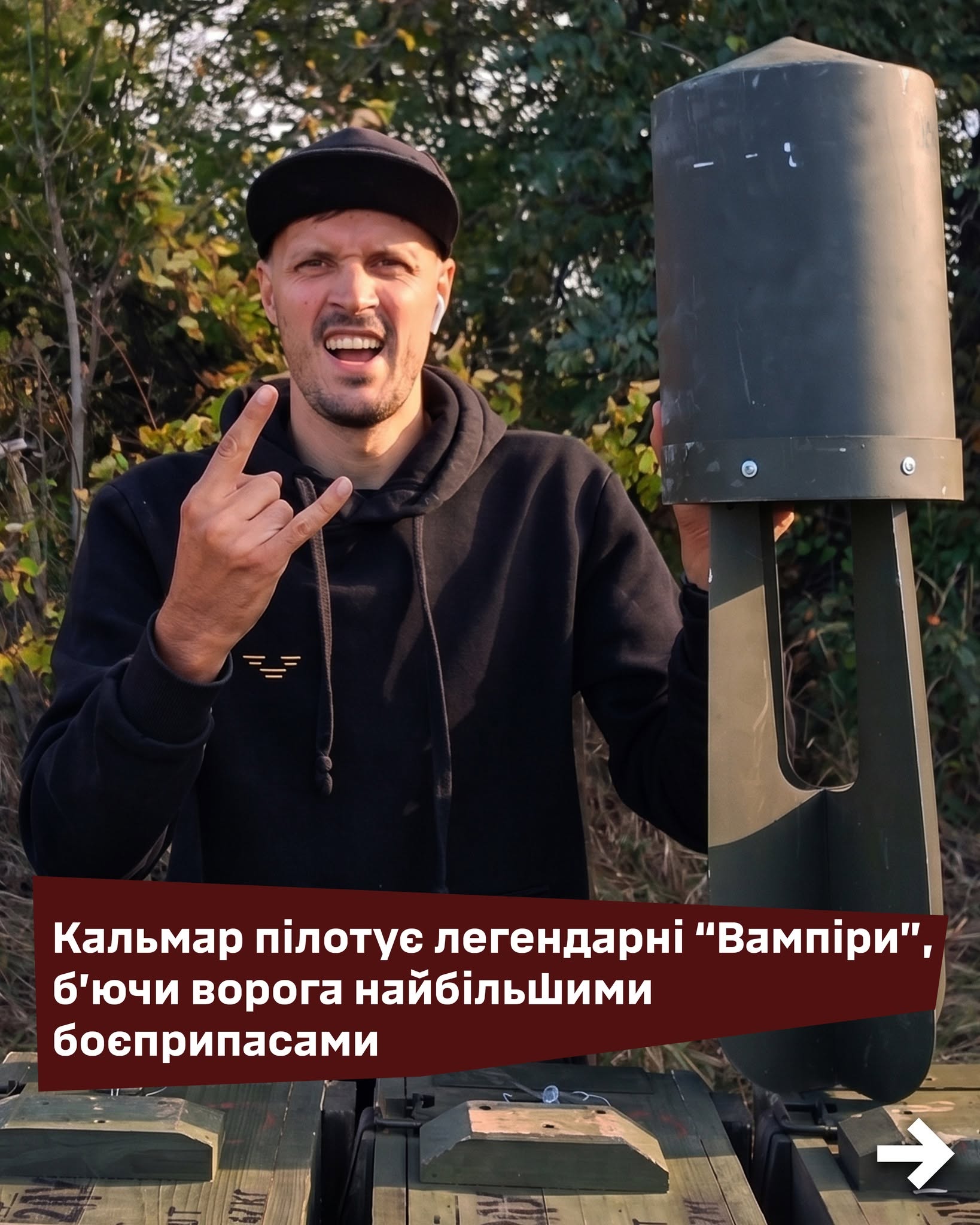
For the first three months with the Hornets, I was a soldier who armed Mavics. Then I spent a month as a Mavic pilot. And then our unit received heavy bomber drones, Vampires, and I was offered: do you want to switch to a heavy one? And I had long wanted to hammer away with something big (he smiles, — Ye.K.)...
I was pulled into that whole scene. And with the heavy bomber drones, too, I first armed them, then became a pilot, and then a crew commander. We entered the Avdiivka sector already as a crew — me and my comrade-in-arms. We worked together on bomber drones throughout the entire Avdiivka-Pokrovsk campaign. It was hard, but we did a huge amount of work. We destroyed enough of the enemy and made our contribution to Ukraine’s defence.
— There will be armchair warriors who say: what danger are these pilots in if they operate from the ground? Tell us what the danger was like near Pokrovsk.
— The main problem that caused us a lot of trouble at the time (2023-2024, — Ye.K.) was, first of all, KABs. We suffered from them a lot. Artillery shelling, too. Closer to the second half of 2024, the enemy began actively using FPV drones.
Even getting to our positions became quite an adventure — constantly with a scanner and in contact with the command post: what is the situation in the sky? So the main problem was FPV drones.
— All the more so because UAV units work against one another with particular zeal and excitement...
— Of course. The greatest excitement is to find your, so to speak, "colleagues" and work specifically against them. Naturally, when you have information that an enemy UAV crew is operating somewhere within your reach, you will do everything possible and impossible to get to them and cause them harm. At the very least, to make their work impossible; at most, to kill them completely.
— A quick crash course: what are "Vampires", and what are their specifications?
— The Vampire is already a combat classic among heavy combat drones. As I see it, it is like the Kalashnikov assault rifle in the Armed Forces. It is very widely used in the AFU. The advantage of the Vampire is that it is relatively simple: if it suffers some damage, it can be repaired on the fly with, so to speak, tape and sticks. Compared with other drones that require more care and expertise to repair, the Vampire is a simple and fairly reliable platform for mass use. When we started, we flew it about seven kilometres with a 10-12 kilogram payload. Over time, the technology improved, the Vampire was upgraded, and now we can reach 12-15 kilometres with a 10-12 kilogram payload.
— What kind of payload are we usually talking about?
— Very good question. Heavy bomber drones, despite the name, perform three types of tasks. The first is fire engagement. The second is mine-laying. The third is logistics. We use them depending on the needs of your unit. Whatever is more of a priority for you — striking the enemy, supplying forward positions with provisions, or mining logistics routes on the approaches to the defensive line — that is the task the bomber drone performs.
Most often, it is striking the enemy. When active offensive operations are underway, it is clear that you will not be doing logistics, because first of all you need to stop the enemy. So your priority is to strike the enemy. Fire engagement was the prevailing task during the Avdiivka campaign. When the intensity of combat operations decreased somewhat, there were fewer enemy troops; they had to be searched for and detected, and we had some time freed up. So, instead of sitting around, we did mine-laying — we mined logistics routes. Over time, when logistics to our forward positions became more complicated because of FPV activity and the activity of enemy drones, our focus was specifically on delivering provisions.
— How many kilograms can the Vampire carry now? Earlier it was 10. Is it 15 now?
— Now, apart from the Vampire, there are also heavy bomber drones that we use — so-called Starlink-equipped drones. They have a higher payload capacity and can already carry 15-20 kilograms over 10-15 kilometres. They are now more convenient to fly. With the specifications the Vampire has today, on the most active sections of the front, it is already somewhat behind other bomber drones. But in the sector where we are working now, it performs quite well. Again, it all depends on the overall situation. Somewhere it is more effective, somewhere less so. In our sector, it is quite an effective weapon. When we were working near Pokrovsk, its capabilities were no longer sufficient: it could not fly to the range we needed and could not carry as much payload as required. So we needed to switch to other means. But in the new sector (in the Sumy region), it has got a "second wind", and we are again using it with pleasure.
— How much does a basic Vampire cost now?
— These are very relative figures — it depends on who is buying it and how. Now we often buy them with e-points. And, as far as I remember, it costs somewhere around 1.2 million. I may be wrong, because I have not looked into it for a long time, as I am currently performing somewhat different tasks.
— What specific characteristics or skills does a person need to have to operate a Vampire?
— I cannot say that operating a Vampire requires some mandatory set of skills. The main necessary trait is the desire to learn and the desire to hit the enemy. Everything else you can calmly acquire. I do not know a single serviceman who wanted to learn to operate a Vampire but could not manage it.
— I spoke with one of the Hornets — a Vampire pilot with the call sign Kolektor. For security reasons, he forbade publishing photos showing his face. Is that a justified position?
— Absolutely. Just as we hunt our opponents who operate drones, they hunt us. And heavy bomber crews are an even more valuable target, because they inflict more damage on the enemy.
— If, after the war, a veteran with the call sign Kalmar comes to a school and children ask him, "Uncle, what were your three most successful sorties?" — what will you say?
— The first thing I am proud of is not a fire strike, but mine-laying. There was a sortie at night; it was just a pause, there were no attacks, but they were planned for the morning, and we were tasked with mining the access routes. We loaded the mines and delivered them to the designated points where the enemy offensive was expected. We completed the mission, went home, and went to sleep. I woke up — and they sent me a video showing two IFVs driving along exactly the route we had mined. They kept driving — boom! — the first IFV hit our mine. The second went around it — and hit our mine too! So it was a kind of double strike.
That made me very happy. At some point, when you are not carrying out fire strikes, it seems — God, what is the point of this mine-laying, who needs it, it would be better to fly out and hit some dugout and find something somewhere. But then I understood that none of it was in vain. That with one mine-laying sortie, two enemy infantry fighting vehicles were destroyed the next day.
— That was the first best sortie. What about No. 2?
— Again, going back to the search for our drone-operator opponents. During the Avdiivka campaign, we detected their positions... The terrain allowed us to descend to ground level on enemy territory — that is not always possible; sometimes you have to strike from high altitudes. And so, when we found another position of enemy pilots, what did we do? We took an anti-tank mine with us, flew up to their position, they hid — and we dropped the mine right at the entrance. The mine rolled into the dugout — and then there was a spectacular explosion...
— Then let us do No. 3 — logistics.
— With logistics, it often happens that the guys in forward positions — not encircled, but with very difficult logistics — need provisions. We get calls from other battalions that do not have the means to do it. We try to meet the needs of the guys first, because thanks to them the enemy does not reach us. So we have to do everything possible to provide them with the necessary supplies, food, and water. Especially the guys who are on the zero line or encircled. If that happens, we put everything else aside and bring the guys everything they need.
— What exactly is included in such cargo?
— In summer, water is especially critical. There is not much water at the positions, so we carry it. And food. Although "a lot" is a relative term. It is not exactly the standard amount, but enough for them to function, live, and conduct combat operations. For survival. Such cargo usually includes water, food, medicines, and dry rations. Sometimes, in super-urgent cases, we can deliver it during the day as well. Heavy bomber drones are considered night drones because they are large. But over time, everything has blurred. Sometimes it is more effective to work during the day as well. For example, near Pokrovsk, the pattern was that at night it was easier to spot you in the sky with a thermal imaging camera.
— The Dovbush Hornets are now fighting in Sumy region. How is this direction different from others?
— These are fundamentally different directions. In terms of combat intensity, Pokrovsk and Sumy are not comparable at all. But Sumy region has its own specific features. We like to joke that finally, in the fourth year of the war, a jaeger brigade has ended up not in fields and tree lines, but in forests. There is its own specificity there. As strange as it may sound, for a jaeger brigade this is a new experience.
— And what exactly is this specificity of the forests in the Sumy region?
— Previously, you would arrive at a tree line, set up your antenna on its edge, give a salute and launch — that was it, you could work. But here the nuance is that you are in the middle of a forest. You cannot take the antenna to the edge of the forest, because that edge may face completely the wrong direction. You are standing in the middle of the forest, and you need to set up your launch and landing site there, from which you can work. Accordingly, you need to master tree-climbing skills, find a taller tree, climb it, attach your antenna — and work from there.
Plus geography. Sumy region is a special region that personally reminds me of the Carpathians: forests and, if not mountains, then hills, ravines of some kind. Forest roads. Pokrovsk spoiled us because the vast majority of routes there are paved roads. Here, the vast majority of routes are mud, dirt, and forest roads. Therefore, the vehicles we used near Pokrovsk are either unsuitable or break down very quickly. They are not suitable for carrying out tasks in this sector. We have to adapt quickly and look for operational solutions — ATVs, motorcycles, lighter and more maneuverable transport.
— Do you think residents of Sumy should expect the intensity of shelling to increase closer to winter?
— According to my own observations, the main means of attack here are drones. And again, if we analyze the overall situation, Sumy is currently not a convenient direction for an offensive. Why? The landscape. Swamps, forests — very difficult terrain for organizing an offensive. It is like Volyn, Belarus.
— There is now a popular view that the war has either reached a turning point in our favor, or is about to. The main reason for this shift is Ukraine’s advantage in UAVs. We are seeing the scaling-up of Ukraine’s defense-industrial complex and new tactical approaches. Do you agree? It would be interesting to hear the opinion of a professional.
— I am not a military strategist or analyst either. I am an ordinary officer of the Armed Forces who sees only his own section of the front. But I do have my own opinion. Right now, a shift is indeed taking place. It is being felt in our sector — a shift and our dominance in unmanned technologies. That does not mean the enemy will not try to take countermeasures. But at the moment, we are recording our advantage in unmanned systems.
— The Russians have a rigid state vertical for UAV production, while we have a variety of private companies — large, small and medium-sized. Accordingly, different areas of engineering thought are flourishing here, and UAVs embody different priorities on the battlefield. And this diversity makes life much more difficult for the Russians.
— Yes. In my view, this large menagerie of systems on our side gives us more advantages than disadvantages. Because it requires the enemy to have a whole range of countermeasures against such a menagerie. It is not a situation where, relatively speaking, you have one system, the enemy has developed a countermeasure against it — and that is it.
— At the same time, everyone has always agreed that their strong point is EW.
— But now we have technologies that allow us to stay one step ahead. They are catching up with us in terms of countermeasures. That is, we strike them, some time passes — and only then do they begin to counter it somehow.
But if we return to the question of a turning point, yes, there really is such a feeling now, and it is inspiring. But it is very important not to relax and to keep working twice as hard. Otherwise, everything will go in circles.

— When you hear that our UAVs, downed by Russian EW, fly over to the other side, what do you think?
— This is war. When wood is chopped, chips fly — we call and apologize.
— In your opinion, are the Russians really set on expanding into Europe (as many people in the Baltic states, Poland and other countries believe)? Or are they bluffing in a hybrid way because, in reality, they have worn themselves down against the Armed Forces of Ukraine?
— It is more of a bluff — just like the talk about using nuclear weapons: as if, now we are going to start fighting at full strength. If they could fight at full strength, they would have done it long ago. Instead, it is just empty talk. They do not have the capability. They cannot even take, relatively speaking, Mala Tokmachka here...
— As they say at bureaucratic meetings, let us move on to personnel issues. As a deputy company commander, you regularly visit training grounds and not only them, and recruit people into your unit. How do you approach this process? Many of your colleagues sigh when the conversation turns to the quality of mobilized personnel.
— The main problem with the people now being brought into the ranks of the Armed Forces is that their trust in the state and the Armed Forces has already been undermined by the time they were packed into a van. And there are quite a few such people among those we recruit at distribution points... I will explain a little how the scheme works: a person is picked up in a van and, with or without his consent, brought to the military medical commission (MMC). He goes through the medical commission. After that, there is a pool of units, each of which offers the potential recruit to join it specifically.
Personally, it now seems to me that joining the Armed Forces has potentially become comfortable — because you can choose the unit yourself. Moreover, different units will even compete for you. And if you are an adequate, intelligent person, you have a chance to get into a top unit of the Armed Forces of Ukraine. Including USF units (Unmanned Systems Forces). For reference: when I was working at the Darnytsia TCR, and people were brought in, the following units were selecting recruits for their units: Madyar’s Birds, Nemesis, Achilles, K-2, Dovbush Hornets, and less well-known units. That is, in essence, the top elite of the Armed Forces. Accordingly, people have an opportunity to get into the elite of the Armed Forces of Ukraine.
But the problem is that potential recruits do not understand how good the prospects opening up before them are. And they are very skeptical about it. It seems to them that someone is trying to screw them over. And it is very difficult to explain to a person that he is not going into the infantry.
So at the moment, the main task is to sow trust in people toward the structure of the Armed Forces. As I understand it, Minister Fedorov is now actively working on this issue. May God give him strength in this.
— The Hornets are constantly looking for new personnel. So what exactly can you offer newcomers? Give us the media version of what you tell recruits.
— First and foremost: the Dovbush Hornets are mostly made up of civilians, so our unit functions less like a military unit and more like a company based on human relations, on civilians. A minimum of army-style rigidness, normal human communication and interaction. If you are a decent person and behave like one, if you have something in your head, you will be treated accordingly.
Second, the opportunity to do what you do best. Again, within the work of our unit: either piloting, or repairs, sapper work, some paperwork, document flow, programming. You can apply these skills with us as much as possible. The main thing is desire. I am now very afraid to use the word motivation, because it has been worn out, but in general, there is now a shortage specifically of motivated people.
— By education, you are a thermal engineer. What about your comrades-in-arms? What are their professions?
— A journalist, a designer, a private entrepreneur, an IT specialist, another private entrepreneur, a lawyer, another lawyer, a builder, a general worker, a photographer... And I have named only the pilots.
— So it is not as if they were born UAV pilots...
— None of us had any idea what a UAV was. Including me, until I came to the Armed Forces, took a controller and tried to fly. No one knew how to fight, what tactics to use, how to load grenades onto a drone, how to screw a detonator into an FPV drone, how to fly that FPV drone, how to ride an ATV or drive an ordinary car. We acquired all these skills and abilities here. And now their expertise is at the highest level.
— An important question: what about money?
— Financial support. Salary plus bonus. Combat pilots working at positions currently receive UAH 100,000 in state-provided pay.
— You are on leave now. When you came to Kyiv and looked at social media, were you not taken aback by the battles going on here over the Bulgakov monument and similar things?
— To be honest, I first learned about this news from you. I do not focus much on issues that do not help me keep myself in good spirits, that distract me from performing my tasks and demotivate me. I try to abstract myself from all that. It really helps me avoid keeping unnecessary things in my head. I do not waste energy on pointless, useless chatter, arguments, and the rest.
— Viktor, as an Odesa native, have you seen the monologue by the well-known Russian propagandist Solovyov about Odesa? He said, roughly, that Odesa used to be a Russian city, but now it is not, because Odesa residents "dishonored" themselves in May 2014, so it must first be destroyed and then rebuilt...
What would you, as an Odesa native, say to him?
— I would answer this way: Uncle Vova, go f#ck yourself. That is all I can say to him.
They say a lot of things they cannot do. Let them talk, let them invent things in their wet fantasies. It has nothing to do with reality, with what will happen in the future. Nothing at all!
Yevhen Kuzmenko, Censor.NET


