



Open exports: have Ukrainian arms makers won, and what challenges still await them?
The beginning of the summer proved very successful for Ukrainian arms makers. Ukraine was successfully represented at Eurosatory 2026, with 80 companies compared with five stands four years ago. During the exhibition, around 20 announcements were made regarding further collaboration with foreign manufacturers.
On July 1, the Cabinet of Ministers adopted a resolution opening up arms exports. On July 3, President Volodymyr Zelenskyy said after a meeting of the Headquarters of the Supreme Commander-in-Chief: "Ukraine has reached the capacity to produce such a volume of technological weapons that, in the long term, it may exceed Russia’s capabilities."
For more than a month, Ukraine has been successfully attacking Russian production facilities that feed its economy. We have watched with satisfaction footage of burning plants and queues for gasoline.
But does our success really open all doors for us, including for the products of Ukrainian arms makers?
NATO Deputy Supreme Allied Commander Europe John Stringer told Business Insider that allies should learn specifically from Ukraine’s "pace of absorbing and adapting technologies," where it is measured in weeks.
According to him, Ukraine’s success rests largely on the fact that technologists and manufacturers work alongside the military on the front line, so "lessons are not merely learned — they are actually applied."
Such a rapid cycle — testing, identifying shortcomings, refining and testing again — is indeed the main advantage.
During the Defence Talks organized in June by the Independent Anti-Corruption Commission, participants in the discussion, including Oleksandr Yabchanka, head of the robotic systems service of the Da Vinci Wolves battalion, emphasized that while in 2022-2023 Ukraine fought mainly with artillery, now 80% of strikes are carried out by drones, which are evolving rapidly.
Anton Melnyk added that while in 2025 drone upgrades still took several months, now they happen every week. And this is the reality.
Western media are increasingly reporting that Ukrainian soldiers have defeated troops from NATO countries during exercises. And some openly admit that if Ukrainian troops were removed from the front line and foreign troops were deployed there with the same weapons, they would be unable to do anything.
And this is not only about combat experience as tactics and strategy, but also about how much Ukrainian soldiers fine-tune in workshops beyond what the General Staff provides them with.
NATO really does have something to learn from Ukraine. John Stringer is right about that. Rapid testing, identifying shortcomings, refining and testing again create our advantage. As does competition among dozens of companies in this market.
Moreover, NATO is learning from us not only the speed of testing and codification. It is studying our evolution and the speed of procurement. Even looking at this process from the perspective of the Ukraine-NATO strategic procurement review, one can see that Ukraine has very quickly traveled such a complex path and developed its procurements to the point where some indicators approved two years ago are no longer relevant.
And now it is our procurement specialists who are being studied, including in terms of how such tools as Brave1 and Dot-chain operate.
Our accumulated wartime experience should indeed become a commodity for a beneficial exchange with partners.
But the first two points, unfortunately, do not guarantee that Ukrainian weapons will quickly conquer global markets.
So let us return to Eurosatory 2026.

"Today, Ukraine is represented by 75 companies — this is a real breakthrough. Every year, when I visit this exhibition, I see progress. But this time, it is no longer just progress, but a true triumph of our defense industry. Everyone here feels that Ukraine is becoming a significant player in the global arms market," Ambassador to France Vadym Omelchenko said, summarizing the exhibition in a comment to journalists.
Following the exhibition, nearly 20 different collaborations were announced, including:
- Fire Point + Germany’s HENSOLDT — an agreement on strategic cooperation on FREYJA air defense, with HENSOLDT, in particular, to supply and integrate TRML-4D radars, which are already used in Ukraine. One such radar can simultaneously track up to 1,500 aerial targets, AIN writes;
- Luch Design Bureau + MBDA signed a memorandum of cooperation, which provides for the development of the NEPTUNE2 cruise missile;
- Ukrainian Armor announced cooperation with the Czech company AviaNera to produce engines for missiles and drones;
- Frontline Robotics + Ukrainian-Danish Dropla — the companies will cooperate on the development of robotic systems against drones and continue integrating Buria onto the THeMIS platform;
-
Ukrainian company AIDronesUA and Sweden’s Njord Technology agreed to launch production of the MAUL unmanned ground vehicle in Sweden;
-
MAC — a partnership on the Dead Fly interceptor drone and the KATRAN unmanned surface vessel, with entry into the European and African markets.
Among the premiere exhibits were Ukroboronprom’s jet-powered UAV-290 (with a speed of up to 800 km/h) and Global Mark’s underwater SEA TRIDENT (weighing 1,000 kg and with a range of 2,000 miles), as well as updated AI-powered FP-1/2 drones, with the strike version now carrying 200 kg over 370 km.
All of this is great.
A week later, new collaborations are announced again at the URC.
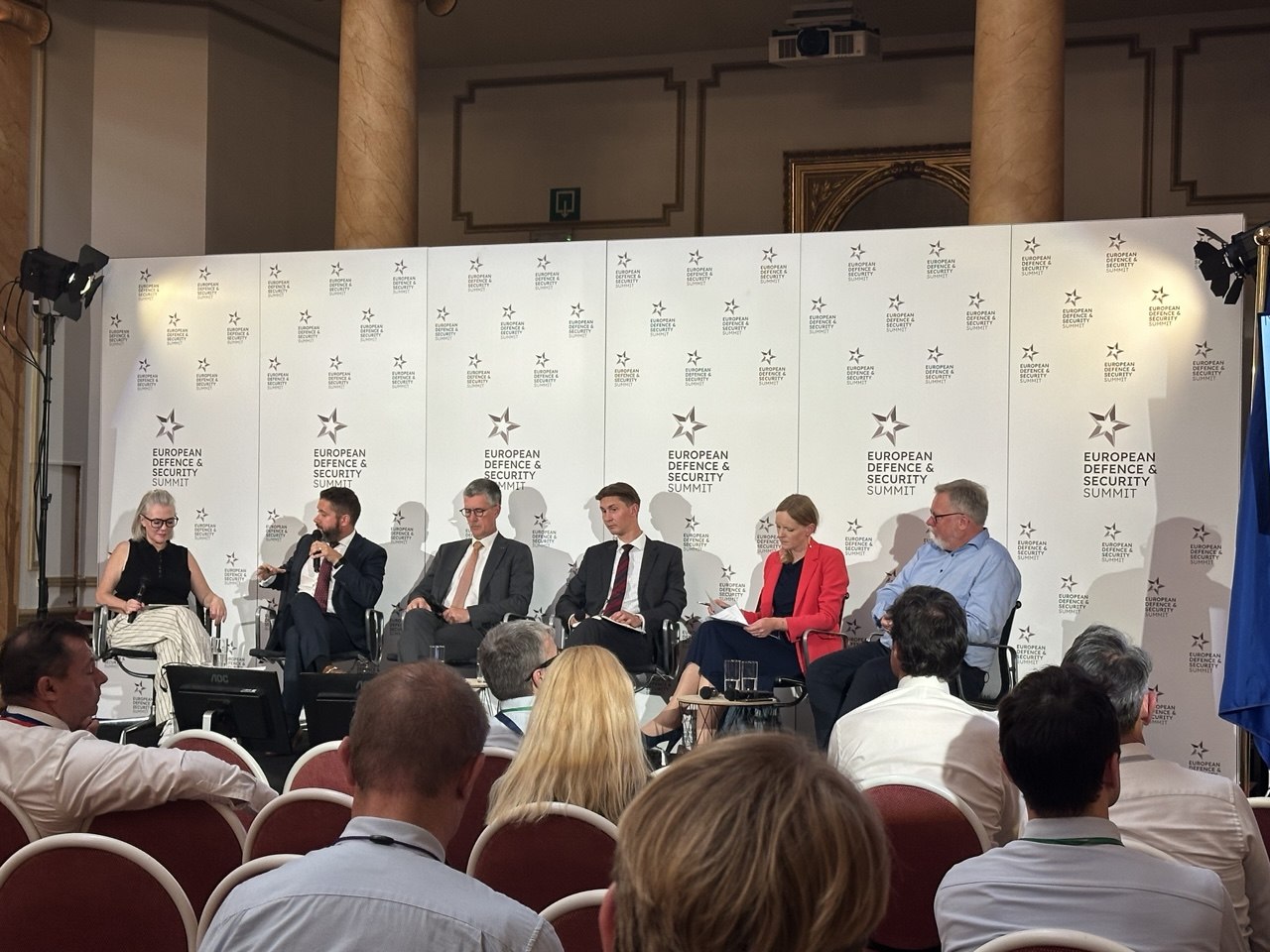
But alongside this, the European Defence Security Summit is taking place, where participants are discussing how to develop the European defense industry. And there is just one defense company from Ukraine present on the sidelines, and just one speaker from Ukraine on stage, and even that speaker does not represent the official authorities.
Meanwhile, this discussion is very important for us.
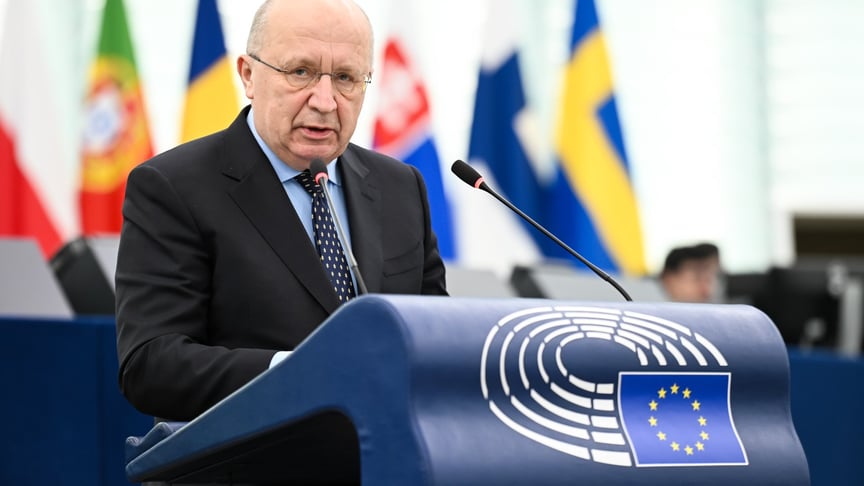
Because, on the one hand, European Commissioner for Defence Andrius Kubilius says: "It would be difficult to understand if we did not integrate the most innovative defense industry in the world into our European defense technological and industrial base. We must integrate Ukraine into our European defense industry, into our European defense market, and into our future European Defence Union."
The EU itself is now in a difficult situation because of the change in U.S. policy. If the United States removes strategic enablers from Europe, replacing them will cost hundreds of billions. The Kiel Institute (Germany) speaks of EUR 500 billion in its study. The budget envisaged by the European Commission for 2028-2034 is EUR 131 billion. That is why Kubilius proposes involving local budgets, where there are EUR 7 trillion.
At the same time, he also notes that up to 80% of defense procurement in Europe is carried out through direct contracts under Article 346 of the TFEU (Treaty on the Functioning of the European Union), without competitive tenders. The result is that several companies effectively monopolize the market, while startups and small and medium-sized enterprises have neither the space nor the opportunities to enter it. This is where the EU runs into the problem of "no market, no innovation," which is why Kubilius proposes creating not 27 budgets, but one integrated market.
And this is where a heated debate begins. Representatives of smaller European countries say that large European arms companies, driven by their current interests, are blocking transnational alliances and smaller companies, and they propose involving smaller companies from Germany, Poland, and Portugal in projects.
What is the view of the large companies themselves and the associations that represent them?
They ask that the issue not be caricatured as "old means outdated": they argue that large companies invest heavily in innovation and partner with newcomers. In their view, Europe needs three different things at the same time, and each requires a different approach:
- Mass production — through the modernization and scaling of existing production facilities ready to "fight tonight."
- Complex platforms — ISR, communications, complex operations: these are developed over years and do not appear overnight.
- Disruptive innovations — here they acknowledge that they need to "learn from Ukraine" as much as possible. But no one talks about buying.
Overall, the position of large European arms companies can be summarized as follows: let the money stay with us, and if anything happens, we will invest in those drones of yours.
Against this backdrop, Sven Kruck of Quantum Systems appears almost revolutionary when he offers his own recipe for development.
"My picture is always this: we have black coffee — the old legacy players — and we have milk — the new defense companies. And we need to find the right mix. Right now, we are simply pouring milk into black coffee. What we need is a cappuccino — or maybe a macchiato — so that the ratio is right."
But even this coffee-with-milk recipe, as understood in Europe, always assumes the presence of Ukrainian companies in the common European market.
But what about all these memoranda and cooperation agreements? For now, all of this is working on the Ukrainian market and for the Armed Forces of Ukraine.
"Where joint ventures have been created, foreign government funding is involved, followed by further deliveries to Ukraine. How effective this is, in terms of volume or quality, is difficult to assess. Where memoranda have been signed, it is difficult to understand their status until contracts and deliveries are launched, or until a public announcement is made," a Censor.NET source in the arms market says, taking the market’s overall temperature.
Last week, Polish Defense Minister Wladyslaw Kosiniak-Kamysz said that Polish authorities would not transfer MiG-29 fighter jets to Kyiv because the Ukrainian side, according to the Polish official, had refused to share drone production technologies.
Almost the only company that has announced cooperation with the Poles is TAF Industries. This happened at the URC, which was held this year in Gdansk, Poland.
Censor.NET asked Mykhailo Diachenko, CBDO of TAF Industries, how they see further cooperation and whether technology transfer will take place.
"The memoranda signed as part of the Build with Ukraine initiative are documents that confirm the intention of both sides to cooperate. This is only the first step, laying the foundation, and there is still a great deal of work ahead. And this is very important to understand," Diachenko says.
"Build with Ukraine is a clearly structured process that takes into account the requirements of Ukraine’s Ministry of Defense and export control. This is not classic export, and it is not about a full transfer of technologies. We seek to build long-term cooperation today and for the future. In other words, this is not about 'getting technology,' but about creating shared value, where each side preserves its own strength," he adds.
Asked how cooperation develops after memoranda are signed and whether they remain only on paper, Diachenko replied:
"Signing memoranda of intent is the first, but very important, step toward building long-term cooperation. We are aware that the creation of joint defense enterprises cannot be fast, and haste is absolutely unnecessary in these processes, including in the formation of our relationships."
"We have priority tasks, and we are moving in line with them. It is in the memoranda that the parties record their positions, and then we begin productive but balanced work. All sides are trying to do the work properly so that cooperation can later be productive for both sides," the CBDO of TAF Industries adds.
But usually, six to eight months pass between a memorandum and some tangible result.
Accordingly, the results of what was announced in April-June will probably be visible only toward the end of the year.
Why are Ukrainian companies looking for these partnerships? Mostly to gain access to European financial instruments such as SAFE and EDIP, or simply to investments.

The announced opening of exports will allow some Ukrainian companies to send their products abroad. This includes exporting technologies for which they obtain an export license. At the same time, intellectual property rights will remain with Ukraine. And the contract must start at UAH 15 million (EUR 350,000) so that this does not turn into industrial espionage, which some companies are also trying to play at.
For now, the exports opened on July 1 concern only the Drone Deal. This involves only a few European countries (Latvia, Lithuania, Qatar, the UAE, Azerbaijan, and KSA). Preliminary talks on similar agreements are underway with another twenty countries.
Most likely, only a handful of companies will be allowed to use this mechanism.
So for now, Ukrainian companies continue to look for partners abroad mostly in order to increase their capacity as suppliers to the Ukrainian army. And only a few are thinking about entering the European market in order to establish themselves there.
So even if Ukrainian weapons have become technologically advanced enough to change the course of the war with Russia, they are only beginning their path toward entering global markets.
And here, it is necessary to add not only business-to-business or state-to-state contacts. What is also important is an analytical assessment of what we will be able to promote and how we can establish ourselves on the global market. And here, too, we need to broaden the search for what we have to offer the EU as dual-use products.
And one more nuance: we are now talking about exports only in the context of drones, but it should be understood that despite the fact that, for now, we are producing artillery only for ourselves and are not allowing it for export, its availability in sufficient quantities forces global suppliers to lower their prices. The latest tenders for 155mm rounds are a clear example of this.
Tetiana Nikolaienko, Censor.NET


