



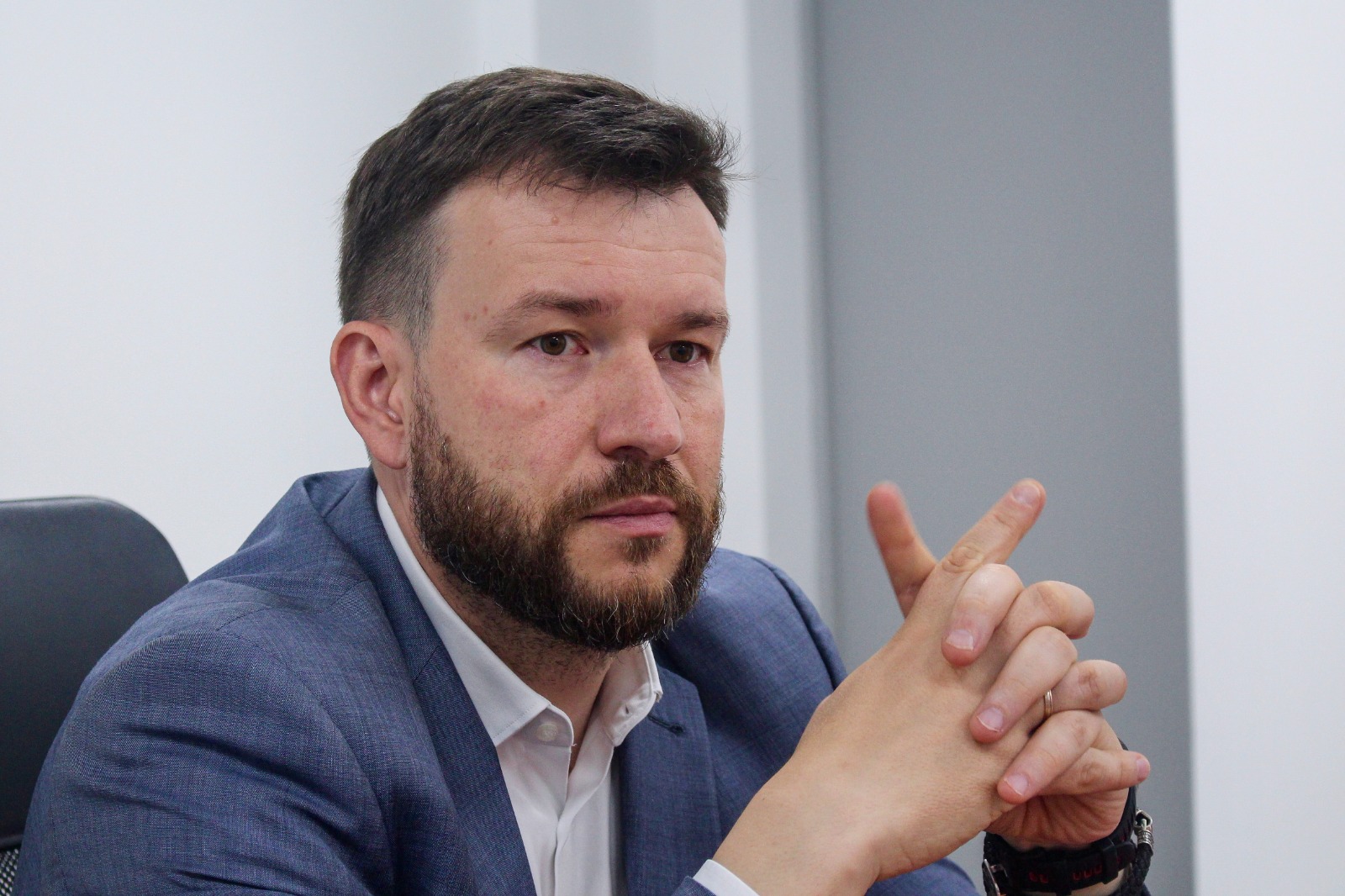
Minister of Social Policy, Family and Unity Denys Uliutin: "Certain amount should be added to pension for each month of combat experience"
The government of Yuliia Svyrydenko has repeatedly been criticised for using ineffective tools to support the population in the form of various one-off payments distributed not only to those in need but indiscriminately to everyone. After the World Bank approved the new SPIRIT project aimed at modernising Ukraine’s social protection system in late May, it prompted a strong public response.
For several reasons. On the one hand, Ukraine is receiving USD 880 million for the social sector during the war, which means that this social spending will be funded. On the other hand, some politicians stressed that only USD 20 million constitutes grant co-financing, while USD 860 million is a loan that will have to be repaid, and that the new system they plan to introduce will further worsen the already difficult situation of people who need state assistance. When we spoke with Minister of Social Policy, Family and Unity Denys Uliutin, we therefore focused primarily on the practical aspects of this reform so that people could understand what actually awaits them. Since the interview was recorded before the resignation of Yuliia Svyrydenko’s government, when asking about the problems faced by internally displaced persons, I did not yet know that the new Cabinet would restructure several ministries and establish a new one.
We also spoke with the minister about another pressing issue: pension reform, particularly special pensions, pension supplements for people who are fighting, and the funded pension system, which could be rolled out on a broad scale if lawmakers pass the relevant legislation.
WHAT WILL REPLACE "STATUS-BASED" PAYMENTS?
– It was announced that the USD 880 million Social Protection for Inclusion, Resilience, Innovation and Transformation (SPIRIT) project, which will be implemented by the ministry, supports a large-scale package of reforms to modernise social assistance for low-income families, transform the financing and provision of social services, and introduce a modern support system for persons with disabilities that meets European Union standards.
Minister, if this reform were explained to people in simple terms, what exactly would change for them apart from the amount of the payments?
– This project is not primarily about payments. First and foremost, it is a reform that will link payments to social services and for which funding has been allocated by the governments of three countries. It consists of three components that will make it possible to change the overall approach to social policy.
Let us start with the main point. Social policy is currently status-based. The easiest approach is to grant a person a particular status, provide a small payment on that basis, and leave the underlying problem unresolved. Under such a system, however, the person remains permanently dependent on that payment because they continue to face difficult life circumstances.
The system we will be transitioning to, for which the World Bank has approved the project, provides for a needs-based approach. Problems must be addressed by providing services that will help people overcome difficult life circumstances, regain self-reliance, and become economically active.
This is difficult because it will require a fundamental transformation of the existing state system, as well as changes at the community level. Therefore, one of the elements is the development of a system for providing social services specifically at the community level. Another element of the reform supported by the World Bank is the transition to assessing the needs of persons with disabilities using an international system for classifying functioning. This means that a payment will no longer simply be tied to a disability group but will compensate for the loss of functioning. This is also a significant area of reform, but I will return to the core element: the introduction of basic social assistance.
The relevant bill is currently before the Verkhovna Rada. It has passed its first reading and is being revised ahead of the second reading.
The document provides for the consolidation of separate payments, eliminating the need for a person to submit a separate application for each one.
As I have already said, needs-based payments will also be accompanied by the provision of social services. For example, a single mother may need childcare services so that she can study, take up employment or look for work.
Alternatively, a family may include a person with a disability who also requires a certain level of care. Such services should be provided so that other family members can go to work or get some respite.
In other words, we are trying to provide assistance based specifically on a person’s needs in a particular situation. At present, people with the same status may have different needs, but the system does not respond to this. Meanwhile, families with roughly the same financial circumstances and needs may receive different payments simply because they have different statuses.
– It is all so complicated.
– Even those who understand this social system find it difficult to determine exactly what assistance a family needs and which status should apply. The new system will simplify this process as much as possible.
We are currently implementing a pilot project to introduce basic social assistance by consolidating payments. It involves 22,000 families (approximately 66,000 people). Our target for the first year after the law is adopted is 100,000 recipients of such assistance, together with services that should become a mandatory component of this social reform as a whole.
– Are there any contentious amendments on which you have been unable to reach an agreement with lawmakers?
– No, we have a good, constructive working relationship with lawmakers. We understand what we want to achieve. Moreover, there will be a transition period, and we are making that clear.
How does it work at present? Through Diia, a person submits an application stating that they wish to participate in the pilot project and receive basic social assistance. A calculation is then made, the documents are assessed, and the person is shown how much they would ultimately receive. If they wish to switch to basic social assistance, they can do so. If they do not wish to switch because they currently receive more through a combination of different benefits, they do not have to.
During the transition period, we will demonstrate that the new system will be far more people-centred. It will target the problems that need to be addressed.
– If a family’s problems change, what should they do? Will they have to notify a public authority, or will the process be automated?
– This is precisely how the new social system will differ: it will assess needs rather than status. Needs can, of course, change. Status is static and cannot resolve the problems faced by a household, a family or an individual.
There may also be crises, and we have provided for this in the bill. We can see how Russia is destroying civilian infrastructure, and a person may suddenly lose everything. They will need assistance. Under the current system, however, an assessment of their financial circumstances over the preceding period would prevent them from accessing support. The new system will also respond to such crises.

– And how do you calculate the cost of services? It varies, after all.
– This is one element in the development of social services. There are basic social services that must be provided at the community level, and eight such services have currently been designated. There is also a list of nationwide social services that must be provided and funded from the state budget. One of the services we currently fund at the national level is the resilience-building service. In addition, together with the UK government and UNICEF, we are developing a network of social service providers in communities under the Small Grants project. Establishing a service provider is genuinely quite costly. This is also part of what we are doing in the reform process. The programme has demonstrated its effectiveness, and the UK government is providing grant funding to help us develop the network of providers because it will subsequently be easier to procure services.
In addition, establishing a national purchaser of these services is another element of the SPIRIT project, which we will also implement with the World Bank. We envisage doing this through the Fund for Social Protection of Persons with Disabilities. The Fund already procures social services and also runs a grant programme to develop providers of such services in communities.
– Can service providers be organisations with different forms of ownership?
– Yes. They may be municipal enterprises, non-governmental organisations or charitable foundations that must meet certain criteria, provide standardised services and report on their delivery.
We also want to develop a digital application that would allow users to leave feedback on the quality of the service they received.
For us, the measure of effectiveness under the new social assistance model is not the number of payments made or the amount of money spent, but whether people are helped to overcome difficult life circumstances.
– If a person with a disability needs someone to live with them and provide round-the-clock assistance, will funding also be allocated for such a service?
– As I have already said, needs may vary, and services will vary accordingly. We are moving away from institutional care as much as possible. Our primary objective is not to isolate people but, on the contrary, to integrate them into society to the greatest extent possible. If a person can remain at home but requires a service, such as day care or support, that service must be provided.
For example, a supported living service is currently being piloted nationwide under the "money follows the person" principle, targeting older internally displaced persons. In this case, the funds are paid not to the service provider but to the individual, who chooses their own provider.
– Why only internally displaced persons?
– We are continuing to refine the project, and other categories will gradually be added.

– Are the services also divided into categories?
– Eight basic services funded from the state budget are currently envisaged. The remaining services are those we must keep in focus depending on the circumstances.
– Can you name these basic services?
– They include early intervention, supported living, comprehensive development services for children with disabilities, shelter services, long-term nursing care, and the care and upbringing of orphans and children deprived of parental care in family-like conditions.
– If family members receive different types of assistance, do they have to give them up and switch to a single basic benefit?
– If you wish to receive basic social assistance, then yes, you will have to give up the benefits it replaces. Basic social assistance takes into account all family members who have given their consent. The base amount today is UAH 4,500 per adult. The number of family members and their income are calculated, and the difference is paid as basic social assistance.
To receive the assistance, a person must sign the relevant consent agreement for the provision of a social service.
– Let us imagine that a family comes to you and says: none of us is currently working, so please support us. Can they qualify for basic assistance, since this situation could be regarded as difficult life circumstances?
– If they are of working age and do not want to work? (he smiles — author).

– Or they may be unable to find work.
– We will help them find it. Incidentally, we had a case in which a person said they did not want to work but wanted to be paid. That will not happen. A person must either work or be registered with an employment centre. They will then receive basic social assistance. If people of working age simply do not want to work, they will not be able to join the programme. The system will screen them out.
– How long will people who have lost property in a missile attack be able to receive payments?
– The bill provides for payments to be made for three months. After that, we must provide the relevant services at both the community and national levels.
– Will they receive the full amount?
– The full amount. We are currently piloting a base amount of UAH 4,500, but it may change annually if the relevant amount is approved in the State Budget Law.
– Who calculated UAH 4,500 as the base amount? Do you often shop for groceries yourself?
– All the time.
– How much do you spend on average per shopping trip? Can you work out how long UAH 4,500 would last?
– The question is what we, as a state, can afford. This is more than the subsistence minimum established by the State Budget Law. This basic assistance cannot replace the income that a family should earn.
Within this framework, as a ministry, we are focused even more on helping people regain self-reliance and live with dignity without depending on the state, and we are developing employment programmes, including for persons with disabilities. The Cabinet of Ministers recently adopted a resolution under which we will provide cybersecurity retraining for 2,000 people with Group I and Group II disabilities, including male and female veterans with amputations, so that they can acquire a profession that will provide them with a decent income.
This profession will not require a high degree of mobility but will enable them to earn an income, which addresses your question.
The sum of UAH 4,500 is intended to cover basic needs.
– Given current prices and the rate of inflation, that still sounds unconvincing. What will it cover?
– Food.
– If a person lives alone, they must at least pay their utility bills as well.
– There is a subsidy for that.
– Will subsidies remain in place?
– Basic social assistance does not replace the subsidy. It will remain in place.
– How much of the funding allocated by international partners will go directly to people in the form of payments, and how much will be spent on administering the reform?
– The entire USD 880 million will go into the budget and be used to finance social spending.
– And how will the capacity-building in communities envisaged under this reform be financed?
– Through the investment component, which currently amounts to USD 20 million. This is grant funding from the United Kingdom and Germany that will be channelled through the state budget to further develop the system of social service providers at the local level, train social workers to implement an integrated model of basic social assistance, and support digitalisation.
– Ukraine has already received USD 600 million of the announced amount. Can you explain how you persuaded the partners to allocate such substantial funding to social reform? After all, this is not defence, on which the security of other countries also depends.
– Together, we can transform the system by moving away from the concept of spending and towards the concept of investing in our people. Addressing a problem at an early stage, when it is only beginning to emerge, costs far less than ultimately dealing with a large accumulation of problems.
– Will the partners monitor how the funds they have provided are used?
– Any use of funds is monitored by international partners. They hire audit firms for this purpose.
For our part, we fully support ensuring that the use of funds is accountable and subject to audits, since these are, first and foremost, taxpayers’ money from countries whose people believe that we are changing.
– What will change for persons with disabilities as this reform is implemented? What will you do to ensure that the new assessment system does not replicate the problems of the Medical and Social Expert Commissions, such as subjectivity, corruption and degrading treatment?
– You are right: this is a highly sensitive issue. We are trying to make everything as comfortable and clear as possible for people who expect assistance from the state.
At present, payments are simply tied to disability groups and do not take people’s actual needs into account.
The old Soviet system we inherited was not designed to change the circumstances in which a person finds themselves. The International Classification of Functioning is a WHO system that assesses not a person’s disability group but the extent to which they have lost the ability to move, work and care for themselves. In other words, two people with the same diagnosis may have entirely different levels of functioning under the ICF. For example, if a person worked in IT and something happened that reduced their mobility, they could continue working in their profession. They would suffer no loss of income. We, as the state, would therefore need to support them and provide the particular set of services they require, such as care services, social support, or something else.
If, however, a person worked at a factory and lost mobility, they would also lose the ability to perform their job and could no longer work in the same position. We must therefore give such a person an opportunity to retrain, adapt their workplace, and work with employers. In other words, we must do everything possible to enable them to earn an income again and become self-reliant.
– I would like to clarify whether I have understood you correctly. At present, persons with disabilities receive payments tied to the disability group assigned to them. Under the new system, could they be deprived of those payments if the state decides that they are capable of supporting themselves? Is that what this means?
– It is not simply a matter of the state deciding; such a person’s needs must be assessed.
– So will the existing payments be taken away from everyone who has been assigned a disability group or not?
– First, the state must create a system capable of assessing functioning.
More broadly, let me answer your question with a question: what do we want? The average payment for a Group III disability is currently approximately UAH 2,500. We have just discussed the fact that even UAH 4,500 is not much.
– But if even that payment is taken away, it will not make people’s lives any easier.
– As a society, we must decide whether we are prepared to pay everyone UAH 2,500 and forget about them until the next payment, or whether we should pay more to those who genuinely need it. And what exactly does a person need: a small payment or services?
– A larger payment would be better. But my point is different. When people receive money, they can decide for themselves how to use it. For example, if they need medication, they can buy it.
– I understand what you are saying, and I understand the public sentiment. But let me try to explain once again. The point is not simply to pay people small sums and keep them on a short leash. It is to assess their needs and give them the opportunity to earn more.
– One of the pressing needs we are all thinking about is preparing for winter. It is said that this winter may be more difficult than the last. Are you planning any programmes to support the population?
– Together with donors, we are preparing a major support programme for people living in frontline areas and expanding the list of vulnerable categories. What will be different this year is the use of state systems and registers to direct funds from humanitarian organisations, primarily through the humanitarian account. This will allow us to avoid gaps in coverage. We have already tested this mechanism by providing UAH 6,500 payments from UNICEF to 8,700 children with disabilities in frontline regions.
– Will this be financial assistance?
– Yes. It will be provided partly through our channels and partly through donors. We want to coordinate our efforts to prevent duplication and ensure that everyone living in these areas who meets the vulnerability criteria receives assistance.
EMPLOYERS TO PAY EXTRA FOR SPECIAL PENSIONS
– Another reform that has sparked public debate is pension reform. What stage has it reached?
– We have completed the preliminary work on the bill internally, presented the reform to lawmakers, and now want to present it to stakeholders – employers, trade unions, and economists. After that, we will put the document forward for broad public consultation.
Pension reform is about changing attitudes and establishing a degree of responsibility between generations. When you are young, you do not think much about retirement. When citizens come to my meetings with their appeals, show me their payment slips, and ask, "How can anyone live on such a pension?", I also have certain questions. Not for everyone, but I do have them.
– What exactly do you ask?
– I ask: "How much did you pay in unified social contributions over your working life?" People reply that times were different and that there was no need to pay such contributions.
We must understand that when you participate in the economic system, you pay taxes and social contributions because the pension you receive in the future depends on them.
However, I also understand that the pay-as-you-go pension system is structured in a way that does not adequately reward consistent contributions. We want to restructure it so that a person’s pension depends directly on how much they have contributed and how many years they have worked.
– What should people do if they are due to retire in five or ten years but cannot work much, or at all, because of their health?
– Our pension system has three elements that we are working on. One of them concerns the situations you have described. When a person reaches a certain age, the state must prevent them from falling into poverty in old age. There must therefore be a basic payment. We want to set the minimum pension payment at UAH 6,000 initially. However, our goal is for the basic pension payment to equal the actual subsistence minimum.
– But the amount is currently based not on the actual subsistence minimum but on what the budget can afford.
– The problem is that the subsistence minimum has long been used as a benchmark for things that have nothing to do with it. At present, 180 different payments and supplements that have no connection whatsoever to the social sphere are linked to the subsistence minimum. We cannot reform the subsistence minimum without first delinking these payments from it.
We have made considerable progress on this framework with the Council of Europe and are working on reforming the subsistence minimum so that it fully complies with European standards.
– You said there were three elements of the pension system that you are trying to change. One is the pay-as-you-go system. What are the others?
– The second is special pensions. There has long been a need to move this element into funded pension schemes for the relevant occupations. This is necessary both to balance public finances and to protect people whose professions entitle them to such pensions. They will be better protected under a system in which they can change occupations while retaining the enhanced pension benefits accrued through those professions.
The third element, which has long been avoided but which we must eventually address, is the funded pension system. Everyone who works should consider how much pension income they will receive in the future and make funded pension contributions. In our bill, we propose a voluntary system with automatic enrolment. Once automatic enrolment is introduced, everyone in the system will automatically be enrolled to make pension contributions at a specified level, but each person will be able to opt out. At the same time, they must clearly understand that, in the future, they will receive no more than the pay-as-you-go system provides.
The transition from special pensions to occupational pension schemes will take approximately 13 years. This is slightly more than half the qualifying period currently required to enter the system. In other words, everyone who has already completed more than half of the required qualifying period will remain under the old system. All new entrants will join the new system directly. In this way, we will gradually transition to a pension system that will broadly meet our expectations.
– Will people be able to choose independently which non-state pension fund will hold their funded pension account?
– Of course they will.
– How can they assess whether such a fund is reliable?
– The National Securities and Stock Market Commission and the National Bank of Ukraine are responsible for this system. You should address that question to them.
It is important to us that people trust this system. To do so, they must genuinely be confident that their money will be protected over such a long period. We emphasise this when speaking with our colleagues from other agencies.
– Attempts have been made to launch a funded pension system for many years. Why have they failed?
– We are moving towards a mandatory funded pension system fairly slowly because there will always be the question of who will pay the contributions. Previous proposals envisaged using contributions already being paid into the system. A portion of those contributions would be transferred to a funded pension scheme, which, in my view, would merely postpone the problems until those entering the system begin to retire.
– How much will people have to pay each month under the funded pension system?
– The calculations are still being made.
– When will we live to see the day when, like pensioners from European countries, we can travel freely around the world and have enough money to do so?
– When we have saved enough (he smiles — author).
Joking aside, I understand that you are referring to the German experience. Before the COVID-19 pandemic, when we travelled, the tourists we most often saw on holiday and on trips were pensioners from Germany and Japan. They genuinely save money for a long time to afford such opportunities.
– You have said that occupational pensions will be financed not from the state budget but through additional contributions made by employers. Could you explain the mechanism in greater detail?
– We have a wide range of laws establishing special entitlements. We have calculated how much these entitlements cost and understand that they must be paid for. However, they should be funded not by all taxpayers, as is currently the case and which causes public controversy, but by employers. Depending on what is stipulated by the law governing a particular special pension, early retirement, a higher pension, and so on, this could involve an additional unified social contribution of 15%, paid specifically into the funded occupational pension system. This would be a major advantage for individuals because their savings would begin accumulating from their very first year of employment.
– What if employers do not want to pay the contributions?
– They will have no choice if it is required by law.
– You have also said that the issue of additional pension supplements for combat service is being considered. How much would they be, and under what conditions would they be awarded?
– A certain amount should be added to the pension for every month of combat service completed by our male and female defenders. At present, there is simply a payment for combatant status. It is the same for everyone, regardless of whether they spent one day there or four years. We must change that.
– Has the amount already been determined?
– No, we are still working on it.
– Whenever I watch videos of people being forcibly evacuated from areas where hostilities have made life impossible, I realise how frightening it is for them to leave everything behind and effectively start their lives from scratch without the money to do so. Why has the state failed during the years of war to create acceptable conditions for them and develop genuinely effective support packages? Is the recently approved Strategy for Supporting Internally Displaced Persons until 2030 a genuine attempt to help them, or merely another formality?
– This is the first comprehensive document setting out the entire path from evacuation to a person’s reintegration into a community. It also provides for support at every stage: at transit evacuation centres and temporary accommodation facilities. The next stage is integration into a community and work with the person there because, as I have already said, the objective of social policy is to restore a person’s capacity for self-reliance and enable them to become an active member of society. All our measures are designed to achieve precisely that. These include the work of dedicated teams at evacuation centres and the provision of long-term nursing care. We know that people are evacuated from extremely poor conditions, and some of them, particularly people with limited mobility and older people, require medical care. At present, they can remain in healthcare facilities for 90 days. After that, they move to temporary accommodation while a place is found where they can live on a longer-term basis. Relevant services are also provided in communities. These include a shelter service that we are currently piloting, under which housing providers are paid to accommodate people. Other services include restoring documents and certificates and arranging the relevant payments.
The strategy also contains a substantial section on housing. We are responsible for two programmes in this area. One is intended for people who have been evacuated but remain economically active and can take out a mortgage to purchase housing because they are employed. The loan is provided on preferential terms: the state covers 70% of the down payment and 70% of the payments during the first year. The state also provides UAH 40,000 towards the cost of arranging the loan. To date, 3,000 applications have been submitted, 2,800 of which have already been processed. A total of 720 loans have been issued. The remaining applicants are looking for housing that would be suitable for them.
The second programme we are currently implementing concerns the purchase of housing in rural areas and was initiated by lawmakers. Under this pilot project, we expect to purchase 1,000 houses this year. This is beneficial both for people who want to live in rural areas and for communities, which will be revitalised as a result. However, these communities must have the necessary infrastructure (such as kindergartens and schools, as well as employment opportunities).
In addition, UAH 1 billion in subventions has been allocated to communities to ensure that temporary accommodation facilities provide suitable conditions for people with limited mobility.
– Regarding the programme for purchasing houses in rural areas, the ministry proposed capping the price of a house at UAH 500,000. At the same time, housing that requires major repairs or reconstruction, is not connected to the electricity grid, or lacks central or individual heating may not be purchased. What can actually be bought for that amount?
– Communities select the houses themselves and provide us with the relevant information. Kyiv region, for example, has identified 100 houses.
– Mandatory evacuation from settlements in the border areas of Chernihiv region began on 1 July. However, people do not want to leave. Suspilne, for example, reports that approximately 170 people currently live in the village of Chaikyne, including 28 internally displaced persons who previously left other border settlements. In early June, the village head collected residents’ signatures regarding the mandatory evacuation, but not a single resident agreed to leave the village. Is it possible to design assistance programmes so that people know exactly where they will live and can receive help finding work in their new location?
– We are currently working on a digital solution that would cover the entire journey of an internally displaced person. It will include every step, as well as the option to register for evacuation in advance. In addition, we are working with donors so that advance registration will enable us to provide people with financial assistance for the initial period.
We also plan to create a list of all temporary accommodation facilities, including photographs and information on available places.
As for employment, we also have a dedicated initiative developed in partnership with others called Prykhystok. Robota. Employers use it to advertise jobs that include accommodation.
We have also developed plans for a platform for internally displaced persons. Its purpose is to provide people with sufficient information to make informed decisions and understand how to rebuild their lives.
Tetiana Bodnia, "Censor.NET"
Photo: Anhelina Shorokhova, "Censor.NET"


