



What happened at military exhibition near Kyiv in first minutes after the strike
Yulia attended an exhibition held near Kyiv and, in the first minutes after missiles struck the venue, rushed to help the wounded. She had four tourniquets with her and used every one of them. She also spoke about organisational issues that had raised concerns and appear to have led to the tragedy.

Warnings about the likelihood of another ballistic missile attack on Kyiv and the surrounding region had been circulating for several days. Therefore, the explosions that began to be heard on Thursday, 24 July, between 11 am and 12 noon, did not come as a great surprise. If anything, the timing of the attack was unexpected. But the enemy is constantly changing its tactics to terrorise Ukraine… An hour and a half after the air-raid alert, information began to emerge explaining why the Russians had fired missiles at precisely this time and in this location – in a residential area, right next to the Zhytomyr motorway. With every passing minute, the details of what had happened became increasingly horrifying. By evening, it was reported that 10 people had been killed and around a hundred wounded. The target of the Russian missiles was… an exhibition of unmanned systems, electronic warfare equipment and other cutting-edge technologies. What is most shocking is that the announcement of the event had been circulating online and on social media the day before. It appears that it was not difficult for the enemy to ascertain the coordinates of the venue and direct ballistic missiles there…
Similar incidents, where strikes target exhibitions and conferences, formations and award ceremonies, have occurred repeatedly over the years of full-scale war. And people are always killed. One would think that security measures should be flawlessly organised, but, unfortunately…
Among the witnesses to the shelling and those who were among the first to arrive at the scene of the tragedy were some acquaintances of mine, with whom we discussed everything that had happened and the reasons that led to it. Everyone unanimously believes that this might not have happened at all.
"IT WAS STRANGE THAT THE EXHIBITION WAS HELD RIGHT NEXT TO CIVILIAN BUILDINGS"
Yulia, a resident of Kyiv, works for a company that develops and assembles ground-based robotic systems. She regularly takes part in demonstration events – unmanned vehicles and their capabilities need to be shown to the military so that they know what variants are available and what can be ordered.
"When inviting us, the organisers noted that their aim was to protect civilian infrastructure – in other words, to showcase the technical solutions that private companies could deploy at petrol stations or above shopping centres to deflect enemy weapons," says Yulia. "Nowadays, air defence systems can be privately owned." Businesses can purchase air defence systems for their own protection. In fact, the exhibition was aimed specifically at them. It’s not quite my area of specialisation, as I work on robotic ground-based systems, but we were told that other manufacturers of UGVs would be there too, so we agreed to take part. We decided that we could mount the electronic warfare systems onto the platform of a robotic system and showcase the company’s various capabilities. That’s what we agreed on. So at 11 am – when the exhibition opened – I was already at the stand allocated to our company. The robotic systems and other equipment had already been delivered. We were due to be there until 4 pm.
- When were you informed of the exhibition venue?
- The day before, about a day before the event.
The first thing I noticed when I arrived was the absence of any ambulances. There wasn’t a single one, even though they’re supposed to be present at a mass event. And if any of the many guests were to feel unwell? Looking ahead, I’m certain that if medical staff had been on duty at the exhibition, at least two or three people would have survived… But as it was, they simply bled to death… It was also rather strange that the exhibition was situated right next to houses where civilians clearly live. As a rule, such demonstration events are organised out in the open, away from civilians. We ourselves held a similar exhibition not so long ago, and found a location far from villages and cities.

At 11.00, when the exhibition officially began, there weren’t that many people there yet. As I understood it, more were expected a little later; representatives from various companies interested in the information had only just started to arrive. The presenter, standing on a clearing surrounded by tents and with three military vehicles positioned in the centre, was just explaining to those present where the shelter was located and what was in store for us during the day. To be honest, we weren’t really paying much attention to what she was saying. We’d been told beforehand that there was a reception area where coffee and sandwiches were available. I grabbed a coffee and sat on a chair by our platform. The day was only just beginning. And then the first explosion went off. It was at 11.26.
- Did the alarm go off?
- I didn’t hear it. Perhaps you just can’t hear it in that spot. I don’t know. But I didn’t hear any alerts on anyone’s phones either… Maybe because there was no signal there…
After the explosion, I tried to ring my son. I couldn’t get through. I messaged a friend who’s in the army. He arrived quite quickly, and my son came rushing over straight after him.
After the first strike, people ran for cover. I can’t say how it’s set up, or whether there’s enough space in there. I saw the wounded and tried to help them.
"ONE OF OUR TESTERS WAS KILLED"
Our mutual friend, who came to see Yulia, points out that she was born not even in a shirt, but in a bulletproof vest, because one of the dead was lying three metres from where she was during the first airstrike.
- When Yaroslav arrived, and later my son, I mentioned that my vision was blurred. I had a sort of tunnel vision. But I can say for certain that the people were injured not by debris, but by small stones and gravel that were flung about during the missile strikes. The wounds on the injured were the size of a coin. All the injuries were to the groin, abdomen and legs – where the gravel had ricocheted.
- Initially, there was talk of seven missiles striking the exhibition, - adds Yaroslav. - But it later emerged that some had been shot down. However, four ‘Zircons’ reached their target. Their warheads are smaller than those of the ‘Iskanders’. If ‘Iskanders’ had been launched, there would have been far more casualties…

‘Between the first and second waves, I managed to apply two tourniquets to the wounded,’ continues Yulia. ‘One of these men hobbled to the car himself to go to hospital. He was bleeding quite heavily from his wound.’ At that moment, the second wave struck. Afterwards, I realised I needed to get the body armour out of the boot. But I fumbled about with it for ages; for some reason, I couldn’t put it on straight away – I was sticking my head in the wrong way round. Next to the bulletproof vest, I found a first-aid kit containing another tourniquet. Having finally managed to pull the vest on, I ran over to the man lying nearby. He had a wound to his stomach. I gave him my fleece from the car to apply pressure to the wound.
- How many strikes were there? Because in the evening they said two rockets had hit the exhibition.
‘At first there were two strikes, one after the other. About 15 minutes later, there were two more. The subsequent strikes came from the other side of the clearing, about 150 metres away from me.’
- Does your company often take part in events like this?
- Quite often. The day before, on Wednesday, there was an event on UGVs, in which all manufacturers of such systems took part. Not long ago, we organised a major presentation of our own products. But for that, we find a field some distance away from civilian infrastructure. We carry out these demonstrations for the military. We inform them of the meeting point on the day of the event. However, to avoid a build-up of cars, we collect everyone from the meeting point by bus and take them directly to where our UGVs are located. Other organisers do the same. Perhaps some people don’t like having to leave their car and travel to another location, but this helps to avoid what happened during this exhibition.
- Do you know the organisers? Have you heard anything about them before?
- No. I first saw the name ‘Armada’ when I was sent the exhibition programme, along with the date and time.
- Did anyone from your company get hurt?
- One of our testers was killed…
After the first explosions, I immediately saw six people who had been killed. After the subsequent explosions – two more… Among them was a young woman who was registering everyone at the entrance… I found out later that representatives of manufacturers from Kharkiv and Ivano-Frankivsk had been killed. There were also military personnel among the dead who had come to look at the products…
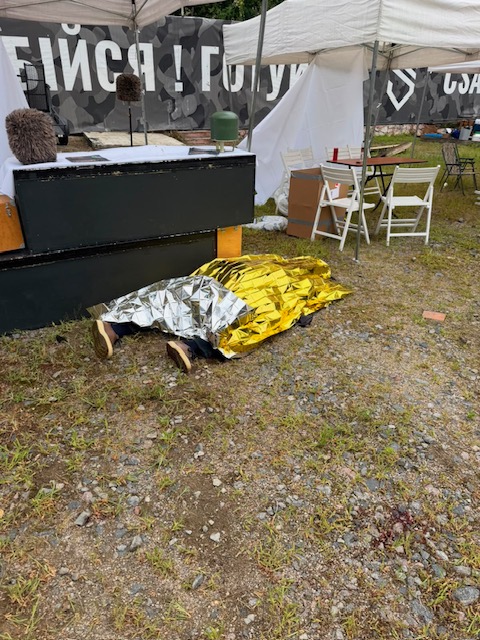
I still regret not taking my first-aid kit with me – it was left in the minibus I use to travel to the front line.
How can I explain this? The exhibition was set up in a small square, not on the training ground itself, which is there. Training was actually taking place there at the time, by the way. The clearing where we were was next to a residential area. I’m still wondering why there was no mobile signal. The wounded were screaming in pain. They couldn’t get through to the ambulance service themselves. I switched on our mobile hotspot, equipped with a StarLink, and shared the internet connection with everyone nearby. If the medics had arrived sooner, or if more people present had had tourniquets and helped the wounded, we might have managed to save another two or three victims. I heard them screaming. And I realise they bled to death because there was no one to help… Three or four people tried to help… No more than that. And the number of injured, as we now know, was around a hundred! One woman – wearing an embroidered dress – was running between the injured. She called the ambulances and tried to tell people that help would be there soon. I wonder if she was the host of the event… Then a bloke in military uniform arrived with a small briefcase. I gathered that he was involved in organising the exhibition… Representatives of the State Emergency Service, the police and the local administration turned up fairly soon after.
I’m always thinking about safety and assessing risks. I’ll admit, on that day I didn’t expect anything like that to happen. I didn’t see this exhibition as some major event that would be targeted by missiles. There were no flagship products on display. There are bigger events organised in the same way, but everything went smoothly there.
"THE EXHIBITION ORGANISERS REFUSED TO COOPERATE WITH A MAN WHO HAD STRICTER SAFETY REQUIREMENTS"
Yulia keeps coming back to the injured, assessing her actions and analysing whether she did everything right.
- One lad had a tendon damaged just above his heel. I cut his trainers open but didn’t take them off – it seemed his heel would stay in the shoe. I applied a tourniquet to him to stop the bleeding. The other two had wounds above their knees. The man with the stomach wound also had an injured leg. A soldier had applied a tourniquet to him, but the wound kept bleeding, so he gave me a bandage and said, ‘You need to bandage the wound as well. Can you manage on your own?’ I said yes, and he ran off to help the other wounded.
- Did you see any dead bodies?
- A stone hit the man lying next to me in the face. There was another dead man about ten metres away – he’d also been shot in the head and was lying in a pool of blood. I remember that the Polish UGV manufacturers were using their vehicles to move the bodies of the dead and the wounded closer to the road, because the emergency vehicles couldn’t get through to where the casualties were due to parked cars…
Pavlo was driving along the Zhytomyr highway to a military shop, where he was due to buy some specialised equipment for a friend. He has combat experience and has recovered from a serious injury he sustained in 2023 in the Kherson region…
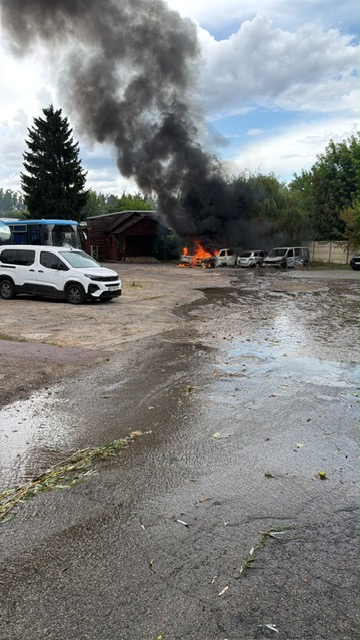
- I heard the sounds of incoming missiles and realised something was exploding very close by. As far as I could tell, there were three or four missiles. I immediately rushed to where I thought they had landed. Once there, I helped however I could. I straight away found the organisers’ notebook containing the names of the exhibition participants. I then handed it over to the investigators so they could identify the people.
When I arrived at the scene, I counted eight bodies. I was shocked by what I saw. Civilian homes had been destroyed all around; people had been injured, and some had been killed…

Once all the emergency services had arrived at the scene, I passed on the information I had at that point, and then went to that shop. There, by chance, I met a man who hadn’t made it to the exhibition that had been hit. He told me that this exhibition, which the Russians had struck, was supposed to take place… on his premises. But he immediately laid down his conditions to the organisers: from the meeting point, to be announced on the day of the event, people would be picked up by other transport and taken directly to where the manufacturers’ exhibits were to be displayed. The organisers replied: "You’re being far too strict." And they refused to cooperate with him. You see, they found someone whose security measures weren’t quite so strict…
- As someone with experience, how would you assess what happened? What can you say about the organisation of the event?
- I think this is total bullsh#t. We’ve lost civilians and people whose minds were supposed to be working for the country’s defence capabilities. The organisers of such events – which need to take place because new products have to be showcased – can’t just ignore the possibility of an attack. The enemy will always try to find even the tiniest loophole to find out about our manufacturers. And we need to think ahead about how to ensure the maximum safety of everyone involved. All safety rules, unfortunately, have been written in blood. They must not only be followed, but also constantly made even stricter.
Violetta Kirtoka, Censor.NET


