



"In six months’ time, we won’t be able to move around front line unnoticed at all," — Oleksii Shuhailo, commander of 132nd Reconnaissance Battalion of Airborne Assault Forces
"It is unlikely that the enemy will advance on Zaporizhzhia," says Oleksii Shuhailo, commander of the 132nd Separate Reconnaissance Battalion of the Airborne Assault Forces. What is the actual situation on the Zaporizhzhia front, and is there a threat of a breakthrough into the city? How did the reconnaissance battalion’s soldiers manage to carry out a unique operation in the Kucheriv Yar area and capture 101 Russian soldiers at once? What actually happened during the so-called Dobropillia breakthrough, and how did the Airborne Assault Forces thwart the enemy’s large-scale plan to encircle Sloviansk and Kramatorsk?
The company commander spoke about all this in the latest episode of journalist Iryna Sampan’s series ‘In the Line of Fire’. We also discuss the technological revolution on the front line: why, in six months’ time, it will be impossible to move around unnoticed on the battlefield; how the Airborne Forces’ unique ‘tech unit’ operates; and what changes to contracts will genuinely motivate soldiers to remain in the army.
Iryna Sampan: I’d like to start with Zaporizhzhia, because just yesterday we happened to come under shelling in Zaporizhzhia. Three KABs struck the city centre. What is the tactical and operational situation specifically in your area of responsibility? How is the enemy operating?
Oleksii Shuhailo: Tactics are dictated by weather conditions and the nature of the terrain. Based on these factors, the enemy’s actions follow. As for mechanised assaults, the use of armoured combat vehicles in this area at present, under these weather conditions, would be unrealistic. The only thing the enemy can do is make isolated movements. At most, one or two motorbikes will simply leave their assembly area and ride across open fields or through some woodland. But they won’t get very far. That’s where the whole assault will end. Even if the enemy manages to get into a forest strip or a wooded area, they’ll literally cover 300 metres, and that’s it – they’ll be stuck there. That’s the current tactic.
Iryna Sampan: How likely is it that the enemy will advance on Zaporizhzhia?
Oleksii Shuhailo: I think the likelihood is low. The use of guided bombs or missiles is possible. An enemy advance is unlikely. We know how the enemy’s propaganda works – what they call ‘flag-wavers’, when two soldiers approach a settlement carrying a flag. They simply walked up and unfurled the flag. Within 15 minutes, they had already been spotted and eliminated, and that was the end of it. But they report to their command that everything is fine, painting a picture of the front line as they see fit. It’s simply disinformation from the enemy commanders. I’m confident the enemy won’t be in Zaporizhzhia.
Iryna Sampan: Since spring, if we are to believe the General Staff’s data, we have achieved certain victories and carried out successful counter-offensive operations in the Zaporizhzhia sector, particularly in the Oleksandrivka area. What enabled our troops to advance in this sector?
Oleksii Shuhailo: In my opinion, this was achieved because the correct direction was chosen for the offensive operations. An offensive group was formed, comprising the best-trained and strongest units and sub-units. They were not all from the same branch of the armed forces. They included, amongst others, airborne assault troops and an unmanned reconnaissance component, which, in a specific sector, thanks to their cohesion and the setting of the right priorities, simply broke through along this axis, liberated a dozen settlements and are now continuing to hold them.
Reconnaissance combat groups from the 132nd Separate Reconnaissance Battalion broke through the enemy’s line of defence on the Oleksandrivka front. March 2026
Iryna Sampan: After all, this was one of the enemy’s main lines of attack. So, can we say that our success was partly due to the enemy withdrawing some of its forces or redeploying them to the Donbas?
Oleksii Shuhailo: They didn’t withdraw them. I think, most likely, they simply didn’t expect something like this to happen. They were advancing, had achieved some success, and thought everything would go well. But in fact, they encountered advancing units — our units — coming towards them. They weren’t prepared for this. They were only pushed back after they’d started concentrating their reserves in that direction.
Iryna Sampan: In your opinion, do we have the strength and capability to build on this success?
Oleksii Shuhailo: Yes, of course we do.
Iryna Sampan: You arrived in the Zaporizhzhia sector from the Donbas, from the Dobropillia sector. What actually happened in the Dobropillia area? This is the so-called Dobropillia breakthrough, the ‘pincer movement’ that everyone was talking about. Why did the enemy manage to reach as far as Zolotyi Kolodiaz?
Oleksii Shuhailo: The enemy’s main objective is to gain complete control of the Donetsk and Luhansk regions. Whilst there are still some settlements in the Luhansk region under our control, in the Donetsk region there is still a fairly large swathe of land under our control. As of autumn 2025, the enemy’s intention was to reach Barvinkove (Kharkiv Oblast) and advance further towards Izium, thereby completely cutting off the force defending the Kramatorsk district, Druzhkivka, Kostiantynivka and Sloviansk. But the enemy failed to do so.
I believe that, at that point, we did achieve a certain degree of success. We understand the scale of the situation that could have unfolded had the enemy reached Izium from the west and completely encircled Kramatorsk and Sloviansk, and how many civilians would simply have been killed. We prevented that from happening. Yes, the enemy did reach the settlement of Dobropillia. And I do not wish to comment now on which units failed or did not fail there. I think this is the responsibility of every commander who carried out tasks in that sector, and for me, as the commander of a different unit, it would be somehow inappropriate and wrong to condemn others. Perhaps the mechanised assaults there were such that he was simply unable to repel them. Therefore, I will not blame specific commanders.
Iryna Sampan: We already know that the enemy has entered Hryshyne and is also trying to advance from the north. What are the plans from here: to cut off Dobropillia completely?
Oleksii Shuhailo: To reach Dobropillia and move on. The enemy has focused its attention specifically on capturing the Donetsk region. In other words, the greatest concentration of troops there is in the Pokrovsk and Dobropillia sectors. They will deploy tens of thousands of troops there and try to advance metre by metre to achieve at least their minimum objectives. We will do our job; we will simply destroy them, and that’s it.
Iryna Sapan: What role did the reconnaissance battalion play in the operation to cut off these ‘pincer movement’?
Oleksii Shugailo: By that time, we had liberated the village of Kucheriv Yar, its outskirts, the forest strips and ravines adjacent to it. With proper planning, we advanced in stages, fully encircling the settlement from various sides, and then cleared it out completely. As a result, during that operation, our battalion alone took 101 prisoners. A further 53 enemy combatants were eliminated.
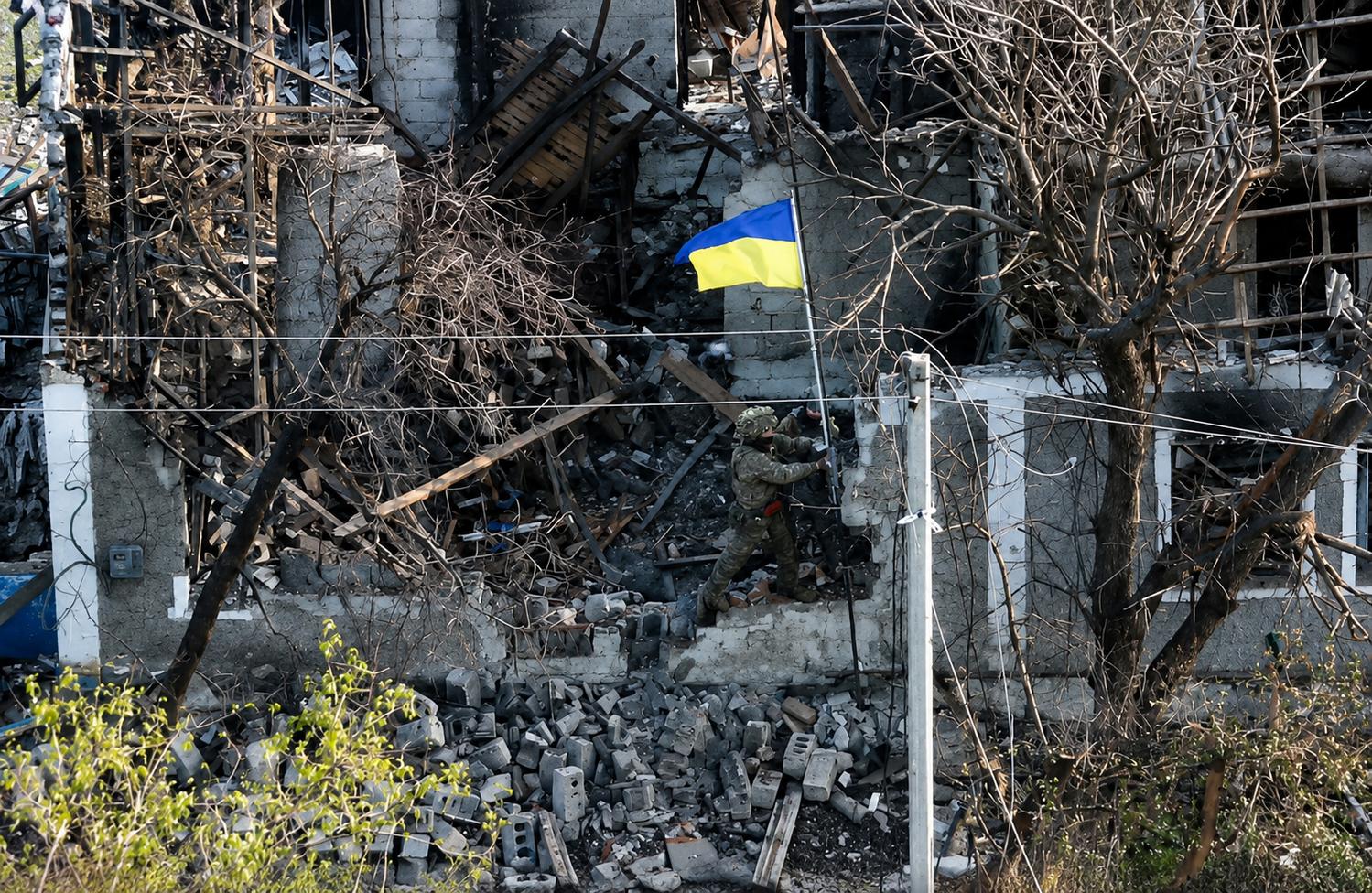
Liberation of the village of Kucheriv Yar in the Donetsk region by strike groups of the 132nd SRB. October 2025
Iryna Sampan: And who were these prisoners?
Oleksii Shuhailo: There were people from the Donetsk region — from Mariupol, Horlivka, and Berdiansk. They all said they’d been forcibly conscripted into the army. There were even officers who were originally from Berdiansk. One such officer was a platoon commander.
Iryna Sampan: To what extent is the nature of reconnaissance changing due to drones? By the way, as an ‘old-school’ reconnaissance officer, do you place more trust in military intelligence and ‘ground troops’, or are you adapting and developing aerial reconnaissance? How does this work in your battalion?
Oleksii Shugailo: In our battalion, it’s all down to technological development. We all understand that in order to save lives, we need to develop technologically. Of course, the use of foot patrols and reconnaissance teams is not ruled out. But here we’re comparing the situation in 2022, when a reconnaissance officer would go out on their own, listening, detecting and observing, with today, when a large number of forces are concentrated on the movements of a single group. For example, fifteen men might be supporting three scouts. Using our own resources, we monitor the situation as closely as possible, conduct reconnaissance along their route, and carry out advance reconnaissance of the area they are due to enter. We cannot rely solely on technical means. Someone has to go into that cellar we can’t fly into, have a look, or approach a foxhole to make sure the enemy isn’t there.
Iryna Sampan: I’m aware of mechanised brigades where reconnaissance platoons are often disbanded and their personnel transferred to unmanned reconnaissance. Do you think this is the right approach?
Oleksii Shuhailo: I think it’s partly the right thing to do. When a person has already covered the whole of Donbas on foot, been wounded and wants to stay in the unit, but, for example, has become mentally exhausted or lost a comrade, it makes sense to offer them a choice of roles within their unit. For example, I want to retain this serviceman and give him a choice. He could join my FPV crew, a heavy bomber crew, or be assigned to a Mavic. He’ll make a better pilot because he’ll know how to support that unit, having once served in it himself. But as for completely disbanding a unit, well, I don’t know – that’s the responsibility of each commander who makes such a decision.
Iryna Sampan: Are there still people keen to join conventional military reconnaissance?
Oleksii Shugailo: Of course there are people keen to do so. Mainly young people, lads under 25. There are even those who turn up, sign a contract and become military intelligence officers. There were also those who had already covered the ground on foot, blazed trails through certain areas, carried out missions, and now they’re serving there as pilots.
Iryna Sampan: Whilst preparing for our interview, I asked several of my acquaintances who are reconnaissance officers from various units about the biggest problem they’re facing at the moment. And they all said that when they move into a new area, the previous unit doesn’t always provide accurate intelligence on the location of our positions or the presence of the enemy there, so they have to start from scratch. Have you experienced this? How do you deal with it?
Oleksii Shugailo: We’ve never had a situation where we arrived at a position only to find it wasn’t there. We’ve been lucky, because our situation is a bit different. Each brigade has its own sectors, and we can’t just swap them around. But when we arrive to relieve someone—say, just one or two positions—we simply ring up all the neighbouring units along our group’s route and tell them our group is on its way—please meet us there. I’m in constant contact with the commanders of the units we’re carrying out tasks with. We arrive — there are actually people there, or perhaps they’re positioned just 30–50 metres away. Well, we’ve never had a situation where we’ve arrived and there was simply no one there, or where the enemy was already there.
Iryna Sampan: I’d now like to talk about the people. You said that when someone is burnt out, the commander has to recognise where to redeploy them. As a commander, how do you recognise this when, for example, your deputies or your company commanders are burnt out?
Oleksii Shuhailo: I’m not just responsible for the company commanders; I’m even aware of every group carrying out a task under my command. I know about 70 per cent of them personally, because I visit them at the training ground and see how they work. And whilst they’re carrying out a task, I listen in on the radio. I can establish direct contact with each squad whilst they’re carrying out their tasks. And I hear how they speak, what they’re saying, how they’re carrying out their tasks, how much drive and resolve they have as they advance, outflank the enemy, storm their positions, dislodge them and repel enemy attacks. I can see exactly how they’re doing it. So, perhaps a scout or a squad leader has been wounded — he’s been evacuated. After treatment, he returns, and following the MMC’s, he’s deemed unfit for military service. But the man himself expresses a desire to stay, saying: ‘I want to remain in the unit’. We’ll definitely find a place for him, because we know how he worked and how he carried out his tasks. I’m 100 per cent confident in this person. Emotional burnout is very rare. Basically, it’s usually injuries. Or, purely physically, a person can’t cover the distance. In that case, we offer a different role.
Iryna Sampan: And how do you keep yourself going and stay motivated?
Oleksii Shuhailo: My wife and two children motivate me. That’s the best motivation. It’s hardest for those carrying out their duties on the front line. Yes, there are moments like that – perhaps some negative ones – but, as a commander, I believe I have no right to give up, to simply let my head drop, or to show my troops that I’m having some sort of panic attack. I can’t allow myself to do that. I went outside, had a smoke, calmed down, and made sure to make decisions not on the basis of emotions, but with a clear, rational mind. Then I went back inside, and we carried on with our work. After all, the war isn’t over.
Iryna Sampan: As we can see, the new contracts are designed for the infantry and recruits, but I haven’t seen any benefits for ‘senior’ officers. How do you assess these contracts overall?
Oleksii Shuhailo: I take a positive view of any changes taking place within the Armed Forces that are aimed at improvement. We all understand that everything is currently at an early stage. It is clear that everything will be further refined, for example, by the Ministry of Defence. Before reaching a final decision, they will hold further discussions, listen to a number of senior officers, commanders and unit leaders, and, based on that, make a decision that will fully satisfy everyone. But this is far better than simply sitting around, relying on the motivation of the same officers who have been fighting there since 2022 or even earlier. It is better to make a decision, as has now been done correctly with the contracts, with additional incentives and additional payments. Things are progressing gradually; everything is being done. It is still too early to assess this decision, but the approaches and directions taken by the state and the Ministry of Defence, I think, are entirely correct.
Iryna Sampan: What would be the right form of motivation and recognition for your long service: financial rewards, guaranteed leave, housing loans, social improvements – so that you’d be prepared to give another five or ten years to the army?
Oleksii Shuhailo: For any serviceman, I think the motivation lies in pay, awards and leave. And an increase in pay specifically. Everything is moving in that direction, and perhaps a final decision will be taken. So I think these are the three key points. We mustn’t forget the wounded: there need to be properly regulated payments for injuries and disability. It shouldn’t be the case that they have to run around gathering all these documents. Especially when someone has had an amputation. It all needs to work as a whole: support for veterans, and those currently carrying out their duties, must also receive social benefits.
What you said about housing – if a decision is taken on this, it will also be the right step. I am from the occupied territory and currently have no place to live. And there are so many soldiers and sergeants who have moved away, lost their homes, and whose families are now renting accommodation. They’re spending a fortune from their pay whilst at the same time carrying out their duties, fighting and worrying about their families: how to provide for them. All in all, if a decision is made regarding housing for military personnel, it will be a positive development.
Iryna Sampan: Experts are currently talking about a turning point in the war. Do you really think that’s the case, because I’m more pessimistic and don’t see any such turning point at the moment? Where exactly are we at right now?
Oleksii Shuhailo: As military personnel, we are holding our positions and carrying out the tasks assigned to us. There has been significant technological advancement. Similarly, on the battlefield, rather than being left to fend for myself, I have a range of forces and resources at my disposal – firepower that carries out tasks designed to simply destroy the enemy and prevent them from reaching my frontline positions.
Even from 10 km away, with the help of technology, I can spot the enemy, sever their head from their torso and leave them there on the battlefield. I think that in 6–8 months’ time, it will be impossible to move around unnoticed on the battlefield. But the same applies to us. The enemy is developing in the same way. Every action is met with a new counter-action. At the moment, the entire focus is on the technological aspect.
I can really see the progress. Whereas at the start of the year we had fewer of these resources – there was a certain shortage – and we were looking for ways to source them, involving volunteer organisations, now, even at the state level, I simply receive the resources I need. I state what I need to carry out my tasks. Funds are allocated to me through government procurement. This equipment reaches us quickly, and we don’t have to wait years for it. We are successfully carrying out combat missions. In other words, this process, which has streamlined all procurement, is a positive one. We eliminate the enemy and, for this, our unit receives certain points, for which we are allocated specific funds. We’re trying to scale up in this area. And I think every unit will scale up, resulting in more enemies eliminated and more successful missions completed.
Iryna Sampan: I’d also like to ask you about the militarisation of society. In your view, how can we better motivate people to join the army and communicate with society in such a way that a country at war becomes more ‘army-centred’?
Oleksii Shuhailo: We run training sessions for children and show them the technology we use. The children are genuinely interested in this. They sometimes come to our meetings. We have our own ‘Marunhub’, where we hold meetings with our own servicemen who have been wounded and discharged from our ranks. They come to us, and we talk to them there, simply offering these people our support.
And I’d also like civilians to come to their senses, because without an army, the people cannot survive, nor can the state. To ensure we don’t end up feeding the enemy’s army in the future, we simply need to do everything we can right now to support our state and our military, so that we can hold our ground there and see our mission through to the end.
Iryna Sampan, ‘In the Line of Fire’


