



Identifying 30,000 Ukrainians killed in Polish-Ukrainian conflict of 1939–1947: "So that they become people, not just cold numbers in statistics," historian Igor Hałagida
About 30,000 Ukrainians were killed by Poles between 1939 and 1947, according to the latest research. Of these, 20,000 were identified by name, and their sex and age were established. The Ukrainian Catholic University project "Victims of the Ukrainian-Polish Conflict of 1939–1947" has proposed a new methodology that makes it possible to arrive at the most accurate possible estimate of the number of people killed.
To date, three volumes listing Ukrainian victims have been published. Work is now underway, using the same methodology, to establish the number and names of the Polish victims.
The project has also launched a publishing subseries dedicated to previously unknown sources and research. One of the books already published is Pogrom, which examines the events in the Hrubieszów region (the Polish underground’s attack on more than 30 Ukrainian villages in March and April 1944).
Project head Igor Hałagida, a professor at the University of Gdańsk, stresses that this is first and foremost about something that should have been done long ago: honouring the victims and identifying the places where they died. He is convinced that this should not give rise to disputes or politicisation, as these are people who could not defend themselves and will never be able to do so.
Censor.NET asked Mr Hałagida about the research methods, the victims and perpetrators, remembrance and oblivion. He described the complex realities in which people living in the areas affected by the Polish-Ukrainian conflict were forced to live. The actions and propaganda of the occupying regimes, soldiers serving them, partisans from resistance movements of various stripes, criminal gangs, and ordinary peasants who believed the propaganda – all of this formed the historical backdrop.
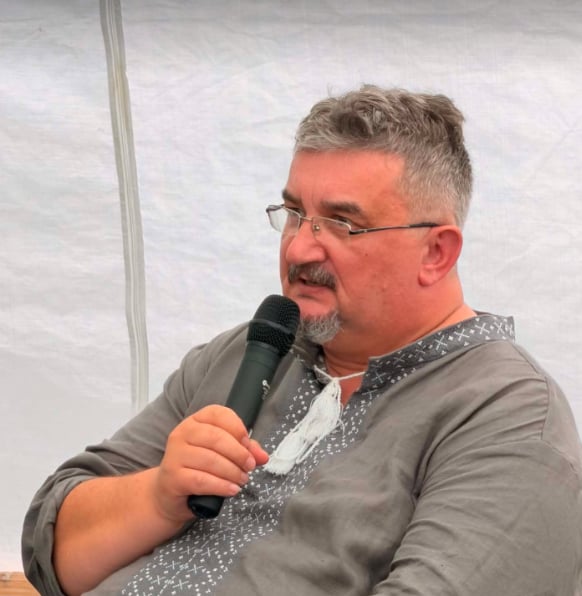
THE DEBATE OVER THE POLISH-UKRAINIAN CONFLICT WILL CONTINUE FOR SEVERAL MORE DECADES
- The project began almost by chance. Could you tell us about it?
- In 2013, Myroslav Ivanyk and I were researching the legacy of Volodymyr Kubijovyč in the Ottawa archives and found a wealth of information that could enable us to identify by name the victims in the Lublin District. So we began working on that. At the same time, I had the idea of turning it into a larger project, especially since the Polish-Ukrainian historical dialogue had become somewhat bogged down at the time.
I said then that we could debate the interpretation of facts until the end of the world and for one more day. At that point, I saw no prospect of Polish and Ukrainian historiography reaching any kind of common conclusion. Unfortunately, we can now see that I was right. The debate over the Polish-Ukrainian conflict will continue for several more decades. I therefore proposed focusing on something that raises no historical or ethical doubts: the victims and their identification. It is our duty as human beings and Christians. My words were not met with much enthusiasm among either Polish or Ukrainian historians, so the project had to be pursued by a somewhat different route.
- You once said that this research had caught the last train, because had a little more time passed, it would have been impossible. You were referring primarily to the number of eyewitnesses whom you managed to speak to while they were still alive. So why was it the last train?
- I have serious criticisms of Ukrainian historiography because, over the past 30 years, there have been almost no attempts to collect testimonies or other information about the victims of the Polish-Ukrainian conflict. In Poland, this work began during the communist era, in the late 1980s.
Let me tell you an anecdote, although it is one of those stories that makes you laugh through tears. It happened, I believe, under Kuchma. Yaroslav Tsaruk, a local historian from Volyn who has since passed away, tried to travel from village to village collecting testimonies about those events. Naturally, he appealed to various institutions and governments for assistance. All the Ukrainian state managed to do at the time was buy him a bicycle so that he could travel more quickly between settlements. Compared with historical research conducted in other countries, it looked rather pathetic.
- You see, back in the 1990s, after decades under Soviet rule, there were gaps in historical memory everywhere you looked. Everything had to be tackled at once.
- Yes, at the time everyone was interested in the Ukrainian liberation struggle of 1917–1921, the Holodomor, Soviet repression during the interwar period, the 1930s, and the terror. I understand that all of this is extremely important, but somehow the period of the Second World War and the Polish-Ukrainian conflict were overlooked, even though they are no less important.
- Your work is also based to a large extent on archival documents. Why do you consider eyewitness testimony so important?
- Of course, you are right that archival documents are also important and documents of every possible kind. These include, for example, documents produced by the Polish and Ukrainian underground movements. Then there are documents from various official institutions, such as the German occupation authorities during the war, the Soviet administration after the Second World War, and various Polish communist institutions operating in Poland during the early postwar period.
There are also the press of the time, court records, parish registers... But oral history, that is, interviews with eyewitnesses, is also very important. Testimony is, of course, a rather specific type of source, but witnesses can provide information that is absent from other types of sources.
Such testimony had to be approached with great caution because these accounts very often come from people who did not witness the events themselves but heard about them from others or read certain things about them. People come to believe that they experienced or witnessed something when this was not actually the case. With such testimony, it is important to isolate the kernels of genuine information.
- And have many such fragments of information already been lost in Ukraine?
- It is deeply regrettable when members of my project arrive in a village and approach a local teacher, the village council or a priest to ask whether there are any elderly residents who can tell them about the events that took place there, only to be asked: "Why didn’t you come three, four or five years ago? This or that person was still alive then." Had such work been carried out in the 1990s or early 2000s, the situation would have been entirely different.
THE CASE OF THE VILLAGE OF SLAVIATYN: 35 POLES WERE KILLED BY UKRAINIAN PEASANTS WHO HAD SUCCUMBED TO SOVIET PROPAGANDA
- How did you conduct the research? In professional terms, what was your methodology?
- Historiography has a methodology that involves accumulating information and subsequently using it to construct an overall picture. We do something similar: we accumulate information, but not about an event, about an individual.
Imagine that we find a record in a document stating that people were killed in a particular locality. We then try to find further information about it, for example in a Ukrainian underground document from the period of German occupation. We then look for confirmation in German documents and German police reports, as the Germans recorded such matters quite meticulously.
This was particularly evident in the Kholm region, in the Lublin District, when Ukrainian public figures were killed. These people were fairly well known within their communities and were local leaders at the time - village heads, heads of village councils, activists, heads of cooperatives and teachers. Their deaths or funerals were sometimes reported in the official Ukrainian press published under German occupation, such as "Kholmska Zemlia". These reports very often provide the date on which the death occurred or the date of the funeral. The next step is to search the parish registers themselves.
- Did you encounter killings about which no definite information had existed before your research?
- Yes, sometimes there was only a reference to a particular person having been killed. But when we examine a parish register, we find complete identification: the person’s first and last name, the date on which they died, and often even where, when, and under what circumstances.
One example is the Polish village of Slaviatyn (now in the Ternopil region - ed.), where Ukrainians killed several dozen Poles in September 1939. The literature quite often states that the killings were carried out by an OUN (Organisation of Ukrainian Nationalists - ed.) combat unit and that between 35 and 85 Polish civilians were killed. There is no doubt that the event occurred, as it is mentioned in a number of publications. We began searching other sources. Andrii Yaremchuk, who researched the subject, travelled to the village. First, he found the grave, which has survived to this day. He also spoke to several elderly residents, who described the situation at the time.
It turned out that the killings had not been committed by the OUN, but by revolutionary-minded peasants who had responded to the Red Army’s call. It happened on 18 September 1939. When the Soviets arrived, they appealed to the Ukrainian peasants, telling them to kill the Polish landlords. The peasants simply attacked the settlement and killed several dozen Poles.
Most importantly, however, we managed to find the parish register of the Roman Catholic parish, in which the local priest recorded precisely that 35 people had been killed that day.
- Where did the figure of 85, which now predominates in academic literature, come from?
- I think it was distorted during reprinting or digitisation; the number three became an eight at some point. We now have precise information showing that 35 people were killed, as well as a list of their names and ages.
We understand that the picture we are constructing will not be perfect either. Every good historian understands that historical truth is an ideal towards which every historian strives, while remaining aware that they will never fully attain it. They may come slightly or significantly closer to it.
Our primary concern is to honour the victims so that these people are no longer anonymous. So that they become people, rather than cold numbers in statistics. Behind these numbers are people who had their own lives and their own stories, and whose lives were cut short under various circumstances.
I DO NOT ACCEPT LISTS COMPILED IN POLAND IN WHICH ALL POLISH VICTIMS ARE INDISCRIMINATELY SAID TO HAVE BEEN KILLED BY "UKRAINIAN NATIONALISTS"
- You faced a dilemma over whether to include among the victims of the Polish-Ukrainian conflict Poles killed by Ukrainians, or Ukrainians killed by Poles, when the killings were carried out on the orders of an occupying regime, whether Soviet or German. As I understand it, you ultimately decided to include them, with the appropriate clarifications.
- Yes, there was some consideration as to whether such cases should be included in the project. I do not accept lists compiled in Poland in which Polish victims are often all lumped together. Whether it was a Pole killed by an OUN armed unit in 1939, by Ukrainian communists, by an SS police regiment whose members were Ukrainians, by UPA (Ukrainian Insurgent Army - ed.) fighters or by some other Ukrainian organisation, they are all described as "victims of Ukrainian nationalists."
The killing of Poles in Huta Pieniacka is one example. It was a crime committed by the 4th SS Police Regiment, a security formation whose members were Ukrainians. In Polish historiography, these people are counted among the victims of the Polish-Ukrainian conflict. When the media reported on the searches in Huta Pieniacka, I rarely encountered any mention that it was a Ukrainian crime committed under German command. Everywhere, it was simply described as a crime committed by Ukrainians.
We take a different approach from that previously adopted by Polish historiography. We state that there is a category of victims who were killed by the Polish underground, but also a category of people who were killed by Poles acting under German command. This is more honest and allows people to decide how the number of victims of the Polish-Ukrainian conflict should be calculated.
The situation is even more complicated with Ukrainian victims of Soviet destruction battalions whose members were Poles. In Poland, it is believed that they should not be taken into account because they were victims of Soviet rather than Polish units. The "destruction battalions" were indeed units subordinate to the NKVD and were part of the Soviet apparatus of terror. But there is one nuance. Those members of the destruction battalions who fought against the Ukrainian nationalist underground have today been granted official veteran status in Poland precisely for doing so.
- In other words, the Polish state officially recognises them as fighters who fought for Poland.
- Interestingly, this status has been granted only to those who fought against the Ukrainian underground as members of these Soviet units. Poles who were members of destruction battalions in Lithuania and Belarus are not entitled to veteran status. It is therefore time to decide: were they participants in the Polish-Ukrainian conflict or not? One cannot simply choose whichever interpretation is convenient. I believe that if these veterans were granted their status for fighting the OUN and UPA, they should also be viewed in their entirety, and the crimes they committed, which also took place, should be acknowledged.
- I would like to dwell on Huta Pieniacka. You mentioned the Polish village of Slaviatyn. It is clear why, in 1939, the Soviet authorities incited Ukrainian peasants to attack Poles – to diminish Polish influence in the newly occupied territories. It is also generally clear why the Nazi and Soviet regimes exploited the Polish-Ukrainian conflict to destabilise the situation. However, Huta Pieniacka was destroyed by an SS formation on the orders of the Nazi leadership. Why?
- The situation in Huta Pieniacka was more complicated because, on the one hand, there was a Polish self-defence post there (subordinate to the Home Army - ed.), and, on the other, a Soviet partisan detachment. Although the latter left the village on 23 February 1944, by then it had made its presence strongly felt, including by looting the surrounding Ukrainian villages. The immediate cause of the village’s pacification was reportedly the death of two soldiers from the regiment who, after the Soviet partisans had withdrawn, were killed by Polish self-defence fire as they entered the village. Five days later, on 28 February, a UPA detachment also took part in the destruction of Huta Pieniacka alongside subunits of the aforementioned police regiment. Several hundred Polish civilians were killed. In the context of our project, they are the ones who must primarily be remembered.
I HAVE NO DOUBT THAT THE ANTI-POLISH CAMPAIGN BY THE BANDERA WING OF THE OUN TOOK PLACE AND THAT A CORRESPONDING ORDER EXISTED
- You managed to identify by name approximately 20,000 Ukrainians who were killed, as well as roughly another 10,000 who remain anonymous victims. How did you arrive at the figure of 10,000 if their identities are unknown? Is it based on calculations of how many people lived in each village?
- If documents contain information that, on a particular day, Polish troops, the Polish militia, or some other Polish armed unit entered a village, and that five people were killed, but we do not know their names, we trust the documents. Sometimes the victims’ identities were not recorded in the documents. There are cases in which doubts arise as to whether a killing actually took place, and we do not even include such cases in our statistics. Although I do not like the word "statistics," because numbers are secondary to us. Our concern is with first and last names, with identifying those who were killed. "Remember every person," urged Bishop Borys Gudziak of the Ukrainian Catholic University, who supported the project and articulated its axiological foundation (his text opens every volume containing the lists of victims’ names). The fact that we have managed to identify 20,000 such people is a considerable achievement.
- Your research covers the period from 1939 to 1947. Most people in Poland and Ukraine are nevertheless familiar with these tragic reciprocal killings in the context of the mid-1940s, when the massacres reached their peak. Yet at the beginning of the war, in 1939, it turns out that Poles were already killing Ukrainians on a mass scale, rather than in isolated incidents as before.
- The conflict during the war and the postwar years was the bloody culmination of a conflict that had begun in the late nineteenth century. The Ukrainians subsequently lost the Polish-Ukrainian War, and the situation deteriorated during the interwar period. Polish governments failed to pursue a sound policy towards the Ukrainian national minority and veered between cooperation or support and harsh assimilation and anti-Ukrainian measures (particularly towards the end of the 1930s). The year 1939 brought several developments. First, the Polish state capitulated under German and Soviet assault. Ukrainian communists supported by the Soviets, as well as the OUN, which had been operating clandestinely against Poland, attempted to take advantage of this.
Historical literature generally states that an anti-Polish Ukrainian campaign of sabotage took place at the time, but if we examine the pattern of casualties, the situation looks somewhat different. It turns out that more than 1,000 Ukrainian victims were killed in September 1939, most of them during the first two weeks of the month. By contrast, if we look at the Polish victims, most of them were killed after 17 September, following the Soviet invasion. Historians have yet to assess the Soviet factor in this process fully.
Although some of the killings were political in nature, they very often also had a social dimension. We must remember the hostility between Ukrainian villages and Polish settlers, or between Ukrainian villages and Polish landed estates. In some parts of Galicia, the pacification campaign carried out in the autumn of 1938 played a role (this should not be confused with the campaign to destroy churches in the Kholm region that same year!) At the time, units of the Border Protection Corps effectively conducted a raid during which several hundred Ukrainian activists were brutally beaten.
A year later, people clearly remembered this. Nor do I rule out the possibility that some of the attacks were criminal in nature. The picture was therefore far more complicated than many people believe.
- In one interview, you said: "No one can tell me that in 1942–1943 the peasants in Volyn did not remember how, several years earlier... the Polish military had demolished a church and, at gunpoint, driven the local peasants into a Roman Catholic church."
Around 120 churches were destroyed in total at the time. Discussions of the Polish-Ukrainian conflict often descend into arguments over "who started it." Some Polish public figures try to argue that ordinary Ukrainians in Volyn in the 1940s knew nothing about the destruction of Ukrainian churches in the Kholm region or Podlachia in 1938, and that the events of 1943 should therefore be regarded as a separate campaign of violence. You, by contrast, are convinced that Ukrainian peasants remembered it. How was information exchanged at the time, and to what extent could they genuinely have connected all these events into a single picture?
- At the same time, some people justify the attacks on Ukrainian villages in the Sian region or the Beskids by invoking Volyn, even though most residents of those villages did not even know where Volyn was... And the destruction of churches was not confined to the Kholm region and Podlachia; it also occurred in Volyn. In the Volyn village of Hrynky, matters went so far that in 1938 the Polish military forcibly drove Orthodox Ukrainians into Roman Catholic churches. This campaign provoked outrage among intellectuals in Poland at the time. Maria Dąbrowska wrote in her diary: "Poor Volyn. All that will remain there are Hrynky (which Europe already knows about) and the Polish military in the role of Polish crusaders, converting people from Orthodoxy to Catholicism through fear and bribery. Morally – repugnant; politically – clinical stupidity, an act of madness for which Poland will have to pay." This, of course, does not excuse anything, but I believe it does explain something.
I do not justify either side at all. I have no doubt that an anti-Polish campaign took place and that the Bandera wing of the OUN was responsible for it. I believe that a corresponding order was issued and that these were not spontaneous outbreaks of violence.
AFTER THE WAR, NOT ONLY THE POLISH COMMUNISTS BUT ALSO MOST OF THE POLISH POPULATION WANTED THE UKRAINIANS EXPELLED
- The final year covered by your research is 1947. This concerns killings committed during the expulsion of Ukrainians from Poland. By then, the war had ended, and the new regimes had been established. Why did organised killings occur once again?
- In 1944, the front crossed the new Polish border. The Ukrainian population found itself divided. Once the front had passed, Polish-Ukrainian hostility resurfaced. Ukrainians were killed in what is now Poland.
In the summer of 1944, a quasi-communist government, the Polish Committee of National Liberation, was established. It signed an agreement with the Ukrainian SSR on a population exchange that was supposed to be voluntary. Poles who remained east of the Bug were to move to Poland, while Ukrainians living on Polish territory were to move to Ukraine.
For the first few months, this exchange was voluntary. Among the Ukrainians who left were communist activists, pro-communist peasants and those who had lost their homes in Polish attacks. By the beginning of 1945, however, these voluntary departures had ended.
At the same time, beginning in the spring of 1945, Polish underground groups attacked Ukrainian villages, particularly in the Rzeszów Voivodeship, in an effort to force their inhabitants to leave for Soviet-controlled Ukraine. These included the crimes in Pawłokoma (365 people were killed); Berezka (156 were killed); Bachów (71 people were killed); and Małkowice (128 were killed). There were dozens of such attacks. Some Ukrainians did indeed leave as a result.
This period of suffering ended in the summer of 1945, when the Ukrainian and Polish underground movements reached an agreement to end the hostilities. The agreement was not approved at the highest level on the Polish side, but both underground movements ceased attacking villages, civilians stopped being killed, and voluntary resettlement consequently came to an end.
The Polish authorities held a meeting that was also attended by Ukrainian communist activists. Unexpectedly, the delegates said almost unanimously that everyone who had wanted to leave had already done so, while the rest intended to remain on the land of their ancestors. They proposed an amnesty so that some of those hiding in the forests could come out. The Polish communists then faced a choice: accept these demands or resort to brutal force. They chose the latter. In the autumn of 1946, units of the Polish military were deployed to forcibly deport people to Soviet Ukraine, resulting in the expulsion of most Ukrainians. Those who remained or later returned were subsequently dispersed across Poland as part of Operation Vistula, which brought an end to the Ukrainian community’s traditional way of life in Poland. During these operations, Ukrainians were killed by the Polish military, including in Zawadka Morochowska.
- I would like to emphasise that, once again, these were victims of the regime, rather than of the Polish underground or spontaneous acts of violence.
- We must take into account how people thought at the time. If a village in Volyn was set on fire by people wearing German uniforms but speaking Ukrainian, few would remember that German officers had issued the orders. They would remember the Ukrainian language. The same applies in the opposite direction. Nor should we forget that after the war, it was not only the Polish communists but also the majority of the Polish population who favoured the expulsion of Ukrainians.
Overall, we adopt a broad interpretation, but I always repeat: let us first establish the victims’ names.
MORE THAN 600 PEOPLE WERE KILLED IN SAHRYN – THE LARGEST CRIME COMMITTED BY PARTISANS IN THE GERMAN-CREATED GENERAL GOVERNMENT
- I would like to dwell on the tragic case of the Ukrainian village of Sahryn. For some time, Polish historians spoke of 100 or 200 victims. Ukrainian accounts mentioned as many as 1,200 people killed. You established a figure of approximately 600. Why is there such a discrepancy?
- We identified by name slightly more than 600 people who were killed, and several dozen more whom we were unable to identify can probably be added to that figure. They included several Poles whom Home Army fighters mistook for Ukrainians.
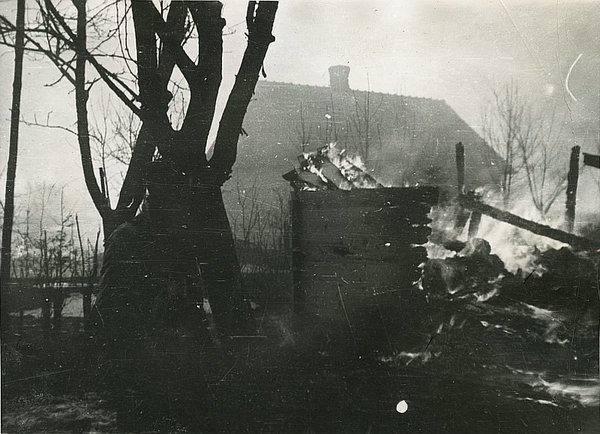
Sahryn was a large village with a unit of Ukrainian police in German service. People came there from the surrounding villages because they believed it would be safer. The Germans had also previously resettled Ukrainians from the Biłgoraj region there. We therefore do not know how many people were in Sahryn on that fateful day, 10 March 1944.
In addition to their names, we managed to establish the sex and age of those killed. To this day, some circles in Poland maintain that the operation targeted a heavily armed Ukrainian stronghold, that armed UPA fighters were present and offered resistance, and that not all those killed were accidental victims.

Home Army partisans after the burning of the village of Sahryn (Source: Local History)
First, there was no UPA unit there. There was a self-defence group consisting of several dozen men who had virtually no weapons. If there were any individual SS soldiers there, they were most likely men who had previously deserted. There were also several members of the Ukrainian police. Almost all of them managed either to escape from the village or break through the encirclement formed by the attacking Home Army fighters.
Most of the victims were therefore women and children, while most of the men were over 40 (they lacked the strength to flee). There was no battle – after a brief initial defence, there was only the mass killing of civilians. Polish historian Mariusz Sawa describes this well, in various contexts, in his latest book. Sahryn was the largest crime committed by partisans in the German-created General Government. Among Polish victims, the destruction of the villages of Janowa Dolina or Ostrówki (Pavlivka) may be regarded as analogous, both in scale and in the manner in which it occurred.
This crime is virtually unknown internationally. People know about Lidice and Oradour, villages where the Germans committed mass atrocities. Yet no one knows about Sahryn.
- If you were to imagine what memorial sites for Ukrainian victims in Ukraine and Ukrainian victims in Poland should look like, what would you propose? Today, almost no trace remains in Poland of either the churches or the Ukrainian cemeteries.
- For me, the most important thing is to look at the matter from the victims’ perspective. There is therefore no doubt that exhumations must be conducted to find their remains. On both sides of the border. Both in Ukraine and in Poland, where remains also lie in unconsecrated ground. There are more than 200 localities in Poland where over five people of Ukrainian nationality were killed, meaning that these were not isolated crimes.
The second issue is remembrance of the victims of the Jaworzno concentration camp. Frankly, I do not understand why no search for the victims has yet been conducted there. The concentration camp was originally established by the Germans, and after the war the communists used it for their own purposes. In 1947, a kind of subcamp was established there in which mainly Ukrainians were imprisoned. A total of 5,000 people passed through the camp, and 162 died of starvation or torture. They were civilians, including women and children. The location of their burial site has been known since the 1990s – it is not where the symbolic memorial to the victims of Jaworzno stands. Neither Ukraine nor Poland has shown any desire to locate the remains of those 162 people (and I stress once again that they were Polish citizens of Ukrainian nationality) and give them a proper burial.

Jaworzno concentration camp, a fragment of the wall and railway tracks
The next issue is the commemoration of sites where villages in which mass killings occurred once stood. There should at least be a memorial stating how many people were killed and, if possible, listing their names.
- Finally, I would like to ask about the project’s funding. I know that you lack sufficient personnel and that a great deal of work still lies ahead in identifying the Polish victims.
- Four people work on our project. From the very beginning, I did not want it to be funded by either state, Poland or Ukraine, because that could have resulted in politicisation or financial dependence. Our principal sponsor is the Ukrainian Studies Fund in the United States, to which we are deeply grateful for its support, because without it we would have been unable to carry out our project.
Olha Skorokhod, Censor.NET


