



Oleksii Haran on 35 years of independence: from ’severed fingers in Kyiv’ to missiles on Moscow
Despite stereotypes, a unique feature of Ukrainians compared to many other countries that emerged from the USSR is the ability to unite and reach compromises in order to save the state. This is the opinion of political scientist, professor of the National University "Kyiv-Mohyla Academy" Oleksii Haran. The Ilko Kucheriv Democratic Initiatives Foundation, of which Haran is a scientific advisor, is a sign of the highest political expertise, and he most often voices it.
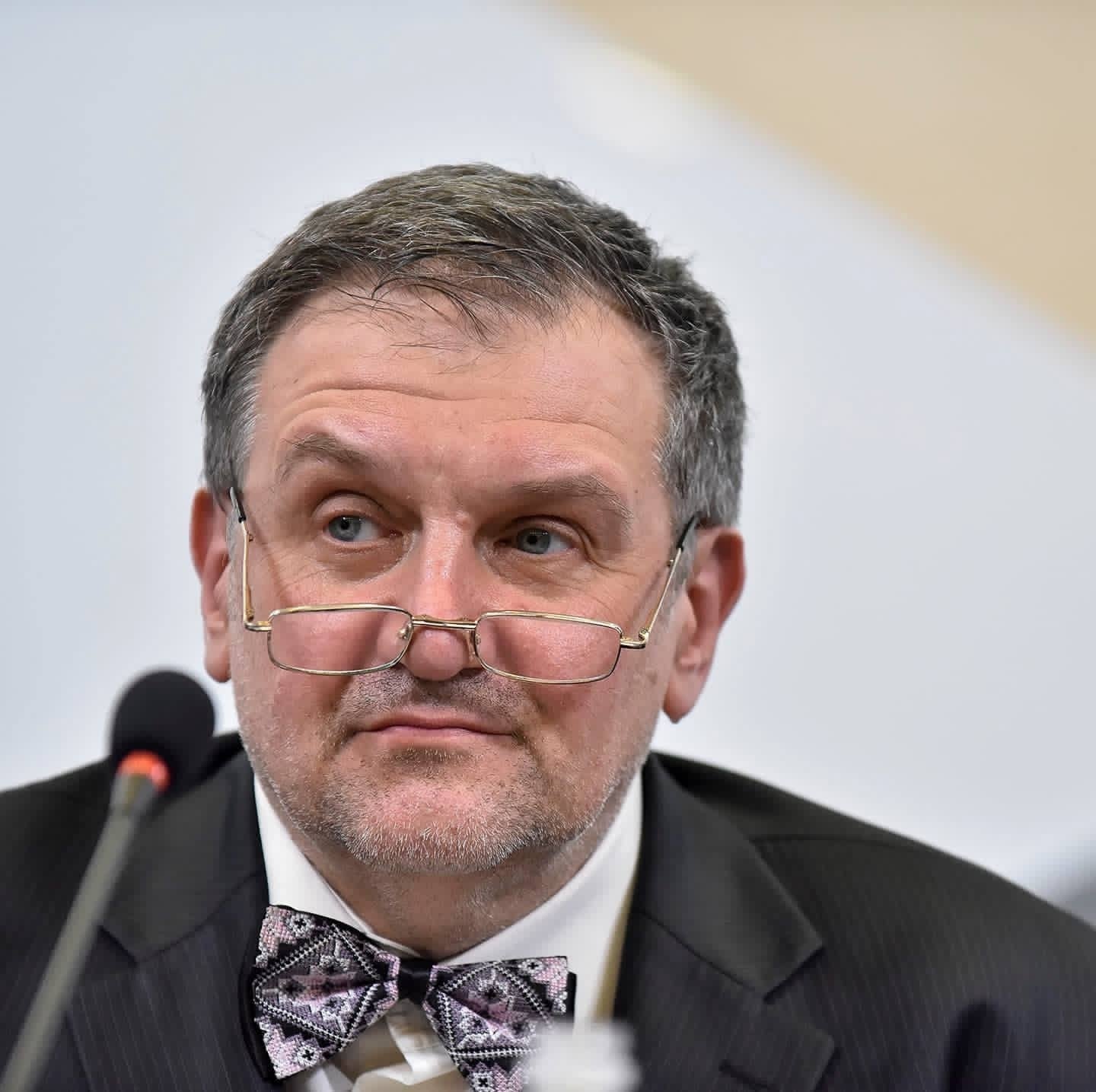
Haran belongs to a generation that did not experience the hardships and the stranglehold of Stalinism; it came of age during the period of ‘stagnation’, albeit in peacetime, and laid the foundations for Ukraine’s independence and proclaimed it.
To mark the 35th anniversary of Independence, we spoke to Mr Haran about the development of Ukrainian society and the political establishment on the path to independence and in the years that followed. Today, this period is, in some respects, romanticised, in others underestimated, and in yet others – misunderstood.
If we take a generation to be roughly 25 years, we have defined the period up to the end of Kuchma’s presidency as the focus of our discussion – as one we can discuss from a historical perspective. Haran wrote the first history of the Movement about this period –*Killing the Dragon* (1993), the first book on the left – *The Ukrainian Left: Between Leninism and Social Democracy* (2000), and his own memoirs,*From Brezhnev to Zelenskyy: The Dilemmas of a Ukrainian Political Scientist*(2021), the English translation of which is due to be published in January 2027 in the ‘Ukrainian Voices’ series by the German publisher Ibidem, and will be distributed in the US by the prestigious Columbia University Press.
SINCE 1972, UNDER SHCHERBYTSKY, *KOBZAR* HAS BEEN PUBLISHED IN A CENSORED VERSION
- You belong to a generation that laid the foundations for independence, but also came of age during the Brezhnev ‘stagnation’. Like most citizens at the time, coming from a Russian-speaking family, you accepted communism and saw yourself as part of that system, whilst gradually becoming aware of its flaws. How did you come to identify as Ukrainian? And when did you start embracing the Ukrainian language?
- I’ve always felt Ukrainian, even though my family is indeed Russian-speaking. My father is from a village, with roots in the Vinnytsia region, but he came to Kyiv and became Russified here. My mother grew up in Kyiv; she was also Russified and was even registered as Russian, although in reality she has no ethnic Russian heritage. I could choose what to write in the ‘nationality’ section of my passport, and for me it was never in doubt that I am Ukrainian, even though I am a Russian speaker.
And again, my father’s relatives spoke Ukrainian, and he spoke Ukrainian with them too. My Jewish grandmother taught me to write essays in Ukrainian. She came to Ukraine from Belarus in the 1920s, during the period of Ukrainisation. She worked at the central telegraph office and so learnt Ukrainian well.
I tried to switch to Ukrainian whilst studying at what was then the Faculty (now the Institute) of International Relations and International Law at Taras Shevchenko National University of Kyiv. Later, whilst doing my postgraduate studies there, I tried again to switch to Ukrainian. I simply couldn’t manage it because the environment wasn’t right. Not to mention that people were constantly giving me sidelong glances. As if to say, why had I suddenly started speaking Ukrainian so ostentatiously? My parents were terribly frightened, as they thought I’d fallen under some kind of influence and would be accused of nationalism.
- At what points did you realise that something was wrong with the Soviet reality of the time?
- I was interested in history and geography. My father was lucky in the sense that he was probably one of the first Ukrainians to start travelling abroad during the Soviet era. He was a talented trombonist – and he was recruited into the Virsky Ensemble, with which he toured a whole host of countries that were effectively off-limits to us at the time. He visited the US, Canada, the UK, Mexico and Spain.
He would bring back coins, souvenirs and postcards. As a lad, I used to look at them. Then, at my grandmother’s dacha, we found money from the Ukrainian People’s Republic and the Ukrainian State. It was an incredible experience! And how fascinating it was to read about the Cossacks! In other words, this interest in history—even in the Soviet version of it—gave me an understanding of who I was and hinted that the world was more complex than we were led to believe.
My father used to listen to ‘enemy broadcasts’ – ‘Voice of America’, the ‘BBC’, even ‘Radio Liberty’. They were jammed, but he listened to them anyway. When I asked to listen in, he’d shoo me away. In other words, he didn’t want me to get involved in it.
I was also very interested in Ukrainian literature. I had a 1972 edition of Shevchenko’s *Kobzar*. It contained notes on some of the poems in which he condemns Bohdan Khmelnytsky. And it stated that Shevchenko did not understand the historical significance of the Pereyaslav Council and, for some reason, criticised Peter the Great. And after 1972 – that is, when Volodymyr Sherbytsky became First Secretary of the Central Committee of the Communist Party of Ukraine and ostentatiously switched to speaking Russian – editions of *Kobzar* were published in a censored form; parts of the poems were missing. And I asked myself: why? Later, at university, we discussed this further. Even an article in the *Great Soviet Encyclopaedia* could give one pause for thought.
I believed in the world revolution back then, but the realisation that something was going wrong came during my student years. It seemed to me that our socialism was distorted. I looked at the failed attempt at ‘socialism with a human face’ in Czechoslovakia in 1968, crushed by Soviet tanks, or at the so-called ‘Eurocommunists’ in Western Europe, who rejected Lenin’s ‘dictatorship of the proletariat’ and criticised the USSR for its lack of freedoms.
- It is often said that the 1980s in Ukraine were a time not merely of stagnation, but of outright suffocation in many spheres. You graduated from university in 1981. How did you experience that period?
- It felt as though many things were more liberal in Moscow than in Kyiv. There was a saying: ‘Where they trim your nails in Moscow, they chop off your fingers in Kyiv.’ The Ukrainian leadership kowtowed to Moscow so that, God forbid, they wouldn’t be suspected of anything nationalistic. If we take art, culture and television, it was easier to breathe in Moscow than in Kyiv. Like many of my colleagues, I used to visit Moscow’s libraries and theatres, in particular the Taganka Theatre, where Vladimir Vysotsky performed and where there were daring productions, whereas in Kyiv all that was being stifled. Ryazanov’s satirical film *The Garage* was banned from release in Kyiv.
Nevertheless, even in the Ukrainian SSR it was possible to achieve truly significant things, for example, in the publishing sector. Take the world literature magazine *Vsesvit*: it rivalled the Moscow publication *Inozemnaya Literatura*. I know people who read *The Godfather* in Ukrainian for the very first time (!) – it was published in *Vsesvit*.
And yet, what Gorbachev brought about is almost impossible to put into words. When we first saw on television that the General Secretary was simply going out to the people and speaking to them, we were shocked. Well, after that, people began, in small doses, to talk about things that had previously been forbidden.
For Ukraine, there was another crucial factor – Chornobyl, 1986. It starkly demonstrated that neither the Moscow nor the Kyiv communist leadership cared about us. We saw more than just the authorities’ inaction. Shcherbytsky led people, including children, out onto the streets for the May Day demonstration. In fact, he even brought his own grandson along. It became clear that the system was corrupt, but we wanted to believe that socialism would be reformed.
Informal clubs began to spring up. The first ‘informals’ in Ukraine were environmentalists. Then came the Society for the Study of the Ukrainian Language; ‘Memorial’, which dealt with the victims of Soviet terror – this was precisely the result of the policy pursued by Gorbachev.
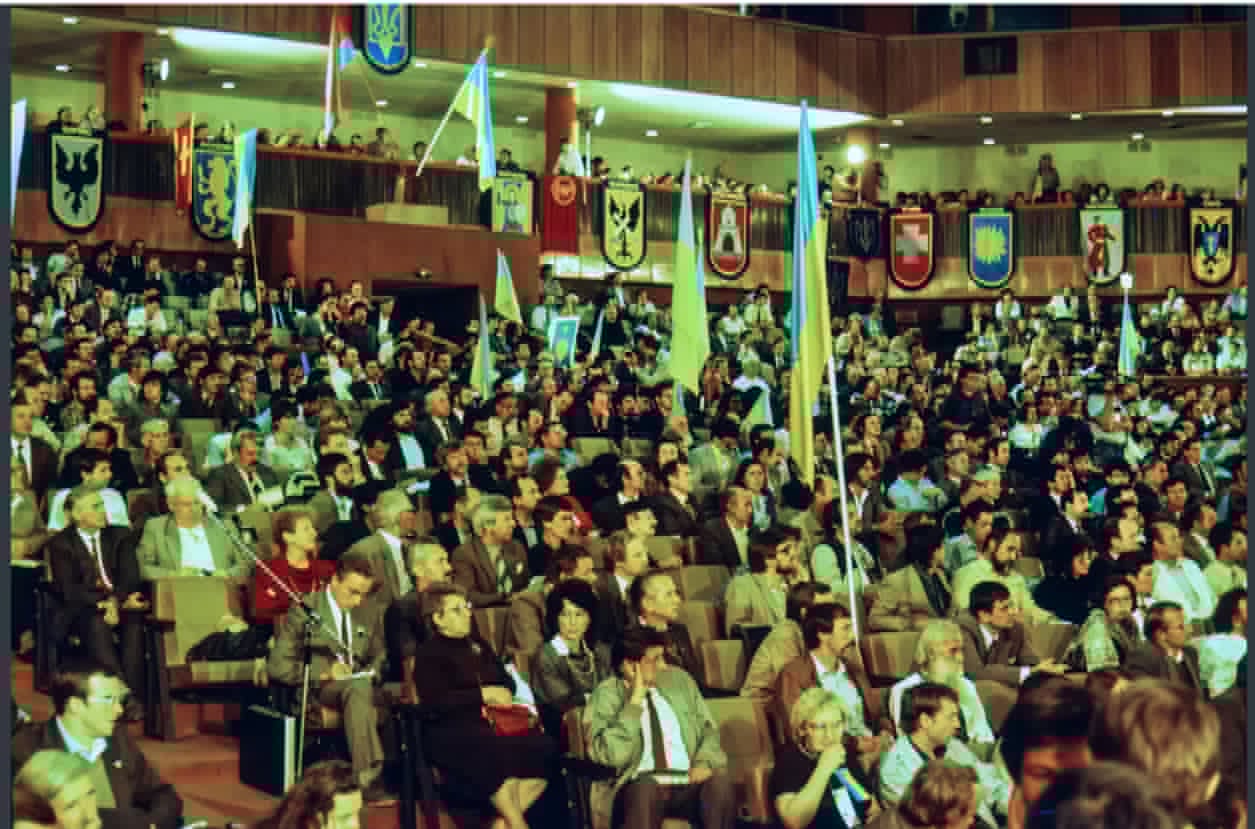
SOCIETY STILL HAD TO MATURE TO EMBRACE THE IDEA OF INDEPENDENCE
- And then broader-based associations and parties began to emerge, and you found your place within them. How do you assess the phenomenon of the ‘People’s Movement of Ukraine’ today?
- The organisations I mentioned were each trying to occupy their own niche. But by then I had come to realise that broad political changes were needed. I became a member of a small Kyiv-based ‘People’s Union for Perestroika’. And then the Movement emerged. Let’s recall what the Movement’s original name was: ‘People’s Movement of Ukraine for Perestroika’.
And here it is very important to mention something we often forget. Attempts to create various people’s fronts were modelled on the Baltic states (as they were called at the time). And initially, they demanded democratisation and sovereignty, not independence. In Lviv, there was an attempt to create a Democratic Front, and there were other similar efforts. In 1988, the Declaration of Principles of the Ukrainian Helsinki Union was adopted. In effect, what they were calling for was the transformation of the Soviet Union into a confederation. Among other demands were the restoration of the Autocephalous and Greek Catholic Churches, military service within the republic, Ukrainian as the official language, and so on. For 1988, this was a fairly radical programme. But it was put forward by former dissidents, whom Soviet propagandists had slandered in every possible way, silenced, and, when they were mentioned at all, accused of some crime.
And whilst it was easier to mobilise people in Western Ukraine, where the UPA had been active as recently as 30 years earlier, it was generally difficult across Ukraine as a whole. That is why the mass mobilisation of people and the creation of the ‘Movement’ began after the Writers’ Union declared: ‘Let’s create a movement in support of perestroika.’

- And most of the Union’s members were Communists.
- Exactly. And they were well-known figures – Ivan Drach and Dmytro Pavlychko, to name but a few. When they said they would create a movement to support the changes Gorbachev was bringing about, people listened to them and thought something along the lines of: ‘Here are some decent people; they’re not anti-communists, they’re not anti-Soviet.’ But society still had to come to terms with the idea of independence.
I always emphasise that there were two main currents within the People’s Movement. One consisted of people who believed in ‘perestroika’, including members of the Communist Party of the Soviet Union. Vyacheslav Bryukhovetskyi, for instance – who later founded the Kyiv-Mohyla Academy – was secretary of the party organisation at the Institute of Literature. And it was there that the draft programme of the Movement was written and first read out.
Added to this was a second, more radical wave, which originated from former dissidents. It was smaller in number, but its radicalism influenced everyone else.
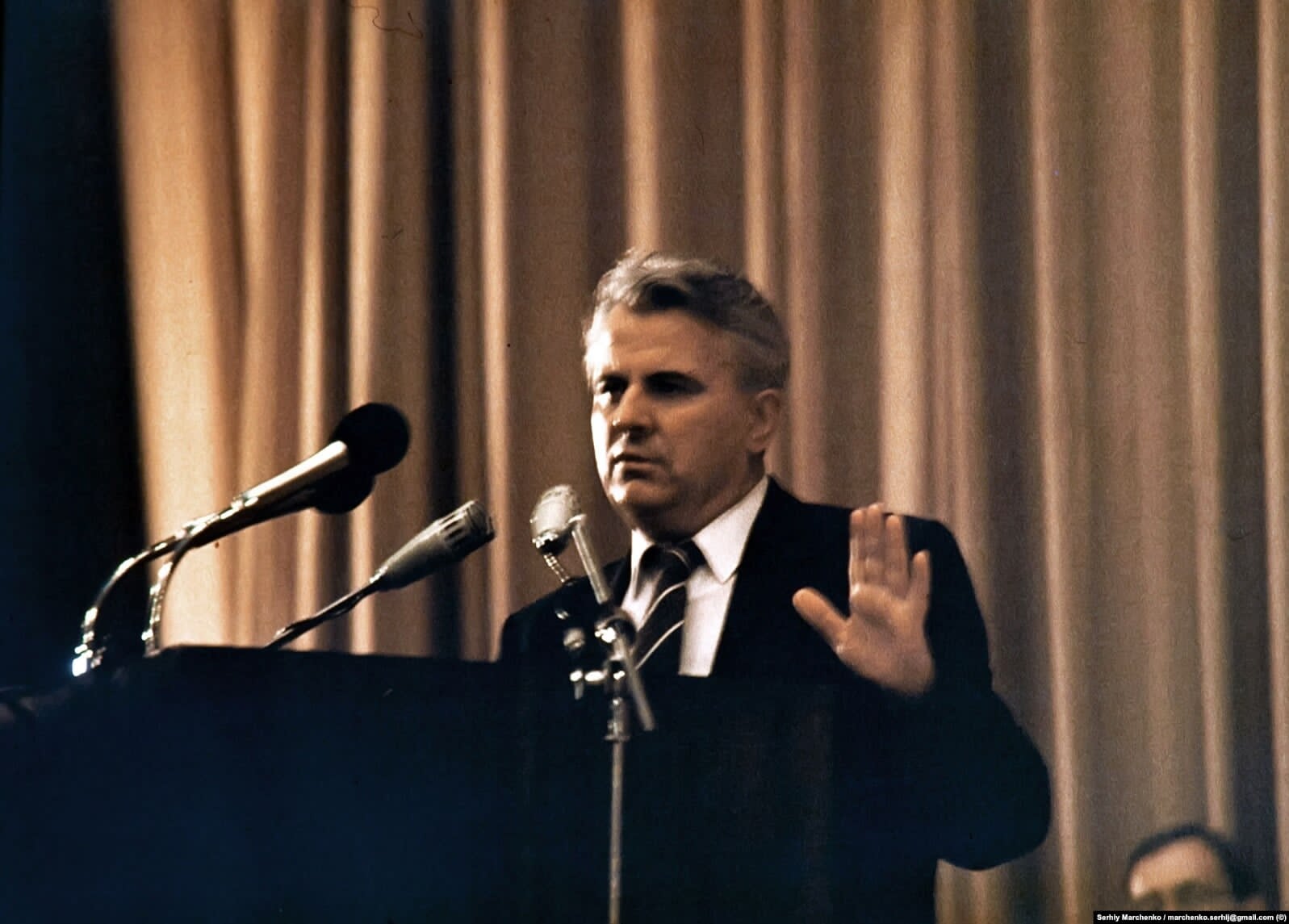
- In the spring of 1990, the People’s Movement entered parliament, where it formed the opposition ‘People’s Council’. By July, the Act on State Sovereignty was being voted on. How did this radicalisation and progress towards independence unfold?
- If we look at the People’s Movement’s first manifesto, it contained a clause on concluding a new union treaty. By June 1990, the Movement’s Grand Council had already declared that we must move towards independence. And in the autumn of 1990, following the well-known student hunger strike, the Verkhovna Rada was forced to remove Article 6 of the Constitution of the Ukrainian SSR, which stipulated the leading role of the Communist Party. Following this, the Movement’s second congress took place, at which a course towards independence was incorporated into the Movement’s programme documents, along with a ban on members of the Communist Party of the Soviet Union participating in the Movement.
- With the benefit of hindsight, we have come to view the series of events in the late 1980s as a step-by-step movement towards Ukraine’s independence. Although the situation and the general atmosphere were complex. What role did the ‘Revolution on Granite’ play in this process? It was no coincidence that you mentioned it in the context of the ‘Movement’s’ new slogan.
- The students did not formally demand Ukrainian independence. Their demand was not to sign the new union treaty. By then – in the autumn of 1990 – criticism of perestroika from more radical quarters had already begun. Moreover, our Ukrainian press was already writing extensively on a variety of topics. A great deal of ‘samizdat’ and reprinted newspapers were being published. Rallies involving thousands of people were taking place. In other words, by that point we were already discussing every issue under the sun.
That is why the student protest fell on fertile ground. Such a huge student encampment right in the middle of the capital, with people walking past and talking to them – that was something unheard of in Ukraine.
- Gorbachev’s referendum on 17 March 1991 ‘on the preservation of the USSR’ was a significant factor and an attempt to slow down the process. Moscow put forward the question of ‘a renewed federation, where all people’s rights would be preserved, regardless of nationality’.
- In other words, the referendum question was entirely manipulative. I use this example to teach my students: here is a prime example of a manipulative referendum question. The majority of Ukrainians said ‘yes’ to a renewed federation. But… Ukrainians are shrewd, and by that point the so-called national-communist wing, led by Leonid Kravchuk, had already emerged. Informally, they joined forces with the ‘Rukh’ movement and devised an interesting manoeuvre. At that time, Ukraine could not call a referendum; there was no such concept as a republican referendum. Instead, the Presidium of the Verkhovna Rada of Ukraine announced that a poll would be held. It contained the following question: ‘Do you agree that Ukraine should be part of the Union of Soviet Sovereign States based on the Declaration on the State Sovereignty of Ukraine?’.
And the Declaration, despite having been voted for predominantly by Communists, was based on what the ‘Rukh’ movement had demanded. And if the union had been created based on this declaration, it would have meant that the Soviet Union as a federation no longer existed. Instead, there would have been an amorphous confederation.
As a result of this move, the majority of the population of the Ukrainian SSR answered ‘yes’ to the question in Gorbachev’s referendum and also answered ‘yes’ separately in the republican poll. This was March 1991, and by the end of the year everyone was already voting for independence.
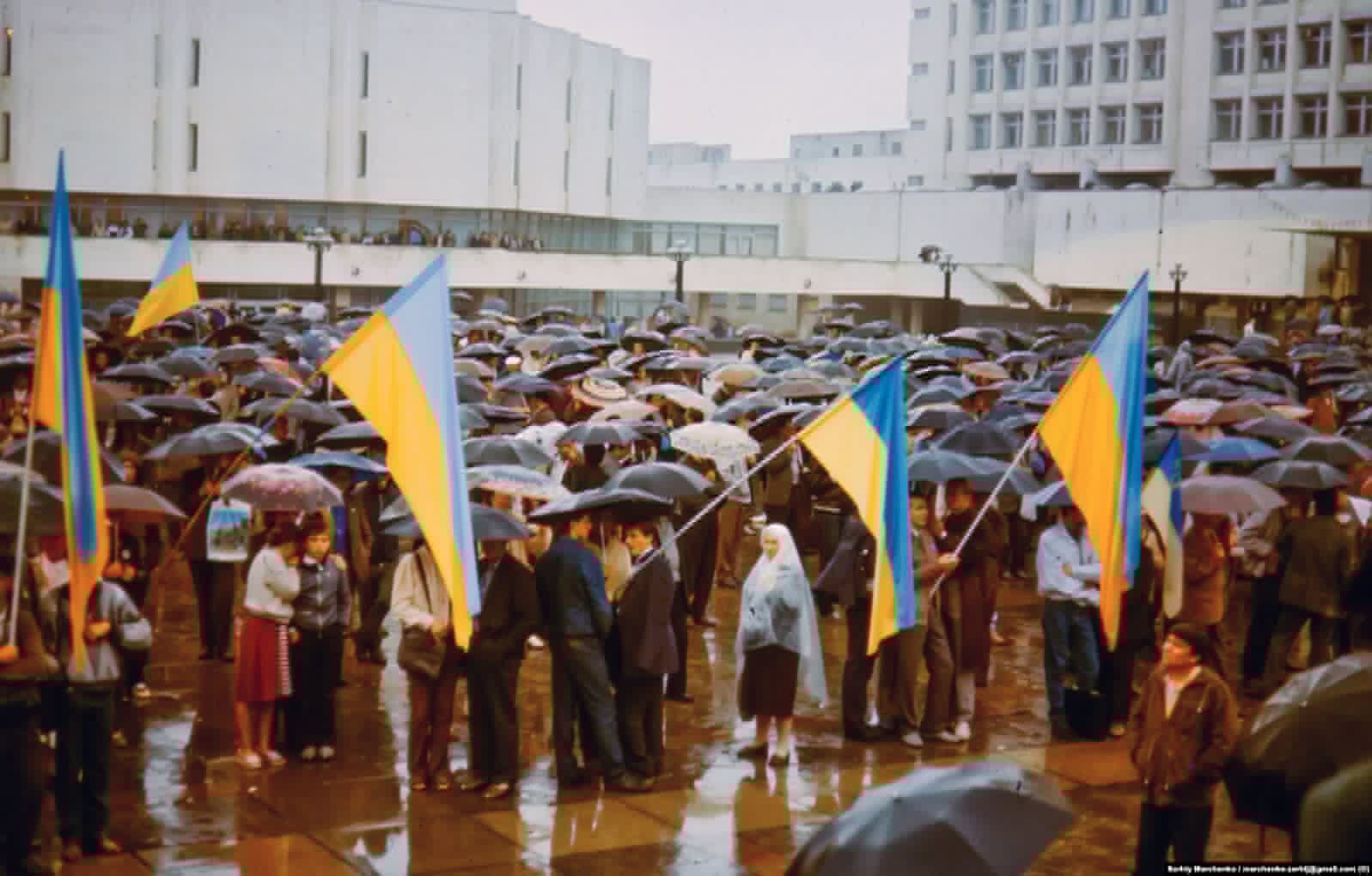
- So, was this a situational alliance between the national communists and the Rukh movement, or were there perhaps certain agreements in place?
- This meant that the Communist Party leadership sitting in the Verkhovna Rada had already embraced the ‘Rukh’ movement’s slogans. In effect, two factions had emerged within the Communist Party of Ukraine. One was the wing based on Bankova Street at the time, as that was where the Central Committee of the Communist Party of Ukraine was located, headed by First Secretary Gurenko. Interestingly, the Writers’ Union of Ukraine was situated directly opposite. Such is the irony of fate.
Kravchuk, meanwhile, was in the Verkhovna Rada. He was, in a sense, a Communist, but could no longer rely on the Central Committee. He had to rely on those sitting in the chamber. And there were no longer just Communists there; there were also members of the Rukh, national democrats, whilst demonstrators were marching around the Rada.

The Declaration on State Sovereignty and the referendum were a striking example of how these two currents had, de facto, come together. Then came the decision that it was too early to sign the union treaty, followed by the vote on Ukraine’s independence.
I always think of Levko Lukyanenko. He said: ‘The Communists who want to see an independent Ukraine created are our allies at this stage in the making of history.’ This was said by a man who had spent 27 years in camps and settlements and had been sentenced to death. Lukyanenko was then leading the first opposition party – the Ukrainian Republican Party, founded based on the Ukrainian Helsinki Union.
Incidentally, when I speak to Africans, I recount Lukyanenko’s life story. Non-violent methods, campaigning for withdrawal from the oppressive Soviet Union, sentenced to death, 27 years in prison, author of the declaration of independence. Does that remind you of anyone? "Yes," they say. "Nelson Mandela."
Drach had a joke about this. He asked: why does the whole world know about Mandela, but not about Lukyanenko? ‘Because Mandela is black. The Soviet Union and Europe both fought against racism, and there was even a civil rights movement in the US. That’s why everyone knows who Nelson Mandela is. But at the time, only the diaspora and specialists knew about Lukyanenko.
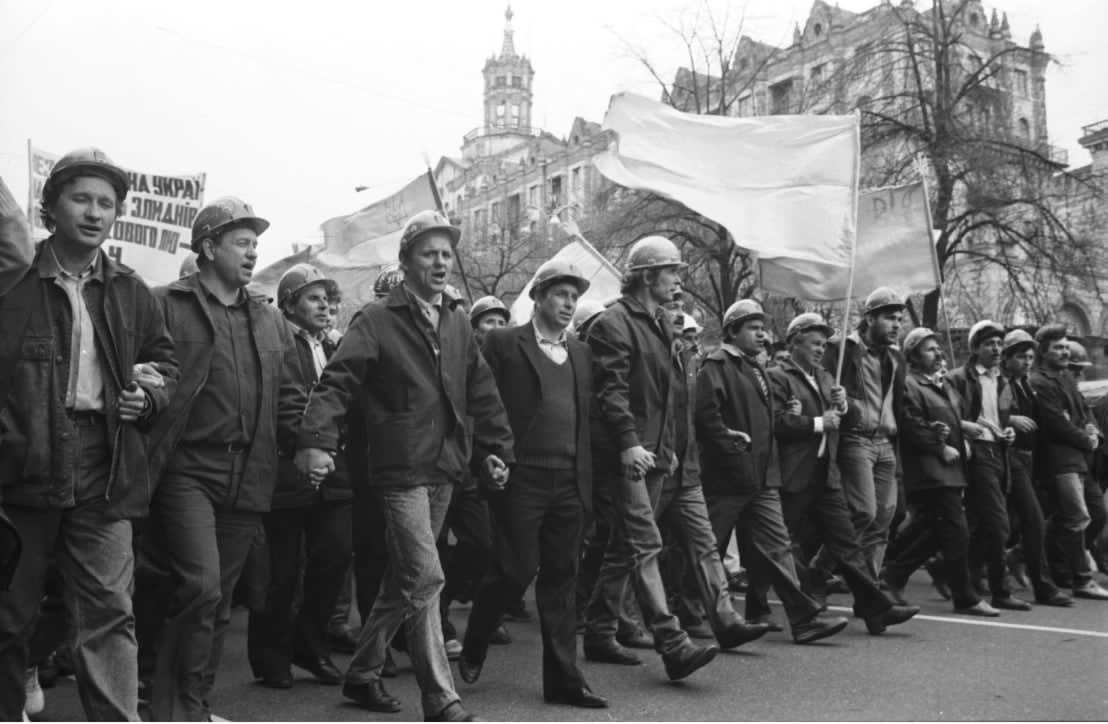
- The labour movement in the East and South, including the miners’ strikes, was another aspect of the process. It was crucial that the predominantly Russian-speaking participants in this movement were convinced of the need to support Ukraine’s independence. How was this achieved?
- Many of them had a different motivation – an economic one. They were told that if we remained in the Soviet Union, our coal would not be able to compete with coal from Kuzbass, and it would spell the end for all Ukrainian mines.
But this collective rallying round a single idea ultimately gave us a peaceful, evolutionary transition to independence – something the West did not believe in, because Moscow’s propagandists claimed that Ukrainians would start slaughtering Russians, Jews and other Ukrainians. And then there were the Crimean Tatars, who would start slaughtering absolutely everyone. What can one say, when President George Bush Senior, speaking in the Verkhovna Rada on 1 August 1991, warned Ukrainians against ‘suicidal nationalism’. In reality, however, there was not a single inter-ethnic conflict here, and this stood in stark contrast to what was happening around Ukraine – in Russia, Moldova, the Caucasus and Yugoslavia.
- When searching for the roots of the many hardships and problems we faced after 1991, two arguments are often put forward. The first is that, although the Communists adopted the Movement’s slogans and voted for independence, they shaped the state according to Soviet models, which is why former Komsomol and Party officials retained their leadership roles and positions. The second argument, which is also quite popular, is that Ukrainians entered independence without a clear plan. In other words, there were rose-tinted dreams that riches would rain down on Ukraine, as it was a land of milk and honey. However, in practice, neither the former communists, nor the Rukh members, nor the democratic Russian-speaking wing knew what to do. What is your view on these arguments?
- There are two detailed answers to this. Firstly, it is true that such a view existed at the time; it was advocated in particular by the Deputy Speaker of the Verkhovna Rada, Volodymyr Gryniov. He is from Kharkiv, ostensibly a democrat, but not a national democrat. And he said at the time that if we were to separate from Yeltsin’s Russia, it would result in Ukraine remaining in a communist reservation.
However, a unique situation had arisen at that time – the failure of the anti-Gorbachev coup and the opportunity to declare independence very quickly indeed. In those circumstances, we had to vote IMMEDIATELY; we had to seize the moment. Moreover, we know full well that the West did not want the Soviet Union to collapse. We remember George Bush Senior’s infamous ‘Chicken Kyiv speech’ mentioned above – and that was three weeks before the collapse of the USSR. So the opportunity seemed incredible.
There are various versions of an alternative history. According to one of them, if things had dragged on for longer, Ukrainians would have been able to prepare better, the foundations of civil society would have been laid, and we would have been better prepared for independence.
After all, why was the coup directed against Gorbachev? Firstly, he wanted to sign a new union treaty. A date had already been set, and it was known exactly who would be travelling to Moscow (Ukraine had no intention of going). Gorbachev’s opponents wanted to derail this. Secondly, a draft of a new version of the Communist Party’s programme had emerged. Gorbachev was steering the Communist Party towards social democracy. Who knows what would have happened if he’d gone through with it? Perhaps we would have gained some extra time before independence. But Gorbachev was already losing popularity and power – largely due to events in the national republics.
What happened, happened – the failure of the coup in Russia and the unique opportunities that followed. Independence was declared, and after that the Presidium of the Verkhovna Rada of Ukraine, where the Communists were in the majority, banned the CPSU/CPU, because the Communist Party of Ukraine had no autonomy whatsoever.
INFLATION – 10,000 PER CENT… ALL THE FRUSTRATION WAS BLAMED ON KRAVCHUK
- And this raises the second question we were discussing – about plans to build an independent state. There is a key question: what would have happened if Chornovil had been president?
- The first answer: Chornovil would not have been president! Let’s look at the election results. Kravchuk won in the first round with over 60 per cent of the vote. The Democrats had already split by then, with Lukyanenko, Yukhnovsky and others going their separate ways. People were not ready to vote for a former dissident and anti-communist.
Still, it’s an interesting question: what if? I have my own view on this. It coincides with that of the historian Oleksandr Zinchenko, who even made a documentary film entitled ‘What If Chornovil? The Best Scenario for Ukraine?’ After all, we have examples of former dissidents coming to power in Georgia and Azerbaijan. How long did they last? Chaos ensued; in Georgia, a civil war broke out, and Russia was not the only force behind it. Shevardnadze quickly came to power in Georgia, whilst in Azerbaijan, Aliyev Senior returned to power – both former heads of the republican KGB.
So, imagine if Vyacheslav Chornovil had been in power here, and the government had consisted mainly of members of the Rukh movement. Let’s think back to 1993. Inflation stood at 10,000 per cent. I think today’s young people cannot imagine what 10,000 per cent inflation is like. What would have happened? People would have said: ‘So much for your independence – look what all those Rukh members and Bandera supporters have led us to.’
Instead, all the discontent was shifted onto Kravchuk. Kravchuk lost, and Kuchma came to power. In the polls, Ukrainians’ support for independence fell slightly, but the idea of independence was not discredited, and soon the poll results returned to the level seen in the 1991 referendum.
As for the fact that we didn’t foresee the difficulties, well, yes, we really didn’t. We looked at it superficially: Ukraine was the most developed republic of the Soviet Union. It was only later that we realised this was largely due to the military-industrial complex. And after the break-up of the single Soviet market, a crisis ensued.
Radical reforms were needed, but Kravchuk was unable to implement them. And to a large extent, why were we not prepared for them? Because Russia was right next door. That was a factor that always restricted our actions, including when it came to radical reforms.
- Do you think it was a mistake not to have implemented ‘shock therapy’ along the lines of Balcerowicz’s reforms in Poland at that time?
- You’d have to be Balcerowicz to sacrifice your political future and carry out such radical reforms, as he did in Poland. But it was easier for Poland, even though ‘Solidarity’ and President Lech Wałęsa lost the subsequent elections. Who came to power instead? Aleksander Kwaśniewski, a former Komsomol member, came to power, but he was a Pole who believed in Poland and led it into NATO and the European Union.
Here, we got Leonid Kuchma, who won in 1994 on pro-Russian slogans, but life forced him to strengthen the Ukrainian state. We’ve always had a paradox with our presidents: during elections, they relied on slogans promising either improvements or the normalisation of relations with Russia. Even Viktor Yushchenko did this, as did Petro Poroshenko – promising that he would ensure peace. But when they came to power, they began to pursue policies dictated by Moscow. And even Viktor Yanukovych. Let us recall that the Association Agreement with the EU was initialled, that is, prepared, under Yanukovych. Then Russia eventually put the squeeze on him.
In other words, every president – even if they had campaigned on a pro-Russian platform to win votes in the East and South – faced the question once in office: ‘Which country do I want to be president of? I don’t want to be president of just part of the country; I want to be president of the whole of Ukraine.’ And in that case, one must take into account not only what the East says, but also what the West and Kyiv say. And Kyiv, despite the city having been Russified, predominantly supported the national democrats.
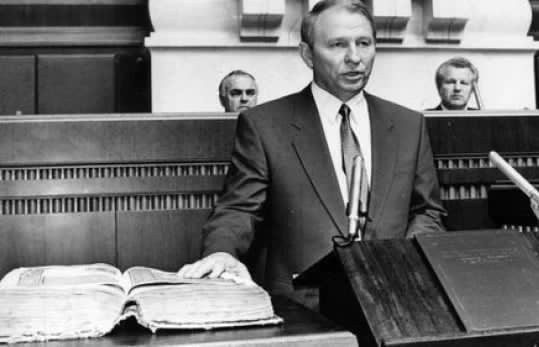
Kuchma was six votes short of confirming the referendum results. Can you imagine such a thing happening in Russia?
- It was the same with Kuchma. Although his two presidential terms differed markedly, and the first is considered more successful.
- Kuchma represented a whole phenomenon – the ‘red directors’. That is, the directors of powerful Soviet enterprises, the so-called pragmatists. It was thanks to this image that he was elected – the thinking being that here comes a man who knows how to run things.
Kuchma was surrounded by ‘evil geniuses’, such as Dmytro Tabachnyk, who was the head of his administration. There was a joke going round: ‘Who is Kuchma? He’s a lowly clerk working in Tabachnyk’s administration.’
But Kuchma eventually sidelined Tabachnyk. Tabachnik was countered by Volodymyr Horbulin, who also came from ‘Pivdenmash’ and became Secretary of the National Security Council. He thought on a very broad scale. And under Kuchma, both the ‘grand treaty’ with Russia and the Charter on a Distinctive Partnership with NATO were signed. Why was the treaty with Russia important? Because in it, Russia recognised Ukraine’s territorial integrity.
Kuchma quelled separatism in Crimea because he wanted to govern and understood the importance of the state’s integrity.
We remember how difficult it was for him to switch to the Ukrainian language. Yet he was born in the Chernihiv region. In what language did his grandmother sing songs and tell him fairy tales? Later, he became Russified, but as president he was once again forced to use Ukrainian.
If we look at the policies pursued by Kuchma, Ukrainisation was gradually taking place. School textbooks were being enriched with new material.
- These clear state-building and cultural achievements relate to his first presidential term, although it was then that the so-called oligarchy emerged.
- Kuchma’s first term was characterised by the stabilisation of the situation in Ukraine. Ukraine did not split apart, which was what people feared under Kravchuk in 1993. In 1994, there was a peaceful change of president and a change of parliament. This was something entirely new in the former Soviet space. Ukraine was a pioneer in this regard, and it was a manifestation of Ukrainian political culture. If we have disagreements and feel that everything is falling apart, what is the solution? Civil war? No, we go to the polls.
Ukraine stabilised its relations with Russia. Under his leadership, a course towards the EU was declared, and later – towards NATO.
The book authored by Kuchma had a brilliant title: ‘Ukraine – Not Russia’. It explained to Russians, in their own language, why we are different.
The introduction of the hryvnia, the adoption of the Constitution (we were, incidentally, the last in the former Soviet bloc to adopt a Constitution). Kuchma put immense pressure on parliament, saying he would put the Constitution to a referendum and dissolve parliament. Parliament was frightened, but the Verkhovna Rada had already made significant progress, which formed the basis of the Basic Law. And so the Constitution was adopted overnight.
- How do you assess the 1996 Constitution today?
- It was a Constitution in which compromises were made not only by Kuchma and parliament, but also by various groups within parliament – the Communists and the National Democrats. Broadly speaking, the National Democrats agreed to Crimean autonomy, whilst the Communists agreed to the blue-and-yellow flag and the Trident.
It was a constitution that favoured the president very heavily. But it was more democratic than Yeltsin’s 1993 constitution, which had been adopted by referendum, bypassing parliament. Kuchma was effectively denied the power to dissolve parliament. He complained bitterly about this: "Why can the President of Portugal dissolve parliament, but I cannot?" By way of comparison, Trump cannot dissolve Congress or the Senate either. Parliament could dismiss the prime minister, and it could refuse to approve a candidate for prime minister put forward by the president. This was not the case in Russia.
- What were the biggest drawbacks of Kuchma’s presidency?
- I think it was the establishment of an oligarchic system. It began under Kravchuk, but the term itself emerged under Kuchma. There were entire clans and names: the Donetsk, Dnipropetrovsk and Kyiv clans, and so on. Lazarenko, the Surkis brothers, Akhmetov… Yet Kuchma acted as a sort of moderator over the oligarchs. He stood above them, but could not completely crush them. Yanukovych adapted this model to suit himself – ‘I am in charge, and everything is concentrated in the hands of the Family’.
- In the 1999 elections, Kuchma’s team employed a blatant political manoeuvre to ensure that the Communist Symonenko would be their opponent in the second round. And, as far as I recall, everyone understood this even back then.
- The elections were rigged. Kuchma did indeed win them, because they ensured Symonenko reached the second round, and the people would not have voted for a Communist. Had the Socialist Oleksandr Moroz been his opponent in the second round, Kuchma might well not have beaten him. But in Simonenko’s case, the propaganda worked a treat: ‘Do you really want your children to be sent to fight in the Russian war in Chechnya if the Communist wins?
And then, on the one hand, Kuchma formed Viktor Yushchenko’s government, which stabilised the situation in Ukraine, whilst on the other hand, the country was sliding towards authoritarianism. Then came the tape scandal; Kuchma tightened the political screws, appointed Medvedchuk as head of the administration, and sent out talking points to the media. And in the end, he chose Yanukovych as his successor. This was simply a huge mistake on Kuchma’s part.
However, this slide towards authoritarianism did not come to a complete halt, because Ukraine is, after all, ‘not Russia’. When there is an attempt to establish an authoritarian dictatorship here, what do we end up with? Maidan.
- Kuchma’s 2000 referendum was an attempt to strengthen presidential powers, but he failed. Was it the political establishment’s principled stance that prevented this at the time?
- At that time, the Constitutional Court was highly professional and independent. Kuchma won the referendum, but the Constitutional Court said: ‘Leonid Danilovich, we congratulate you on your victory. Now, however, in order to put this splendid victory into practice, the provisions of the referendum must be approved by a two-thirds majority in the Verkhovna Rada.’
Kuchma was six votes short of ratifying the referendum results. Can you imagine such a scenario in Russia, where the Constitutional Court, firstly, rejected two out of the president’s six proposals, and secondly, instructed parliament to ratify them, only for parliament to fail to do so?
Political scientist Lukan Wei coined the term ‘pluralism by default’. He cites Ukraine and Moldova as examples of states where dictatorships did not take hold, not because these countries are more democratic, but because the presidents simply lacked the power.
But why was there a lack of power? A different historical legacy, a different political culture. In Ukraine, the opposition has always accounted for at least a third of parliament, even during Yanukovych’s presidency. In other words, our pluralism did not appear out of nowhere. Democratic principles are ingrained in our mindset.

- It is clear that Kuchma ruined his own image, but if we recall the story of the recordings of his conversations, the ‘Kolchuga’ affair and other scandals that affected Kuchma’s and Ukraine’s reputation on the international stage, there is a view that these were specifically instigated by Russia to keep us within its sphere of influence. What is your view on this?
- On the other hand, there are rumours of a so-called ‘Brzezinski plan’ to topple Kuchma and make Yushchenko president. We still do not know who made the recordings that formed the basis of the ‘tape scandal’. But if we look at the result, Kuchma was indeed forced to make some concessions to Russia. Although Kuchma did manage to put a stop to the provocation surrounding Tuzla.
To be honest, the murder of Georgiy Gongadze and the style of governance in Kuchma’s administration – which we learnt about as a result of these tapes – were not the work of Russia. In other words, whilst Russia did interfere, it was exploiting problems that actually existed. The impression left by those tape recordings is similar to that of the Mindichgate transcripts. Didn’t we know that this sort of thing was happening? We did know, but we simply couldn’t have imagined the extent of the cynicism or the scale of the phenomenon.
As for the ‘Kolchuga’ systems that were allegedly sold to Saddam Hussein, in the end no ‘Kolchuga’ systems were found in Iraq. And it is quite possible that this scandal was indeed staged specifically to undermine trust in Ukraine. But then again, as far as I recall, Kuchma said something along the lines of "let’s consider the possibility of supplying ‘Kolchuga’ systems" on the recordings. The Americans seized on this, and Kuchma was discredited.
At the time, even at one of the NATO meetings attended by Ukraine, the seating arrangements were changed. According to the English alphabet, Ukraine was supposed to be seated between the USA and the UK. They deliberately adopted a French seating arrangement so that Kuchma would not be seated next to the US President and the British Prime Minister.
BOTH YUSHCHENKO AND YANUKOVYCH BLOCKED THE CONSTITUTIONAL COURT – AND EVERYONE WENT TO THE POLLS
- I suggest we save the period after Kuchma for another interview – the milestones of more recent history that are better preserved in our memory. I just want to focus on a feature of Ukrainian political culture that you have mentioned on several occasions – seeking a compromise between opposing forces during times of crisis, or else going to the polls. We remember how this pulled Ukraine out of crisis in 2004 and 2014. Can you recall other instances when compromise helped avert a split?
- An interesting example is when, in 2007, Yushchenko dissolved parliament because Yanukovych had begun to form a majority by recruiting ‘turncoats’, that is, defectors. Yanukovych could have secured two-thirds of the votes and amended the Constitution.
Although changing the coalition in this way is not in line with the Constitution, from a legal point of view the dissolution of parliament was also a questionable move at the time, as it too was not provided for in the Constitution. However, it was politically justified based on general notions of democracy.
That was when the standoff effectively began, which nearly ended in violent clashes. The Ministry of Internal Affairs was under Yanukovych’s control, whilst the army was aligned with Yushchenko. We were on the brink of actual clashes in Kyiv. Both Yushchenko and Yanukovych were blocking the Constitutional Court, which could have served as a forum for resolution. So what did these politicians say? They went to the polls rather than starting a civil war.
- And in the elections, Yanukovych lost overall.
- Evidently, Yushchenko had promised him that if he won the election, they would form a government together. The ‘Party of Regions’ was formally in first place, the Yulia Tymoshenko Bloc (BYuT) was second, and ‘Our Ukraine’ was third. If Yushchenko had refused to appoint Yulia Tymoshenko, his authority would have been completely undermined. That is why he appointed Tymoshenko as Prime Minister, whilst Yanukovych lost.
That story is very telling – it shows how the elections resolved the crisis. Interestingly, the agreement on the elections was symbolically concluded on Trinity Sunday – on that great feast day, they agreed that there would be no internal conflicts.
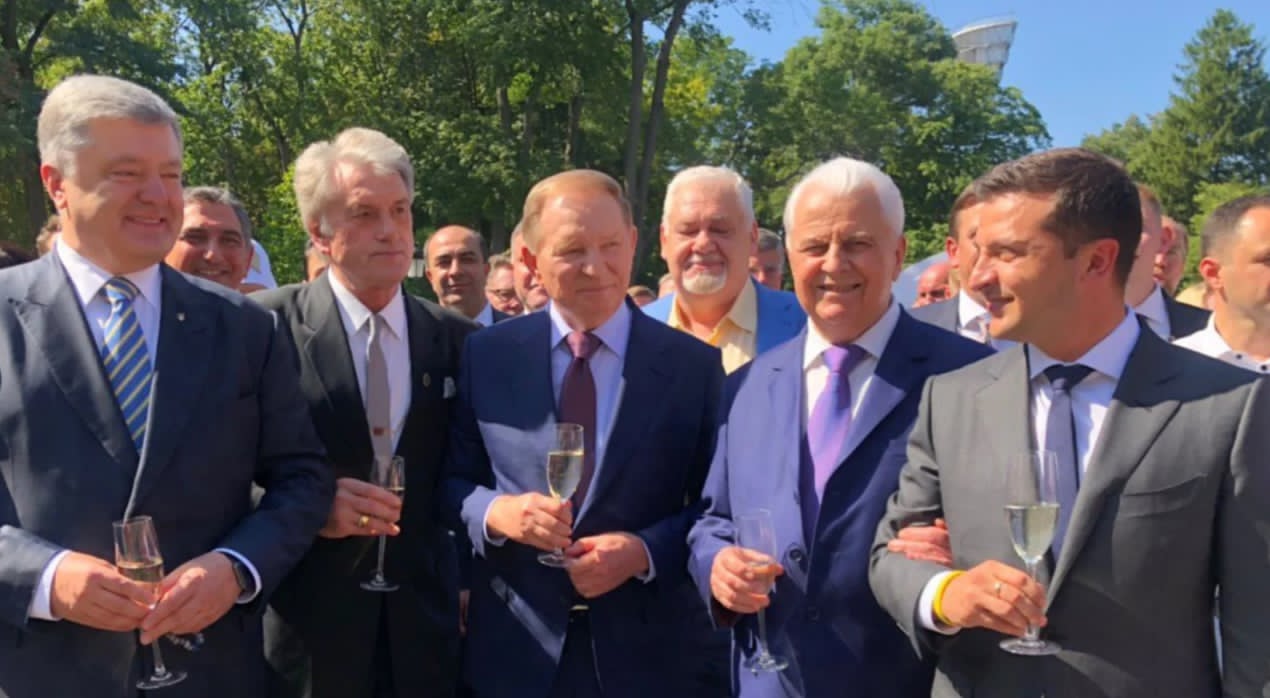
"WE CAN PROMISE ZELENSKY THAT HE WON’T BE PERSECUTED AFTER THE WAR"
- We are currently in the midst of a major war, and it is unclear how much longer it will last. This imposes its own constraints on society and political life; we have not held elections since 2019. How do you see the current state of affairs, and how can we survive as a nation and as a democracy in the foreseeable future?
- When the Russians attacked us, I said at the time that Ukraine had already won. Because Russia had shown its true colours, whilst Ukraine had not collapsed. The situation has now become more complicated again, because Putin has switched to a war of attrition. The international community is helping us enormously, but it is clearly not enough. And so we find ourselves in a difficult situation. Although Ukraine and the Ukrainian people are performing technological miracles, we were not prepared for this war of attrition.
The authorities bear a significant share of the responsibility for this. In 2022, following our successful counter-offensive, we all believed that we were on the verge of liberating Ukraine. And then came the disappointment. At the time, the authorities did not dare to have an honest conversation with the public or to carry out mobilisation based on fair principles. Consequently, problems with mobilisation began to arise. The President should have responded to this as early as 2023, but he did not.
The problem was swept under the carpet. And if people feel that there is no justice due to corruption and the abuse of power, this undermines our capacity for resistance. I cannot say that this danger is greater than the military threat, but polls show that people have begun to regard it as the greatest threat.
- Can we emerge from this with minimal losses and at least some positive outcome?
- I think there is a chance of that. And first and foremost, if Ukrainians do not remain silent and turn a blind eye to what the authorities are getting up to. There have already been two ‘cardboard Maidans’. In addition to this, the anti-corruption bodies – NABU and SAM – are beginning to operate at full capacity.
European integration is also driving change. Our dependence on funding from Europe is currently justified, because otherwise we would not have survived. But it gives Europeans the opportunity to constantly talk about the necessary changes and reforms.
An external enemy is trying to exploit our disillusionment to destabilise us. But Ukrainians have so far shown that they act very prudently. In other words, Ukrainians are saying: we want to change the government. Do you want to change it now through elections? Ukrainians say: no, because we cannot do that whilst at war. And if we cannot do it whilst at war, how can we keep this government in check? We can keep it in check through the institutions that have been established, and through the fact that people are voicing their views and demanding change.
We need to sit down and talk, and think together about how to emerge from the crisis. This is a call both to the opposition and to Zelenskyy. Unfortunately, Zelenskyy has many traits that stand in the way of this, in particular a messianic complex and an unwillingness to listen to others. I always hope that common sense will prevail. In the initial meetings with opposition representatives, we saw signs that things would no longer be as they were under Yermak. But it didn’t go any further than that.
- What form should the dialogue with the authorities take on the part of the various factions of the opposition?
- This is a question of what vision the opposition should present to Zelenskyy. Is it necessary to threaten to imprison him after the war? I think that at such critical moments as now, one can make many concessions for the sake of preserving the country.
We could promise Zelenskyy that he won’t be prosecuted after the war. Is that fair? No, it isn’t fair. But if it needs to be done to save the country, then it’s worth doing.
This is not my position. I mentioned Lukyanenko’s stance on the communists. Mandela took a similar stance; he did not, in fact, ensure full justice in South Africa, as virtually no one was punished for the racist crimes of the ‘apartheid’ era, and large-scale property remained predominantly in the hands of white business interests. Although the new government has begun to incentivise its own businesspeople, there have been no mass arrests of representatives of the former regime.
I think that Zelenskyy is simply afraid at the moment and is asking himself: ‘What will happen after the war?’. He is afraid of losing in democratic elections. Therefore, to prevent him from dragging us into undemocratic elections and even greater instability, there may be a sort of agreement – along the lines of: ‘Right now, we are uniting for the sake of the country, and afterwards we are prepared to forgive you’.
In other words, to emerge from this critical situation, there must be a unity that is willing to sacrifice justice for the sake of the country’s survival. However, President Zelenskyy must be in no doubt: if violations of the law continue, the situation will change.
Olha Skorokhod, Censor.NET


