



Russia strikes Kyiv petrol stations: Will capital have enough fuel?
Over the past six months, more than 300 petrol stations across various regions have been destroyed or damaged in Russian attacks, according to the Ministry of Energy. Most of them were located in frontline regions.
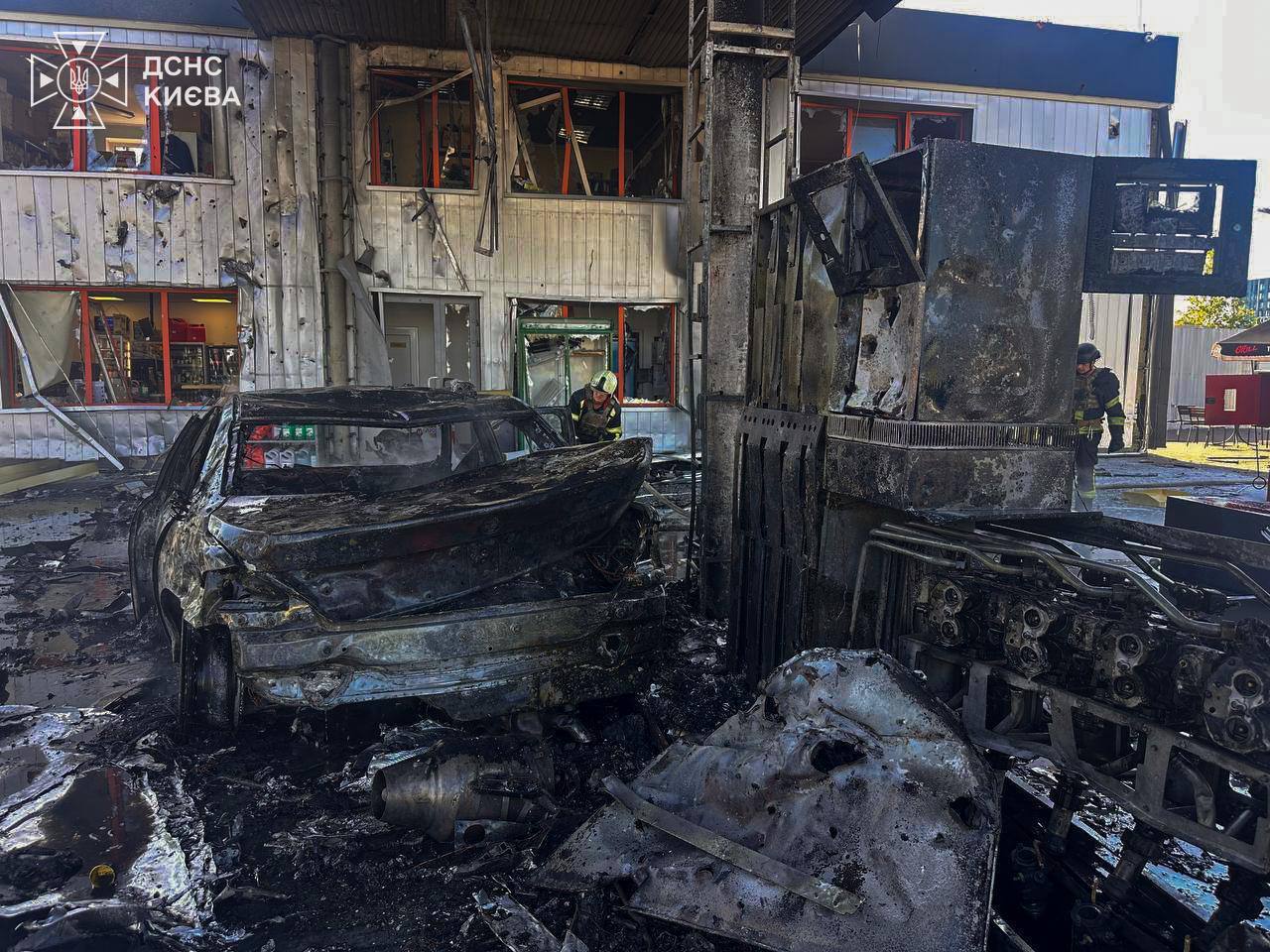
In recent days, monitoring channels reported that the enemy had identified around two dozen petrol stations on both banks of Kyiv as planned targets. There have been no official comments from authorities, but three stations from the "hit list" have already been attacked by jet-powered Shahed drones.
It cannot be said that Russians had not previously tried to strike petrol stations in the capital. At least one such case was recorded during shelling in May 2026. However, systematic attacks on fuel infrastructure in Kyiv are a new phenomenon. That is why it is important to heed air-raid alerts, while petrol station staff and visitors should head to shelters.
Whether Kyiv will have fuel has become the number one concern among city residents. Business Censor looked into whether the capital faces a shortage and whether Russian strikes could affect the market.
Terror and intimidation of civilians
Serhii Kuiun of the A-95 Consulting Group immediately points out that there is nothing new in Russian tactics. They are the same as in Sumy, Kharkiv, Zaporizhzhia and Dnipro.
"The difference is that the capital does not yet have FPV drones, Molniya drones or KABs. These attacks on petrol stations have only one purpose: terror. There are no other purposes and there will be none," the expert says.
Bohdan Kukura, Chairman of the Board of JSC Ukrnafta, expressed a similar view:
"There is no military purpose in such strikes. This is terror and intimidation of civilians," he stressed.
Clearly, Russians seek to create additional discomfort and danger for Kyiv residents so that they pressure the Ukrainian authorities to make peace at any cost, even on the Kremlin’s terms. This is especially significant ahead of the coming heating season, as Russia will resume attacks on energy infrastructure, while generators will also require fuel.
"According to the tax service, Kyiv currently has 270 active licences for retail trade in petroleum products, while Kyiv Oblast has 529. That means 800 petrol stations in total. Accordingly, there is certainly no reason to speak of any impact of these attacks on the market," Serhii Kuiun explains.
He added that around 80% of the 300 stations attacked across Ukraine are being restored. "Therefore, no region is experiencing fuel shortages or price increases as a result," stresses the director of the A-95 Consulting Group.
Viktoriia Voitsitska, a former MP of the eighth convocation and former secretary of the Verkhovna Rada Committee on Fuel and Energy Complex, Nuclear Policy and Nuclear Safety, told Business Censor that the enemy has so far managed to destroy only three petrol stations in the capital. Even if the pace of strikes continues, it would take more than 260 days to put all petrol stations in Kyiv and Kyiv Oblast out of service.
"Therefore, even based on these figures, I do not believe there are grounds to say that there will be a crisis. Across Ukraine, estimates put the number of petrol stations at between 5,000 and 6,000. If the enemy were to focus exclusively on petrol stations, it would probably have to launch thousands of drones every day, which I cannot imagine. So I would not speak of Armageddon or a complete lack of fuel. This objective will not be achievable," she asserts.
At the same time, Voitsitska notes that fuel retail chains are suffering enormous losses, which will most likely be passed on to consumers and affect fuel prices.
The key issue is safety
Fuel expert Dmytro Loushkin says the main thing is to avoid casualties, while a petrol station can be brought back online in less than a month.
"You install new pumps and can resume operations. The entire technical infrastructure is usually unaffected," he notes.
There will be no shop or cafe at such a station, however. But, Loushkin points out, are they really needed at petrol stations now?
"If I were the government, I would now ban all kinds of hot dogs in dangerous places so that there are no crowds in the station office. Fuel only, and as quickly as possible. New technologies should also be introduced so people do not even have to communicate with an attendant, but can buy fuel and activate the pump through an app," the expert says.
There is logic in this, as the successive destruction of several petrol stations in one area will shift traffic patterns and increase the load on other nearby stations. This, in turn, may lead to queues and crowds, which the enemy tracks, including through OSINT. Relevant photographs quickly appear on social media, often with geotags.
"The most important issue is safety. During an air-raid alert, a petrol station is certainly not the best place to be. The other day, I saw a temporary mobile shelter built at an OKKO station on the Odesa highway in two days. Such shelters already exist at a UPG station on the Ring Road and at an AMIC station in Vorzel. They are already being installed by the dozens in frontline regions. Evidently, they will soon appear en masse in the capital as well," Serhii Kuiun predicts.

Dmytro Liushkin suggests temporarily closing Kyiv petrol stations from the previously published list of potential targets. "Perhaps it will save lives," he says.
"Unfortunately, there is no countermeasure against Shaheds. While in the east there are projects involving nets and even steel "cope cages" over petrol stations, there is no protection against a Shahed," Kuiun adds.
The market remains under control
Experts unanimously say Kyiv is not facing a fuel shortage. The government says the same.
"The market remains under control and balanced, while available resources make it possible to meet consumers’ current needs," First Deputy Prime Minister and Minister of Energy Denys Shmyhal stressed in early September.
The government has launched an experimental project for underground fuel storage. Ukraine is to establish an extensive network of underground petroleum product storage facilities. The priority is to ensure uninterrupted supplies of diesel fuel, primarily for defence and critical infrastructure needs.
At the same time, according to Viktoriia Voitsitska, in order to build up reserves, market operators need to take money from their cash flow and invest it in creating these reserves, hoping they will not be destroyed.
"We still run up against the issue of security. If it were about building up reserves outside Ukraine, say in Poland, Hungary, Romania or Slovakia, so that we could promptly draw on them and bring fuel to Ukraine, that would be a different matter," she says, though she does not rule out Russian sabotage at such sites.
"In any event, the risks of strikes and losing all these volumes under such conditions are much lower. But instead, the government tells market players: ‘Dear market players, you currently face high risks of losses because the enemy is systematically striking our petrol stations. Divert additional resources and build up this strategic fuel reserve, which the country may need.’ This raises the question: who will guarantee the security of storing such volumes, and where? Even Drohobych has been struck, for example. So there are questions of money, security and compensation if this strategic reserve is lost as a result of a strike. Does the state undertake to compensate these losses? I doubt the state will do that," Viktoriia Voitsitska notes.
Still, she says, the state is trying to create at least some kind of safety buffer in this way, which is understandable.
According to Denys Shmyhal, fuel stockpiling is continuing, as is work to diversify supply routes.
"As of early September, according to the State Customs Service, the State Tax Service and market operators, fuel reserves are sufficient to meet current consumption levels," he says.
Acting First Deputy Head of the Kyiv City State Administration Petro Panteleiev previously stated that Kyiv has already created a 5,000-tonne fuel reserve for the priority operation of essential services and is continuing to build it up. For obvious reasons, the details are not being disclosed.
"I think the crisis seen at the beginning of the full-scale invasion is impossible," Voitsitska stresses.
On 11 September, Prime Minister Serhii Koretskyi held an urgent meeting with fuel market operators. The meeting discussed, among other things, safety at petrol stations, progress in installing additional protective structures on elements of above-ground infrastructure, and equipping shelters for people.
"We are already testing a software solution that will allow us to see the direction in which drones are moving and respond to the threat in advance. It involves automatic and timely alerts at petrol stations about approaching enemy drones. We will test it at fuel station complexes while simultaneously connecting other businesses. Ministers have been tasked with accelerating this process as much as possible," the prime minister said.
Will Ukraine become a country of mobile petrol stations?
Meanwhile, an initiative has emerged in Ukraine to legally permit mobile petrol stations to operate in communities where Russian strikes have destroyed all permanent stations or made them unsafe to operate. This primarily concerns frontline areas of Sumy and Chernihiv oblasts, where some communities no longer have a single surviving permanent petrol station. People have to drive 50–60 kilometres, burning fuel to buy fuel. Kyiv is not at risk of this. At least not yet.
"Unfortunately, it is a challenge. But what alternatives are there?" Viktoriia Voitsytska says.
Ukraine already has experience using mobile petrol stations. Fuel was sold from tanker trucks in the Trostianets community in Sumy Oblast. The relevant bill was intended, first and foremost, to regulate this practice. After all, selling fuel from vehicles creates a risk of pushing the market into the shadows (in Trostianets, for example, only cash was accepted) as well as of selling counterfeit fuel.
"For me, such mobile petrol stations, if they are not subject to proper oversight, would effectively stimulate the fuel market’s ‘grey’ sector, which has always existed, still exists and is unlikely to disappear tomorrow. So who will control the quality of the fuel, and what kind of fuel will it be? That is a major question mark. I do not know how this can be implemented effectively," Voitsitska says.
Work on the draft law was described at the time as urgent and requiring immediate action. However, as Business Censor found, there is no draft law. An informed source told us that fuel and energy sector stakeholders opposed the initiative. Therefore, there has been no movement in this direction. Meanwhile, mobile petrol stations have already been spotted even in Odesa.
Petrol stations in frontline communities are not being rebuilt quickly, as they may again become enemy targets. Volodymyr Petrenko, founder and co-owner of UPG, previously told LIGA.net that building a full-scale fuel station complex in UPG’s format costs around $5 million. However, according to Petrenko, a modern petrol station can be built from scratch in Ukraine for $1.3–1.4 million.
So, it appears that the plan for now is simply to hope the enemy does not destroy all petrol stations. No comprehensive approach is currently in sight.
***
Therefore, experts see no threat of fuel shortages either in Kyiv or in other regions of the country. There is enough fuel; the question is distribution — how to deliver it to the end consumer. This issue is particularly acute for frontline communities.
Kyiv has not yet reached that point and is unlikely to at this stage. Therefore, when going to a petrol station, people should be more concerned about their own safety than about whether there will be fuel. There will be fuel, as long as there are petrol stations.


