



"Russians will do everything to make us afraid and want to leave," – Kyiv Oblast Military Administration head Tymur Tkachenko
After the tragedies in Vyshneve and the village of Myla in Kyiv Oblast, where ammunition detonations damaged hundreds of homes, the question has resurfaced of who should oversee the placement of such facilities near residential areas and bear responsibility for the consequences. Tymur Tkachenko, head of the Kyiv Oblast Military Administration, says the administration has no authority to inspect such ammunition depots and that the Ministry of Defense has not formally asked it to conduct inspections.
In an interview with Censor.NET, he also discussed compensation for residents of Vyshneve and Myla, support for businesses affected by repeated Russian attacks, Kyiv Oblast’s preparations for the heating season, protection of energy infrastructure, and the initial findings of a review of reconstruction projects.

WHO APPROVES THE PLACEMENT OF AMMUNITION NEAR HOMES?
— After the tragedy in Vyshneve, the president said that placing ammunition near residential buildings directly violated both current law and decisions of the Supreme Commander-in-Chief’s Staff. Has the Kyiv Oblast Military Administration done anything since July 6 to check whether similar facilities exist in other communities?
— The oblast military administration must act, and does act, strictly within the law. This entire matter is 100% connected with the movement and accounting of ammunition or other such equipment. It is certainly outside the jurisdiction of the Kyiv Oblast Military Administration: civilian authorities have no power to inspect such depots.
As for the decision of the Supreme Commander-in-Chief’s Staff, all responsible bodies are required to comply with it.
— In a comment to Censor.NET, Deputy Prosecutor General Andrii Leshchenko said that the Prosecutor General’s Office had written to the Ministry of Defense asking it to conduct an audit or inspection to determine where else similar facilities were located within residential areas and to take steps to prevent such tragedies from happening again. Has the Ministry of Defense contacted you, as head of the Kyiv Oblast Military Administration, about conducting inspections in the oblast?
— I can say with certainty that I have had no contact with the Ministry of Defense on this matter. As of today, I have received no formal requests from the ministry in my capacity as head of the Kyiv Oblast Military Administration either.
At the same time, matters concerning the location and operation of certain defense facilities are security-sensitive. Details of their locations, inspections, or possible response measures therefore cannot be discussed publicly.
— Did the Kyiv Oblast Military Administration know about the depot in the village of Myla before August 28? And if it did, could the administration legally demand that the ammunition be moved?
— I think even the head of the community, who had led it for 32 years, knew every square meter of the area and died there at the scene, did not know about it. If people who have led a community for three decades do not know what is in those depots, imagine how difficult it is for the oblast administration or other officials to have that information.
On the other hand, that information should not be known to a wide circle of people. It should be known only to those with the relevant expertise who deal with the matter and are responsible for it.
Whether the rules governing the location of such facilities were followed is a separate question. The competent authorities responsible for oversight must investigate that.
— Perhaps the safety protocols and the overall approach to locating such facilities should be reviewed? That would allow heads of military administrations to have this information, understand exactly what is located in their territories, and respond accordingly in an emergency. They could also, in principle, express their position if they believe such depots should not be located near residential buildings. How realistic is that during the war?
— As a citizen, I would want to know what I live next to, what my children walk past on their way to school, and so on.
But speaking as someone who holds public office and must act within current law, no law or regulation says that I must initiate a review of safety protocols or anything else of that kind.
So it will depend on what the lawmakers and the military command, which make these decisions today, decide. I am not authorized to make those decisions.
For my part, as head of the oblast state administration, I have initiated the development and updating of procedures for various crises. These include clear instructions for Kyiv Oblast residents on what to do if their home is damaged or destroyed in an enemy attack, as well as procedures for business owners whose businesses have been affected.
I have also initiated a separate review of safety protocols for gas stations during air raid alerts. Together with Ukrainian Railways, we are working to install mobile shelters at railway stations. This is another important area, because people must be protected in the places they use every day, including when they travel.
We must do more than respond to the consequences of attacks: we must continually adapt the safety system to new challenges. The enemy is changing its tactics, so we must change and improve our protocols and procedures accordingly. The main thing is for people to understand clearly what to do in each situation and for the system to be ready to respond quickly.
— But given that several such incidents have already occurred in Kyiv Oblast, have you had any discussions about this with the military command?
— There have been no official contacts on this matter.
— After the events in Myla, the president called the placement of explosives near people "appalling negligence" and stressed that, after Vyshneve, a repeat of such a situation was absolutely unacceptable. In your view, should anyone bear administrative and political responsibility for what happened, as well as criminal liability?
— Those responsible under the law, their protocols, statutes, and regulations for the placement of such facilities, for authorizing their placement, and so on must be held accountable.
I know that the competent authorities dealing with these matters must establish the facts during the pretrial investigation and submit the case materials to the court. The court must then determine liability to the full extent of the law.
— Isn’t the placement of any businesses or warehouses subject to approval by local authorities? How does the process work?
— I do not know how these processes are organized because they are outside my remit. We may know, broadly speaking, who built a facility and whether it is a logistics hub or a warehouse. What happens next – leases, subleases, the grounds on which something was placed somewhere – is certainly classified information. That information is absolutely not available to a wide circle of people.
— So it won’t be agreed with the local authorities?
— At present, there is no such requirement. These matters are not subject to approval by either city or oblast authorities. Will that change in the future? I cannot say. If regional authorities are ever added to the list of bodies whose approval is required, we will carry out those duties.
— The prime minister said the government plans to use funds from the state budget’s reserve fund to provide support and compensation to people affected by the detonation in the village of Myla. Do you know when the funds will be allocated and how much will be provided?
— We are working in coordination with the government on this. The amount of assistance from the reserve fund is generally calculated on the basis of verified inspection reports prepared by commissions. In Myla, more than 600 properties have been damaged, mostly private houses and apartments. Providing prompt, targeted payments to every family is our first priority, as set by the president of Ukraine.
So far, 736 applications have been received from residents of Myla.
— How will the funds be distributed among those affected?
— They will be distributed through transparent mechanisms, via the state eVidnovlennia program.
— Have all the inspections you mentioned been completed in Vyshneve, or are they still under way?
— The inspections in Vyshneve are nearly complete. Of the 1,239 applications submitted by residents, the local executive committee has processed 1,036. Let me remind you that, initially, comprehensive restoration was considered. But I can now say that it is not planned. Instead, people will receive compensation for damaged property. They will receive the money and decide for themselves what to do with their homes.
— How is the amount of compensation a person can receive determined? Is it based on the property’s market value or calculated in some other way?
— A Cabinet of Ministers order allocated UAH 2.3 billion in compensation for the restoration of damaged housing, including in the Vyshneve territorial community. So far, 740 applications worth UAH 34.7 million have been approved. Sixty-eight compensation payments have already been made. A draft Cabinet of Ministers order has also been prepared to allocate UAH 838 million in compensation for destroyed housing in the Vyshneve and Dmytrivka communities of Kyiv Oblast.
As for how payment amounts are calculated, that is handled, in effect, by Ukraine’s Ministry of Restoration, Infrastructure and Transport. Generally, if a house is damaged in its entirety, the amount is calculated using certain coefficients based on the floor area recorded in its technical passport. For less extensive damage, up to UAH 500,000 is paid for repairs to windows, roofs, and so on.
— What is the point of allocating money from the reserve fund if the standard procedure is being used?
— Reserve fund money is specifically intended for unforeseen expenses, including dealing with the consequences of emergencies and wartime attacks.
— What is the situation in Myla? How many people have applied, and are applications still being submitted?
— More than 700 applications have been submitted there. We can already provisionally identify several categories of damage: minor repairs, major repairs and complete destruction. A total of 367 private homes have been damaged, as have apartment buildings, businesses and social facilities. At present, approximately 182 applications fall into the first category, 145 into the second and 42 into the third.
— Has the government allocated the necessary funds yet?
— The calculations are still underway, and the commission is continuing its work. As I said, the extent of damage varies from one property to another. Some people’s property has been completely destroyed (and they will need a certificate for new housing), while others need repairs (and they will receive up to UAH 500,000, depending on the extent of the damage).
— How advisable are these repairs from a safety perspective, including environmental safety? Would it be better for people who were at the epicenter of the detonations in Myla and Vyshneve to move to other regions for the time being?
— Usually, if there are consequences of that kind, the public is informed, and appropriate measures are taken. Such matters are considered by the local, oblast, or national Commission on Technogenic and Environmental Safety and Emergencies (the commission responsible for technogenic and environmental safety and emergencies - ed.). The consequences are then addressed. In my view, and in the view of specialists, there are no particular environmental consequences in Myla or Vyshneve.
As for safety, the State Emergency Service has been working at the sites from the outset. It carries out demining where necessary and authorizes people to return to the area. According to the State Emergency Service, Myla and Vyshneve are safe. People are returning to their homes after the State Emergency Service has checked everything.
So people can live there safely. The main thing is to restore and repair their homes.
— Unfortunately, many other towns and villages in Kyiv Oblast are also being hit. If the decision was made to allocate reserve fund money for Myla and Vyshneve, where will the money for payments to other affected people come from? How is this being handled? Are payments made in order of application? How is the order determined?
— Finding the money and setting priorities for payments is work we do together with the government. People are the main priority. I am confident that everyone who needs compensation to restore their property will receive it.
However, it is impossible to predict future attacks. We cannot know how many more buildings the enemy will strike, how extensive the damage will be, or how much more money will be needed to cover it. The country also has other needs, from military to social ones. But together with the government, we will do everything possible to compensate people for the damage so they can continue living in their homes.
— After the events in Vyshneve, some people whose homes had been completely destroyed told journalists that they had not been offered temporary housing. They said they could not afford to rent apartments and were staying with relatives or friends. There have been similar cases elsewhere. Can the Kyiv Oblast Military Administration respond in such situations? How is temporary housing for those affected generally arranged, and who is responsible?
— It is important to note that city authorities should take the lead in such matters. Why? Because they have resources available locally. It is their job to arrange suitable temporary accommodation. For people who have no other home and no relatives who can take them in temporarily, the city authorities need to find funding for targeted programs that could cover their rent. That would allow them to rent somewhere to live while their own home is being restored or while they wait for a certificate or compensation.
For example, in Myla, a response center began operating within minutes of the strike. Together with local and district authorities, we arranged places where evacuees could stay temporarily and accommodated those who needed housing. We acted quickly because we had to.
As for Vyshneve, I spoke personally with the head of the community. He assured me that compensation would be arranged for everyone who needs it.
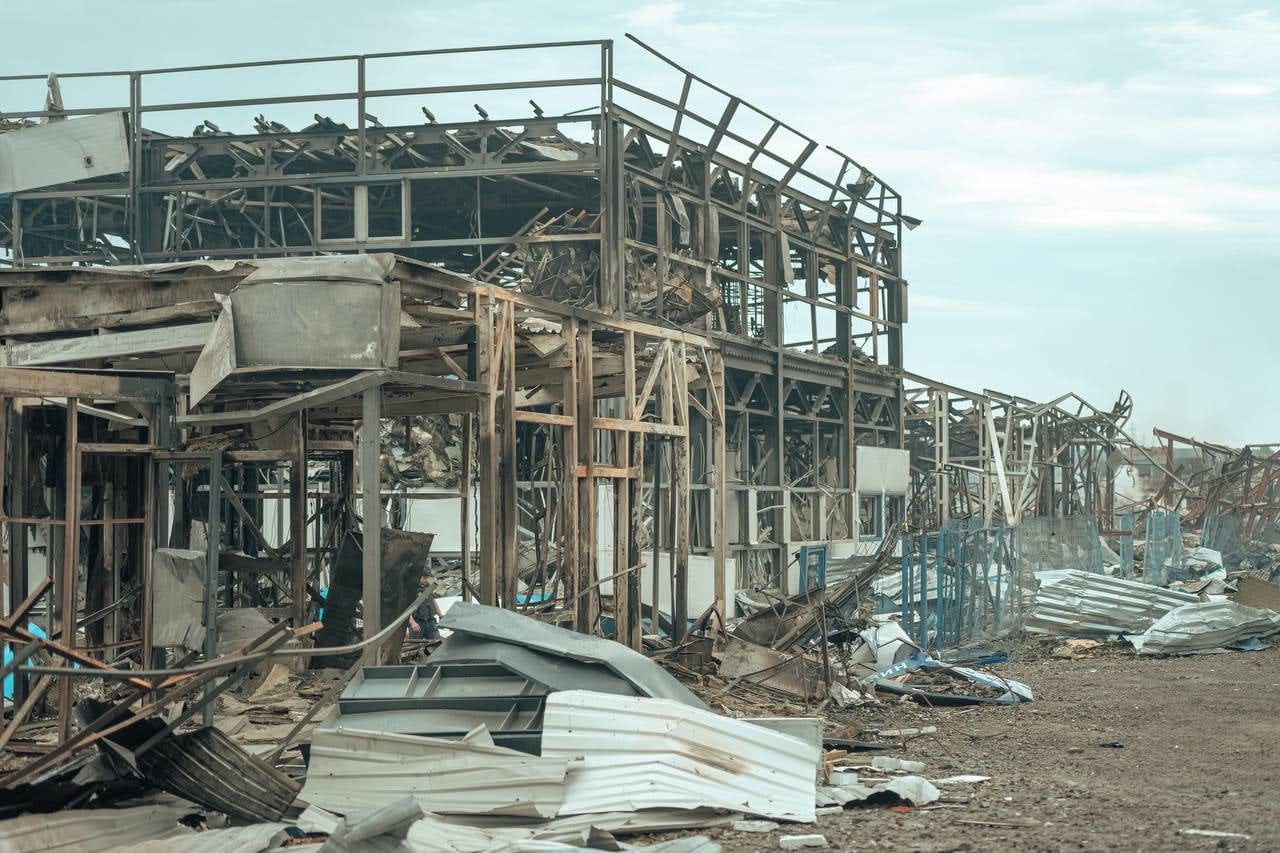
WHY UNDERGROUND WAREHOUSES WILL NOT PROTECT BUSINESSES FROM RUSSIAN ATTACKS
— During this period, no one has expressed interest in setting up new logistics hubs anywhere in the oblast.
— So far, I haven’t had anyone willing to set up new logistics hubs in the region. At the same time, we can see that there is a demand for additional logistics capacity. At the same time, we can see that there is demand for additional logistics capacity.
I have spoken with business owners who have been affected. Some have decided to rebuild; others may decide to suspend operations temporarily. There is no single decision for everyone. Each business makes its own decision and assesses its own risks.
— Are you tracking how many businesses have left Kyiv Oblast because of Russian attacks and the destruction of warehouses?
— We do not currently have figures of that kind. Both residents and businesses are more likely to come to us asking for help than to say they plan to re-register in another region.
Kyiv Oblast remains an attractive region for logistics. Businesses will always operate here. Unfortunately, the war is forcing changes, but I am confident businesses will adapt. We will rebuild everything.
In fact, businesses, including international ones, are considering long-term investment in the oblast. For example, during a meeting with representatives of the Finnish company Happy Nordic Living, we discussed building a plant in Kyiv Oblast to produce prefabricated wooden structures. The plant could create approximately 400 jobs.
— Is there perhaps a mechanism for quickly providing alternative premises to companies whose facilities have been damaged or destroyed in Russian attacks so they can continue operating?
— There is no separate program to provide premises to affected businesses. That would probably require some sort of pool of available premises that could be offered to anyone who needs them. We do not have one.
Besides, businesses are now interested in spreading out their operations. In other words, it is better for them to avoid storing large quantities of products in large warehouses and to diversify their risks, so to speak.
Of course, businesses work with communities, and we can offer them cooperation with industrial parks to accommodate their operations. We can also establish new industrial parks for that purpose. More generally, businesses now need financial support.
We are very grateful to the government for the grant program currently available and for the recently adopted resolution on loan programs for affected businesses.
— You said there is no reserve of warehouse space to meet demand if it arises. But if a business approaches the Kyiv Oblast Military Administration and asks for some sort of space on agreed terms while it rebuilds its own premises, can it expect any help?
— It is entirely possible to operate in the industrial parks I mentioned.
— What about premises or spaces with a higher level of protection, particularly underground ones?
— I will answer now not as head of the Kyiv Oblast State Administration, but as someone who worked on shelters when I was a deputy minister.
Of course, many spaces are in a neglected state (such as old bunkers at factories), and something could be done with them. But I am not sure these sites would appeal to logistics businesses, because they need specific conditions for storing goods. There is also the question of size. In logistics, a 20,000-square-meter warehouse is considered small. Underground spaces large enough to be of interest simply do not exist.
Perhaps they could be built. But again, speaking as someone familiar with the issue, I would say that doing so is impossible under current conditions. It would require large plots of land and enormous sums of money. Besides, it would not solve the overall problem. Such a site could still be targeted by the enemy. The enemy might simply use a missile instead of a drone. So logistics companies are more likely to move goods directly from production to the point of sale than to build such large underground warehouses.

— But that would make the final product more expensive.
— Imagine how much more expensive it would become if the owner of an underground facility, having invested hundreds of millions of dollars in it, raised the rent for a company wanting to use the warehouse. The owner would need to recoup the investment somehow. That, in turn, would affect the price of the final product.
— You said Kyiv Oblast would remain attractive to businesses because of its convenient location for logistics. Is logistics the only factor, or are there others? How can businesses be kept here as attacks increase?
— Businesses are generally very adaptable. They understand where they can operate, where they can do so effectively, and so on. I have spoken with businesses in Kyiv Oblast and, as I said, many logistics companies and other enterprises intend to rebuild and continue operating. So if you ask me what makes Kyiv Oblast competitive, I would probably say it is the region’s ability to adapt. It is a logistics hub around the capital, with a developed cluster-based economy. And, in my view, it has highly skilled workers.
People here are generally positive. We will continue working to create attractive conditions for investment, including through those industrial parks and what we will do to decentralize energy supply… I think that is where our strength lies: we have many different strengths despite today’s threats.
— Businesses in Kyiv Oblast that have suffered losses due to Russian aggression can receive financial support. The compensation amount was recently increased to UAH 2 million. How many businesses have applied for assistance so far? And is there enough funding for all affected businesses?
— As you correctly noted, we managed to increase funding for the oblast program to UAH 2 million. This program compensates entrepreneurs for the cost of an independent expert assessment of the damage they have suffered. We help businesses with this because it is an extremely important step. Such an assessment is needed for subsequent claims against the Russian Federation to succeed. Put simply, the information must be documented.
Applications from entrepreneurs are coming in, and funding has already been allocated for this purpose. If the number of applications exceeds what the available funding can cover, I think we will promptly ask the oblast council to increase the allocation. Our real aim is to ensure that every entrepreneur can properly document the damage suffered.
I also want to say that we continue to support businesses through the "Affordable Loans 5-7-9%" program. We have allocated UAH 25 million to provide additional interest subsidies under this program. As a result, the interest rate for entrepreneurs can effectively be reduced to zero.
Around 370 loans were issued here in 2025. Since the beginning of 2026, I think more than 150 loans have been issued. So we can see that demand for this form of support remains high and, I think, will continue to be high.
— According to official figures as of January 2026, 850 businesses had been damaged during the war and 127 had been completely destroyed. If each received UAH 2 million, that would come to UAH 1.954 trillion. Yet Kyiv Oblast’s 2026 budget was initially approved at UAH 6.8 billion. That is a substantial difference. Will the oblast find the money for all this?
— Your calculation is slightly incorrect. We increased funding for the entire program to UAH 2 million, not the payment to each entrepreneur. The maximum compensation for a damage assessment is UAH 100,000 per entrepreneur.
— MP Horbenko recently said that Kyiv and Kyiv Oblast could be designated frontline areas as early as September. Can you confirm that?
— I can neither confirm nor deny it. As of now, there is no official decision concerning Kyiv Oblast. However, on September 17, the government decided to include Kyiv Oblast on the list of territories at heightened risk. This does not mean any new restrictions or changes to the rules of people’s daily lives. Above all, the decision matters to businesses.
— But if such a decision is made, what would it mean for local businesses, and how would it affect their operations?
— If we are talking about frontline status, the focus shifts to cooperation with the military, and the military receives additional administrative powers. This directly concerns the organization of potential combat operations. I do not want to say more about that.
I can say more about the heightened-risk status that Kyiv Oblast has now received. Above all, it gives businesses the opportunity to insure property against war risks and receive state compensation for part of the value of damaged property. It also raises the maximum annual insurance compensation for one business from UAH 3 million to UAH 5 million and expands the range of insurable property, including fuel and the means used to transport and store it.
In effect, this is another way to protect assets and enable businesses to continue operating even when security risks are high.
I thank the prime minister and the government for this decision. It truly matters to Kyiv Oblast. Our entrepreneurs work every day, pay taxes, support the economy, help the Defense Forces, and rebuild what the enemy damages.
Our task is to create the best possible conditions for businesses so that companies can operate, people have jobs, and community budgets receive the revenue they need.
We also have several other priorities to pursue. They guide our work, our budget planning, and so on.
— Could you tell us more about those priorities?
— The main priority is getting through the next heating season. The previous autumn and winter were very difficult. The enemy is treacherous, so we must prepare as effectively as possible, both to protect our energy system and to expand our power generation capacity.
— Are you managing to do all that? There is very little time left.
— Some things have been done; others are still in progress. That is all I can say because the information is classified.
Last autumn and winter, I worked constantly at the coordination headquarters chaired by the energy minister. A great deal of work was done every day. We held around 60 in-person headquarters meetings and made important decisions every day to keep essential services running during that period. In other words, the work continued around the clock.
The energy sector emergency declared at the time was necessary for proper coordination, so that someone would be responsible for handling the issue. I want to thank Denys Anatoliiovych for the fundamental work that took place then, which I saw with my own eyes, and for what we went through together. Decisions were made constantly, procedures were simplified, and changes such as amendments to government resolutions were initiated at Cabinet level.
Last winter showed that these issues can be resolved only by working in that way. Take something as basic as a generator in a hospital: for it to work, it needs maintenance. Maintenance requires spare parts. Those parts have to be delivered. Delivery requires customs procedures to be completed, and so on. Even in a case like that, timely, swift decisions are essential at the precise moment they are needed.
At the headquarters in Kyiv, which operated around the clock at the time, we understood what was happening, what resources were needed to resolve particular problems and which specialists were required…

— You are clearly familiar with the situation in Kyiv. In your view, what should Kyiv residents expect this winter? Many people are alarming them, saying, "Leave." But most people have nowhere to go.
— It would be inappropriate for me to comment on the city of Kyiv. But I hope and believe that, together, we will get through this winter with dignity, and that everyone involved in this work will give it their all.
In Kyiv Oblast, the work is being carried out systematically. Generators are being supplied, additional power generation capacity is being built, and protective measures are being put in place…
Of course, the Russians will do everything they can to make us afraid and want to leave.

— The president signed a decree putting into effect a National Security and Defense Council decision on the Comprehensive Resilience Plan. It requires apartment buildings and facilities that provide essential services to have backup power before the start of the 2026–2027 heating season. What does this involve? Is funding being allocated, and from which sources?
— I cannot say very much, but I will explain enough for you to understand. It is a comprehensive approach involving many different components, funded from various sources.
Because this is part of the resilience plan, I cannot discuss it in detail. But, broadly speaking, a residential building must have autonomous systems that allow it to function for some time during a blackout.
— Under the 2026–2027 "Competitive Kyiv Oblast" program, one-off, non-repayable financial assistance of up to UAH 20,000 is available to micro, small and medium-sized businesses in Kyiv Oblast — both legal entities and sole proprietors — that operate Points of Invincibility. How many businesses have received this assistance, and what was the total amount paid?
— The program was launched only recently, in the spring. But as far as I remember, there have been no widespread blackouts since then. Only one business has applied during that entire period. God willing, the assistance will not be needed, but we understand that the program remains relevant. I think those who need it will still apply.
— Frontline oblasts are suffering from FPV drone attacks, among other threats. There have already been rumors about such attacks in Kyiv Oblast. How likely is this to become a real problem for the region? Are you discussing such scenarios and countermeasures with those responsible for protecting against this threat? I mean anti-drone nets or anything else that needs to be done now, before the threat becomes widespread.
— The 12th Army Corps is responsible for the defense of Kyiv Oblast. So military matters are its responsibility (along with that of other competent bodies). The task of civilian authorities, meanwhile, is to find the funding needed to carry out the necessary plans and tasks. Although we are called a military administration, that is a status we were given for the duration of the war. Military matters must still be handled by the military. The projects we are working on with the military are not for public discussion.
— The National Security and Defense Council has stressed that city leaders and heads of military administrations are personally responsible for timely and proper preparations for winter. What depends on you as head of the Kyiv Oblast Military Administration, and what depends on local authorities?
— Preparing for winter is a shared responsibility across all levels of government. For my part, as head of the Kyiv Oblast State Administration, I am responsible for coordinating this work across the oblast, monitoring the completion of assigned tasks, and working with communities, critical infrastructure operators, energy companies, and all the services that must keep the oblast functioning reliably through winter.
We identify the main risks, check the readiness of communities and critical infrastructure, build up reserves, work on alternative sources of power and water supply, and monitor the readiness of Points of Invincibility, medical facilities and schools.
At the same time, much of the practical work depends directly on local governments. They must prepare boiler houses, utility networks, backup power sources, fuel reserves, Points of Invincibility and shelters in their areas, and establish procedures for responding to accidents or prolonged power outages.
That is why the personal responsibility of leaders is more than a formality. Everyone must clearly understand their area of responsibility and be ready to act in advance, before a problem arises. The Kyiv Oblast Military Administration’s job is to monitor, coordinate, and help communities; local authorities must ensure that their areas are genuinely prepared.
— You said that one of your first decisions was to review every reconstruction project in Kyiv Oblast. What has the review shown so far? Have you found projects with missed deadlines, inflated cost estimates, poor-quality work or problems left unresolved for years? How do you respond when you find such issues?
— Yes, the review has already identified delays in the implementation of some projects, as well as questions about how work is organized and its quality. But I would not want to generalize. Each case needs to be examined separately, with an understanding of its causes and each party’s responsibility.
In such cases, our first approach is dialogue. We cannot leave people hostage to bureaucracy, procedures, or unfulfilled commitments. When we see a problem, we bring all the parties together, determine exactly what is preventing the work from being completed, and set specific deadlines and assign responsibility.
Transparency and accountability are essential to me. People should know what stage the reconstruction has reached, who is responsible for carrying it out, and when they can expect results. If there are violations, they must be remedied and those responsible identified. Our aim is not simply to find problems, but to see every project through to completion and restore normal living conditions for people.
Tetiana Bodnia, Censor.NET


