



Call sign ’Advocate’: "Our position near Popasna could be hit by 70–100 shells in single barrage."
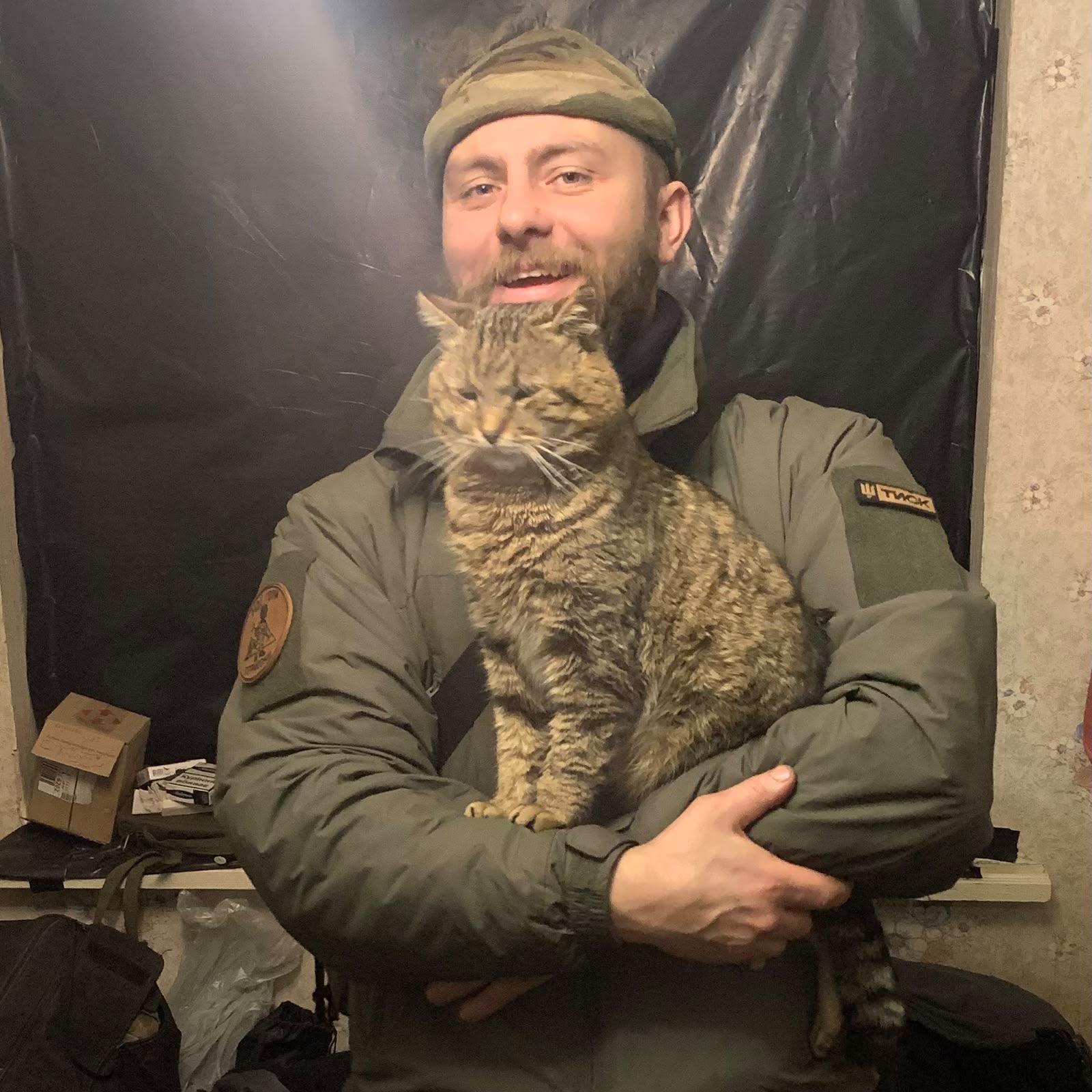
Before the full-scale invasion, Dmytro had worked as a lawyer for over ten years, and his military training was as an artilleryman. But due to the events in the country, he switched from the courtroom to the firing line. It was from his civilian profession that he got his call sign—"Advocate" After being mobilized, he headed to Donbas, where he found himself on the front lines within a few days. Since then, his combat record has included Popasna, Lysychansk, Bakhmut, Orikhiv, Kurakhove, Dobropillia, the Kherson region, and Kupiansk, and among his most memorable moments are the destruction of a column of Russian military vehicles and hitting an enemy ’Tyulpan’.
Until recently, he served in the 33rd Separate Mechanised Brigade, where he commanded a self-propelled artillery battery. He has now transferred to another unit. He says that artillery and law have more in common than one might think: in both fields, you need to be able to defend yourself, assess the situation quickly and strike back accurately.

- You were enlisted in March 2022. How did you find out about the full-scale invasion? Had you been preparing for it?
- Of course! Mentally, I was prepared for the prospect of a great war and for the need to join in the defence of our country. Although I’d envisaged it slightly differently: I’d anticipated an escalation in the Donbas and that the Russians would advance southwards. But I didn’t think there would be a battle for Kyiv. I’d assessed our enemy quite rationally, but they had other plans.
- Where were you on 24 February, when it all began?
- At home in Kyiv. I went to the local military recruitment office. They told me that, as I am neither an OR-1 nor an OR-2 (i.e. I have no combat experience in the ATO or the Joint Forces Operation), I would first need to attend further training courses. But there’s no time for that right now, so they advised me to come back later. Then it so happened that, together with colleagues from my law firm – where I worked and still work – I left Kyiv for Truskavets. There, I went straight to the local military recruitment office and calmly enlisted in the Armed Forces.

- Why was it easier to join the Armed Forces in Truskavets? Were there fewer people wanting to join?
- I don’t know why. I could see there were plenty of people keen to join. Perhaps they took an interest straight away because they saw I was an artillery officer and decided that retraining wasn’t a major issue.
- What happened next?
- I went to the renowned 24th Separate Mechanised Brigade named after King Danylo Halytskyi. I spent a few days at the permanent deployment point, after which we headed east – to the area near Popasna. A few days later, I found myself right on the front line, where I gained my first combat experience. My first combat deployment lasted quite a long time – two months.
- That was your first combat experience. What were your impressions at the time? How did you feel? Was it perhaps scary or unnerving?
- It was brilliant! I didn’t feel any fear at the time. It sort of set in afterwards. And even then – not for my own life, but because of the realisation of the magnitude of the events unfolding. You know, a couple of days after we arrived, I heard that Valerii Fedorovych Hudz, the former commander of the 24th Brigade, had led a counter-attack in Popasna and was killed. He was a figure of great significance to all the fighters in the unit. He was highly respected. That event had a profound effect on me. I realised that I was just a speck of dust in this maelstrom, in these ‘steel storms’.
Generally speaking, I’d put it this way: at that time, artillery wasn’t the toughest specialism. Of course, there was some pretty heavy shelling, but it’s not like being in the infantry, where you’re constantly on the front line. For artillerymen, the course of the war is a little easier. Of course, you have to work hard and keep your wits about you. But having spent all these years in the Armed Forces of Ukraine, I’d say: no specialism involves anything like astrophysics. Any reasonably educated person can handle any military profession. I’d paraphrase Clausewitz: ‘War is a very simple matter, but fighting is difficult’.
- As far as I know, those first two months were particularly tough for you. During that time, you only managed to have a shower twice. And even then, using a diesel canister that had been used to carry water for "motolyga". Why was that?
- Generally speaking, there was very little time because of the constant fighting – one minute we were firing, the next we were under fire, so we had to keep moving to avoid being spotted. Our positions were completely unprepared – that is, there were no trenches or dugouts. The first thing we did after taking up a new position and preparing our guns to fire was to dig in – we simply dug ourselves some basic cover straight away. The fighting was so intense that we never even had time to go for a shower.
— Let me quote you: "It was scary, but fun and very exciting. There wasn’t much time to think, and the results were inspiring. At that time, the artillery accounted for 80–90 per cent of all fire damage". What was the hardest thing for you during the defence of Popasna?
- The working conditions. I slept very little and ate whatever I could get my hands on – some frozen tinned meat and the like. We were constantly sitting and digging in under continuous shelling. There were lots of different incidents, but there was such a rush that I didn’t dwell on them. I just wanted to get on with the job. I think everyone who fought in 2022 knows that feeling.
- Near Popasna, you and your comrades completely destroyed an entire enemy armoured group – a convoy of vehicles trying to break through towards your positions. How did you spot it?
- We had aerial surveillance – I think it was the ‘Leleka’ wing. It was a very dynamic phase of the war overall, when there were many such breakthroughs in that direction. Popasna held out for a long time. But because they outflanked us, we lost it, and the enemy broke through into operational space. They were pushing towards the Bakhmut–Lysychansk road, and within a couple of weeks were just a few kilometres away from it. At that point, our brigade still held ATO positions in the settlements of Hirske and Zolote. We were in a semi-encirclement there, very close to the enemy. When the first tank breakthrough came from the flank, we had to re-aim one gun to 15-00 – turning it 90 degrees towards the tanks. That’s a huge angle. We had to do it quickly to at least try to halt the breakthrough. We managed to destroy one tank out of five at a range of two and a half kilometres. That’s a very close range for artillery.
- I remember that Popasna was one of the first cities the Russians razed to the ground. Why was that? Couldn’t they "drive out"?
- Exactly! They had a massive advantage in artillery – ten to one. They realised that if they couldn’t take our infantry positions by force, they simply had to destroy everything where Ukrainian troops might be. They used what you might call a ‘wall of fire’.
- You also fought near Lysychansk. What do you remember most from there?
- It was precisely that incident, when we destroyed a convoy of military vehicles, which took place near the Lysychansk Oil Refinery, where heavy fighting was taking place. It was a natural continuation of the battle for Popasna. At that time, the enemy had surrounded Lysychansk, so our troops were withdrawing from there.
What I remember is that those few weeks of fighting flew by in the blink of an eye. Every day saw fierce clashes. For example, when the enemy broke through very quickly towards the Bakhmut–Lysychansk road, the infantry in front of us – from some TDF battalion – retreated right behind our backs. Just imagine: I could see more than a hundred people walking – retreating to the rear. And I realised: that was the entire infantry unit that had been positioned in front of us. Now we were on our own. That day, we were firing with the sight set to 56 – meaning the barrel was almost horizontal…
- Because the enemy was very close?
- Yes. It turns out our first position was behind the road, and they were just coming onto it – they wanted to ‘jump’ onto the tarmac. We sort of held them off. I don’t know how many shells we fired back then. But literally a couple of minutes later, we were told: ‘Lads, look: about five tanks have crossed the road towards you. But we don’t know if they’re ours or the Russians’’. We asked, ‘How can we tell them apart if there are no insignia?’ They replied, ‘Our tanks have a receiver (that part on the barrel) painted yellow.’ Just then we heard the sound of vehicles, and realised: we only had three grenade launchers as anti-tank weapons. So if these were Russian tanks, we were as good as dead. We couldn’t even fire at them with our main gun, because they’d come up behind us. We couldn’t turn round. We took cover with those grenade launchers and started to look closely: the first tank’s receiver wasn’t painted at all; the second’s was white, like the enemy’s; the third’s was something like green; and the fourth, as it was already driving past us, we saw was yellow. We breathed a sigh of relief: ‘Most likely, we won’t die today.’
- How did you get out of there?
- Back then, reconnaissance wasn’t as intensive as it is now. So the enemy didn’t see every single movement within five kilometres of the front line, as they do now. So, after fending off those who wanted to cut across the road, we made our way out. I reckon those little tanks helped – they weren’t driving round there for nothing. So it turns out they performed their role as an armoured group.
- Then there was Klishchiivka. The lads from the Third Army Corps – which at that time was still the Third Assault Brigade – told me it was a tough battle. What do you make of that?
- My friend from the Third Assault Brigade was killed in Kurdiumivka, not far from Klishchiivka. They had such a gruelling experience there in the autumn of 2022. It was such a difficult situation, with all the action happening right there. For us, the couple of weeks we fought there in the summer were a bit easier. Of course, there was heavy shelling. But it was easier than what we went through near Popasna, and also near Bakhmut, where things were much more intense. Literally the day before we moved here, our entire landing zone was burnt to the ground, and a ammunition on the ground exploded. And then we moved to the area near Klishchiivka. On the very first night, we came under quite heavy shelling. But overall, compared to our position near Popasna, where 70–100 shells could land in a single barrage, here, as I said, it’s a bit of a lighter affair.
- Then you ended up in the Kherson region. Why were you moved there?
- After the Donbas, the brigade was withdrawn for a couple of weeks to restore. We had a bit of a rest and then headed to Zaporizhzhia. This was because, initially, Zaluzhnyi’s plan was to launch an offensive not in the Kherson or Kharkiv regions, but on Tokmak. We were supposed to be involved in that. Then the whole thing was abruptly cancelled, and it was decided that we would go and liberate the Kherson region. At that time, none of us knew that a Kharkiv counter-offensive was being planned, but there was a great deal of talk about the Kherson one – "from every nook and cranny". So everyone knew that it would be in the Kherson region. That’s why, at the end of August 2022, we took up positions there for the offensive.
- Did you actually enter Kherson or not?
- No, we were on a slightly different stretch – on the Inhulets bridgehead. Across the River Inhulets, we had a small patch of land – initially four kilometres inland. Very little. As far as I know, we were actually the first artillery unit to reach this bridgehead – that is, to cross the river. I’m just guessing, because I didn’t hear any of our artillery operating there.
- But you were sent back to the Donbas, and you fought in Bakhmut…
- Yes. We spent quite a long time there – from November to March, until we moved to the area near Toretsk. In essence, we were there for the entire active phase of the battle for Bakhmut. At first we were on the northern flank of this salient – closer to Soledar – and then on the southern flank. The ‘Adam’ tactical group was fighting there, which was very significant at the time. Our unit was incorporated into it. The task was to prevent Bakhmut from being encircled from the south. In principle, it actually managed to fulfil that task completely, and Bakhmut ultimately fell from the Soledar side, and then, following prolonged urban fighting, was eventually captured.
- Among those who fought for Bakhmut were "Wagner Group fighters" – both experienced mercenaries and convicts who were simply driven forward. How do you remember the enemy from those days?
- We’d already come up against the ‘Wagner Group’ back in Popasna, where they began their combat operations in this war. To be honest, they were a highly skilled enemy. We’re not talking about moral qualities, but as professionals they were a formidable opponent. There was a noticeable difference compared to ordinary Russian motorised rifle brigades – especially in the spring of 2022.
And near Bakhmut, it was already clear that they’d indeed recruited a lot of prisoners there. What stuck in my mind was that they weren’t afraid of death at all. I couldn’t quite understand that. There were instances during the battle for Bakhmut when we were providing covering fire for the 80th Brigade’s position. Twenty men (if not more) were advancing across the field towards them, charging forward without any fear of being hit. We had to cut them off from the 80th’s paratroopers. Most of them were killed. The rest managed to reach the position. They were then driven out of there by the ‘Pion’.
- You were also at Kupiansk, where your battery hit an enemy target with two shells "Tyulpan" - a 240-calibre mortar. Tell us, how did that happen?
- The first cluster round hit, and the enemy crew started to flee, but just 50 metres away, the Russians were caught by the second shell. It was actually a huge stroke of luck. We only managed to hit them with a cluster shell. I was surprised that we’d managed to hit and disable the ‘Tyulpan’ and force the crew to flee. Any artilleryman will tell you that was pure coincidence. In fact, we just wanted to scare them, but it turned out we actually hit it. However, we weren’t allowed to finish it off with another gun that was closer. We were told that the HIMARS would be targeting it next. But, unfortunately, the HIMARS failed to hit it with either of its two missiles – as I understand it, the electronic countermeasures jammed the signal.
- Until recently, you were in command of a self-propelled artillery battery in the 33rd Separate Mechanised Brigade. How did you end up here?
- In the summer of 2023, a self-propelled artillery division was being formed within the 33rd Brigade. One unit was preparing for the Zaporizhzhia counter-offensive, whilst the other was still in the process of being formed. I and more than two dozen of my comrades were transferred there to ensure the unit was staffed by experienced artillerymen rather than newly mobilised personnel. Many of the lads came from the 44th Brigade, and a few from the 14th. They wanted the Western weaponry we’d received to end up in capable hands.
- Were you a battery commander straight away?
- Yes. But I’d also been a battery commander in the 24th Brigade – so I was simply transferred to the same post.
- I remember that at the start of the full-scale invasion, the artillerymen were called "gods of war". Did you feel like that?
- I’ve never liked to put it that way, because it sounds too self-congratulatory. However, the artillery did play a decisive role. In reality, 80 per cent (and sometimes even more) of the targets were destroyed by artillery fire. But for me, the real ‘gods’ of this war are the infantry. Then, as now, they are the people who bear the brunt of the fighting. That’s why, for me, they will always be the true ‘shadow gods’.
- How has your work changed with the advent of such a large number of drones?
- The unmanned component has been growing steadily throughout the war and is becoming increasingly important. Its role is expanding literally with every passing month. The first ‘Lancet’ struck my position in March 2023. From that moment on, it became clear that drones (mostly strike drones) would have a significant impact on our work. We tried to adapt, dig in, better fortify our positions and camouflage ourselves.
Today, we continue to observe developments in this area. The issue of long-range shells has become particularly pressing. This is because it is vital to position ourselves as far away as possible from the front line, to minimise the risk of being spotted by the cameras of enemy reconnaissance drones and to avoid routes patrolled by FPV drones. Getting a gun into position and moving it out again is currently the hardest part of an artilleryman’s job. In other words, once you’ve taken up a position and camouflaged yourself well, you can, in principle, work with precision. But the actual process of moving the gun in and out is truly difficult. You have to pick the right moment, know the terrain well, and have suitable weather conditions when there’s no air traffic. Now that’s a challenge!
- We’re facing more and more challenges. This is particularly true in civilian cities, which the enemy has decided to destroy, as they have no significant advantage or victories on the battlefield. The Russians are deliberately targeting not only infrastructure, but also shopping centres and residential buildings. What are your thoughts on all this? What does it mean to you?
- It’s obvious to everyone: the enemy is trying to wear us down emotionally and physically. They think that this way they’ll be able to break us. It didn’t work in the first month, nor in the first year. The years are passing. They simply have no other methods left, so they’re trying to break us in the only way they can. They believe this will be effective. They don't care about civilian lives. They deliberately exploit humanitarian issues in an attempt to weaken us. Their missile campaign last year spoke volumes.
- Have you thought about how long this war might last? I hear from most military personnel that it’s going to be a long haul...
- That’s exactly right. As I see it, the enemy’s strategy is currently geared towards wearing us down in the long term. They want to capture the rest of the Donbas, trying to advance there.
They’ve had some success in the areas that interest them most. First and foremost, Kostiantynivka, and, of course, Sloviansk. Our forces are trying to stabilise the situation in both of these places. Muscovites will continue to strike civilian cities with ballistic missiles and destroy the infrastructure there. I do not think they will be inclined to end the war. They will carry out some sort of limited mobilisation at home in order to bolster their units with personnel as quickly as possible – to replenish those that are currently understaffed, and perhaps to fill some newly formed divisions. And not to make up for current losses, but to very quickly obtain large numbers of troops and, consequently, increased capabilities, and to try to wear us down somewhere else – on a section of the front that is currently uncontested. For example, to launch some sort of limited offensive in the Chernihiv region. Or in areas where we simply lack the resources to provide adequate cover, because we are spread too thin. Or to step up the pressure on one of the existing fronts. In other words, I see absolutely no intention on their part to rest on their laurels. They think everything is going well for them. But that’s only until significant economic changes take place in russia. Their economy is huge in scale. Such a cumbersome ‘wardrobe’ is, of course, difficult to bring down. Although serious financial problems are brewing for them, they’re still prepared to put up with it for the time being, just to keep the pressure on us.
Olha Moskaliuk, "Censor.NET"
Photos and videos provided by Advocate


