



Where is Ukraine’s forensic medical service heading: towards full centralization or independence?
Recently, Ukrainian courts have faced a strange situation. Judges order examinations at the forensic bureaus they have always used, only to receive a response stating that the institution in question no longer exists, has changed its name and reporting structure, and that all examinations have been postponed for a prolonged period while it undergoes reorganization. As a result, court proceedings are also grinding to a halt.
The situation is similar in forensic medical services across many regions. A brief investigation showed that the Main Bureau of Forensic Medical Examination had been reorganized and that, in April 2026, the Kyiv Regional Bureau of Forensic Medical Examination and the Kyiv City Bureau of Forensic Medical Examination became part of the newly established State Institution "Institute of Forensic Psychiatry and Forensic Medicine of the Ministry of Health of Ukraine," which replaced the Main Bureau. Some regional forensic medical bureaus also became branches of the institute. However, the Ministry of Health’s website contains no information about this reorganization. The only publicly available order in this area concerns the reorganization of the Main Bureau of Forensic Medical Examination through its liquidation.
The forensic medical examination sector is currently undergoing both structural reorganization and an update of its regulatory framework. The Ministry of Health’s draft order "On the Organization of the Activities of State Specialized Institutions of Forensic Medical Examination" is open for public consultation, but fundamental changes are already taking place. Given that most orders reorganizing forensic medical institutions are not made public, this raises questions among the professional community: forensic experts, lawyers, and doctors.
So why is this being kept secret from the professional community and the public? Courts are still ordering examinations at these bureaus, only to receive responses stating that some bureaus are not operating because they are undergoing reorganization.
On August 14, a petition was registered calling for amendments to the Law of Ukraine "On Forensic Examination" to end the monopoly on forensic medical and forensic psychiatric examinations, ensure equal rights for non-state experts and incorporate international experience. The petition’s author, forensic medical expert Nataliia Erhard, explained that she had submitted the proposal to draw the professional community’s attention to the monopoly in the sector.
She had previously communicated with the Ministry of Health, which indicated that it did not oppose allowing forensic medical and forensic psychiatric examinations to be conducted outside state institutions (Censor.NET has the Ministry’s responses on this issue), but that legislative changes were needed.
A draft law "On Forensic Expert Activities" was developed in 2021. It was expected to be placed on the Verkhovna Rada’s agenda several times, but never was. It was withdrawn after the change of government. In September this year, two new draft laws were registered proposing changes to the rules governing entry into the forensic expert profession.
PETITION AUTHOR: IF PRIVATE EXPERTS WERE ALLOWED TO PRACTISE, ALTERNATIVE EXAMINATIONS WOULD BE POSSIBLE
We asked Nataliia Erhard to explain the issue, as the subject is highly specialized.
- What is the main problem and contradiction? From my experience as a journalist, I have seen that alternative forensic examinations were possible.
- Currently, forensic medical and forensic psychiatric examinations can be conducted at state institutions, but cannot be conducted at non-state institutions as an alternative. When the Criminal Code was amended in 2012, the Law of Ukraine "On Forensic Examination" was also amended. This allowed experts whose work does not involve medicine (such as those who conduct handwriting examinations) to work at both state and non-state institutions, ensuring competition in court proceedings and access to an alternative opinion. But the rules for forensic medical and forensic psychiatric examinations remained unchanged: they are conducted exclusively at state institutions.
While a forensic psychiatrist can work both as a forensic psychiatrist and as a general practitioner, a forensic medical expert has no such choice. Moreover, if there is no vacancy at a state bureau, they have nowhere to work. There are no non-state institutions in these fields. Unless a forensic medical expert works at a state institution or teaches, for example, in a university’s department of forensic medicine, they cannot work anywhere else. To do so, they would have to retrain in another specialty.
I am aware that interns at medical universities have already been warned that the number of positions is limited. We could end up in a situation where people obtain a specialist qualification but have nowhere to work.
- You are deeply concerned about the Kyiv City Bureau of Forensic Medicine and the Kyiv Regional Bureau of Forensic Medicine being placed under the authority of the "Institute of Forensic Medicine and Forensic Psychiatry." Officially, this is being presented as a transition to European standards.
- Previously, there were several forensic medical bureaus, meaning that each city had several such institutions. In Kyiv, for example, there were the city and regional bureaus. When, for instance, a case concerning the provision of medical care was referred to the Odesa Regional Bureau, its findings could subsequently be challenged at another bureau, such as the one in Kharkiv or Lviv.
Now, a Ministry of Health order has established the State Institution "Institute of Forensic Medicine and Forensic Psychiatry." This reorganization has been underway since the beginning of 2026. They have already brought the two Kyiv bureaus under their control: they became branches of the Institute. They want to bring all the other bureaus under their control in the same way. In other words, a monopoly is being established.
There is a Ministry of Health order from 1995, "On the Development and Improvement of Ukraine’s Forensic Medical Service." It has not been amended for a very long time and contains contradictions. The newly established Institute is not mentioned in this order at all, so the legislation has long needed to be changed in any case.
The Institute could develop methodologies that all state experts would have to follow consistently. But there is no alternative option of commissioning an additional examination from an independent expert.
- In his official response to us, the Institute’s director assured us that bureaus in other regions would not be placed under his authority.
- He told the Kyiv bureaus the same thing, and then they were made branches of the Institute. This was done by liquidating them, dismissing their employees, and recruiting staff for the new institution.
A large-scale reorganization of all bureaus is now underway. Those that gave in sooner are already branches, but the reorganization process has not yet been completed, although the people listed on the website are already in charge. There is still resistance in some regions, but the website already lists the appointed heads who will oversee those regions. And they are all psychiatrists. In other words, psychiatrists are in charge, while the former heads of the forensic medical bureaus will serve as their deputies for now.
Experts now have no choice and are forced to work there because there is no alternative. Previously, an expert working at the Kyiv City Bureau who wanted to change jobs could move to the Main Bureau of Forensic Medical Examination or the Kyiv Regional Bureau. Now they have all been brought under one institute.
- This is a matter of employment opportunities for people in a particular sector and competition. How does this affect the quality of expert examinations and, consequently, the speed and quality of the resolution of legal disputes?
- They cannot meet all the requests. They are currently undergoing reorganization, and most examinations are scheduled to take place in a year’s time.
Today, for example, it is much harder for a doctor to defend their rights. When a patient brings a claim against a doctor or a healthcare institution, the relevant medical records are seized from the patient and sent to the bureau. They will sit there for an entire year until the case’s turn comes. During that time, the doctor’s lawyer cannot even obtain copies of the documents because requests are repeatedly refused on procedural grounds. In other words, the prosecution has every opportunity to commission an examination, while the defence has no such opportunity.
If private experts were allowed to practise, the defence could commission examinations at non-state institutions in parallel, based on copies of those documents. This would provide an alternative opinion that could be presented to the court. As things stand, two bureaus effectively coordinate with each other and produce identical findings. These are submitted to the court, and the judge sees two examinations that have reached the same conclusion, so the judge considers everything to be correct. In reality, it is incorrect, but there is no way to challenge it.
- If there are forensic bureaus in other regions, an examination can be commissioned there.
- The court has to authorize it. Yes, previously, an examination could be commissioned at the Lviv Bureau, for example, but recently courts have been refusing to order a third examination because two have already been conducted.
Lawyers still try to secure one, if not at first instance, then on appeal. However, once the Institute brings all forensic medical bureaus under its control and turns them into branches, there will be nowhere to challenge the findings.

LAWYER’S VIEW: THERE MUST BE A REAL OPPORTUNITY TO OBTAIN AN ALTERNATIVE EXAMINATION
Lawyer Yuliia Duz, who works with doctors, acknowledges that reform of the sector is long overdue but offers a cautious assessment of the changes currently underway:
"Yes, reform is long overdue. In particular, the core documents governing forensic medical examinations were adopted back in 1995, and both medicine and judicial practice have changed dramatically over the past thirty years. But I do not yet see what specific problem the structural reorganization itself addresses.
The Ministry of Health’s draft order ‘On the Organization of the Activities of State Specialized Institutions of Forensic Medical Examination,’ which is currently open for public consultation, confirms this. It highlights how many questions remain unresolved rather than answering them. For example: how examinations are to be conducted under a contract, whether medical information can be used without the patient’s written consent, and which sources an expert will use to assess a doctor’s actions. These are among the questions that concern me as a lawyer practising in the medical field."
How will placing all forensic medical institutions under a single state institution affect the administration of justice? The lawyer believes centralization has two sides:
"On the one hand, there are uniform requirements for examinations, the ability to redistribute workloads between regions, the development of laboratory facilities and standardized methodologies.
But there are also serious risks when organizational management, methodological support, certification, oversight and the actual conduct of examinations are concentrated within a single chain of authority. For example, a repeat examination may formally be conducted by different people but effectively remain within the same organization.
If a party disagrees with an expert opinion, they must have a real, rather than merely formal, opportunity to obtain an alternative examination. I therefore fully support allowing qualified non-state experts to conduct forensic medical examinations, subject to certification, inclusion in the Register, uniform methodological requirements and personal liability.
State institutions must remain part of the system. But an institution’s ownership structure should not be the sole criterion for determining whether it may conduct examinations."
Duz believes it is too early to assess the new organizational model’s impact on practice, as the reorganization is still underway and no established practice yet exists.
"The problems with the current system, however, are clearly visible in specific cases," she notes. "Take a typical civil dispute in which a healthcare institution is the defendant. The Civil Procedure Code expressly allows a party to the proceedings to commission an examination independently and submit the expert opinion to the court.
In practice, it is impossible to exercise this right in a case requiring a forensic medical examination. Under current legislation, a forensic medical examination can only be conducted pursuant to a procedural decision by an investigator or a court, based on the case materials and original medical records.
This means that procedural law gives a party the right to commission an examination independently, while the specific regulations and actual access to the materials substantially restrict that right. As a result, a healthcare institution or a doctor in criminal or civil proceedings effectively depends on the willingness of the opposing party, an investigator’s decision or access to documents."
This is why reform must address not only which authorities the institutions report to, but also ensure that parties to court proceedings can genuinely present competing cases by giving them equal access to evidence such as forensic medical expert opinions, the lawyer adds.
"Certain types of forensic medical examinations must undoubtedly remain exclusively within the scope of criminal forensic examinations. These include, for example, examinations of bodies as part of criminal proceedings that have already been opened. But forensic medical examinations based on medical records should be classified as examinations that can be commissioned by parties other than law enforcement agencies or courts," Duz concludes.
POSITION OF THE STATE INSTITUTION "ISPS OF THE MINISTRY OF HEALTH OF UKRAINE": THE REORGANIZATION COMPLIES WITH THE LAW
At the time of publication, we had not received a response from the Ministry of Health regarding the grounds for reorganizing forensic medical institutions or the failure to make public the orders under which this was done.
However, Serhii Shum, Director General of the recently established State Institution "Institute of Forensic Medicine and Forensic Psychiatry," presented his position. He assured us that only the two Kyiv bureaus mentioned above had become branches of the Institute, while the remaining forensic medical institutions in Ukraine would retain their current status:
"The other 23 state specialized institutions of forensic medical examination operate as separate legal entities, and the Institute has no role whatsoever in their management. These legal entities are headed by chiefs appointed by the Ministry of Health of Ukraine in accordance with the established procedure."
The website of the State Institution "Institute of Forensic Medicine and Forensic Psychiatry" provides information about its branches. Looking at the heads and contact details of these branches, it is clear that they are the former regional forensic medical bureaus of Vinnytsia, Zhytomyr, Volyn…


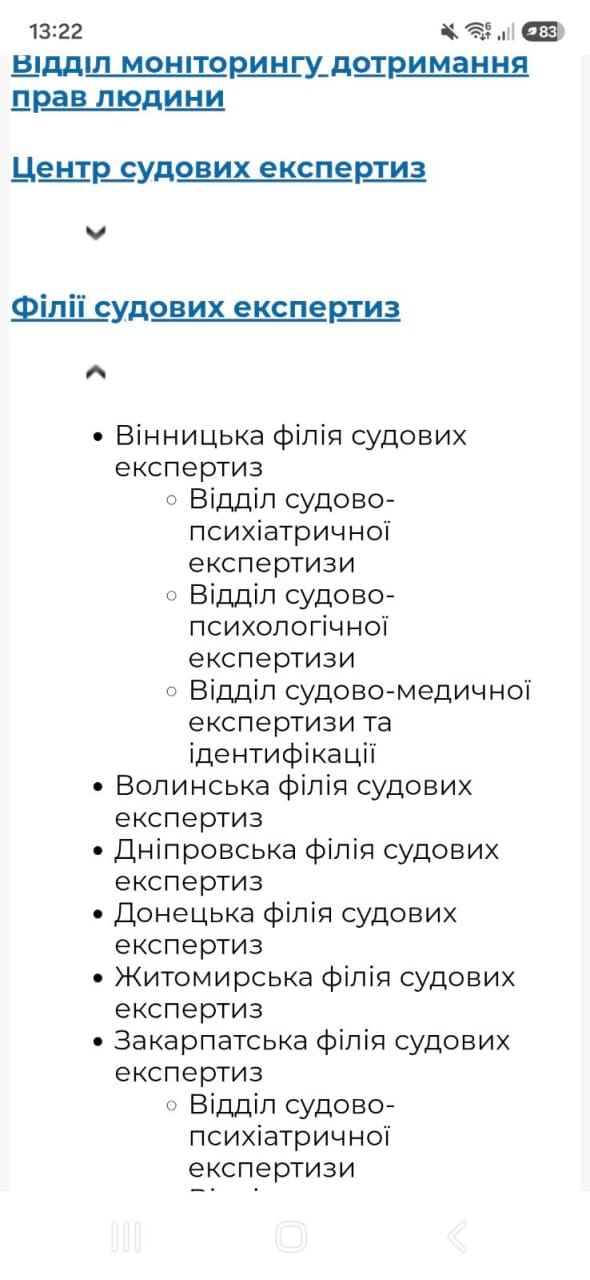
Their reorganization followed the same model as that of the capital’s institutions: the relevant Ministry of Health order was not published on the Ministry’s website but sent directly to the bureaus. The question therefore remains whether the forensic medical bureaus that have not yet become branches will be incorporated into the single state institution.
Shum is convinced that this reorganization complies with Ukrainian legislation and practices in EU countries, does not affect the adversarial nature of proceedings "and cannot affect it unless it worsens their financial and social support."
He explained his position by quoting a provision of the law: "The independence of a forensic expert is ensured not by the way legal entities operate, but by the safeguards provided for in Article 4 of the Law of Ukraine ‘On Forensic Examination.’ Specifically, a forensic expert’s independence and the accuracy of their opinion are ensured by: the legally prescribed procedure for appointing a forensic expert; a prohibition on anyone interfering with a forensic examination, subject to liability prescribed by law; the existence of forensic examination institutions independent of bodies conducting operational and investigative activities, pretrial investigation bodies and courts; the provision of the necessary conditions for a forensic expert’s work, including financial and social support; a forensic expert’s criminal liability for knowingly providing a false opinion or refusing without valid grounds to perform their assigned duties; the possibility of ordering a repeat forensic examination; and the presence of participants in the proceedings during a forensic examination in cases prescribed by law."
He believes that professional experience and the mandatory disclosure in an expert opinion of information about education, specialized knowledge and professional activities do not constitute proof of an expert’s competence. "In the Institute’s work, there have been cases where, during a traineeship, a person with substantial experience in a particular field of specialized knowledge who intended to qualify as a forensic expert demonstrated an inability to apply that knowledge in practice," he says.
This was Serhii Shum’s response to draft laws proposing a different approach to the appointment of forensic medical experts by courts and the assessment of an individual specialist’s expertise. More on the draft laws below.
DRAFT LAW AUTHOR: I WANT TO MAKE THE PROCESS ADVERSARIAL WHEN IT COMES TO EXPERT EXAMINATIONS
In September, two draft laws concerning forensic medical examinations were registered in the Verkhovna Rada: No. 16048, on amendments to the Law of Ukraine "On Forensic Examination," proposing changes to the rules governing entry into the forensic expert profession; and No. 16049, on amendments to Article 102 of the Criminal Procedure Code of Ukraine regarding the information to be included in an expert opinion.
Serhii Vlasenko, who initiated both draft laws, explained that his reasons and motivation differ from those of specialists calling for employees of private institutions in the field to be allowed to work as forensic medical experts. However, his proposed legislative amendments could also have an incidental impact on this issue.
According to him, the draft laws were prompted by accusations against the National Anti-Corruption Bureau of Ukraine (NABU) of abuses in the commissioning of examinations. Given the importance of the anti-corruption body’s reputation, this undermines the entire system. Vlasenko proposes a fundamental change in how experts are selected and expertise is assessed, which he believes should ensure that examinations are truly independent and experts are impartial.
"We have, so to speak, a system for trying cases in court, with the prosecution, the defence and the court. And, unfortunately, there is an invisible component called expert examination. It is a kind of kingdom within a kingdom.
A great deal depends on the status of an expert examination in criminal proceedings, because a person’s freedom is at stake. This field receives far less public attention than it deserves, and when it does attract attention, it is generally discussed using Komsomol-style slogans. The latest such slogan was: "Let’s give NABU the right to conduct its own independent examinations."
There is a problem with the slogan itself, because if an examination is conducted for the prosecution, it cannot be independent. I propose making examinations truly independent, as they are in very many countries around the world where experts do not require licences. In most civilized countries, an expert is someone with practical work experience and a reputation in a particular field. For example, the court determines which doctor is the better expert: one with five years of practical experience or one with forty years. But neither needs to register with the Ministry of Justice or anywhere else. A person with experience can act as an expert in court and prepare expert opinions for the court."
Vlasenko explains that experts are directly accountable to the court for their opinions, which provides a safeguard against a market for unscrupulous experts.
"The expert testifies in court, and the court itself will make its assessment during the hearing of the specific case, rather than after the fact," he adds. "The judge has the right and the opportunity to ask the expert questions then and there. So does the opposing party. In other words, if this is an expert for the prosecution, the defence has the right, first, to find an expert to challenge their findings and, second, to question the expert to establish both their competence and the soundness of their opinion."
Vlasenko points out that in many EU countries, the United States and Israel, a forensic medical expert effectively serves as an adviser to the judge and is a truly independent figure. He is convinced that Ukraine should have something similar:
"Today, we very often hear views and rumours, not without grounds, that the prosecution manipulates examinations in various ways. Others say that the defence manipulates examinations in various forms and ways.
But if we have, so to speak, unrestricted access to anyone with specialized knowledge, only the judge will determine which expert’s findings to accept. This would create a real market for independent examinations, and both sides would then have no need to manipulate experts. Monopolies would also disappear from the market, because there are indeed certain fields of expert examination in which the state holds a monopoly.
It is absurd when someone has worked as an expert at a state institution for twenty years, then leaves for some reason and can no longer act as an expert on those issues. I want to make the process adversarial in this area of expert examinations as well.
Each side will be able to seek a more qualified expert without restricting the other side. This is what sometimes happens: one of the parties (more often the prosecution than the defence) approaches a state forensic institution and obtains an opinion from an expert. The institution then says it can no longer provide another opinion in the same case. After all, it has already issued an opinion, and it would be strange to issue another that contradicts it. Yet other experts at the same institution may disagree with the expert who signed that opinion.
I therefore want to make the examination system free from outside influence by, first, eliminating monopolies and, second, allowing each party to find as many experts as it can. Then there will be only one question: which expert is more convincing to the court? Unfortunately, that is not how the system works today."
As for the state’s monopoly on forensic medical examinations, the MP agrees that it exists and affects the degree of independence of examinations.
"For at least the past twelve to fifteen years, the state has done everything it can to control expert examinations. Our prosecution is state-run, meaning that the state acts as the prosecutor.
With all due respect, and despite all the declarations about judicial independence, our courts are still oriented towards the state. On top of that, we have state-run expert examinations. On the other side are the accused and their lawyer. This means entirely unequal conditions. We therefore need to create equal conditions, given that the state will always seek to retain control over expert examinations. When experts work for the state, there is an opportunity to influence them. In practice, experts are not always independent: they are sometimes intimidated, and their selection is sometimes manipulated."
Overall, while the forensic medical examination sector is undergoing renewal, the path to change and correction remains open. How willing are the public and the professional community to oversee this process, and how willing are the authorities to act? Even this year may provide an answer.
Olha Skorokhod, Censor.NET


