


491 days at his position, he cut off his own leg: Story of soldier evacuated by aerial drone in world first
Kostiantyn Vlasenko, a soldier with the 30th Separate Mechanized Brigade, held a combat position for 491 days. After his comrade was killed and he lost both legs, he continued to carry out his tasks and maintain contact on his own. He was then evacuated by air: for the first time in the world, a soldier was extracted from his position by drone.
A story that will live on forever. About character, determination, and rescuing our own. For 491 days, a soldier from the 2nd Battalion of the 30th Mechanized Brigade carried out combat missions at his position.
He was left alone. His comrade was killed. He lost both legs as a result of his wounds. He had to cut off his own wounded leg with a knife.
The enemy repeatedly called on him to surrender. They told him he was cut off from his own forces. That he was deep behind enemy lines and had no chance of rescue. And yet Ukrainian soldiers rescued the hero.
For the first time in the world, an aerial drone flew in to rescue a Ukrainian soldier. The hero was flown back to our rear. He is now receiving treatment in the hospital. He is feeling well and can talk about this truly remarkable story.
Please introduce yourself, my friend. What is your name?
Vlasenko Kostiantyn Valentynovych. Born on the seventh of the seventh, seventy-seven.
Please tell us how you joined the army.
I volunteered. No Territorial Recruitment Centre brought me in, nothing like that. For a long time, they wouldn’t take me.
I had never fought or served in the military at all. I had a reserved-worker exemption from mobilization, so they wouldn’t let me join. Then, when the Territorial Recruitment Centre started picking up guys from my workplace at the coke plant, I drove over myself and begged them to give me a call-up notice.
Please tell us which city you are from.
Kryvyi Rih.
Where did you work before the invasion?
Before the invasion, I worked at the Central Mining and Processing Plant in the urban-type settlement of Petrove. In the open-pit mine, driving a BelAZ.
A BelAZ is one of those enormous machines.
Yes. A 130-tonne one.
There was a famous film, "Saving Private Ryan." And here, my friend, I think saving Private Vlasenko is a story no less remarkable.
As for how those 491 days came about, my comrade returned from leave and took over at the Vertun position. It was a concrete drainage pipe. The guys had broken a hole in the middle of it and made a shelter. The pipe extended in both directions, so you could keep watch on both sides. And there was shelter too.
He took over there, but then had some bad luck when he went to collect a package. Supplies had been dropped off, and he didn’t notice a Lepestok mine. He stepped on it, and it blew off his toes and foot. So on 2 June, I had to go out to evacuate him, and on 3 June, I took over at Vertun in his place.
How long were you in that pipe?
Ten months.
Ten months in a concrete pipe where you couldn’t even sit up. Well, there was a dugout shelter. As I said, a pit. We stayed in the pit too. You could sit up there, because we ate sitting down. We also kept digging, doing more engineering work, because we wanted to be able to hand over properly when our relief came. So that when someone came to relieve us, we could stay seated while he climbed in and crawled over to us, and we could change over. It was only designed for two. The shelter held two people, and the observation post, the pipe itself, could also fit two people. We wanted all four to be able to sit in the shelter rather than have anyone stay in the pipe at the observation post. So we kept digging to make room.
We even made a kitchen where we could cook. We dug it out properly, settled in, so to speak, and got used to the conditions.
All of this was underground. So you only saw daylight through a narrow little gap.
Yes, looking out from the shelter. One opening on one side, another on the other.
How many people were at your position?
Two. My comrade and I.
The two of you held it?
Yes, the two of us.
Please tell us how it happened that the previous team went in for two months, but your stint kept getting longer and longer?
The enemy increased the number of drones they had. They had so many Mavics and other drones that the sky was "dirty."
And when the sky is "dirty," whatever cover you have as an infantryman, or whatever cloaks you use, the drone can still see you. If you haven’t spotted it, it has spotted you. That’s it; it will kill you. Guys tried to come and relieve us, but they never made it to us.
How many times did they try to relieve you?
Well, they tried once. But they couldn’t relieve us; they never made it. Then the comrades who went to recover their bodies didn’t make it either; they couldn’t recover them, so I said there was no need to come for me.
I’d rather die alone than have more men keep dying. I was left alone. On 14 February, we pulled back. I warned my commanders that the position was flooded. We couldn’t stay. We climbed out and were already soaking wet as we walked. And another freeze had set in, by the way. There had been a thaw, and it had flooded.
After ten months there, I had no strength left. My muscles were weak by then. My commander had told us, "At least do some exercises, so that if you suddenly have to get out, you have a chance, so you can at least run."
Run? Nobody could have run there. I was just crawling on all fours by then. And it was a good thing there were no enemy drones when we pulled back, so nobody would know.
We found a ruined school where we could rest and informed our commanders. They dropped dry clothes to us by drone. But the enemy’s reconnaissance drones also saw things being dropped there. That meant someone was there. They flew over and spotted us.
We hid in a little corner of the school, where the slabs had already been shattered. They started dropping munitions. I was hit in the leg.
But my legs were so frostbitten that I didn’t even feel anything hit me. Anyway, my left leg was shattered. I could still put weight on my right one. Then our drones flew over again and dropped food, and I twisted my right ankle.
So I couldn’t move at all by then. There was rebar, slabs, all that debris you couldn’t see. I wanted to retrieve the package quickly before it was hit, so there would be something left.
My comrade was very hungry and crawled out to get the sack. I told him to wait until dusk, when it would be less risky, so it wouldn’t be so dangerous. But he crawled out for the sack because he wanted to eat. He opened it and took out some sausage.
"Want some?" he asked. "No," I said. He climbed onto the broken bricks beside me. There was a concrete slab still sticking up that seemed to shield him. How the enemy drones got in there and hit him, I don’t know. I only heard it when they dropped the munition. I had heard them circling.
I had already braced myself, knowing they were bound to drop something. And my comrade was hit. I reached over to him, but I couldn’t see any blood.
It was already dark. I thought I’d look in the morning. He was crying out in pain, "oh, oh, aah," and couldn’t really say anything. I asked, "Where were you hit? In the leg, in the arm?" He just kept crying out. I pulled him closer to me.
He was groaning. But, as I said, I couldn’t see any blood anywhere. I felt him over and looked at my hands. I didn’t have a torch to switch on.
By morning, my comrade had died. I couldn’t save him, and he died on his 50th birthday. A milestone birthday. His birthday was on 16 February. God gave him a gift and took him. I was left alone on 16 February. As it started getting light, I covered him. I realised it wasn’t very safe there, and I had to put weight on the leg I’d twisted, because I could no longer stand on my left one.
I took my rifle and gathered whatever I could. They’d dropped a blanket and some dry clothes; I stuffed a few things in. Then there was an explosion, a moderate one. I thought something had gone off nearby and that they’d spotted me. But it turned out they were warning me, because afterwards they dropped some kind of little record player or speaker playing a message telling me to surrender.
What was it? What recording was playing on that speaker?
The recording went: "Bro, we know you’re here. Believe us, your comrades won’t save you. Did you hear that explosion? The next one could hit you. We don’t want to kill you. Put a jar or a bottle in the window, and we’ll know you’re ready. A white light will guide you." They have a drone with a white light (so bright you can see it even in daylight). "Then captivity, a prisoner exchange, and home." Those were the exact words: "and home."
And I told them, "Russian warship…" Shame they couldn’t hear me. There couldn’t have been a microphone on it. "Russian warship," and so on.
I radioed our guys too. I said they’d dropped this little thing and were offering to take me prisoner. "Where is it? What is it?"
I said I didn’t know where it was. Maybe it was lying near the pipe? Our drones flew over and started dropping VOG grenades to destroy the speaker. But they either missed it or couldn’t find it. Twenty minutes later, one of their big drones arrived. I didn’t know they had a big drone like that. I thought only we had one in that sector. But no, this big enemy drone flew in. What frightened me wasn’t so much what it dropped as the way it descended.
It stirred up all the dust around me. There was dust everywhere; I couldn’t see anything.
The drone descended, and its propellers alone kicked up all that dust around you? Wow! So it came right down to the position to make sure it hit you. And you knew it was about to drop something on you.
Yes, I’d already curled up on my left side and clenched my teeth. Why do soldiers have no teeth left? They’re always clenched. Then came the explosion.
That was when I understood what it was. Most likely, they’d dropped a TM anti-tank mine on me. It exploded. I thought I was dead, but I could feel grit crunching between my teeth.
It was dark. I opened my eyes, and it was dark. I wondered whether I could still see. But if there was grit crunching between my teeth, that meant I was still alive.
And that damn speaker was still there, still going: "And home." Then they dropped another one just like it. It turned out the drone had come with two. So they dropped another.
Everything came down on me. All the slabs shifted, the bricks, everything. But I felt the same grit crunching between my teeth, so I knew I was alive.
I thought I’d been buried and wondered how to dig myself out. I’d already found shelter by then, moved inside the furnace itself, where the cast-iron grates were. There was a little opening where the embers fell through. I don’t know what angel put me in there.
I crawled in among those cast-iron grates. When the second munition was dropped, just as big as the first, the bricks came down, leaving only a framework of pipes that carried water to be heated by the furnace. That framework remained, along with a small square section of slab. And I was already underneath that grate.
That was where I lived until I was evacuated. They dropped food and medicine to me. I crawled out of there and back in, and kept watch, so to speak.
I reported where I was and what I could hear.
Please tell us what happened, what injuries you sustained, and what they led to.
What’s interesting is that our bodies reject foreign objects on their own. I only saw that later, when things started falling out of me. I wondered what had fallen out. It was shrapnel coming out.
My leg was already swollen, and the right one was swelling too. I was crawling out to collect packages with my legs swollen like that. I couldn’t stand on them anymore. Then my left foot died.
The tissue simply started dying. Gangrene. And my left leg died.
And you used tourniquets to stop the gangrene from spreading. How did you protect your legs after that?
When I started bleeding, I used a tourniquet. But I knew I couldn’t keep it on forever. Once my left leg was gone, I switched to a pressure dressing. I tightened the tourniquet there; it started dripping a little. I bandaged myself up, put on a pressure dressing, and stopped using the tourniquet straight away; I released it. As for my right leg, I couldn’t feel it when I tried to put weight on it. It was dangling, but it didn’t hurt. That was the one I’d dislocated.
I couldn’t feel it anymore. Then it started getting in the way. Why? Because the bone, the joint, maybe it had rotted through and the bone came out through the skin, while the leg hung there.
The more I crawled out for packages, the further the dangling leg pulled the bone out, and the skin peeled away. I realised I had to cut it off, because if I kept dragging it like that, it would reach my knee. So I decided to cut it off. I knew it couldn’t be saved anymore. I’d wanted to keep at least one leg, well, one foot.
But it didn’t work out, so it didn’t work out. At least I stayed alive.
Tell us how it happened. Where did you get the knife, and how did you cut off both your legs? Was it at the same time?
No. I put it on a brick and took a knife. I wet myself; tears were streaming down my face, but I had to cut. I cut it off. The left leg, the one that had been wounded, had already rotted off on its own.
I said, "You can congratulate me. I no longer have flat feet or size 44 feet." He understood. It was in April that I lost my left foot; it rotted off on its own. Then in May, I cut off the right one myself. That’s how it happened.
I was left without my feet, so I threw them out of the window. I remember it was a cold spring, by the way. Then, when it got warmer, I was crawling out for a sack of supplies and looked out to see what had happened to my feet. There were about 200 butterflies there, around 200. Not moths, but big orange-and-black butterflies. I thought, God, even butterflies have come out of my feet. First there were maggots, and now butterflies too. I don’t know why I mentioned that.
I’m just telling you everything that happened to me. That’s the story.
That really is straight out of Stephen King. "I looked at where my feet were lying, and now butterflies had emerged from them, from those maggots. And now they’re flying over the position of life."
It’s cold now, so they aren’t flying anymore. Yes. They say flies emerge. I had butterflies emerge. How it then happened that the infection didn’t spread, I don’t know. Neither do the doctors. As for medicine, they dropped Betadine and painkillers to me, and that was more or less it.
Everything healed over, healed up, and nothing hurt anymore. Only the bone was sticking out like a spike, about 5 cm.
Please tell us: even without your legs, you continued carrying out your tasks and informing your commanders about what was happening. And the enemy never entered your position.
They didn’t. Nobody came.
When I heard voices over the airwaves, when I heard the guys at the other observation posts reporting, "4.5.0, 4.5.0," (In Ukrainian military slang 4.5.0 means "everything is quiet"- ed.note) I felt I was there with other people. But I knew that once I’d reported, "Nothing significant to report," I was the last one, that nobody came after me, and that was it: silence again. I’d look at my watch again. One minute had passed. What was going on? Every hour, I waited for those reports. Hearing someone, knowing I wasn’t alone, made me happy. I’d certainly gone feral during that time. I told the guys that too.
I didn’t know whether I’d be afraid of people or start lashing out at them. It was terribly lonely. They didn’t abandon me; my commanders didn’t abandon me. The guys were thinking about me.
Even little things, you know, like wanting a chocolate bar. I told them I needed sweets, tea, water and cigarettes. They dropped cigarettes to me, spoiled me, so to speak, so I’d at least have some comfort, something to take my mind off things. My wife sent a package. They packed it up and dropped it to me. My wife had sent me a Stephen King book, The Outsider.
I’d watched all the adaptations of his work and read his books too. But she hadn’t particularly taken note of how much of a fan I was. And I am a Stephen King fan.
Simply incredible, friends. A Stephen King book helped a soldier survive 491 days at his position without his legs, carrying out combat missions in a kill zone covered by drones and every type of weapon. I think this story alone is worthy of becoming the plot of a new Stephen King novel.
What did you think about when you were there alone? What allowed you to retain such clarity of mind, composure, such a strong desire to survive, character and determination? What kept you going, do you think?
Maybe the fact that there were so many things I hadn’t done in my life. Hadn’t had time to do. I hadn’t given my daughter enough attention. Maybe it was wanting to change something?
The will to live is one thing. Although, as I said, I’d already given myself up for dead.
What is your daughter’s name?
Khrystyna.
And what is your wife’s name?
My current wife is Tetiana. She’s my second wife.
Did you want to return to them?
Yes, I did. I hadn’t spoken to my daughter for a long time. Maybe she’ll understand that her dad was at war.
My friend, please tell us about this extraordinary event. You’ve truly made history, not only as someone who spent one of the longest continuous stints at a combat position, on combat duty. You are the first soldier in history, in world history, to be evacuated by an aerial drone. Nobody had ever done that before. And you were the first person in history it was done for.
So your commanders’ promise that they would try to get you out by any means possible was fulfilled. Yes, I can see you’re wearing a Gurzuf Defence cap. That’s the company’s name. And it was one of that company’s drones that rescued you. Please tell us about the operation. First, how did you find out they were going to evacuate you by air?
Towards the end, I knew they were planning to evacuate me. But I didn’t think it would be by air. My comrade, Sergeant Lysyi, told me, "Kostian, it’s being planned. Practically everything is ready; just a few finishing touches left." I thought maybe some vehicle would come, or someone would race in on a quad bike, or something like that. I didn’t know it would be by air. Then my commander said, "They’ll drop you some instructions today." What instructions?
Did they think I didn’t know how to crawl out of a hole or something? They dropped a little sack. I retrieved it and unpacked it. There was a nylon sling seat inside. Some kind of tough polyethylene with carabiners.
There was a phone wrapped up, with a video showing me what to do. There were written instructions too, from Chornyi, the pilot who evacuated me. He’d written them out by hand in Ukrainian and Russian.
I was even a little offended. [Laughs] What was that about? Ukrainian, and then the same thing in Russian.
I told him about it afterwards. "How was I supposed to know what language you speak?" he said. It was funny. Then I realised it would be a drone, because in the video he said, "I’ll come down. Once I land, you need to do this and this." I thought that by "land," he meant he would hover.
I didn’t think he would actually land on the ground. Land and shut off the motors so I could crawl underneath. I was already crawling under the drone while the motors were still running, although I wasn’t supposed to do that.
Once the drone had been shut down, I quickly crawled in. The winch, the carabiner—click. He’d told me, "There’ll be cameras and loudspeakers. But you probably won’t hear anything because it’ll be very noisy. If anything happens, use hand signals." As soon as I’d clipped myself on, I gave them the OK sign and an "I love you." Made a heart for the camera. They laughed about that afterwards. They said, "After all that time, he still has a sense of humour." And that was it. I lifted off and flew away.
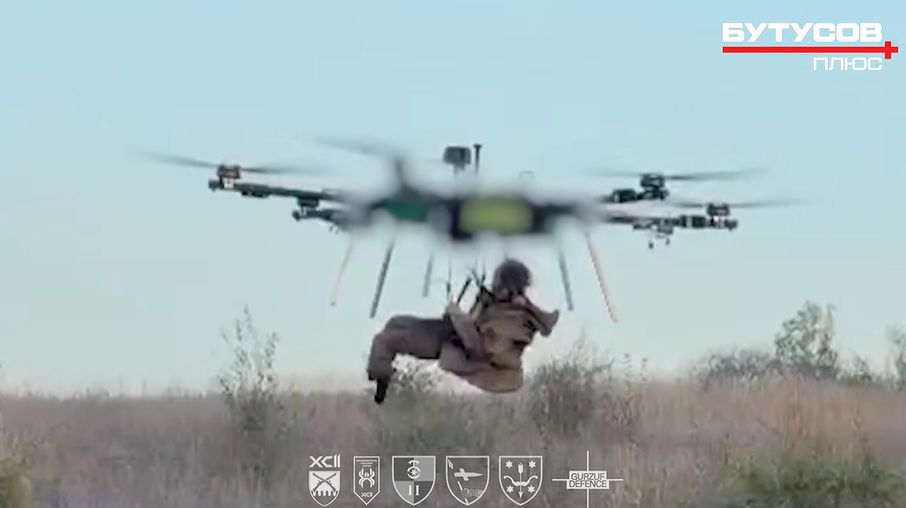
I wasn’t afraid like that. Of heights, I mean. I’m not afraid of heights. What I was afraid of was water.
When we were flying over the river, I was afraid we’d be shot down, and I’d fall into the water. I can’t swim. That was what frightened me. As for being up high, the wind made my eyes water. That hadn’t quite been thought through, because I didn’t have goggles.
The guys had dropped headphones to me, but I didn’t even have time to put them on. If you’ve seen the video, they’re hanging around my neck. And I’m holding on, damn it, looking around. I hadn’t come in that way. Where we were flying, hell knows. I couldn’t work out where I was. I just kept looking and looking. One of our Vampire drones flew towards us, carrying a package to one of the guys. That was pretty cool too. It flew past, and I thought its operator could see me too.
I also had an escort, as I understood it. The guys said three of our Vampire drones were flying with us, and one was lost. The enemy destroyed it. They were covering me. Yes, my rear was covered.
They were providing cover so the enemy would strike them first and wouldn’t spot or hit you. So the other drones were covering you.
It was quite an operation…
And one of the drones covering you was shot down by an enemy interceptor drone. But that shows the enemy was constantly patrolling the air. Without that cover, unfortunately, you would have been shot down.
Fortunately, that didn’t happen, thanks to such competent planning and coordination of everyone’s efforts. And you couldn’t recognise where you were, because they really took you along a route where you couldn’t have been found. The drone lifted you out of the village of Petropavlivka and carried you from the left bank of the Oskil to the right, across the Oskil River, over a very, very long distance. Simply an incredible operation. On an incredible scale.
And how did you cope with that? You’d lived underground for almost 17 months, and then you were lifted to a height of 100 metres, 100–120 metres, looking down as if from the top of a 16-storey building. You realise they took you straight out of the enemy’s rear and brought you back to ours. Unique. It’s a miracle. A world first.
I couldn’t believe it myself.
My unit’s chief of intelligence, callsign Aleks, planned the whole operation and put all the pieces of the puzzle together. I’m very grateful to him for managing to coordinate it all. As I said, there are people who brought everything together, and there are people who pushed for my rescue. That was my commander.
I have no words. I want to thank every one of them. First of all, Naum, Viktor, Lysyi, and the battalion commander. When I went into the position, my battalion commander was Abkhaz. There’s a different battalion commander now. I haven’t met him. I’d really like to, because he was involved in everything that was done to get me out. My morale officer, Yurii Vasylovych, callsign Odin, he’s like an older brother to me. My comrades from the 92nd Brigade, who provided the drone to get me out. Everyone involved. There were so many people. I don’t even know them, but I want to give them a little part of myself, to show how grateful I am.
My friend, I want to say that what you have done represents, in my view, the very highest level of human endurance and courage. This is, without question, an absolutely heroic story, a series of heroic acts. And what you have done will live on forever.
I haven’t really grasped that myself yet. As I said, I’m someone who doesn’t like being first. I’d rather be second.
You’ve already become the first, and there’s no getting away from that now. You’re among those who have spent the most days at a position, and you’re the first to have been rescued this way.
And this truly merits the title of Hero of Ukraine. Thank you, my friend.
UAV operator Chornyi:

I’m very glad it all worked out. It’s wonderful. The operation was very well planned, a great many people were involved, and we succeeded. A new phase of serious, systematic work is beginning to make this happen regularly. It is an enormous and complex undertaking.


