


Call sign Lev: "Russians dropped leaflets saying, ’Ukrainian Armed Forces soldier, surrender! Your commanders have abandoned you!’ It was funny"
Over four years of full-scale war, the chief sergeant of the 3rd Company, 1st Battalion, 12th Azov Brigade, call sign Lev, has been wounded five times and returned to duty each time. In civilian life, he worked as a warehouse manager at a paint and coatings company. But when Russia launched its full-scale invasion, he went to the military recruitment office without hesitation and soon began his service.
Lev has fought in various sectors of the front – in the Donetsk, Kharkiv, and Kherson regions, during the Dnipro crossing, and in the Serebrianskyi forest, New York, and Shcherbynivka. In our conversation, he recalls his first battle and injury, discusses how assaults differ today, how the proliferation of drones has changed the war, and why no technology can yet replace an infantryman in a trench.
– Let’s start with how you found out about the full-scale invasion.
– About 40 kilometres from my city, there is a small town with a military airfield dating back to Soviet times. At around five in the morning on 24 February, we were on our way to work and stopped at a petrol station for coffee. We heard aircraft flying there, and then explosions. Although it was quite far away, we could still hear them. We checked the news, but it was still unclear what was happening. A few hours later, reports said that a full-scale war had begun. That same day, I handed over my duties to the colleague taking over my shift. That was when I decided to go and fight. For me, there was nothing extraordinary about it. Nor was it for my family. Everyone had already understood that if war broke out, I would fight. It came as no surprise to anyone. They took it as well as could be expected.
There was chaos in the city that day. It was impossible to make sense of what was happening on the roads. There were long queues at petrol stations. What I remember most is driving past a bus stop where servicemen were waiting to travel to Kyiv to report to their unit’s base, while some men were heading for Poland.
– How did you join the military?
– On the morning of 25 February, at around 10:00, I went to the local military recruitment office. The queues were enormous. People kept arriving. Some saw how many people wanted to join, turned around, and left. Others stayed despite the circumstances. I waited for about seven hours. When I entered the office, they simply gave me an address to report to and said I had been assigned to the Territorial Defence Forces. I didn’t really understand what the Territorial Defence Forces were. I went there. They lined us up and told us this was a new military formation. Then they issued us uniforms and weapons. We went to our temporary accommodation. We spent a week there and then left for the area where we were to carry out combat missions. At that point, it was the Poltava region. Some kind of breakthrough or something else was expected there; I didn’t have all the information, as I was a private. Then we went to the Sumy region, and sometime in early April 2022, we entered the Donetsk region.
– Did you receive any training during that time?
– There was no training because the enemy was on the outskirts of Kyiv. There was heavy fighting. Those were the circumstances. Among us were people who had already experienced war and civilians who had only just turned up at the military recruitment office.
– What about the necessary skills? You at least need to know how to shoot.
– Just before we left for the Donetsk region, the men were taken to a firing range, where they practised shooting. Otherwise, we learned from one another, as there were volunteers among us who had experience. Everyone demonstrated what they knew and offered advice. There were no standards at all at that point.
So that was how we ended up in the Donetsk region. There was very heavy fighting there at the time. The enemy’s objective was to capture Sloviansk by 9 May. We moved into the Sviatohirsk forest, where I had my first firefight.
– What was it like?
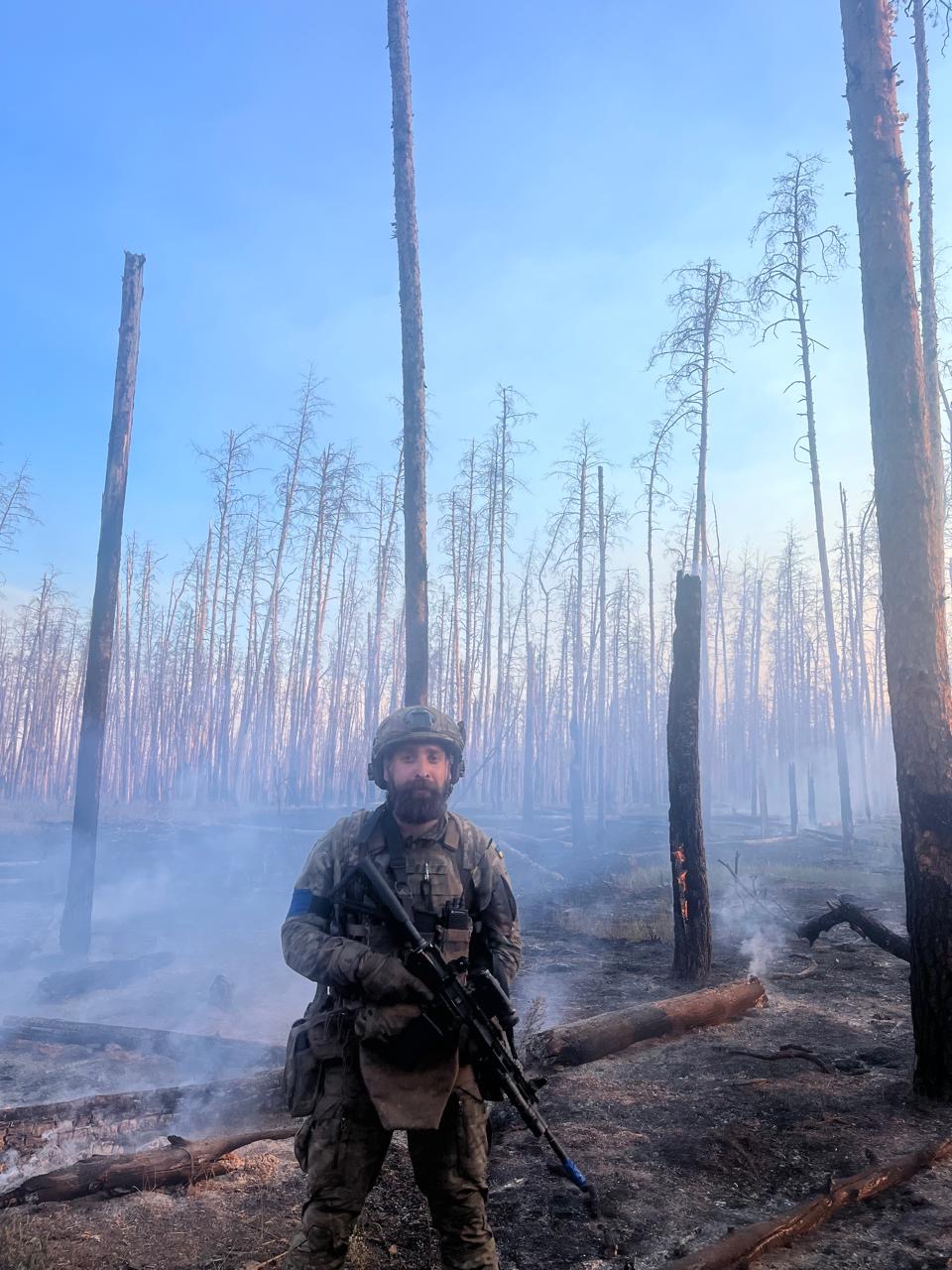
– As it happened, when we arrived in the forest, some of our comrades were wounded straight away. Others were killed. The situation was difficult and demanded our full concentration. I cannot single out one firefight because, given the enemy’s objective that I mentioned, the assaults came one after another. So it is impossible to pick out any one incident. The only thing I would mention is that the Russians kept dropping leaflets saying, "Ukrainian Armed Forces soldier, surrender! Your commanders have abandoned you!" It was very funny. But there was probably a serious side to it, too, because we had no information at that point. By then, I had spent about three weeks at the position, cut off from the world, with no idea what was happening beyond that little patch of forest. Even so, we were holding our own; the enemy could not advance. But one fine day, one of their tanks arrived and began destroying our position. And we had no anti-tank weapons at all.
That was where I sustained my first injury. It was not serious: a shrapnel wound to my right leg, as well as a burn to the cornea of my right eye. Then came the standard procedure: the evacuation plan, the hospital. Everything was fine there: in 2022, all servicemen were heroes, and wounded servicemen were the very best. I did not spend long in treatment, about 14 days, before returning to duty to continue my service.
– Does being wounded change your attitude towards what is happening?
– Having been wounded several times, I can say this: the first time is probably the hardest because you have to overcome a psychological barrier. You come back after being wounded and feel as though your next mission will be your last. But you go out, everything is fine, and then you go on another and another. After that, you no longer have those psychological difficulties. Personally, physical recovery takes me longer than psychological recovery. But people are different, so they do not all react the same way. After my second injury, I no longer had any psychological problems that would prevent me from going out to a position. You just follow your usual routine.

– What was that second injury?
– A shrapnel wound. We had already completed the assault and consolidated our positions. But then an enemy FPV drone struck. I was wounded on the left side of my body. Nothing critical. Again, evacuation, about 10 days in hospital, and then back to the unit. Most of my injuries have been caused by enemy shelling or drones.
– What about concussions?
– We usually do not count those. It is quite easy to sustain a concussion in war. Of course, you have to understand that they vary in severity. Some cause people to lose consciousness, with all the possible consequences. I have never had concussions that severe.
– Where did you return after your first injury? Were you already in the Kharkiv region?
– No, first I went back to the Donetsk region. We carried out certain missions there and only then moved to the Kharkiv region, where we spent about a month.
– So you took part in the Kharkiv counteroffensive?
– That’s right. We took part as infantry. Among other things, we carried out an assault alongside a tank formation. It was successful. The enemy retreated as quickly as they could. Of course, there was fighting, but mostly the enemy fled, and we had to chase them.
Then we were withdrawn for a month to rest and refit, after which we went to the Mykolaiv region and then the Kherson region. It was difficult there at first, then a little easier, and eventually even harder, because we had to cross the Dnipro under fire, which is extremely difficult.
– Was this during the Kherson counteroffensive, when Kherson was liberated?
– Yes, but we did not liberate the city itself; we fought in the region. Then we were assigned our own area of responsibility. My separate battalion mostly served as an attached force under another brigade. We held that sector for about seven months. With the river there, the enemy was not really planning any offensives. They did not want to cross the Dnipro either, which is understandable because, as I said, it is difficult. Then they blew up the Kakhovka Reservoir. That caused a huge surge of water, and a couple of our positions were destroyed – flooded. We lost one man in the unit: he was simply swept into the river. A great many roads and settlements were flooded. It was terrible for civilians and military personnel alike. After the water receded, the decision was made to cross the Dnipro. Since we were the attached force, we were the ones who had to do it. In the end, nothing terrible happened there. We crossed to the left bank by boat and consolidated our positions. Everything went well for us. My unit did not even suffer any casualties. We completed our mission and returned. Under fire, of course. The enemy used shrapnel rounds to sink our boats, as we were using rubber boats at the time. But everything turned out fine. After returning, given that we had spent so long in one place holding a defensive sector, I submitted my paperwork for a transfer to Azov…
– Why did you choose Azov specifically?
– I wanted to join professionals. And, most importantly, it is a volunteer unit. That matters to me. That is why I chose this brigade. Just after returning from the left bank, I went on leave for the first time, and afterwards I went to Azov. I completed a training course and joined a unit that was deployed in the Serebrianskyi forest at the time.
– What do you remember most often from there?
– The devastated forest itself, with almost nothing left of it. War is difficult everywhere, really. I cannot single out any one moment as the hardest. There were new challenges, but we dealt with them. We even advanced. Of course, it was frightening in the Serebrianskyi forest. Everyone called it the "Forest of Wonders". But overall, I think we did our job well, and that is what matters most. The enemy could not penetrate our lines. We did not give up our land to them. We even recaptured some of it. In my view, we accomplished our mission in full.
– Then came the New York campaign and Shcherbynivka, correct?
– Yes. We were sent to take part in the New York campaign because the enemy was assaulting our positions and had to be stopped. I also took part in assault operations there. As I said, I cannot single out any one thing. It was difficult, as always.
– Was that where you sustained your second injury?
– I sustained my second injury in the Serebrianskyi forest. This was the next one, minor and not critical. The main issue was the after-effects. Friends were wounded there, and we helped evacuate them, but I was more or less fine.
Then I was wounded in Shcherbynivka, as was my comrade, whom we managed to carry out and save; he is doing well. During that, I also sustained another injury: a broken leg. But we got him out. Then it was back to the hospital, where I underwent lengthy treatment while it healed. After returning to duty, I sustained another injury – I broke my other leg. That put me out of action for about four months. When I returned again, I was appointed company chief sergeant within a short time.
– During our conversation, I counted five injuries. Have there been more?
– Yes, there were five. As I said, psychologically, it is only hard after the first one. After that, you just get on with the job, drawing on the reserves you have.
– With a broken leg, you were away from the military for four months, your first absence of that length during your service. What was it like to return?
– If you spend a long time in civilian life, of course it is difficult to return. Some time passes, and you leave again, knowing that there is no telling when you will come back, because the situation could be extremely difficult. So you could once again spend a very long time at war. And you do have a family, people who want to see you. But then you return to the army and carry on doing your job as you should. You simply go back to the same schedule and the same work, which you do because someone has to.

– Speaking of the job, what can someone never understand about an assault unless they have been through one themselves?
– Time moves differently during an assault; something changes every second. It may actually last just two or three minutes, but you can almost live a lifetime in that time. Someone who has never been there will never understand that. Only those who have experienced assault operations understand it. Your life can end at any second, whether you want it to or not.
Generally speaking, there is always planning. It works about 50 per cent of the time because this is war, where everything changes as you go; many different things can happen in a short space of time. When it is all over, you think three or four hours have passed, when in fact it has been 30 minutes.
– How have assaults changed with the proliferation of drones on the battlefield?
– As blunt as this may sound, a drone cannot replace a soldier who has to enter an enemy trench. Today’s infantryman simply has another problem that did not exist before. It is an additional threat alongside enemy infantry and vehicles. Another challenge for a serviceman.
But war is always changing; something new is constantly appearing. We also use drones in our work. I will not go into detail for obvious reasons, but we use them successfully. We introduce new technology that helps us do our job. Today’s infantryman has skills that enable him to deal with enemy drones.
– When new soldiers join you, how do you prepare them mentally? What do you tell them first?
– I would not say it is about telling them something. It is more about briefing them on the plan and training them so they understand how to act. Whatever you tell someone, if they do not know what to do in a given situation, talking will not help. So the first thing they are given is the skills that will help them in actual combat. But it is impossible to prepare them psychologically for what awaits them. Everyone responds differently to the combined stresses, and we cannot know how each person will react psychologically out there. Yes, of course, there are talks to prepare them and explanations of what can happen in combat, but that is not the main focus of their development. What matters most is training them for what awaits them on the battlefield.
What I like about our unit is that this work is done by people who have actually been through it, who have personal experience and pass it on. That is a huge advantage, compared with having people trained by those who do not understand what it will be like on the front line.
– You have been fighting for four years. Looking back over that time, can you get used to war?
– You know, human beings are so adaptable that they can get used to anything. Is that something you should do? In my opinion, no. First of all, people who get used to war have a very low chance of survival. When you are in that state and think you will not be killed, it can have fatal consequences. I have seen civilians living in combat zones. We have had cases where we almost had to force them to leave the city because they did not want to leave their homes. They grew accustomed to constant shelling and fighting in their area. Why they stayed under those circumstances is unclear. Perhaps they were waiting for Russia or were simply afraid to leave their homes.
– Have you ever spoken to the so-called "people waiting for Russia to arrive"? Servicemen have told me that locals in Donbas even said to their faces: "You brought the war here!"
– We have met people like that. But I would not say they are waiting for the "Russian world". They are more likely people who were born in the Soviet Union and believe that if it returned tomorrow, their youth would return with it. So in most cases, they belong to the older generation. But I would not say they are found only in Donbas. There are actually plenty of them in every region. Unfortunately.
Another thing: we should not forget the propaganda campaign conducted by the Russian Federation; people were persuaded that Ukraine had started the war. And there really are people who believe that. Although it is very easy to go online and find evidence of what actually happened.
– Can you imagine yourself working as a warehouse manager again?
– I can imagine myself in civilian life. But, of course, it would be different now. First, I have gained experience in war. Second, I have matured considerably during this time. So I do not think I would have trouble adapting. But I would change jobs.
– Would your work be connected to the military?
– I do not know. I cannot answer that question yet. It is so far off that I do not even think about it.
– So you think the war will last for years?
– For now, we have no reason to celebrate or think that everything will end tomorrow. We can assess the situation by looking at how society treats military personnel. I already mentioned that in 2022, I experienced a time when servicemen were still heroes to civilians. Now we have reached the point where part of the population calls them "man-catchers". But military recruitment centre personnel are not the only people who wear uniforms. A friend of mine came home and was mistaken for a military recruitment centre employee because he was in uniform, and a confrontation followed. I find it strange when this happens in a country at war, whose army is fighting for victory. The support of our population matters to us. Unfortunately, public attitudes are changing, partly because of Russian propaganda, as Russia is actively spreading narratives about "man-catchers". It is very noticeable. And for some reason, some people are not applying critical thinking. That is one of the reasons I still believe the war will not end soon. I do not see the conditions for that. Perhaps I am wrong.
– Both the president and your commander Redis have said that Russia plans to mobilise 500,000–600,000 people after the State Duma elections. How do you prepare yourself mentally under these circumstances, knowing what is happening?
– I had a friend whom I met at the beginning of the full-scale war, when we had just joined the military. He used to say: "Everyone needs to eliminate five Russians, and then we can all go home." He started working it out mathematically. I no longer remember the figures, but that was the mood. But we understand that Russia is a country with a very large pool of people available for mobilisation. If they have already lost more than half a million people and that has not stopped them, then they are not going to stop fighting. So there is no point worrying that they will recruit another 500,000 people. Let them.
– Can we say that modern warfare increasingly depends on technology rather than the number of troops?
– War has always changed at a very rapid pace. Those who have been on the front line since the beginning of the full-scale invasion, or even earlier, have already witnessed several phases of it.
If humanity tried to introduce that much technology into civilian life, I think the world would have far fewer problems. Right now, people are developing a vast amount of technology to kill. If they developed as much technology to help people survive, that would be much better.
The Russians do constantly use the latest technology. In practice, however, they still rely more on manpower. Once one group of soldiers is gone, they recruit another. And the cycle continues. But the quality of the Russian Federation’s pool of recruits is still far lower than Ukraine’s. Our training and skills enable us to win. Despite its considerable military potential, Russia has somehow failed to take Ukraine in two or three days, as it promised. That says a lot.
– The Russians are not achieving success on the battlefield, but they continuously terrorise civilian cities with missile and Shahed attacks. What does that tell you?
– It tells me that Russia cannot defeat Ukraine militarily; direct aggression is not working. So they are destabilising the situation and trying to drive a wedge between the army and the home front. Russia continues to act as a terrorist state, killing civilians and destroying infrastructure, because it simply has no way of achieving its objective through military means alone. They have achieved nothing recently. They keep talking about the cities they have managed to capture. But they only succeeded because they razed them to the ground, leaving the defenders of those settlements with nothing to hold on to. If a city is completely destroyed, there is no point holding the ruins.
So far, everything suggests that things are not going particularly well for the "world’s second army", as they call themselves. They are already having to mobilise more people, and this is far from their first mobilisation. Despite that, they still find it extremely difficult to advance. We have repeatedly seen them announce the capture of an area, only for it later to emerge that this was another fabrication. Sometimes, to create the appearance of success, they send in two servicemen to plant a flag or display some other symbol and take a photograph, which is then used to announce that a position has been captured. In reality, it amounts to two soldiers dying for that picture. Quite a story.
– Finally, let me ask about your awards. You have quite a few, including the Presidential Distinction "For the Defence of Ukraine", the Cross of the 86th Separate Territorial Defence Battalion, the National Guard of Ukraine’s "For Bravery" badge, the Ministry of Defence’s "Cross of Honour" medal, the "For Military Service to Ukraine" medal, a weapon awarded by the Ministry of Defence, the Azov Assault Knife, and the Order "For Courage", 3rd Class. Which means the most to you? What do they mean to you in general?
– In my view, every award matters to a serviceman and has a particular meaning. At the very least, it recognises their professionalism or the fulfilment of their duty.
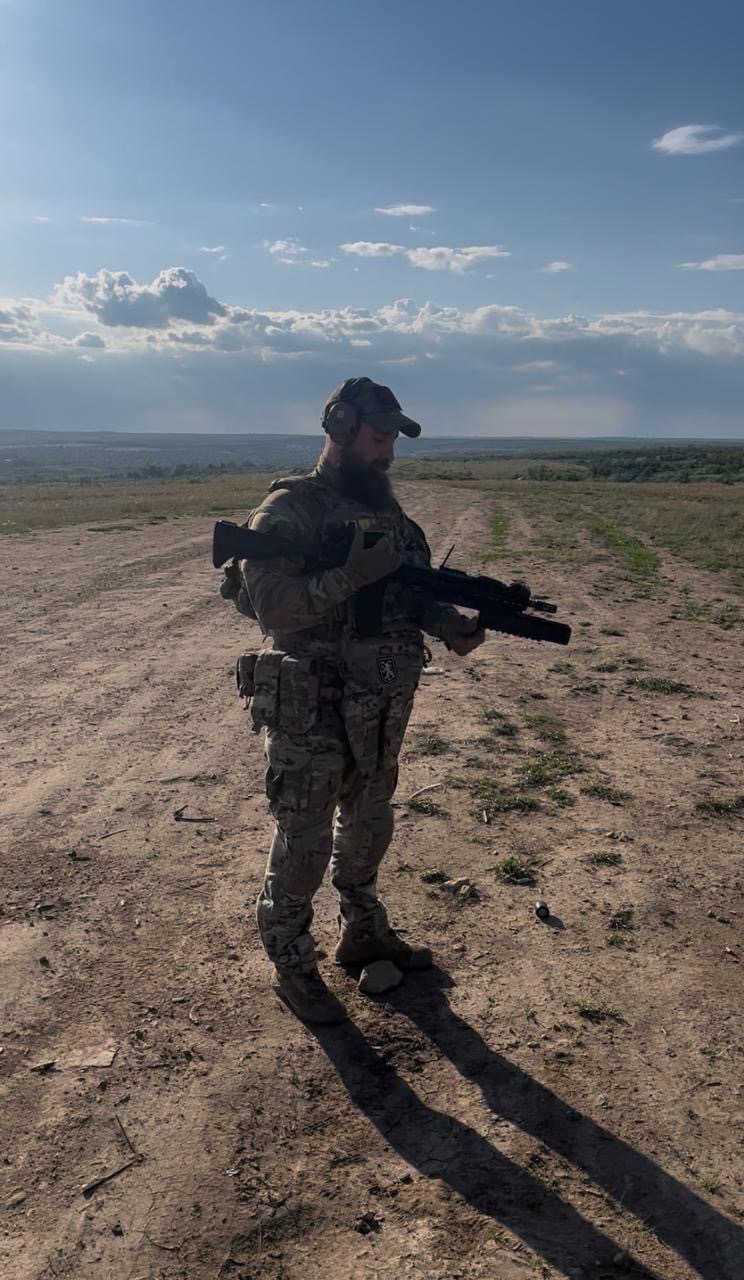
For me, the most important award is the Azov patch itself, which our men receive after developing within the unit into professionals who have earned the right to bear the proud title of an Azov soldier. That is why it meant so much to me: it recognised that I am a professional in what I do, that I can be part of our Azov brotherhood and a large unit doing vitally important work.
Olha Moskaliuk, Censor.NET
Photos provided by the interviewee


