


I’ll never forget it: assault began, and there I was, all on my own with assault rifle and machine gun – Spartan warrior
From an infantryman who once found himself alone at his position to the commander of an artillery unit—such is the journey of the warrior with the call sign "Sparta." A recipient of the Iron Cross and the Knight’s Cross (3rd Class), he recently took command of a multiple-launch rocket system (MLRS) battery within the 148th Separate Artillery Brigade (Zhytomyr).
To put it bluntly – he and his lads work for ‘HIMARS’, so we didn’t talk much about this current chapter of his military life.
Sparta spoke much more candidly about his experience as an infantryman: the euphoria of manning a machine gun, his first taste of command, the feeling of preparing to repel an enemy assault on his own, and a serious injury.
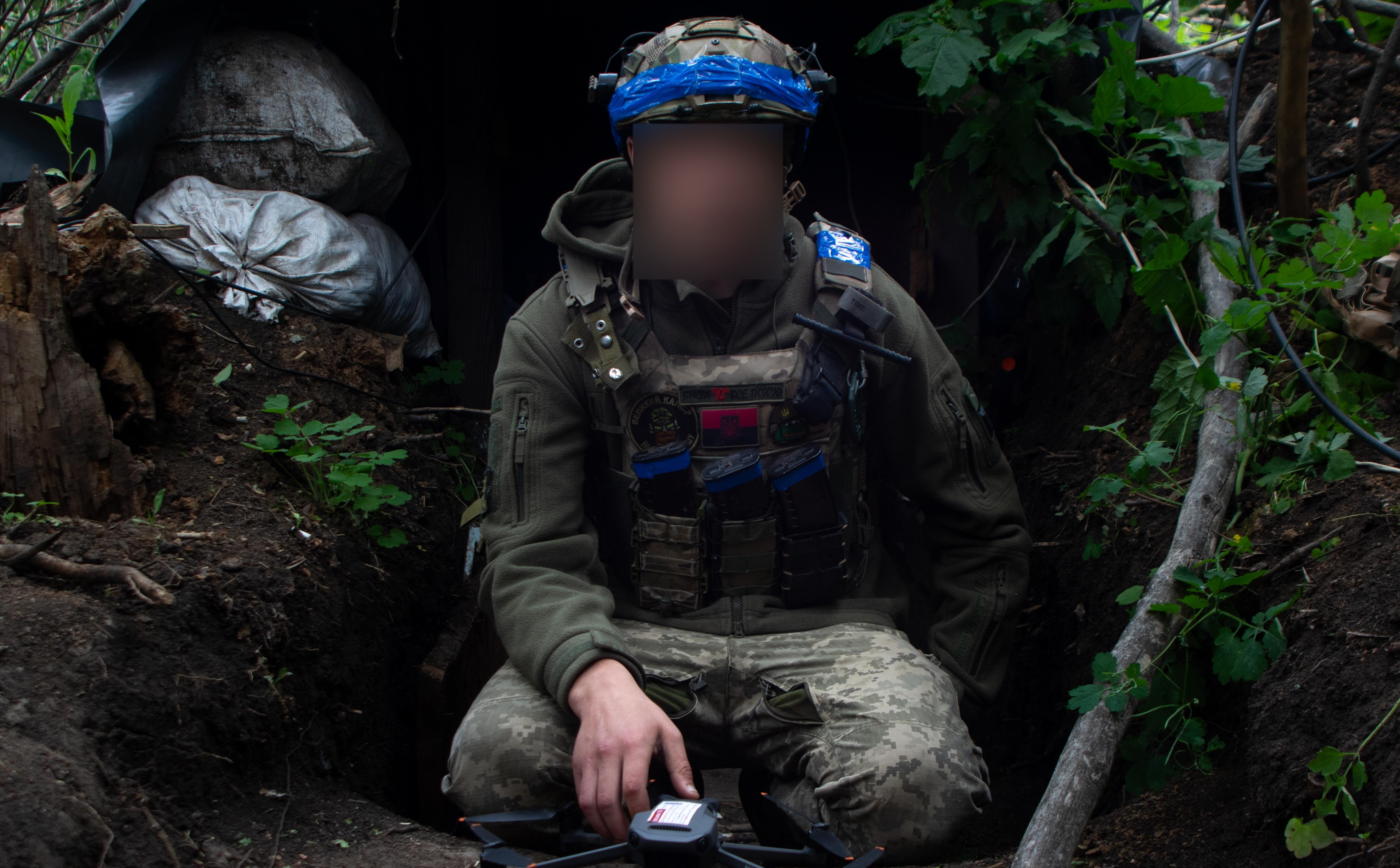
BEHIND THE MACHINE GUN, I FELT A KIND OF EUPHORIA, AS IF I WERE A BIG-CALIBRE HERO
- I’m from Volyn, from the town of Lyuboml. I went to the military recruitment office almost immediately after the full-scale invasion began, on 25 February; I was 23 then. They told me to wait because the queue of volunteers was very long, but I stood my ground. I’d returned from my compulsory military service in 2020, so I was already in the first reserve. But on top of those who were already queuing at the military registration office, volunteers were arriving. I insisted that they take me. Eventually, I got my way – they took us by bus to Vysoka Pech in the Zhytomyr region.
At first, I was assigned to the 79th Brigade of the Airborne Forces. We underwent basic training. But at that time, the enemy had broken through the 95th Brigade’s convoy, and I was sent there with a few lads to reinforce them. We set off in a convoy towards Donetsk, then on to Sloviansk. There, I was assigned to the 1st Battalion, 2nd Company, and then our commander took us to Mykilsk.
Our company operated in the vicinity of Dovhenke, Kam’yanka and Dolyna – we held defensive positions and repelled assaults. But I was also part of the mop-up group; in other words, after our lads had repelled the assaults, we would clear the area and secure our positions there.
- Tell us about your first deployment to the front line and your first battle.
- I really wanted to join the Airborne Forces specifically, because they’re the elite, and I’ve always respected them. I asked to be assigned to the assault troops, because they were the only ones fighting at that time. In the end, I became a machine-gunner, and soon after that, the commander of an assault squad.
But my first deployment took place at a landing site we knew almost nothing about, even though we’d been stationed there for three days. It was on the very third day that we came under attack. It was my first time, so I didn’t realise what was happening: shooting simply broke out from both sides, and I fired back too. It was all over quickly, in about ten minutes. As I understand it, the enemy had stumbled upon us by mistake.
After a rest, we were taken to Slonova Posadka, where we also held the defence. And after that, I was sent to the ‘Sparta’ position. That’s where my first major battle took place, one I’ll remember forever.
We were also told we’d be there for three days. Our platoon took up six SPShok positions. The lads we were replacing warned us that it wouldn’t be just three days, and that it was quite tough here, as the enemy were attacking every day. In other words, they’d prepared us for the fact that, if not by evening, then by five o’clock in the morning, we’d be under attack, most likely from the direction of a nearby trench. We took this on board, and my heart started racing. I lost my confidence and asked myself whether I’d be able to hold out, whether I’d be able to fight them off.
Our combat post was a machine-gun post. As it happened, another lad and I were assigned as machine-gunners, even though we didn’t even know what a machine gun was. At the company command post, we’d had a day’s training on the DShK. We took the machine gun with us to our position and prepared to use it.
And so we set up the machine gun. It was quite scary, because I lacked confidence. Almost everyone around me was either a contract soldier or a veteran who’d been through the ATO. They said: ‘If there’s an assault, don’t worry, because on the other side there are people with the same capabilities as us. It’s easier for us because we can see them.’
- In the end, did you need the machine gun?
- The assault did indeed begin at around five o’clock in the morning, but the firing was coming from another observation post about 60 metres away from me. So it sounded as if the shooting was coming from our side. At first, I just crouched down and didn’t know what to do. I was waiting for some sort of command, but everyone was just returning fire and telling me to get to the machine gun.
I tried to reload it, but at that moment the adrenaline rushed into my hands, and I couldn’t manage it. They helped me; I started firing, and then my confidence came back very quickly. I felt a sense of euphoria, as if I were a heavyweight powerhouse. I didn’t know if I was hitting anything, but I was covering our position. And then they started climbing out of the trench; our eyes met – and that was something else entirely. We later realised we’d taken out four occupiers, though we couldn’t see how many more were beyond the trench. I kept firing until I’d used up all my ammunition.
The command post later told us not to let our guard down, as it hadn’t been confirmed that the enemy had withdrawn. And so we were under constant strain.
I was a YOUNG COMMANDER; THEY DIDN’T REALLY LISTEN TO ME. BUT I WANTED TO PROVE THAT I COULD DO IT, BECAUSE THAT WOULD MEAN THEY COULD TOO
- And in fact, during that sortie, you took charge of the squad.
- We held our defences there for three weeks; during that time, I became the commander of the assault squad. There were usually assaults like that every day.
Some time before we were due to be relieved, we took four of them prisoner. They had no body armour, no helmets, just assault rifles and machine guns. They’d simply got lost and stumbled upon the first checkpoint near us. A firefight broke out, and they started to flee, but towards our checkpoint. We engaged them; they ran out of ammunition and surrendered. I simply said: ‘Put down your weapons. Hands up, surrender.’ Two raised their hands; one managed to escape behind our lines, but the lads from the other checkpoint caught up with him.
- And what happened next? How did you cope with the command responsibility that had effectively fallen on you?
- Our position must have been given away, because mortar rounds started landing with pinpoint accuracy. The shelling of our position was very intense; they shelled us all night long. The enemy were about 400 metres away.
We could hear their tank rolling out and firing. We tried to call in a strike via radio to take it out, but we didn’t get confirmation. The very next morning, the enemy launched an assault; we hadn’t slept all night. Back then, in 2022, our defensive positions were just ordinary trenches covered with branches, not dugouts.
We, utterly sleep-deprived, repelled the assault. Two of our lads panicked and started refusing to go into battle. As you can imagine, I was a young commander with little experience. Nobody was particularly keen to take orders from me. But I wanted to show that I could do it, and therefore so could they. Conversely, I didn’t want to show any fear, because if I was afraid, how could I urge the others to stay calm?
So, we repelled the assault, but at one point the lads said to me: ‘Get in touch with our command and ask them to move us from this position, because its coordinates are already known.’
I contacted the platoon command, explained that the occupiers were really close, and that we should move a few metres to the side. They didn’t permit me; they told me to hold the defence there. My lads didn’t listen and moved away. Only me and another lad, Winston, remained at the position.
Almost immediately, shelling began, and as it happened, they attacked the spot where Winston was standing. He was clearly severely concussed. I did my best to help him and went back to the command post to report that ‘300’ needed to be evacuated. He was evacuated, and I was promised reinforcements, but for a while I was left alone at the position.
- So you had to fend off assaults on your own? Was that when you were wounded?
- I had SPs to my right and left – a few dozen metres away from me. I’d been promised three men. What’s more, the commander had asked for those who’d left to return.
Around lunchtime, another assault began from the enemy’s side. I’ll never forget it – the assault started, and I’ve only got one assault rifle. Right in the middle of the fighting, a lad – Rybak – ran over to me from the neighbouring SP and took up the machine gun. We repelled that assault, and we were warned that another one might follow. I thought Rybak was already with me and would stay. But he sat with me for another half an hour and then left. After that, I was on duty on my own.
About an hour later, a shell from an 82-millimetre mortar landed literally three metres from my firing position. I crawled deeper into the position to take cover in a sort of shelter – a depression in the ground. Only half my body could fit in there… As a result, my body armour, my arm, my shoulders and part of my pelvis were torn apart. It hurt terribly, but I couldn’t tell where, as I couldn’t see any blood. I radioed the command post to say I’d been hit in the arm. I thought some logs from the fortifications had fallen on my arm. I tried to stand up, but couldn’t – I felt as if I’d fallen into water. It was only later that I saw blood gushing from my artery.
I applied a tourniquet myself, tightened it properly, and only then reported that I’d actually been hit by shrapnel after all. And my body armour had simply been torn apart. I thought it had just been torn by shrapnel, but there were no wounds because I couldn’t feel anything, and I didn’t see any blood on it either, on my shoulders. It later turned out that a piece of shrapnel had lodged in my elbow joint and remained there, having pierced the elbow socket. It was so painful it brought me to tears.
THE TOURNIQUET STAYED ON MY ARM FOR THREE HOURS; MY ARM WASN’T BLUE, IT WAS BLACK. I THOUGHT THEY WERE GOING TO AMPUTATE IT
- How were you evacuated from there?
- The platoon commander came out to me and said they couldn’t get me out straight away because they didn’t know if the enemy had retreated. They told me not to move. I simply picked up my assault rifle, sat where I was, and waited. About 20 minutes later, a lad from a neighbouring platoon came running up to me. He said we couldn’t leave just yet, but he’d tightened the tourniquet very tightly. They still wouldn’t permit us. I couldn’t bear the pain any longer, so I suggested we take our usual route.
We tried to walk, but soon we didn’t know which way to go. The lad wanted to turn back, but I was determined to carry on alone. So we eventually made it to our fourth checkpoint, then on to the command post, where the platoon commander and the medic were waiting for me. They put a bandage on my arm and applied another tourniquet. There was another lightly wounded soldier from the 300th waiting with me. We had to walk about two kilometres to the vehicle that would take us away.
We finally made it to the vehicle. They’d just thrown the two of us in, and we’d only just started moving when a 120-millimetre shell landed 10 metres from the vehicle. They’d thrown the two of us, both with 300-calibre wounds, into the vehicle; we’d only just started moving when a 120-millimetre shell landed, perhaps ten metres from the vehicle. It punctured two tyres, and we drove on with two flat tyres towards the company command post.
Nobody had any painkillers; only the driver had some in an ampoule. When we managed to stop, he injected me with it, but it didn’t help at all.
- You say that they re-tightened the tourniquet on you several times. How many hours did it stay on your arm?
- About three hours had already passed. Back at the medical evacuation point, the doctor loosened it a little, because my arm was no longer blue but black. I thought they were going to amputate my arm. I was drifting off to sleep, so the doctor kept talking to me to stop me from passing out. He pricked my arm, but I didn’t feel a thing. They gave me a painkiller, but it didn’t help either; they gave me another one during the next evacuation. There, they only managed to remove the upper fragments. Once I’d been transferred to Dnipro, they immediately did an X-ray and took me in for an operation; five days later, they performed a second one. Then they sent me to Lutsk for rehabilitation.
- How is your arm now?
- It’s been four years, so it’s not too bad now. I’ve had two operations; they repaired the nerve. Everything’s fine now; I can feel my arm – not quite as I used to, but I can use it.
My entire rehabilitation took four months. I returned to the 95th Brigade, but my arm still wasn’t working properly. I submitted a request at the medical centre in Zhytomyr to be sent back to the Donbas, but, of course, they didn’t approve it; they told me to undergo a medical assessment.
The medical board was supposed to be in Kostiantynivka; there was a rumour that they declared everyone fit for service. But for the most seriously wounded, including myself, the medical board was held in Zhytomyr, and I was declared fit for limited service. I said I was ready to continue serving, wrote a request to travel voluntarily to Donetsk, and was assured that I would be sent to Donetsk in the first batch.
Time dragged on, so at the weekend I asked my company commander for leave to go home. Whilst I was at home, I was told that I was being sent to Britain as an instructor for 45 days. We were to assist foreign instructors and look after our own personnel.
They said my arm wasn’t fully recovered yet. What’s more, whilst I was still undergoing treatment, I was removed from the active roster.
- That’s a sad story…
- Yes, during all three 45-day trips when I was in Britain, I was paid 750 hryvnias.
IT WAS EASIER TO TRAIN IN THE UK BECAUSE THERE WERE NO INTERRUPTIONS DUE TO ALERTS
- So, in total, you travelled to the UK three times.
- Yes, that was the first one. At the time, the 82nd Airborne Assault Brigade was being formed, and their first company was sent to Britain for training. After that trip, another order came to send people to Britain, myself included. It was only after the third trip that I was reinstated on the brigade’s payroll and received my full salary.
- Was it difficult financially?
- I must admit it was. What’s more, apart from the company and platoon commanders, I didn’t know anyone there.
On our first trip, we worked with British instructors, and later with instructors from various countries. They showed us the training programme, whilst we advised them on what should be taught and what shouldn’t; what works and what doesn’t. All the instructors on the Ukrainian side had been wounded, meaning they had real combat experience.
- And what was your impression of how prepared Western military personnel were to understand the realities of our war?
- During the first trip, there was a lot of unnecessary stuff in the programme, some of it rather far-fetched. Take, for example, the way the British taught us to storm terrain. But by the third trip, it was clear that they were taking our experience on board quite well. Generally speaking, it’s easier to train there because it isn’t interrupted by alerts – for example, when we went into the mountains for five days, we operated just as we would there, without running for cover. They let you do a lot of shooting there, which is a big plus. In a way, each of us also gained experience and passed it on to our comrades.
- How did you pass that on?
- After returning from Britain, I did ask to be permitted to go to the Donbas. But I was stunned to find out that I was no longer in my own unit, but in the 3rd Battalion (it was a reserve battalion).
I went to the 3rd Battalion, now as a sergeant. That was around May 2023. At that time, there were no rank-and-file soldiers there yet, only sergeants and officers. I was offered the post of platoon sergeant major. They told me I’d be training the rank and file under my command, including people who would be trained in Britain. In short, they promised that everything would be fine. I spent a couple of days at the battalion’s training ground before an order came through for my transfer to the 199th Training Centre.
- So, they were appointing you as an instructor.
- Yes. Because I have limited fitness, I couldn’t serve in the 3rd Combat Battalion.
I DIDN’T WANT TO BE A SERGEANT, SO I ASKED TO BE A DRIVER FOR A ‘GRAD’ ROCKET LAUNCHER
- Did you feel you had the strength, that you were ready?
- During my time in Britain, I realised I could do it. I wouldn’t be able to lift heavy things with this arm, but I can shoot.
There were three of us who’d come from the 95th. We were looking for places where we could transfer to. I was already on my way to Volyn to join one of the brigades there. No sooner had I reached Rivne than my company commander rang me. He said: "Turn back; you’ve received orders to transfer to the 148th Brigade." At that moment, I had absolutely no idea what sort of brigade it was.
I’d never heard of it; I immediately thought it was some sort of self-defence unit. It turned out to be a newly formed unit. My comrades ended up there too. We were told there that they wouldn’t force us to stay, but if we genuinely wanted to serve, this was the place for us. We volunteered for the rocket battery, and within a few weeks we were in Zaporizhzhia.
- Tell us about your journey to working with the ‘HIMARS’.
- In the summer of 2023, we arrived in the Zaporizhzhia sector and met our immediate commander. At that time, there were no ‘Haimars’ yet. We had ‘Grads’ and one ‘Mavik’ platoon.
I didn’t want to be a sergeant, so I asked to be a driver. That’s how I became a driver for a ‘Grad’ launcher, although at that time we weren’t yet heading out to firing positions. We needed to get to grips with this equipment, as we’d come from the infantry. We trained for about a month and were already waiting for the moment when the ‘Grads’ would fire. Personally, I never got to see that happen, because I was transferred to the ‘Maviks’ (they were actively involved in combat at the time).
I spent about a week as a crew driver, and then I was assigned as a drone operator. I underwent five days’ training in Zhytomyr, and on the very first day after we returned, we headed out to our position. I worked on the ‘Mavics’ for about a year, until the brigade switched to the active use of drop-type munitions and EFPs.
I actually taught myself how to use the EFP whilst working on the ‘Mavics’. The hardest part was working on the Zaporizhzhia front, because we’d have to march eight kilometres on foot into enemy territory. Back then, it wasn’t possible to leave for long periods and just stay put there with all the equipment. But we’d stay there for two days at a time and then make our way out, carrying the equipment.
- Apart from drones, does the equipment include EcoFlow units, generators, and Starlink? And all of this, obviously, under fire. How far away from the Russians were you operating?
- Yes, we were under constant fire. It was about eight kilometres from the enemy, four or five kilometres from the very front-line enemy, who were also moving into position.
It was particularly difficult to move into position and withdraw whilst under fire. On more than one occasion, the lads who were due to relieve us, or whom we had just relieved, were killed or wounded. Our crew was very lucky.
- Is there anything in particular that stands out in your memory regarding hitting targets?
- That’s exactly where we carried out reconnaissance, but we were also learning as we went along – on our own, without any orders. And once the brigade had moved to Vuhledar, Maryinka and Kurakhove, we were tasked with carrying out air-dropped operations. The main target was the enemy’s manpower. We dropped a great many directly into the hatches of their armoured vehicles. And when they started launching assaults on motorbikes and quad bikes, we targeted them – we got the hang of it.
And by 2025, near Kurakhove, we were achieving excellent results. There were days when we took out as many as 200 bastards – that’s my personal best. We achieved this because the best pilots took turns very frequently. That’s why, within two months, we delivered outstanding results at brigade level.
I returned to the ‘Maviks’ because there had been so many casualties and fatalities in those crews that there was simply no one left to operate the ‘Maviks’.
NO OTHER BRIGADE HAD A SYSTEM LIKE OURS – ONE THAT WOULD OPERATE EVERY SINGLE DAY
- So how did you end up on the ‘Haimars’ after all? I mean, moving from the ‘Mavics’ to the ‘Haimars’ – is that really a leap in specialisation?
- I didn’t transfer from the ‘Maviks’; by then I’d already held a position – I was a squad commander in the command unit. That was just when the ‘E-points’ system was introduced. I suggested using them to get a ‘Vampire’ (I really wanted to work as a bombardier). The commander said that if I wanted to, I could get one even without the ‘E-points’.
At one point I even regretted it, because we were short-staffed and it was quite difficult to master. I learnt it from scratch in four days and was the first in the brigade to be assigned one – I collected it myself from the depot.
I had some acquaintances from the 46th Airborne Brigade who fly ‘Vampires’ in our sector. They agreed to show me everything in an hour. In short, by the morning of the second day I’d already done a test flight and prepared all the antennas and equipment. On the third day, I was allowed to go out to the firing range with the head of the Air Defence Unit so that I could drop high-explosive shells. In other words, I demonstrated that I was ready to go out on combat missions. So, within four days, the first ‘Vampire’ crew took to the skies.
And sometime in mid-2025, we were told that our battery would be able to receive ‘HIMARS’ systems. And that any pilots who wished to could go to Rubak.
Naturally, our company commander went there with almost the entire unit – he took command of the battery. Here, I was offered the post of deputy company commander. But the former company commander—who was then the battery commander—suggested I stay with the battery. That was the choice I faced… I decided, after all, to stay with my battery and work on the ‘HIMARS’, because everyone here is one of us.
I then completed my officer training. After that, I went to Germany for training on the ‘HIMARS’ – we’d finally received them. And that’s how I became a senior officer in the ‘HIMARS’ battery.
- What are you most proud of in your work with the ‘HIMARS’? Any unforgettable hits?
- We’re proud of every launch we make, because practically all of them hit the target dead on. I’m in touch with all the officers I trained with back then, so I know for a fact that there isn’t a single rocket brigade with a crew that operates the way we do – almost every day.
If something goes wrong technically or the equipment needs repairing, we sort it out anyway. I know not all brigades do that.
- How are you feeling in general at the moment? The war is still going on, and there seems to be no end in sight. Do you think about what you’ll do after the war? What are your thoughts on all this right now?
- To be honest, I quite often find myself wondering what I’ll do after the war. My youth has, in a way, been spent in this war. So it’s hard to say what I’ll do next.
I’ve just signed a two-year contract, and I’ve still got a year and a half left to serve.
- I imagine everyone’s tired, and that you’d like to be relieved. You’ve already mentioned that the state doesn’t really value its soldiers. What are your general thoughts on the mobilisation process?
- The state does underestimate soldiers, including financially – that’s true. But despite that, I realise I need to be here. I don’t regret coming here. It’s just that I don’t shout about it, I don’t say that anyone out there is bad, and I don’t ask why they haven’t come. But despite that, I do say that every man should defend his country. I’m not saying that if he comes, he should replace me. No, he should just come. There’s a place for everyone.
And if someone gets ‘drafted’, it means they’re doing something wrong in life. If they haven’t been called up but are afraid, then they should have stayed at home… Or they should have gone to serve themselves.
Olha Skorokhod, Censor.NET


