


Russia’s war crimes in Oleshky
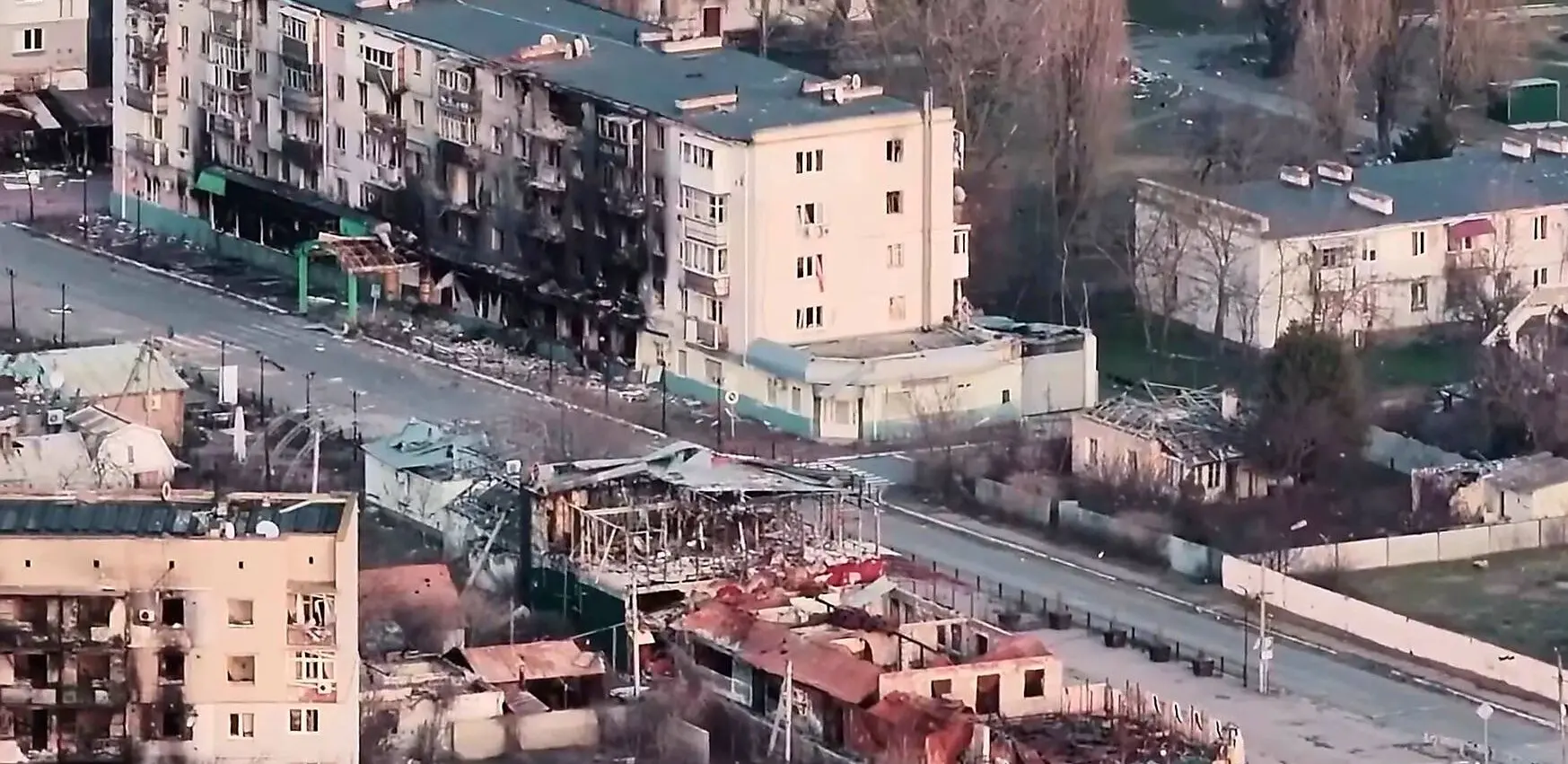
Occupied since the very first days of the full-scale invasion, Oleshky in the Kherson region has become a harrowing example of the full spectrum of Russian war crimes—ranging from ecocide and torture to the deliberate creation of famine. This is evidenced by more than 1,100 criminal proceedings initiated by law enforcement—in this community alone—regarding the commission of war crimes.
The story of a family from Oleshky:
"Either escape or starve to death"
Vitalii, together with his wife Iryna, their 13-year-old son Vlad, and their pet cat, took the most dangerous step of their lives – walking out of the occupied town of Oleshky in the Kherson region. The town, which has been under the control of Russian troops since the early days of the full-scale invasion, found itself in the line of fire and on the brink of a humanitarian disaster.
"One glass of buckwheat for the three of us. We supplemented this ration with a salad made from a single cucumber and a single tomato. And to stave off hunger a bit more and create a feeling of fullness, we added purslane," the man recalled of their survival under occupation in an interview with Reuters journalists.
When their food supplies finally ran out, the family realised they could delay no longer. Pointing to a photo of their destroyed home on his phone screen, Vitaliy adds: "This is our flat after a drone crashed into it. You look at the remains of the food and realise you have only one choice – either to flee or to starve to death."
On 13 September, the family, as part of a small group of eight people, set off on foot for the nearest village, Radensk. The locals call the route, which is over 20 kilometres long, the ‘road of death’. They took only the bare essentials with them: autumn clothes, their son’s favourite teddy bear, their cat and a few family photographs.
"The journey was gruelling – 23 kilometres, and around 5 kilometres of the route consisted of mined areas: ‘petal’ mines, unexploded ordnance, anti-personnel and anti-tank mines scattered all around," says Vitaliy.
From Radensk, the family travelled by bus deeper into the occupied territories, endured lengthy interrogations at the border with Russia, and then, via Belarus, finally returned to Ukrainian-controlled territory on 17 September.
The family is now settling into life in the village of Tarasivka in the Kyiv region. The first thing they did upon arrival was to fulfil their son’s long-held dream.
"My son loves potatoes, so we immediately bought some – something that wasn’t available at all in Oleshky – made mashed potatoes, and he was finally able to enjoy the taste," the man says with a smile.
Now that the family is safe, and their son Vlad has resumed his studies, 55-year-old Vitaliy reflects on his own contribution to victory: "As for me, I will either enlist in the Armed Forces of Ukraine or try to find a position within the military or at ‘Ukroboronprom’ to help our country defeat its enemies."

The Melania Trump Humanitarian Mission
Oleshky, on the left bank of the Kherson region, came under the control of Russian troops in the early days of the full-scale invasion in February 2022. Before the full-scale war, the town was home to around 24,000 people. By the autumn of 2022, following the liberation by the Ukrainian Defence Forces of the right-bank part of the region, including Kherson, Oleshky had effectively become a frontline settlement, situated directly opposite the regional centre across the Dnipro.
The town suffered its greatest catastrophe in June 2023 after the Russians blew up the dam at the Kakhovka Hydroelectric Power Station. Around 90 per cent of Oleshky’s territory was submerged, whilst the occupying forces left the civilian population without systematic assistance or evacuation.
In the years that followed, the situation in the town only worsened, escalating into a full-scale humanitarian crisis. Constant shelling, drone attacks and widespread landmining blocked supply routes. Delivering food and medicines has become virtually impossible, whilst leaving the town has become life-threatening. The town has been without electricity and gas supplies for a long time, and the civilian population is on the brink of survival under the blockade.
According to official figures, approximately 1,500 people remain in the town. Among them are around 40 children. There are also many elderly people. Discussions regarding the humanitarian catastrophe facing the residents of Oleshky have reached the international stage. An immediate evacuation of the people was demanded from the floor of the UN; the Vice-President of the European Parliament went on hunger strike; and Pope Leo XIV discussed the situation in Oleshky with Vladimir Putin.
However, the path to rescuing the trapped civilians began with another diplomatic breakthrough – on 23 October, the White House announced that, thanks to the efforts of US First Lady Melania Trump, an agreement had been reached on a local ceasefire between Ukraine and Russia. On the night of 27 October, the Verkhovna Rada’s Commissioner for Human Rights, Dmytro Lubinets, announced the official introduction of a ‘ceasefire’ in Oleshky and neighbouring territories, which would remain in force until 1 November. This information was confirmed by Russia. The humanitarian operation took place on 30 October. All residents of the town who wished to do so were able to leave.
Mark Beckman – a private adviser to Melania Trump and producer of a documentary about her – emerged as a key figure on the US side in planning the evacuation, notes Ostap Yarysh, media adviser to the Razom for Ukraine Foundation and a former journalist with ‘Voice of America’.
Beckman is the founder of the advertising agency DMA United and has experience exclusively in the fields of marketing, media, and working with fashion brands; he has no diplomatic or humanitarian background and does not hold any official positions within the US government. According to Yarysh, official representatives of the US government are not directly involved in the operation on the ground, and media coverage from the US has been entrusted to a film crew from the Newsmax television channel.
The creation of inhumane conditions
The humanitarian catastrophe in Oleshky and neighbouring settlements is not merely a consequence of hostilities, but a deliberate crime committed by the occupying forces, which is being investigated at the highest legal level. According to the Office of the Prosecutor General of Ukraine, prosecutors from the Kherson Regional Prosecutor’s Office are conducting a pre-trial investigation in criminal proceedings under Part 1 of Article 438 of the Criminal Code of Ukraine (violation of the laws and customs of war/war crimes) concerning the creation by representatives of the occupying authorities of inhumane living conditions for the civilian population.
The pre-trial investigation has established that, from 1 March 2022 to the present day, the territory of the town of Oleshky and the settlements of Stara Zbur’ivka, Nova Zbur’ivka and Hola Prystan in the Kherson district of the Kherson region have been under the de facto control of the occupying forces of the Russian Federation’s armed forces.
"During the occupation, representatives of the occupying authorities have effectively deprived the civilian population of these towns of adequate access to food, drinking water, medical care, and electricity and water supplies, thereby creating inhumane living conditions. At the same time, adequate and necessary measures for the evacuation of the civilian population have not been ensured, and access to essential resources has been restricted," the Office of the Prosecutor General of Ukraine reported.
The office reports that a pre-trial investigation into the criminal proceedings in question is currently ongoing, and steps are being taken to identify those involved in committing this war crime.
International lawyers specialising in the investigation of war crimes are also providing a legal assessment of the situation in the town. According to Elise Lorio-Prévot, head of the ‘Conflicts, Business and International Crimes’ division at the international human rights organisation Global Rights Compliance (GRC), Russia’s actions in Oleshky clearly constitute a war crime – the starvation of the civilian population.
"These actions undoubtedly constitute starvation, as defined by the Rome Statute. The blockade and siege of the town, which prevent civilians from either leaving or receiving food, constitute a direct violation of international humanitarian law. Starvation can take various forms: it is not merely a direct lack of food, but also the deliberate obstruction of humanitarian aid and the destruction of facilities essential for survival. In Oleshky, we can see that the water, electricity and heating supplies, as well as the sewerage system, have all been put out of action. This constitutes the war crime of starvation, in accordance with the Rome Statute," emphasises Prévot.
The expert stresses that, as an occupying power, Russia is violating not only prohibitions but also its direct obligations under the Geneva Conventions, which place a duty on the occupying power to provide the civilian population with food and medicines.
Global Rights Compliance notes that the blockade of Oleshky is not an isolated incident, but a deliberate tactic of warfare that Russia has been employing for years.
"Russia has been using starvation tactics as a method of warfare since the Syrian conflict – this was the case in Yarmouk and Homs. It was subsequently repeated in Mariupol, and now in Oleshky. This is a pattern they have been employing for years," notes Prévot.
After the destruction of the Kakhovka hydroelectric power station dam three years ago, the occupying authorities had sufficient time to restore basic infrastructure and prevent a humanitarian disaster. Instead, according to Prévot, they deliberately exacerbated the situation: they shot civilians trying to get food, mined the roads, and distributed the occasional "aid" in the form of tins of condensed milk only in exchange for a Russian passport, using artificial famine as a tool for forced Russification.
From ecocide to torture
The occupied town of Oleshky has become a chilling example of how Russia is committing virtually the entire spectrum of war crimes recognised under international law against the civilian population. According to official data from the Office of the Prosecutor General of Ukraine, within the territory of the Oleshky community alone, law enforcement agencies have registered 1,117 criminal proceedings concerning violations of the laws and customs of war (Article 438 of the Criminal Code of Ukraine).
The scale and variety of crimes committed by the Russian army in Oleshky are staggering:
- Ecocide and mass loss of life: The occupation forces’ bombing of the Kakhovka Hydroelectric Power Station on 6 June 2023 caused catastrophic flooding of the city, the destruction of infrastructure and an environmental disaster. According to the findings of the investigation so far, at least 35 civilians died during the flooding, whilst a further 24 are considered missing. Due to the lack of access to the occupied territories, these figures are not final.
- Murder and executions: Seven criminal proceedings have been opened into the murder of civilians. The case against an occupier from the ‘Redut’ private military company, who in January 2024, whilst under the influence of alcohol, shot a 67-year-old local resident with an automatic rifle, has already been referred to court.
- Torture and unlawful detention: Inside the premises of the former Police Station No. 2 in Oleshky, law enforcement officers are investigating the operation of an illegal torture chamber where brutal physical violence was inflicted on detained civilians. Among those to be tried for the brutal treatment of civilians is the commander of a reconnaissance platoon of the Russian Federation’s 247th Airborne Assault Regiment.
- Sexual violence: Prosecutors have filed an indictment against a serviceman of the Russian Federation’s 19th Motorised Rifle Division who, in early 2023 in Oleshky, raped a minor girl whilst threatening her with an automatic weapon.
- Deportation and forced displacement of children: Juvenile prosecutors are investigating cases of the deportation and removal of children from the Oleshky children’s home to the Russian Federation and Belarus, followed by the granting of Russian citizenship and their placement in the care of Russian families. In total, four criminal proceedings are ongoing concerning the forced resettlement of over 1,000 people from state-run institutions in the Kherson region.
- Forced passportisation: Investigators are documenting the actions of the occupying authorities in forcibly imposing Russian citizenship under threat of deprivation of basic rights and means of subsistence.
According to GRC experts, Oleshky is a chilling, vivid example of the full spectrum of war crimes and crimes against humanity being committed by the Russian Federation in the occupied territories of Ukraine.
"Unfortunately, in Oleshky today we are witnessing the full range of crimes: torture, unlawful detention, forced passportisation, deportation, mining, environmental destruction, looting of property and starvation. You could take the Rome Statute and tick off practically every item relating to war crimes and crimes against humanity," concludes Prevo.
Lawyers at Global Rights Compliance emphasise that the key task at present is to document evidence using OSINT tools and by gathering facts. This will make it possible to bring those responsible to justice in international courts in the future.
Veniamin Trubachev
This article was produced with the support of IWPR


