


Larysa Holnyk: suspension case and judicial system
The state of our judicial system, how judges are pressured, and why justice reform has remained a stumbling block for years.
Maryna Danyliuk-Yarmolaieva: Hello, everyone. This is Censor.NET.
When it comes to opening new clusters or our progress towards joining the European Union, EU officials ask, "Where’s your justice reform? What about the courts, the State Bureau of Investigation and the Security Service of Ukraine?" We keep going around in circles.
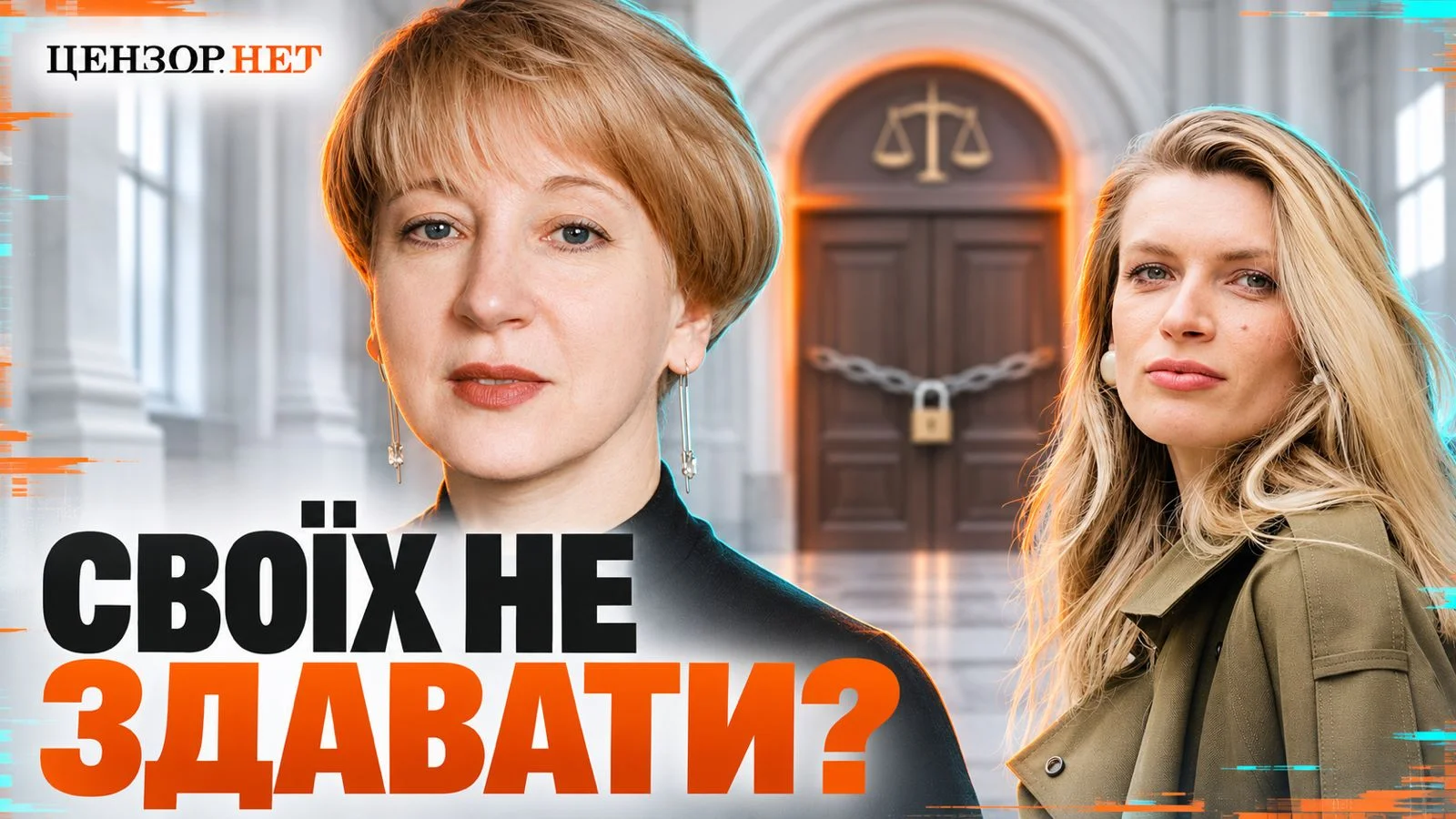
We’ll discuss these and other issues with Larysa Holnyk, a judge at the Shevchenkivskyi District Court in Poltava. She’s also a judge with a fairly high media profile, which is just how things have turned out over the years. Hello.
Larysa Holnyk: Hello.
WHY LARYSA HOLNYK WAS SUSPENDED
Maryna Danyliuk-Yarmolaieva: Ms Holnyk, let’s start with your story. Just a few days ago, we learned that you had been suspended from your judicial duties. How did that happen, and why?
Larysa Holnyk: A Poltava resident filed a disciplinary complaint asking for disciplinary action against me. The grounds for his complaint were that I had gone myself to the High Council of Justice, the judicial governance body that can take disciplinary action against judges.
I asked the council to take action against a judge at our court who had handled cases involving fathers raising children on their own in violation of the law. I came across those rulings by chance in the register, which judges have full access to.
This has to do with an issue that’s very important to us: mobilisation. It will soon be five years since the full-scale invasion began, and the war has been going on since 2014. We understand how important this is. Mobilisation is a painful issue for the country, and many people don’t even want to talk about it openly. At the same time, we see anti-mobilisation sentiment being stirred up to get citizens to evade their duty to the state.
When I saw such a serious violation, I went to the High Council of Justice. Under the unwritten rules of the judiciary, it’s considered bad form for one judge to file a complaint against another. But I couldn’t let it pass. This issue is constantly on the radar of the media, the judiciary and law enforcement agencies.
CASES INVOLVING CHILDREN RAISED BY ONE PARENT AND DISCHARGE FROM MILITARY SERVICE
Are we talking specifically about Poltava and the surrounding region? How much more common has this scheme for evading mobilisation become, where the court determines that the child will live with the father?
Many people have heard about schemes like this in courts in Chernivtsi and Odesa regions, including in Bilhorod-Dnistrovskyi. When I counted how many such rulings our court had handed down, there were enough men who had evaded their duty to make up a military platoon.
Some got deferments, and some may have gone abroad. The complainant in my case, a man named Sikalov who has a fairly high media profile in Poltava and even tried to gain national recognition, obtained grounds for demobilisation through one of these rulings. The judge’s ruling, issued in the name of Ukraine, provided the grounds for his discharge from military service. So this is effectively a matter of evading military duty.
Maryna Danyliuk-Yarmolaieva: Who is Sikalov? Could you explain for our viewers?
Larysa Holnyk: He presents himself in Poltava as a businessman and philanthropist. He has a website, which is what he bases his claim to be a journalist on. The State Service of Special Communications and Information Protection has kept the site blocked for several years for spreading disinformation.
The site carries information that harms the country’s defence capabilities, publishes articles and blogs that undermine the authority of state institutions, and even spreads pro-Kremlin narratives. That’s why it was blocked. You can only access it with a VPN.
What’s most interesting is that a study found that material from the site is used in Russia by the media group of the well-known propagandist Kiselyov. The message is essentially, "See, we have our own people in Ukraine who say things aren’t going well here and that there are serious problems with mobilisation." These are the narratives they need to use against our state and its information security.
And it’s strange to see opposition growing stronger against patriotic citizens who advocate positive changes, the country’s development along European lines and judicial reform. This man constantly undermines the authority of the judiciary, including by writing against current and former members of the High Council of Justice and individual judges. Yet the High Council of Justice, which should defend that authority, is taking no action.
CLOSED HEARING AND DISCIPLINARY COMPLAINT
Maryna Danyliuk-Yarmolaieva: You said the ruling provided grounds for demobilisation. Does he have one child or two? What exactly were the grounds?
Larysa Holnyk: He was supposedly raising a minor child on his own, and the mother was either planning to go abroad or had already left. That was the basis for his discharge.
When I filed the disciplinary complaint, I effectively exposed a serious scheme. It went beyond the single-father scenario, which was already known and had been used by judges. All information about the case was kept confidential in this man’s interest. That may have happened at the judge’s request or in some other way.
The Code of Civil Procedure provides for information about the parties and the subject matter of a civil dispute to be published on the judiciary’s website. The case is then assigned automatically to a judge, who decides whether to admit the claim and proceed with the case. Here, however, the court itself withheld information about the parties and even the subject matter of the dispute, although that information was not subject to confidentiality restrictions.
The judge later accepted the case for proceedings. It was only in about the third procedural document that she decided to hear it in closed session. The grounds for that decision are unknown. It may have had to do with confidential matters or intimate aspects of the parties’ lives.
Although the hearing was closed, judges can see the ruling. We need to study and analyse case law to understand how it is developing and how to assess evidence. That is an essential part of a judge’s work.
I’ve seen Supreme Court rulings, for example, in cases heard in closed session, and I had access to them. All rulings must be pronounced publicly, whether the hearing was open or closed. In the register, information about the parties is anonymised. They’re listed as "Person One," "Person Two," and certain details are removed so that people cannot be identified immediately. Here, even that was not done.
The state enterprise that operates the register and posts rulings said it could not identify which specific information had to be kept confidential.
When the judge was eventually disciplined, one of the findings was that she had heard the case in closed session without grounds. A number of serious violations were found, involving both human rights and procedural rules. I won’t go into the details. Lawyers will understand them, but they may matter less to the general public. The main point is that the judge received a severe reprimand for serious violations.
The High Council of Justice, meanwhile, took issue with my disclosing information from the ruling to the disciplinary body, the very body that was supposed to act on the violations.
WHY THE PENALTIES DIFFER
Maryna Danyliuk-Yarmolaieva: Why is there such a disparity between the penalties? The judge who issued the ruling received a severe reprimand, while you face dismissal?
Larysa Holnyk: To me, the reason is obvious. I speak publicly, I act transparently, and I want to back up what I say with action.
Members of the judiciary often say they oppose corruption. But who would support it? Everyone is against corruption in words. Think of former Supreme Court Chief Justice Vsevolod Kniaziev, who spoke of zero tolerance for corruption. Oleksii Salnikov, the head of the State Judicial Administration, said the same thing at the time. Everyone believed them, but it turns out it was a front. These individuals were punished for corruption.
The problem in the judiciary is that people try to protect one another and make the very act of standing in the way of wrongdoing unacceptable.
Imagine that Kniaziev had approached a Supreme Court judge and put a sum of money in front of them or offered it to them. If that judge had gone to the relevant authorities, it would have broken this chain of shameful events. I consider those events a dramatic episode for the judiciary. They showed that the highest judicial body was engaging in corrupt conduct. I don’t think that stain will be erased anytime soon.
To return to your question about the disparity, I think the aim is to make an example of a judge who actually meets the criteria that the High Council of Justice itself talks about and has adopted.
What are those integrity criteria? They include rejecting corruption and preventing corruption offences. The High Council of Justice’s strategy and the uniform integrity criteria say that judges should report wrongdoing by colleagues in a reasonable manner and foster a culture of intervening to prevent such conduct.
I demonstrated that in practice, and they’re making an example of me by imposing the harshest possible penalty. I’m convinced that nothing I did amounted to disciplinary misconduct. I’ll defend that position when I appeal the decision.
At the same time, the High Council of Justice is creating a chilling effect by showing all judges what happens when they speak up. Even if you see a colleague do something wrong, under no circumstances should you tell anyone in any way.
I asked a friend who’s a doctor, "If you saw a colleague do something unlawful or apply a treatment protocol incorrectly, that would be dangerous. What are you supposed to do?" She replied, "At the very least, I’d go to my supervisor, my employer, and tell them that this is unacceptable."
I asked someone I know in law enforcement what he would do if he saw a colleague break the rules. He said, "We have a unit we’re entitled to go to."
Judges have only one disciplinary body, the High Council of Justice. It upholds the authority of the judiciary and the independence of judges and can take measures to punish and prevent wrongdoing.
STAYING SILENT OR SPEAKING UP: A CHOICE WITHIN THE SYSTEM
Maryna Danyliuk-Yarmolaieva: How will your case affect efforts to expose people involved in corruption, as well as separatists, collaborators, and people who use their official powers to do truly outrageous things?
I think many of our viewers are familiar with the District Administrative Court recordings, in which judges talked about how they would issue unlawful rulings and pray for forgiveness for their sins at the Moscow Patriarchate. There were also cases of judges with pro-Russian views saying at work that they were waiting for Russia to come.
What would you advise colleagues or court staff who hear this kind of thing but will now look at what happened to you and be afraid? They have a stable job and a good salary, and it takes a lot to become a judge. Some people will think, "Why report it? Better to leave things as they are."
Larysa Holnyk: It’s hard to know what advice to give. I’ve long said that independence has two major dimensions, external and internal. External pressure comes from outside the judiciary, for example, when individual citizens put pressure on you through posts or by other means. The internal dimension is when pressure comes from within the system, and you have principles you try to uphold, but you face a dilemma over whether to report what happened or stay silent.
Everyone will have to make that choice for themselves. That brings me back to the chilling effect. Everyone will look at my case and get the message. Close ranks and protect one another. If you see a violation, keep it to yourself. People who report wrongdoing become a problem for the judiciary. They aren’t welcome.
Even if people like that somehow make it into the judiciary, they aren’t accepted and aren’t allowed to advance, for example, by winning a selection competition. That’s how they can be denied that opportunity.
Now that question will be decided in my case too. I’m at the final stage of the interview process, and there’s already a recommendation to dismiss me as a judge. For a long time, the rapporteurs, my colleagues, kept taking my case off the agenda. I got the impression they were waiting for a decision in my case so they could then keep me out of the running. In effect, they would deny me the chance to advance in my career.
It comes down to each person’s values and the self-respect that comes from being honest and doing what’s right. The double standards this decision sets are dangerous and shameful for the judiciary. On paper, there are all the right documents affirming the European choice. In practice, terrible things are happening. Each person will make their own choice based on their convictions.
SUSPENSION, WORK AND SUPPORT
Maryna Danyliuk-Yarmolaieva: You’ve been suspended, so you’re no longer hearing the cases that were already scheduled?
Larysa Holnyk: I was still hearing them until today.
Maryna Danyliuk-Yarmolaieva: But you’re still allowed to go into work?
Larysa Holnyk: I can, and I’m required to. I can work remotely. I’ll now prepare my appeal and make the case that the decision was unlawful.
I’m still a judge. And I think I still set an example for some people, perhaps even outside the judiciary.
I find it telling that people sometimes come up to me. It used to happen more often. The war has taken a heavy toll on society, and many people are at the front now. But there are still people who do that.
A man from Poltava came up to me in a shop and said, "I couldn’t walk by without saying something. Hang in there. The stand you took inspired me to go into public service." He applied through a competitive selection process, got the job, and is making changes as he helps build up an institution. That sets an example for others.
Perhaps someone inspired me, too. We’re always drawing inspiration from one another, from our heroes, from Ukrainians and their resilience. It gives us the strength to keep going and the confidence that we’ll win, that we’re doing the right thing and that justice is on our side. It helps us stand our ground.
We have to support one another in difficult situations. Solidarity helps in hard times.
THE APPOINTMENT OF JUDGES WITH CONTROVERSIAL REPUTATIONS
Maryna Danyliuk-Yarmolaieva: Ms Holnyk, I have to ask you about some cases that are hardly inspiring. As recently as October, there were several troubling episodes in which the president used his power to appoint people with controversial reputations to permanent judicial posts by decree.
Two cases immediately come to mind. The first is the appointment of Olena Izovitova-Vakim as a judge of the Kharkiv District Administrative Court. She is the daughter of Lidiia Izovitova, who heads the association that Andrii Yermak went to work for. Olena was a "Maidan judge." She banned peaceful assemblies in Kharkiv in 2014.
The second is Viktor Kytsiuk’s appointment as a judge of the Pechersk Court, also on a permanent basis. He is one of the most notorious "Maidan judges" and tried to revoke the driving licences of people who drove to Yanukovych’s residence at Mezhyhiria. Why are these people returning to positions of power, and what do those in power need them for?
Larysa Holnyk: In short, these judges share the values of most people in the judiciary. And it seems they have no use for people like me, with my values, my idealism, and what may be an excessive insistence on doing the right thing and being honest.
That’s very sad. Society needs more principled, independent people with those values across government, including in the judiciary. Their decisions will determine how well we hold up as a state and how far we get in building our institutions.
Decisions like these send a negative signal to society. As a citizen, I feel the same pain for our country. It’s hard to find a rational explanation. Most likely, these people think much like those who head the relevant institutions and have the power to appoint judges.
Maryna Danyliuk-Yarmolaieva: Why not appoint someone unknown to these posts? Someone who worked as Kytsiuk’s secretary, for example. We’ve had cases where people who worked for these notorious judges went on to become judges themselves.
Larysa Holnyk: Again, it’s a show of power. You won’t get the outcome you want.
It often happens. There’s a case, and someone has been charged, probably with good reason. It goes to court and drags on for years. At first, people attend the hearings. Then fewer people show up and interest fades. How long can you keep waiting?
Towards the end, when things have gone quiet and there’s no transparency, the court can issue a ruling that later causes outrage. It sends a message. Whatever outcome you want, you won’t be able to influence the decision. We’ll rule as we see fit.
THE PECHERSK COURT, THE STATE BUREAU OF INVESTIGATION AND DISCIPLINARY DECISIONS
Maryna Danyliuk-Yarmolaieva: Speaking of Kytsiuk, I have to quote the Anti-Corruption Action Centre, which described the scheme that brought him back to the bench. He could well have been dismissed, and the High Qualification Commission of Judges was reviewing his case. But as the centre wrote, as soon as the commission got to the Pechersk Court judges, it was subjected to searches by the State Bureau of Investigation.
How much influence can the State Bureau of Investigation exert over the courts, particularly the Pechersk Court? Why are the authorities so determined to shield it from reform, from change and from the arrival of new judges?
Larysa Holnyk: I was interested to see what decisions Makhinchuk, a member of the High Council of Justice, is now making and proposing. He’s the council member who proposed dismissing me and who, incidentally, changed his position.
Initially, he opposed opening disciplinary proceedings and believed they should be closed because the complaint contained insulting language. In the complaint, Sikalov called my husband a psychopath. The disciplinary inspector said that was a value judgement and was permissible in a disciplinary complaint.
Yet in another disciplinary complaint, where judges were called "criminals" or "a drug lord’s lackey," he considered that language insulting.
When it came to judges of the Pechersk District Court or the District Administrative Court, this council member was firmly opposed to dismissal or any severe penalty. Once again, we see how differently these judges are treated.
The court’s enormous caseload can always be used as cover. Procedural deadlines are certainly missed there, and that may be what the judges are disciplined for. But amid the chaos of such a heavy caseload, judges can issue some rather strange rulings that people then turn a blind eye to, including at the State Bureau of Investigation. The bureau probably does have some influence over these judges. It may even influence how they rule.
WHAT COULD SPUR REFORM
Maryna Danyliuk-Yarmolaieva: In numerous reports, our European partners say we need to reform the State Bureau of Investigation and the Office of the Prosecutor General. It’s reached the point where they spell out how much the European Union could provide for each reform.
That’s a significant amount of money for Ukraine’s budget, which has been running a persistent deficit because of the war. Yet it seems to give neither the Verkhovna Rada nor the government nor the president enough incentive to move these reforms forward. In your view, what might spur us to carry them out?
Larysa Holnyk: If even money isn’t an incentive, it’s hard to say what else might be. Perhaps decisions will start getting made when lawmakers themselves can no longer receive money. I say that in jest.
I’ve always thought that serious arguments and the need for the country to survive should be enough to persuade people. We depend heavily on funding and support from our European partners. Without that, I don’t think we can hold out. You’d think they would listen to objective, persuasive arguments and make decisions based on common sense.
Unfortunately, there seems to be little common sense there. There’s a real fear that if law enforcement works properly and its institutions act independently, the people who currently control decision-making will be the first ones they come for. That’s probably what they’re afraid of and why they’re holding off on making decisions.
Some serious leverage is needed. It seems they’re waiting for some guarantee of immunity.
JUDGE SHORTAGES AND DELAYS IN HEARING CASES
Maryna Danyliuk-Yarmolaieva: How do you assess the current state of the judicial system? People have been talking about a shortage of judges for a long time. Even at first instance, the caseload is heavy enough that a simple case can take a year and a half.
Larysa Holnyk: That’s true, including at our court. Judges who are eligible for retirement tend to retire when they come under serious pressure. Qualified staff are undervalued, and there are even attempts to push them out.
At the same time, priority goes to those who close ranks and protect one another and who have powerful backing. In some cases, you can see that from the Mudra tapes and other information that is gradually becoming public.
Some appointments are puzzling when you look at them. Then information like this comes out, and it all falls into place. You see why the appointment was made the way it was. Unfortunately, to some extent, the selection process still favours the wrong people, even though it is supposedly competitive.
Maryna Danyliuk-Yarmolaieva: You mentioned Iryna Mudra. She was deputy head of the Office of the President until the notorious "second set of tapes" from NABU and SAPO, and she was supposed to oversee justice reform. Have you seen any reforms under her leadership since 2024?
Larysa Holnyk: I haven’t seen their effects in the courts themselves.
Maryna Danyliuk-Yarmolaieva: Did you perhaps talk with colleagues about major reforms that might be coming?
Larysa Holnyk: I know of one "major reform" now. Judges are saying the High Council of Justice will be unable to function. There are reports that it could effectively suspend operations, as it has before. That would be the opposite of reform.
There’s a risk that the High Qualification Commission of Judges, which handles judicial appointments, could stop working again. That would leave competitive selection procedures unfinished.
Why do simple cases take so long to hear? For some reason, the selection procedures for commercial and administrative courts were completed first. Yet the local courts of general jurisdiction, at the lowest level of the court system, hear the most cases.
Those courts have the heaviest caseloads. They handle criminal cases, motions from investigators that require judicial oversight, and a great many civil cases. The process of bringing in new judges was interrupted and has only just restarted.
It will take time to fill the vacancies. Even filling all of them will fall short of what’s needed, given the current caseload in the courts of general jurisdiction.
HOW THE SYSTEM ADAPTED TO REFORM
Maryna Danyliuk-Yarmolaieva: Judicial reform has always been difficult for us. I remember that in 2019, between the two rounds of the election, the High Anti-Corruption Court was finally established, once the need arose. Do you remember a period when you could say judicial reform really was moving forward?
Larysa Holnyk: There were individual measures that brought improvements. Progress on the reform as a whole was another matter.
In my view, the problem is that the judiciary adapted very well to the reform period. It effectively took control of the reforms and began using the changes to serve its own interests.
Take the Ethics Council, for example. It looked like a positive step. It was meant to keep candidates who lacked integrity off the High Council of Justice, so that people with principles who had worked honestly throughout their lives could join it. But we saw that there were problems there too.
There are questions about the Ukrainian members of the Ethics Council. Remember how it was formed. The Council of Judges put forward a list of judges. For some reason, Triasun, Kyshakevych and Severyn were at the top of the list, which wasn’t in alphabetical order. Those were the very people who joined the Ethics Council. Specific people had been picked out.
I went through an interview myself and watched other interviews as well. I saw candidates being treated quite differently. The international members took a democratic approach. They tried to give candidates room to state their views, show who they were and give a full answer.
The other members of the Ethics Council, by contrast, could take an inquisitorial approach in some cases and demand a definite yes or no. If you didn’t give one, they might ask, "Are you refusing to answer?" Refusing can mean your participation in the interview is automatically terminated.
In my view, those differences in how candidates were treated suggest there may have been lists of people they wanted in a given institution and people they wanted to keep out.
Lev Kyshakevych is a member and chair of the Ethics Council and a judge of the Grand Chamber of the Supreme Court. Vsevolod Kniaziev was still chief justice of the Supreme Court when Kyshakevych joined the Grand Chamber.
At the time, the perception was that Kniaziev, Kyshakevych and Oleksii Salnikov presented a united front at events they attended together, casting themselves within the judiciary as people on whom a great deal, almost everything, depended.
The State Judicial Administration handles funding. The chief justice heads the Supreme Court. The Ethics Council decides who gets through to the High Council of Justice. Those were the channels through which these people could exert influence.
They could take control of the various safeguards introduced by the reform and make compromises that left some of those safeguards unable to work as needed for the reform to be fully implemented.
INTERNATIONAL EXPERTS AND THE UKRAINIAN CONTEXT
Maryna Danyliuk-Yarmolaieva: You can read plenty of comments, including from members of the parliamentary law enforcement committee such as Maks Buzhanskyi, Ionushas and others, saying that we don’t need international observers on supervisory boards and selection panels. The line is that they’re Soros’s people and we can sort everything out ourselves.
Could you explain why international representatives matter? When we eventually get to reforming the State Bureau of Investigation and the Office of the Prosecutor General, why is it important to have them involved?
Larysa Holnyk: International representatives matter because they’re genuinely independent. That’s a good thing.
I came across a comment by a member of one selection panel whose name I won’t mention now. Their involvement is a good thing, but even international experts can be like blind kittens sometimes if they don’t know enough about Ukrainian realities or understand the context.
They understand that the judiciary or another body is undergoing reform. But I think international members of selection panels proceed on a degree of trust. If Ukraine has put forward candidates for the Ethics Council or other bodies, they assume Ukraine trusts those candidates. So the international members trust their Ukrainian counterparts too. Sometimes that trust can leave them in a bind.
For example, when the Ethics Council first started work, everyone voted the same way and the votes were unanimous. But once the international members got burned and saw that things weren’t so clear-cut, they began to look more critically at what the Ukrainian side was telling them. They started paying more attention to the Ukrainian context, although they still don’t always fully understand it.
That’s why we need people who can point out the system’s problems from the inside. If there’s no one left to do that, we won’t see why some mechanisms fail to work during the reform process.
SHABUNIN, CIVIL SOCIETY AND SUPPORT FOR WHISTLEBLOWERS
Maryna Danyliuk-Yarmolaieva: I have to ask about your relationship with Vitalii Shabunin. There are bound to be comments like, "Ah, that explains it. Judge Holnyk, she’s with Shabunin, those anti-corruption activists." How did you first get to know him, and why are you sympathetic to anti-corruption activists?
Larysa Holnyk: When I first had to expose a corruption offence involving the mayor of Poltava and his representatives, I found myself in a position where I had to go public.
People from civil society supported me. Inside the system, only a few individuals offered support, and even they did so quietly, so as not to draw too much attention, just in case. Only a handful of people in the judicial community supported me publicly.
When I received an award in London for my courage in fighting judicial corruption, I spoke with people from British society. They asked, "Who has an interest in exposing wrongdoing? The state?" No, not really. The state has no use for these disclosures. It sees whistleblowers as enemies because they expose problems within an institution.
Society at large and civil society in particular have the greatest interest in exposing wrongdoing. That was when I realised why people from civil society had supported me.
They saw the problems in the judiciary and tried to understand why the courts had become an instrument of repression during Maidan. We don’t want the courts to carry on with that repression today and for us to become a kind of little Russia. We want to become a European state with a human face, where people can go to court and defend their rights. We want to get away from a system where someone pulls strings and the person seeking protection gets none.
Vitalii Shabunin and I met some time ago, but we only knew each other briefly. It’s mainly about support based on shared values, the kind that should unite us as Ukrainians so we can develop our country.
Those values are probably what I have in common with Vitalii Shabunin and other people in civil society who care about the country’s future. We can make mistakes, and so can they. But we’re looking for a way forward, trying to do what’s right and be on the right side of history.
HOW TO RESTORE TRUST IN THE JUSTICE SYSTEM
Maryna Danyliuk-Yarmolaieva: What will it take for people to stop associating the justice system with the likes of Tatarov, Izovitova, Medvedchuk and Bohdan? Medvedchuk is over in Russia with his child’s godfather for now, but these are the names that come to mind when you think about justice and the courts. When will people start associating the system with decent people?
Larysa Holnyk: When there are more people in the judiciary who think independently and are prepared to take a stand. When we live up to the standards set out so nicely on paper and show through our actions that we reject corruption and other wrongdoing.
When that becomes how we actually behave, because there’s no other way to act. It has to go beyond saying the right things for a selection process or to get through a particular cluster. I realise that’s an ideal, perhaps even a fantasy, like something out of a fairy tale.
Maryna Danyliuk-Yarmolaieva: But there are examples. Take Germany. Steinmeier spent many years as a diplomat, served as foreign minister and is now president. Why is he respected? His wife is a judge. Or take Friedrich Merz, a friend of Ukraine. He’s a respected lawyer, and his wife is a judge who is respected in her state. We see examples of lawyers and judges who are respected.
Larysa Holnyk: I think we have many judges who deserve respect too. They meet high standards of justice; they uphold these ideas and put them into practice, and we have no reason to be ashamed of them.
Yet for some reason, they aren’t always the ones who set the tone. Then unexplained wealth among judges comes to light and overshadows whatever positive impression people might otherwise have of the judiciary.
I was punished for allegedly bringing the office of judge into disrepute and undermining the authority of the judiciary. In my view, it was the High Council of Justice’s own decision that undermined that authority yet again.
Perhaps they’ll backtrack later. We’ll see how my case turns out. But their actions have already caused a stir in the media and undermined trust. How much hard work will it take to repair the damage from actions we never wanted to see?
Think of Kniaziev, Salnikov, the judges of the Bilhorod-Dnistrovskyi Court who churned out rulings on single fathers to help people evade mobilisation, and other judges who engaged in shameful conduct. All of that wipes out whatever good may have been achieved over the years.
APPEALING THE DECISION AND PLANS FOR WHAT COMES NEXT
Maryna Danyliuk-Yarmolaieva: Let’s return to your case, where we started. You’ll have a temporary break from work while you appeal the decision. We wish you success. What will you do during this period, now that you’ve effectively been taken off the job?
Larysa Holnyk: Preparing complaints and pursuing the appeal will be a serious challenge in itself. I’ll need to study the legislation and European case law in depth, especially on human rights. It’s a vast subject that you don’t always have time for in your day-to-day work, even though it matters for professional development.
Wherever I end up, that knowledge will come in handy. Working in law means constantly working to improve yourself every day. I think anyone whose work is intellectual understands that. It applies to judges and to anyone who wants to get better at what they do, grow as a professional, and become a more knowledgeable person.
I’ll have plenty to do. I’ll probably give more attention to my health and my family. There’s never enough time for those things because work comes first. I doubt many judges get to work earlier than I do and leave later.
Maryna Danyliuk-Yarmolaieva: Just like me.
Larysa Holnyk: Now I’ll be on time.
Maryna Danyliuk-Yarmolaieva: We hope you get some rest and return to the work you love. It is work you love, isn’t it?
Larysa Holnyk: Yes.
Maryna Danyliuk-Yarmolaieva: We want professionals in the roles they’re qualified for. Thank you.
Larysa Holnyk: Thank you, too.


