


Vaccination in military and beyond: tetanus, flu, COVID-19 and rabies
"All service members shall receive preventive vaccinations against major infectious diseases," states Article 243 of the Statute of Internal Service of the Armed Forces of Ukraine. This provision, like many other procedures governing vaccination in the military, was adopted in peacetime and for peacetime. In practice, it is not implemented, while modern standards are still being developed or awaiting adoption—in the fifth year of the full-scale war.
Now, at the start of the flu and viral infection season, vaccination of military personnel is once again a major topic of debate. The health of personnel directly affects combat readiness, and epidemics can cripple even the best-prepared military—history offers dozens, if not hundreds, of such examples. Their living conditions place military personnel at increased risk of viral and other infectious diseases.
Ukrainian Armed Forces soldier and historian Myroslav Borysenko, recommending an article about how the armies of the Ukrainian People’s Republic and the Ukrainian Galician Army lost the war because of a typhus epidemic in 1919, and how the Ukrainian Insurgent Army prevented a similar catastrophe a quarter of a century later, offers his own ironic take on the current state of vaccination in Ukraine’s defence forces.
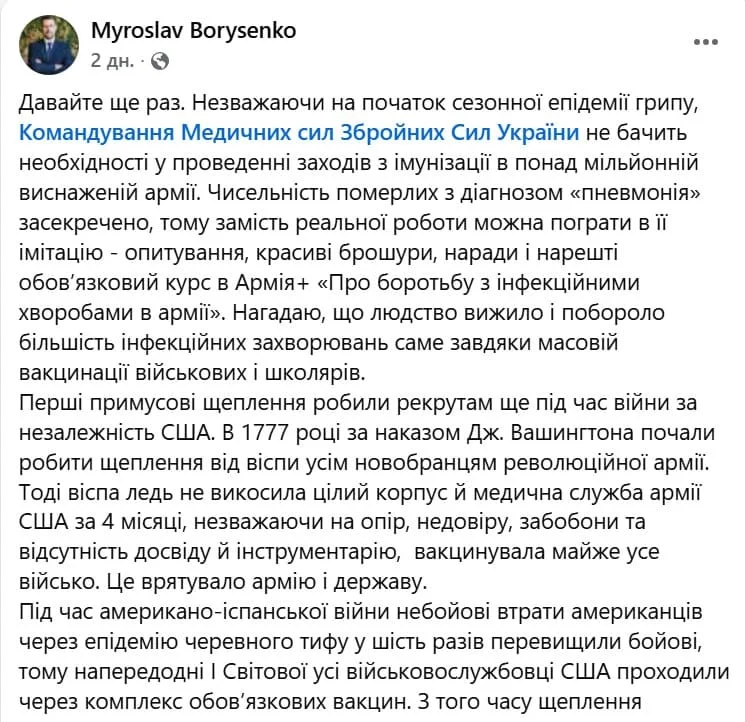
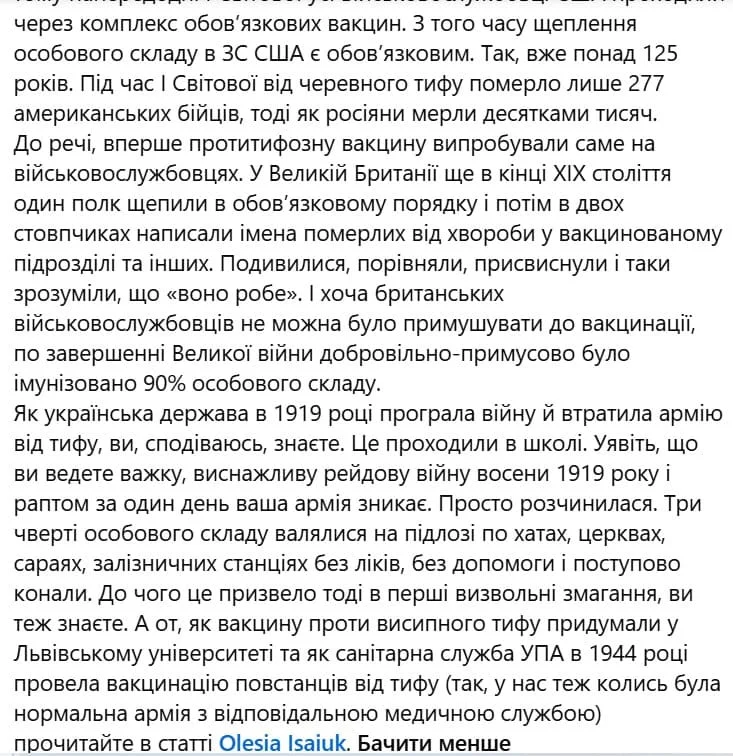
Statistics on infectious diseases in the Armed Forces of Ukraine, the National Guard, the Security Service of Ukraine, the State Border Guard Service and other defence institutions are indeed classified, as they could reveal vulnerabilities within units and are therefore of immense interest to our enemy. The aggressor’s corresponding statistics are not made public either (although those familiar with the situation offer some reassurance that vaccination there is in a worse state than here).
The survey Borysenko mentions is indeed revealing. On 2 October, the Office of the Military Ombudsman published the results of an anonymous survey conducted in the Army+ app from 30 September to 13 October 2026. Almost 60,000 military personnel took part.
Of this sample of 60,000, more than 66% of service members had not been vaccinated during their service. Of these, 56.5% explained that they had not been offered vaccination. Only 20.3% of respondents said they knew enough about vaccination. Other respondents wanted to learn more about possible adverse reactions to vaccines (42.9%) and their effectiveness (37.5%). Healthcare professionals were the most trusted source of vaccination information among military personnel (43.3%).
Our military mirrors a society that inherited anti-vaccination fears from the Soviet Union and developed new prejudices on that basis, despite the availability of new protocols and new-generation vaccines. According to the Public Health Centre, adult booster vaccination coverage against diphtheria and tetanus in Ukraine remains low, at 32–45.6%. Hepatitis B vaccination, which became mandatory for children in the early 2000s, did not reach the vast majority of currently serving personnel because of their age. That is before even considering optional vaccinations against diseases for which military personnel are also at increased risk: influenza, hepatitis A, COVID-19 and rabies.
Ukraine serves as a model for its Western allies in resisting the Russian Federation, including in organising medical support for the military in the field. When it comes to vaccination, this can sometimes seem comical. Immunology experts describe the genuine bewilderment on European specialists’ faces when they hear about the problem of tetanus vaccination in the Armed Forces of Ukraine. After all, routine tetanus boosters are scheduled every 10 years, while an emergency booster is indicated following an injury if five years have passed since the last vaccination. The full-scale war against Russia has been going on for less than five years, yet low tetanus vaccination coverage among adults has created a problem where there should have been none.
However, both personal prejudices and obligations under military regulations can be addressed through competent management and communication. At present, vaccination appears to be handled on an ad hoc basis. Why is this still the case in the fifth year of the war, and are measures being taken to change the overall situation?
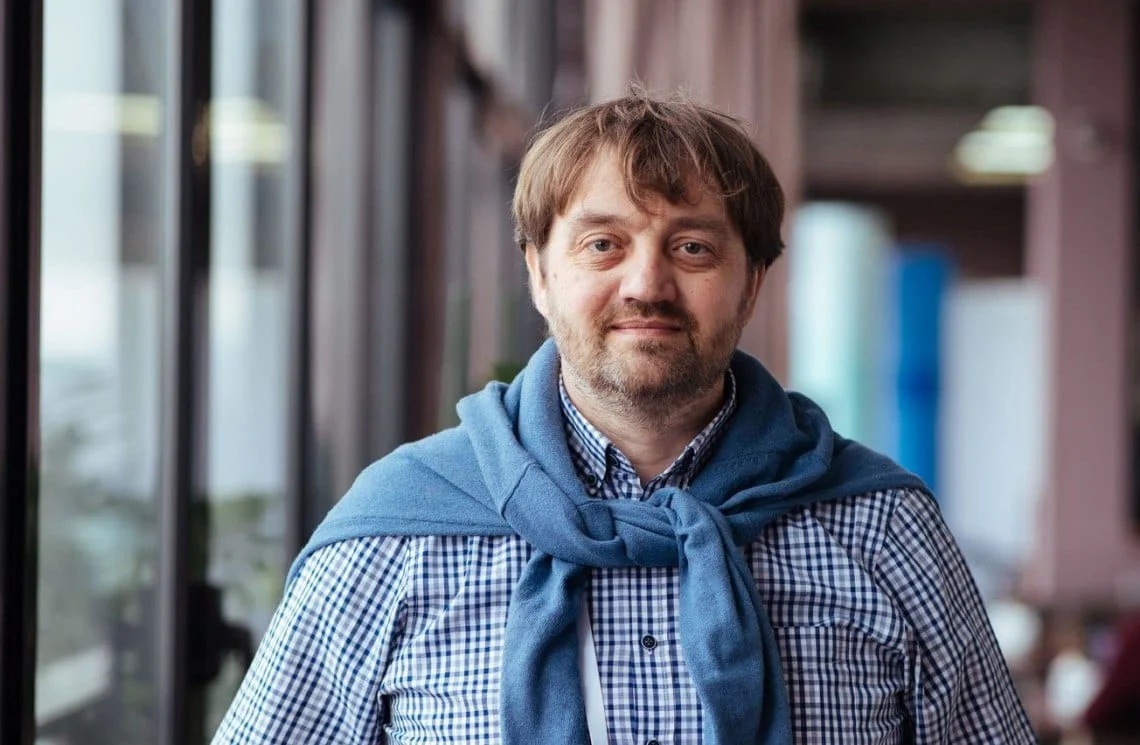
Our guide to vaccination in the defence forces is Fedir Lapii, chair of the National Technical Advisory Group on Immunization, a member of the European Technical Advisory Group of Experts, and founder of the now-legendary Facebook group "Vaccination: Questions and Answers".
MILITARY VACCINATION IS STILL A UNIT-LEVEL RESPONSIBILITY, RATHER THAN AN ARMY-WIDE ONE: REGULATIONS AND PROCEDURES ARE BEING DEVELOPED
Much currently depends on the competence of whoever heads a particular military unit’s medical service. Many procedures were written for peacetime, but we are now several years into the war. Even if we leave aside the period since 2014 and count only from 24 February 2022, the situation is now entirely different. A great many people have been mobilised. They have come under the authority of Ukraine’s Ministry of Defence, the Security Service of Ukraine or the Ministry of Internal Affairs, each of which has its own medical departments that should have been briefing medical personnel in different units on procedures for vaccinating service members.
Lapii advises medical personnel in military units to contact the Department of Health, the Centre for Disease Control and Prevention, or simply the Primary Healthcare Centre at their permanent base or in an area close to where the unit operates in the combat zone. This is how it works: healthcare workers travel to the unit for a day and vaccinate those who wish to receive a vaccine, including at training grounds or in training units. They do this either during their working day, with their local community’s understanding, or on their day off. They pay out of their own pockets for fuel, vehicle wear and tear, or other consumables.
Medical personnel in military units also quite often turn to volunteer healthcare workers who take an active civic role. These medical volunteers currently receive no reimbursement for their expenses.
"Of course, there are forward-thinking brigades with forward-thinking medical units, such as Ulf (the medical service of the 108th Da Vinci Wolves Battalion). They are very supportive of vaccination: they buy vaccines and administer them themselves," the expert says.
"Overall, the various defence institutions, the Ministry of Defence, the Security Service of Ukraine and the Ministry of Internal Affairs, have dedicated departments that should be dealing with vaccination. There is also, after all, the Military Medical Academy. The situation at the Ministry of Defence is now encouraging. I think we will soon have a sufficiently robust document on vaccination for military personnel.
"Of course, many healthcare workers have been mobilised or voluntarily joined the resistance movement, but some of them hold prejudices about vaccination. In paediatrics and family medicine, this situation has improved considerably in recent years. The difference is very noticeable to me.
"Now, when my friends who were paediatricians or family doctors in civilian life join the military, they organise vaccination much better than those who treated adults before the war, because the latter had less exposure to vaccination. Much remains unfamiliar to them, or they continue to hold certain prejudices about vaccination.
"When it comes to infectious diseases and vaccination against them, we are now seeing some positive trends towards addressing these issues. At various levels of command in the Armed Forces of Ukraine, including in medical units, there are leaders who are very knowledgeable about vaccination. This applies not only to diphtheria and tetanus, for which routine vaccination is provided, but also to hepatitis B, influenza and COVID-19."
Fedir Lapii currently remains chair of the National Technical Advisory Group on Immunization. The Ministry of Health is expected to issue a new order shortly appointing the group’s new membership for its customary three-year term. The newly selected NITAG members will elect their chair. Applicants for the new NITAG membership include people with ties to the Armed Forces of Ukraine. The current chair hopes they have been selected and will help bring about institutional change.
"This issue needs to be discussed both in terms of the scientific approach and the drafting of documents. Previously, within the Ministry of Health’s task force on vaccine-preventable diseases, which also includes representatives of the security and defence agencies, we discussed the need to coordinate our efforts to address the problem. We understand that we can draft very clear orders. But if my colleagues in the military, or those working in civilian healthcare whom military personnel approach, lack the necessary knowledge, they will give ill-informed recommendations on emergency or routine prevention of infectious diseases," he says.
So, if a unit’s medical service has the resources and willingness to organise vaccination, primarily against influenza or tetanus, it does so. However, addressing this when a prospective service member first enters the military system would save resources and time.
"I underwent a military medical assessment a year and a half ago at a Primary Healthcare Centre in Kyiv," Lapii recalls. "I kept quiet, wondering: who would ask whether I was vaccinated, at least against tetanus? After all, I am liable for military service, although I have a mobilisation deferment as a university lecturer. I volunteer with a mobile fire group and go out on a 24-hour shift roughly once a week to counter Shaheds. But I could potentially be mobilised if, for example, the mobilisation rules changed. So why not ask during the military medical assessment: ‘When did you last have a diphtheria and tetanus booster? Go down one floor and get a booster if it has been 10 years.’
"When a colleague of mine undergoing a military medical assessment said he was an immunologist, the surgeon examining him subjected him to a lecture about the ‘harm caused by vaccination’ and other myths that persist among many Ukrainians, including healthcare workers.
"So we are speaking openly about the problem and are now working on the regulatory framework governing which vaccinations must be recommended to military personnel."
In response to Censor.NET’s inquiry, the Central Military Medical Commission of the Armed Forces of Ukraine cites the outdated Regulations on Military Medical Assessment in the Armed Forces of Ukraine, which provide for preventive vaccination of conscripts, but not of persons liable for military service. The Ministry of Health cites the same regulations in its response.
TETANUS: FROM A SCRATCH TO A WOUND
A booster every 10 years is indicated for everyone, but in wartime, with the risk of being trapped under rubble, cut off, or wounded on any given day, it becomes essential. Fedir Lapii’s experience at the start of the full-scale invasion vividly illustrates the importance of vaccination before trouble strikes, rather than afterwards:
"I was up early on 24 February 2022 because I realised something was going to happen. On 25 February, the bridge in our area was blown up. My neighbours and I found ourselves virtually cut off from the outside world in the area between the Dnipro and Desna rivers. Some people had left, abandoning their pets, which were becoming aggressive because they were hungry. When the explosions began, wild animals, including foxes, started coming into the area.
"The question of preparedness for gunshot wounds, injuries, animal bites, burns and births outside the hospital arose immediately, and with it the question of tetanus prevention. On 25 February, I went to the local paramedic station to introduce myself and let them know I was a doctor in the area. They immediately asked me: ‘Can you deliver a baby?’ I replied: ‘Do you need me to?’ They said: ‘Yes, possibly today, possibly tomorrow.’ At that point, they had no one else to turn to.
"I said I would go and prepare and that I would be available, but I still advised them to look for other options.
"Then there was the issue of vaccine supplies. The staff member responsible was at home on the other side of Kyiv. Public transport was not running, and she could not afford a taxi, with fares having risen severalfold, just to come and open the warehouse. The distributor would not come either, given the risk of shelling.
"Through personal contacts, I found vaccines. I explained that we could be cut off if the katsaps broke through into Vyshhorod or Troieshchyna. There would be injuries and wounds, and many people had not had a tetanus booster.
"I joined a volunteer formation of the territorial community (VFTC) in the first days of the full-scale invasion. In March 2022, the situation was developing in such a way that we were preparing to retreat into the forest. We had the ADP-M tetanus vaccine. I told the commander that everyone should get a booster. I explained it simply: ‘What am I going to do in the forest if someone is injured in an explosion? How will I provide emergency tetanus prophylaxis?’ After all, I would not be taking the vaccine and tetanus immunoglobulin with me."
INFLUENZA: THIS YEAR, UKRAINE IS BEHIND SCHEDULE ALONG WITH THE REST OF THE WORLD
Influenza vaccination is administered annually, with manufacturers adapting the vaccine each year to the expected seasonal strains. In Ukraine, this vaccination is recommended, which may explain its low uptake. In previous years, distributors were forced to destroy hundreds of doses at the end of the season because they had been imported but never used. Even so, influenza vaccines attract intense interest year after year, with people complaining about shortages and deliveries arriving later than in Western countries. If at least the core of the military is also to be vaccinated, the shortage will be enormous.
It is now November, and vaccines are unavailable in Ukrainian pharmacies and clinics, although they usually arrive in mid-October. This year, an unusual situation has arisen: influenza vaccine deliveries are being delayed worldwide because manufacturers have changed the vaccine formulations. Meanwhile, the Ministry of Health does not procure influenza vaccines and therefore cannot influence the immunisation of military personnel against the disease. In its response to our inquiry about vaccine supplies for healthcare facilities within the security and defence agencies, the ministry makes no mention of influenza vaccines at all.
Fedir Lapii explains why the state cannot immediately influence the quantity of influenza vaccines supplied to Ukraine and what is causing the delays:
"The Ministry of Health does not procure influenza vaccines because we lack the regulatory documents that would allow it to do so. In other words, we cannot include influenza vaccines on the procurement list. Under current legislation, we can procure vaccines against 11 infectious diseases, plus rabies as the twelfth, in accordance with the vaccination schedule.
"The military is a cross-section of Ukrainian society. We await the influenza vaccine and see intense interest every year, but actual uptake is around 500,000 doses annually. Ukraine’s population is around 30 million. And, of course, the at-risk groups requiring influenza vaccination number far more than 500,000 people. But if a million doses were imported, I guarantee that the distributor would be disposing of unused vaccines at the end of the season (because these vaccines are imported for a single season), this has happened before.
"The second point is that this year, for the 2026–2027 season, the composition of influenza vaccines has changed radically. It is reviewed regularly, but this time the change was substantial. Why did I mention WHO recommendations? The influenza vaccines we currently use in Ukraine come from two manufacturers: France’s Sanofi and South Korea’s G.C. Flu. For both vaccines, the viruses are grown in chicken embryos. A strain that is relevant for the season may not replicate or ‘multiply’ particularly well in chicken embryos. Germany, Britain and other countries have already issued official statements saying that influenza vaccine deliveries are expected to be delayed because of production issues with these vaccines grown in chicken embryos.
"When are influenza vaccines expected, and in what quantities? We expect slightly more than 400,000 doses by the end of 2026. According to my information, around 250,000 doses from the French manufacturer were due to arrive in Ukraine around mid-October. Once the required procedure is completed, the vaccine will become available for use.
"Following the required laboratory testing, which is streamlined for influenza vaccines, we expect the vaccines to become available in November, primarily at private healthcare facilities (because they reserve a certain number of doses with distributors). Still, some will reach pharmacies. We are also expecting some supplies through humanitarian aid."
COVID-19: IT HAS NOT GONE AWAY
Recommendations on COVID-19 vaccination remain virtually unchanged both in Ukraine and elsewhere, the expert explains:
"Although this is a respiratory tract infection, and in the early years its seasonal peaks occurred mainly in autumn and late winter, many cases have been recorded in summer in recent years. Vaccination or booster vaccination remains relevant for groups at risk of severe disease. These are primarily pregnant women and older people (60+). Vaccination is recommended during every pregnancy and every six months for older people to maintain protection against severe COVID-19. Moreover, in January 2020, before the first dose of a COVID-19 vaccine arrived in Ukraine, we stipulated that military personnel were among those who should receive priority vaccination.
"When the full-scale invasion began on 24 February 2022, COVID-19 case statistics were not made public. I had access to them, and I can tell you that COVID-19 did not go away. I very often hear that COVID-19 ended with the full-scale aggression. COVID-19 did not end. We had statistical data showing a rise in COVID-19 cases, notably in March 2022. Cases then declined, but my friends serving as medics in the military were reporting COVID-19, pneumonia and lung damage."
RABIES: FIRST, WE NEED TO ESTABLISH HOW MANY DOSES UKRAINE ACTUALLY NEEDS
Contrary to popular belief, there is no rabies epidemic in Ukraine. Confusion may arise because quarantine measures have been declared in certain areas following rabies cases among animals. Wartime restrictions have significantly increased the risks of rabies spreading among wild animals, transmission to domestic animals, and people contracting the virus from them.
"There is no epidemic, because the term ‘epidemic’ is not entirely appropriate when discussing rabies cases. Rabies is endemic in Ukraine. In other words, we have animals that serve as a reservoir for the rabies virus. They carry it, transmit it to one another and pose a danger to us," Lapii explains.
"Because of the war, it is impossible to vaccinate and cull wild animals as before. Aircraft are needed to distribute vaccine baits. However, this work continues, and vaccine baits are being laid out. Discharging firearms under martial law is also prohibited outside service in the defence forces, so hunting is on hold too. Hunting is not simply about killing animals; it also provides a degree of population control to maintain the food chain.
"In Ukraine, foxes pose the greatest rabies risk in the wild because they enter residential properties. If they have rabies, they lose their natural inhibitions and get into fights with our pets, cats and dogs, for example and our cats and dogs cannot tell us about it. Rabies reaches us as wildlife comes closer to where we live; in many regions, we now see entire herds of deer roaming around.
"In Kyiv and other regions, we have most often detected rabies in cats. Rabies has also been recorded in horses, cows and beavers in Ukraine. I live outside Kyiv. It is no secret that there are plenty of foxes running around there, but an eagle listed in the Red Data Book has also appeared. When I go out on duty at night with a thermal imager, I see sika deer, in herds of around 30, as well as roe deer, goats and moose. A colleague in my mobile fire group is a hunter, and once, while taking a walk towards the Desna River, he encountered a wolf. We had not seen wolves for a very long time. Could these animals be infected? They could, because a rabid wolf or fox could bite them."
A new rabies treatment standard will take effect on 1 January 2027, and it also specifically mentions military personnel. Formally, their inclusion is unavoidable, as service members are at risk because of their proximity to wild and feral animals at training grounds, in the grey zone and along the line of contact. In practice, however, providing vaccination for such a vast number of people, either preventively or following contact with an animal, is currently very difficult.
"The issue of rabies pre-exposure prophylaxis, before a possible bite or contact with a rabid animal, has been raised before, and military personnel are an at-risk group. How many service members would need this pre-exposure prophylaxis? Half a million? A million? How would it be implemented?
"A three-dose vaccination schedule for, say, 500,000 people would require 1.5 million vaccine doses. And how long would this guarantee protection without the need for emergency immunoprophylaxis after a bite? The answer is up to three months. After three months, if a bite occurs, emergency rabies prophylaxis must be administered under a simplified schedule. This is, of course, better, but the question is who should procure these vaccines, and whether humanitarian aid can be used for military personnel. No, humanitarian aid cannot be used for military needs," Lapii says.
Even civilian doctors far from the front line, in various regions, often fail to follow current recommendations:
"The situation here is similar to that with influenza vaccines. A distributor operating in Ukraine estimates consumer demand. If they import a million vaccine doses and only 500,000 are used, the remaining 500,000 will be disposed of.
"If we compare the number of people who received rabies care (after animal bites.- ed.) with the number of recorded bites that warranted emergency rabies vaccination, the figures do not match. Why does this happen? I was once Kyiv’s chief paediatric immunologist, and my responsibilities included submitting requests to the state for vaccines for the city in accordance with the vaccination schedule. I received requests from healthcare facilities, and I also know how this works across Ukraine: regional needs are calculated from the bottom up. A healthcare facility reports that it needs, for example, 50 doses because that is how many it used the previous year. That request would be passed up to us, and we would submit it at the national level.
"We still have medical professionals who discourage vaccination even after a bite, telling people to keep an eye on the squirrel in the forest that bit them. We read all these gems online: it goes as far as scaring people by saying that a rabies vaccine will make them ‘grow a tail or horns’. We also often hear that people will feel so ill after vaccination, with so many side effects, that it is not justified."
A firm political decision is needed to find ways to resolve this problem and, most importantly, Lapii says, apologising for his bluntness, "to make sure we do not get into trouble for it".
"If the regions request 50,000 doses year after year, but we order 150,000 based on projected actual needs, law enforcement agencies may ask: on what grounds? After all, this involves procurement and the expenditure of public funds. There is the Prosecutor General’s Office and all the other agencies waiting for Akela to miss his kill.
"When I headed paediatric immunology in Kyiv, I met with various law enforcement agencies. I told them: ‘Guys, let me save you the trouble and tell you what you could jail me for. If there are vaccines, but too many, you can jail me. If there are no vaccines and there is a shortage, you can jail me too. So I am in zugzwang, and I have essentially laid all my cards on the table. If you want to jail me, you will open a case and find a way to make me guilty.’
"We must raise this problem nationally and propose solutions. We need to be honest: even if more vaccines can be supplied locally, doctors do not always know that state-funded rabies vaccines are available. So a major information campaign is needed. In some communities, I was told that this was the first they had heard of the state procuring rabies vaccines, so they had been buying them from their own local budgets. We also need to communicate with law enforcement agencies and announce a decision at the national level, so that procuring more vaccine doses does not subsequently lead to accusations."
The immunologist is optimistic. He believes Ukraine is now moving towards an accurate estimate of the number of vaccine doses it needs by providing online and in-person training, drawing on activists and people who care, developing modern standards, building a culture of rabies prevention and treatment, and countering myths about rabies vaccination.
Olha Skorokhod


