



Russia is attempting to Russify IAEA and is tightening information blockade on Enerhodar, - Defence Intelligence
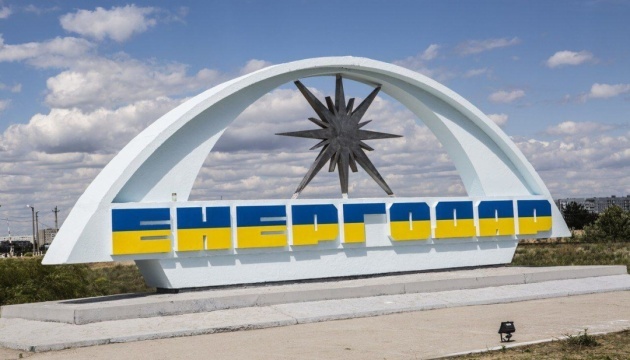
The security situation at the temporarily occupied Zaporizhzhia Nuclear Power Station remains difficult.
This has been reported by Ukraine’s Defence Intelligence, according to Censor.NET.
The situation at the Zaporizhzhia Nuclear Power Station
As before, none of the six power units at Zaporizhzhia NPP is generating electricity – they are all in a ‘cold shutdown’ state.
The water level in the cooling pond is falling. Whilst the level stood at 12.86 metres in July 2026, it had fallen to 12.63 metres by early August and to 12.55 metres by the end of the month, and continues to fall. A level of 15 metres is considered the minimum required to meet the power station’s normal needs.
Throughout August, the facility’s operations and maintenance were carried out by a duty shift comprising only around 1,150 staff members.
The Defence Intelligence (DIU) noted that in early August, the Zaporizhzhia Nuclear Power Station was left without an external power supply on three occasions – the power cuts occurred on 1, 4 and 8 August. Since the start of the full-scale invasion, the number of such incidents has already reached 23–25.
The power cuts at the station in August were caused by problems with the ‘Ferosplavna-1’ power line. When the Zaporizhzhia Nuclear Power Station lost its external power supply, the backup diesel-electric generators were activated as per standard procedure.
It is noted that the use of backup generators places an additional strain on the already difficult fuel situation in the temporarily occupied territories of Ukraine. In the event of a prolonged total blackout, the power station’s daily diesel fuel requirement would be around 150 tonnes.
Furthermore, the station is experiencing problems with its internet connection. On 13–14 August 2026, the network was cut off due to the actions of the Russian occupying forces, which hampered communication, performance tracking and international monitoring.
The Kremlin has also stepped up its efforts to integrate the Zaporizhzhia Nuclear Power Station into its own ‘legal framework’ — the aggressor state’s so-called Federal Service for Environmental, Technological and Nuclear Supervision, ‘Rostekhnadzor’, has sent a special team of inspectors to the plant.
The information blackout in Enerhodar
The situation is also deteriorating in the temporarily occupied Enerhodar in the Zaporizhzhia region. The city is experiencing widespread disruptions to mobile communications, internet access, and electricity and water supplies. There is also a continuing shortage of fuel, drinking water and food.
It is emphasised that Russia is deliberately creating conditions of information isolation in Enerhodar in order to minimise the leakage of information about the catastrophic situation in the city and at the Zaporizhzhia Nuclear Power Station. In particular, there have been reports of deliberate cuts to internet and mobile communications, as well as instances of abuse by Russian ‘police’ against the civilian population.
The Russification of the IAEA
Through its representatives at the IAEA, Moscow is seeking to Russify the organisation and exploit the agency’s international status to justify the occupation of the Zaporizhzhia Nuclear Power Station. One of the objectives of this hybrid campaign is to ‘normalise’ the information landscape and lay the groundwork for the further legitimisation of Russian control over the Ukrainian nuclear power station.
As part of these efforts, Russia attempted to organise and exploit for its own ends a visit by the agency’s Director General, Rafael Grossi, to the occupied Zaporizhzhia Nuclear Power Station ahead of the 70th session of the IAEA General Conference in Vienna on 14–17 September, where the issue of nuclear safety in Ukraine will be discussed.
Russian representatives at the IAEA continue to promote the Kremlin’s interests and exert pressure on the international organisation. For instance, the IAEA’s Deputy Director General, Russian national Mikhail Chudakov, secured the Agency’s support for the cartographic representation of the temporarily occupied territory of the Autonomous Republic of Crimea as part of the Russian Federation in the IAEA’s updated global integrated information system, PRIS. Russian representatives within the organisation are also demanding that Russified names for Ukrainian settlements be used in the system: Chornobyl, Rivne, Khmelnytskyi and Zaporizhzhia.
"The station continues to serve as a military base and a kind of shelter for the Russian occupying garrison, as the Muscovites realise that Ukrainian troops will not launch attacks on the Zaporizhzhia Nuclear Power Station," the DIU emphasises.


